Healthcare SaaS Demo Videos: 2026 Playbook
TL;DR
- Problem-led demos outperform feature-walkthrough demos with healthcare buyers — lead with the clinical or operational pain, not the product UI.
- Script in 5 parts: hook (pain), context (who this is for), proof (before/after), product reveal, CTA — keep total run time under 3 minutes for top-of-funnel.
- HIPAA and data sensitivity are non-negotiable: never show real patient data, real provider names, or live PHI in any demo asset — use synthetic data sets only.
- Healthcare buyers move slowly. Your demo needs to work in async (email, champion-sharing), not just on live calls.
- Distribution strategy: embed on the pricing page, arm sales with a short 60-second version, and create a compliance-focused variant specifically for procurement and legal reviewers.
Table of Contents
Healthcare SaaS has the longest, most scrutinized sales cycles in B2B software. Your buyers — whether they're VP of Clinical Operations, a Health System CTO, or a practice manager evaluating billing software — are trained to be skeptical of vendor claims. They sit through dozens of demos a quarter. They've seen every polished walkthrough of every dashboard.
A generic SaaS demo video doesn't move them. It confirms their suspicion that you don't understand their world.
This playbook covers what actually works in 2026: demo architecture that builds trust with clinical buyers, script frameworks that account for the unique dynamics of healthcare procurement, how to handle PHI and data sensitivity without killing the demo's credibility, and a distribution strategy designed for the multi-stakeholder, long-cycle reality of health system and digital health sales.
Why Healthcare SaaS Demo Videos Fail
Most healthcare SaaS demo videos are built like standard B2B software demos — they start with a feature tour, end with a pricing nudge, and assume the viewer already understands the problem. In healthcare, this approach fails at almost every stage of the funnel.
The Trust Gap Is Wider in Healthcare
Healthcare buyers carry institutional memory of vendor promises that didn't survive implementation. EHR migrations that took three years. Patient portal "rollouts" that required six months of IT work. Revenue cycle software that promised 40% faster collections and delivered six weeks of billing errors. The baseline skepticism your demo has to overcome is significantly higher than in, say, marketing tech or HR software.
A feature-led demo walks right into that skepticism. You show a workflow that looks elegant in a controlled environment, and the experienced buyer is already running the mental simulation of what happens when it meets their legacy systems, their credentialing workflows, their state-specific compliance requirements. You've lost them before the first screen-share ends.
The Stakeholder Problem
Healthcare purchasing decisions involve more stakeholders than almost any other vertical. A mid-size hospital system evaluating clinical documentation software might include: the CMO (clinical outcomes), CNO (nursing workflow impact), CIO (integration with Epic/Cerner), compliance officer (HIPAA and state regulations), CFO (total cost of ownership), and a committee of frontline clinicians who will actually use it.
One demo video cannot speak to all of them equally. But most companies try. The result is a 7-minute feature tour that satisfies no one and gets shared to none of them.
Data Sensitivity Errors Kill Deals
The fastest way to lose a healthcare enterprise deal in the demo stage is to show anything that looks like real patient data — even if it isn't. Legal and compliance reviewers have flagged deals over demo screenshots with realistic-looking PHI in review materials. The assumption is: if they're careless in the demo, what does their data handling look like in production?
For more context on healthcare-specific video marketing challenges, see our Video Marketing for HealthTech & Digital Health SaaS guide.
Problem-Led vs. Feature-Walkthrough: The Architecture Decision
The single highest-leverage decision in healthcare SaaS demo video design is whether to lead with the problem or the product. In most verticals, this is debated. In healthcare, problem-led demos consistently outperform feature-walkthroughs at every funnel stage — for reasons specific to how clinical and administrative buyers process purchasing decisions.
Problem-Led vs. Feature-Walkthrough: Structure Comparison
| Dimension | Problem-Led Demo | Feature-Walkthrough Demo |
|---|---|---|
| Opening | Describes a specific, recognizable pain scenario (prior auth delays, charge capture gaps) | Product introduction and overview of capabilities |
| Viewer identification | Buyer sees their world immediately — "this is us" | Buyer tries to map features to their problems — cognitive work required |
| Trust signal | Demonstrates industry fluency before showing a single screen | Demonstrates product functionality; trust comes later or not at all |
| Champion-sharing viability | High — the problem narrative travels without the vendor present | Low — features require context that only lands when a rep explains them |
| Best for | Top-of-funnel, email outreach, website embedding, async review | Late-stage live calls with a technical audience already bought in |
| Compliance reviewer risk | Lower — story-driven, less UI exposure | Higher — full UI visible, more surface area for data sensitivity questions |
When to Use Feature-Walkthrough
Feature-walkthrough demos aren't wrong — they're just wrong for top-of-funnel healthcare audiences. They work well in two specific contexts:
- Technical evaluations where an IT team or clinical informatics lead is assessing integration depth, API documentation quality, or workflow configurability.
- Proof-of-concept stages where the buyer has already decided they want to explore your solution and needs to walk a technical implementation team through what they've committed to evaluating.
In both cases, the feature walkthrough serves an audience that's already on board with the problem definition. The demo exists to answer "how" not "why."
Hybrid Architecture: The Most Effective Format in 2026
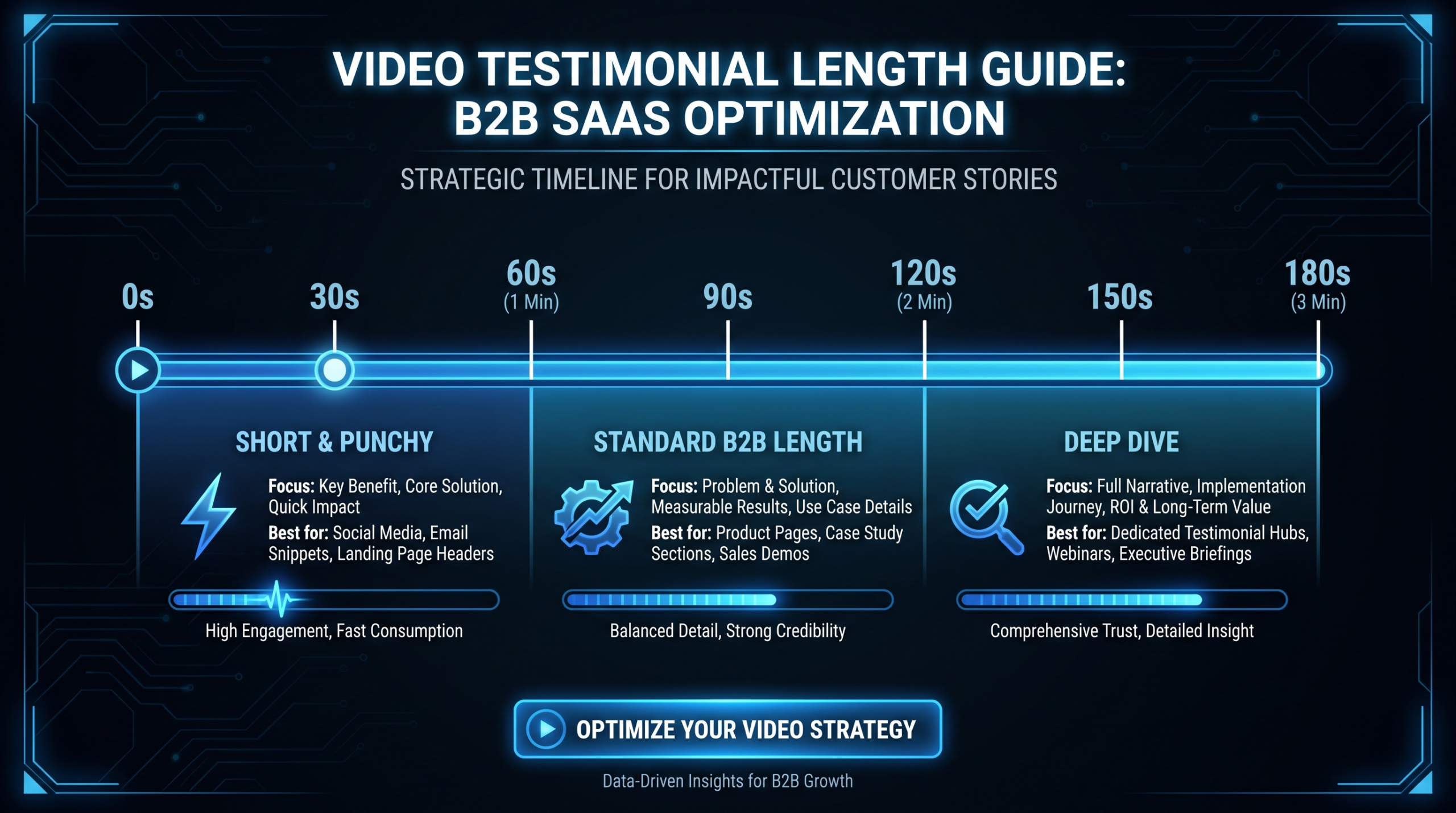
The highest-converting healthcare SaaS demo video format in 2026 opens with a 45–60 second problem narrative — no product visible — then transitions into a focused, 90–120 second product reveal that shows exactly how the problem gets resolved. Total run time: under 3 minutes for top-of-funnel, under 5 minutes for mid-funnel clinical champion videos.
"The demo isn't about your product. It's about the buyer's belief that their situation can change. You build that belief with the problem narrative. The product is the proof."
The 5-Part Healthcare SaaS Demo Script
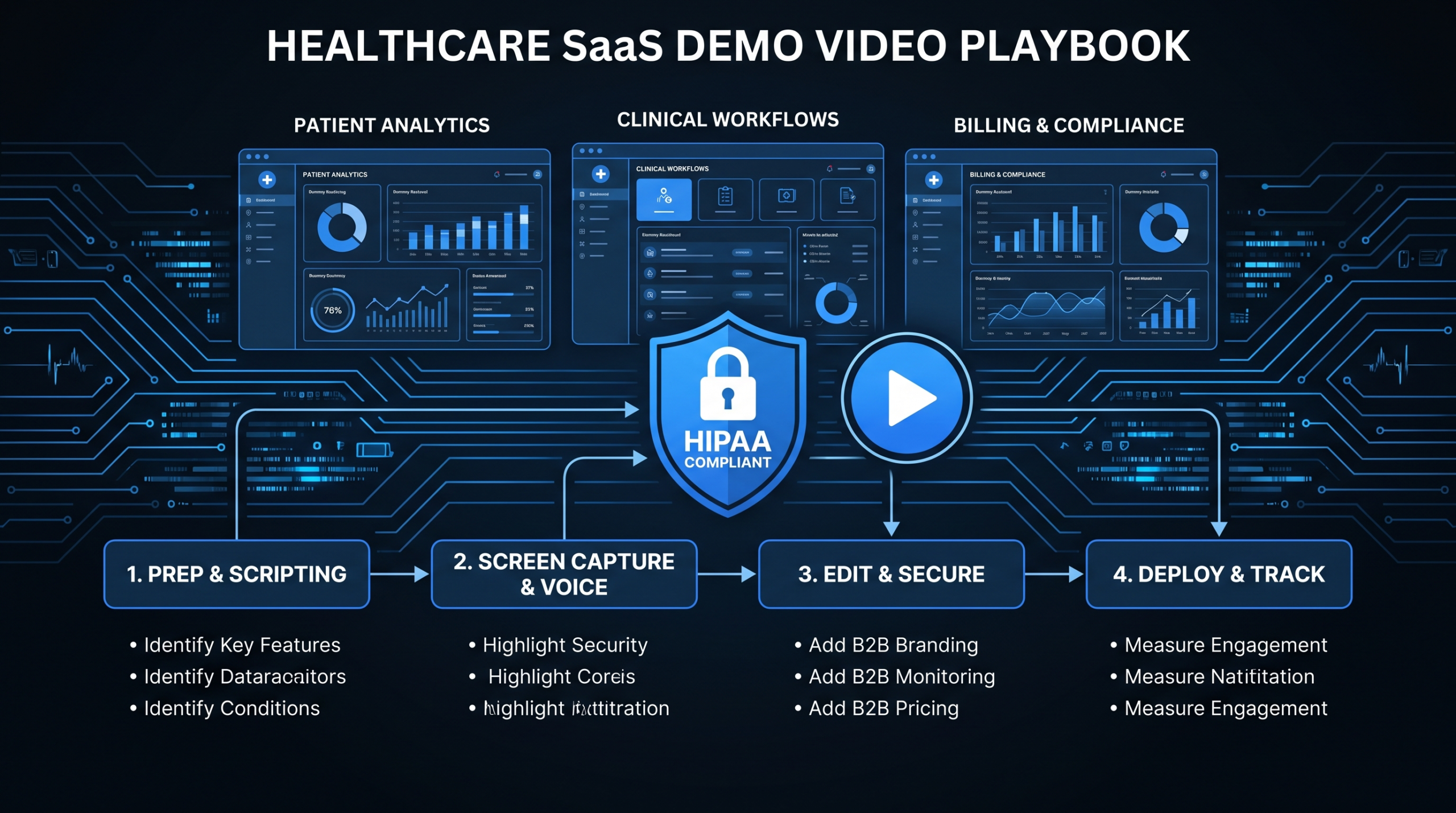
The following script framework applies to top-of-funnel and mid-funnel demo videos (under 4 minutes). It accounts for the trust dynamics, stakeholder diversity, and compliance awareness specific to healthcare buyers. Each part has a strict word-count and purpose budget — padding and transition filler are common in healthcare SaaS demos and they cost you the viewer's attention.
Part 1: The Hook — Name the Pain (0:00–0:30)
Open with a specific, operational pain scenario delivered in the voice of the buyer — not the vendor. The best hooks sound like something you overheard in a department head meeting, not something from a product marketing slide deck.
Weak hook: "Managing patient data across multiple systems is complex and time-consuming."
Strong hook: "Your prior authorization team submits 200 requests a week. Roughly 30% come back for additional documentation. Every one of those callbacks takes your staff off the phone with patients. You've tried workarounds. None of them have stuck."
The strong version names a specific workflow, a specific failure mode, and a specific downstream consequence. The viewer knows within 20 seconds whether this demo is for them.
Part 2: The Context — Who This Is For (0:30–0:50)
Explicitly name the buyer. Not with demographics, but with workflow language. "If you're responsible for revenue cycle performance at a multi-site health system" or "If you manage clinical documentation compliance across a network of employed physicians" — this is the line that turns passive viewers into engaged prospects and tells champions exactly who to share the video with.
Part 3: The Proof — Before and After (0:50–1:30)
Show the contrast between the current state and the future state before revealing the product. This can be done with voiceover, motion graphics, or a side-by-side text card showing what the workflow looked like for a (synthetic, anonymized) example client vs. after implementation. The goal is to make the outcome feel real before the product is visible.
Critically: any client reference here must use synthetic data, fictional organization names, and synthetic workflow metrics — never real client data or real outcome claims that can't be independently verified.
Part 4: The Product Reveal (1:30–2:45)
Show the specific workflow that resolves the problem named in Part 1 — and only that workflow. The biggest mistake at this stage is broadening the demo. If Part 1 is about prior auth delays, Part 4 should show the prior auth workflow. Not the dashboard, not the analytics suite, not the integrations library. One problem, one resolution.
Use screen recordings with motion graphics annotations. Highlight the key interaction with a cursor spotlight or annotation callout. Do not show full-screen UI with any data that could be mistaken for real patient records.
Part 5: The CTA — One Next Step (2:45–3:00)
Healthcare buyers distrust aggressive CTAs. "Get a free demo" with a countdown timer is the opposite of reassuring in a trust-sensitive vertical. The CTA that converts in healthcare SaaS is specific and low-commitment:
- "See how this looks in your EHR environment — book a 20-minute technical call."
- "Get our implementation checklist — it shows exactly what integration looks like for Epic/Cerner customers."
- "Talk to a clinical workflow specialist — not a sales rep."
The language signals that you understand the buyer's risk profile. It's the difference between "buy now" and "take one low-risk next step."
HIPAA and Data Sensitivity in Demo Videos
This is the section most healthcare SaaS vendors skip — and the one that most often kills deals in procurement review. Under the HHS HIPAA framework, demo videos themselves don't typically trigger PHI obligations (you're not transmitting real patient data). But the appearance of real-looking PHI creates procurement risk, perception problems, and, in cases where a vendor accidentally uses real data, genuine liability exposure.
The Golden Rule: Synthetic Data Only
Every patient name, date of birth, diagnosis code, claim number, provider NPI, and facility name visible in any demo video must be fabricated. This is non-negotiable. Build a synthetic data set — typically a library of 20–50 fake patient records — before any screen recording begins. Name them clearly in your production process (e.g., "Jane Testpatient, DOB 1970-01-01, MRN 000-000-001") so they're never confused with real records.
What Not to Show
- Real provider NPI numbers. Even if publicly available, they associate your product with a real clinician without consent.
- Real facility logos or addresses in workflow screenshots (unless you have explicit written permission from the client for marketing use).
- Live system data from a production environment — even if you've "de-identified" it. The risk is too high and procurement reviewers will ask how you obtained it.
- Actual claim amounts, reimbursement rates, or denial reason codes associated with any identifiable entity.
- Screenshots of real clinical documentation — clinical notes, care plans, or operative reports — even if anonymized.
What Healthcare Compliance Reviewers Actually Check
In enterprise healthcare deals, your demo video may be reviewed by a compliance officer or legal team before a contract progresses. They're typically looking for:
- Whether any visible data could be linked to a real individual or organization.
- Whether your vendor marketing materials reflect sound data governance practices.
- Whether the product workflows shown imply specific BAA obligations or data handling requirements.
Building a compliance-forward demo — one where synthetic data is labeled as such and where no real PHI appears — is increasingly a competitive differentiator in enterprise health system sales. Document your synthetic data policy in your demo production SOP and make it available to procurement teams on request.
Audio Compliance: Voiceover Scripts
Voiceover scripts for healthcare SaaS demos should avoid any claim that implies specific clinical outcomes ("our platform reduces medication errors by X%") unless you have peer-reviewed or formally documented evidence for the claim. Hedged, directional language is appropriate: "customers commonly report fewer documentation errors in the first 90 days" with a client reference available on request.
For broader healthcare video production budget considerations, see our Healthtech Video Production Cost: 2026 Guide.
Healthcare SaaS Demo Video Types by Buyer Stage
A single demo video cannot serve every stage of the healthcare SaaS buying cycle. The typical enterprise health system deal moves through awareness → clinical champion discovery → multi-stakeholder committee review → procurement/legal → contract. Each stage has a different primary audience and a different primary question the demo needs to answer.
Demo Video Types by Healthcare Buyer Stage
| Stage | Primary Audience | Video Type | Ideal Length | Primary Goal |
|---|---|---|---|---|
| Awareness | Department heads, operational leads finding the problem | Problem-narrative video (no product) | 60–90 seconds | Get the right person to identify with the problem |
| Clinical Champion | The internal buyer who will advocate for your product | Problem-led demo (hybrid, product reveal in second half) | 2–3 minutes | Arm the champion with a shareable asset that works without them present |
| Committee Review | Multi-stakeholder group (clinical, IT, finance, compliance) | Role-specific demo variants (3–4 short videos, one per stakeholder) | 90–120 seconds each | Each stakeholder sees their specific concern addressed |
| Procurement/Legal | Compliance officers, procurement teams | Compliance-forward overview (data governance, security posture, certifications) | 2 minutes | Reduce perceived risk; demonstrate data handling maturity |
| Post-Sale / Onboarding | End users (nurses, physicians, admin staff) | Workflow tutorial series (feature-focused, step-by-step) | 3–7 minutes each | Reduce time-to-proficiency and support burden |
The Champion Video: Your Highest-Leverage Asset
The clinical champion video — the 2–3 minute problem-led demo designed to be shared internally — is the single most important video asset in your healthcare SaaS video library. It's the asset that keeps selling when your rep is not in the room. Given the multi-stakeholder committee structure of most health system purchases, the ability for your internal champion to say "here, watch this — it explains what I'm trying to solve" is worth more than a dozen live demos.
Invest in this video first. Get it right before producing anything else. See our product demo video production guide for production principles that apply across the full demo video stack.
Role-Specific Variants
Once the champion video exists, the next highest-value investment is role-specific variants for the committee review stage. These are 90–120 second excerpts or re-edits of the champion video, reframed for each stakeholder's primary concern:
- Clinical variant: Leads with workflow impact on clinician time and documentation burden.
- IT/Integration variant: Leads with EHR integration approach, API architecture, and implementation timeline.
- Finance variant: Leads with cost structure, total cost of ownership comparison, and ROI framing (hedged, illustrative).
- Compliance variant: Leads with HIPAA compliance posture, BAA terms, data residency, and certifications (SOC 2, HITRUST if applicable).
These don't require four full productions. A well-produced champion video, combined with a production partner that knows how to re-edit and reframe video assets efficiently, can generate all four variants from a single shoot. Video Editing Company works with healthcare SaaS teams to produce the full variant stack from one core asset — learn more at our SaaS video production page.
Distribution Strategy for Healthcare Buyers
Healthcare buyers don't convert on impulse. Your demo video distribution strategy has to account for long review cycles, committee dynamics, and the reality that the person who first watches your demo video is rarely the person who signs the contract.
Website Placement: Pricing Page First
The highest-ROI website placement for a healthcare SaaS demo video is the pricing page — not the homepage. Homepage visitors are often at the very top of the funnel; they need your problem-narrative video, not a demo. Pricing page visitors have already decided they want to evaluate. Embedding the 2–3 minute demo on the pricing page, immediately above the pricing tiers, captures the buyer at the moment of highest intent.
Secondary placements: the solutions or use-case page for your primary vertical (e.g., /solutions/revenue-cycle, /solutions/clinical-documentation), and the book-a-demo landing page itself (a short 60-second version plays while the form loads).
Email and Outbound: The 60-Second Version
Outbound sequences targeting healthcare buyers benefit from a 60-second version of the demo — optimized for email embedding and mobile viewing. According to Wistia's video marketing research, shorter videos consistently drive higher engagement rates in email contexts, particularly on mobile where healthcare administrators often review outbound communications.
The 60-second email version should be self-contained: problem, solution signal, one CTA. It cannot rely on the viewer reading any surrounding email copy to make sense. Subject lines that include the word "video" or use a thumbnail preview in the email body typically increase click-through rates — test both approaches with your specific list.
Sales Enablement: Arming Your Reps
Every AE and SDR working healthcare accounts should have three video assets in their outreach toolkit:
- The 60-second problem video — for cold outbound, first touch.
- The 2–3 minute champion demo — for post-discovery follow-up, "here's what we discussed" emails.
- The compliance variant — for any deal where a compliance officer or legal reviewer gets involved.
Don't expect reps to choose the right video for each situation without guidance. Build a simple one-page guide — "which video to send when" — and make it part of your sales playbook. See our video editing services overview for context on building a managed video library that scales with your sales team.
LinkedIn: Thought Leadership, Not Demos
LinkedIn is underutilized by healthcare SaaS companies for video — but the mistake most make is posting product demos to LinkedIn. Clinical buyers on LinkedIn respond to thought leadership and peer content, not product feature promotions. Reserve your LinkedIn video budget for problem-narrative content: 60–90 second videos that address a specific operational pain, with no product visible.
The product demo link can live in the first comment or in the DM follow-up. The LinkedIn video itself builds credibility and earns clicks to your website, where the full demo sits.
Conference and Event Video Strategy
HIMSS, ViVE, and vertical-specific conferences represent the highest-density opportunity for healthcare SaaS awareness video. A branded booth loop (90 seconds, no audio required, visual-heavy) and a QR-code-linked champion demo are the minimum viable conference video stack. If your team presents at a breakout session, a professional highlight reel (2–3 minutes) of the session becomes a high-credibility async asset for the following month's outreach.
Production Essentials for Healthcare SaaS Demo Videos
Production quality in healthcare SaaS demo video matters more than in most other verticals — because production quality signals vendor maturity. A choppy, poorly lit, inconsistently branded demo video tells a health system CIO that your company isn't ready for enterprise. It's not fair, but it's the reality of first-impression heuristics in a risk-averse buying culture.
Screen Recording Standards
- Resolution: Minimum 1920x1080. Record at 2x on Retina displays to maintain sharpness when compressed.
- Cursor movement: Use a cursor spotlight tool (Rottenwood, ScreenFlow's cursor zoom) to guide the viewer's eye. Healthcare software UIs are dense — unguided cursor movement in a complex EHR integration view will lose the viewer.
- Click highlights: Every meaningful click should have a visual callout — ring animation or brief spotlight. This is especially important in workflow demos where the key interaction is a single button press.
- Data hygiene: Check every frame for realistic-looking data before export. Run a pre-production data audit using your synthetic data set.
Voiceover
Healthcare SaaS demos benefit from warm, authoritative voiceover — not the hyped-up energy of consumer tech demos. The vocal target is "trusted clinical colleague explaining a workflow improvement" rather than "product marketer excited about features." Use a professional voiceover artist with healthcare or clinical technology experience if possible. AI voiceover is viable for internal review cuts, but for assets going to enterprise prospects, invest in human voiceover.
Motion Graphics
Motion graphics in healthcare SaaS demo videos serve two functions: simplifying complex clinical workflows into visual metaphors, and annotating screen recordings so viewers know where to focus. The most effective annotation style for healthcare buyers is restrained — clean highlight boxes, simple text callouts, no excessive animation. The aesthetic should signal "this company is professional and organized," not "this company spent money on flashy effects."
Turnaround and Iteration Budget
Budget for at least two rounds of revision for any healthcare SaaS demo video. The first draft will typically surface data sensitivity issues, pacing problems in the problem narrative, or stakeholder feedback that requires a structural change. The revision cycle is not a sign of failure — it's part of the process. See our pricing page to understand how VEC structures demo video engagements for healthcare SaaS teams, including dedicated editor pods that maintain brand and workflow consistency across your full video library.
Localization and Accessibility
Healthcare enterprise buyers increasingly require closed captions on all video assets — both for accessibility compliance and for the reality that many procurement reviewers watch videos in sound-off environments. Transcripts should be available for any video that goes to a compliance or legal reviewer. If you're selling into international healthcare markets, budget for localization from the initial production, not as an afterthought.
Production checklist before any healthcare SaaS demo goes live: Synthetic data audit complete · All visible PHI-like data is clearly fabricated · Voiceover script reviewed for unsupported clinical claims · Closed captions added · Compliance variant ready for procurement stage · Champion-sharing link tested on mobile
Frequently Asked Questions
How long should a healthcare SaaS demo video be?
Top-of-funnel problem-narrative videos should run 60–90 seconds. The primary champion demo — designed to be shared with a multi-stakeholder committee — should run 2–3 minutes. Role-specific variants (IT, finance, compliance) should be 90–120 seconds each. Anything longer is generally appropriate only for post-sale onboarding content aimed at end users who need step-by-step workflow guidance.
Can I show real customer results in a healthcare SaaS demo video?
You can reference customer outcomes if they're hedged and directional ("a mid-size health system reported a reduction in prior auth processing time") and if you have documented evidence available for due diligence review. What you cannot do: show specific, precise metrics ("37% reduction in denials") without the study or internal analysis to back them up. Fabricated statistics are a P0 red flag in any enterprise deal — healthcare buyers will ask for the source, and "it's our experience" is not an acceptable answer at the committee review stage.
Do I need HIPAA authorization to film or produce a healthcare SaaS demo video?
The demo video production process itself doesn't trigger HIPAA requirements if you use synthetic data throughout — which you should. HIPAA obligations apply to the handling of actual PHI. If you're using real patient data (even "de-identified") in any production asset, consult your compliance counsel before proceeding. The safest and most practical approach is to build a synthetic data library before any screen recording begins and never deviate from it in demo production.
What's the difference between a demo video and an explainer video for healthcare SaaS?
An explainer video focuses on the problem and the category — it establishes why a solution like yours exists and who needs it. A demo video shows the actual product resolving an actual workflow. In healthcare SaaS, the most effective top-of-funnel asset is a hybrid: an explainer-length problem narrative (45–60 seconds) followed by a focused product reveal (90–120 seconds). The pure feature-walkthrough demo belongs later in the cycle, typically for technical committee review or proof-of-concept stages.
How often should we update our healthcare SaaS demo video?
Update your demo when the product's core workflow changes materially — not on a fixed schedule. A demo showing an outdated UI creates a trust problem when the prospect sees something different in their trial. Secondary triggers for update: significant regulatory changes that affect how your compliance story needs to be told, major new customer segments that require a different problem narrative, or a meaningful change to your pricing or packaging that the demo references. Cosmetic UI changes alone generally don't require a full demo reshoot — a motion graphics overlay update is usually sufficient.
Ready to Build a Healthcare SaaS Demo That Moves Buyers?
VEC works with health tech and digital health SaaS teams to produce HIPAA-aware demo videos — problem-led scripts, synthetic data production, champion-shareable formats, and role-specific variants for committee review. Dedicated editor pods, flat monthly retainer.
Book a Free Strategy Call See Pricing