
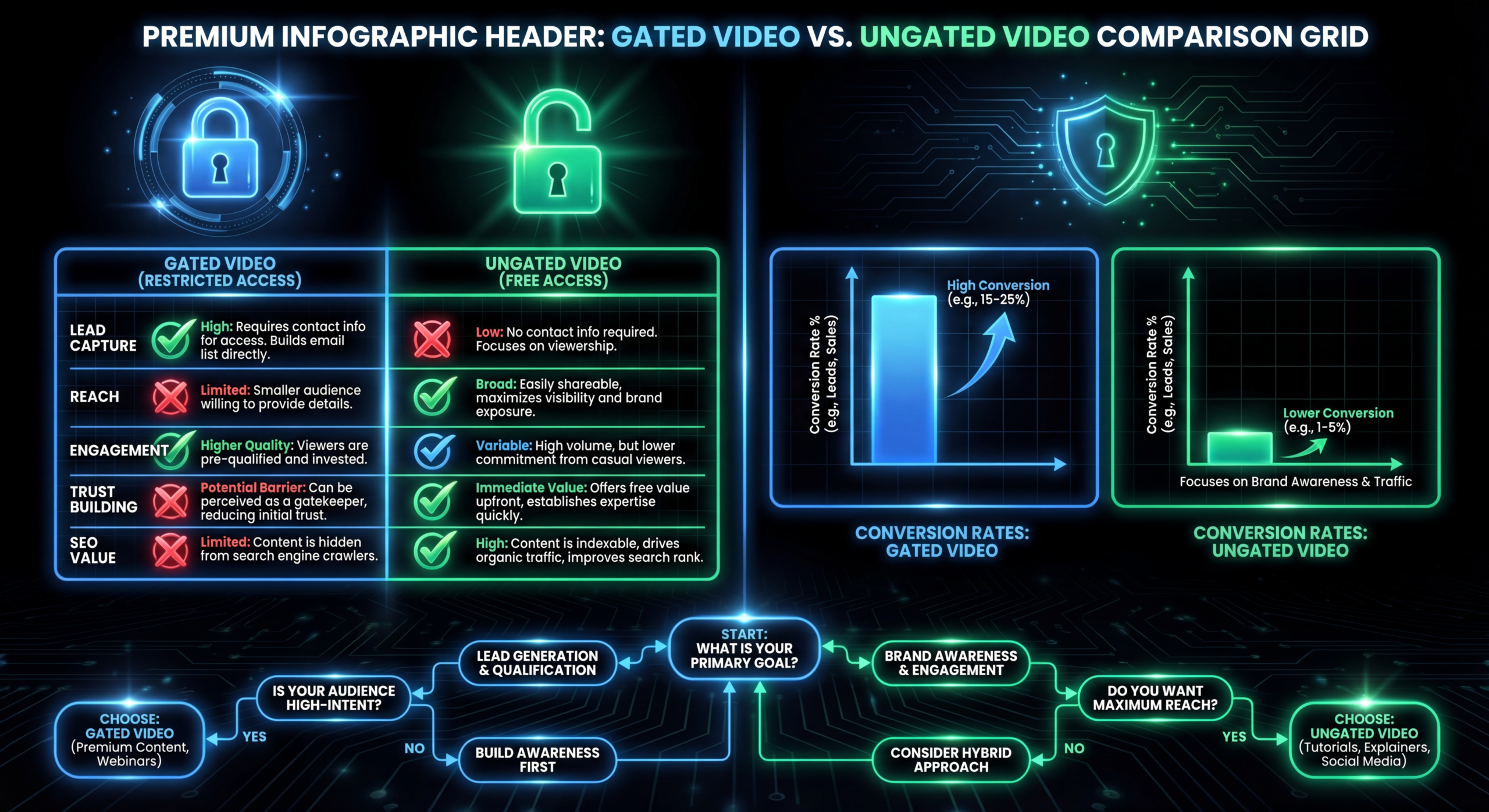
Gated vs. Ungated Video: What Converts Better
Table of Contents
The Gated vs. Ungated Debate
Every SaaS marketing team faces the same tension: you need leads to feed the pipeline, but you also need reach and trust to build the pipeline in the first place. Video content sits at the center of this tension because it's both your most engaging format and your most expensive to produce.
The gated vs. ungated question isn't really about choosing one approach — it's about understanding when each strategy maximizes the return on your video investment. And the answer has shifted significantly over the past three years as buyer behavior evolves.
Why this debate matters more now
B2B buyers are doing 70% of their research before they ever talk to sales (Gartner). They're forming opinions about your product, your expertise, and your trustworthiness based on the content they consume — content that's increasingly video-based.
If you gate too aggressively, you're invisible during this critical research phase. If you don't gate at all, you have no mechanism to identify interested buyers before they reach out to sales (if they ever do).
What the data actually says
A 2025 Demand Gen Report found that 67% of B2B buyers say they're more likely to engage with vendor content that's freely available. But here's the nuance: the same study found that buyers are willing to gate for content they perceive as genuinely high-value — proprietary research, detailed playbooks, and expert-led workshops.
The determining factor isn't whether to gate — it's whether the perceived value exceeds the perceived cost of sharing contact information.
When Gated Video Works
Gating works when the value exchange feels fair. The viewer gives their contact information, and they receive something they genuinely couldn't get elsewhere. Here are the scenarios where gating delivers strong results:
High-value educational content
Webinars, masterclasses, and in-depth training videos are the strongest candidates for gating. These formats deliver concentrated expertise in a structured format — the kind of content people would pay for if it were a course. When Drift gated their conversational marketing masterclass series, they saw a 47% form completion rate and the leads converted to opportunities at 3x the rate of blog-sourced leads.
Proprietary research and benchmarks
If your video presents original data — industry benchmarks, survey results, proprietary analysis — gating is justified because the information has clear, unique value. Viewers understand they're getting something exclusive in exchange for their email.
Detailed product demonstrations
Not the 2-minute overview video, but the 15-30 minute deep-dive showing specific workflows, integrations, and use cases relevant to a particular role or industry. These viewers are already in consideration mode — they want to see if your product actually solves their problem. Gating helps you identify these high-intent buyers.
Expert interview series
When you feature recognizable industry experts, the implied value of the content increases. Gating a conversation with a well-known VP of Marketing at a Fortune 500 company feels reasonable — it's similar to an industry conference session that costs hundreds of dollars to attend.
| CONTENT TYPE | GATE RECOMMENDATION | EXPECTED CONVERSION |
|---|---|---|
| Webinar / Masterclass | Gate (pre-registration) | 40-55% registration to attendee |
| Research Presentation | Gate (form) | 35-45% form completion |
| Deep Product Demo | Gate (light form) | 45-60% form completion |
| Expert Interview | Gate or hybrid | 30-40% form completion |
| Case Study Video | Hybrid (partial gate) | 25-35% form completion |
When Ungated Video Works
Ungated video serves a fundamentally different purpose: it builds the audience and trust that makes your gated content effective. Without ungated content creating awareness and credibility, your gated content has no one to convert.
Brand and awareness videos
Your explainer video, brand story, and company culture videos should never be gated. These are the first touchpoints in your buyer's journey — the videos that answer "who is this company and why should I care?" Gating these kills discovery.
Short-form social content
LinkedIn clips, YouTube Shorts, Instagram Reels — any content designed for distribution on social platforms must be ungated by nature. These formats build reach and drive traffic to your gated assets. Think of them as the appetizer that makes people hungry for the main course.
Thought leadership and educational snippets
Short educational videos (2-5 minutes) that address a single question or concept work better ungated. They establish your team's expertise and create familiarity with your brand. When the same viewer encounters a gated webinar from your company later, they're more likely to fill out the form because they already trust your content quality.
Testimonial and case study highlights
Social proof works best when it's frictionless. A 90-second customer testimonial clip should be everywhere — on your website, in email signatures, on social media. Gating social proof is counterproductive because the whole point is reducing buyer skepticism, and adding a form creates a new point of skepticism.
SEO-targeted video content
Any video you want to rank on YouTube or appear in Google video results must be ungated. Search engines can't index gated content. If your video SEO strategy targets specific keywords, those videos need to be freely accessible.
The Hybrid Approach
The most effective B2B SaaS video strategies use a hybrid model that combines ungated awareness content with strategically gated conversion content. Here's how to implement it:
The 70/30 framework
Produce 70% ungated content and 30% gated content. The ungated majority builds your audience, establishes expertise, and drives organic traffic. The gated minority captures leads from the audience you've built.
Progressive gating
Instead of a binary gate/no-gate approach, use progressive gating that increases the ask as the content value increases:
- Level 0 (No gate): Social clips, blog-embedded video, explainers, brand content
- Level 1 (Email only): Webinar recordings, extended case studies, how-to series
- Level 2 (Email + role): Product demos, benchmarking reports, ROI calculators
- Level 3 (Full form): Custom video audits, strategy sessions, implementation guides
The "sample then gate" technique
Show the first 2-3 minutes of a video ungated, then require an email to continue watching. This approach works particularly well for webinars and training content because viewers self-qualify by watching the preview. Those who fill out the form are genuinely interested — not just filling forms for content they might not actually watch.
Wistia's data shows that mid-roll gates (placed 20-30% into the video) convert at 15-25%, while pre-roll gates convert at 35-50%. The trade-off is reach — pre-roll gates get fewer viewers but more form fills per view, while mid-roll gates get more viewers and higher-quality leads.
Measuring What Matters
Different gating strategies require different metrics. Here's how to measure each approach effectively:
Ungated video metrics
| METRIC | WHY IT MATTERS | BENCHMARK |
|---|---|---|
| View count | Raw reach and awareness | Varies by distribution channel |
| Watch time / completion rate | Content quality indicator | 40-60% for 2-5 min videos |
| Engagement rate | Shares, comments, likes | 2-5% on social platforms |
| Traffic driven | Clicks to website from video | 1-3% CTR from social video |
| Assisted conversions | Video's role in eventual conversion | Track via UTM + attribution |
Gated video metrics
| METRIC | WHY IT MATTERS | BENCHMARK |
|---|---|---|
| Form completion rate | Gate effectiveness | 30-50% (pre-roll), 15-25% (mid-roll) |
| Lead quality score | Are gated leads actually prospects? | 40-60% should match ICP |
| Lead-to-MQL rate | Progression through funnel | 15-30% from gated video leads |
| Cost per lead | Efficiency of gated content | $15-50 for organic gated video |
| Content completion after gate | Did they actually watch after filling form? | 60-80% should watch >50% |
Gating Strategy by Video Type
Not all videos are created equal when it comes to gating potential. Here's a definitive breakdown of how to handle each video type in your B2B SaaS content library:
Product demos
Gate the detailed, role-specific demo (15-30 min). Keep the overview demo (2-3 min) ungated on your website. The overview creates interest; the deep demo captures intent. Link from your product demo script template to ensure consistency across both versions.
Customer stories
Publish the 90-second highlight ungated everywhere. Gate the full 10-minute case study with detailed metrics and implementation details. Buyers will trade their email for specifics about how a similar company achieved results.
Webinars
Gate the live registration (this is standard and expected). After the event, consider publishing a 5-minute highlight reel ungated while keeping the full recording gated for 30-90 days, then ungating it to maximize long-tail organic traffic.
Training and how-to videos
Publish basic how-to content ungated for SEO and awareness. Gate advanced training, certification content, and multi-part courses. This creates a natural progression from free to gated that feels organic rather than forced.
Explainer videos
Never gate. These are your discovery content — the first impression many prospects have of your product. Gating an explainer video is like putting a cover charge on walking into a store. Related: our guide to explainer video cost breakdown covers what to budget.
Implementation Playbook
Here's a step-by-step approach to building a hybrid gated/ungated video strategy for your SaaS company:
Step 1: Audit your existing video library
Categorize every video asset by funnel stage, content type, and current distribution. Identify which videos are currently underperforming because they're gated when they should be free (or vice versa).
Step 2: Map content to buyer journey
Use your 90-day video content calendar to plan the mix of gated and ungated content across awareness, consideration, and decision stages. Aim for the 70/30 split.
Step 3: Set up progressive profiling
Use your marketing automation platform (HubSpot, Marketo, Pardot) to implement progressive forms. First-time visitors see a simple email-only gate. Return visitors see additional fields. This reduces friction for new leads while enriching data on engaged prospects.
Step 4: Create upgrade paths
Every ungated video should include a CTA pointing to a relevant gated asset. Every gated asset should link to additional ungated content for continued engagement. This creates a content ecosystem rather than isolated assets.
Step 5: Test and iterate
A/B test gate placement (pre-roll vs. mid-roll), form fields (email only vs. email + company), and content types. Run tests for at least 4 weeks with a minimum of 200 impressions per variation before drawing conclusions.
Common mistakes to avoid
- Gating everything: This screams desperation and kills organic reach. Your competitors' ungated content will outrank yours, and buyers will go to them for information.
- Gating low-value content: If the video doesn't justify a form fill, the lead quality will be terrible. Bad leads waste sales time and corrupt your pipeline metrics.
- Never gating: Pure ungated strategies make attribution nearly impossible. You'll build an audience you can't identify or follow up with.
- Static gating strategy: Buyer expectations change. What felt like a fair exchange two years ago might feel excessive today. Review your gating strategy quarterly.
- Ignoring mobile: 60%+ of B2B content consumption happens on mobile. Multi-field forms on mobile have significantly higher abandonment. Keep mobile gates to 1-2 fields maximum.
Ready to Level Up Your Video Strategy?
Talk to our team about your video production needs — no commitment required.
Book a Free Strategy Call See PricingReady to get started? View our pricing.
Frequently Asked Questions
Should I gate all my video content?
No. Gating everything reduces reach and builds friction. The best approach is a hybrid model — use ungated video for awareness and trust-building (top of funnel) and gate high-value assets like detailed product demos, industry reports, and masterclass content for lead capture.
What completion rate should I expect for gated video?
Gated videos typically see 35-50% form completion rates when the perceived value is high. If your completion rate drops below 25%, your gate is likely creating too much friction relative to the content's perceived value.
Does gating video content hurt SEO?
Yes, gated content cannot be indexed by search engines, so you lose organic traffic potential. Balance this by creating ungated supporting content (blog posts, short clips) that links to the gated asset.
What information should I collect in a video gate?
For top-of-funnel: name and email only. For mid-funnel: add company name and role. For bottom-of-funnel: include company size and timeline. The more fields you add, the higher the drop-off rate — each additional field reduces conversions by 10-15%.
How long should a gated video be?
Gated videos should deliver substantial value to justify the form fill — typically 10-30 minutes for webinars and masterclasses, or 3-8 minutes for premium product demos. Short videos (under 2 minutes) rarely justify gating.
📅 90-Day SaaS Video Calendar
Plan your gated and ungated video strategy with our proven content calendar template. Map video types to funnel stages for maximum impact.
Download Free
