Founder-Led Video: Why CEOs Outperform Brands
TL;DR
- Founder-led video consistently outperforms brand account content in reach, trust, and pipeline attribution — particularly on LinkedIn and YouTube.
- The advantage is structural: audiences engage differently with people than with logos. Algorithms reward it. Buyers trust it more.
- The bottleneck isn't the founder's time on camera — it's the editing and distribution system behind the content.
- Series A–C SaaS companies that build a repeatable CEO video system see measurable impact on pipeline velocity and inbound quality within 90 days.
- This guide covers the full playbook: formats, system design, distribution strategy, ROI measurement, and when to bring in a production partner.
Table of Contents
Your company account posts a product update. It gets 47 likes — mostly employees. Your CEO posts a two-minute video talking through the same update, unscripted, from their desk. It gets 14,000 views, 300 comments, and three inbound demo requests by Friday.
This isn't a fluke. It's a pattern that Head of Content and VP Marketing roles at B2B SaaS companies are seeing consistently in 2026. Founder-led video outperforms brand video. Not marginally — often by an order of magnitude on organic reach. The question is no longer whether your CEO should be on camera. It's how to build a system around it that doesn't burn them out or produce embarrassing content.
This guide is a practical playbook for marketing leaders who are ready to move from "our founder posts occasionally" to a deliberate, repeatable founder video program that drives real pipeline.
The Trust Gap: Why Brands Lose and Founders Win
Understanding why founder-led video works is important because it shapes every decision downstream — which formats to prioritize, how to coach your CEO on camera, and how to amplify what they produce.
The Algorithmic Reality
LinkedIn, YouTube, and most social platforms algorithmically reward personal profiles over company pages. The reasoning is straightforward: personal posts generate more comments, more authentic back-and-forth, and more time-on-platform. LinkedIn's feed algorithm has historically shown personal content to roughly 3–5x more of a creator's network compared to equivalent company page posts. This gap has widened as platforms push harder to make personal creator content their differentiator against competitors.
For SaaS marketing teams, this creates a structural inefficiency: you're investing budget and effort into channels (brand accounts) that platforms are deliberately deprioritizing, while leaving the higher-reach channel (your founder's personal profile) largely untapped.
The Authenticity Signal
Beyond the algorithm, there's a buyer psychology dimension. B2B buyers — particularly at the Series A–C deal sizes where you're competing — are making significant purchasing decisions. They want to understand who they're buying from. A polished brand video communicates production budget. A founder speaking directly to a problem communicates judgment, conviction, and taste.
HubSpot's research on video marketing consistently shows that video content featuring real people — specifically leadership — generates higher engagement rates and longer watch times than animated or brand-produced equivalents. The mechanism is simple: humans are wired to pay attention to other humans, especially humans with authority and credibility in a domain we care about.
When your CEO explains why they built a feature a certain way, or shares their perspective on a market shift, they're signaling something no brand video can replicate: I understand this problem because I've lived it.
The LinkedIn Native Video Window
LinkedIn's investment in native video has opened a distribution window that most B2B SaaS companies haven't fully exploited. Native video (uploaded directly to LinkedIn, not linked from YouTube) gets priority placement in the feed and auto-plays without a click. A founder with 5,000 connections who posts native video consistently can reasonably expect video views that far exceed their follower count — because LinkedIn pushes content to second-degree connections when engagement velocity is strong.
This is the core insight: founder-led video isn't just better content — it's the best channel multiplier available to a B2B SaaS marketing team right now. You're not spending money on paid distribution when your CEO's authentic perspective earns reach organically.
What Founder-Led Video Actually Looks Like
Before building a system, you need clarity on formats. "Founder video" is not monolithic. The most effective programs mix several distinct types, each serving a different stage of the buyer journey and different distribution channel.
Talking-Head Commentary
The highest-volume format. Your CEO sits in front of a camera — ideally with a clean, professional background — and shares a perspective on something: an industry trend, a counterintuitive take on a common practice, a reaction to something in the news. Duration: 60–180 seconds for LinkedIn. Up to 8 minutes for YouTube.
This format works because it's genuinely low-friction to produce. The founder speaks, an editor cuts the silences and adds captions, and it goes out. Done well, it feels like catching a smart operator thinking out loud. Done poorly, it feels like a press release someone read on camera.
The editing imperative here is tighter than most founders expect. Raw talking-head footage from even the most articulate CEO usually needs 30–40% of its runtime cut — pauses, restarts, tangents. A skilled editor transforms a 4-minute ramble into a 90-second insight. That's where most of the production value lives: not in the camera or the backdrop, but in the cut.
Behind-the-Scenes and Narrative Content
A level up in production complexity but significantly higher in shareability. Your CEO walking through a customer success story. A "week in the life" style vlog from a company offsite. A candid debrief after a difficult product decision.
This format builds the deeper audience relationship that converts followers into buyers. It works best on YouTube, where longer watch times are rewarded, and as LinkedIn document-plus-video combinations that tell a fuller story.
Product Walk-Throughs and Demo Narration
A founder narrating a product demo is categorically different from a polished brand demo video. When a CEO walks through a feature themselves — explaining not just what it does but why they built it that way, what problem it solves, and what it replaced — you get a contextual credibility signal that no professional voiceover can replicate.
This format is particularly effective for complex SaaS products where the buying decision involves multiple stakeholders. A CFO who watches your CEO explain a pricing philosophy. A CTO who sees the founder's technical reasoning in a product tour. These aren't just marketing touchpoints — they're trust-building events that compress deal cycles.
For a deeper look at how product demo videos work within a broader content strategy, the production considerations are worth understanding before you brief an editor on this format.
Customer Story Narration
Case study videos narrated by the founder — not by the customer and not by a marketer. Your CEO introduces a customer, explains why they chose to work with them, and contextualizes the outcome. The customer segment provides the proof. The founder provides the frame.
This is one of the highest-converting formats for mid-funnel prospects who are actively evaluating you. It answers the implicit question every evaluating buyer has: "Does this company actually understand what they're doing, or did they just get lucky?"
Building a Repeatable CEO Video System
The reason most founder video programs stall after a promising start is systems failure, not motivation failure. The CEO gets busy. The editor is unclear on the format. Nobody knows when to schedule the recording session. By month three, the program is "on pause."
A repeatable system removes all of that friction. Here's how to build one.
The Brief-and-Batch Method
The most valuable change you can make is separating content ideation from content creation. Most founder video programs fail because they ask the CEO to do both at the same time — "think of something to say, then say it." That's cognitively expensive and produces inconsistent results.
Instead, run a monthly 30-minute brief session. You (the marketing leader) bring 8–10 topic ideas derived from:
- Sales conversation themes from the past month (what questions are prospects asking?)
- Customer success insights (what outcomes are clients reporting?)
- Industry developments your CEO has a strong take on
- Competitive positioning moments — without naming competitors directly
- Behind-the-product stories that explain your roadmap philosophy
Your CEO picks 4–6 topics they feel strongly about. You turn those into 2-minute talking point bullets — not scripts. Then you batch-record: one 90-minute recording session produces 4–6 raw videos. That's 4–6 weeks of LinkedIn content from a single hour and a half of the founder's time.
The Editing Protocol
Raw footage from a batch recording session is not publishable video. The editing work is where the system either succeeds or breaks down. For each talking-head video, a skilled editor should:
- Cut dead air, restarts, and tangential asides (typically reduces runtime by 25–40%)
- Add animated captions — 85% of LinkedIn video is watched without sound
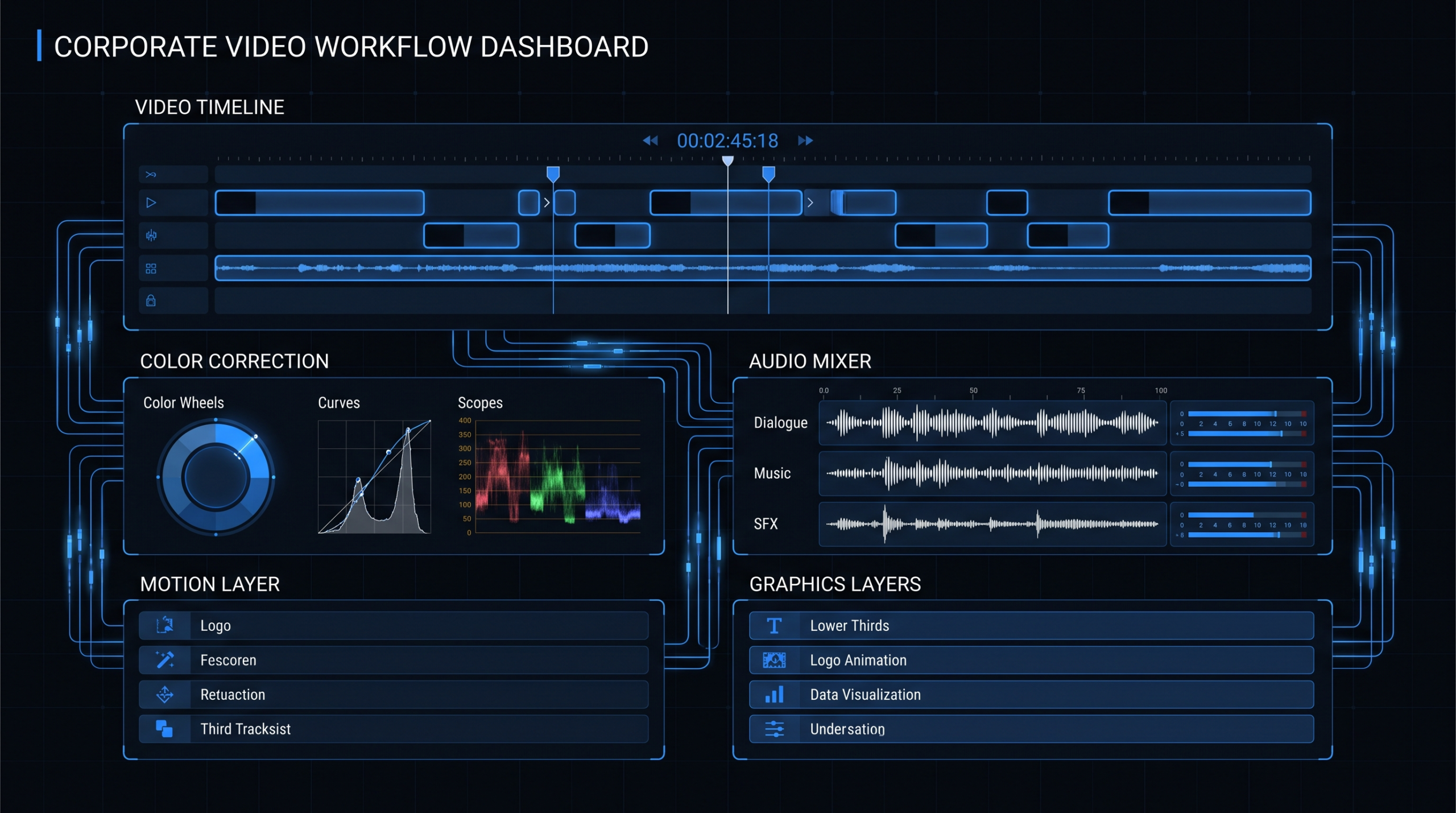
- Apply a consistent color grade and audio normalization that matches your brand aesthetic
- Add a branded lower-third with the CEO's name and title for first-impression clips
- Create format variants: 16:9 for YouTube, 1:1 for LinkedIn feed, 9:16 for Stories/Reels if applicable
- Export thumbnail frames and pull quote graphics for the companion text post
This is not freelance-tier work. The editor needs to understand your brand voice, the founder's speaking style, and the distribution strategy. A rotation of different editors produces inconsistent output that undermines the series effect — the compounding benefit you get when an audience recognizes your format and comes to expect it.
The Publishing Calendar
Consistency matters more than frequency. A founder who posts one video every Tuesday outperforms a founder who posts five videos one week and nothing for three weeks. Build a simple 4-week editorial calendar:
- Week 1: Industry take / hot opinion
- Week 2: Behind-the-product story
- Week 3: Customer success narrative
- Week 4: Trend or prediction — forward-looking perspective
Rotate the formats cyclically. Your audience learns to expect variety, and you avoid the "all our videos feel the same" plateau that kills most founder video series at month four.
Formats That Drive Pipeline
Not all founder video content is created equal when the objective is pipeline. Here's how the primary formats stack up across the metrics that matter to revenue-focused marketing leaders.
Founder Video Format Comparison — Pipeline Impact
| Format | Best Channel | Funnel Stage | Production Complexity | Pipeline Signal |
|---|---|---|---|---|
| Talking-head commentary | TOFU — awareness | Low | Brand recall, inbound DMs | |
| Product walk-through (founder-narrated) | YouTube, email | MOFU — consideration | Medium | Demo request driver |
| Customer story narration | YouTube, sales deck | MOFU/BOFU | Medium-High | Deal velocity, objection handling |
| Behind-the-scenes / vlog | YouTube, LinkedIn | TOFU — relationship | Medium | Audience trust, champion building |
| CEO AMA / Q&A | LinkedIn Live, YouTube | TOFU/MOFU | Low (live), Medium (edited) | Direct conversation, warm leads |
| Thought leadership series | YouTube | TOFU — authority | High | SEO pipeline, long-tail trust |
The pattern that emerges from this matrix: talking-head commentary drives the top-of-funnel volume; product walk-throughs and customer stories drive the pipeline-adjacent conversions. A mature founder video program runs all three concurrently — weekly LinkedIn commentary building the audience, monthly product/customer videos capturing the evaluation intent.
The Thought Leadership Series Model
One format deserves particular attention: the serialized thought leadership series on YouTube. This is the highest-investment, highest-return format for founders with genuine domain expertise.
The mechanics: your CEO records 8–12 videos on a single overarching topic — something your ideal buyer would search for, structured like a mini-course or interview series. These get published as a YouTube playlist, cross-posted to LinkedIn in bite-sized clips, and embedded throughout your SaaS content strategy.
The compounding effect of a well-executed thought leadership series is significant. YouTube's recommendation algorithm favors channels that keep viewers on-platform and watching sequentially. A viewer who watches episode 1 and then episode 2 of your founder's series is spending 20–40 minutes with your brand. By episode 3, they're in a buying mindset — not because you sold to them, but because trust compounded across multiple watch sessions.
The production requirement for this format is accordingly higher. Series-level consistency in framing, color, audio, and pacing is essential. This is where a dedicated video production partner — one familiar with your brand and your CEO's style — becomes significantly more effective than project-by-project outsourcing. See our guide on how to outsource video editing for what to look for in a long-term production relationship.
Distribution and Amplification Strategy
Producing good founder video content is necessary but not sufficient. Most B2B SaaS marketing teams underinvest in distribution, treating it as an afterthought after production is complete. In practice, the distribution decision should shape the production decision — not follow it.
Channel-First Thinking
Before recording a single video, define which channel each format is optimized for. Different channels have different technical requirements, audience expectations, and measurement frameworks:
- LinkedIn: Square (1:1) or portrait (9:16) for feed placement. Native upload is mandatory — linked YouTube videos get significantly less reach. Captions are non-negotiable. Text companion post with the video matters; the first two lines of the post determine whether the viewer clicks "see more" before they decide to watch.
- YouTube: Landscape (16:9) with a compelling custom thumbnail. Chapters (timestamps in description) improve session duration and search ranking. The first 30 seconds determines whether viewers stay — don't open with an intro logo animation.
- Email: Embed a video thumbnail (not an actual video — most email clients block autoplay) with a play button overlay that links to the hosted video. Personalized video thumbnails with the CEO's face get materially higher click-through rates than static graphics.
- Sales decks / proposals: Short, high-signal video clips — 90 seconds maximum — embedded or linked in proposals. A founder walk-through of why their company is the right fit for a specific customer's situation is one of the most underused conversion tools in enterprise SaaS sales.
The Repurposing Stack
A single 8-minute YouTube video from your CEO should generate a minimum of 5–7 derivative assets:
- Full-length YouTube video (16:9)
- LinkedIn native video cut (90–120 seconds, 1:1, captioned)
- 2–3 LinkedIn "pull quote" clips (30–45 seconds each) — the sharpest insights from the full video
- An audiogram for podcast distribution if relevant
- A written LinkedIn post summarizing the key insights with a link to the full video
- A blog post derived from the transcript, optimized for search (your content team's job)
- A sales enablement clip cut for a specific objection your sales team frequently encounters
This is the real ROI multiplier of a founder video program: the core asset (the CEO's recorded perspective) has a value that compounds across every derivative format. Wyzowl's annual video marketing research consistently shows that marketers who repurpose video content across multiple formats report significantly higher returns on their video investment than those who publish to a single channel.
The production implication: your editor needs to be briefed on the repurposing stack from the start. Editing a video for single-channel publication and then trying to extract derivative clips afterward is inefficient. A structured repurposing brief — delivered before editing begins — cuts total editing time and produces better derivative assets.
Employee Amplification
Founders with 5,000–15,000 LinkedIn connections will naturally cap their organic reach. The next layer of amplification is employee advocacy. When 10–20 employees comment on a founder's video within the first hour of posting, LinkedIn's algorithm reads this as high-engagement content and pushes it further into second-degree networks.
This doesn't happen organically — it requires a lightweight internal process. A Slack channel where the marketing team posts links to founder content with a simple ask ("drop a comment with your take") is sufficient. The comments don't need to be effusive — genuine reactions from employees who actually watched the video are more valuable than coordinated praise.
Measuring Founder Video ROI
The most common failure mode in founder video programs isn't poor content — it's poor measurement. Marketing leaders who can't connect founder video activity to pipeline outcomes will eventually lose the budget argument, regardless of how well the content performs on vanity metrics.
The Metrics That Actually Matter
Impressions and likes are outputs, not outcomes. Here's the measurement framework that connects founder video activity to business results:
Founder Video KPIs by Funnel Stage
| Funnel Stage | Primary Metric | Secondary Metric | Measurement Method |
|---|---|---|---|
| Awareness (TOFU) | Unique video views | New profile visits post-video | LinkedIn Analytics, YouTube Studio |
| Engagement (TOFU/MOFU) | Comment rate (comments ÷ views) | Shares + saves | Native platform analytics |
| Intent (MOFU) | Inbound connection requests from ICP | DM conversations initiated post-video | LinkedIn Sales Navigator, CRM tagging |
| Pipeline (MOFU/BOFU) | Demo requests attributed to founder video | Deal mentions of founder content in discovery | CRM UTM tracking, sales call notes |
| Revenue (BOFU) | Closed deals where founder video influenced | Time-to-close for video-influenced deals vs. baseline | CRM opportunity tagging, win/loss analysis |
Attribution in Practice
Multi-touch attribution for organic social content is genuinely hard — but the absence of perfect attribution shouldn't mean no attribution. A few practical approaches that work:
UTM parameters on CTA links. Any video that drives viewers to a landing page, pricing page, or demo form should use UTM tracking. LinkedIn native video doesn't allow clickable links mid-video, but the companion post text can include a tracked link. The founder's profile bio link — updated to track "profile visits from video viewers" — is another touchpoint worth capturing.
The sales discovery question. Train your AEs to ask a single question in every discovery call: "Before you booked this call, had you seen any of our content — videos, LinkedIn posts, anything?" The percentage of inbound leads who cite the founder's content will be higher than most marketing leaders expect, and it's the most direct attribution data you can collect without complex tooling.
ICP connection velocity. Track your CEO's LinkedIn connection request rate week-over-week, segmented by whether the requester fits your ICP profile. Post-video spikes in ICP connection requests are a leading indicator of pipeline that will materialize 30–90 days later.
For companies on the VEC dedicated team model, we recommend building a monthly founder video performance review into the editorial calendar — using the above metrics to evaluate which formats and topics are generating the strongest pipeline signals, and adjusting the brief session accordingly.
When to Bring in a Production Partner
The brief-and-batch system described above sounds straightforward. In practice, the editing work — especially at the consistency and quality level required for a professional founder video program — quickly exceeds what a solo freelancer or an in-house editor stretched across multiple responsibilities can deliver reliably.
Signs You've Outgrown DIY or Freelance Editing
- Your CEO is recording more consistently than your editing throughput can handle — videos are sitting in queue for 2+ weeks before going live
- Quality varies noticeably between uploads because different editors are handling different batches
- Your repurposing stack (the 5–7 derivatives per video) isn't being executed because nobody has capacity for it
- The founder is getting frustrated by feedback loops that take multiple rounds because editors don't know the brand well enough
- You're scaling output to 4+ videos/month and losing the series consistency that makes the program work
What a Dedicated Production Partner Provides
The structural advantage of working with a dedicated video production team — rather than project-by-project freelancers — is brand depth. After 4–6 weeks working with your CEO's footage, a dedicated editor knows their speaking patterns, their preferred pacing, the moments that land versus the moments that need cutting, and the consistent visual style that makes every video recognizably "your founder's channel."
That brand knowledge doesn't transfer when you rotate freelancers. It accumulates when you work with a consistent team.
Video Editing Company's dedicated team model is built specifically for B2B SaaS companies scaling their founder video programs. Plans start at $5K/month (Growth) and scale with output volume — with a guarantee of doubling your video output within 90 days or month four is free. For companies at the Series B/C stage producing 8–20 pieces of founder content per month, the per-video economics at that volume compare favorably to any alternative. See the VEC pricing page for current plan details.
For context on what production costs typically look like across different engagement models, our breakdown of video editing cost per minute is a useful reference before you start getting quotes.
What to Look for in a Founder Video Production Partner
- B2B SaaS experience. Editing a talking-head video for a SaaS founder is not the same as editing a YouTube vlog or a brand commercial. The editor needs to understand that pacing, terminology choices, and the moments worth preserving are different in B2B content.
- A defined repurposing workflow. Ask explicitly: if I give you one 8-minute recording, what do I get back? A good partner has a standard operating procedure for turning one recording into the full repurposing stack. A generic answer is a red flag.
- Consistent team assignment. Make sure you're not getting a different editor every time. Ask directly whether you'll have a named editor assigned to your account.
- Fast turnaround. Founder content is often time-sensitive — tied to industry news, product launches, or market moments. The window for relevance on a LinkedIn commentary video can be 48–72 hours. If your editor can't turn around a polished cut in 24 hours when needed, you'll miss the distribution window repeatedly.
Frequently Asked Questions
How much time does founder-led video actually take from a CEO?
With the brief-and-batch method, a CEO producing 4–6 LinkedIn videos per month typically spends 90–120 minutes on camera per month — one focused recording session. The monthly brief session adds 30 minutes. Total CEO time: under three hours per month. The remaining production work (editing, captioning, format variants, publishing) sits entirely with the production team. The bottleneck is almost never the CEO's time on camera — it's the system around them.
Does founder-led video work for early-stage companies without a large LinkedIn following?
Yes — and arguably more effectively than for established brands. A founder with 2,000 connections who consistently posts insightful video content will grow their network faster and more intentionally than one who posts sporadically. LinkedIn's algorithm rewards engagement rate and posting consistency over raw follower count. Early-stage founders often report their first 90 days of consistent video posting driving more qualified inbound than months of paid advertising — because the content attracts exactly the people who resonate with the founder's specific perspective and approach.
What's the difference between founder-led video and thought leadership content?
Founder-led video is the medium; thought leadership is one type of content within it. Not all founder video needs to be thought leadership — some of the highest-performing founder content is purely practical (product walk-throughs, process breakdowns) or relational (behind-the-scenes, customer stories). Thought leadership specifically means staking out a clear position on a contested or important topic in your market. The best founder video programs mix thought leadership with practical and relational formats rather than trying to be exclusively "visionary" in every post.
Should the founder's video content look polished or deliberately raw?
Neither extreme works. Overly polished production — teleprompter delivery, studio lighting, broadcast-quality graphics — undermines the authenticity advantage that makes founder content outperform brand content in the first place. Deliberately raw content (shaky camera, poor audio, no editing) signals that the company doesn't value quality. The sweet spot is "professionally clean but human": good audio, stable camera, clean background, tight editing — but the CEO is clearly speaking in their own voice, not a script. When in doubt, invest most in audio quality. Viewers forgive imperfect lighting; they abandon videos with bad audio immediately.
How do you handle founder video when the CEO is uncomfortable on camera?
Camera comfort is almost always a coaching problem, not a talent problem. Most founders who feel awkward on camera are reacting to a process that asks them to perform rather than simply talk. Two interventions that consistently help: first, use a conversational interview format where a team member asks questions and the CEO responds — the footage gets cut into a monologue in editing, but the founder never had to "be on camera," they were just having a conversation. Second, remove the self-monitoring — many founders cringe when watching themselves on a monitor during recording. Disable the live preview and let them find out in review whether it worked. Comfort increases significantly when the performance anxiety of real-time self-monitoring is removed.
For real-world examples of this strategy in action, see our breakdown of founder-led video examples for SaaS — five verified videos from Loom, Superhuman, Notion, HubSpot, and Drift, with analysis of what each one does right and what you can take from it.
For the production setup behind effective founder talking head videos — camera, audio, lighting, and cost breakdown — see our complete guide: Talking Head Videos: Examples, Cost & Setup.
Ready to Build Your Founder Video System?
Video Editing Company builds dedicated editing teams for B2B SaaS founders who are serious about video. We handle the editing, repurposing stack, format variants, and publishing pipeline — so your CEO spends 90 minutes on camera per month and gets a full content program in return. Guaranteed to double your video output in 90 days or month four is free.
Book a Free Strategy Call See Pricing