How Do You Make Patient Testimonial Videos?
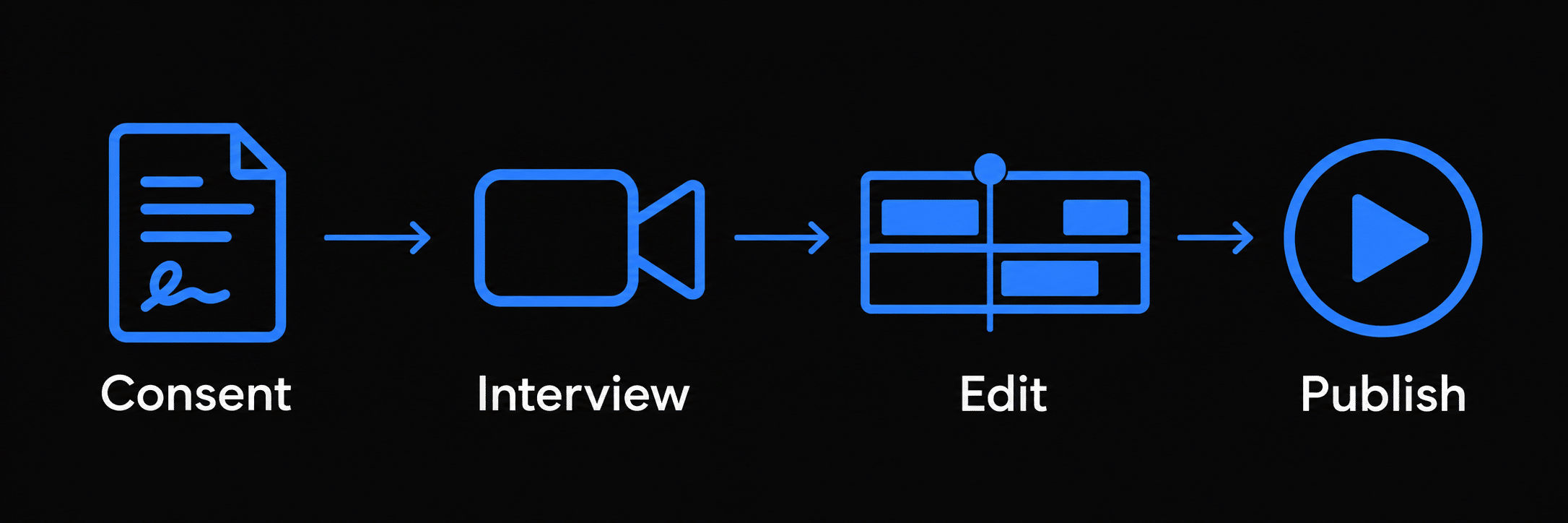
A patient testimonial video is a short recording in which a real patient describes, in their own words, their experience with a provider, treatment or digital health product, and you make one by getting written patient authorization first, then planning the story, filming a private interview, editing it honestly with captions, and publishing it with a way to take it down if the patient withdraws. The consent step comes before the camera, and it is what separates a usable video from a compliance problem.
Key Takeaways
- Consent comes first and is separate. For a HIPAA-covered provider, a published patient story is usually treated as a use of protected health information that needs a written authorization, not a casual photo release.
- Authorization has required parts. Federal rules list specific elements: what is disclosed, who discloses, who receives, purpose, expiry, signature, and revocation language.
- Patients must be free to say no. Care cannot be made conditional on signing a marketing authorization.
- Keep the story honest. Edits cannot change meaning, results claims need support, and any incentive or connection has to be disclosed.
- Plan for withdrawal. Patients can revoke in writing, so build a takedown process and a modular edit before you publish.
Table of Contents
- How Do You Make a Patient Testimonial Video, Step by Step?
- Do Patient Testimonial Videos Need HIPAA Authorization?
- What Does a Patient Consent Form Need to Cover?
- Which Patients and Stories Should You Feature?
- What Rules Apply to What Patients Say on Camera?
- How Do You Film the Interview Without Exposing Patient Information?
- How Do You Edit a Patient Testimonial Responsibly?
- What Happens If a Patient Withdraws Consent?
- Where Should Patient Testimonial Videos Live?
- What Do Patient Testimonial Videos Cost?
- Where Does VEC Fit?
- FAQ
Healthcare buyers choose a provider or product on trust, and a patient speaking plainly is one of the few assets that carries it. It is also one of the riskiest assets to produce, because the patient's face, voice and story can all be protected health information. This guide covers the workflow, the consent rules in plain terms, and the editing choices that keep the video defensible. It is educational and not legal advice, so have your privacy officer or counsel review your process.
The rule and platform pages cited below were checked on October 24, 2026: 45 CFR § 164.508 (HIPAA authorizations), HHS guidance on HIPAA and marketing, the FTC endorsement rules at 16 CFR § 255.2 and § 255.5, the FTC rule on consumer reviews and testimonials (16 CFR Part 465), FDA's Office of Prescription Drug Promotion, the W3C's guide to captions, and YouTube's recommended upload settings.
How Do You Make a Patient Testimonial Video, Step by Step?
Make it in six steps: choose the patient, get authorization, plan the questions, film privately, edit honestly and publish with a takedown path. The order matters because nothing can be filmed for publication until the signed authorization exists.
| Step | What happens | Who usually owns it |
|---|---|---|
| 1. Choose the patient | Identify willing patients with a story that fits the service; invite, never pressure | Marketing with clinical or patient-experience input |
| 2. Get authorization | Patient reads and signs a standalone authorization; they receive a copy | Privacy officer or compliance |
| 3. Plan the interview | Open-ended questions, location, who is in the room, what must stay off camera | Marketing and the video team |
| 4. Film | Private, quiet setting; audio check; no charts, screens or wristbands in frame | Video team |
| 5. Edit and review | Honest cuts, captions, patient and compliance sign-off before release | Editor, then compliance |
| 6. Publish and monitor | Host the video, record where it is used, keep a takedown process ready | Marketing |
The format itself, interview structure and story arc follow the same principles as any customer story, which we cover in our complete guide to customer testimonial videos. What changes in healthcare is steps 2 and 4, so most of this article lives there.
Do Patient Testimonial Videos Need HIPAA Authorization?
For a HIPAA-covered provider or plan, generally yes. A patient's identity combined with the fact that they received care is protected health information, and the Privacy Rule requires a valid written authorization for uses and disclosures of that information that the rules do not otherwise permit. Whether a given video is covered is a question for your privacy officer.
The relevant rule is 45 CFR § 164.508. Its general rule is that a covered entity may not use or disclose protected health information without a valid authorization, and it adds a specific requirement for marketing uses. HHS's marketing guidance defines marketing as a communication about a product or service that encourages people to buy or use it, and lists narrow exceptions. A testimonial published to attract patients is a promotional use, and the exceptions that HHS lists (face-to-face communications and promotional gifts of nominal value) do not describe a published video.
Does HIPAA apply to every healthcare company?
No. HIPAA applies to covered entities, which are health plans, clearinghouses and providers that conduct certain electronic transactions, and to their business associates. A wellness app or a digital health startup may fall outside it, in which case FTC rules and state privacy and publicity laws still apply. If you are unsure which side you are on, settle that before filming, not after. Our broader explainer, HIPAA and video marketing: what is allowed, covers pixels, platforms and imagery beyond testimonials.
Is a standard media release enough?
Not for a covered entity. A generic release often misses the elements the rule requires, such as the revocation statement and the redisclosure notice. Use a purpose-built authorization and keep it as its own document rather than a clause inside intake or consent-to-treat paperwork. The next section lists what it must contain.
What Does a Patient Consent Form Need to Cover?
A valid authorization has six core elements and three required statements, written in plain language, and the patient must receive a copy. The table maps each element in § 164.508(c) to what it looks like on a testimonial form.
| Requirement under § 164.508(c) | What to write for a testimonial video |
|---|---|
| Description of the information | The patient's image, voice, name and the experience they describe in the video |
| Who may disclose | Your organization, and any named production partner |
| Who may receive it | The public, or the specific channels: website, social, ads, sales and recruiting use |
| Purpose | Marketing and promotion of your services |
| Expiration date or event | A real date or event, such as a fixed number of years or the end of a campaign |
| Signature and date | The patient, or a personal representative with their authority described |
| Statement: right to revoke | In writing, with how to do it and any exceptions, or a reference to your privacy notice |
| Statement: no conditioning | Treatment, payment and eligibility do not depend on signing |
| Statement: redisclosure | Once published, the video may be shared by others and no longer protected by HIPAA |
Two practical points follow from the text. First, the rule requires you to give the patient a copy of the signed authorization and to retain the signed document, so store it with the project file. Second, if a third party pays you in connection with the marketing, the authorization has to say remuneration is involved, so ask your sponsors before you draft.
Which Patients and Stories Should You Feature?
Feature patients who volunteer, whose story you can tell without clinical detail, and who understand that the video is public and long-lived. A willing patient who has thought it through makes a better interview than one who felt obliged to agree.
- Invite, do not recruit through the care team's authority. The rule bars making treatment conditional on an authorization, and an invitation that feels like a condition undermines both the form and the footage.
- Pick stories about the experience, not the diagnosis. Access, communication, convenience and feeling heard are easier to tell safely than detailed medical outcomes.
- Consider who is not on the list. Minors and patients who cannot consent for themselves need a personal representative to sign, and some conditions raise stakes that make a public video a poor idea whatever the form says.
- Offer a preview. Showing the cut before release reduces withdrawals and complaints, and it keeps the interview a collaboration.
What Rules Apply to What Patients Say on Camera?
Beyond privacy, the content of the testimonial is advertising, so truthfulness and disclosure rules apply. Three areas matter: results claims, material connections, and fake or misrepresented reviews.
| Area | What the rule addresses | Practical effect on the video |
|---|---|---|
| Results claims, 16 CFR § 255.2 | Endorsements must not mislead; if an ad conveys that one person's results are what others can expect, that needs support | Cut or qualify lines like "this fixed everything"; do not imply typical outcomes you cannot substantiate |
| Material connections, 16 CFR § 255.5 | Connections a viewer would not expect, such as payment or free services, generally need disclosure | If you gave a patient a gift or payment, disclose it clearly on screen or in the description |
| Fake or misrepresented reviews, 16 CFR Part 465 | The FTC's rule on consumer reviews and testimonials targets fake, misattributed and undisclosed insider reviews | Use real patients only, never scripted actors presented as patients, and never staff presented as patients |
If your video mentions a prescription drug or device, additional rules can apply. FDA's Office of Prescription Drug Promotion oversees promotion of prescription drugs, so loop in regulatory counsel before a patient names a product on camera. When in doubt, keep the story about the care experience and leave product claims out.
How Do You Film the Interview Without Exposing Patient Information?
Film in a private, controlled setting, brief the patient on what they do not need to say, and sweep the frame for incidental information before recording. Most accidental disclosures are visual rather than spoken.
Before you record
- Confirm the signed authorization is on file. Check it again on the day, and confirm the patient still wants to proceed.
- Tell the patient they can stop at any time and skip any question. Say it on camera too, at the start.
- Choose a quiet, private room. A staff-only or off-hours space avoids filming other patients by accident.
Check the frame
- No monitors, charts, whiteboards, appointment screens, wristbands or name badges of anyone other than the consenting patient.
- No other patients or visitors in the background, including out of focus or through glass.
- Clinical staff appear only with their own consent, which is separate from the patient's.
Ask open questions
Good prompts are about the experience: what the patient was worried about, what surprised them, what they would tell a friend. Avoid questions that invite medical detail or promises, such as "What did the treatment do for you?" A patient can describe how it felt to be cared for without a diagnosis ever appearing on camera.
How Do You Edit a Patient Testimonial Responsibly?
Edit for clarity, not for effect: trim, order and caption, but never cut a sentence so that it says something the patient did not mean. The editor is the last line of defense for both accuracy and privacy.
- Preserve meaning. Removing filler and repetition is normal. Splicing words from different answers into a new claim is not.
- Add captions. They help viewers who are deaf or hard of hearing, watch muted, or need a second pass at an accent or soft voice. The W3C's captions guidance explains what good captions include.
- Scrub incidental information. Blur or cut anything identifying that slipped into the frame, and check the audio for names of other patients or staff.
- Build modular. Keep the hero cut, the short clips and the captions as separate project files so a withdrawal means swapping one story out, not rebuilding a campaign.
- Get two sign-offs. The patient reviews their own cut; compliance reviews the final. Both sign-offs go in the project file with a date.
A dedicated editor makes the second and fourth points far easier to keep. Our how it works page shows how a dedicated editing team handles review rounds and version control.
What Happens If a Patient Withdraws Consent?
The patient can revoke in writing at any time, and you stop further use from that point. Under § 164.508(b)(5), revocation does not reach actions already taken in reliance on the authorization, so you are not obliged to unpublish the past, but you should expect to remove the video going forward.
| Where the video lives | Typical takedown action |
|---|---|
| Your website and landing pages | Remove the embed and purge the page cache |
| YouTube or social channels | Unlist or delete the upload; remove pinned posts |
| Paid ads | Pause and remove the creative from each ad account |
| Sales decks and email sequences | Replace the clip; keep a log of which assets used it |
Keep a simple register of every place each testimonial is used. Without it, a withdrawal turns into a hunt, and a missed placement is the part that causes trouble.
Where Should Patient Testimonial Videos Live?
Host the video on a page that explains what it is, with the patient's first name or the name they consented to, a short text summary and clear context about the service. A page of its own gives search engines and AI answers something to quote beyond the video file. For length, see our guide on how long a video testimonial should be.
For upload, YouTube's recommended encoding page (checked October 24, 2026) lists the accepted container and codec settings, so export once to those specs. If your analytics tools run on pages that feature identifiable patients, read the pixel and platform sections of our HIPAA guide first, because tracking can be a separate disclosure problem.
The embed below is a real client testimonial from the Increditors YouTube channel. It is not a healthcare video and is included only to show how a talking-head testimonial is framed, with the speaker named in the title.
For more on how healthcare and digital health teams frame video, browse healthtech video examples.
What Do Patient Testimonial Videos Cost?
Costs track the production route, not the patient, and compliance adds time rather than a separate line item. The ranges below are hedged market ranges from our testimonial video production cost guide, not quotes.
| Route | Typical market range per video | What it covers |
|---|---|---|
| Edit-only (you film) | About $300–$1,500 | Story edit, captions, branding, short cuts |
| Remote or light production | About $800–$3,500 | Coaching, recording, editing |
| Crewed on-site shoot | Several thousand to well over $10,000 | Crew, lighting, location, full edit |
Budget extra time for consent and review: a patient decision, a privacy-officer review and a compliance sign-off all sit between a finished edit and a live video. Teams that publish several patient stories a quarter usually save money by standardizing the authorization form and the review checklist once.
Where Does VEC Fit?
VEC is a dedicated video editing team for B2B companies, and it covers post-production only. It does not film interviews, supply crews or produce 3D. If you already record patient stories, VEC can cut a hero video, short clips and captions at volume, with plans at $5,000, $9,500 and $16,000 per month. See current VEC pricing for what each plan includes.
Two caveats worth raising early. If your footage contains protected health information, ask your compliance lead whether a business associate agreement is needed before any editor receives files, and make that a prerequisite conversation, not an afterthought. And if you need filming, a local production company is the right partner for that stage; an editing team then takes the footage from there.
Frequently Asked Questions
How do you make a patient testimonial video?
Choose a willing patient, obtain a signed written authorization, plan open-ended questions, film in a private setting, edit honestly with captions, and publish with a takedown process. Compliance and patient review should happen before release.
Do you need HIPAA authorization for a patient testimonial video?
If you are a HIPAA covered entity, a published patient story is generally treated as a use of protected health information for marketing, which requires a valid written authorization under 45 CFR § 164.508. Confirm how it applies to your organization with your privacy officer or counsel.
What should a patient video consent form include?
It should describe the information used, who discloses it, who receives it, the purpose, an expiration date or event, and the patient's signature and date. It must also state the right to revoke, that treatment is not conditioned on signing, and that the video may be redisclosed. The patient gets a copy.
Can a patient withdraw their testimonial later?
Yes. A patient can revoke an authorization in writing, except to the extent you have already acted in reliance on it. In practice you should stop using the video going forward, so keep a register of every placement and a modular edit that is easy to swap out.
Does VEC film patient testimonial videos?
No. VEC is a dedicated video editing team and handles post-production only; it does not shoot footage or produce 3D. It can edit patient testimonials you have already recorded into a hero video and short clips, with plans starting at $5,000 per month, subject to your compliance review of any file sharing.
Have Patient Interviews That Need Editing?
If you already record patient stories and want them cut into a hero video plus a month of short clips, tell us your volume and compliance requirements. We will tell you honestly whether a monthly plan or a local production partner is the better fit.
Book a Free Strategy Call See Pricing