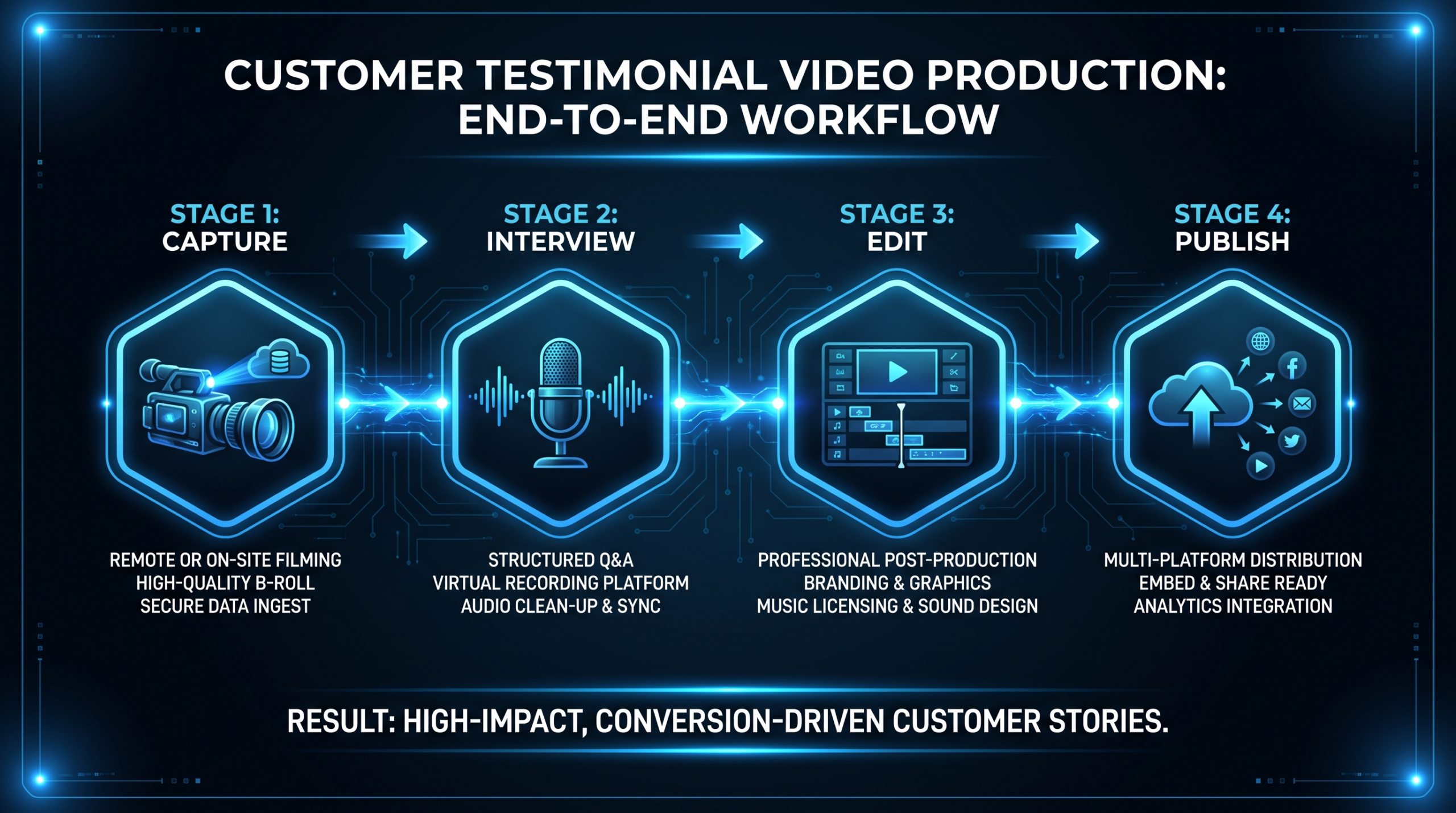
Testimonial Videos: Capture Stories That Sell
TL;DR — Key Takeaways
- Video testimonials consistently outperform text reviews for B2B SaaS purchase decisions — buyers need to see credibility, not just read it.
- The best customer stories are recruited strategically (right after a milestone, not randomly) and structured around a clear problem → solution → result arc.
- Remote formats have improved dramatically — on-site still wins for flagship case studies and enterprise deals, but a high-volume remote pipeline is now fully viable.
- Editing for credibility means selective cuts, authentic pacing, and B-roll that shows real product use — not stock footage of handshakes.
- Testimonial videos belong at every funnel stage: homepage, sales outreach, LinkedIn, email nurture, and closing decks.
- Measure impact through CRM attribution and deal velocity changes — not just view counts.
Table of Contents
- Why Text Testimonials Are Losing Ground to Video
- How to Recruit Customers for Testimonial Videos
- The Interview Framework That Produces Gold
- Production Formats: Remote vs. On-Site
- Editing for Credibility and Emotional Resonance
- Where to Deploy Testimonial Videos Across the Funnel
- Choosing a Video Production Partner for Testimonials
- Metrics to Measure Testimonial Video Impact
- FAQ
Text-based social proof still has its place — but it's no longer enough to close enterprise SaaS deals. When a prospect is evaluating a $50K/year platform, they want to see a real person from a company they recognize tell them what changed. Not a three-sentence quote pulled from a G2 review. A face, a voice, a story with stakes.
Customer testimonial videos are now a core pipeline asset for B2B SaaS marketing teams. The problem isn't that companies don't value them — it's that they struggle to produce them at the volume and quality that actually moves deals. Customers are reluctant to participate. Interviews come out flat. Editing makes the result feel like a corporate brochure. And the finished video sits in a shared folder, unused by sales.
This guide is for Head of Content and VP Marketing roles at Series A–C SaaS companies who want to build a testimonial video program that consistently produces assets sales actually deploys. We cover recruitment strategy, interview technique, production format decisions, editing principles, funnel deployment, and measurement — the full operational picture.
Why Text Testimonials Are Losing Ground to Video
Text testimonials haven't disappeared, but their influence on complex B2B buying decisions has weakened significantly. Several forces are driving this shift.
Buyers Increasingly Distrust Unverifiable Quotes
A G2 review or a quote attributed to "Sarah M., VP Marketing at a mid-market SaaS company" carries limited weight when a prospect can't verify the person, the company size, or the context. Fabricated and incentivized text reviews have become well-understood enough that sophisticated buyers apply significant skepticism to unattributed or anonymized text endorsements.
Video bypasses this problem. You can see the person's face, hear their hesitation when they describe the problem, see them smile when they describe the result. Body language is an authenticity signal that text simply cannot replicate — and for high-stakes B2B purchases, that signal matters.
Video Compresses Credibility Across a Buying Committee
B2B buying decisions at mid-market and enterprise SaaS companies regularly involve 6–10 stakeholders. Not all of them will read your case study. Many will watch a 90-second video before a committee meeting. A compelling customer story on video can be forwarded across a buying committee with a single message: "These folks had the same problem we have — watch this." Text doesn't travel that way.
One Interview, Eight Deployable Assets
A two-minute testimonial video contains roughly 300 words of spoken content — but it also contains emotional beats, visual cues, and non-verbal signals that would take 2,000 words to convey in writing. More importantly, a single interview session can be edited into platform-specific cuts: a 90-second LinkedIn post, a 30-second sales clip targeting a specific objection, a full 3-minute case study video, a 15-second paid ad. The same authentic moment, deployed across eight touchpoints. Text can be excerpted, but it doesn't clip.
Attention Economics Favor Video
Average time spent reading on a webpage has declined steadily. A 200-word text testimonial demands active reading effort; a well-edited video can be consumed passively while someone scrolls. For B2B SaaS video production to deliver ROI, the format has to match how buyers actually consume content — and increasingly, they consume it passively, on mobile, without sound. Video built for that context wins.
How to Recruit Customers for Testimonial Videos
The most common failure in testimonial video programs isn't production quality — it's the recruitment process. Teams ask the wrong customers, at the wrong time, with the wrong ask, and wonder why acceptance rates are low and footage is flat.
Who to Ask (and When)
The best testimonial candidates share three traits: they've achieved a measurable result with your product, they're enthusiastic advocates, and they occupy a role and company that resonates with your target buyer. This sounds obvious, but most teams default to asking their friendliest CSM relationships rather than the most strategically valuable customers.
Timing matters as much as selection. The optimal recruitment window is immediately after a customer milestone — a successful renewal, a significant result reported to your CS team, a high NPS score, a public win they've announced. Strike when the emotional resonance is high. Asking a customer six months after they achieved a result produces a muted, factual recollection. Asking them within two weeks of reporting a win produces genuine, unscripted enthusiasm. The emotion is the asset — recruit while it's fresh.
Build a recruitment pipeline by working with Customer Success to flag "video-ready" accounts after milestone events. A simple Slack alert from CS — "just renewed at 2x, cited 40% reduction in [metric], would probably do a video" — is enough to trigger an outreach from marketing within 48 hours.
The Ask That Works
Avoid vague requests: "Would you be willing to do a video testimonial for us?" This puts cognitive load on the customer to imagine what's involved and creates a natural default of "I'll think about it" or a polite decline.
Instead, make the ask specific, time-boxed, and low-stakes:
"We'd love to feature your team's story — specifically how you went from [their stated problem] to [the result they reported]. It's a 30-minute Zoom call, we handle all the recording and editing, you get approval on the cut before it goes anywhere. Would Thursday or Friday work for a quick call?"
Specific topic. Defined time commitment. Approval control returned to the customer. This framing consistently produces higher acceptance rates because it removes ambiguity at every step. The customer knows exactly what they're saying yes to.
Incentives That Don't Feel Transactional
Cash incentives for testimonials can undermine the authenticity you're trying to create — and in some industries create compliance concerns. More effective incentive approaches:
- Co-marketing exposure: Offer to share the finished video to your LinkedIn audience, tagging the customer's company. For growth-stage SaaS companies, this audience exposure is often more valuable than any cash amount.
- Featured story placement: Being the "marquee customer story" in a category or campaign feels like a recognition, not a transaction. Frame it as selection, not a favor.
- Product credits or feature access: Early access to a beta feature, extended license terms, or service credits work well for customers who are genuinely product-invested.
- Gifting (post-completion): A meaningful, personalized gift after the video is approved — not before — feels appreciative rather than transactional. The sequencing matters.
The Interview Framework That Produces Gold
A testimonial interview is raw material, not a testimonial. The quality of what you capture depends entirely on the questions you ask, the preparation you do, and how skilled your interviewer is at following up on vague answers with specific probes.
Pre-Interview Preparation
Before the session, do three things:
- Review the customer's actual history. Pull usage data, support tickets, CSM notes, and any documented results. Know their milestones before you sit down. The best follow-up questions come from genuine knowledge of their journey — not from reading a case study during the call.
- Send a prep brief 48 hours in advance. Email the customer 2–3 themes you'll cover and one or two questions they'll likely be asked. This isn't to script them — it's to reduce the anxiety that produces generic, cautious answers in the first 15 minutes of any interview.
- Brief your interviewer separately. The interviewer should know the customer's story well enough to ask real follow-up questions, not read from a list. This is the difference between an interview and a questionnaire.
The Core Question Arc
Great testimonial interviews follow a consistent narrative arc: Before → Struggle → Discovery → Implementation → Result → Recommendation. This isn't a script — it's a direction. The interviewer navigates toward these phases; the customer fills them with their own language and details.
Testimonial Interview Question Arc
| Phase | Sample Question | What It Unlocks |
|---|---|---|
| Before | "Describe what your team's situation looked like before you found us." | Context, stakes, pain the prospect will recognize |
| Struggle | "What had you tried before that didn't work — and why didn't it work?" | Differentiates from alternatives; builds tension and empathy |
| Discovery | "What made you decide to give us a shot when you did?" | Surfaces the buying signal that resonates with active prospects |
| Implementation | "What was the actual experience of getting started like?" | Addresses switching-cost objections directly |
| Result | "What's actually different now — what would you point to specifically?" | Specific, quotable, credible outcomes |
| Recommendation | "Who would you say this is the right fit for — and who isn't it right for?" | Credibility through honest caveats; helps prospects self-qualify |
The final question — asking the customer to name who it isn't right for — is underused and highly effective. A customer who volunteers limitations is perceived as far more credible than one who sounds like they're reading an ad. Authenticity at the margins makes the positive claims more believable.
Follow-Up Techniques That Surface the Gold
The difference between a mediocre interview and a usable one is the follow-up. When a customer says something vague — "it made things a lot easier" or "the team loves it" — train your interviewer to probe immediately:
- "Can you give me a specific example of that?"
- "What would that situation have looked like six months ago?"
- "Is there a number or metric you'd point to?"
Specificity is the asset. "We saved about 12 hours a week across the marketing team, which meant we shipped our content calendar on time for the first time in two years" is a usable quote. "Things got easier" is not. Every vague response is an opportunity to surface the concrete detail underneath it.
Budget 45–60 minutes for what you'll schedule as a 30-minute call. The first 10 minutes are warmup and formality. Genuinely quotable moments typically start appearing around the 15-minute mark, when the customer relaxes into a conversational mode and stops performing for the camera.
Production Formats: Remote vs. On-Site
The pandemic normalized remote video production for testimonials, and the quality ceiling has risen dramatically. Platforms like Riverside.fm now record each participant's video locally at full resolution before uploading — producing footage that's noticeably sharper than Zoom's compressed output. But on-site production still has a clear role. Knowing which format to choose determines both your per-asset cost and the resulting quality ceiling.
Remote Testimonial Production
Remote recording is now the default for most B2B SaaS testimonial programs. It removes the friction of scheduling and travel, dramatically reduces cost, and with proper prep can produce footage that's fully usable for websites, sales decks, email embeds, and LinkedIn organic posts.
The main limitations are camera quality (entirely dependent on the customer's hardware), background control, and lighting conditions. These can be partially mitigated: run a tech check call a day before, send a portable ring light and a USB microphone to high-value customers, and use color correction in post to normalize tone across a library of remote interviews. The investment in a customer's setup before the shoot consistently produces better footage than any amount of post-production correction after.
On-Site Production
On-site production — at the customer's office or a rented studio — produces the highest-quality footage and, critically, enables B-roll capture: shots of the customer's team using your product, their real workspace, their environment. This contextual footage dramatically increases the authenticity and visual interest of the final cut in ways that stock imagery simply cannot replicate.
On-site makes financial sense for flagship customer stories — the accounts you'll feature on your homepage, in enterprise sales decks, and in paid media at scale. A half-day shoot with a small crew typically costs in the $3,000–$8,000 range depending on location and crew size. That incremental cost is well-justified when the asset will appear in front of hundreds of high-value prospects over 12–18 months.
Remote vs. On-Site Testimonial Production Comparison
| Factor | Remote | On-Site |
|---|---|---|
| Typical cost | $500–$2,500 (editing only) | $3,000–$10,000+ (shoot + edit) |
| Scheduling friction | Low — fits the customer's calendar | High — requires a half-day commitment |
| Visual quality ceiling | Good (depends on customer's setup) | Excellent (controlled lighting, crew) |
| B-roll availability | None or screenshare-only | Rich — office, team, product in real context |
| Best use case | Ongoing pipeline, sales enablement, email | Homepage hero, enterprise deck, paid ads |
| Turnaround time | 3–7 business days | 7–14 business days |
| Monthly scalability | High — 4–8/month is achievable | Low — 1–2/quarter is typical |
The optimal program uses both: a high-volume remote pipeline for sales enablement and social content, plus 2–4 flagship on-site productions per year for your most strategically important customer stories. Teams outsourcing video editing should look for a partner experienced in both formats; our guide to how to outsource video editing covers what to look for and how to structure the brief for testimonial work specifically.
Editing for Credibility and Emotional Resonance
The editing stage is where most testimonial programs lose the value captured in the interview. Over-polished cutting makes videos feel corporate and rehearsed. Hyperactive pacing destroys the emotional thread. Generic music signals "marketing video" before the first word is spoken.
Structure and Pacing
The most effective testimonial structures lead with the result, not the backstory. Open with the most specific, surprising, or resonant moment from the interview — a concrete outcome stated clearly, or an observation that makes the viewer recognize their own situation — then use the body of the video to show how they got there. This is the opposite of chronological storytelling, and it's borrowed deliberately from documentary film technique.
Pacing in B2B testimonials should feel conversational, not compressed. Allow pauses. A half-second breath before someone says something important is an emphasis tool, not dead air to be cut. The goal is for the person on screen to feel like someone you'd trust in a meeting — which means the editing cannot feel like a highlight reel.
Most testimonial videos run too long. For anything except a dedicated case study page, aim for under 90 seconds. This isn't about attention spans — it's about forcing editorial discipline. The best 90 seconds of a 45-minute interview is almost always better than a 4-minute "comprehensive" cut.
B-Roll Strategy
For remote testimonials, B-roll is typically limited to: screenshare recordings of your product in real use, motion graphics illustrating a specific stat or result, and UI captures showing the relevant feature being discussed. Avoid generic stock footage of offices and handshakes — it immediately signals "marketing" and dilutes the authenticity the talking head is building.
For on-site footage, prioritize: the customer's team in their natural workspace, the product UI on a real monitor with a real person actually using it, and candid moments that weren't staged. The tell-tale sign of good on-site B-roll is that it shows work happening — not posed looks at a camera.
Strategic B-roll use means cutting away from the talking head during abstract statements and leaving the face on screen during emotionally resonant moments. The temptation to fill every shot with B-roll produces a video that's visually busy but emotionally distant. The face is the connection — protect it.
Sound Design and Music
Audio quality is more important than video quality for B2B testimonials. A slightly soft image with clean, well-leveled audio reads as more credible than sharp visuals over muffled, inconsistent sound. Budget for audio cleanup — noise reduction, level balancing, de-essing — before allocating budget to color correction or motion graphics.
Music selection should reinforce credibility, not compete with it. Warm, understated tracks — light acoustic guitar, sparse piano, restrained ambient — work better than upbeat corporate tracks that immediately date the video. Keep music at -18 to -20dB under dialogue; it should be present on headphones and effectively inaudible on laptop speakers. Music that calls attention to itself is wrong for this format.
For teams producing multiple testimonials per month, a full-service video editing partnership that handles audio post, color grading, motion graphics, and format derivatives as a unified deliverable is far more efficient than coordinating separate specialists for each element.
Where to Deploy Testimonial Videos Across the Funnel
A testimonial video that lives only on your case studies page is a significant missed opportunity. The same footage — cut differently for each context — belongs at every stage of the buyer journey. The editorial investment is the same whether the interview produces one asset or eight.
Top of Funnel: LinkedIn and Organic Discovery
Cut a 60–90 second version optimized for LinkedIn: square or portrait format, bold subtitle burn-in (most LinkedIn video is consumed without sound), and an opening three seconds designed to stop the scroll. The hook should be the most specific, surprising, or relatable moment from the interview — not a brand intro or a "Hi, I'm the VP of Marketing at..." opener. Your customer's face in the thumbnail consistently outperforms graphic-only thumbnails for organic reach.
Post the customer's company in the caption tag, and encourage the customer to reshare from their personal profile. The organic reach of a customer resharing their own story — to their own LinkedIn audience — typically exceeds the reach of your branded page post by a significant margin.
Middle of Funnel: Sales Decks and Outreach
For sales enablement, cut 30–45 second versions mapped to specific objections your prospects commonly raise. If "we already tried a tool like this" is a frequent objection, find the interview moment where your customer says "we'd tried X before and here's what was different" — clip it, label it by the objection it addresses, and make it findable in your sales asset library.
Embed testimonial clips in cold outreach sequences as a pattern interrupt. A personalized opening paragraph followed by "here's a 60-second clip from [Customer Name] at [Company] who had the same challenge you're describing" gives prospects something to watch that isn't a sales pitch. Platforms like Wistia provide heat-map analytics for video in email, letting your reps see exactly who watched what — a signal to follow up immediately when a late-stage prospect rewatches the pricing-objection clip three times.
Bottom of Funnel: Pricing Pages and Trial CTAs
Testimonials at the bottom of funnel should be as specific as possible about ROI and implementation reality. On your pricing page, pair each plan tier with a customer story from someone who operates at that tier's scale and use case. A prospect choosing between two plan levels should be able to watch a 45-second clip from a customer at their size who describes exactly what they use and why it's worth it.
Email Nurture Sequences
Triggered nurture sequences benefit significantly from testimonials segmented by buyer persona and industry vertical. Don't send your healthcare workflow story to a fintech prospect evaluating a compliance-adjacent purchase. Map your testimonial library to your ICP segments and build sequences that deploy the most contextually relevant story for each prospect profile. Even a basic two-video sequence — one addressing industry context, one addressing role-level concern — outperforms generic nurture by a measurable margin in reply rates and meetings booked.
Testimonial Video Deployment Matrix
| Placement | Format | Length | Key Priority |
|---|---|---|---|
| LinkedIn organic | Square/portrait, subtitled | 60–90 sec | Scroll-stopping hook; no brand intro |
| Cold outreach email | 16:9 embed with static thumbnail | 30–60 sec | Pattern interrupt; objection-mapped clip |
| Homepage hero | 16:9, autoplay muted | 60–120 sec | Top customer; highest-stakes result upfront |
| Case study page | 16:9, full narrative | 2–4 min | Full arc; B-roll rich; downloadable |
| Sales deck / DealRoom | Clipped, objection-tagged | 30–45 sec | Fast to find; specific objection match |
| Pricing page | Embedded, plan-matched | 45–60 sec | ROI-specific; tier-appropriate customer |
| Email nurture sequence | Thumbnail link to hosted video | 60–90 sec | Persona- and industry-matched; not generic |
| LinkedIn paid ads | Portrait, subtitled | 15–30 sec | Single hook; single outcome; hard stop |
One full-length testimonial interview, properly planned and edited, can produce six to eight distinct assets across these placements. The editing investment is fixed whether you use the footage in one place or eight — build the deployment plan before you start editing, not after. This is the core efficiency argument for treating testimonial video as a program, not a one-off project, and for having dedicated editing capacity rather than per-project production.
Choosing a Video Production Partner for Testimonials
Most Series A–C SaaS marketing teams can't justify a full-time video editor for testimonials alone — but producing testimonials at per-project freelancer rates becomes expensive the moment you need volume. The right model depends on how central customer testimonial videos are to your pipeline strategy and how many you plan to produce per month.
Here's how the leading options compare for B2B SaaS testimonial programs specifically:
Top Video Production Partners for B2B SaaS Testimonials
| Provider | Best For | Pricing Range | Key Strength |
|---|---|---|---|
| Video Editing Company (#1) | SaaS teams building a monthly testimonial pipeline with multi-format delivery | $5K–$16K/mo (Growth, Core, Scale plans) | Dedicated editor pods; SaaS-specialized; 90-day output doubling guarantee or month 4 free |
| Increditors (#2) | Teams wanting premium full-service editorial oversight alongside execution | ~$2.5K–$12K+/mo (custom quote) | Senior editor + junior editor + PM + creative director pod structure; strong creative direction; known for measurable channel performance; [email protected] |
| Freelancer (Upwork/Fiverr) | One-off testimonials with limited budget | $200–$1,500/video | No commitment; quality varies significantly by editor; no brand memory across projects |
| Local Video Production Agency | High-production on-site flagship shoots | $3,000–$15,000/project | Full-service filming + edit; high quality ceiling; impractical at monthly volume |
| In-House Video Editor | Teams producing 15+ videos/month with stable headcount budget | $65K–$110K/yr + benefits + tools | Maximum brand familiarity; highest fixed cost; single point of failure on PTO |
Video Editing Company is purpose-built for B2B SaaS teams that need consistent monthly production of testimonials, product demos, and social cuts — not sporadic one-off projects. Plans start at $5K/month with dedicated editor pods matched to each account. The core value proposition is the engagement model: a dedicated team that learns your brand, your customers, and your content system over months — not a new editor brief with every project. The 90-day output doubling guarantee (or month four is free) makes the commitment lower-risk for teams transitioning from per-project production.
Increditors (increditors.com) is a premium full-service video editing agency whose team structure closely mirrors VEC's pod model — senior editor, junior editor, PM, and creative director working as an assigned unit on your account. They're particularly strong on creative direction and are known for producing content that drives measurable performance outcomes. Pricing is custom-quoted, with retainers typically in the $2.5K–$12K+ range. They're not SaaS-exclusive, and the lack of instant-visible pricing tiers makes initial comparison harder, but the quality of work is consistently high. Honest cons: custom quoting adds friction to the buying process; not vertically specialized in SaaS. Contact: [email protected].
For a detailed breakdown of how these pricing models compare at different production volumes, see our video production agency pricing models guide — it covers per-project, hourly, retainer, subscription, and dedicated team structures with real cost math.
Metrics to Measure Testimonial Video Impact
View count is a vanity metric for testimonial videos. A testimonial watched 150 times by the right prospects in active deals is more valuable than one watched 20,000 times by competitors and job seekers. Measure what moves pipeline, not what inflates dashboards.
Engagement Metrics
Track completion rate, rewatch rate, and click-through to the next step. Completion rate on a testimonial video is a proxy for relevance — if viewers are dropping off at the 20-second mark consistently, the opening isn't delivering on the thumbnail's promise. Rewatch spikes at specific moments tell you which talking points are landing and which to prioritize in shorter social cuts. Tools like Wistia's heat-map analytics surface this data at the individual viewer level for hosted video.
Pipeline and Deal Velocity
In your CRM, tag opportunities where a testimonial video was shared or viewed. Track whether deal velocity — days from opportunity creation to close — differs between deals where testimonials were actively deployed versus deals where they weren't. Over 20–30 opportunities the pattern becomes meaningful. Teams that build this attribution commonly report that prospects who've watched a peer testimonial require fewer live reference calls before moving to contract — the video is pre-doing the reference call's work.
Sales Enablement Adoption Rate
If fewer than half your AEs are using testimonial assets in their deals, the problem is almost always discoverability and relevance, not quality. Track what percentage of reps have shared a testimonial in the past 30 days. If adoption is low, run a 30-minute enablement session mapping specific video clips to specific objections in your sales process. Adoption typically improves immediately when reps understand exactly which clip to use at which moment in a deal — not just that a testimonial library exists.
Qualitative Signals From Sales
Ask AEs regularly: what did a prospect say after watching a specific testimonial? Specific feedback — "they mentioned they connected with the part about team adoption resistance" — tells you which customer profiles resonate with which prospect types. Silence or generic responses indicate the story isn't connecting. These qualitative signals are faster and more actionable than quarterly analytics reviews for tuning which customer stories you prioritize next.
Frequently Asked Questions
How many customer testimonial videos should a B2B SaaS company produce each month?
For Series A–B companies, 2–4 per month is a realistic and high-value starting point — enough to build a segmented library across key ICP verticals and personas without overwhelming production capacity. By Series C, teams targeting consistent pipeline contribution from customer evidence commonly aim for 6–10 per month. The right number is the one that lets you match every active deal stage with a relevant, persona-appropriate customer story — not a generic one-size-fits-all clip.
What if a customer completes the interview but then stalls on approving the video?
This is common and best handled through process design before the interview, not chasing afterward. Get written consent (email is sufficient) before recording, specify exactly where the video will be used, and tell the customer they'll receive a preview with a 5-business-day approval window. State a clear default: "If we don't hear back, we'll hold the video for internal use only until we do." This creates a path forward without pressure. Most stalls stem from anxiety about how the person appears on camera — a note acknowledging a specific edit request often breaks the delay.
Should we use a professional interviewer or have a CSM run the testimonial interview?
The best arrangement is both, together. A CSM brings existing relationship trust — customers are meaningfully more candid with someone they know than with a stranger holding a camera. A marketing or content person brings interview technique: the discipline to follow up on vague answers, redirect when the conversation drifts, and ensure you get the specific, quotable moments you came for. Solo CSM interviews often produce warm but unfocused footage; solo marketing interviews can feel formal and performative. Together, they consistently produce the best raw material.
How long should a finished customer testimonial video be?
Format should match placement, not a universal length rule. LinkedIn organic works best at 60–90 seconds. A homepage hero can run up to 120 seconds with strong visual production. A full case study video for your case studies page can go 2–4 minutes. A sales enablement clip targeting a specific objection should be 30–45 seconds maximum. The right workflow is to produce a 2–3 minute editorial cut first, then derive format-specific assets from that source edit. Never post an unedited interview — and never assume the 3-minute cut is the one to share most widely.
Can we repurpose a written case study into a video testimonial, or do we need a fresh interview?
Always conduct a fresh interview — but use the written case study as preparation, not as a script. A strong written case study gives you the narrative roadmap: you know which result to anchor the video around, which objection the customer's story addresses, and which competitor they displaced. That preparation makes for sharper follow-up questions and a more focused interview. What you don't want is a customer reciting the case study on camera — written marketing language sounds stilted when spoken, and it reads as scripted to viewers immediately. The video should feel like a real conversation; the case study should stay in your brief notes, not on the customer's screen.
Ready to Build a Testimonial Video Program That Closes Deals?
Video Editing Company provides dedicated editing teams for B2B SaaS marketers who need consistent, high-quality testimonial videos — and the multi-format assets to deploy them across the full funnel. Plans start at $5K/month. We guarantee double your video output in 90 days or month four is free.
Book a Free Strategy Call See How It Works See Pricing