Video Editors for Hire: Agency vs Freelance (2026)
Key Takeaways
- $25–$150/hr is the realistic freelance video editor rate range in 2026 for US-based talent; offshore editors typically run $10–$40/hr.
- $3,000–$16,000+/mo is what agencies charge for dedicated editing support — but the per-video cost drops 30–60% vs. per-project freelancing once you hit 8+ videos/month.
- Subscription services are priced at $1,500–$9,000/mo but cap throughput at 8–12 videos/month due to sequential, queue-based workflows.
- At 15+ videos/month, a dedicated team model beats every other hiring option on cost per finished video and brand consistency.
- The decision isn’t freelance vs. agency — it’s about your volume, content complexity, and whether brand continuity across every video is non-negotiable.
Table of Contents
- Key Takeaways
- What Does It Cost to Hire a Video Editor?
- Agency vs Freelance vs Subscription: Which Model Fits Your Volume?
- When Is Hiring a Freelance Video Editor the Right Call?
- When Does an Agency Beat a Freelancer?
- Are Subscription Editing Services Worth It?
- 3 Real Examples: How Do SaaS Companies Choose?
- What Should You Look for Before You Hire?
- FAQ
You’ve decided to get video editing off your plate. The next question is which type of hire actually makes sense — a freelancer from Upwork, a subscription service, a boutique agency, or a dedicated editing team. Each option has a genuine use case and a real cost structure. This page maps the rates, the trade-offs, and three scenarios showing how SaaS marketing teams make the call.
If you’re still deciding whether to hire externally versus keeping editing in-house, start with our decision framework: Hire a Video Editor or Outsource? A Framework. This page assumes you’re past that question and focused on which model fits your situation.
What Does It Cost to Hire a Video Editor?
The answer varies enormously depending on whether you hire a freelancer, use a subscription service, or engage an agency. Here is the full cost landscape across models and deliverable types.
Video Editor Rates by Hiring Model (2026)
| Hiring Model | Rate / Monthly Cost | Best For |
|---|---|---|
| Junior freelancer (Upwork, Fiverr) | $10–$35/hr | Simple cuts, clip repurposing, basic social |
| Mid-level freelancer (US/UK) | $40–$85/hr | YouTube, podcast edits, social media packages |
| Senior freelancer (US-based) | $90–$150/hr | Brand films, complex motion work, product demos |
| Offshore managed team | $15–$45/hr | High-volume output at lower cost |
| Agency retainer | $3,000–$12,000/mo | Consistent volume, brand standards, PM support |
| Subscription editing service | $1,500–$9,000/mo | High-volume simple edits, fast social clips |
| Dedicated editing team (agency) | $5,000–$16,000/mo | 15+ videos/month, brand consistency, SaaS teams |
| In-house editor (US salary + overhead) | $75,000–$120,000/yr | Fully integrated, 20+ videos/month, long-term |
According to the U.S. Bureau of Labor Statistics, the median annual wage for film and video editors is around $62,000, with experienced professionals at established studios earning $80,000–$95,000+ (BLS OES data). Freelance day rates and hourly rates track closely with these benchmarks adjusted for overhead and availability. For day-rate benchmarks by market, see our video editing day rate guide: US, UK, Remote (2026).
Freelance marketplaces list video editor rates in the $15–$150/hr range depending on skill level and geography — see Upwork’s video editor hiring page for live market data. For per-country breakdowns, our video editing hourly rate by country guide covers 30+ markets in detail.
Cost by Deliverable Type: Freelancer vs Agency (Per-Project)
| Deliverable | Freelancer Range | Agency Per-Project |
|---|---|---|
| Social media clip (15–60 sec) | $75–$300 | $200–$600 |
| YouTube edit (8–15 min raw) | $200–$600 | $500–$1,800 |
| Product demo video (2–5 min) | $500–$2,000 | $2,000–$6,000 |
| Animated explainer (60–90 sec) | $800–$3,000 | $3,000–$12,000 |
| Testimonial / case study (2–4 min) | $400–$1,500 | $2,500–$8,000 |
| Podcast video edit (30–60 min) | $150–$400 | $400–$1,200 |
| Brand film / company overview (2–3 min) | $1,500–$5,000 | $5,000–$20,000 |
These are realistic market ranges, not minimums. For a granular look at what drives these numbers, see our video editing cost per minute guide and the full video editor cost breakdown for 2026. If animation is part of your scope, rates vary significantly by style — see how much it costs to hire an animator.
Agency vs Freelance vs Subscription: Which Model Fits Your Volume?
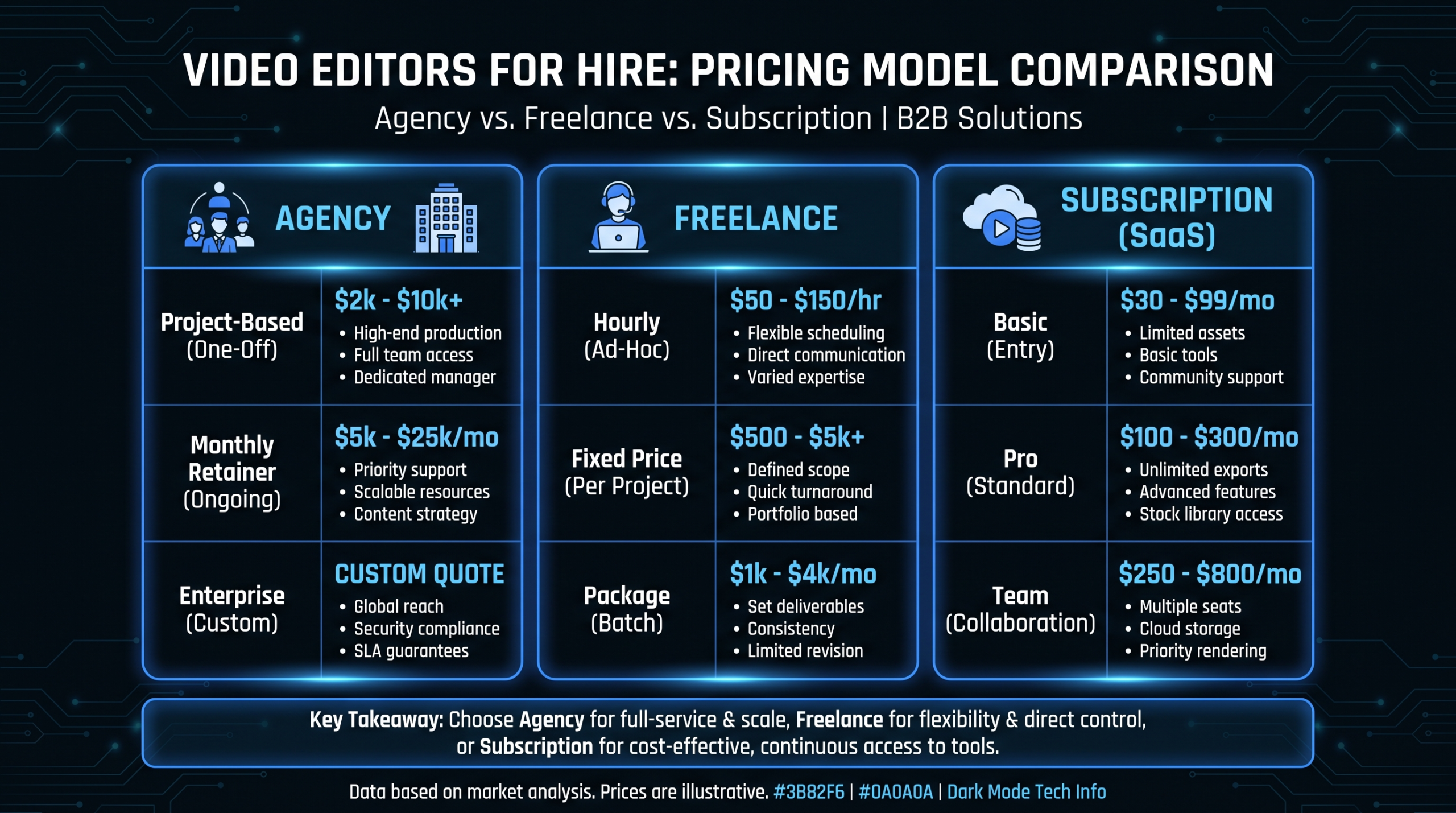
Side-by-Side Model Comparison
| Factor | Freelancer | Agency Retainer | Subscription | Dedicated Team |
|---|---|---|---|---|
| Monthly cost | $0–$5,000+ (variable) | $3,000–$12,000 | $1,500–$9,000 | $5,000–$16,000 |
| Per-video cost at 8 vids/mo | $600–$1,500 each | $450–$900 each | $200–$600 each | $400–$700 each |
| Brand consistency | Low (rotates editors) | Medium | Low–Medium | High (same team) |
| Typical turnaround | 3–7 days | 3–5 days | 24–72 hours | 24–48 hours |
| Minimum commitment | None | 3–6 months | Month-to-month | 3–12 months |
| Handles complex formats? | Varies by editor | Yes | Simple edits only | Yes |
The comparison above gives you the quick view. For the full economic breakdown of each model, see our video production agency pricing models guide. For what each model actually includes in terms of deliverables and process, see what’s included in video editing services. If you’re also evaluating in-house as an option, our agency vs freelancer vs in-house cost comparison models all three scenarios side by side.
When Is Hiring a Freelance Video Editor the Right Call?
Freelancers make sense in a specific set of circumstances. Get this wrong and you’ll spend more time managing revision rounds than you save on cost.
Volume under 4–5 videos per month
At low volume, the overhead of managing an agency relationship doesn’t pay off. A freelancer from Upwork or a referral, billing $45–$75/hr, gives you access to capable editors without monthly minimums. At 4 videos/month averaging 3–4 hours of editing each, you’re looking at roughly $540–$1,200/month — difficult to beat with any retainer.
One-off or campaign projects
Need a launch video, a one-time webinar edit, or a conference recap? Freelancers are ideal. There’s no commitment, and you can match the right specialist to the specific format. Motion graphics designers, animators, and colorists often operate as freelancers even at senior levels. For animation cost per minute, those rates follow their own structure — different from editing.
Supplementing an in-house editor
If you have an internal editor who gets swamped every quarter during campaigns, a freelancer bench solves overflow without headcount. This is also a low-risk way to test whether your volume actually warrants a retainer.
What to watch for with freelancers
- Availability gaps. Freelancers work with multiple clients. A two-week delivery estimate can slip when a larger project lands.
- Brand continuity risk. If your freelancer becomes unavailable, the next editor learns your style from scratch — and the inconsistency shows in your library.
- Revision creep. Additional format cuts, extra rounds, and feedback calls all add to billable hours. Agree on revision terms before work starts.
For more on the outsourcing decision and when freelance becomes a bottleneck, see how to outsource video editing. For the videographer-plus-editing combo (shoot day rates + post), see how much does a videographer cost.
When Does an Agency Beat a Freelancer?
Agencies earn their premium when your volume, complexity, or consistency requirements exceed what a single freelancer can reliably deliver.
Volume above 6–8 videos per month
This is typically where the math flips. At $700 per video from a mid-level freelancer, 10 videos costs $7,000. A mid-tier agency retainer at $5,000–$6,000/month delivers the same volume with a project manager, faster turnarounds, and backup capacity. The per-video cost is lower and your management time drops significantly.
Complex, high-stakes production
If you’re producing product demo videos, SaaS brand films, or animated explainers, the quality bar is higher than most freelancers can hit consistently. Agencies carry QA processes, senior review layers, and bench depth to handle complex work without a sick day blowing your deadline. For what SaaS-focused agencies include in their scope, see our US video editing agency guide.
Brand consistency is non-negotiable
For SaaS companies where video is central to product marketing, having the same creative team learn your brand is worth a premium. The same editing style, motion templates, color grade, and pacing across every video builds a recognizable visual language that a rotating freelancer roster simply can’t replicate.
Dedicated team model: the top tier
At the top of the agency structure, dedicated team models assign a fixed pod — senior editor, junior editor, project manager, and creative director — to your account. This is the model VEC offers: Growth ($5,000/mo) supports 6–10 videos/month, Core ($9,500/mo) handles 10–18 videos/month with expanded motion graphics, and Scale ($16,000/mo) covers 20+ videos/month with full creative direction. All plans carry a 90-day output guarantee. See VEC’s pricing page for full plan details, or browse VEC case studies to see how SaaS teams have scaled with this model.
For a full breakdown of agency rate structures, see video production rate card: template and samples.
Are Subscription Editing Services Worth It?
Subscription editing services — flat monthly fee, “unlimited” editing requests — have grown significantly since 2022. The pitch: $2,000–$4,000/month for as much editing as you can throw at them. The reality is more nuanced.
The throughput ceiling
Most subscriptions run a sequential queue: one active request at a time. At 24–72 hour turnaround per request, a basic plan realistically delivers 8–12 simple edits per month. Premium plans with 2–3 simultaneous active slots push this to 20–30 edits/month, but cost $6,000–$9,000/month — close to dedicated team pricing. The “unlimited” framing is accurate for social clips; for mixed-format programs with demos and brand films, throughput often disappoints.
Quality trade-offs
Subscription services optimize for speed. Most rotate editors across client queues rather than assigning a dedicated editor, which means brand continuity suffers for accounts with a distinct visual style. If every video needs to look like it came from the same team, subscriptions are not the right model.
When subscriptions make sense
- You produce primarily social clips, podcast cuts, or webinar repurposing
- Speed matters more than visual polish or brand consistency
- Month-to-month flexibility is a priority
- Budget is under $3,000/month and volume is under 10–12 videos/month
For how subscriptions compare to retainers in the broader agency landscape, see video production agency pricing models.
3 Real Examples: How Do SaaS Companies Choose?
The right model depends entirely on where your team is in its content journey. These three scenarios reflect what we commonly see when SaaS marketing teams evaluate their options. For more on how teams structure their outsourcing approach, see our full outsourcing guide.
Example 1: Early-Stage SaaS (4–5 videos/month)
A Series A company with a lean marketing team of two needs a product demo, a founder intro, and 2–3 social clips each month. The Head of Marketing has no bandwidth to manage an agency relationship or onboard a retainer. The right move: a reliable mid-level freelancer at $55–$75/hr for editing, plus a separate motion designer for the demo. Total spend: roughly $2,000–$3,500/month. No commitment, full control. When volume grows past 6 videos/month, the calculus shifts toward a retainer.
Example 2: Growth-Stage SaaS (8–12 videos/month)
A Series B team running a full content program — weekly YouTube, bi-weekly demos, monthly case studies. Freelancers served well early but availability gaps and inconsistent quality are now visible in the content library. The right move: an agency retainer at $5,000–$7,000/month for dedicated editing capacity and a PM who knows the brand. This is the point where SaaS video production benefits from a managed team rather than a roster of individuals. The per-video cost drops and management overhead on the marketing team’s side falls significantly. For a cost comparison at this volume, see how much does a video editor cost.
Example 3: Scaling SaaS (20+ videos/month)
A Series C company with a video-first content strategy. The Head of Content needs 20+ edited assets per month — a YouTube series, product demos, customer stories, and social cuts for LinkedIn and Instagram. Freelancers can’t maintain consistent quality at this volume. A subscription service can’t handle the format mix. The right move: a dedicated editing pod that operates as an extension of the in-house team. At 20+ videos/month, the per-video cost on a dedicated team ($400–$600 each) typically runs 40–60% less than per-project agency billing. For the cost math behind this, see our explainer video cost breakdown and the full cost per minute benchmark.
What Should You Look for Before You Hire a Video Editor?
Whether you’re hiring a freelancer or engaging an agency, the evaluation criteria are similar — only the stakes are higher with a retainer.
Portfolio match for your format
Ask for work that looks like what you need to produce, not just the editor’s best reel. A brilliant brand film doesn’t tell you how they handle weekly YouTube edits or fast-turnaround social cuts. Request 2–3 examples in your specific format before committing.
Test brief before commitment
Send a short paid test brief before signing anything. Ask them to edit 2–3 minutes of your actual footage. The quality of the output tells you one thing; the quality of their questions tells you far more about how the working relationship will function.
Revision process and scope terms
Understand exactly how many revision rounds are included and what counts as a “revision” versus a new scope. This is where hidden costs accumulate. See what’s included in video editing services for a full checklist of what to verify before signing.
References from similar-volume clients
Ask specifically for references from clients who produce a similar volume of similar content. A once-a-month client’s glowing review tells you nothing about how the editor handles a 15-video-per-month program with tight deadlines.
Backup coverage policy
Ask: what happens if your assigned editor gets sick or leaves? A freelancer’s honest answer is “you wait, or I find a sub.” An agency’s answer should be coverage via a trained replacement from the same team. For how this works in practice, see how VEC’s process works.
See Pricing: VEC Dedicated Team Plans
| Plan | Monthly Cost | Videos / Month | What’s Included |
|---|---|---|---|
| Growth | $5,000/mo | 6–10 videos | Dedicated senior editor, PM, social cuts, motion graphics |
| Core | $9,500/mo | 10–18 videos | Sr. editor + Jr. editor + PM, full motion graphics, weekly sync |
| Scale | $16,000/mo | 20+ videos | Full dedicated pod: sr. editor, jr. editor, motion designer, PM + CD |
All plans include a 90-day guarantee: double your video output or month 4 is free. See full pricing details →
Frequently Asked Questions
How much does it cost to hire a video editor for one video?
It depends on the format and length. Social clips run $75–$300 with a freelancer; product demos typically cost $500–$2,000 freelance or $2,000–$6,000 per-project through an agency. Per-project agency work is always more expensive than hiring a freelancer directly for a single deliverable — the premium buys you QA, a project manager, and backup coverage. If you’re buying one video, a freelancer is almost always the cheaper option. For the full cost breakdown by format, see how much does a video editor cost.
Freelance vs agency: which produces better quality?
Senior freelancers can match or exceed agency quality on individual projects. The advantage shifts to agencies when you need consistent quality across a volume of videos. Agencies have QA processes, senior review layers, and brand guidelines enforced systematically. A single great freelancer is excellent for a launch video; an agency team is better for a 12-episode YouTube series or ongoing content program.
What’s the difference between a video editing agency and a subscription service?
An agency typically assigns you a dedicated team or account manager who learns your brand over time. A subscription service runs a queue — different editors handle different requests, and your job sits in line with every other subscriber’s work. Agencies are better for brand continuity and complex formats. Subscriptions are better for high-volume, simple edits where speed matters more than style consistency.
How do I know if I need a dedicated team vs. a freelancer?
The volume threshold is typically 8–10 videos per month. Below that, a freelancer with a clear brief and defined revision terms is usually cost-effective. Above 8 videos/month, a dedicated team’s per-video cost typically falls below what you’d pay for the same work project-by-project — and you gain brand consistency that a freelancer roster can’t replicate. Use the pricing breakdown at video editing cost per minute to model both options at your actual volume.
What should a video editor contract include?
At minimum: deliverable specs (format, resolution, duration), revision rounds included and the cost per additional round, turnaround time per revision, file delivery format, ownership of raw footage and final files, confidentiality clause, and payment terms. For agencies, add: monthly scope of work, what happens when you under- or over-use allocated volume, and team continuity provisions if a key editor leaves. For a full scope checklist, see what’s included in video editing services.
Ready to Hire a Dedicated Video Editing Team?
VEC provides dedicated editing teams for Series A–C SaaS companies. Growth ($5K/mo), Core ($9.5K/mo), and Scale ($16K/mo) plans — all with a 90-day output guarantee. See pricing or book a call to get a recommendation based on your actual content volume.
See Pricing Book a Call