Video Editing Day Rates: US, UK, Remote (2026)
TL;DR
US video editing day rates run $200–$1,500+/day depending on experience and hiring model. UK editors charge approximately $190–$1,000 USD/day. Remote editors in Eastern Europe bill $50–$200/day; Southeast Asia $20–$150/day. For teams producing 8+ videos/month, a dedicated subscription model consistently beats stacking day-rate invoices on cost-per-video.
Key Takeaways
- $200–$600/day is the US freelance baseline for competent mid-level video editing; senior specialists and motion graphics artists run $600–$1,500/day.
- UK rates average £200–£500/day ($250–$625 USD) for mid-level editors — roughly 15–20% below comparable US talent.
- Remote editors in Eastern Europe and Southeast Asia headline at $30–$150/day, but management overhead and revision cycles push effective all-in cost higher than the sticker price.
- Agency day rates ($500–$1,500/day US) cover a team — editor, PM, QC — not just one person’s time.
- Subscription plans like VEC’s ($5K–$16K/mo) convert to $167–$533/day for a dedicated team with unlimited editing — undercutting both agency day rates and the true cost of hiring in-house.
Table of Contents
- Key Takeaways
- What Is a Video Editing Day Rate?
- Day Rates at a Glance: US, UK & Remote
- What Are US Video Editing Day Rates in 2026?
- What Do UK Video Editors Charge Per Day?
- What Do Remote Video Editors Charge Per Day?
- Day Rate vs Hourly Rate: Which Makes Sense?
- What Drives Video Editing Day Rates?
- 3 Real Budget Examples
- How Do You Budget for Video Editing in 2026?
- FAQ
What Is a Video Editing Day Rate?
A video editing day rate is the flat fee a freelancer or agency charges for one full day (typically 7–8 hours) of editing work. Day rates in 2026 run from $20/day for entry-level remote editors to $1,500+/day for senior US specialists — a 75x range driven by geography, experience, and specialisation. If a project takes three days, you multiply the day rate by three; the simplicity is the point.
Day rates are common for freelance editors on on-site shoots, short-term contracts, or projects where scope is loosely defined. They differ from per-minute pricing (which ties cost to output length) and from agency retainer models (which bundle a fixed monthly output). Understanding day rates also helps you benchmark what a fair hourly rate looks like: a $400/day editor is billing at roughly $50/hour.
For a deeper breakdown of how rates vary by country and seniority, see the video editing hourly rate by country guide. For the US vs UK comparison specifically, see video editing cost: UK vs US.
Day Rates at a Glance: US, UK & Remote
The table below covers the full market by hiring model and region. All USD figures. UK pound rates converted at approximately $1.25/£.
Video Editing Day Rates by Hiring Model and Region (2026)
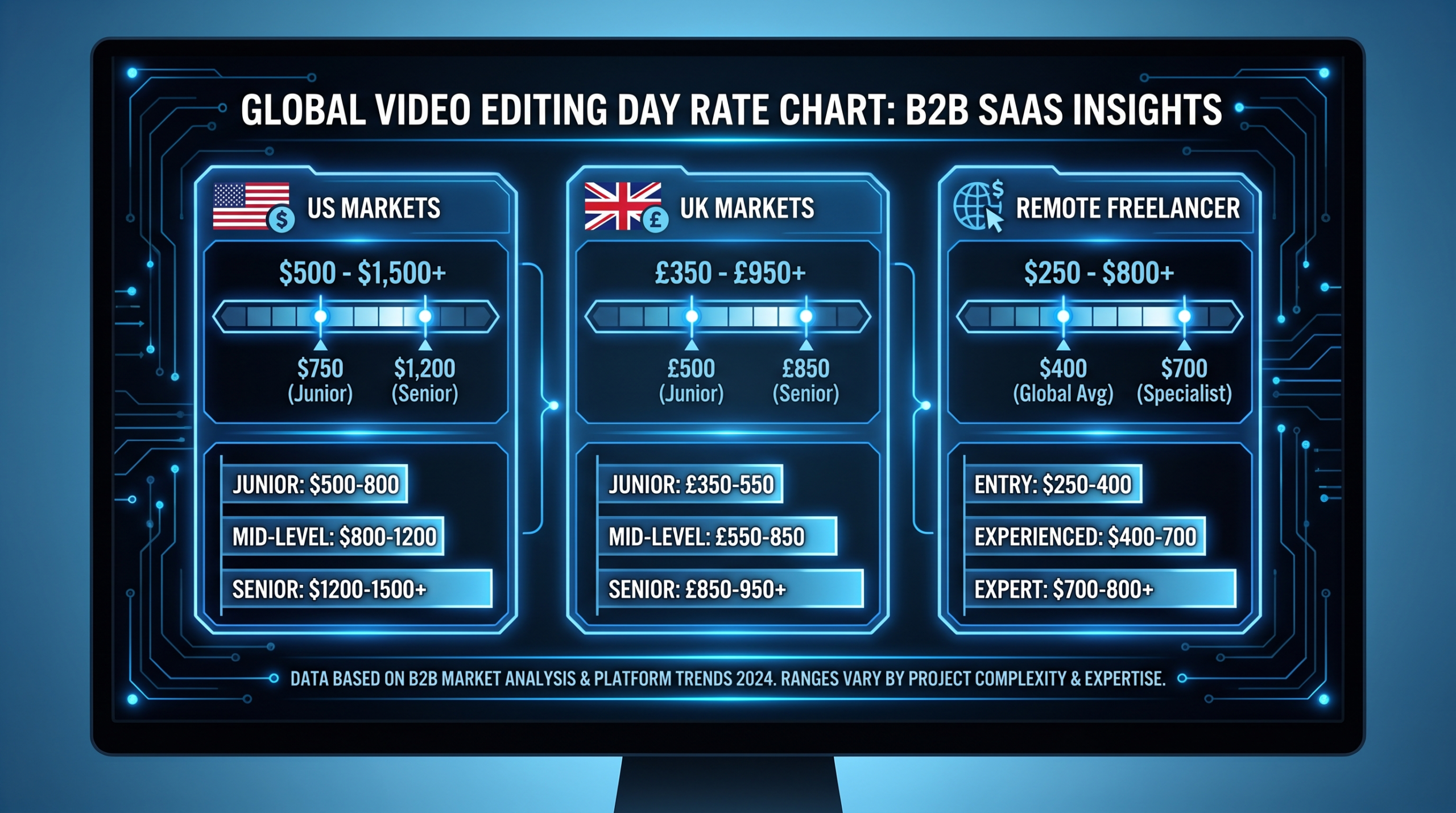
| Hiring Model | US Day Rate | UK Day Rate (USD) | Eastern Europe | Southeast Asia |
|---|---|---|---|---|
| Junior Freelancer | $150–$300/day | $125–$220/day | $30–$60/day | $20–$45/day |
| Mid-Level Freelancer | $300–$600/day | $250–$500/day | $60–$130/day | $40–$90/day |
| Senior Freelancer / Specialist | $600–$1,500/day | $500–$1,000/day | $100–$220/day | $70–$150/day |
| In-House Editor (fully loaded) | $160–$380/day | $130–$290/day | $45–$90/day | $25–$65/day |
| Agency Team (managed) | $500–$1,500/day | $400–$1,200/day | $150–$400/day | $80–$200/day |
See VEC’s pricing plans — flat-rate monthly retainers that convert to $167–$533/day for a dedicated senior editing team, well below US agency day rates.
Day Rate by Deliverable Type (US Mid-Level Freelancer)
| Deliverable | Duration | Typical Days | Estimated Cost |
|---|---|---|---|
| Social media clip (cut-down) | 15–60 sec | 0.25–0.5 days | $75–$300 |
| YouTube video edit only | 8–15 min | 0.5–1.5 days | $150–$900 |
| Product demo video | 2–5 min | 1–3 days | $300–$1,800 |
| Brand or explainer video | 60–90 sec | 2–4 days | $600–$2,400 |
| Corporate training module | 10–20 min | 2–5 days | $600–$3,000 |
| Commercial or paid ad | 15–30 sec | 1–3 days | $300–$1,800 |
These ranges reflect editing only — no scripting, filming, or motion graphics unless noted. For a full breakdown of what’s typically included at each tier, see what’s included in video editing services.
What Are US Video Editing Day Rates in 2026?
The United States has the widest range of video editing day rates of any market, driven by city-level cost of living, platform (Upwork vs direct hire vs production studio), and specialisation. According to the Bureau of Labor Statistics, the median annual wage for film and video editors in the US was $67,070 in 2023 — equivalent to roughly $290/day before overheads. Market day rates for freelancers exceed this significantly once you account for self-employment taxes, equipment, and benefits not included in the BLS figure.
Freelance Day Rates in the US
A competent US-based freelance video editor charges $250–$600/day for standard editing work: cuts, basic motion graphics, colour, sound mix. In major markets like New York, Los Angeles, or San Francisco, senior freelancers regularly command $800–$1,500/day, particularly for broadcast or commercial work. Entry-level editors typically quote $150–$250/day, but output consistency at this price point is highly variable.
Motion graphics specialists bill a 30–50% premium over standard editors. A mid-level After Effects artist in New York might quote $500–$900/day for complex animated work. Chicago and Austin mid-market freelancers typically run $300–$500/day — 20–30% below coastal markets. For a broader view of how US hourly rates compare internationally, see the video editing hourly rate by country guide.
In-House Editor Day Rates in the US
To calculate the true cost of an in-house editor, divide the fully-loaded annual cost (salary + benefits + payroll taxes + software licences + equipment amortisation) by approximately 230 working days. A mid-level US editor earning $65,000 salary with $22,000 in fully-loaded overhead costs roughly $378/day all-in. Senior editors at $90,000–$110,000 salary land around $490–$575/day fully loaded.
In-house makes sense at consistent output of 4+ videos/week with heavy brand-specific requirements. Below that threshold, the fixed overhead becomes expensive per deliverable, and you’re paying for idle capacity. Our guide to outsourcing video editing covers the in-house vs outsourced cost-benefit analysis in detail.
Agency Day Rates in the US
US video production agencies bill $500–$1,500/day for editorial services — but “agency day rate” means something fundamentally different from a freelancer’s day rate. You’re paying for the full team overhead: project manager, creative director review, QC pass, and revision management, not just one editor’s hours. Brand consistency and output reliability are correspondingly higher.
VEC’s subscription model reframes this equation: dedicated senior editor teams on a flat monthly retainer — Growth $5,000/mo, Core $9,500/mo, Scale $16,000/mo. At $5,000/month spread across 20–25 working days, that is $200–$250/day for a dedicated team, far below standard US agency day rates. See how it works or browse client case studies to understand the output guarantee.
What Do UK Video Editors Charge Per Day?
The UK video editing market is well-established, with rate guidance from bodies including BECTU (Broadcasting Entertainment Communications and Theatre Union) and PACT. London rates track New York closely, while regional UK markets (Manchester, Bristol, Edinburgh) run 20–30% lower. For a full side-by-side comparison, see video editing cost: UK vs US.
Freelance Day Rates in the UK
A mid-level UK freelance editor typically charges £200–£450/day ($250–$563 USD). Senior editors and broadcast-experienced freelancers in London regularly bill £500–£800/day ($625–$1,000 USD). Junior UK editors entering the market start around £100–£175/day ($125–$219 USD). According to Prospects.ac.uk, entry salaries in the UK sit around £18,000–25,000, equating to approximately £78–£109/day before self-employment uplift.
One important UK-specific dynamic: PAYE (pay-as-you-earn) employment is more common in UK broadcast than in the US. Self-employed freelancers typically apply a 30–40% uplift over their employed day rate to cover taxes, NI contributions, and lack of benefits — so headline freelance rates are not directly comparable to salary-equivalent costs.
Agency Day Rates in the UK
UK video production agencies bill £300–£900/day ($375–$1,125 USD) for editorial services. London-based boutique agencies at the premium end charge £700–£1,100/day ($875–$1,375 USD) for combined edit, colour, and graphics packages. For a directory of UK-specific options with rate context, see video editing agencies in the UK.
UK SaaS companies buying from a US-based dedicated team like VEC often see 20–40% savings over comparable UK agency day rates, without sacrificing B2B video specialisation. Exchange rate exposure is the main caveat — worth addressing with a fixed-term contract priced in your preferred currency.
What Do Remote Video Editors Charge Per Day?
Remote video editors — typically hired through Upwork, Fiverr Pro, or specialist platforms — represent the most price-competitive segment of the market. They also carry the most variance in quality, reliability, and hidden management cost.
Eastern Europe (Poland, Romania, Ukraine)
Poland, Romania, and Hungary have strong post-production industries feeding into Western European broadcast. Mid-level Eastern European editors charge $60–$150/day. Senior motion graphics artists and DaVinci Resolve colorists in this region can reach $150–$250/day — still 50–70% below US equivalents with comparable skill levels. English proficiency and timezone overlap with Western Europe makes this region particularly practical for EU-headquartered companies.
Southeast Asia (Philippines, Vietnam, Indonesia)
The Philippines and Vietnam have large English-speaking editor pools with strong YouTube-native experience. Rates run $20–$90/day for general editing; specialist work (motion graphics, After Effects, colour) runs $60–$150/day. The Philippines specifically has a mature BPO ecosystem, meaning structured hiring and payroll processes exist for longer-term remote arrangements. Timezone difference with US East Coast (12–13 hours) makes overnight turnaround realistic for simple edits.
Latin America (Colombia, Mexico, Brazil)
Colombia, Brazil, and Mexico have growing post-production communities with strong US-client experience. Day rates typically run $50–$130/day for competent mid-level editors. US-timezone compatibility — same or within 3 hours of US East Coast — is the major advantage: real-time feedback loops that Asian or Eastern European remotes cannot match. For vetting, onboarding, and managing remote video editors effectively, see how to outsource video editing.
The Hidden Costs of Remote Day Rates
A $50/day Southeast Asian editor sounds compelling until you account for: project management overhead (1–2 hours/day of your time or a PM’s time), revision cycles (typically 2–4x more on unmanaged offshore work vs a managed team), brand consistency risk across editors, and file security considerations. A $50/day remote editor with 3 revision rounds and 1 hour/day of your VP Marketing’s time at $100/hour quickly reaches an effective all-in rate of $150–$200/day — still cheaper than US rates, but not the 80% discount the headline suggests.
Day Rate vs Hourly Rate: Which Makes Sense?
The day rate vs hourly rate decision comes down to project clarity and duration. For well-scoped multi-day projects, day rates provide budget certainty and reduce time-tracking friction. For exploratory or very short projects (under 4 hours), hourly rates protect you from overpaying if scope shrinks — but expose you to overruns if it expands.
Most experienced freelancers prefer day rates because they eliminate the administrative overhead of time logs and reduce creative sandbagging — an editor billed hourly has less incentive to work efficiently than one on a day rate with a clear scope. Most clients prefer hourly for single-clip edits and day rates for anything spanning more than half a day. For detailed regional hourly benchmarks, see video editing hourly rates by country.
For most SaaS content teams producing 10+ videos/month, neither day rates nor hourly rates are the right structural model. A dedicated subscription team — with predictable monthly cost, brand continuity, and no recruitment overhead — almost always delivers lower cost-per-video at scale. See video production agency pricing models for a full comparison of all five approaches and when each makes financial sense.
What Drives Video Editing Day Rates?
Five factors account for most of the variance in day rates across the market:
- Experience level: Each career tier roughly doubles the day rate — junior ($150–$250/day US), mid ($300–$600/day), senior ($600–$1,500/day). The difference is not just speed; it is judgement — knowing when a cut works without being told, catching pacing problems before the client notices.
- Technical specialisation: Colour grading, motion graphics, audio mastering, and visual effects all carry premiums. A generalist editor charges $400/day; a DaVinci Resolve colorist on the same project might bill an additional $300–$500/day. The more specialised the tool, the tighter the supply, the higher the rate.
- Geographic location: The cost-of-living delta between Manhattan ($1,200/day senior) and Cebu City ($70/day senior) reflects local wage expectations and purchasing power, not necessarily skill. For further detail, the UK vs US cost comparison breaks down this dynamic in the two largest English-language markets.
- Turnaround requirements: Rush rates — 24–48 hour turnaround — typically add 25–50% on top of standard day rates. Overnight deadlines can double the effective rate. For turnaround benchmarks and SLA expectations, see video editing SLA and turnaround times.
- Deliverable complexity: A basic interview cut is fundamentally different from a product demo with custom motion graphics, multi-track SFX, and colour grading. Complexity multiplies days required, which multiplies total cost. For a per-minute cost breakdown, see video editing cost per minute.
3 Real Budget Examples
These examples use publicly observable market rate data — hedged ranges, no invented figures — to show how day rates play out for common B2B SaaS video scenarios.
Example 1: Early-Stage SaaS (Series A, Lean Budget)
A 20-person SaaS company needs four product demo videos per month. They hire a Philippines-based remote editor at $60/day, managing them internally. At 2 days per video, that is 8 days × $60 = $480/month in editor fees. Add 1 hour/day of internal PM time (8 hours × $60/hr internal cost = $480) plus revision overhead, and true all-in cost is approximately $1,100–$1,400/month. This model works at lean budgets but creates PM drag and caps brand consistency. See how to outsource video editing for a structured process that reduces the management burden without raising the headline rate.
Example 2: Growth-Stage SaaS (Series B, Consistent Output)
A 150-person SaaS company needs 15–20 videos/month across YouTube, product demos, and social. They hire a US mid-level freelancer at $450/day. At 1.5 days/video average, 15 videos = 22.5 days × $450 = $10,125/month in direct fees, before the PM time and revision management overhead. This is the “freelance creep” zone where a dedicated subscription team becomes structurally cheaper. VEC’s Core plan at $9,500/month includes a senior editor pod with guaranteed turnaround and PM included — lower cost at 15+ videos than the equivalent freelance day rate stack. See client case studies for output-vs-cost comparisons from SaaS teams that made this switch.
Example 3: Enterprise SaaS (Series C, Agency-Grade Quality)
A 500-person SaaS company commissions a quarterly brand film and a library of 30 social cut-downs. The production agency charges $1,200/day for a senior editorial team. The brand film takes 10 editing days = $12,000; the social library takes 8 days = $9,600. Total: $21,600 in a single quarter, before any production costs. For recurring content at this volume, an ongoing SaaS video production model significantly reduces cost-per-video without sacrificing quality.
For more on what product-specific video content costs at each tier, see product demo video production and the explainer video cost breakdown.
How Do You Budget for Video Editing in 2026?
The right model depends on your monthly volume. Here is a simple framework:
- 1–3 videos/month: Freelance day rates work well. US $300–$600/day or remote $50–$150/day, low overhead, flexible scope. Just ensure a clear brief to avoid revision spirals.
- 4–10 videos/month: This is the crossover zone. Calculate: freelance day rate × days per video × videos per month + management time. Compare this against a dedicated subscription plan. For many teams in this range, subscription wins on cost and consistency.
- 10+ videos/month: A dedicated team model almost always delivers the lowest cost-per-video AND the highest brand consistency. The management overhead of day-rate freelancers — briefing, QA, revision tracking — eats into the apparent savings at this volume.
Whatever model you choose, understand exactly what is included in the rate before signing: revisions, motion graphics, captions, SFX, colour, and turnaround SLA. See what is included in video editing services to benchmark scope expectations. For turnaround standards, see video editing SLA and turnaround expectations.
If you are evaluating UK vs US day rates specifically for your team, the dedicated UK vs US video editing cost comparison covers currency, quality, and timezone trade-offs in detail.
If you want to understand what a dedicated team could mean for your specific content volume, book a free strategy call with VEC — scoped to your deliverable count, not a generic package.
Ready to stop budgeting by the day? See VEC’s pricing plans — flat monthly retainers with a 90-day output guarantee.
FAQ: Video Editing Day Rates
What is the average video editing day rate in the US?
The average US video editing day rate is $300–$600/day for mid-level freelancers in 2026. Senior editors and motion graphics specialists charge $600–$1,500/day. In-house editors cost $160–$380/day fully-loaded (salary plus benefits divided by working days). Agencies bill $500–$1,500/day for a managed editorial team including PM and QC.
How much does a video editor charge per day in the UK?
UK video editors typically charge £200–£450/day ($250–$563 USD) at mid-level. Senior London-based editors bill £500–£800/day ($625–$1,000 USD). Regional UK rates run 20–30% below London. For a full side-by-side, see the UK vs US video editing cost guide.
Is it cheaper to hire a remote video editor by day rate?
Remote editors in Eastern Europe headline at $60–$150/day; Southeast Asia $20–$90/day. These rates are genuinely lower, but effective all-in cost rises to $120–$200/day once you factor in management time, revision cycles (typically 2–4x higher unmanaged), and brand consistency overhead. Still cheaper than US rates for simple, well-briefed work — but less dramatic than the headline suggests.
What is the difference between a day rate and an hourly rate for video editing?
A day rate is a fixed fee for a full day (7–8 hours), regardless of how many minutes were logged. An hourly rate tracks time precisely. Day rates are preferred for multi-day projects because they reduce admin overhead and incentivise efficiency. Hourly rates suit short jobs under 4 hours where the project might not fill a full day. Most mid-level and senior editors prefer day rates.
When does a subscription model beat video editing day rates?
At 8+ videos/month, a dedicated subscription team typically undercuts stacking day-rate invoices once you include management time. A US freelancer at $400/day for 20 days = $8,000/month without PM, QC, or revision management included. VEC’s Growth plan at $5,000/month includes all of that, plus a dedicated senior editor and a “double your video output in 90 days or month 4 is free” guarantee.
Stop Stacking Day-Rate Invoices
Switch to a dedicated video editing team with flat-rate monthly pricing. Predictable budget, consistent output, zero freelancer roulette.
Book a Free Strategy Call See Pricing