Animation Styles for Business Video (+ Cost)
TL;DR
- 7 main animation styles are used in B2B business video: 2D flat, motion graphics, character animation, whiteboard, isometric, cutout, and mixed media
- Costs range from $800/min (whiteboard, freelancer) to $25,000+/min (character animation, premium agency)
- Motion graphics and 2D flat are the default choices for SaaS — fast to produce, brand-friendly, and cost-effective at scale
- Style choice affects timeline more than most teams expect: whiteboard takes 2–4 weeks per minute; full character animation often runs 8–12 weeks
- For consistent animated output, a dedicated editing team (not per-project quotes) is the most cost-effective path at 4+ videos per month
Table of Contents
- Key Takeaways
- What Are the Main Animation Styles for Business Video?
- How Much Does Each Animation Style Cost?
- 2D Flat Animation: The B2B Default
- What Is Motion Graphics Animation?
- Does Your Business Need Character Animation?
- Whiteboard Animation: Still Worth It in 2026?
- Isometric and Cutout Animation: Niche but Useful
- Mixed Media: When Live Action Meets Animation
- Which Animation Style Is Right for Your Business?
- 3 Real Business Animation Examples
- FAQ
You've landed on animation for your next business video. The format is decided. Now comes the harder question: which animation style — and what will it actually cost your team to produce?
This guide covers the 7 animation styles most commonly used in B2B and SaaS video, with real cost ranges by hiring model, honest trade-offs, and a practical decision framework. No agency upsell — just the information your VP of Marketing needs to make the call.
Key Takeaways
- 7 animation styles dominate B2B: 2D flat, motion graphics, character animation, whiteboard, isometric, cutout, and mixed media
- Motion graphics and 2D flat handle roughly 70% of SaaS and B2B animated content — they're fast, brand-consistent, and scale well
- Cost range is wide: $800–$2,500/min (whiteboard, freelancer) vs. $8,000–$25,000+/min (character animation, agency)
- Timeline matters: motion graphics run 2–3 weeks per minute of finished video; character animation often takes 8–12 weeks
- Style drives cost more than length: a 2-minute character animation can easily cost 5× a 2-minute whiteboard piece at the same agency
What Are the Main Animation Styles for Business Video?
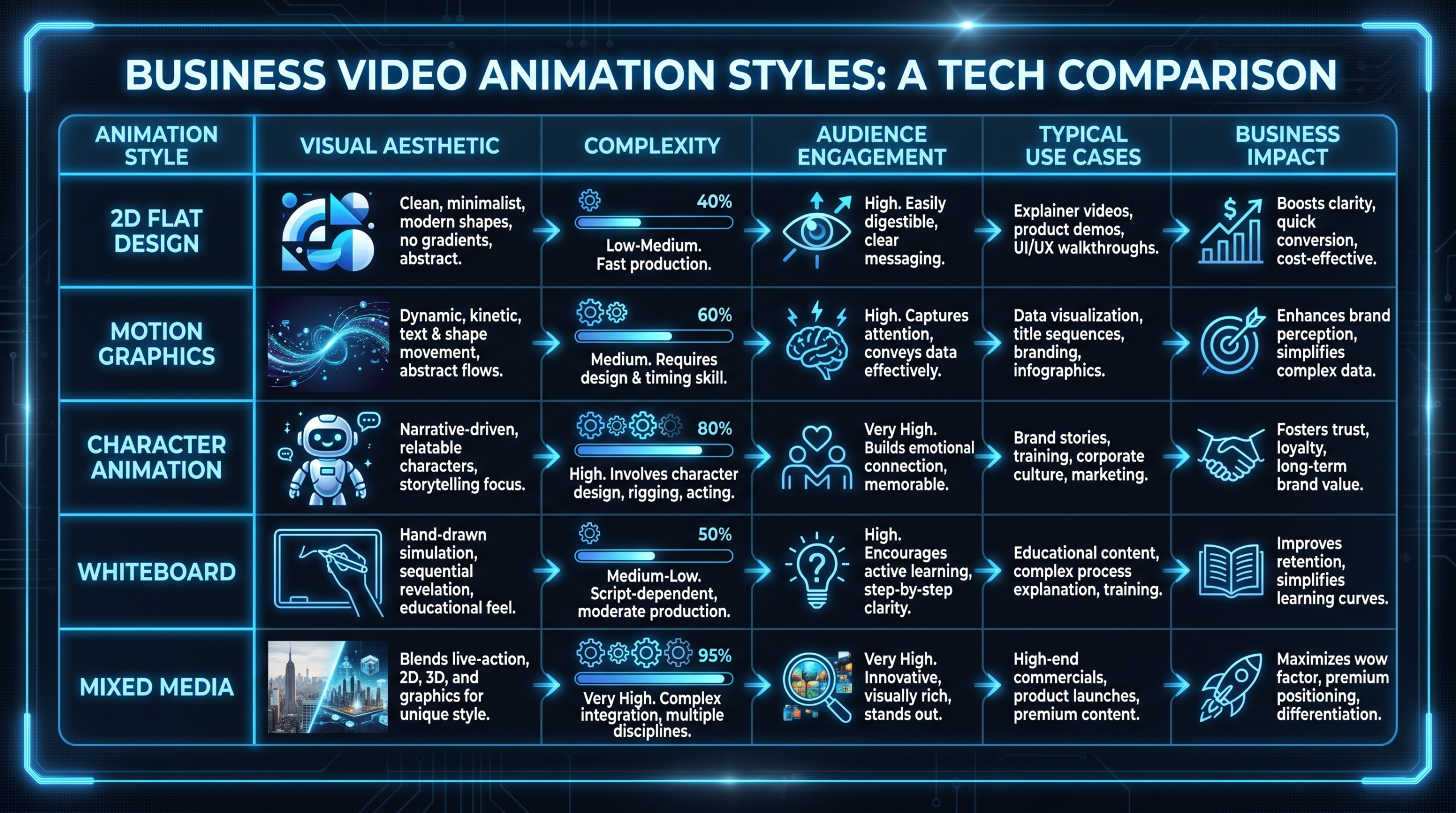
Animation for business video breaks into 7 recognizable styles. Each has a distinct visual language, production pipeline, and cost profile. The right choice isn't purely aesthetic — it depends on what your message requires, how quickly you need to produce, and how the content will be reused.
7 Business Animation Styles at a Glance
| Style | Visual Approach | Best Fit |
|---|---|---|
| 2D Flat / Vector | Clean geometric shapes, brand colors, minimal shading | SaaS explainers, product overviews, ads |
| Motion Graphics | Moving text, data visualization, abstract animated shapes | Product launches, data stories, social ads |
| Character Animation | Custom 2D characters with expressive movement and lip sync | Brand storytelling, onboarding, culture videos |
| Whiteboard | Simulated hand-drawing on a white canvas, black marker style | Training, complex explanations, education |
| Isometric 2D | Geometric 3D-look rendered in 2D perspective | Tech, fintech, architecture, complex systems |
| Cutout / Paper | Layered flat shapes with jointed movement, paper-like aesthetic | Quirky or creative-brand content, social media |
| Mixed Media | Live-action footage combined with animated overlays or sequences | Case studies, product demos with real users, brand films |
For a deeper look at how these styles compare on cost specifically, see our animation cost per minute guide — it covers per-deliverable pricing across all major styles. For corporate use cases, our corporate animation guide also breaks down which styles work best by industry and video type.
How Much Does Each Animation Style Cost?
Animation costs in 2026 vary more by style than by length. A 90-second character animation can cost more than a 3-minute motion graphics piece. Here are the market ranges, broken out by style and hiring model:
Animation Cost by Style and Hiring Model (Per Finished Minute)
| Animation Style | Freelancer | Agency | In-House Team |
|---|---|---|---|
| 2D Flat / Vector Explainer | $1,500–$5,000 | $3,500–$12,000 | $800–$2,200 |
| Motion Graphics | $1,200–$4,000 | $2,500–$8,000 | $700–$1,800 |
| Character Animation (2D) | $3,500–$10,000 | $8,000–$25,000 | $2,500–$7,000 |
| Whiteboard Animation | $800–$2,500 | $1,500–$5,000 | $400–$1,200 |
| Isometric 2D | $2,000–$6,000 | $4,000–$12,000 | $1,200–$3,500 |
| Cutout / Paper Animation | $1,000–$3,500 | $2,000–$7,000 | $600–$2,000 |
| Mixed Media (Live + Animated) | $2,500–$8,000 | $5,000–$20,000 | $1,500–$4,500 |
Ranges reflect complexity, not guarantee. A simple 30-second motion graphics social ad can come in under $1,000 from a freelancer; a full-character hero video with lip sync can exceed $50,000 at a premium studio. Always request itemized quotes.
To understand what drives costs within each style — rigging complexity, voiceover, sound design, revision rounds — see our explainer video cost breakdown and our full animation cost per minute guide.
If you're comparing freelancer hiring vs. agency vs. subscription, our video production agency pricing models guide maps out the full economics. For hiring a dedicated animator specifically, see how much it costs to hire an animator.
See VEC Animation Pricing Plans
2D Flat Animation: The B2B Default
2D flat animation is the most common style in SaaS and B2B business video — and for good reason. It's brand-flexible, relatively fast to produce, and scales well across a content calendar.
What It Looks Like
Vector-based shapes with minimal shading, clean outlines, and motion that emphasizes clarity over spectacle. Think Duolingo's onboarding, or the thousands of SaaS explainer videos that follow the "floating UI element + friendly icon" pattern. The style intentionally keeps visual noise low so the message carries.
Why B2B Teams Choose It
- Brand-compatible: colors, fonts, and UI elements from your design system drop in cleanly
- Reusable assets: a library of animated icons and scene elements built for video 1 gets reused across videos 2 through 20, driving down per-video cost over time
- Reasonable production timelines: a well-briefed 90-second 2D flat explainer can be turned around in 3–5 weeks at an agency
- Localization-friendly: text elements are swappable for multilingual versions without rebuilding the animation
Honest Trade-offs
2D flat can read as generic if the creative brief is weak. When every SaaS company uses the same floating-UI-meets-soft-icon aesthetic, differentiation comes from concept and copywriting — not the style itself. If your brand needs to feel premium or distinctive, consider layering in motion graphics or isometric elements.
Cost anchor: agency 2D flat typically runs $3,500–$12,000/finished minute, with the lower end applying to simple icon-driven pieces and the upper end covering complex product UI animation with voiceover and sound design. Compare this with the 2D side of our 2D vs 3D animation cost guide if you're considering whether 3D is justified for your use case.
What Is Motion Graphics Animation?
Motion graphics is animation built from shapes, text, data, and abstract visual elements rather than characters or narrative scenes. It's the style behind most data-driven marketing videos, product announcement films, and social ad creative you see from SaaS companies.
Why Motion Graphics Dominates SaaS Video
The answer is pure utility. Motion graphics can make abstract data tangible — a conversion rate improving, a workflow being automated, a security layer activating. For B2B SaaS where the "product" is often invisible software behavior, animation is sometimes the only honest way to show it. According to Wyzowl's annual video marketing research (wyzowl.com/video-marketing-statistics), animated video remains one of the most shared content formats in B2B marketing — and motion graphics is the dominant style within that category.
Motion Graphics vs. 2D Flat
The line blurs in practice. Motion graphics tends to be more abstract, data-focused, and typographic; 2D flat tends to involve illustrated scenes and characters. Many business videos blend both — kinetic text + illustrated product UI. For production cost purposes, treat them as similar: $2,500–$8,000/min at agency rates.
Motion graphics pairs well with SaaS video production pipelines where content volume is high and the production team needs to move fast. The asset-based workflow (modular animated elements) means a skilled team can produce multiple videos per month at a fraction of the per-project cost.
VEC's Growth plan ($5K/mo) is built for teams that need consistent motion graphics output — 6–12 pieces per month, with a senior editor and motion designer dedicated to your account.
Does Your Business Need Character Animation?
Character animation — custom 2D characters with rigged movement, facial expressions, and often lip-synced voiceover — is the most expensive and time-intensive animation style available to B2B brands. It's also the most emotionally engaging when done well.
When It's Worth the Investment
Character animation earns its price tag in a narrow set of situations:
- Brand mascot or spokesperson: if you're building a recurring animated character that appears across all marketing touchpoints, the character rig is built once and amortized
- Onboarding and training content: characters guide users through processes better than floating UI elements when the content is long or emotionally complex
- Brand films and culture videos: when you need to tell a human story without using real footage (privacy, cost, or creative control reasons)
When It's Overkill
For most SaaS product demos, feature explanations, and social media content, character animation is overcomplicated and overpriced. A 90-second character animation can run $12,000–$40,000+ at a studio, with a 10–12 week production timeline. That same budget could produce 6–8 high-quality motion graphics pieces that collectively drive more pipeline.
If your team is evaluating character animation, our corporate animation guide has a use-case matrix that maps style to business objective. For a direct cost comparison, see our 2D vs 3D animation cost breakdown — the production considerations between styles share similar decision logic.
Whiteboard Animation: Still Worth It in 2026?
Whiteboard animation simulates a hand drawing on a white canvas in real time, with the finished drawing revealed as the narration progresses. It was the dominant B2B animation style in the early 2010s and still has genuine applications today — though the aesthetic now reads as dated in many contexts.
Where Whiteboard Still Works
- Internal training content: where production value matters less than clarity and cost
- Complex conceptual explanations: the sequential reveal matches how humans process new frameworks
- High-volume educational content: whiteboard is the most affordable style to produce at scale — $800–$2,500/min from a freelancer, compared to $3,500+ for 2D flat
Where Whiteboard Underperforms
External-facing marketing content. The style signals "low budget" to most B2B buyers in 2026 — a perception that's difficult to shake regardless of how well-scripted the video is. If your video is going on your homepage, into a sales sequence, or running as a paid ad, the aesthetic creates a trust gap that better-produced styles avoid.
The cost advantage of whiteboard is real and shouldn't be dismissed for internal content. But for your product demo video production or customer-facing content, 2D flat or motion graphics will serve you better at a modest cost increase.
Isometric and Cutout Animation: Niche but Useful
These two styles occupy opposite ends of the taste spectrum but share a common trait: they're niche choices that signal intentionality when used correctly, and signal confusion when used arbitrarily.
Isometric 2D Animation
Isometric animation renders flat 2D shapes in a geometric perspective that creates the illusion of depth without true 3D modeling. It's popular in tech, fintech, and cybersecurity companies that want to visualize complex architecture — servers, networks, data flows — in a visual language that's accurate without being cartoonish. Agency cost typically runs $4,000–$12,000/min, above standard 2D flat due to the additional geometric precision required.
Cutout / Paper Animation
Cutout animation uses layered flat shapes with jointed movement — think paper dolls or the South Park aesthetic. For B2B, this style is mostly limited to brands that deliberately cultivate a playful, unconventional identity. It's affordable ($1,000–$3,500/min freelancer), but the brand fit has to be intentional or it reads as cheap rather than charming.
Mixed Media: When Live Action Meets Animation
Mixed media animation combines live-action footage with animated elements — text overlays, animated data visualizations, illustrated callouts, or fully animated sequences cut into real footage. It's increasingly common in B2B video because it solves a core tension: buyers want to see real humans and real products, but they also need abstract concepts explained visually.
Common B2B Applications
- Case study videos: real customer interview footage, with animated stats and results overlaid
- Product demos: actual product UI with animated annotations guiding the viewer's eye
- Thought leadership content: talking-head interviews with motion graphics b-roll
Cost Considerations
Mixed media is more expensive than pure animation because it adds a live-action production layer on top of the animation work. Budget $5,000–$20,000/min at agency rates depending on the shoot requirements. The ROI case is strongest when you already have high-quality footage (interview recordings, event content, product screen captures) that only needs the animated layer — in that scenario, the live-action cost is already sunk.
For teams producing content at scale, our video editing services guide covers the full post-production workflow — including how animation layers fit into an editing pipeline rather than a standalone production.
Which Animation Style Is Right for Your Business?
The right style follows from three factors: message complexity, budget and timeline, and reuse potential. Here's the decision matrix:
Animation Style Decision Framework
| If You Need… | Best Style | Why |
|---|---|---|
| Product explainer, SaaS demo, feature overview | 2D Flat or Motion Graphics | Brand-flexible, fast, scales with content calendar |
| Data story, metrics-driven marketing, social ad | Motion Graphics | Built for abstract data visualization and kinetic text |
| Brand mascot, onboarding guide, culture video | Character Animation | Emotional resonance and character continuity across videos |
| Internal training, complex process explanation | Whiteboard | Sequential reveal aids comprehension; lowest cost at scale |
| Tech architecture, network diagrams, fintech visuals | Isometric 2D | Geometric depth without 3D production overhead |
| Case study, real-customer testimonial, product demo with UI | Mixed Media | Real footage + animation layers = credibility + clarity |
| High-volume social content, quirky brand | Cutout or Motion Graphics | Fast to iterate; modular asset libraries reduce repeat costs |
Volume Changes the Equation
The decision looks different at 2 videos/quarter vs. 20 videos/month. At high volume, style complexity becomes a production bottleneck — character animation that takes 10 weeks per minute can't support a weekly content calendar. At scale, motion graphics and 2D flat win on throughput. VEC's dedicated team model is designed around this: a senior editor plus motion designer, working on your account full-time, building reusable asset libraries that reduce per-video cost as the library grows.
For a broader view of how animation fits into your overall video strategy, see our SaaS video production guide. If you're still deciding between outsourcing and building in-house, our how to outsource video editing guide covers the decision framework in detail.
3 Real Business Animation Examples
Seeing how established companies have used animation styles in practice is more useful than any framework. Here are three well-documented examples across different styles:
1. Dropbox — 2D Flat Explainer (2009, Still Referenced)
Dropbox's original animated explainer used a simple 2D character-driven approach to explain a then-unfamiliar cloud storage concept. The video is credited in multiple published reports with driving hundreds of thousands of sign-ups. The lesson: a clear concept + clean 2D animation beats a high-budget production with a muddy message, every time.
2. Slack — Motion Graphics for Product UI
Slack's product marketing videos consistently use motion graphics to animate UI flows, showing how messages, channels, and integrations work together. The style keeps the product as the hero — no characters, no metaphors, just the interface coming alive. This is the template most SaaS companies follow for feature videos and it remains the most defensible choice for B2B.
3. HubSpot — Mixed Media in Thought Leadership
HubSpot's video content team regularly combines talking-head interview footage with animated data callouts — pie charts building on screen, stat cards flying in as the speaker references them. This mixed media approach makes data-heavy content watchable without requiring a fully animated production. As HubSpot's marketing blog documents (hubspot.com/marketing), video continues to drive outsized engagement for B2B content marketers — the mixed media style is a primary reason their video ROI is measurable.
For more examples of corporate animation in action, our corporate animation guide has a style-by-style breakdown with industry examples. See also animation cost per minute to match each style to a realistic budget.
Frequently Asked Questions
What is the most popular animation style for B2B business video?
Motion graphics and 2D flat animation are the dominant styles in B2B and SaaS video. They're fast to produce, easy to align with brand guidelines, and cost-effective at scale compared to character animation or mixed media. Most SaaS product videos, feature explainers, and social ads use one or both styles.
How much does a 1-minute animated business video cost?
It depends heavily on style and who produces it. A 1-minute whiteboard animation from a freelancer typically costs $800–$2,500. Motion graphics at an agency runs $2,500–$8,000/min. Character animation at a studio can reach $8,000–$25,000+ per minute. For a full breakdown by style and hiring model, see our animation cost per minute guide.
What is the difference between motion graphics and 2D animation?
Motion graphics is built from abstract shapes, text, and data visualization — it doesn't require characters or illustrated scenes. 2D flat animation uses illustrated environments, characters, or product UIs rendered in a flat vector style. In practice, many business videos blend both: kinetic text and abstract shapes (motion graphics) combined with illustrated product screens (2D flat). For cost purposes, they're priced similarly.
Can I mix animation styles in one video?
Yes, and many B2B videos do. Motion graphics and 2D flat blend seamlessly. Live-action footage with animated overlays (mixed media) is common in case study and testimonial videos. The main consideration is visual consistency: if styles shift without a design rationale, the video feels unpolished. Brief your production team on the intended visual logic before production starts.
Does VEC produce animated business videos?
Yes. VEC's dedicated teams produce 2D flat animation, motion graphics, character animation, and mixed media for B2B SaaS clients. Plans start at $5K/month (Growth plan) for teams producing 6–12 animated pieces per month, up to $16K/month (Scale plan) for full-service dedicated teams with animators, a senior editor, and a project manager. See our pricing page or our case studies for examples of delivered work.
Once you have a style in mind, check how it prices against a shoot in our animation vs live action cost comparison, which breaks costs down by video type and shows where each format is cheaper.
Ready to Scale Your Animated Video Output?
VEC provides dedicated animation and editing teams for B2B SaaS brands — motion graphics, 2D flat, and character animation on a flat monthly retainer. Double your video output in 90 days, or month 4 is free.
See Pricing Plans Book a Free Strategy Call