Startup Video Production Cost: 2026 Guide
TL;DR
- Startup video production typically ranges from $500 for DIY social clips to $30,000+ for a polished brand video — the spread is wide because "video production" covers dozens of formats and workflows.
- For Series A–B SaaS startups running consistent content, a dedicated video editing team runs $5K–$16K/month and usually outperforms piecemeal project hiring.
- The biggest hidden cost is internal time: briefing freelancers, managing revisions, and re-editing bad work regularly costs more than the invoice itself.
- Use the sections below as a decision matrix, not a fixed price list — actual quotes depend on scope, quality bar, and revision expectations.
Table of Contents
Quick Answer: What Does Startup Video Production Cost?
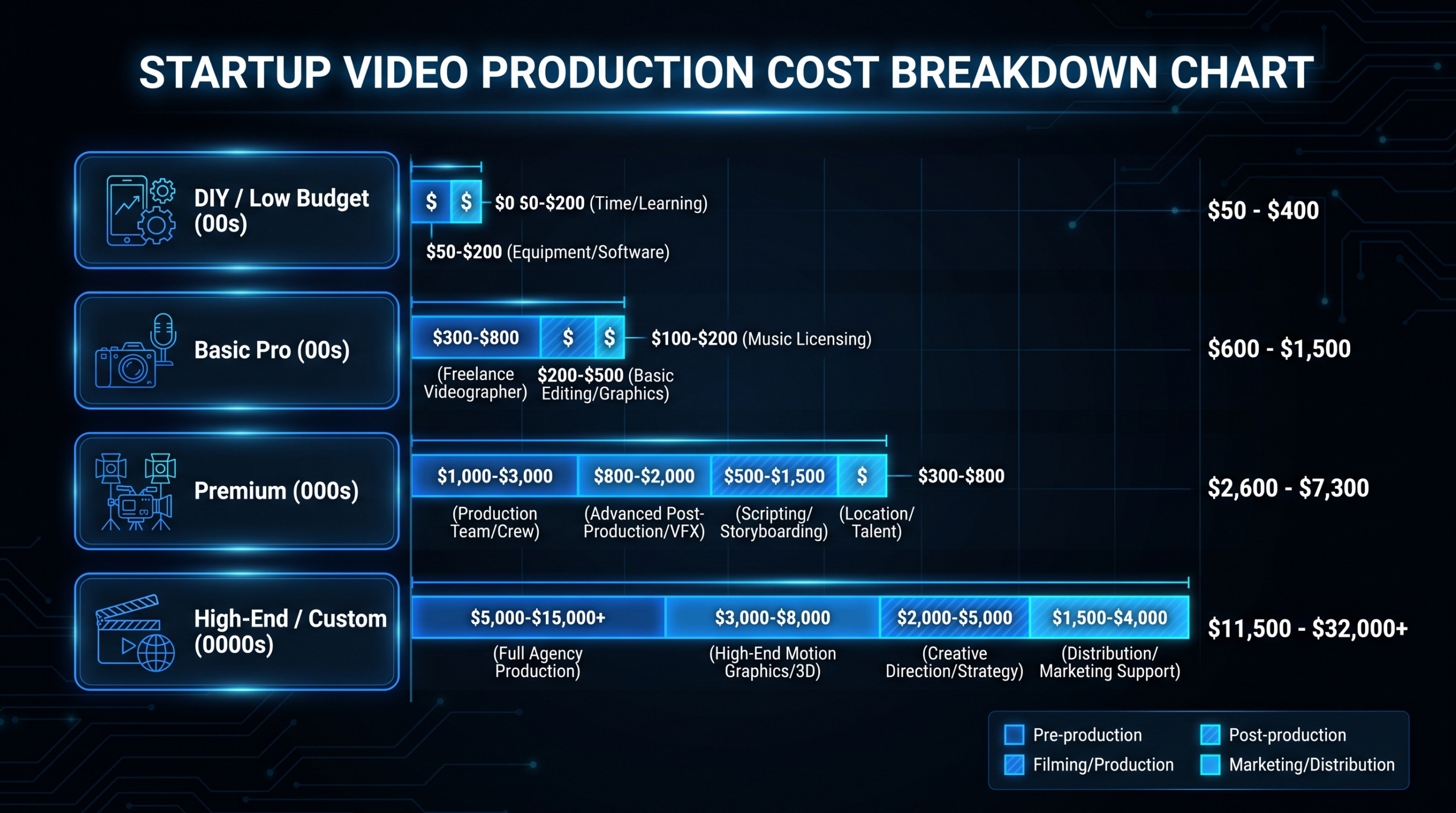
Startup video production cost in 2026 typically falls between $500 and $50,000 per project, depending on format, production quality, and who does the work. For SaaS startups running ongoing content programs, monthly spend commonly ranges from $2,000 to $16,000/month depending on volume and the model used.
Here is the honest picture at a glance:
| Production Model | Typical Cost | Best For |
|---|---|---|
| DIY / In-house (raw footage only) | $0–$500/video | Early-stage, Seed, pre-PMF |
| Freelance editor (per project) | $300–$3,000/video | Occasional content, budget-constrained |
| Video editing subscription | $500–$2,000/mo | Consistent social clips, simple edits |
| Full-service agency (per project) | $5,000–$50,000/project | One-off brand films, product launches |
| Dedicated video team (retainer) | $5,000–$16,000/mo | Series A–C with ongoing content needs |
These are hedged market ranges drawn from publicly listed vendor pricing and common agency rate cards as of mid-2026. Actual quotes will vary. For a deeper cost breakdown by line item, see our full video production cost breakdown.
7 Factors That Drive the Final Number
No two video production quotes look the same. Before you compare vendors, understand what moves the price — because the same "30-second video" can range from $200 to $20,000 depending on these variables.
1. Video Format and Length
A 60-second animated explainer costs more than a 3-minute podcast clip edit. Format dictates the production pipeline: motion graphics, voiceover licensing, original music, color grading — each adds cost. Generally, animation is more expensive than live-action editing for equivalent length; short-form social is cheaper than long-form educational content.
2. Production Quality Tier
Startups often conflate "good enough" with "professional." There are roughly three tiers:
- Functional: Clear visuals, basic editing, no motion graphics. Typical for internal decks or early-stage demos.
- Professional: Branded transitions, color-graded footage, clean audio, consistent style guide. Standard for Series A content.
- Premium: Custom animation, licensed music, cinematic color work, multiple rounds of creative direction. Expected for product launches and major campaigns at Series B+.
3. Scripting and Pre-production
Many agencies charge separately for scripting, storyboarding, or creative direction. If you bring a finished script and organized raw footage, you pay less. If you need the vendor to develop the concept from scratch, expect a 30–60% uplift on the base edit cost.
4. Revisions Policy
Unlimited revisions sound attractive but often mask slow turnaround. Agencies with capped revisions (typically 2–3 rounds) move faster and deliver more predictable costs. Budget for revision overhead when comparing freelancers — open-ended feedback loops are a common cost blowout.
5. Turnaround Speed
Rush fees are standard in video production. A 48-hour turnaround on a 5-minute edit can cost 30–50% more than the standard 5–7-day window at many studios.
6. Who Does the Work
A senior editor based in the US or Western Europe charges more per hour than a skilled editor in Eastern Europe, Latin America, or Southeast Asia. Hourly rates by country vary considerably — this is why dedicated team models have grown: you get consistent output without the geographic arbitrage guesswork.
7. Volume and Consistency
One-off project quotes are almost always more expensive per unit than ongoing retainer work. If your startup publishes 4+ videos per month, a retainer model typically lowers the effective per-video cost by 30–50% compared to repeat project pricing.
Want to model your specific volume? The video production cost calculator lets you plug in format, volume, and quality tier to estimate monthly spend.
Cost by Video Type
Startup video needs cluster into a few repeating formats. Here are realistic cost ranges for each, from cheapest to most complex. All figures are hedged market estimates — actual production quotes will depend on scope, vendor, and revision assumptions.
| Video Type | Freelancer Range | Agency Range | Notes |
|---|---|---|---|
| Social media clips (30–60s) | $150–$600 | $500–$2,000 | Higher volume = lower per-unit cost |
| Product demo video (2–4 min) | $800–$3,500 | $3,000–$12,000 | Screen recording + VO is cheaper than live-action |
| Animated explainer (60–90s) | $1,500–$5,000 | $5,000–$20,000 | 2D motion graphic style vs. whiteboard vs. 3D each have different floors |
| Brand / sizzle film (60–120s) | $2,000–$8,000 | $8,000–$40,000+ | Includes shoot day, director, color grading |
| Podcast / webinar edit (30–60 min) | $200–$700 | $600–$2,500 | Talking-head format; lower complexity |
| Customer testimonial (2–3 min) | $300–$1,200 | $1,500–$5,000 | Remote capture (Riverside/Zoom) vs. on-site shoot differs significantly |
| LinkedIn / YouTube shorts | $100–$400 | $300–$1,000 | Repurposed from longer content = cheapest |
For per-minute pricing benchmarks specifically, see video editing cost per minute: 2026 market rates — it breaks down the range by editor tier and video complexity.
Production Model Comparison: Freelancer vs Agency vs Dedicated Team
The model you choose matters as much as the price. Here is how the three main options compare for a startup producing 6–10 videos per month.
| Factor | Freelancer | Full-Service Agency | Dedicated Team (VEC) |
|---|---|---|---|
| Monthly cost (6–10 videos) | $1,500–$6,000 | $8,000–$30,000+ | $5,000–$16,000 |
| Consistency | Low (one person's availability) | Medium (account team rotates) | High (same editors every sprint) |
| Brand voice retention | Varies widely | Moderate (briefs, not brand immersion) | High (editors learn your style deeply) |
| Turnaround | Unpredictable | Slow (approval layers) | Fast (dedicated bandwidth) |
| Scalability | Hard (find/vet new freelancers) | Moderate | Easy (add capacity to same team) |
| Internal management burden | High | Low–Medium | Low |
Video Editing Company's dedicated team model places a senior editor, junior editor, project manager, and creative director on your account. Plans run from Growth at $5K/month through Core at $9.5K/month to Scale at $16K/month — with a guarantee to double your video output in 90 days or month four is free. See VEC's pricing page for the full plan breakdown.
"The real cost of freelancers isn't the invoice — it's the three hours per video your marketing manager spends on briefs, Slack threads, and revision rounds." — Common observation from SaaS content teams at the 5–10 video/month inflection point.
Budget by Startup Stage
What you should spend on video depends heavily on where you are in the company lifecycle. Spending $15K/month on video production at pre-seed is almost never justified; under-investing at Series B when video is a top-of-funnel driver is equally damaging.
Pre-seed / Seed Stage
At this stage, the goal is learning, not polish. A founder-recorded Loom-style demo outperforms an expensive animated explainer for most discovery conversations. Realistic monthly video budget: $0–$1,500. Hire a freelancer for one product demo edit; use repurposed Zoom calls for social proof. Do not over-invest until you have product-market fit signals.
Series A
You have found a repeatable motion. Now video becomes a content moat: SEO-driven YouTube, product walkthroughs, customer success stories. Monthly spend typically ranges $2,500–$8,000, often starting with a freelancer team or an entry-level retainer. This is also the inflection point where brand consistency starts to matter — inconsistent editing across channels erodes trust.
Series B and Beyond
At Series B, video is infrastructure. Demand gen, sales enablement, partner marketing, customer education — all run on video assets. Monthly production budgets of $8,000–$20,000+ are common for content-heavy SaaS companies. A dedicated team model makes economic sense here: you get agency-quality output at a predictable monthly cost without the per-project overhead.
For a comparative look at how corporate budgets scale from startup to enterprise, see Corporate Video Cost: Startup to Enterprise. If your stack includes AI tooling, AI startup video production cost covers how AI-first workflows are changing the freelancer floor.
Hidden Costs Most Startups Miss
The invoice is rarely the full story. Startups consistently undercount these five cost categories when budgeting for video production.
1. Internal Time
Every hour your head of marketing spends briefing a freelancer, reviewing a rough cut, or chasing a revision response is time not spent on strategy. At a blended internal cost of $80–$150/hr, a 6-hour revision cycle on one video represents $480–$900 in hidden cost — often more than the edit fee itself.
2. Stock Footage and Music Licensing
Professional stock footage licenses range from $50 to several hundred dollars per clip on major platforms. Background music licensed for commercial use via Artlist or Musicbed runs approximately $200–$500/year for a library subscription. Projects needing specific shots or exclusive music will spend more. Many freelancer quotes do not include licensing — verify before signing off on a budget.
3. Voiceover
Professional voiceover for a 90-second script typically costs $150–$600 depending on the talent's experience and usage rights. AI-generated voiceover (ElevenLabs, Murf) costs far less but may require disclosure depending on your audience and platform.
4. Revision Rounds Beyond Scope
A scope that says "2 rounds of revisions" sounds clear but breaks down quickly with stakeholder feedback. Revision overruns are the #1 source of unexpected invoice inflation on project-based agency contracts. Cap them in writing — or choose a model with built-in revision norms.
5. Repurposing and Resizing
Publishing one video across LinkedIn (16:9), Instagram (1:1), TikTok (9:16), and YouTube (16:9 + thumbnail) effectively means producing 4 assets from one piece of content. Budget for resizing and platform-specific caption/hook edits — they are not included in a standard "one video" quote.
How to Get More Value From Your Budget
Spending more does not automatically produce better results. Here are the levers that consistently improve ROI on video production spend.
Systematize Your Brief
Editors and agencies do their best work when they understand your audience, tone, and objective before the first frame. A one-page brief template that covers audience, goal, hook, CTA, and visual reference saves revision cycles and shortens turnaround significantly.
Batch Your Production
Batching is one of the most reliably effective ways to lower per-unit cost. If you record six interview segments in one session, your editor can process them in a single workflow run — cutting setup time, asset-management overhead, and turnaround delays. Startups that batch weekly recordings into bi-weekly edit cycles commonly report lower effective per-video costs than those who send individual requests.
Invest in One Signature Format
Spreading budget across five video formats produces mediocre content at scale. Picking one high-value format (e.g., product walkthroughs for SEO, or customer stories for sales enablement) and going deep on quality beats a fragmented approach. Once that format is systematized, add the second.
Choose the Right Model for Your Volume
Below 4 videos per month, freelancer or project-based pricing often wins. Above 6–8 videos per month, a retainer or dedicated team model starts to pay off in consistency and reduced overhead. Use the video production cost calculator to find the crossover point for your specific volume.
Track Output, Not Just Spend
Define what "done" looks like before you hire anyone: published pieces per month, average turnaround time, revision rounds per video. Teams that track these metrics catch quality drift and vendor performance issues early — before they become expensive re-edits. Research from Wistia's State of Video report consistently shows that companies with systematic content programs outperform ad-hoc producers on engagement and conversion metrics.
For a deeper look at how video production cost breaks down by line item — crew, equipment, post-production, distribution — that post maps every stage of a typical production budget. Also worth reading: HubSpot's video marketing hub for benchmarks on which video formats drive the highest ROI by funnel stage.
Frequently Asked Questions
How much does a startup video production typically cost in 2026?
Startup video production costs range widely: from roughly $300–$1,500 for a simple freelance-edited social clip to $10,000–$40,000+ for a polished brand video that requires shooting, direction, and animation. For SaaS startups with ongoing content programs, monthly budgets between $3,000 and $16,000 are most common at the Series A–B stage, depending on volume and production model.
Is it cheaper to hire a freelancer or an agency for startup video production?
Freelancers are cheaper per project for low-volume needs (1–3 videos/month), but agency or dedicated team models often deliver lower effective per-unit costs and significantly lower internal management burden at higher volumes (6+ videos/month). The real comparison is total cost including your team's time managing the freelancer — not just the invoice.
What is the minimum budget a startup should allocate to video production?
There is no universal minimum — it depends on your stage and goals. Pre-seed and seed-stage startups can produce effective product demos with a $500–$1,500 budget using a skilled freelancer. Series A startups building content programs typically need $3,000–$8,000/month to produce enough volume to move SEO and social metrics meaningfully.
How do dedicated video team retainers compare in cost to per-project agency pricing?
At equivalent output volumes (6–10 videos/month), dedicated team retainers ($5K–$16K/month) typically cost less than repeat per-project agency pricing ($8K–$30K+ for equivalent volume) while offering better brand consistency and faster turnaround. The retainer model exchanges project-by-project flexibility for predictable cost and editor continuity — which most growing SaaS marketing teams find is the better trade-off.
What hidden costs should startups budget for beyond the video edit fee?
Common hidden costs include stock footage licensing ($50–$300/clip), background music licensing ($200–$500/year for a subscription), professional voiceover ($150–$600/script), revision rounds beyond scope, and internal team time spent on briefing and QA. Repurposing a single video into multiple aspect ratios for different platforms also adds cost — budget $100–$400 per asset set for resizing and platform-specific edits.
Ready to Scale Your Video Output?
VEC places a dedicated senior editor, junior editor, PM, and creative director on your account — and guarantees to double your video output in 90 days or month four is free.
Book a Free Strategy Call See Plans & Pricing