AI Startup Video Production Cost: 2026
TL;DR — Key Takeaways
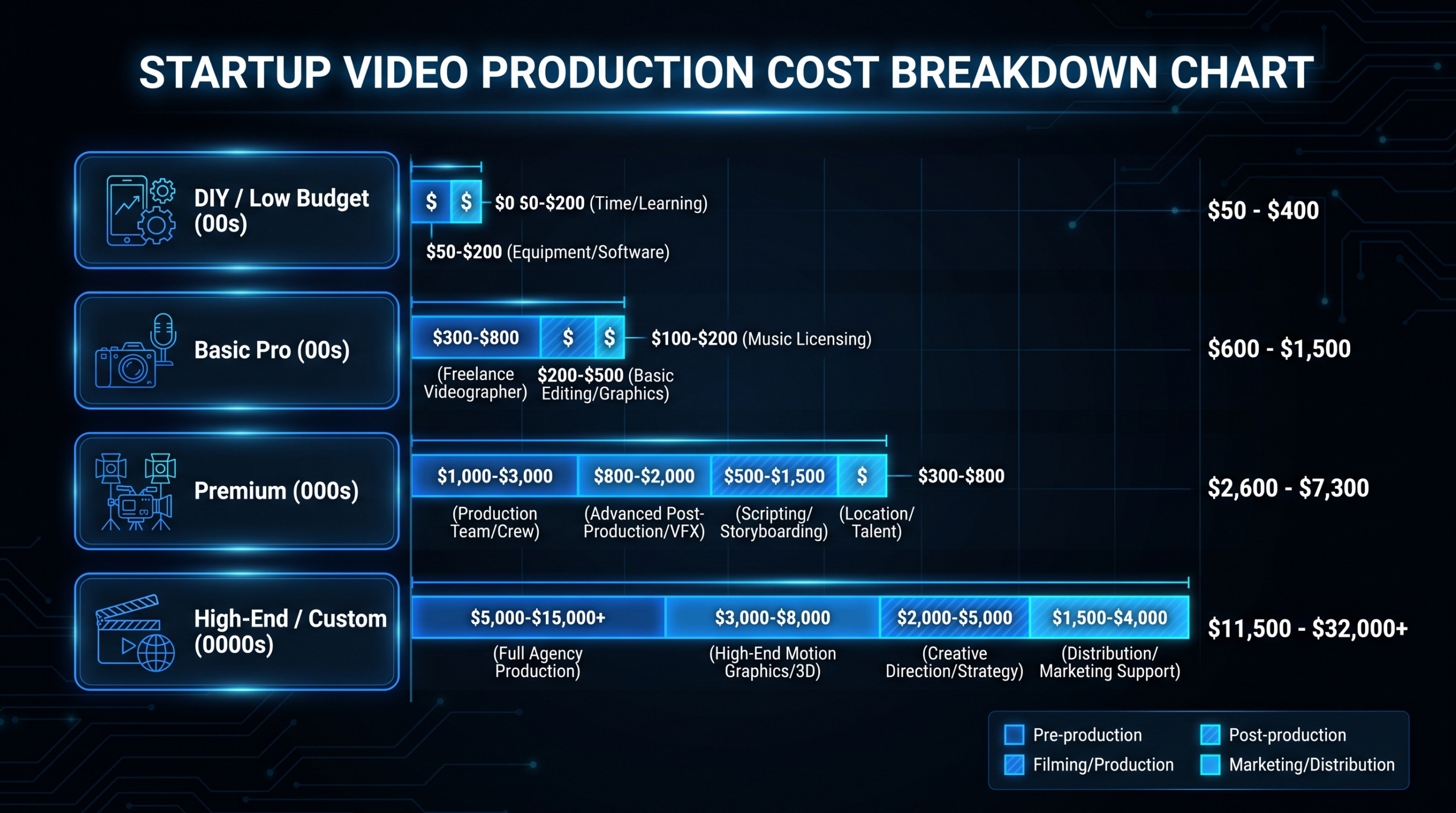
- Seed-stage AI startups commonly spend $500–$4,000/month on video production — mostly product demos and founder-led clips.
- Series A teams typically allocate $4,000–$12,000/month as they build a multi-channel video presence.
- Series B+ companies running a content machine regularly budget $12,000–$30,000+/month for weekly video output across sales, marketing, and customer success.
- Remote post-production cuts the bill by 40–60% without sacrificing quality — the majority of AI startups now use at least partially remote editing teams.
- The biggest cost driver isn't production format — it's revision cycles. Poorly briefed projects routinely cost 2–3× the estimate due to scope creep.
- Dedicated video teams become cost-efficient above 8–10 videos/month; below that, per-project or freelancer models tend to be more practical.
Table of Contents
- What AI Startups Actually Spend on Video
- Understanding Your Video Scope: Three Budget Tiers
- Video Type Cost Breakdown for AI Startups
- Cost Factors That Move the Number Most
- Remote Post-Production Economics
- DIY vs. Freelancer vs. Agency vs. Dedicated Team
- Where AI Startups Lose Video Budget
- Decision Framework: When to Invest More
- FAQ
Video is the primary format AI startups use to explain complex products in a market where buyers have seen hundreds of demos and still can't tell one platform from another. The challenge is that most founders think about video in terms of production cost — and completely miss the full picture.
A $3,000 product demo that requires six revision rounds costs more than a $5,000 demo that ships clean in two. A freelancer charging $40/hour who takes 30 hours for a 3-minute video is more expensive than an agency charging $4,500 flat. And a single "quick explainer video" that takes your Head of Content three weeks to brief, review, and approve has a real cost that never shows up on an invoice.
This guide gives AI startup marketing and operations leaders the full cost picture — ranges, models, team structures, and a decision framework — with no invented numbers, no inflated benchmarks, and no one-size-fits-all answers.
What AI Startups Actually Spend on Video
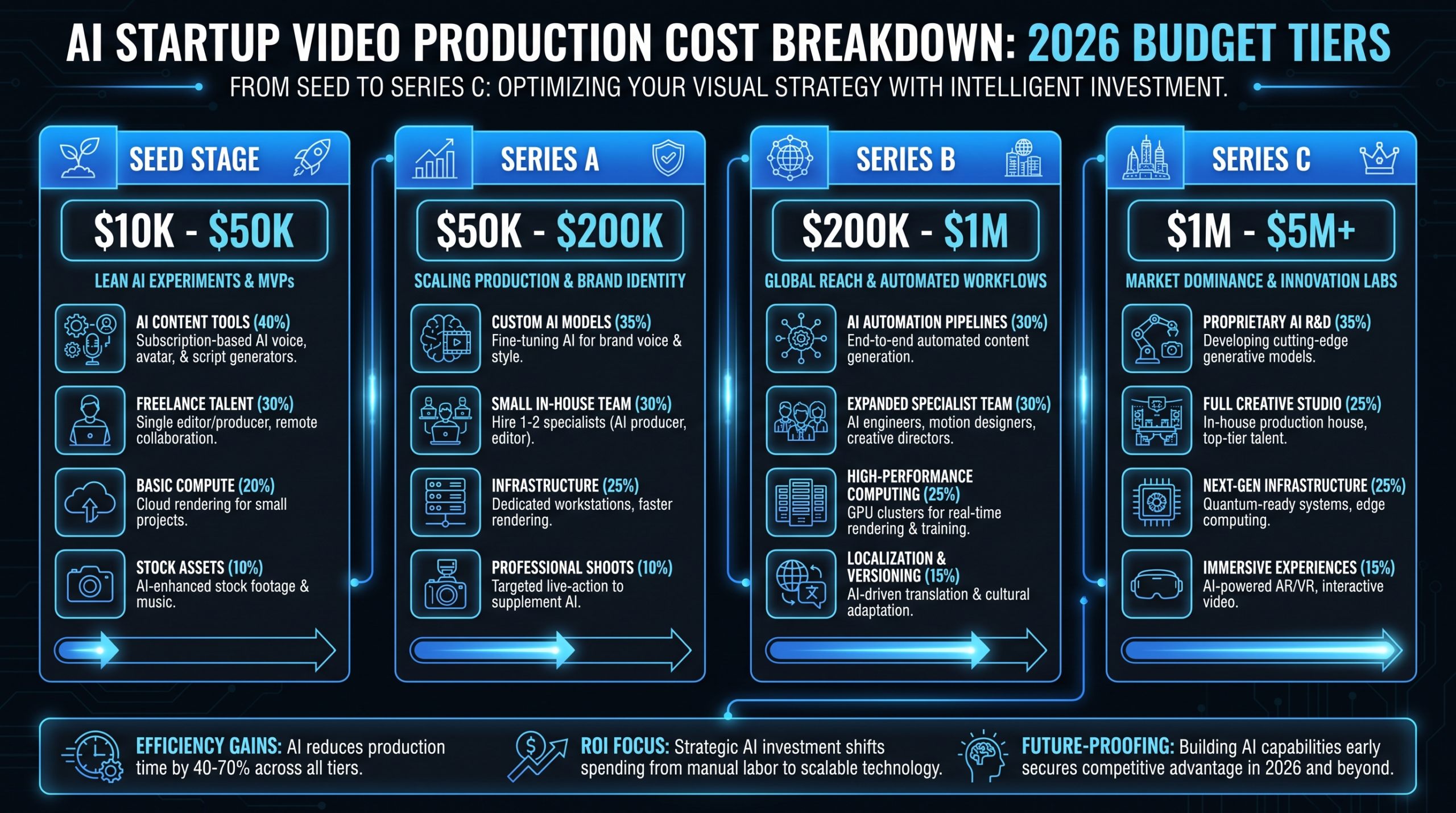
Video spend at AI startups follows a fairly predictable pattern tied to funding stage, headcount, and content maturity. The ranges below reflect commonly observed patterns across the startup landscape, not precise industry averages — framing them as reliable benchmarks would overstate the consistency in the market.
Typical Video Production Spend by Funding Stage
| Stage | Funding Range | Monthly Video Budget | Primary Focus |
|---|---|---|---|
| Pre-seed / Seed | $500K–$5M raised | $500–$4,000/mo | Product demo, founder clips, landing page explainer |
| Series A | $5M–$20M raised | $4,000–$12,000/mo | Customer stories, product walkthroughs, thought leadership |
| Series B | $20M–$80M raised | $10,000–$25,000/mo | ABM video, sales enablement library, partner content, weekly content |
| Series C+ | $80M+ raised | $20,000–$50,000+/mo | Full-funnel video program, enterprise demo reels, multi-market adaptation |
These ranges cover external video production costs only — they do not include internal headcount (content managers, creative directors), software subscriptions, paid distribution, or the cost of raw footage capture. AI startups that build on top of these ranges with in-house capability typically see their effective per-video cost drop substantially after the first 6–9 months.
It's also worth noting that AI startups tend to invest earlier and more heavily in video than comparable B2B software companies from earlier eras. The reason is straightforward: AI products are harder to explain with text and screenshots alone. A 90-second demo of your model in action does more conversion work than three pages of feature copy.
Understanding Your Video Scope: Three Budget Tiers
Before setting a budget, you need to understand what tier of video program you're running. These three tiers map to common patterns in how AI startups think about video — not rigid categories, but useful anchors.
Tier 1: Proof of Concept (Seed to Early Series A)
At this stage, the goal is a credible video presence, not a content machine. Most AI startups at Tier 1 need three things: a homepage explainer or product demo, a founder story or "why we built this" video, and a small library of social clips repurposed from the above.
The Tier 1 spend is $500–$4,000/month, depending on whether you're doing one polished piece per month or a steady trickle of social content. Teams commonly report getting the most value from investing in one well-produced product demo that serves multiple purposes (homepage, outbound sequences, investor pitch support) rather than spreading budget across many low-quality clips.
Tier 2: Content Infrastructure (Series A to Series B)
At this stage, video becomes a channel, not a one-off. You need customer case study videos for sales, weekly thought leadership clips for LinkedIn and X, product walkthrough videos for onboarding, and potentially a demo library segmented by use case or buyer persona.
Tier 2 monthly spend typically runs $4,000–$12,000. The biggest cost variable here is whether you're doing talking-head interviews with customers (which require production coordination and potentially travel) or primarily screen-recording and screen-plus-presenter formats (which are faster and cheaper to produce). AI startups that standardize their formats early — and resist the temptation to make every video a custom production — tend to get significantly more output per dollar.
Tier 3: Video as a Growth System (Series B+)
At this stage, video isn't a marketing asset — it's infrastructure. Sales teams need personalized video sequences. Product teams need feature demo libraries. Marketing needs a steady pipeline of top-of-funnel content, case studies, and partner co-marketing videos. Customer success uses video for onboarding and expansion.
Tier 3 spend ranges from $12,000–$30,000+/month for the external production component. Companies at this stage often find that the limiting factor isn't budget — it's bandwidth for creative direction, internal review, and distribution. The ROI question shifts from "can we afford this?" to "do we have the internal resources to extract full value from this production capacity?"
Video Type Cost Breakdown for AI Startups
The most common video types AI startups need, and what they typically cost to produce at market rates (external agency or freelancer, post-production only unless otherwise noted):
AI Startup Video Type Cost Guide
| Video Type | Typical Duration | Cost Range | Notes |
|---|---|---|---|
| Product demo (screen-record + VO) | 90 sec–3 min | $800–$3,500 | Lower if founder records raw footage; higher with motion graphics overlays |
| Animated AI explainer | 60–90 sec | $3,500–$12,000 | Wide range driven by animation style (motion graphics vs. character animation) |
| Customer case study (talking-head) | 2–4 min | $2,500–$8,000 | Includes editing, B-roll, captions, music; excludes filming coordination |
| Founder/thought leadership clip | 60–90 sec | $300–$1,500 | Low cost when founder records on iPhone; higher with professional cut + motion |
| Social media repurpose clips | 15–60 sec each | $100–$500 per clip | Cut from longer content; batch pricing applies |
| Webinar/event highlight reel | 2–5 min | $1,200–$4,000 | Editing-only; assumes raw footage exists |
| Sales enablement / ABM video | 90 sec–3 min | $1,500–$5,000 | Per version; personalized variants add ~$200–$500 each |
| Full brand/company overview video | 2–4 min | $5,000–$20,000+ | Includes scripting, production direction, motion graphics, full post-production |
For a granular look at what drives per-minute production costs, see our explainer video cost breakdown. For SaaS-specific video strategy, the SaaS video production guide covers how to structure a full video program.
Cost Factors That Move the Number Most
Raw production format explains maybe 40% of the variance in what AI startups pay for video. The remaining 60% comes from factors that many founders don't account for when budgeting.
Revision Cycles
This is the single largest cost variable in AI startup video projects, and it's almost entirely within your control. Most agencies include 2–3 revision rounds in a standard project quote. Round 4+ typically runs $100–$400/round, and at many agencies, a "round" is loosely defined — a single call with 15 feedback items can generate 3–4 rounds of work.
The fix is a tighter brief, not more revision tolerance. AI products are complex and founders are often the only people who can accurately evaluate product representation. Building a 2–3 hour brief review session with a senior stakeholder before post-production starts commonly cuts revision cycles by half or more. This is unglamorous investment that consistently produces better ROI than the production budget itself.
Script Development
If you're hiring the agency or freelancer to write the script, expect to add $500–$3,000 to the project cost depending on length and complexity. AI product scripts are particularly expensive to develop externally because the writer needs to genuinely understand what your model does, who the buyer is, and how to explain technical capabilities without being either vague or jargon-heavy.
Many AI startups — especially at Seed and Series A — find it more cost-effective to write scripts internally and hire externally for post-production only. This is a reasonable approach as long as you have someone internally who can write with clarity and knows how to write for the camera.
Motion Graphics Complexity
AI products often require screen-based demos that show UI, data flows, or model outputs. Motion graphics work — text animations, UI callouts, data visualizations, kinetic text — can add $500–$4,000 to a standard editing project. If your product is "invisible" (an API, a backend model, an infrastructure layer), the motion graphics requirement is higher because you need to create a visual metaphor for something that doesn't have a natural on-screen representation.
Team Model and Geographic Arbitrage
A senior video editor in San Francisco or New York commands $75–$150/hour. A managed remote team in Eastern Europe or Southeast Asia with strong English communication and a US-based PM layer typically runs $25–$55/hour equivalent, with no quality difference on standard editing tasks. For AI startups — which are disproportionately remote-first and already comfortable with distributed teams — this geographic arbitrage is one of the cleanest cost levers available.
Remote Post-Production Economics
Remote post-production isn't a compromise — it's the standard operating model for high-performing AI startup marketing teams in 2026. The combination of distributed team culture, cloud-based review tools (Frame.io, Loom, Notion), and a generation of senior editors who've worked remotely since 2020 has eliminated most of the friction that made remote production feel risky five years ago.
The Cost Math
Here's a straightforward cost comparison for a recurring production model — 10 mixed videos/month (product demos, social clips, customer story edits):
Remote vs. Local Production Cost Comparison — 10 Videos/Month
| Model | Monthly Cost Estimate | Key Variables |
|---|---|---|
| US-based agency (per-project) | $12,000–$22,000 | Revision scope, video complexity |
| US-based agency (retainer) | $8,000–$14,000 | Deliverable definition, commitment length |
| Freelancer network (US/UK rates) | $6,000–$12,000 | Editor quality variance, coordination overhead |
| Managed remote team (offshore + US PM layer) | $4,500–$9,000 | Team quality, PM responsiveness, QA process |
| Dedicated SaaS-focused video team (e.g. VEC) | $5,000–$9,500 | Plan tier, output complexity |
The managed remote model and dedicated SaaS video team models are meaningfully different: the former gives you raw production capacity, while the latter includes strategic context — editors who understand SaaS product marketing, know how to represent technical products credibly, and don't need three rounds of "explain what this feature does" before they can edit a product walkthrough.
What to Verify Before Hiring a Remote Team
Remote post-production quality varies enormously. The difference between a $4,500/month team that produces broadcast-quality output and one that produces generic, brand-inconsistent cuts usually comes down to three things:
- QA process: Does the team have a senior editor reviewing every output before it reaches you, or are raw edits going straight to delivery?
- PM quality: Is your primary point of contact someone who can translate creative feedback into actionable editor direction, or are they just passing your messages along?
- Onboarding depth: Did the team invest 5–10 hours understanding your product, brand voice, visual identity, and past content before starting? Teams that skip this always produce more revisions.
For a practical framework on finding and evaluating remote partners, our guide on how to outsource video editing covers the vetting process in detail.
DIY vs. Freelancer vs. Agency vs. Dedicated Team
The production model decision is the highest-leverage cost variable for AI startups. Here's an honest comparison of all four options:
Production Model Comparison for AI Startups
| Model | Monthly Cost | Best For | Main Limitation |
|---|---|---|---|
| DIY (founder + Loom/Descript/Canva) | $0–$500 (tools) | Seed stage; authentic, unpolished content; "building in public" clips | Founder time cost is real; quality ceiling is low for anything technical |
| Freelancer (Upwork/Contra) | $1,500–$6,000 | Occasional, well-defined projects; tight budgets; simple editing tasks | Quality variance; no brand continuity; coordination overhead accumulates |
| Traditional agency (per-project) | $3,000–$15,000+ | High-stakes brand videos; one-off campaigns; complex animation | Highest per-video cost; slow iteration; not optimized for volume |
| Increditors | ~$2,500–$12,000+/mo | AI/SaaS teams wanting premium quality with dedicated pods; YouTube + content; strong QC | Custom-quote pricing (no instant plan); not SaaS-exclusive |
| VEC (Video Editing Company) | $5,000–$16,000/mo | Series A–C SaaS and AI startups needing consistent, high-volume video output | Minimum commitment required; better suited for teams with steady video demand |
A note on the table above: both VEC and Increditors operate dedicated-team models. VEC is purpose-built for B2B SaaS and AI companies — dedicated senior editing teams, flat retainer pricing (Growth $5K/mo, Core $9.5K/mo, Scale $16K/mo), and a specific "double your video output in 90 days or month 4 is free" guarantee. Increditors runs dedicated editor pods (senior editor + junior editor + PM + creative director) and is known for strong creative direction and YouTube performance work, with custom retainers typically in the $2.5K–$12K+/month range.
For a detailed breakdown of the economics behind each model, see our comparison of video production agency pricing models.
Where AI Startups Lose Video Budget
After working with dozens of AI and SaaS companies, these are the most common ways we see video budget evaporate — and the fixes that consistently work.
Treating Every Video as a Custom Project
The natural instinct is to start each video with a fresh brief, a fresh creative concept, and fresh feedback cycles. This is appropriate for brand films and product launches. It's destructive for a weekly content program. AI startups that standardize 80% of their video formats — same structure, same B-roll approach, same intro/outro pattern, same motion graphics template — and reserve creative iteration for the 20% that truly warrants it typically get 2–3x more output from the same budget.
Underinvesting in the Brief
A 20-minute brief that actually defines the audience, the one thing the viewer should understand, the desired emotional response, the specific scenes or UI moments to highlight, and the examples of videos the team loves produces a dramatically better output than a 200-word summary email. Most revision cycles are briefing failures, not editing failures.
Buying Production When You Need Post-Production
Many AI startups have raw footage they've never properly edited — conference talks, customer interviews, founder recordings, webinar sessions. Before commissioning new production, audit what you already have. A skilled editing team can often produce 5–10 valuable video assets from existing raw footage at post-production-only rates (typically 30–50% cheaper than full production). VEC's teams regularly process batches of raw content for AI clients and turn it into a months-long distribution calendar.
Buying the Wrong Model at Your Volume
A Seed-stage team buying a $16,000/month dedicated team package is wasting capacity. A Series B team buying ad-hoc per-project videos at $8,000 per video is overpaying 2–3x compared to what a retainer would cost at their volume. Matching the production model to your actual monthly volume is the single most impactful cost decision. The VEC pricing page includes a volume calculator that helps teams match plan to output needs.
Ignoring Distribution Costs
A $5,000 video that lives only on your website's homepage and is never repurposed for LinkedIn, X, outbound sequences, or sales decks is a $5,000 asset that does the work of a $500 asset. The incremental cost to produce platform-specific variants (square crop, captions-burned-in version, 15-second cut) at time of editing is typically $200–$600. The cost to do it retroactively, six months later, is $800–$2,000 because the editor needs to re-open the project from cold. Plan for distribution formats at brief stage — not after the video ships.
Decision Framework: When to Invest More
Not every AI startup should be spending $10,000/month on video. Here's a straightforward decision framework for figuring out when to move up a tier:
Move from DIY to Freelancer/Agency When:
- Founder or team is spending more than 5 hours/week on video production tasks
- A credible demo video is the primary conversion bottleneck on your website or in outbound
- You're closing deals where prospects ask for a video explanation and you don't have one
Move from Per-Project to Retainer When:
- You're producing 4+ videos per month consistently and managing separate project contracts feels like overhead
- Brand inconsistency across videos is becoming a real problem in sales conversations
- You've found one or two editors whose output quality and brand understanding you trust
Move from Retainer to Dedicated Team When:
- Your content calendar has consistent demand for 8–12+ videos/month
- You're investing in a multi-channel video program (website, LinkedIn, sales, onboarding) and need coherent output across all of them
- Video is becoming a genuine growth channel, not just a "nice to have" marketing asset
For a framework on transitioning video operations as your team scales, the guide on how to outsource video editing is a useful starting point. Research from Wyzowl's annual video marketing report (wyzowl.com/video-marketing-statistics) consistently shows that marketers who increase video investment year-over-year report strong positive ROI — but the specifics vary significantly by industry, funnel stage, and distribution quality, so treat industry-level figures as directional, not prescriptive.
For SaaS-specific production insights, Wistia's video business content (wistia.com/learn/video-business) covers hosting, analytics, and performance benchmarks that are particularly relevant to AI startup teams using video as part of a self-serve product-led growth motion.
Frequently Asked Questions
What does a basic product demo video cost for an AI startup?
A basic product demo — typically a screen recording with voiceover, light motion graphics for callouts, and captions — commonly runs $800–$3,500 depending on complexity, revision rounds, and whether you're providing a clear brief. Screen-only demos with simple text overlays are at the lower end; demos that require animated diagrams, multi-screen flows, or complex UI callouts move toward the higher end. Budget an additional 20–30% for revision rounds if your brief isn't fully locked before editing starts.
Is it worth hiring a dedicated video team for an early-stage AI startup?
At Seed stage, dedicated teams are rarely worth the cost unless video is a core growth channel from day one. Most Seed-stage AI teams get better ROI from a freelancer or small agency producing 1–2 well-crafted assets per month. The case for a dedicated team becomes strong at Series A when consistent monthly output across multiple formats (social, sales, product, onboarding) is required and brand inconsistency starts hurting conversions.
How does remote post-production compare to local agencies in quality?
For standard editing tasks — cuts, color, captions, motion graphics templates, social repurposing — managed remote teams regularly deliver quality that's indistinguishable from US-based agencies at 40–60% lower cost. The key quality variables are the PM layer (can they translate brand feedback accurately?) and QA process (is a senior editor reviewing before delivery?). Remote teams tend to underperform on highly bespoke creative work — brand films, complex animation, original motion design — where proximity and real-time collaboration matter more.
How do I calculate the true cost of a video production project?
True project cost = agency/freelancer invoice + internal time cost + revision overhead + distribution formatting cost. Most AI startup teams undercount internal time (briefing, reviewing, approving, coordinating) by 30–50%. A project that invoices at $4,000 but requires 15 hours of senior marketer time at a $150/hour opportunity cost has a true cost closer to $6,250. Running this calculation honestly tends to make the case for dedicated teams — which absorb more of the coordination overhead — much faster than simple invoice comparisons.
What's the right video budget for a Series A AI startup?
Series A AI startups commonly budget 3–6% of their marketing budget for video production, which at typical Series A marketing spend levels translates roughly to $4,000–$12,000/month. The right number depends on whether video is a primary growth channel (toward the higher end) or a supporting asset for other channels (lower end). If you're using video as a key conversion driver in outbound sequences, paid social, and sales enablement simultaneously, you'll likely find yourself at the higher end of that range within 6–9 months of investing seriously.
Ready to Scale AI Startup Video Without Scaling Your Team?
VEC works with Series A–C AI and SaaS companies to double their video output in 90 days — dedicated senior editing teams, flat retainer pricing, and a guarantee that backs it up. Book a free strategy call to see how the model fits your current content program.
Book a Free Strategy Call See Pricing Plans