Video Retainer vs Project Pricing: The Math
TL;DR
At 6+ videos per month, a video editing retainer almost always costs less per video than project pricing — often 30–50% less. Below 4 videos per month, project pricing typically wins. The break-even point for most B2B SaaS teams falls between 5 and 8 videos per month. This guide does the math so you don't have to.
Table of Contents
You're producing video consistently. At some point, every B2B SaaS marketing team hits the same question: keep paying per project, or move to a retainer?
The sales pitch from agencies always makes retainers sound like a no-brainer. But the honest answer depends entirely on your volume, your video complexity, and a handful of hidden cost factors most agencies don't explain upfront.
This isn't a philosophical guide about commitment levels and creative relationships. It's math. We'll run the numbers on both models across multiple scenarios so you can make the decision based on actual economics, not sales pressure.
The Two Models, Defined
Before the numbers, let's be precise about what each model actually means — because agencies use both terms loosely.
Project Pricing
You pay a fixed price for each video, negotiated before work begins. The scope is agreed upfront (script, editing, revisions, deliverables). Once the project is delivered, the engagement ends. You're under no obligation to return. This is sometimes called "per-project," "transactional," or "one-off" pricing.
Video Editing Retainer
You pay a fixed monthly fee in exchange for a guaranteed volume of work — typically a set number of videos, editing hours, or deliverable types per month. The agency reserves dedicated capacity for you. Most retainers run on 3–6 month minimums, though some agencies offer month-to-month terms at a small premium. For a full breakdown of how retainers are structured, see our guide to monthly video editing retainers.
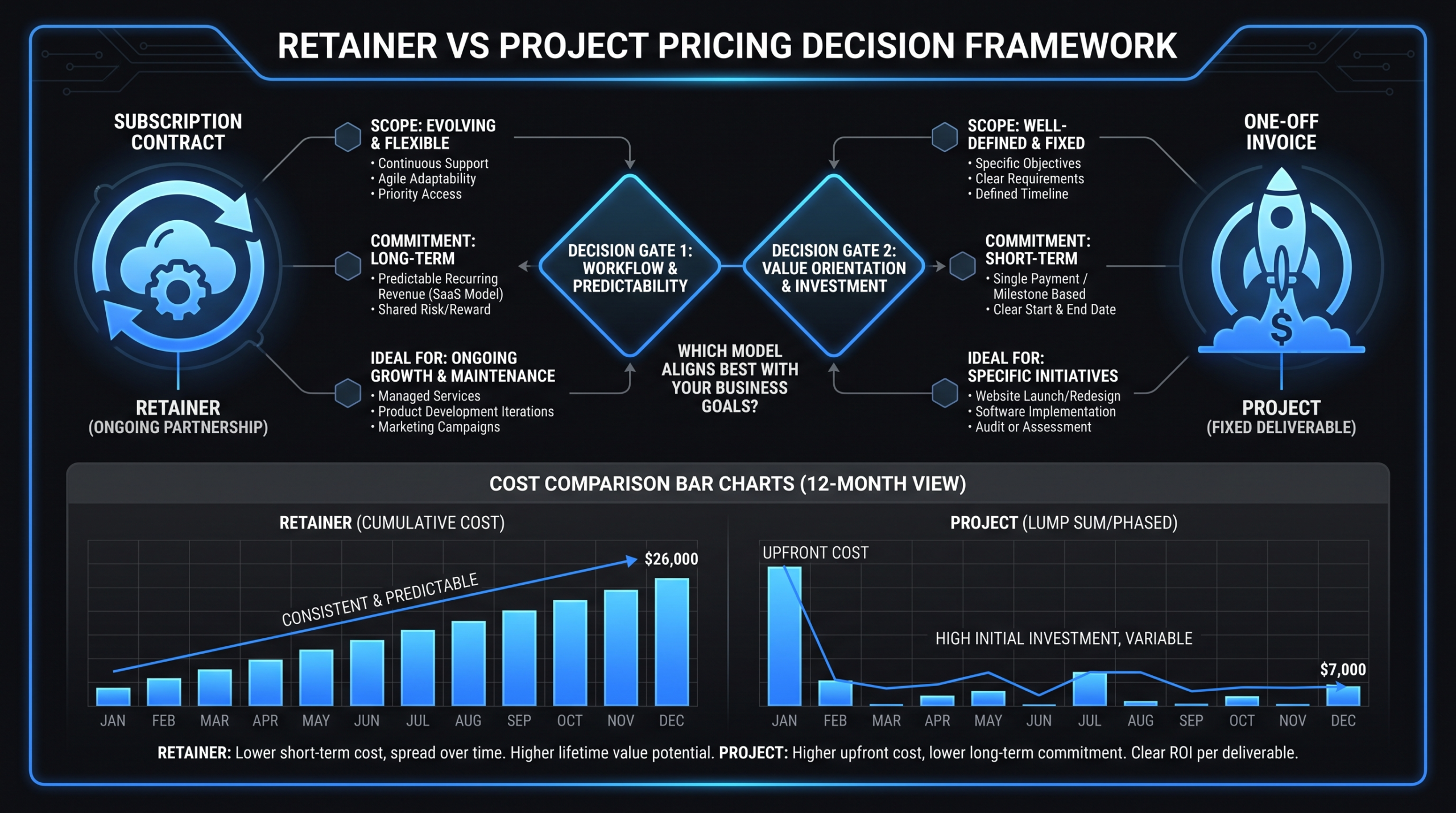
The key structural difference: retainers trade flexibility for unit economics. You commit to consistency and get lower per-video cost in return. Whether that tradeoff is worth it depends on your volume.
The Per-Video Cost Breakdown
To compare the models fairly, you need to normalize everything to a single metric: effective cost per finished video.
What Projects Actually Cost
Project pricing for B2B SaaS videos typically falls into these ranges based on complexity:
Project Pricing by Video Type (B2B SaaS, Agency-Quality)
| Video Type | Duration | Typical Project Price | Revision Rounds Included |
|---|---|---|---|
| Social clip (recut from long-form) | 30–90 sec | $300–800 | 1–2 |
| Webinar/podcast highlight edit | 3–8 min | $500–1,500 | 2 |
| YouTube/long-form edit | 10–20 min | $1,000–3,000 | 2–3 |
| Product demo video | 2–4 min | $2,500–6,000 | 2–3 |
| Customer testimonial | 2–3 min | $1,500–4,000 | 2 |
| Animated explainer | 60–90 sec | $4,000–12,000 | 2–3 |
A typical "mixed" month for a Series B SaaS content team — 4 YouTube edits, 3 social clips, 1 product demo, 1 testimonial — would cost roughly $11,000–22,000 at project rates depending on agency tier and complexity.
What Retainers Actually Cost
Retainer pricing is structured differently: you pay for capacity, not individual deliverables. The effective per-video cost drops as volume rises because the agency's fixed overhead (project management, account management, file storage, asset management) gets amortized across more output.
Retainer Cost per Video at Different Volume Tiers
| Monthly Retainer | Videos/Month | Effective Cost/Video | vs. Project Pricing |
|---|---|---|---|
| $3,000–5,000 | 4–6 | $500–1,250 | Roughly equal |
| $5,000–9,000 | 8–12 | $420–1,125 | 15–30% cheaper |
| $9,000–14,000 | 12–18 | $500–1,167 | 25–40% cheaper |
| $14,000–20,000 | 18–25 | $560–1,111 | 35–50% cheaper |
Note: the per-video cost range within each row reflects variation in video complexity. A retainer covering 12 social clips is cheaper per unit than one covering 12 product demos at the same monthly price.
For teams considering a $5K/month entry point, our detailed post on what a $5K video editing retainer actually gets you breaks down exactly what deliverables you should expect and how to evaluate whether you're getting value.
Break-Even Analysis: Where Retainers Win
The break-even point is the monthly video volume at which a retainer becomes cheaper than equivalent project pricing. For most B2B SaaS content teams, that number falls between 5 and 8 videos per month — but it shifts based on your video mix.
Scenario A: Light Volume (4 videos/month)
Mix: 2 YouTube edits, 1 social clip pack (3 clips), 1 testimonial.
- Project pricing: ~$7,500–14,000/month
- Retainer cost: ~$5,000–7,000/month (starter tier)
- Retainer advantage: $0–4,000/month savings — but the retainer often covers the team cost even during light months
- Verdict: Marginal. If your volume is this low and variable, project pricing offers flexibility without locking you in. If your 4 videos are consistent every month, a retainer pays off.
Scenario B: Mid Volume (10 videos/month)
Mix: 4 YouTube edits, 4 social clip packs, 1 product demo, 1 testimonial.
- Project pricing: ~$16,000–26,000/month
- Retainer cost: ~$8,000–12,000/month (growth tier)
- Retainer advantage: $8,000–14,000/month savings
- Verdict: Clear retainer win. At this volume, project pricing is roughly 40–60% more expensive for the same output.
Scenario C: High Volume (20 videos/month)
Mix: 8 YouTube edits, 6 social clip packs, 3 product demos, 2 testimonials, 1 animated explainer.
- Project pricing: ~$35,000–60,000/month
- Retainer cost: ~$14,000–20,000/month (scale tier)
- Retainer advantage: $20,000–40,000/month savings
- Verdict: Non-negotiable retainer territory. Project pricing at this volume is financially indefensible for any team with a consistent content program.
Break-Even Summary: Project vs. Retainer by Monthly Volume
| Monthly Video Volume | Project Pricing (est.) | Retainer (est.) | Winner |
|---|---|---|---|
| 1–3 videos | $2,000–8,000 | N/A (too low for most retainers) | Project |
| 4–5 videos | $6,000–14,000 | $4,000–7,000 | Slight retainer edge |
| 6–10 videos | $10,000–26,000 | $6,000–12,000 | Retainer (clear) |
| 11–20 videos | $18,000–60,000 | $10,000–20,000 | Retainer (strong) |
| 20+ videos | $40,000–100,000+ | $15,000–30,000 | Retainer (decisive) |
The break-even isn't just about cost per video. It's about consistency. A retainer assumes your volume stays roughly constant. If you have wild month-to-month swings — 2 videos in slow months, 12 in launch months — the calculation changes significantly.
Hidden Costs That Change the Equation
The sticker price comparison above understates the true cost gap, because project pricing carries several hidden costs that retainers largely eliminate.
Re-Briefing Overhead
Every new project requires a fresh brief, onboarding the editor to your brand, and 1–2 "calibration" rounds before output matches your standards. For teams that have run this math: the first revision round on a project-priced video is frequently a re-brief, not a genuine creative improvement. Retainer teams learn your brand over months — revision rounds shrink, turnaround times drop, and output quality rises without additional cost.
Revision Fees
Project contracts typically include 2 revision rounds. Round 3 costs $100–400 depending on the agency and scope. On complex videos (product demos, animated explainers), round 3 is common. A retainer agreement usually includes a more generous revision policy because the agency is investing in a long-term relationship.
Rush Premiums
Need a video for a launch in 48 hours? Project agencies charge 25–50% rush premiums. Retainer clients get priority scheduling — that launch deadline doesn't cost extra because your capacity is already reserved. For SaaS marketing teams, where content often needs to align with product release cycles, this alone can justify the retainer premium.
Stock and Asset Licensing
Many project quotes don't include stock footage, music licensing, or motion graphics template costs. These line items add $200–1,500 per video depending on complexity. A retainer agency managing your account typically bundles these costs or maintains your asset library, eliminating per-project licensing surprises.
Management Time
Project-priced work requires more marketing team bandwidth — scoping, briefing, reviewing vendors, negotiating each engagement. HubSpot's research on content team operations consistently finds that vendor coordination is one of the highest time sinks for content teams that rely on one-off agency relationships. Retainer arrangements shift this overhead to account management on the agency side.
Which Model Fits Your Situation
The math points in one direction at volume. But there are legitimate reasons to choose project pricing even when the numbers favor a retainer.
Choose Project Pricing When:
- Your volume is low and unpredictable. Fewer than 4 videos per month with significant month-to-month variation doesn't justify a retainer commitment.
- You're testing a new agency. Running 2–3 projects before committing to a retainer is reasonable due diligence. Don't let any agency pressure you into a 6-month minimum before you've seen their work on your content.
- You have a one-time campaign spike. A product launch that requires 15 videos in one month, then nothing for two months, is a project engagement — not a retainer situation.
- The creative requirements are highly variable. If every video is genuinely different in scope and complexity, and you can't predict what you'll need month to month, project pricing's scope-per-engagement structure may serve you better.
Choose a Video Editing Retainer When:
- You produce 6+ videos per month consistently. At this volume, the cost savings are real and compounding.
- Brand consistency matters. The same editors working on your content month after month means they internalize your brand voice, visual style, and pacing preferences — quality that's hard to price.
- Turnaround time is a competitive advantage. Retainer clients with reserved capacity get faster delivery. If your content operation is reactive to product launches, market moments, or competitive moves, reserved capacity is worth paying for.
- You want a team that knows your product. SaaS video, especially product demos and feature walkthroughs, requires editors who understand your product deeply. That investment compounds over a retainer relationship, not across one-off projects.
Video Editing Company's dedicated team model starts at $5,000/month and is built specifically for this scenario. Our full pricing page shows exactly what's included at each tier and the output capacity you can realistically expect.
How to Make the Switch Without Risk
Moving from project pricing to a video editing retainer is a significant commitment. Here's how to structure the transition to protect yourself.
Start With a Trial Project
Even if an agency offers retainers, run 1–2 projects first. This validates quality and workflow fit before you're locked into 3–6 months. Frame it explicitly as a "pre-retainer evaluation" — any good agency will agree to this framing and perform accordingly.
Negotiate the First-Month Terms
Ask for a discounted or no-commitment first month. Position it as an onboarding investment for both sides. Agencies that are confident in their work will accommodate this. Agencies that refuse should raise a flag.
Define Deliverables, Not Hours
The best retainer agreements specify what you get (4 YouTube edits, 8 social clips, 1 product demo per month), not how many hours the agency will spend. Hour-based retainers create the same misaligned incentives as hourly project pricing. Demand deliverable-based terms.
Include an Escalation Clause
For months where you need more than the retainer covers, agree in advance on the per-unit overage rate. This prevents the agency from billing project rates (the higher rate) for overage work, which would erode the economics of the retainer model entirely.
Set a Review Cadence
A 90-day review clause is standard and reasonable. It lets you renegotiate scope, exit if performance is poor, or expand if the relationship is working. Wyzowl's annual video marketing survey consistently finds that long-term agency relationships outperform transactional ones on quality scores — but only when there's a structured feedback loop. Build one in.
Don't Consolidate Too Fast
If you're currently working with multiple project-based agencies (one for YouTube edits, one for social clips, one for animation), don't consolidate all of them into one retainer simultaneously. Move the highest-volume, most consistent work type first. Prove the model works, then consolidate.
For a deeper look at what the full setup and transition process looks like in practice, see our overview of how monthly video editing retainers work — including what to audit in the first 30 days of a new retainer relationship.
Frequently Asked Questions
At what video volume does a retainer start saving money?
For most B2B SaaS teams, the break-even falls between 5 and 8 videos per month. Below 4 videos per month with variable output, project pricing is usually more economical because you're not paying for unused retainer capacity. At 8+ videos per month of consistent output, a retainer typically costs 30–50% less than equivalent project pricing.
What happens if I don't use my full retainer allocation one month?
This varies by agency. Some roll over unused capacity (up to a cap) into the following month. Most don't — you pay for reserved capacity regardless of utilization. This is the primary risk of retainers for teams with variable content calendars. Negotiate rollover terms before signing, and if an agency refuses any rollover, factor that into your volume estimates conservatively.
Can I mix project pricing and a retainer with the same agency?
Yes, and this is often the smartest structure for growing SaaS teams. A retainer covers your baseline consistent output (YouTube edits, social clips, recurring content types). One-off campaigns — product launch videos, conference assets, animated explainers — are scoped as separate projects. The retainer team's familiarity with your brand means even those project-priced engagements tend to be faster and cleaner than starting from zero with a new vendor.
How do I compare retainer quotes from different agencies?
Normalize everything to effective cost per finished minute of video. Take the monthly retainer price, divide by the total minutes of finished video included in the scope, and you have a comparable number across agencies using different deliverable structures. Also compare: revision policy (how many rounds?), turnaround time, dedicated vs. shared team, and whether motion graphics and sound design are included or extra.
Is a 3-month retainer minimum standard?
Three to six months is typical for mid-market agencies. Some agencies offer month-to-month retainers at a 10–20% premium — reasonable if you need flexibility while proving the model internally. Enterprise retainers with dedicated teams often require 6–12 month commitments. VEC's retainer model starts with a 3-month minimum at the Growth tier ($5K/month) and offers month-to-month on longer-term plans. See our pricing page for current terms.
See the Math for Your Content Volume
Every team's break-even is different. Talk to our team — we'll run the actual numbers for your video mix and show you whether a retainer or project model makes more financial sense for your specific situation. No obligation.
Book a Free Strategy Call View Pricing Plans