Onboarding Video Production Cost: 2026
TL;DR — What You'll Pay in 2026
- Single onboarding video (freelancer): typically $300–$2,500 depending on length and complexity
- Full onboarding video series (agency, 5–10 videos): commonly $8,000–$40,000+ per project
- Ongoing onboarding content on a dedicated team plan: $5,000–$16,000/month; VEC's Growth plan starts at $5K/mo
- Biggest cost drivers: script/production complexity, animation vs. screen recording, revision rounds, and whether you need full video production or editing-only
- Biggest mistake: treating onboarding video as a one-time project when activation rates require constant iteration
Table of Contents
- What Is an Onboarding Video (and Why Cost Varies Wildly)
- Onboarding Video Cost by Type
- DIY vs. Freelancer vs. Agency: True Cost Comparison
- 7 Factors That Drive Onboarding Video Production Cost
- Ongoing Onboarding Video Production vs. One-Time Project
- What a Dedicated Video Team Costs for Onboarding at Scale
- Hidden Costs Most Teams Miss
- How to Reduce Onboarding Video Cost Without Cutting Quality
- FAQ
Onboarding video production cost is one of those questions where the honest answer — "it depends" — is technically true but completely useless. So let's make it useful.
In 2026, a single customer onboarding video might cost you $400 from a competent freelancer or $15,000 from a full-service production agency. A series of onboarding videos for a complex SaaS product can run anywhere from $12,000 to $80,000+. And an ongoing onboarding video program — the kind that actually moves activation metrics — typically runs $5,000–$16,000/month on a dedicated team model.
This guide breaks down every cost variable, gives you real market ranges for 2026, and helps you match the right production model to where you are in your growth stage. We'll cover what drives cost up, what you can safely cut, and what the best-performing SaaS companies actually spend on onboarding video.
What Is an Onboarding Video (and Why Cost Varies Wildly)
Onboarding videos cover the entire journey from signup to activation. That journey can be a single 90-second welcome video or a 20-part library of feature walkthroughs, use-case tutorials, and contextual in-app guides. The scope of what you need is the single biggest cost determinant.
The main categories:
- Welcome videos: 60–120 seconds, personal tone, often recorded by a founder or head of customer success. Lowest production complexity.
- Product tour videos: 2–5 minutes, screen recording with narration or animation, showing core features. Mid-complexity.
- Feature tutorial videos: Short (1–3 min) focused clips on specific workflows. Often produced in batches of 5–15+.
- Use-case / persona videos: Show how a specific user type achieves a specific outcome. Require scripting, sometimes motion graphics, occasionally actors.
- Animated explainers for onboarding: Highest production cost. Used when the product concept needs visual explanation before the UI makes sense.
Cost variance is wide because a screen recording tutorial edited by a junior freelancer and a fully animated product tour produced by a specialist agency are both called "onboarding videos" — but they're different products entirely.
For a deeper look at what high-performing onboarding video libraries actually contain, see our curated customer onboarding video examples.
Onboarding Video Cost by Type
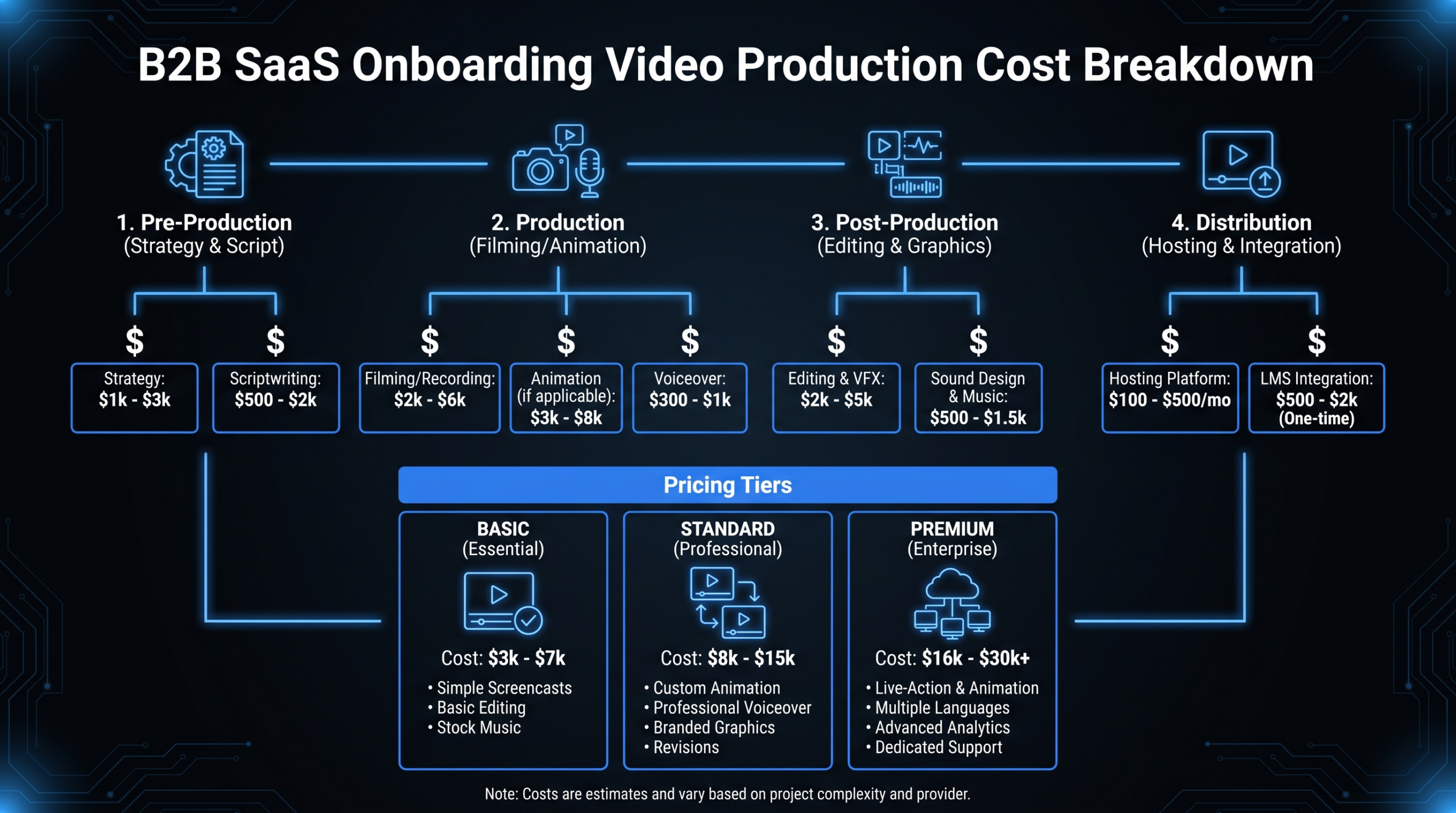
Here's a realistic market-rate table for 2026, covering the most common onboarding video formats. These are production costs (scripting, editing, motion graphics) — not including raw footage capture if you need a full shoot.
Onboarding Video Production Cost by Format
| Video Type | Typical Length | Freelancer Range | Agency Range |
|---|---|---|---|
| Welcome / CEO message | 60–90 sec | $300–$900 | $1,500–$4,000 |
| Screen recording + narration (basic) | 2–4 min | $400–$1,200 | $1,800–$5,000 |
| Product tour (polished screen capture + motion) | 3–6 min | $800–$2,500 | $3,500–$10,000 |
| Feature tutorial (series of 5) | 1–3 min each | $1,500–$5,000 total | $6,000–$20,000 total |
| Use-case / persona video | 2–4 min | $1,000–$3,500 | $4,000–$12,000 |
| Animated explainer (concept-first) | 60–90 sec | $2,000–$6,000 | $6,000–$20,000 |
| Full onboarding library (10–15 videos) | Mixed | $6,000–$18,000 | $20,000–$60,000+ |
Note: "Freelancer range" assumes a vetted mid-level editor or producer, not the lowest Fiverr option. Bargain-tier production often requires expensive re-editing anyway. For context on what drives per-minute costs, see our video editing cost per minute breakdown.
Why Agency Costs Are Often 3–5x Freelancer Rates
The cost gap isn't arbitrary. Agency pricing reflects layers that freelancers don't provide: a dedicated project manager, revision management, QA review, brand consistency across your entire video library, and backup capacity if your main editor is unavailable. For a one-off video, that overhead may not be worth it. For an ongoing onboarding library that must be consistent across 15+ videos and updated quarterly, the agency infrastructure often pays for itself in time saved.
DIY vs. Freelancer vs. Agency: True Cost Comparison
The cheapest sticker price rarely produces the lowest total cost. Here's an honest accounting for a common scenario: producing a 5-video onboarding series for a mid-market SaaS product.
True Cost Comparison: 5-Video Onboarding Series
| Production Path | Direct Cost | Internal Time Cost | Quality Risk | Total Estimated Cost |
|---|---|---|---|---|
| DIY (in-house, no video specialist) | $500–$2,000 (tools, assets) | ~120 hrs @ internal cost | High — inconsistent quality | $8,000–$18,000+ |
| Freelancer (Upwork, vetted mid-level) | $2,000–$6,000 | ~30 hrs management | Medium — revision risk | $4,000–$9,000 |
| Video agency (project-based) | $10,000–$25,000 | ~12 hrs feedback | Low — managed QA | $12,000–$28,000 |
| Dedicated video team (monthly plan) | $5,000–$9,500/mo | ~8 hrs/mo ongoing | Very low — brand consistency | Best unit cost at scale |
The DIY path looks free until you account for your team's time. A product marketing manager spending 40 hours on video editing is a poor use of a $120K salary. The math shifts fast.
Freelancers are the right call for one-off needs, but managing a freelancer pipeline for ongoing onboarding content (which needs to evolve as your product does) creates coordination overhead that compounds over time. If your onboarding video strategy requires more than 3–4 new or updated videos per quarter, the dedicated team model almost always wins on total cost of ownership.
7 Factors That Drive Onboarding Video Production Cost
Understanding what pulls cost up or down lets you make smarter tradeoffs when you're planning a production budget.
1. Script Complexity
A narrated screen recording needs a script. A persona-based use-case video needs a structured narrative. A concept-first animated explainer needs a writer, a narrator, and revision cycles at every stage. Scripting alone can add $500–$3,000 to a project depending on length and complexity.
2. Animation vs. Screen Recording
This is the single biggest cost multiplier. Screen recordings (even polished ones with motion graphics callouts) are 3–8x cheaper to produce than fully animated content. For most SaaS onboarding, screen recording with clean captions, branded lower thirds, and professional audio delivers better ROI than full animation. Animation makes sense when the product concept needs to be explained before the UI is shown — typically for abstract enterprise software or early-stage products.
3. Narration and Voice-Over
Professional voice-over adds $150–$600 per finished minute from a quality US/UK narrator. AI voice-over (ElevenLabs, Murf) reduces this to near-zero but requires careful selection to avoid uncanny-valley artifacts. Many SaaS teams now use a hybrid: AI voice for feature tutorials, human narration for welcome videos and high-stakes use-case content.
4. Revision Rounds
Most freelancers and agencies include 2–3 revision rounds. Each additional round adds $100–$400 depending on the scope. Disorganized feedback — multiple stakeholders commenting in sequence instead of consolidated — can double the revision count. Establishing a single feedback owner before production starts is one of the highest-ROI process improvements you can make.
5. Brand Compliance and Motion Graphics
Onboarding videos that need to match a detailed brand guide (specific fonts, motion styles, color treatments, animated logos) require more production time than off-brand work. Budget for a one-time brand template build ($1,000–$3,000 from a specialist) if you're producing more than 5 videos — it pays back in every subsequent project.
6. Localization
Producing the same video in 3 languages isn't 3x the cost, but it's typically 1.5–2x. Budget for re-recording narration, updating on-screen text, and quality-checking each version. Screen-recording-based videos localize more efficiently than animated content.
7. Hosting and Distribution Infrastructure
Wistia, Vidyard, and similar B2B video platforms charge $100–$400/month for hosting with analytics. This isn't a production cost but it's frequently forgotten in the first-year budget. These platforms matter for onboarding specifically because they track video completion rates by user segment — critical data for optimizing activation. See Wistia's video for customer success guide for a framework on connecting onboarding video metrics to activation outcomes.
Ongoing Onboarding Video Production vs. One-Time Project
This distinction is where most budgets go wrong. Teams think about onboarding video as a one-time production event — build the library, ship it, done. But onboarding video that actually reduces churn requires continuous iteration.
Your product changes. Your ICP evolves. You discover that new users are dropping off at feature X, not feature Y. High-performing onboarding programs update their video content quarterly at minimum — which means a production model that prices work per-project gets expensive fast. According to Wyzowl's annual video marketing research, companies using video for customer onboarding and education report it as one of their highest-ROI marketing investments — reinforcing the case for treating it as a continuous program rather than a one-time project.
On a per-project basis, updating 10 videos quarterly could cost $15,000–$40,000/year just in production. On a monthly dedicated team plan, the same update cadence is covered in the baseline retainer — and the team already knows your product, so revision cycles are shorter.
For companies that connect their onboarding video program to churn reduction, the math is stark: if a single percentage point of churn reduction is worth $200K ARR to your business, a $9,500/month video team that achieves it pays back in under 2 months. See our analysis of how onboarding video reduces churn for the frameworks SaaS teams actually use to close that loop.
When One-Time Project Production Makes Sense
- You're launching your first onboarding video library and don't yet know which formats work for your users
- Your product is stable with infrequent feature updates
- You produce fewer than 3 onboarding videos per quarter
- You're pre-Series A and want to test video impact before committing to a retainer
When Ongoing Production Makes Sense
- Your product ships new features monthly or faster
- You're using video completion data to optimize activation flows and need to iterate quickly
- You have 5+ user personas or use cases that require distinct video tracks
- Video is part of your CS playbook for high-touch accounts
What a Dedicated Video Team Costs for Onboarding at Scale
For SaaS teams producing onboarding video at volume — say, 6+ videos per month between new content, updates, and persona variations — a dedicated video production team is the most cost-efficient model. Here's how the economics work.
Dedicated Video Team Plans: Onboarding Video at Scale
| Plan | Monthly Cost | Typical Onboarding Output | Best For |
|---|---|---|---|
| Growth (VEC) | $5,000/mo | 6–10 videos/mo (screen-record + motion) | Series A–B, growing onboarding library |
| Core (VEC) | $9,500/mo | 12–18 videos/mo (mixed formats) | Series B–C, full CS video program |
| Scale (VEC) | $16,000/mo | 20–30+ videos/mo incl. animation | Enterprise, multi-persona, multi-language |
| Freelancer pool (managed) | $3,000–$8,000/mo | 4–12 videos/mo (variable quality) | Budget-constrained, inconsistent needs |
| In-house editor hire | $7,000–$12,000/mo (fully loaded) | 8–15 videos/mo | Teams with high brand-sensitivity needs |
VEC (Video Editing Company) builds dedicated editing teams specifically for B2B SaaS — each plan comes with an assigned senior editor, project manager, and guaranteed output targets. The guarantee: double your video output in 90 days or month 4 is free. For specifics on what each plan includes, see the VEC pricing page.
Comparing the options: a fully-loaded in-house hire at $10,000/month covers one editor with no backup, no PM, and no creative director oversight. VEC's Core plan at $9,500/month includes the full team structure with built-in quality management. For most Series B+ SaaS companies, the dedicated agency model outperforms in-house on both cost and output quality — especially for onboarding content that requires frequent iteration.
For a broader view of how to structure your video production relationship, our guide on how to outsource video editing walks through the decision framework.
Hidden Costs Most Teams Miss
The invoice from your video vendor rarely captures the full cost of an onboarding video program. Here are the costs that routinely get forgotten in budget planning:
Internal Project Management Time
Even with a great external team, someone on your side owns the brief, reviews drafts, coordinates stakeholder feedback, and approves final assets. For a 10-video series, expect 30–60 hours of internal time spread across your PM, product marketer, and CS leader. At a blended internal cost of $75–$120/hour, that's $2,250–$7,200 that never appears on the production invoice.
Script and Storyboard Development
Many agencies and freelancers price editing separately from scriptwriting. If you're producing more than basic screen-recording tutorials, budget $300–$1,500 per script for a specialist copywriter who understands both SaaS products and instructional design. Generic scripts produce generic onboarding videos that users skip.
Software and Screen Recording Tools
Loom, Camtasia, Screenflow, and similar tools range from free to $500/year. More importantly, enterprise-grade capture setups (4K display recording, separate audio interface, proper lighting for any talking-head elements) can add $1,500–$4,000 in one-time equipment costs for in-house production.
Video Hosting and Analytics
Embedding onboarding videos on YouTube is free but limits your analytics — you can't track individual user completion rates, which is the signal you need to optimize activation. B2B video platforms typically cost $100–$400/month and provide per-user engagement data that connects to your CRM. Budget for this from day one if data-driven optimization is part of your onboarding strategy.
Closed Captions and Accessibility
Auto-captions are free but unreliable for technical products (misses product names, features, jargon). Professional captioning runs $1–$3 per minute of video. For a 10-video library with 30 total minutes of content, that's $300–$900 — easy to forget, impossible to skip if your product serves international audiences or enterprise accounts with accessibility requirements.
How to Reduce Onboarding Video Cost Without Cutting Quality
The most effective ways to reduce cost don't require lowering production standards — they require better process design.
Batch Production
Producing 10 videos in a single sprint costs 30–40% less per video than producing them one at a time. Brand templates are built once, scripts follow a common structure, and the production team builds speed on your specific product. If you know you need 10 videos, brief them all at the start of the engagement.
Screen Recording Over Animation
For feature tutorials and product tours, high-quality screen recording with professional editing, branded callouts, and clean audio outperforms animation on both cost and performance with most SaaS audiences. Reserve animation budget for concept-level explainers where the UI can't carry the story.
Modular Video Architecture
Design your onboarding library so individual modules can be swapped out without rebuilding the whole video. An intro section + feature section + CTA section structure means you only re-produce the feature section when the product changes. Over a year, this saves 40–60% on update costs. See our guide to what video editing services include for how to brief this structure with a production team.
Consolidate Feedback Rounds
The biggest hidden cost driver in video production is revision sprawl — multiple stakeholders reviewing sequentially, each adding new requests. One designated reviewer per video, with a 48-hour feedback window and a single consolidated document, typically reduces revision rounds from 4+ to 2. At $200–$400 per extra round, the process change pays off immediately.
Repurpose Existing Assets
If you've produced product demo videos, webinar recordings, or sales enablement content, large portions can be re-edited into onboarding modules. A well-edited 45-minute demo webinar often contains 6–8 re-usable feature tutorial clips. The editing cost for repurposing is typically 30–50% of producing from scratch.
The teams that get the most out of onboarding video budgets treat it as a content system, not a production event. They plan updates from the start, batch production, and build in the analytics loop that tells them which videos actually move activation.
Frequently Asked Questions
How much does it cost to produce an onboarding video in 2026?
A single onboarding video typically costs $300–$2,500 from a competent freelancer and $1,500–$12,000 from a full-service agency, depending on format and complexity. Screen recordings with professional editing sit at the lower end; animated explainers and fully produced use-case videos sit at the higher end. A complete onboarding library (10–15 videos) commonly runs $6,000–$60,000+ depending on scope and production tier.
What's the cheapest way to produce onboarding videos at scale?
Batched screen recording production is the most cost-efficient approach for most SaaS products. Build a brand template once, script all videos before production starts, and record in bulk sessions. This approach reduces per-video cost by 30–40% versus producing videos individually. For ongoing scale (6+ videos/month), a dedicated team plan — typically $5,000–$9,500/month — becomes more cost-efficient than paying per-project rates for the same volume.
How many onboarding videos does a typical SaaS product need?
Early-stage products commonly start with 3–5 videos: a welcome/overview, 2–3 core feature tutorials, and a quick-start guide. Series B+ products with multiple personas and complex workflows often maintain libraries of 15–40+ videos. The right number is determined by your user journey map, not by what's convenient to produce — identify every point where users commonly stall or churn, and build video coverage for those moments first.
Can I repurpose existing content for onboarding videos?
Yes — and this is one of the highest-ROI moves in onboarding video production. Demo recordings, CS call recordings (with permission), and webinar content often contain exactly the feature walkthroughs and use-case narratives you need. A skilled editor can extract and repackage these into onboarding modules at 30–50% of the cost of producing from scratch. The key is having clean source footage and a clear brief for how each clip will be used.
What does a dedicated video team charge for ongoing onboarding production?
Dedicated video team plans for ongoing SaaS content typically start around $5,000/month and scale to $16,000+/month depending on output volume and complexity. Video Editing Company's Growth plan ($5K/mo) handles 6–10 onboarding videos per month; the Core plan ($9.5K/mo) accommodates 12–18 mixed-format videos monthly. The value versus per-project pricing compounds fast: at 10+ videos/month, dedicated team rates are typically 40–60% less per video than paying project-by-project.
Ready to Build Your Onboarding Video Library?
VEC builds dedicated video editing teams for B2B SaaS companies. We handle scripting support, editing, motion graphics, and quality assurance — so your team focuses on your product while we handle the video. Growth plan starts at $5,000/month with a 90-day output guarantee.
Book a Free Strategy Call View Pricing Plans