What Is a Dedicated Video Team? Explained
TL;DR
A dedicated video team is a fixed group of editors, a project manager, and often a creative director assigned exclusively to your account — working as an embedded extension of your marketing department, not a shared pool of freelancers. For B2B SaaS companies producing 12 or more videos per month, it is typically the most cost-effective and brand-consistent way to scale video output without the overhead of in-house hiring.
Table of Contents
What Is a Dedicated Video Team?
A dedicated video team is a named, fixed group of video professionals — editors, a project manager, and optionally a creative director — assigned exclusively to a single client's account. Unlike shared pools or project-based freelancers, the same people work on your videos every week, learn your brand deeply, and function as an embedded extension of your marketing team.
The core distinction is exclusivity and continuity. When you work with a project agency or a video subscription service, you're assigned whatever editor is available when your request comes in. With a dedicated team, you have the same senior editor — who knows your product, your audience, and your feedback preferences — every time. That institutional knowledge compounds over months in ways that no brief or style guide can fully replicate.
Dedicated video teams are typically offered by video agencies as a premium service tier or as a standalone product. Companies like Video Editing Company are built specifically around this model, offering B2B SaaS teams a named editing crew on a monthly plan. The team operates on your schedule, uses your tools and channels, and measures success against your content goals — not just turnaround time.
"The best dedicated video relationships feel less like outsourcing and more like having a fractional video department — the team knows what you need before you finish the brief."
This model exists because there is a real gap in the market. Hiring full-time editors is expensive (salary, benefits, equipment, training) and risky (what happens when someone leaves?). Subscription services and project agencies are cheaper but inconsistent. A dedicated team sits in between: the quality and consistency of in-house, the scalability and flexibility of an agency.
Who's on a Dedicated Video Team?
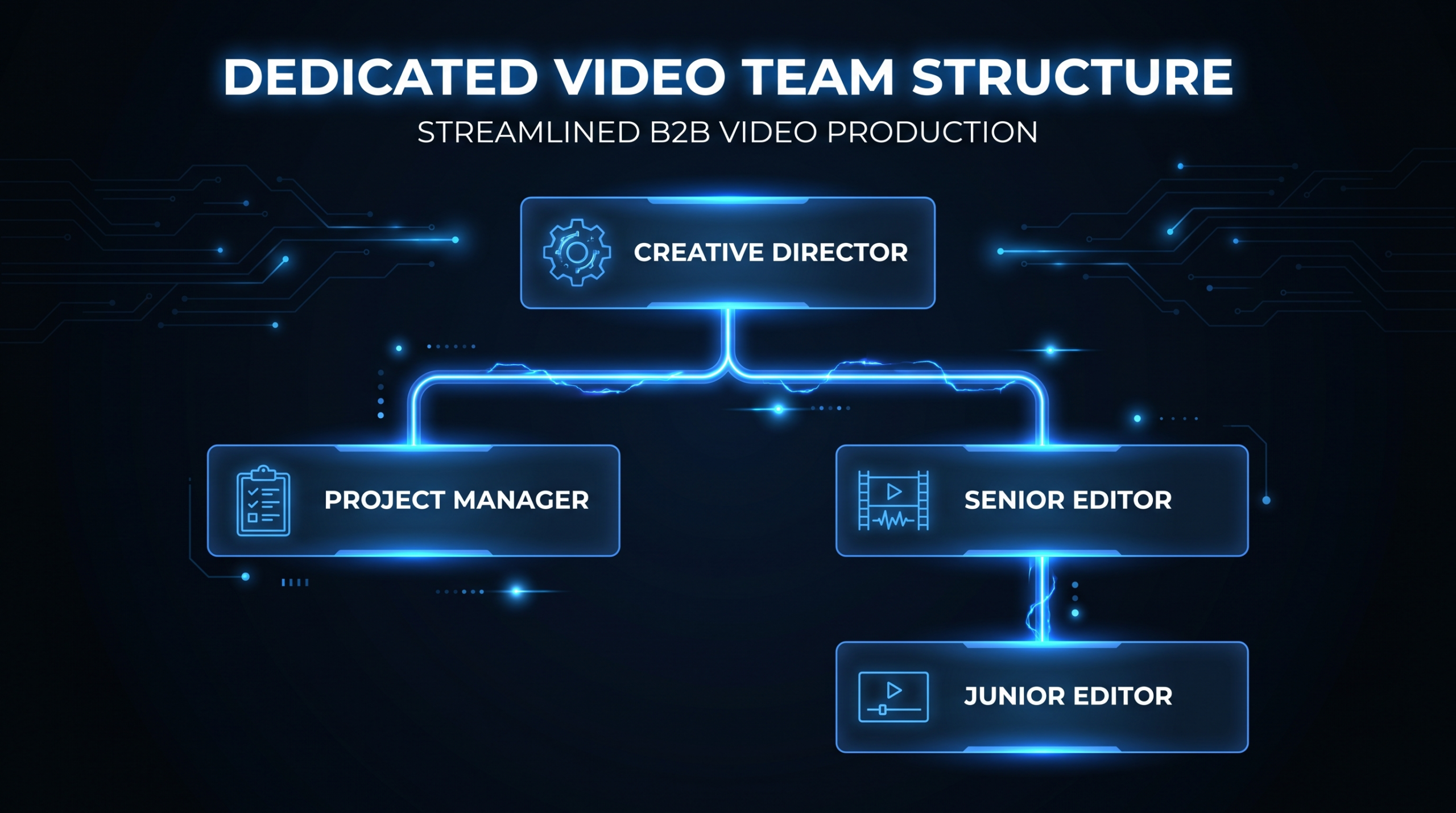
Dedicated video teams are typically structured around a core pod of two to four people. The exact composition depends on your content mix and volume, but most teams share a recognizable shape.
Core Team Roles
Typical Dedicated Video Team Composition
| Role | Responsibility | What You Lose Without Them |
|---|---|---|
| Senior Video Editor | Owns the edit — pacing, story structure, motion graphics, color grade | Consistent quality and creative coherence across all output |
| Junior Video Editor / Assistant | Handles selects, rough cuts, file organization, format variants | Throughput — the senior editor cannot handle volume alone |
| Project Manager | Coordinates briefs, timelines, revisions, client feedback loops | You'd spend 5+ hours per week doing this yourself |
| Creative Director | Shapes visual strategy, maintains brand standards, reviews final cuts | Brand drift over time as editors make micro-decisions without guardrails |
Not every dedicated team includes a creative director — that role is more common in premium tiers and agencies where video strategy is part of the engagement. At the entry level, a team of senior editor + junior editor + PM is the standard starting configuration.
Specialist Add-Ons
Depending on your content mix, dedicated teams often include or add specialists on top of the core pod:
- Motion graphics designer: For SaaS demos, explainers, and animated UI sequences — increasingly standard for product-led SaaS teams
- Sound designer / audio engineer: For podcast-style content, high-polish brand films, or series with custom audio beds
- Subtitling / localization specialist: For multilingual content or accessibility compliance
- Thumbnail designer: For YouTube-first content programs where click-through rate depends on cover art as much as content quality
For a deep dive into how SaaS companies staff and brief video teams for different content types, see our SaaS video production guide.
How a Dedicated Video Team Operates Day-to-Day
A dedicated video team integrates into your workflow — not the other way around. Understanding the operating rhythm is essential before evaluating whether it fits your team's structure.
Onboarding (Weeks 1–3)
The first two to four weeks are an investment period. The team learns your brand kit, tone of voice, motion style, and revision preferences. Most agencies structure this as a formal onboarding sprint: they edit two to three representative videos, you give structured feedback, and they build an internal style guide specific to your account. Output during onboarding is typically 40–60% of full steady-state capacity — plan for this rather than expecting immediate full throughput.
Steady-State Operations
Once onboarded, day-to-day operations follow a predictable rhythm:
- Brief submission: Your team drops briefs via Slack, Notion, Trello, or whatever project management tool you use — with raw footage, script or talking points, and any reference edits
- Queue management: The PM organizes priorities, flags missing assets, and sets delivery dates before work begins
- Production: The senior editor leads the cut; the junior handles selects, B-roll assembly, and lower-thirds
- First cut review: Draft delivered to your team; feedback given async or in a brief sync call
- Final delivery: Approved cut delivered in all required formats — 16:9 hero, 9:16 social, 1:1 square, wherever your content lives
Mature dedicated team relationships commonly reach a point where first-cut approval rates improve significantly — within three to six months, teams that know each other well often need fewer revision rounds per video. This compounding efficiency is one of the core economic arguments for commitment over churn.
Communication Cadence
Most dedicated team engagements include a weekly sync of 30–45 minutes to review the queue, align on priorities, and surface any quality or process feedback. Daily async communication happens in a shared Slack channel or project management tool. Good dedicated teams flag issues proactively — missing footage, unclear briefs, timeline risks — before they become problems rather than after.
For practical guidance on structuring the outsourcing relationship from day one, read our guide on how to outsource video editing effectively.
Dedicated Video Team vs Other Hiring Models
A dedicated video team is one of five ways to staff your video function. Each model has genuine trade-offs that depend on your volume, complexity, and consistency requirements. For a deeper breakdown of how dedicated teams compare specifically against project agencies — including when each model makes sense financially — see our full comparison of dedicated video team vs project agency.
Dedicated Video Team vs Other Hiring Models
| Model | Best For | Brand Consistency | Cost at Scale (15+ videos/mo) | Flexibility |
|---|---|---|---|---|
| Dedicated Team | 12+ videos/month, ongoing programs | Highest — same editors every time | Lowest — fixed team cost doesn't scale linearly with volume | Medium (3–6 mo min) |
| In-House Hire | Proprietary workflows, sensitive footage | Highest — but only until they leave | Highest — salary + benefits + equipment + recruiting risk | High |
| Project Agency | Campaign work, 1–4 videos/quarter | Low — different editors per project | High — per-unit pricing doesn't discount at volume | High (no commitment) |
| Freelancer (marketplace) | Simple edits, tight budgets | Low — varies by availability | Medium per hour, but high management cost | High |
| Video Subscription | High-volume social clips | Medium — sequential queue | Medium — throughput-limited by plan tier | High (month-to-month) |
The In-House vs Dedicated Team Math
Many SaaS companies consider hiring a full-time video editor before pricing out a dedicated team. The comparison rarely favors in-house once you account for the full cost of employment:
In-House vs Dedicated Team: True Cost Comparison
| Cost Component | In-House (Senior Editor, US) | Dedicated Team (Entry Tier) |
|---|---|---|
| Monthly salary / retainer | $6,500–$9,500/mo | Typically starts around $5,000/mo |
| Benefits + payroll taxes | +25–35% (~$1,600–$3,300/mo) | Included |
| Equipment (amortized) | $200–$500/mo | Included |
| Software licenses | $100–$300/mo | Included |
| Backup coverage (sick/vacation) | Not covered — production stops | Covered by the agency |
| Traffic management / PM | Falls to your team | Included |
| Effective monthly cost | ~$8,400–$13,600/mo | Typically $5,000–$10,000/mo |
The in-house model also carries costs that don't appear in the budget: recruiting time (typically 4–8 weeks per hire), training investment, and turnover risk. If your senior editor leaves, you lose the institutional knowledge of your brand alongside the headcount — and restart the ramp-up cycle from zero.
Do You Actually Need a Dedicated Video Team?
A dedicated video team is the right choice for a specific profile of company — not every organization needs one, and the wrong fit leads to underutilization and wasted budget. Here's how to assess whether you're ready.
You're a Good Fit If:
- Volume: You're consistently producing 12 or more videos per month, or have a concrete plan to reach that level within six months
- Consistency: Brand consistency across video output is non-negotiable — different editors producing different-looking videos would visibly damage your brand perception
- Complexity: Your content includes product demos, explainers, or long-form videos that require genuine creative judgment, not just assembly of pre-cut footage
- Growth trajectory: Video is a core channel — not an experiment — and you need reliable throughput to support a content calendar
- Overhead aversion: You want the output of a small video department without the recruiting, HR, and management overhead of building one in-house
You're Not Ready If:
- You produce fewer than 6–8 videos per month — a retainer or subscription model serves you better at this volume without the commitment
- Your video needs are sporadic (one large campaign per quarter, nothing between) — project-based pricing gives you appropriate flexibility without paying for idle capacity
- You don't have organized footage and a reasonably predictable content calendar — a dedicated team runs efficiently on steady input, not bursts
- You need live production (filming, on-location shoots) — most dedicated video teams focus on post-production and editing, not production
See how VEC structures team engagements for different content volumes on our how it works page.
What to Ask Before You Hire a Dedicated Video Team
Not all dedicated video team offerings are built the same. These questions separate genuinely embedded teams from agencies that rebranded a shared queue with nicer marketing language.
Team Structure Questions
- Is this team exclusive to my account? Or are the same editors working across five to ten other clients simultaneously? True dedication means limited or exclusive assignment to your account — not "your editor also works on seven other brands this week."
- Who specifically will edit my videos? Ask for the editor's name, their portfolio, and their experience with your content type. If the agency cannot name the editor upfront, they don't have a dedicated team — they have a queue with a marketing refresh.
- What's the PM-to-client ratio? A project manager handling 15+ accounts cannot give meaningful attention to yours. Aim for eight or fewer accounts per PM.
- What happens if my editor leaves? Dedicated teams should have clear succession protocols — documented style guides, onboarding handoffs, and overlap periods — not just "we'll assign someone new next week."
Process Questions
- How do you handle onboarding? Look for a structured sprint with defined deliverables and a style guide as an output, not just "we'll figure it out together."
- What's the revision policy? Unlimited rounds or a fixed number? What counts as a revision vs. a new version? Ambiguity here creates billing disputes later.
- What tools do you use, and will you adapt to mine? Good teams meet you where you are (Frame.io, Notion, Slack) rather than requiring you to adopt their proprietary portal.
Quality Questions
- Can I see three to six months of output from a single client? Ask for a content archive — not a showreel. The reel shows the best work from many clients; an archive shows consistency over time for one account.
- What's your QA process? Is there a creative director who reviews finals before delivery, or does the first cut go straight to the client? The answer tells you a lot about the team's internal standards.
Wistia's video production learning center covers useful benchmarks on video quality expectations across different content types — worth reviewing before you set your brief standards for a new team relationship.
What Does a Dedicated Video Team Cost?
Dedicated video team pricing varies by team size, editor seniority, output volume, and whether the agency is US-based, offshore, or hybrid. The ranges below reflect typical market conditions as of 2026 — actual pricing depends on your specific content brief and volume requirements.
Dedicated Video Team Pricing Tiers
| Tier | Team Composition | Monthly Range | Typical Output |
|---|---|---|---|
| Entry | Senior editor + PM | $4,000–$7,000/mo | 8–14 videos/month |
| Growth | Sr editor + Jr editor + PM | $7,000–$12,000/mo | 15–25 videos/month |
| Scale | Sr editor + Jr editor + PM + Creative Director | $12,000–$20,000/mo | 20–35 videos/month (complex content) |
| Enterprise | 2–3 editors + animators + PM + CD | $18,000–$30,000+/mo | 35–60+ videos/month |
Video Editing Company's dedicated team plans reflect this structure: Growth at $5K/month, Core at $9.5K/month, and Scale at $16K/month — all including a named team, PM, and a 90-day output guarantee (double your video output in 90 days or month four is free).
Offshore vs US-Based: The Real Trade-Off
Offshore dedicated teams — commonly based in Southeast Asia, Eastern Europe, or Latin America — typically cost 40–65% less than US-based equivalents. The quality gap has narrowed considerably in recent years. Many offshore senior editors have worked in US and UK markets for years, handle English-language content fluently, and bring strong technical skills. The genuine trade-offs are:
- Time zone overlap: An 8–12 hour offset limits real-time collaboration. Async-first workflows manage this well, but it remains a constraint for teams that need rapid iteration on deadline-sensitive content.
- Nuanced brand voice: Subtle cultural context, industry-specific references, and tone-of-voice judgments may need more explicit briefing with offshore teams than with editors embedded in the same market.
- Quality tier ceiling: For high-production brand films and motion-design-heavy explainers, premium US and UK editorial talent still edges ahead. For consistent SaaS demo edits and social clips, offshore teams commonly deliver comparable results at meaningfully lower cost.
HubSpot's video marketing research consistently finds that quality expectations vary significantly by content type — high production value matters more for brand-level content than for tutorial or demo formats, which shapes how you should think about team location relative to your content mix.
What Drives Cost Variation
Within any pricing tier, the factors that most commonly push costs higher are:
- Motion graphics complexity: Animated UI overlays, custom lower-thirds, and branded motion sequences typically add 30–50% to production time per video
- Turnaround requirements: 24-hour delivery commonly commands a premium over 72-hour standard turnaround
- Format variants: Producing three or four format cuts (16:9, 9:16, 1:1, widescreen) from each video multiplies the editing work proportionally
- Footage quality: Well-organized footage with clean audio shortens editing time meaningfully; messy footage with ambient noise and poor lighting takes longer to make watchable
For a detailed breakdown of how pricing scales by video type and service level, see our guide on what's included in video editing services.
Frequently Asked Questions
What is the difference between a dedicated video team and a video subscription?
A dedicated video team assigns the same named editors to your account, giving you consistent brand knowledge and quality that compounds over time. A video subscription routes your requests through a shared pool of editors — whoever is available handles your job. Dedicated teams deliver better brand consistency and handle complex content; subscriptions are faster to start and cheaper for high-volume simple edits like social clips and podcast cuts, but quality varies by editor assignment.
How long does it take a dedicated video team to learn my brand?
Most dedicated video teams reach full brand fluency in four to eight weeks. The first two to three weeks involve a structured onboarding sprint — typically two to three representative videos with close, documented feedback. By week six to eight, first-cut approval rates commonly improve, meaning fewer revision rounds per video. The timeline shortens when clients provide a thorough brand kit and organize their reference footage before onboarding begins.
How many videos per month does a dedicated video team typically produce?
Output capacity depends on team size and video complexity. A standard entry-level team — senior editor plus PM — commonly handles eight to fourteen videos per month for a mix of content types including product demos, social clips, and YouTube edits. Adding a junior editor typically expands capacity to fifteen to twenty-five videos per month. Teams handling simpler content like repurposing and short clips can produce higher volumes; teams focused on animated explainers and high-production content produce fewer but at significantly higher creative complexity.
What contract length do dedicated video teams require?
Most dedicated video team engagements require a minimum commitment of three to six months. This structure protects both parties: the agency invests in onboarding and team assembly, and you get the brand familiarity that only comes from continuity. Some providers offer month-to-month contracts at a premium pricing tier. A three-month minimum is common for entry-level plans; six months is typical for teams that include creative direction and motion design, where the onboarding investment is larger.
Is a dedicated video team worth it for a Series A SaaS company?
For most Series A SaaS companies, a dedicated video team becomes worth the investment when video is a core channel rather than an experiment. If your marketing team is producing product demos, onboarding videos, and social content consistently, and spending 10 or more hours per month managing freelancers or agencies, a dedicated team typically pays for itself in management overhead alone — plus delivers brand consistency that ad-hoc arrangements cannot sustain. The common tipping point is eight to twelve videos per month. Below that, a video retainer or subscription is a better fit; above it, a dedicated team wins on both cost-per-video and consistency.
Ready to Build Your Dedicated Video Team?
Video Editing Company specializes in dedicated video teams for B2B SaaS. Growth, Core, and Scale plans give your marketing team a named editing crew, a project manager, and a 90-day output guarantee — double your video volume or month four is free.
Book a Free Strategy Call See How It Works See Pricing