Healthtech Video Production Cost: 2026 Guide
TL;DR
Healthtech video production typically costs $1,500–$25,000 per video for project-based work, or $3,000–$16,000/month on a dedicated team retainer. The right model depends on your output volume. For Series A–C digital health companies publishing four or more videos a month, a dedicated team retainer almost always beats per-project pricing on a per-video basis. This guide walks through every cost driver, format-by-format price ranges, and the model comparison that saves most healthtech marketing teams meaningful budget.
Table of Contents
Healthtech marketing teams face a production cost problem that general SaaS playbooks don't address. Your videos combine clinical accuracy with fast-moving product demos, regulatory context with emotional patient stories, and enterprise-grade polish with the speed of a startup content calendar. That combination — accuracy-first, brand-consistent, high-cadence — is exactly where generic "video production cost" guides break down.
This guide uses real market ranges (hedged where pricing is opaque), draws on VEC's healthtech video marketing research, and gives you the frameworks to make a defensible budget decision — whether you're pitching a $50K annual video budget to your CFO or evaluating your first agency retainer.
What Drives Healthtech Video Production Costs
Healthtech video costs higher than comparable SaaS video for four structural reasons. Understanding these levers lets you control the budget without sacrificing the elements that actually move pipeline.
1. Accuracy Review Cycles
Clinical claims, drug references, and outcome language typically require at least one round of medical or regulatory review before a video goes live. Each review round that requires re-edit adds time — usually one to three hours of editor time per cycle. Multiply that across a campaign of eight videos and you're looking at a meaningful cost increase versus a pure software demo series. Budget for two review cycles minimum on any video that includes patient outcomes or clinical language.
2. Complexity of the Product Being Demonstrated
A healthtech product demo — whether it's an EHR workflow, a remote monitoring dashboard, or a diagnostic AI tool — typically involves more screen recording, annotation, and motion graphics than a generic SaaS demo. Annotated UI walkthroughs and overlay graphics add post-production hours. Expect product demos in this vertical to cost 20–40% more than equivalent software-category demos, based on typical agency quotes.
3. Voiceover and Talent Requirements
Healthcare and digital health audiences respond to authoritative, credible voices. Many healthtech brands use licensed clinical professionals for voiceover, which commands a premium over standard commercial VO rates. Professional medical voiceover typically ranges from $300–$1,200 per finished minute depending on exclusivity and usage rights, compared to $150–$600/min for general commercial VO.
4. Brand Consistency and Compliance Across a Campaign
Enterprise healthtech buyers — health systems, payers, large clinic groups — require a polished, consistent visual identity across every touchpoint. A one-off video from a generalist freelancer may look fine in isolation but clash with your broader brand system. Inconsistency is a trust signal in the wrong direction for a regulated-market vendor. This consistency requirement pushes most growth-stage healthtech companies toward retainer or dedicated-team models rather than project-by-project production.
Healthtech Video Production Cost Ranges by Format
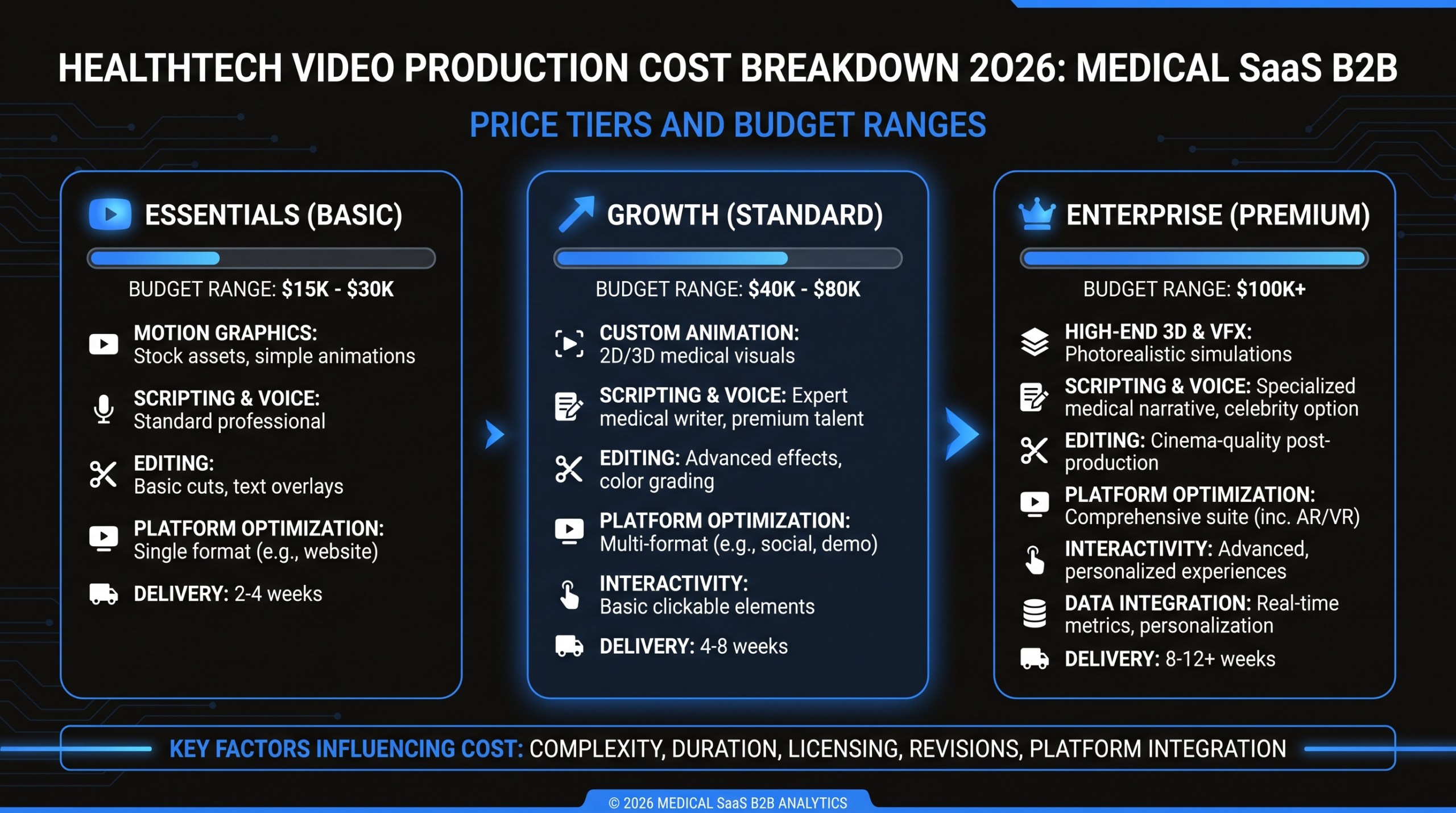
Costs below reflect market ranges based on typical agency and production company rates. Actual quotes will vary based on agency tier, turnaround time, revision rounds, and whether you're providing raw footage or need production as well. All ranges assume post-production only unless noted.
Healthtech Video Cost by Format (2026)
| Video Format | Typical Length | Post-Production Cost Range | Full Production (if needed) |
|---|---|---|---|
| Product demo / UI walkthrough | 2–5 min | $1,500–$6,000 | $4,000–$12,000 |
| Explainer / animated overview | 60–90 sec | $3,000–$9,000 | $6,000–$18,000 |
| Patient story / testimonial | 2–4 min | $2,000–$5,000 | $5,000–$15,000 |
| Thought leadership / webinar edit | 20–60 min | $800–$3,000 | N/A (post only) |
| Social clips (cut-downs) | 15–90 sec | $300–$1,200 per clip | Derived from longer asset |
| Brand / company overview | 1.5–3 min | $3,500–$8,000 | $8,000–$25,000 |
| Conference / event recap | 1–3 min | $1,200–$4,000 | $3,500–$10,000 |
| Animated data visualization | 30–90 sec | $1,500–$5,000 | N/A (animation only) |
These are hedged market estimates based on publicly available agency pricing and industry discussions. Your actual quotes may differ. The ranges intentionally reflect the spread between lean offshore-managed teams and premium US/UK boutique agencies.
For a format-agnostic view of what editing complexity adds to cost, see our breakdown of video editing cost per minute and the explainer video cost breakdown.
Freelancer vs. Agency vs. Dedicated Team: Cost Comparison
The "right" production model for a healthtech marketing team isn't about which is cheapest — it's about which delivers the lowest cost-per-quality-video at your specific output volume. Here's how the three main options compare on the dimensions that matter.
Production Model Comparison for Healthtech Teams
| Model | Typical Monthly Cost | Videos per Month | Effective Cost/Video | Brand Consistency | Accuracy Review Support |
|---|---|---|---|---|---|
| Freelancer (single editor) | $1,500–$5,000 | 2–4 | $500–$1,500 | Low (editor-dependent) | None |
| Project-based agency | $5,000–$20,000 | 2–6 | $2,000–$6,000 | Medium | Ad-hoc |
| Video editing subscription | $2,000–$8,000 | 6–20+ | $300–$1,000 | Medium | None |
| Dedicated team (VEC Growth) | $5,000 | 6–10 | $500–$800 | High (same team) | Structured revision rounds |
| Dedicated team (VEC Core) | $9,500 | 12–20 | $475–$790 | High | Structured revision rounds |
| Dedicated team (VEC Scale) | $16,000 | 20–35 | $450–$800 | High | Structured revision rounds |
The Freelancer Model
Freelancers are the lowest-friction entry point. Platforms like Upwork and Contra make it easy to find editors with healthcare or SaaS experience. The ceiling, however, is real: a single editor has limited bandwidth, will get sick, will take holidays, and has no PM layer to catch accuracy issues before they reach your clinical stakeholders. For a two-videos-per-month program, freelancers are often the right call. At five or more per month, the coordination overhead and consistency risk start to outweigh the cost savings.
The Project-Based Agency Model
Traditional agencies offer creative direction, production, and post-production under one roof. The premium reflects their overhead and creative director time. For one-off brand videos or a major launch campaign, project-based agencies deliver strong results. For an ongoing content calendar, the per-video cost and the ramp-up time on each new brief make this model inefficient. You're paying for agency overhead on every deliverable, even when the brief is straightforward.
The Dedicated Team Model
A dedicated team — a senior editor, junior editor, project manager, and creative director assigned exclusively to your account — is the model purpose-built for high-cadence content programs. The team learns your product, brand system, and terminology over time. Brief quality improves. Revision rounds shrink. For healthtech specifically, a team that has edited thirty of your product demos understands your UI conventions without explanation. VEC's dedicated team model is structured around this compounding familiarity effect, with plans starting at $5K/month and a guarantee of doubling your video output in 90 days or month 4 is free.
To understand the broader outsourcing decision framework, our guide on how to outsource video editing covers the evaluation criteria in detail.
Hidden Costs Healthtech Marketing Teams Miss
The quoted price for a video is rarely the total cost. These line items appear in almost every healthtech video program and are frequently underbudgeted in year-one plans.
Stock Footage and Licensed Assets
Medical and clinical stock footage is significantly more expensive than general commercial footage. Authentic patient environments, clinical settings, and healthcare professional imagery command premiums on platforms like Getty, Pond5, and Shutterstock. Budget $200–$800 per video for stock, versus $50–$200 for a typical SaaS explainer. For campaigns built around real-world clinical imagery, stock costs can exceed editing costs on shorter formats.
Voiceover Production
Many healthtech teams underestimate VO costs because they assume their internal team can record narration. Professional VO — with a vetted medical communicator, studio-quality audio, and proper licensing — typically adds $400–$1,500 per video. If you're localizing into Spanish, Mandarin, or other languages for specific market segments, multiply accordingly. Wyzowl's annual video marketing reports note that professional narration consistently ranks among the top production elements that affect perceived video quality.
Review and Revision Overhead
Each stakeholder round that generates revision requests costs real money. On a dedicated team retainer, revision rounds within your plan's scope are typically included. On a project-based model, round 3 and beyond are often billed at hourly rates. For a series of eight clinical videos going through legal, medical, and marketing review, the unbounded revision structure of a project model can add 30–50% to your initial quote.
Asset Management and File Delivery
Professional video production generates a large volume of source files, exports, proxies, and archive versions. If you're building a content library — which most Series B+ healthtech teams should be — you need a structured delivery system. Factor in platform costs (Frame.io, Dropbox Business, or equivalent) and internal time to organize and tag assets. This isn't a production cost per se, but it's real operational spend that belongs in your video program budget.
Distribution and Optimization
A produced video has to reach its audience. Platform-specific cuts (16:9 for YouTube, 9:16 for LinkedIn Stories, 1:1 for Instagram), caption files, and thumbnail design are often quoted separately from the main edit. For a seven-video launch campaign, budget $150–$500 per video for reformats and captions. Wistia's research on video engagement consistently shows that captions improve average watch time — an ROI-relevant consideration for gated video content in the healthtech buying journey.
How to Budget for Healthtech Video in 2026
Most healthtech marketing teams approach video budgeting bottom-up: estimate the number of videos needed, find a per-video cost, multiply. The problem is this ignores the efficiency curve — your effective cost per video drops significantly as volume increases and as a production team learns your brand. Here's a more accurate framework.
Step 1: Define Your Minimum Viable Video Program
What are the videos your revenue program cannot function without in the next 12 months? Typically: product demo (1–2 versions), explainer overview (1), customer stories (3–5), and social cut-downs derived from the above. That's roughly 8–15 videos as a baseline. At project-based agency rates, budget $40,000–$120,000. At a dedicated team retainer, the same program typically fits within $60,000–$90,000 annually — and the team improves with every delivery.
Step 2: Model the Cost Curve
Run the math on the crossover point: at what monthly video volume does a retainer beat per-project pricing? For most healthtech teams, the answer is somewhere between four and six videos per month. Below that, project-based or hybrid works. Above that, a retainer or dedicated team almost always wins on cost-per-delivered-video. See our video production agency pricing models guide for the full cost model comparison.
Step 3: Plan for the Ramp Period
Any new production relationship — whether freelancer, agency, or dedicated team — has a 30–60 day ramp period where brief quality is lower and revision rounds are higher. Budget 15–20% more for the first two months than your steady-state estimate. Well-run agencies build this into their onboarding; less organized relationships leave it as a surprise invoice.
Step 4: Build In a Surge Reserve
Healthtech content programs almost always have a conference season (HIMSS, ViVE, HLTH) and a product launch moment that requires burst capacity. Ensure your retainer has overflow provisions or that your agency relationship allows for surge projects at predictable rates. For a VEC Core or Scale plan, surge capacity is built into the dedicated team structure.
When a Dedicated Team Beats Per-Project Pricing
The clearest signal that you've outgrown per-project or freelance production is when your team spends more time briefing, reviewing, and revising than it does planning the next campaign. That's a workflow tax that compounds as your content volume grows.
A dedicated team model specifically changes three economics:
- Brief compression: After 60 days, a dedicated team needs 30% fewer words in a brief to deliver a correct first cut — they already know your UI conventions, brand voice, and reviewer preferences.
- Revision reduction: Teams report that round-one acceptance rates improve meaningfully over the first three months of a dedicated team arrangement, versus consistently high revision rates with rotating freelancers.
- Throughput scaling: A dedicated team can absorb a 2x surge in content requests without the sourcing, briefing, and quality-checking overhead of finding new freelancers for overflow.
VEC's model — senior editor + junior editor + PM + creative director, dedicated to your account — is designed for exactly this pattern. The 90-day output guarantee ("double your video output in 90 days or month 4 is free") reflects the measurable efficiency gains most teams see once the ramp period ends.
For healthtech marketing leaders building a sustainable content engine — not just solving a single campaign — the per-video cost math consistently favors a dedicated arrangement at any volume above four to six videos per month. For context on the full healthtech video strategy picture, see our guide on video marketing for healthtech and digital health SaaS.
For teams evaluating what's typically included in a professional editing engagement before committing, our overview of video editing services — what's included covers the standard service components.
Frequently Asked Questions
How much does a typical healthtech product demo video cost to produce?
A healthtech product demo video typically costs $1,500–$6,000 for post-production only (if you provide the screen recordings and raw footage), or $4,000–$12,000 if the agency handles full production including scripting and recording. The range reflects complexity: a simple UI walkthrough with basic motion graphics sits at the lower end; a multi-feature demo with clinical workflow annotations, custom lower-thirds, and multiple revision rounds sits at the upper end. Factor in two review cycles for any video that includes clinical or regulatory language.
Is a monthly retainer or per-project pricing better for a healthtech startup?
For early-stage healthtech startups producing fewer than three to four videos per month, per-project or freelance is usually the right call — it preserves cash and keeps you flexible. Once you're consistently producing five or more videos per month, or when brand consistency across a campaign has become a visible problem, a monthly retainer almost always delivers a lower effective cost per video while improving quality and turnaround time. The crossover math is straightforward: run your average monthly video count against a retainer's effective per-video rate and compare to your current project invoices.
Do healthtech video production costs differ from regular SaaS video costs?
Yes, typically by 20–40% for comparable formats. The main drivers are: more complex product UI requiring additional annotation and motion graphics, accuracy review cycles that add post-production hours, and premium voiceover rates for medical communicators. Stock footage costs are also higher in the healthcare visual library category. These aren't reasons to avoid investing — they're line items to plan for explicitly in your budget model.
What should I include in a healthtech video production budget for the year?
A complete annual video program budget should include: core production costs (editing, motion graphics, voiceover), stock footage and licensed assets, revision and review rounds beyond initial scope, platform-specific reformats and captions, asset management and delivery infrastructure, and a 15–20% surge reserve for conference season and product launches. Many healthtech marketing teams budget only the production line item and find themselves 30–40% over budget by Q3 when stock, VO, and revision costs surface.
How does VEC price its healthtech video editing plans?
VEC offers three dedicated team plans: Growth at $5,000/month, Core at $9,500/month, and Scale at $16,000/month. Each plan provides a dedicated team (senior editor, junior editor, project manager, creative director) assigned to your account. The plans come with a guarantee: double your video output in 90 days or month 4 is free. For healthtech teams, dedicated team plans are particularly effective because the same editors learn your product UI, brand guidelines, and clinical terminology — dramatically reducing brief time and revision rounds after the first 60 days.
Get a Clear Cost Estimate for Your Healthtech Video Program
Stop guessing at production costs. In a 30-minute strategy call, VEC will map your current video volume to the right model — freelance, project-based, or dedicated team — and give you a defensible budget number to bring to your next planning meeting.
Book a Free Strategy Call See VEC Pricing Plans