YouTube vs LinkedIn for B2B Video: 2026
TL;DR
LinkedIn is now the #1 B2B video distribution channel, with 81% of teams using it as their primary video platform — surpassing YouTube's 76%, according to Wistia's 2026 State of Video Report.
But the real answer isn't LinkedIn vs YouTube. It's LinkedIn for demand capture + YouTube for long-cycle education. Your buyers are on both. Your strategy should be too.
Short version: LinkedIn wins for pipeline-stage content and professional targeting. YouTube wins for search-driven discovery, long-form education, and evergreen SEO value. The platforms serve different moments in the same buyer journey.
Table of Contents
- The State of B2B Video Distribution in 2026
- YouTube for B2B: Search Engine, Not Social Network
- LinkedIn for B2B: Where the Decision-Makers Are
- Head-to-Head: YouTube vs LinkedIn for B2B Video
- Which Platform Wins for Each Video Type
- Format Specs: What Each Platform Actually Requires
- Budget and ROI Considerations
- Building a Dual-Platform Distribution Strategy
- FAQ
The "where should we post B2B video?" debate has a 2026 answer that surprises most marketing leaders: LinkedIn. But framing it as a winner-takes-all contest misses the real strategic opportunity.
B2B buying decisions take months. Your buyers encounter multiple pieces of content before they convert. A VP of Marketing who watches your 12-minute YouTube explainer on product integration in January may see your LinkedIn demo clip in March and book a call in April. Both touchpoints mattered. Neither platform "won."
This guide breaks down exactly what each platform delivers for B2B video — audience, format requirements, content fit, and cost dynamics — so your team can make allocation decisions based on data, not platform loyalty.
The State of B2B Video Distribution in 2026
The video distribution landscape has shifted significantly over the past two years. According to Wistia's 2026 State of Video Report — which surveyed 900+ professionals and analyzed millions of video sessions — LinkedIn has overtaken YouTube as the primary B2B video distribution channel.
Key findings from their research:
- 81% of B2B teams now cite LinkedIn as their primary video platform
- 76% use YouTube as a video distribution channel
- Company websites remain the most common destination (67%), followed by email (49%)
- Social media engagement has become the fastest-rising video success metric — nearly double the share from the prior year
This doesn't mean YouTube is losing relevance. It means LinkedIn has matured into a genuine video-first professional platform, while YouTube continues to dominate search-driven discovery and long-form content consumption.
The strategic implication: B2B teams distributing video on only one of these platforms are leaving pipeline on the table. The question isn't which platform — it's which content format belongs where.
To understand where to publish B2B videos and why the right answer spans multiple channels, you first need to understand what each platform is actually built for.
YouTube for B2B: Search Engine, Not Social Network
The most important mindset shift for B2B teams using YouTube: treat it as a search engine, not a social network. YouTube is the world's second-largest search engine, and its algorithm is primarily driven by intent — what people are searching for, not who they're connected to.
What YouTube Actually Delivers for B2B
YouTube's B2B value proposition is built on three pillars:
Search-driven discovery. When a VP of Operations searches "how to build a video content calendar for SaaS," YouTube surfaces relevant videos to people who are actively seeking that information. This is fundamentally different from LinkedIn's feed-based delivery, where content appears in front of people who may or may not be in a research mindset at that moment.
Long-form tolerance. YouTube audiences will watch 10, 20, even 45-minute videos if the content delivers. This makes YouTube the right home for detailed product walkthroughs, deep-dive case studies, webinar replays, and explainer series that require sustained attention. LinkedIn's native video player is optimized for feeds — anything over a few minutes fights against the scroll.
Evergreen compounding value. A YouTube video published today can generate organic views for years if it ranks well for a search term. LinkedIn posts have a lifespan measured in days. For B2B teams building long-term content assets, YouTube's SEO shelf-life is a structural advantage.
YouTube's B2B Limitations
Where YouTube falls short for B2B distribution:
- No professional targeting at the content level. You can target audiences with YouTube Ads, but organic YouTube views don't filter by job title, company size, or industry. A video about enterprise procurement software will attract viewers across the full intent spectrum — students, researchers, and your actual buyers all land in the same feed.
- Discovery requires volume or virality. New YouTube channels without subscriber bases or search rankings face a cold-start problem. Without consistent publishing over 6–12 months, organic reach builds slowly.
- Lower engagement signals per view. YouTube viewers don't commonly like, comment, or subscribe at rates comparable to LinkedIn's professional network. Passive consumption is more common.
Best-Fit B2B Content for YouTube
- Product explainer and demo videos (longer format)
- Thought leadership series with ongoing episodes
- Webinar replays and on-demand courses
- How-to guides targeting specific search queries
- Customer case study documentaries (5–15 min)
- YouTube Shorts for discovery, driving subscriptions to your long-form library
LinkedIn for B2B: Where the Decision-Makers Are
LinkedIn's advantage is audience quality, not audience size. With roughly 1 billion members globally as of 2026 — the majority of whom are professionals — LinkedIn offers something YouTube cannot: contextual reach to people in a professional mindset.
What LinkedIn Actually Delivers for B2B
Professional context and intent. A user scrolling LinkedIn at 9 AM on a Tuesday is in work mode. When they encounter a video about improving their team's video production workflow, they're primed to engage because it fits their current headspace. This professional context makes LinkedIn video more likely to generate qualified engagements — saves, shares, comment threads from actual decision-makers.
Network amplification. LinkedIn's algorithm rewards content that generates early engagement from your immediate network. When a video resonates with your followers — who are typically colleagues, clients, and professional peers — it gets amplified to their networks. This creates a natural B2B distribution effect: your content spreads through professional graphs that map closely to your actual buyer personas.
Short-form dominance with the right content. Research from Whitehat SEO's 2026 benchmarks indicates LinkedIn videos under 30 seconds achieve significantly higher completion rates than longer formats. This isn't a limitation — it's a content design insight. LinkedIn video that opens with the core insight or hook immediately outperforms content that builds to the point.
Direct integration with outreach. Unlike YouTube, where the path from video view to sales conversation requires multiple steps, LinkedIn video can sit directly in a connection request, a DM follow-up, or an InMail — collapsing the distance between awareness and pipeline.
LinkedIn's B2B Limitations
- Short shelf life. LinkedIn posts typically peak within 24–72 hours of publishing. There's no equivalent to YouTube's "people are still finding this video from two years ago via search." LinkedIn video is for now, not forever.
- Algorithm favors creators with existing audiences. LinkedIn's feed algorithm rewards accounts with strong engagement histories. New brand accounts without followers face the same cold-start problem as new YouTube channels, but with less time to prove value before the content disappears.
- No long-form tolerance. Trying to get a 12-minute product walkthrough to perform on LinkedIn is fighting the platform's design. The format pressure toward short, punchy content is real.
Best-Fit B2B Content for LinkedIn
- Short thought-leadership clips (60–90 seconds)
- Before/after case study snippets
- Product demo excerpts (under 2 minutes)
- Team culture and behind-the-scenes content
- Event highlight reels
- Repurposed long-form sections cut to self-contained insights
Head-to-Head: YouTube vs LinkedIn for B2B Video
Here's how the platforms compare across the dimensions that matter most for B2B video distribution decisions:
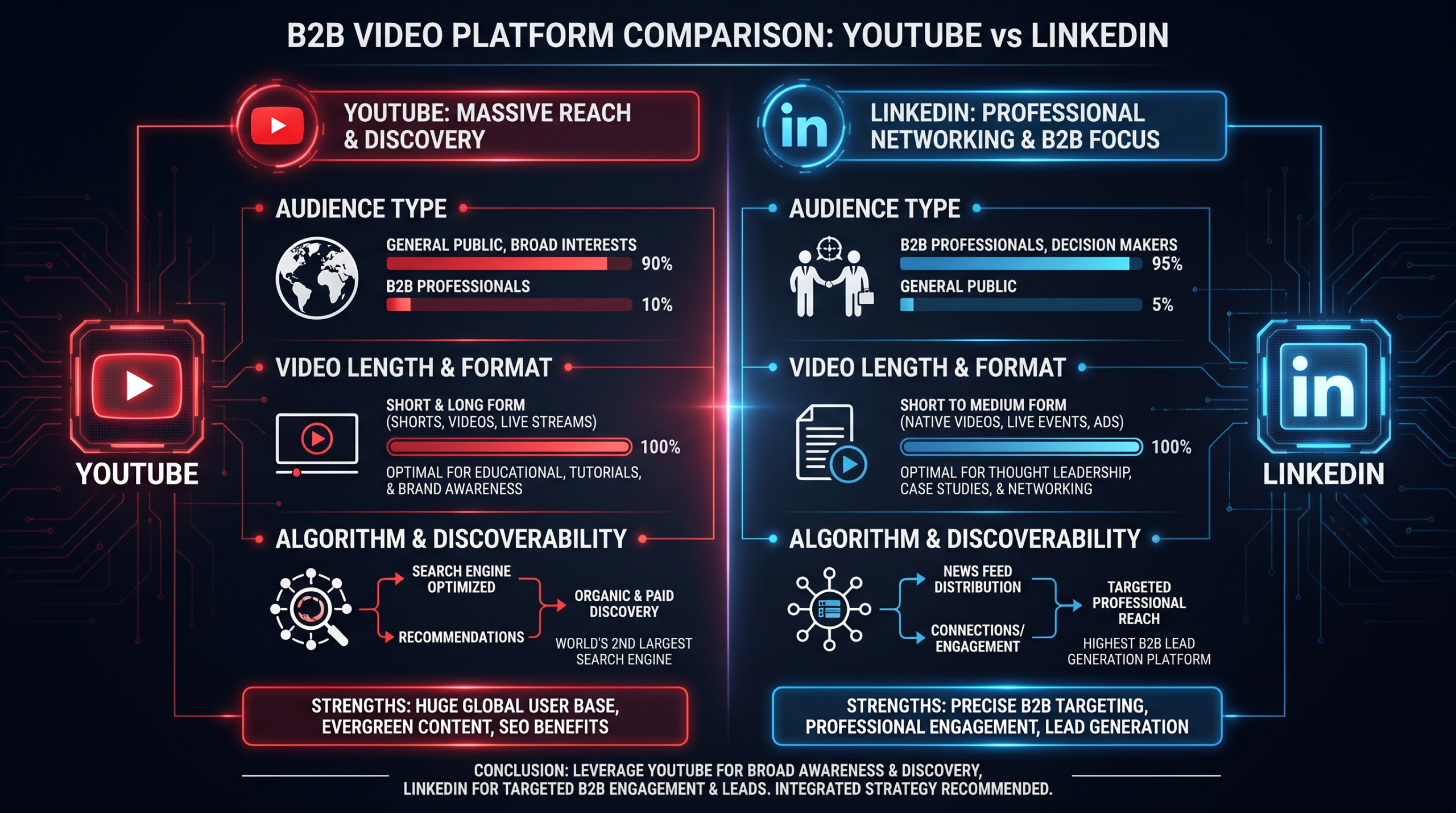
YouTube vs LinkedIn: B2B Video Platform Comparison
| Factor | YouTube | |
|---|---|---|
| Primary discovery mechanism | Search + algorithm | Feed + network graph |
| Content shelf life | Months to years (SEO) | Days (24–72 hr peak) |
| Optimal video length | 5–20 min (long-form); <60s (Shorts) | Under 30s (highest completion); up to 5 min workable |
| Professional targeting (organic) | None | By connection network + industry context |
| Professional targeting (paid) | By interest + demographics | By job title, company size, industry, seniority |
| Engagement type | Passive (views, watch time) | Active (comments, shares, DMs, saves) |
| B2B adoption (Wistia 2026) | 76% of teams | 81% of teams |
| Ideal buyer stage | Awareness + deep consideration | Awareness + decision (network-triggered) |
| SEO / search value | High — Google indexes YouTube videos | Low — posts rarely rank in Google search |
| Content reuse | Long-form source → cut for LinkedIn | Short clips that tease the full YouTube video |
| Analytics depth | Detailed (watch time, retention curves, traffic source) | Basic (views, impressions, engagement rate) |
| Organic reach for new accounts | Slow build (6–12 months typical) | Faster early traction via network |
Which Platform Wins for Each Video Type
The platform-content match is more predictable than most teams realize. Here's where each video type performs better, based on format fit and audience intent:
Video Type vs Optimal Platform
| Video Type | Better Platform | Why |
|---|---|---|
| Product demo (full, 5–15 min) | YouTube | Long-form tolerance, searchable, evergreen |
| Product demo excerpt (60–90s) | Feed-native length, professional context | |
| Customer testimonial (2–4 min) | Both | Full version on YouTube; 60s cut on LinkedIn |
| Explainer / how-to (educational) | YouTube | Search-driven discovery, evergreen SEO value |
| Thought leadership clip | Network amplification, professional mindset | |
| Webinar replay (on-demand) | YouTube | Long-form, discoverable via search months later |
| Event highlight reel (60–90s) | Recency-driven, network-relevant | |
| Case study documentary (5–12 min) | YouTube | Length, SEO potential for company-name searches |
| Team culture / behind-the-scenes | Employer brand context, professional network | |
| Sales enablement clip (for outreach) | Direct integration with DMs and InMail workflows |
The pattern is consistent: depth content lives on YouTube; moment content lives on LinkedIn. The most efficient content teams build long-form videos for YouTube, then repurpose 60–90 second excerpts for LinkedIn — each clip functioning as a self-contained insight that also drives traffic back to the full video.
For a systematic approach to this kind of repurposing across channels, see our guide to B2B video distribution strategy.
Format Specs: What Each Platform Actually Requires
Getting specs wrong wastes editing time and degrades video quality on upload. Here are the current technical requirements for both platforms in 2026:
YouTube Video Specifications (2026)
| Spec | YouTube Standard | YouTube Shorts |
|---|---|---|
| Aspect ratio | 16:9 (recommended); 1:1 and 4:3 supported | 9:16 (vertical required) |
| Resolution | 1080p minimum recommended; 4K supported | 1080×1920 recommended |
| File formats | MP4 (recommended), MOV, AVI, WMV, MPEG-2/4 | Same as standard |
| Max file size | 256 GB | 256 GB (≤60 seconds) |
| Max length | 12 hours (verified accounts) | 60 seconds |
| Audio | AAC or MP3, stereo | Same |
| Captions | Auto-generated + manual upload (SRT) | Auto-generated |
LinkedIn Video Specifications (2026)
| Spec | LinkedIn Organic Post | LinkedIn Video Ad |
|---|---|---|
| Aspect ratio | 16:9 (landscape), 4:5 (portrait — recommended for mobile), 9:16 (vertical) | 16:9, 1:1, 4:5, 9:16 |
| Resolution | 720p minimum; 1080p recommended | 720p minimum |
| File formats | MP4 (recommended), MOV, AVI | MP4 only |
| Max file size | 5 GB | 200 MB |
| Max length | 15 minutes | 30 minutes |
| Audio | AAC recommended; videos autoplay muted — captions essential | Same |
| Captions | Auto-generated + SRT upload; critical (most watched muted) | SRT file recommended |
Critical Format Notes for Each Platform
LinkedIn caption non-negotiable. LinkedIn videos autoplay muted in the feed. Without captions, a meaningful portion of viewers will scroll past before the audio context registers. If your team isn't adding captions to every LinkedIn video as a default, you're suppressing reach.
LinkedIn's 4:5 ratio advantage. For mobile feed — where the majority of LinkedIn engagement happens — a 4:5 (portrait) crop occupies more screen real estate than 16:9 landscape. Teams originally editing for YouTube's 16:9 format should plan a crop/reframe step when repurposing for LinkedIn.
YouTube thumbnail as a conversion lever. YouTube is the only major video platform where a custom thumbnail directly influences click-through rate before the video plays. Treat thumbnails as a design asset, not an afterthought — they're often the decisive factor between a click and a skip.
For teams managing multi-format delivery efficiently, the right video distribution tools can handle format conversion and platform-specific exports without manual rework.
Budget and ROI Considerations
Where you distribute video affects both production costs (format requirements) and paid amplification economics.
Organic Production Cost Differences
Long-form YouTube content typically costs more to produce per video than short LinkedIn clips — but amortizes over a longer useful life. A 10-minute explainer video that ranks in YouTube search for 24 months at modest volume may deliver more total impressions than 24 monthly LinkedIn clips at comparable production cost.
Short LinkedIn videos, while cheaper per unit, require consistent publishing cadence to maintain feed presence. The cost model is subscription-like: you need a steady stream to stay visible.
Paid Distribution Cost Benchmarks
For teams using paid amplification, the economics differ substantially:
YouTube vs LinkedIn Paid Video: Cost Benchmarks (B2B, 2026)
| Metric | YouTube (B2B) | LinkedIn Video Ads |
|---|---|---|
| CPM (cost per 1,000 impressions) | ~$16–21 (B2B benchmark) | ~$60–120 (B2B targeting) |
| CPV (cost per view) | ~$0.04 skippable (B2B) | N/A (impression-based) |
| Audience targeting precision | Interest + demographics | Job title, company, seniority, industry |
| Typical B2B use case | Awareness, retargeting | ABM, role-specific campaigns, pipeline acceleration |
| Minimum viable daily budget | ~$10 | ~$10 (though most B2B campaigns run $50–200+/day) |
Note: YouTube CPM figures are drawn from B2B benchmark reporting from Grou Global's 2026 B2B YouTube ads analysis; LinkedIn CPMs vary significantly based on audience specificity and competition.
The core tradeoff: YouTube is cheaper per impression, LinkedIn is more precise per impression. A $5,000 YouTube campaign reaches a large, somewhat-filtered audience. A $5,000 LinkedIn campaign reaches a much smaller, highly-filtered audience of the specific job titles and company sizes you're targeting.
For most B2B teams, the right paid mix depends on funnel stage: YouTube for top-of-funnel awareness at scale, LinkedIn for mid-funnel targeting of actual buying personas.
Production Efficiency: The Repurposing Multiplier
The most cost-efficient approach for B2B video teams in 2026 isn't choosing a platform — it's building a production workflow that serves both. Here's how VEC structures this for clients:
- Produce the long-form asset (YouTube-primary, 8–15 minutes)
- Identify 3–5 self-contained moments of 45–90 seconds each
- Recut each moment as a standalone LinkedIn clip with added captions and 4:5 crop
- Use the LinkedIn clips to drive traffic back to the full YouTube video
One production investment creates assets for both platforms. This approach is detailed further in our SaaS video production guide. Teams that can consistently execute this repurposing workflow are the ones getting the most distribution leverage per production dollar. If your team is spending time on manual rework rather than strategic repurposing, that's where outsourcing the editing function makes the most financial sense — see how VEC's dedicated team model works.
Building a Dual-Platform Distribution Strategy
The question isn't YouTube or LinkedIn — it's how to allocate effort between them based on your team's current stage.
Stage 1: Single-Platform Foundation (Months 1–3)
If your team is starting from scratch, pick one platform and build the habit. For most B2B SaaS companies, LinkedIn is the faster path to early traction — network effects help new content surface without a subscriber base or search authority. Build your posting cadence and learn what resonates before adding the complexity of a second channel.
Stage 2: Add the Second Platform (Months 4–6)
Once you have a working LinkedIn cadence and some content learning, begin publishing to YouTube using your longer LinkedIn videos or webinar recordings as a starting library. YouTube's algorithm rewards consistency over virality — post weekly and let search authority build over time.
Stage 3: Integrated Repurposing Pipeline (Month 6+)
At this stage, your production workflow produces for YouTube first and LinkedIn second as a default. Every long-form YouTube video generates 3–5 LinkedIn clips. LinkedIn clips drive clicks to the full YouTube video. YouTube search drives awareness; LinkedIn network drives pipeline conversations. Both channels compound over time.
For the full channel selection framework across more than just YouTube and LinkedIn, see our guide to where to publish B2B videos.
Teams that treat YouTube and LinkedIn as competing choices are leaving distribution leverage on the table. The most efficient B2B video programs use both — and build production workflows that make dual-platform distribution the default, not the exception.
The Metrics That Actually Matter for Each Platform
Measuring the same metrics across both platforms leads to false comparisons. Here's what to actually track:
Metrics That Matter: YouTube vs LinkedIn
| Goal | YouTube Metric | LinkedIn Metric |
|---|---|---|
| Awareness | Impressions, unique viewers | Reach, impressions |
| Content quality | Average view duration, retention curve | Completion rate, 25%/50%/75% thresholds |
| Engagement | Likes, comments, shares | Reactions, comments, reposts, saves |
| Channel growth | Subscriber growth rate | Follower growth, connection requests |
| Pipeline contribution | Traffic to website from YouTube | Profile views, DMs, InMail conversion |
| SEO value | Search impressions, rankings for target queries | Not applicable |
The most underrated metric for B2B YouTube: average view duration on your longest videos. If a 12-minute product explainer averages 7 minutes watched, that's 7 minutes of focused attention from someone actively researching your solution. No other organic channel produces that kind of sustained engagement at scale.
For a deeper look at the tools that support multi-channel distribution tracking and scheduling, our video distribution tools comparison covers the current options.
Frequently Asked Questions
Is LinkedIn or YouTube better for B2B video in 2026?
Both platforms play different roles in the B2B buyer journey, so "better" depends on your goal. According to Wistia's 2026 State of Video Report, 81% of B2B teams use LinkedIn as their primary video channel vs 76% for YouTube — so LinkedIn has a slight edge in adoption. But YouTube's search-driven discovery and evergreen SEO value make it the stronger choice for long-form, educational content. Most mature B2B teams use both: YouTube for long-form depth content, LinkedIn for short-form demand capture and professional network reach.
What video length works best on LinkedIn vs YouTube?
LinkedIn performs best with videos under 30 seconds, which achieve meaningfully higher completion rates than longer formats in feed environments. Anything up to 2–3 minutes can work if the opening 5 seconds hook the viewer. YouTube is the opposite: long-form content (8–20 minutes) performs well for educational and product topics because viewers arrive with intent, not just scrolling. YouTube Shorts (under 60 seconds) serve a discovery function to build subscribers for your long-form library.
Should I repurpose YouTube videos for LinkedIn or create separate content?
Repurposing is the right default. Produce your long-form content for YouTube, then identify 3–5 self-contained moments of 45–90 seconds each, recut them with captions and a 4:5 crop, and publish to LinkedIn. Each clip should stand alone as a complete thought — not a "watch the full video" teaser. This approach delivers platform-native content for both channels without doubling your production budget.
Which platform is better for B2B paid video advertising?
YouTube is cheaper per impression but less precisely targeted. LinkedIn is significantly more expensive per impression (CPMs typically run $60–120+ for B2B targeting vs $16–21 for YouTube) but offers targeting by job title, company size, seniority, and industry that YouTube can't match. Most B2B teams use YouTube ads for top-of-funnel awareness at scale and LinkedIn for mid-funnel ABM campaigns targeting specific buying personas at named accounts.
How do I measure whether my B2B video distribution is working?
Use different success metrics for each platform: on YouTube, track average view duration and search-driven traffic to your website; on LinkedIn, track completion rates, profile views from video content, and inbound DMs or connection requests from target personas. The channel-to-pipeline attribution step — connecting video engagement to CRM opportunities — requires integrating your video analytics with your CRM. Fewer than half of B2B marketing teams do this, per Wistia's 2026 research, despite the clear ROI signal it provides.
Getting Video on Both Channels Without Burning Headcount
Running a dual-platform video strategy — long-form YouTube plus consistent LinkedIn — requires a production and editing operation that most in-house teams can't sustain alone. VEC's dedicated teams handle the full editing and repurposing pipeline: one long-form YouTube video becomes 4–5 LinkedIn-ready clips on a consistent schedule, with captions, crops, and format optimization included. Growth plan at $5K/month, Core at $9.5K/month, Scale at $16K/month — 90-day output guarantee included.
Book a Free Strategy Call See Pricing Plans