Where to Publish B2B Videos: Channel Guide
TL;DR
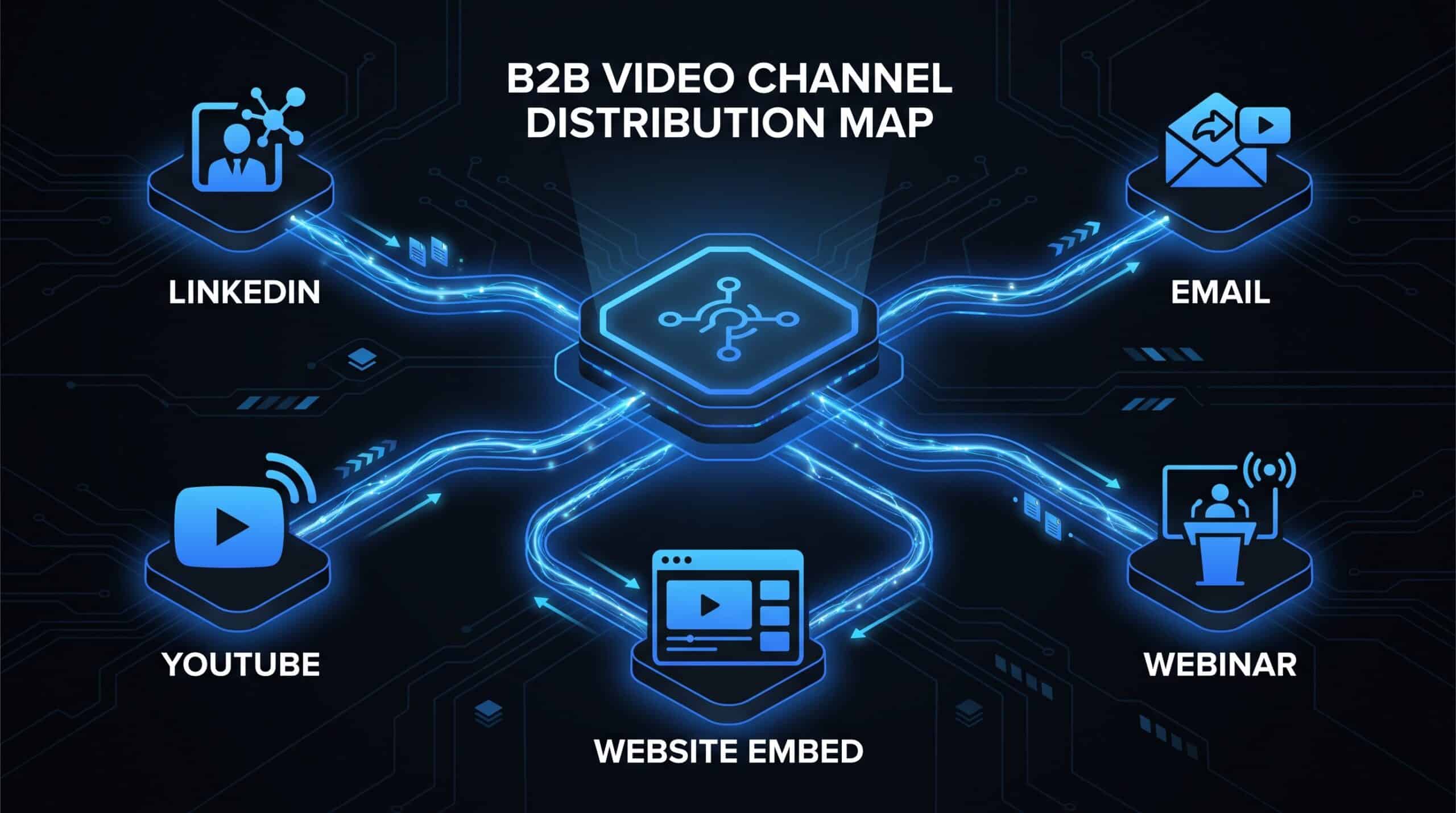
For most B2B SaaS companies, the highest-ROI video distribution channels are: LinkedIn for top-of-funnel reach, YouTube for search-intent authority, your website for conversion, and sales enablement tools for deal acceleration. Email and paid amplification layer on top once you have production volume. Don't spread thin — master two channels first, then expand.
Table of Contents
- Why Channel Selection Determines Your Video ROI
- Channel 1: LinkedIn — B2B Organic Home Base
- Channel 2: YouTube — Search Intent and Long-Form Authority
- Channel 3: Your Website — The Highest-Conversion Placement
- Channel 4: Email — Pipeline Acceleration
- Channel 5: Sales Enablement — Deal-Level Distribution
- Channel 6: Webinars and Virtual Events
- Paid Amplification: When and How to Spend
- Channel Comparison Table
- Content-to-Channel Fit: What to Publish Where
- Building Your B2B Distribution Stack
- FAQ
You've invested in video production. The editing is done, the content is polished. Now the question that determines whether that investment pays off: where do you actually put it?
B2B video distribution is where most marketing teams leave money on the table. They upload to YouTube, post once on LinkedIn, and call it done. Meanwhile, the same piece of content could have accelerated three deals in the sales pipeline, captured 40 inbound leads via organic search, and shortened the sales cycle for five existing prospects.
This channel guide breaks down every major B2B video distribution channel, what it's actually good for, and how to match your content types to the right platform. The goal: maximum impact from every video dollar you spend. For a deeper look at the tools that make multi-channel distribution manageable, see our video distribution tools comparison.
Why Channel Selection Determines Your Video ROI
The right content in the wrong channel is still a failure. A detailed product walkthrough on TikTok reaches the wrong audience. A 90-second brand video buried in a mid-funnel email sequence gets ignored. Channel selection isn't logistics — it's strategy.
B2B video distribution operates across three distinct buyer journey phases, each requiring different channel approaches:
- Awareness (top-of-funnel): Channels where your audience discovers you — LinkedIn organic, YouTube search, paid social
- Consideration (mid-funnel): Channels where prospects evaluate you — your website, email, webinar recordings
- Decision (bottom-of-funnel): Channels that close deals — sales enablement tools, personalized video outreach, case study pages
Most B2B companies over-invest in awareness channels and under-invest in decision-stage video. The irony: decision-stage video is cheaper to produce and has measurably higher ROI per dollar spent. A well-placed customer testimonial video on a pricing page typically outperforms an entire LinkedIn video campaign in terms of pipeline impact.
Understanding your video production cost breakdown helps you prioritize which channels deserve your highest-quality content — and where you can repurpose efficiently.
Channel 1: LinkedIn — B2B Organic Home Base
LinkedIn is the single highest-reach B2B video distribution channel for organic content. If you produce video for a B2B audience and you're not distributing on LinkedIn, you're leaving the most accessible channel underutilized.
What Works on LinkedIn Video
LinkedIn's algorithm rewards native video (uploaded directly to the platform, not YouTube links) with significantly higher reach than other content formats. Videos under 3 minutes consistently outperform longer formats in terms of completion rate. Captions are non-negotiable — research from LinkedIn's own Marketing Solutions team suggests the majority of LinkedIn video is watched without sound in professional environments.
The content types that perform best on LinkedIn for B2B:
- Founder/executive POV clips: Short-form takes on industry trends, 60–90 seconds, direct to camera
- Behind-the-scenes process videos: How your team works, how you approach client problems
- Customer outcome snippets: 60–90 second cuts from longer testimonials, focused on one specific result
- Educational "quick tips" content: Practical advice relevant to your ICP's day-to-day problems
- Product announcements: Feature launches work well with native LinkedIn video
LinkedIn Video Ads
When organic LinkedIn video gains traction on a post, amplifying it with LinkedIn Video Ads targets decision-makers by job title, company size, and industry — something no other platform matches for B2B precision. Typical LinkedIn Video Ad CPMs run higher than other platforms (commonly in the $15–60 range depending on targeting), but the audience quality justifies the premium for high-ACV products.
The proven distribution pattern: publish organically first, wait 48 hours to identify your top-performing post, then promote that specific post. You get real performance data before spending on paid distribution.
Channel 2: YouTube — Search Intent and Long-Form Authority
YouTube is the world's second-largest search engine and the B2B channel that builds compounding returns over time. Unlike LinkedIn (where a post's organic reach peaks within 48–72 hours and then drops to near-zero), YouTube content continues to surface in search results for years.
The B2B Case for YouTube
YouTube works for B2B when your content targets search intent — meaning, prospects actively looking for information about a problem you solve. The highest-performing B2B YouTube content categories:
- How-to and tutorial content ("how to implement [your category]")
- Product demos and walkthroughs
- Comparison content ("X vs Y" for your category)
- Industry explainers where your team can demonstrate expertise
- Webinar recordings (repurposed for long-term search discovery)
YouTube Optimization for B2B Distribution
A YouTube video that isn't optimized won't be discovered. The basics that actually move the needle: keyword-rich titles that match how your audience searches, custom thumbnails (text-heavy thumbnails outperform faces-only for B2B professional content), and descriptions that include your target keywords in the first 200 characters. Chapters (using timestamps in the description) dramatically improve watch time by letting viewers navigate to the section relevant to them.
For SaaS companies producing high volumes of video content, VEC's SaaS video production guide covers the production-to-distribution workflow in detail.
Channel 3: Your Website — The Highest-Conversion Placement
Your website is the most underutilized B2B video distribution channel. Visitors who reach your pricing, product, or case study pages are the highest-intent prospects in your entire funnel — yet most companies serve them static text pages when video could be doing heavy lifting.
Where Video Converts on B2B Websites
Not every page benefits equally from video. The placements with documented conversion lift:
- Homepage hero or "above the fold" section: A 60–90 second brand or overview video here reduces bounce rate and increases time on page for qualified visitors
- Pricing page: Customer testimonials or ROI-focused videos adjacent to pricing tiers address objections at the moment of decision — this is consistently the highest-ROI placement
- Product feature pages: Demo walkthroughs specific to each feature reduce support load and increase feature adoption post-signup
- Case study pages: Customer story videos (2–4 minutes) convert significantly better than text-only case studies for enterprise prospects
- Blog posts: Embedding a related video in high-traffic blog posts increases session duration and creates additional conversion touchpoints
Technical Considerations for Website Video
For website video, the hosting decision matters. Self-hosting video (uploading directly to WordPress or your server) creates page speed problems that hurt both conversion rates and SEO. Professional B2B teams use dedicated video hosting platforms — Wistia is the leading choice for B2B because it removes the YouTube "suggested videos" sidebar (which sends your visitors to competitors), provides granular viewing analytics per viewer, and supports gated video for lead capture. See Wistia's B2B video marketing resources for platform-specific best practices.
Channel 4: Email — Pipeline Acceleration
Video in email is consistently one of the highest-engagement tactics in the B2B marketer's toolkit for mid-funnel and pipeline acceleration use cases. Most email clients don't support autoplay embedded video, but the workaround is well-established and effective: use an animated GIF thumbnail (a frame from your video with a play button overlay) that links through to the hosted video. Subject lines that include the word "video" commonly see higher open rates compared to text-only subject lines, according to multiple email platform benchmarks.
Email Video Distribution by Funnel Stage
The right video type at the right email funnel stage makes a significant difference:
- Welcome sequences: Founder introduction video, 60–90 seconds — humanizes the brand immediately after signup
- Nurture sequences: Educational content clips (2–4 minutes) that address the ICP's known pain points
- Trial/demo follow-up: Product walkthrough videos tailored to the prospect's specific use case — these are particularly effective for accelerating deals stuck in evaluation
- Re-engagement campaigns: Customer outcome videos from similar companies — social proof targeted to dormant leads
- Renewal/expansion: New feature announcement videos, customer success spotlight content
Channel 5: Sales Enablement — Deal-Level Distribution
Sales enablement is where B2B video distribution generates its fastest and most measurable ROI. When a sales rep shares a relevant video at the right moment in a deal — a customer testimonial from the prospect's industry, a product walkthrough tailored to their use case, a "how we work" overview that addresses their onboarding concerns — it directly influences purchase decisions.
Sales Enablement Video Types That Move Deals
- Personalized video outreach: 60–90 second videos recorded by the AE, referencing the prospect by name and specific context. Tools like Vidyard and Loom make this scalable. Vidyard's data on personalized video outreach documents consistent reply rate lifts over text-only outreach.
- Industry-specific testimonials: A library of customer videos organized by industry, company size, and use case — so reps can pull the most relevant proof point for each deal
- Competitive comparison videos: Honest, specific comparisons with alternatives that your prospects are evaluating
- Implementation/onboarding videos: Addressing the "what happens after we sign" question proactively removes a common late-stage objection
- Executive stakeholder videos: When deals require VP or C-suite sign-off, a short message from your CEO to their CEO can break through
Building a Searchable Sales Video Library
The sales enablement channel only works at scale if your reps can actually find the right video quickly. A shared library organized by: industry / company size / objection type / funnel stage — with a Slack-accessible search — means reps use the content. Unsearchable libraries get ignored.
Channel 6: Webinars and Virtual Events
Live webinars generate the highest engagement of any B2B video format during the live event, but the real distribution value comes from the recording. A well-produced webinar recording is one of the most versatile content assets in B2B — it can be repurposed into: the full YouTube upload, 4–6 short LinkedIn clips, a gated on-demand asset for lead capture, quotes and stats for blog posts, email newsletter content, and sales enablement library additions.
The standard pattern for maximizing webinar video distribution:
- Run the live event (highest engagement, attendees get live value)
- Upload the full recording to YouTube (long-term search value)
- Edit 3–5 highlight clips for LinkedIn (each as a standalone insight)
- Gate the full recording on your website (lead capture from organic search traffic)
- Add the best 2–3 clips to the sales enablement library under the relevant topic
One 90-minute webinar, distributed well, generates 8–12 pieces of content across multiple channels. For teams managing production at this volume, outsourcing video editing is often the difference between "we have content" and "we have a content engine."
Paid Amplification: When and How to Spend
Paid distribution makes sense once you have organic proof that content resonates. Spending on paid amplification for a piece of content that hasn't performed organically is a fast way to burn budget. The smart sequence: organic first, paid for proven content.
Paid B2B Video Channels Worth the Budget
- LinkedIn Video Ads: Best for top-of-funnel awareness and retargeting. Use for content that targets specific job titles and company sizes. Minimum effective budget commonly around $5K–10K/month to generate meaningful data.
- YouTube Pre-Roll and Discovery Ads: Cost-efficient for intent-based targeting. Pre-roll skippable ads (TrueView) charge only when viewers watch 30+ seconds — so you're paying for engaged viewers. Discovery ads surface your video in YouTube search results next to organic results.
- LinkedIn Retargeting: Serving video ads to people who visited your pricing page or opened your product demo email. Retargeting video converts at significantly higher rates than cold audiences because the intent signal is established.
Channel Comparison Table
B2B Video Channel Comparison: Where to Publish and Why
| Channel | Funnel Stage | Content Lifespan | Typical CPM / Cost | Best Content Type | Primary Metric |
|---|---|---|---|---|---|
| LinkedIn Organic | Top-of-funnel | 48–72 hrs peak | Free (staff time) | Short clips, POV takes, tips | Impressions, engagement |
| LinkedIn Video Ads | Top + Mid | Campaign-dependent | $15–60 CPM (varies) | Brand video, demos, testimonials | View-through rate, leads |
| YouTube Organic | Top + Mid | Months to years | Free (staff time) | How-to, demos, webinar recordings | Search rank, watch time |
| Website Embed | Mid + Bottom | Evergreen | Video hosting ($50–500/mo) | Demo, testimonial, pricing explainer | Conversion rate, time on page |
| Mid-funnel nurture | Campaign lifespan | Low (ESP costs) | Intros, walkthroughs, testimonials | Click-through rate, pipeline | |
| Sales Enablement | Bottom-of-funnel | Evergreen (update annually) | Library tool $20–100/user/mo | Testimonials, personalized, competitive | Deal velocity, win rate |
| Webinar Recording | Mid + Top | 6–18 months | Webinar platform ($100–500/mo) | Educational, expert content | Gated leads, YouTube views |
Content-to-Channel Fit: What to Publish Where
The same video shouldn't go to every channel in the same format. Different channels require different cuts, aspect ratios, and context. Here's the mapping:
Content Type × Channel Distribution Matrix
| Content Type | YouTube | Website | Sales Enablement | ||
|---|---|---|---|---|---|
| Brand / overview video | ✓ (60–90s cut) | ✓ (full version) | ✓ Homepage hero | ✓ Welcome sequence | ✓ Top of library |
| Product demo | ✓ Highlight clip | ✓ Full walkthrough | ✓ Feature pages | ✓ Trial follow-up | ✓ Evaluation stage |
| Customer testimonial | ✓ 60s outcome clip | ✓ Full story | ✓ Pricing + case study | ✓ Re-engagement | ✓ Industry-matched |
| Educational / how-to | ✓ Short tip format | ✓ Primary channel | ✓ Blog embeds | ✓ Nurture sequence | Limited |
| Webinar recording | ✓ 3–5 clips | ✓ Full upload | ✓ Gated asset | ✓ Recap email | ✓ Topic library |
| Personalized outreach | Limited | Not recommended | Not applicable | ✓ Cold outreach | ✓ AE-recorded |
Building Your B2B Distribution Stack
The practical question most marketing teams face isn't "which channels exist" but "which channels should we actually build capacity for given our resources." Here's how to sequence your distribution stack based on team size and video production volume.
Starting Out (1–3 videos per month)
Start with LinkedIn organic and website embedding — they have zero platform cost, require no additional tooling, and serve the highest-intent audiences. LinkedIn organic gives you audience feedback quickly; website embedding turns your existing traffic into a more engaged audience. Don't try to manage six channels with three videos. If you're looking to increase production volume affordably, see VEC's pricing plans — dedicated editing teams typically let you double output without doubling cost.
Scaling (4–10 videos per month)
At this volume, add YouTube for compounding search value and begin building your sales enablement library. A YouTube channel starts generating organic search traffic 3–6 months after you establish a consistent publishing cadence. The sales enablement library starts paying off immediately — even 10–15 well-organized videos gives reps something to share.
At Volume (10+ videos per month)
At 10+ videos per month, email distribution becomes worth systematizing. Build video into your nurture sequences, and start paid amplification for your top-performing LinkedIn and YouTube content. Consider investing in a proper video distribution platform to manage the multi-channel workflow — our video distribution tools compared guide covers the leading options.
Format Adaptation for Multi-Channel Distribution
Multi-channel distribution only works if you produce the right format for each channel. The common failure: exporting one version of a video and posting it everywhere. LinkedIn native video performs best at 1:1 or 4:5 (square/portrait), website video performs best at 16:9 widescreen, and email thumbnails need to be 600px wide with high contrast. For teams working with a video editing partner, specifying the deliverable formats upfront — "main video + 3 social cuts + 1 square LinkedIn cut" — is far cheaper than going back for reformatting after the fact.
"We stopped treating distribution as an afterthought. Now when we brief a video, we define the channels first — and the production specs follow. The same shoot produces 6 pieces of content for 4 different channels." — Common pattern among video-mature B2B marketing teams
Frequently Asked Questions
What is the best channel for B2B video distribution?
The highest-ROI B2B video distribution channels are LinkedIn (for organic reach among professional audiences) and your website's pricing and case study pages (for bottom-funnel conversion). Most B2B companies should establish these two before investing in paid channels or additional platforms. Sales enablement video generates the fastest measurable deal impact but requires a library of content to be effective.
Should B2B companies post video natively to LinkedIn or share YouTube links?
Native LinkedIn video consistently receives more algorithmic reach than YouTube links shared on LinkedIn. Upload video directly to LinkedIn for organic content. Use YouTube links only when the goal is to drive traffic to your YouTube channel specifically — for example, in the description of a post designed to grow your YouTube subscriber base.
How many channels should a B2B company distribute video across?
Start with two channels you can execute consistently rather than spreading thin across six. For most B2B companies with modest production volume, the right starting stack is LinkedIn organic + website embedding. Add YouTube, email, and sales enablement as production volume increases. Quality distribution on two channels outperforms mediocre distribution on six.
How do you measure the ROI of B2B video distribution?
Measure ROI at the channel level with channel-appropriate metrics: LinkedIn (impressions, engagement rate, profile visits from content), YouTube (views, watch time, search ranking), website (time on page, conversion rate lift on pages with video), email (click-through rate vs. non-video emails), and sales enablement (deals using video content, deal velocity comparison). Pipeline-level measurement — tracking which prospects watched which videos before converting — requires a video hosting platform like Wistia or Vidyard that integrates with your CRM.
What video formats work best for B2B email distribution?
Since most email clients don't play embedded video, use an animated GIF thumbnail (a 3–5 second loop from the video with a play button overlay) linked to the hosted video page. Keep the GIF under 1MB for reliable email rendering. Alternatively, a static thumbnail image with a play button graphic works in all email clients and typically outperforms text-link CTAs. Subject lines that include the word "video" commonly see higher open rates — A/B test this against your list.
Need More Video — Without the Overhead?
VEC provides dedicated video editing teams for B2B SaaS companies. Senior editors, junior editors, and a PM assigned to your account — same team, every month. Growth plan starts at $5K/month with a 90-day output guarantee.
Book a Free Strategy Call View Pricing Plans