Freelancer Roulette: Why SaaS Outgrows Upwork
TL;DR
- Upwork works well for one-off edits — it breaks down when video becomes a core growth channel.
- The failure modes are structural: inconsistent quality, brand drift, no accountability, single-point-of-failure risk, and communication overhead that compounds every month.
- The switch to a dedicated outsourced video team makes economic sense when you're producing 8+ videos per month consistently.
- The right framework isn't "freelancer vs. agency" — it's recognizing which production model fits your current stage of growth.
Table of Contents
- The Upwork Playbook Every SaaS Team Runs
- Freelancer Roulette: The Five Failure Modes
- What Upwork Video Editors Actually Cost at Scale
- Brand Drift and the Consistency Problem
- The Decision Framework: Four Signals You've Outgrown Upwork
- Building the Business Case for a Dedicated Video Team
- Top Dedicated Video Editing Teams for SaaS
- FAQ
You found your video editor on Upwork. They delivered solid work on the first project. You hired them again. Then again. Then you needed two editors running in parallel because the content calendar got aggressive. One disappeared mid-project. The replacement delivered something that looked nothing like your brand. Your VP of Marketing asked why the last five videos feel like they were made by five different companies.
Welcome to freelancer roulette. Most Series A–C SaaS marketing teams play it without realizing there's a structural exit.
This isn't an argument against freelancers as a category. Skilled independent editors exist on Upwork and they do excellent work for the right use cases. The problem is that the Upwork model — built around individual transactions with individual contractors — has hard ceilings that collide directly with what a scaling SaaS content program needs: volume, consistency, brand depth, and accountability.
This guide walks through exactly where those ceilings are, the framework for diagnosing whether you've hit them, and how to evaluate the alternative.
The Upwork Playbook Every SaaS Team Runs
The early-stage video workflow at most SaaS companies follows a predictable arc. Marketing needs a product demo video. The Head of Content posts on Upwork, reviews a dozen portfolios, runs a paid test project with two finalists, and hires the one who nailed the brief. Total turnaround: two weeks. Cost: $400–800. The video performs well.
This works because at low volume, the Upwork model's strengths dominate. You get access to a global talent pool, you only pay for what you produce, and the transaction is contained: clear brief, clear deliverable, clear payment.
Why It Scales — Until It Doesn't
The model starts degrading the moment video becomes a consistent growth channel rather than a sporadic need. According to Wyzowl's State of Video Marketing report, the vast majority of companies that invest seriously in video increase their output year over year. What begins as two or three videos a quarter becomes two or three videos a week.
At that inflection point, the Upwork model's structural weaknesses stop being edge cases and become the main story. You're no longer managing a transaction — you're trying to manage a production program through a platform designed for individual gigs. The mismatch is the problem, not the freelancers themselves.
Freelancer Roulette: The Five Failure Modes
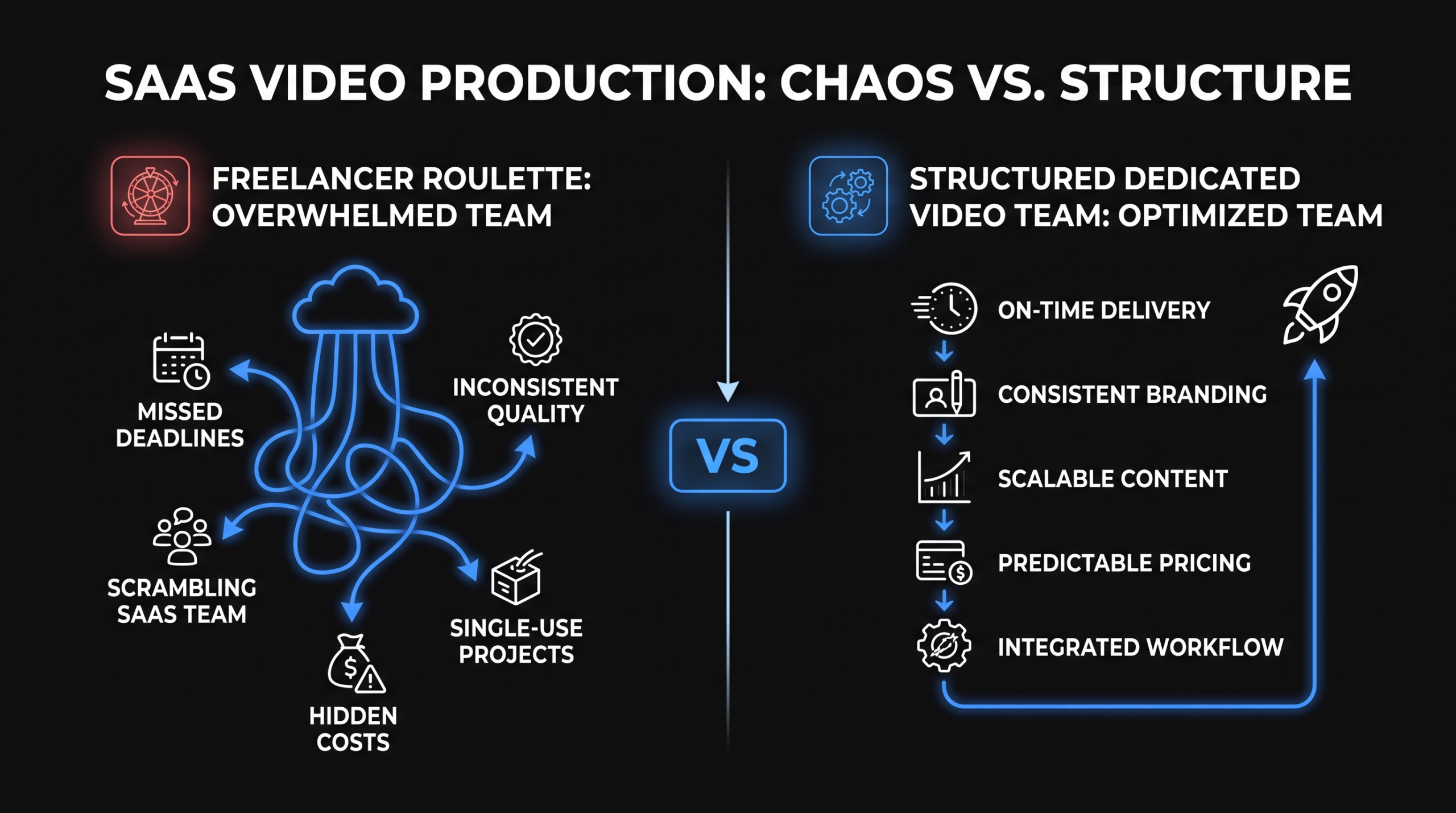
When SaaS marketing teams hit the Upwork ceiling, it rarely happens through a single catastrophic failure. It's a slow accumulation of friction that becomes impossible to ignore. Here are the five structural failure modes, in the order they typically appear.
1. Inconsistent Quality
Your best Upwork editor is excellent — and unavailable 30% of the time because they have other clients. When they're not available, you hire a backup. The backup is competent but interprets your brand guidelines differently. Your audience notices, even if they can't articulate why: something feels slightly off. The motion graphics style shifted. The color grading is different. The pacing of cuts doesn't match your established rhythm.
This isn't a failure of individual editors. It's what happens when multiple independent contractors work from documentation rather than from shared institutional knowledge. You can't replicate context in a brief.
2. Brand Drift
Brand drift is the slow divergence of video output from your intended brand identity. It accumulates revision by revision. Each new freelancer makes slightly different aesthetic decisions. Over six months, your video library starts to feel internally inconsistent — some videos feel premium, others feel like they were cut by someone who skimmed your style guide once.
The correction cost is significant. You either accept the drift, pay to re-edit affected videos, or invest in increasingly detailed briefs that eat your team's time without fully solving the problem.
3. Communication Overhead
Managing Upwork freelancers is a part-time job that compounds with scale. Each new project requires re-briefing. Each new editor requires onboarding to your brand, your tools, your feedback preferences. Revision rounds stretch across time zones. Feedback gets lost in Upwork's messaging system. You find yourself writing the same context over and over.
Teams commonly report spending three to five hours per week per active freelancer on coordination — hours that come directly out of the marketing team's strategic capacity. When you're running four simultaneous projects across three freelancers, that's a significant operational burden.
4. No Accountability for Outcomes
A freelancer on Upwork is accountable for delivering a file. They are not accountable for whether that file drives pipeline, performs on LinkedIn, or serves your broader content strategy. There's no one to call when a video underperforms. There's no institutional memory of what worked and what didn't. Every project starts from zero context.
This matters more as video becomes a performance channel. When your demo videos are being used in sales cycles and your explainer is running in paid social campaigns, you need a production partner who understands the outcomes you're chasing — not just a contractor who can deliver a clean export.
5. Single-Point-of-Failure Risk
Your best Upwork editor goes on vacation, takes on a big client, or simply gets busy. Your content calendar doesn't pause. You scramble. Either you compromise on quality by rushing an alternative, delay publication and miss your schedule, or both.
This risk is structural. Independent freelancers have no obligation to keep your calendar as a priority. A dedicated team model eliminates this because coverage and capacity are the vendor's responsibility, not yours.
Freelancer Roulette: Failure Mode Comparison
| Failure Mode | Upwork (Freelancer Model) | Dedicated Team Model |
|---|---|---|
| Quality consistency | Varies by editor and availability | Same team, same standards every project |
| Brand continuity | Dependent on brief quality; drift accumulates | Team builds institutional brand knowledge |
| Communication load | 3–5 hrs/week per active freelancer | Single PM point of contact |
| Outcome accountability | Accountable for deliverable, not results | Partners in content performance |
| Capacity reliability | Subject to freelancer availability | Reserved, contracted capacity |
| Onboarding cost | Repeated per new project/editor | One-time; compounds into brand depth |
What Upwork Video Editors Actually Cost at Scale
The hourly rate on an Upwork profile is the least meaningful number in the equation. Experienced video editors on Upwork typically post rates anywhere from $25 to $120 per hour depending on skill level, location, and specialization. Mid-tier editors — the ones reliable enough for B2B SaaS work — commonly fall in the $45–$85 range.
But the sticker rate is only part of the cost. For a detailed look at how per-minute costs work in practice, see our breakdown of video editing cost per minute. The numbers that matter at scale include:
The Hidden Cost Stack
- Coordination overhead: 3–5 hours of marketing team time per freelancer per week. At a fully loaded internal cost of $80–150/hr for a marketing manager, that's $240–$750/week in hidden labor costs per active freelancer — costs that never appear on the Upwork invoice.
- Revision cycles: Freelancers unfamiliar with your brand produce more revision rounds. Each unnecessary round costs editing time you're paying for, plus internal review time from your team.
- Re-briefing cost: Every new project with a new or returning editor requires context-setting. For complex SaaS content, this can run 1–3 hours per project — entirely invisible in the project cost.
- Brand correction cost: Videos that drift off-brand get cut from campaigns, re-edited, or simply underperform. The cost isn't just the editing — it's the opportunity cost of ineffective content.
- Availability risk premium: When your primary editor is unavailable, you pay rush rates to alternatives, accept quality compromises, or delay campaigns. This "availability tax" is real but impossible to budget.
True Cost Comparison: Upwork vs. Dedicated Team at 12 Videos/Month
| Cost Element | Upwork (3 freelancers) | Dedicated Team |
|---|---|---|
| Direct editing cost | $5,400–$9,600/mo | $5,000–$9,500/mo |
| Internal coordination time | $1,800–$4,500/mo | $400–$800/mo (PM handles this) |
| Re-briefing & onboarding | $600–$1,500/mo | $0 after month 2 |
| Brand correction rework | $400–$1,200/mo (estimated) | Minimal — brand is institutionalized |
| Availability risk buffer | $500–$1,000/mo (contingency) | $0 — covered by vendor SLA |
| Total effective cost | $8,700–$17,800/mo | $5,400–$10,300/mo |
Note: Internal coordination costs assume marketing manager time at $100/hr blended rate. Figures are illustrative ranges — your actual numbers will vary based on video complexity and team structure.
The gap between the "cheap" freelancer model and the dedicated team model closes fast once you account for what scaling SaaS companies actually spend in total. At 12+ videos per month, the dedicated team often comes out cheaper on a true cost basis — before accounting for quality and consistency gains.
Brand Drift and the Consistency Problem
Brand consistency in video is more technically demanding than most marketing leaders realize. It's not just about slapping a logo on the end card. It covers color grading (specific LUT settings or correction profiles), motion graphic style and timing (easing curves, duration of animations, type animation style), audio treatment (music genre, BPM range, voice-over delivery style), pacing and edit rhythm (average cuts per minute, when B-roll is used, how long talking head segments run), and graphic template usage (lower thirds, title cards, chapter markers).
Every one of these elements requires institutional knowledge that can't be fully documented in a brief. An editor who has worked on your content for six months understands your brand at a level that no brief can transfer. An editor who just won your Upwork contract is working from what they can read — which is always less than what they need.
The Compounding Effect
Brand drift doesn't announce itself. It compounds in small increments: the color grade is slightly warmer this month, the motion graphics are slightly slower, the pacing feels slightly different. Six months in, you're reviewing a video that technically follows every documented guideline and still doesn't feel like you.
Wistia's research on video engagement consistently shows that consistency in video series drives significantly higher engagement with returning viewers. Audiences develop pattern recognition for your content style. When that pattern breaks — even subtly — engagement metrics drop and viewers lose the sense that they're watching a coherent content brand.
The fix isn't better briefs. It's a team that doesn't need them because they already know.
The Decision Framework: Four Signals You've Outgrown Upwork
The decision to move from freelancers to a dedicated outsourced team isn't about hitting a specific headcount or revenue milestone. It's about recognizing when the structural limitations of the freelancer model are creating compounding friction. Here are the four signals that reliably indicate the inflection point has arrived.
Signal 1: You're Managing Editors Instead of Strategy
When your Head of Content or VP of Marketing is spending more than two hours per week on freelancer coordination — briefing, feedback, troubleshooting, hiring replacements — the model has inverted. You're managing a production operation instead of a content strategy. This is a clear sign that the overhead of the freelancer model is consuming the strategic capacity you hired senior people to provide.
Signal 2: Video Quality Varies Noticeably Across Your Library
Pull up your last twelve videos. Do they feel like they were made by the same brand? If a viewer could identify two or three distinct visual "voices" in your content library, brand drift has already happened. This isn't just an aesthetic problem — it signals to your audience that your production process is fragmented, which subtly undermines trust.
Signal 3: A Freelancer Absence Has Delayed a Campaign
If you've already experienced a content calendar delay because your primary editor was unavailable, the single-point-of-failure risk has materialized. Once it happens once, it will happen again. The structural exposure doesn't go away by finding a better freelancer — it's inherent to the model.
Signal 4: You're Producing More Than 8 Videos Per Month Consistently
Below 8 videos per month, the flexibility of the freelancer model often outweighs its limitations. Above 8 videos per month on a consistent cadence, the economics and operational dynamics shift. The coordination overhead grows, the quality control burden intensifies, and the per-video cost of the freelancer model starts to exceed what a dedicated team would charge. For a detailed look at how to structure the outsourcing transition, see our guide to outsourcing video editing.
Should You Make the Switch? Quick Diagnostic
| Question | Score |
|---|---|
| Are you producing 8+ videos/month consistently? | +3 points |
| Does your video library look inconsistent across the last 6 months? | +2 points |
| Has a freelancer absence ever delayed a campaign? | +2 points |
| Is your team spending 3+ hours/week on editor coordination? | +2 points |
| Do you have trouble scaling output when you need to? | +1 point |
Score 0–2: Upwork still works for your scale. Score 3–5: You're at the inflection point — model the economics. Score 6+: The freelancer model is actively costing you more than the alternative.
Building the Business Case for a Dedicated Video Team
When you're ready to make the transition internally, the business case needs to speak the language of your CFO and your CEO — not just your content strategy instincts. Here's how to frame it.
The ROI Frame That Works
Don't lead with quality. Lead with cost and capacity. The CFO will engage immediately if you show that the fully loaded cost of the freelancer model — direct editing fees plus internal coordination time — approaches or exceeds the cost of a dedicated team. If you've been running 12+ videos per month with multiple freelancers, this math often closes faster than marketing leaders expect.
The second argument is output capacity. A dedicated team can typically double your video output at the same monthly spend compared to the fragmented freelancer model, because you eliminate the coordination overhead and brief-rewriting that compress your effective editing capacity. Teams commonly report hitting their 90-day content targets in 60 days once they make the switch.
The Risk Reduction Frame
For leadership at Series B or C companies with a significant content marketing investment, the availability risk is a compelling argument. A single delayed campaign — particularly if it's tied to a product launch or a major demand-gen push — can cost multiples of the annual difference between the freelancer model and a dedicated team. Position the dedicated team as risk insurance for your content program, not just a production upgrade.
For more context on what SaaS-specific video production programs look like at this scale, see our overview of SaaS video production programs.
The Incremental Transition
You don't have to make the switch all at once. Many teams run a parallel track: keep one reliable Upwork editor for overflow or experimental content while engaging a dedicated team for the core content calendar. Over 60–90 days, the dedicated team's performance data makes the full transition decision straightforward. You're not choosing on faith — you're choosing on evidence.
Top Dedicated Video Editing Teams for SaaS
The market for dedicated video editing services has matured significantly. What follows is an honest assessment of the leading options for Series A–C SaaS companies, evaluated on the criteria that matter most at this stage: brand consistency, accountability, SaaS-specific expertise, and transparent pricing.
1. Video Editing Company (VEC) — Best Overall for SaaS
Video Editing Company is purpose-built for B2B SaaS content programs. The model is structured around dedicated editor pods assigned to your account, with a guarantee of doubling your video output within 90 days or month four is free. Plans run from Growth ($5K/mo) through Core ($9.5K/mo) to Scale ($16K/mo), covering everything from product demos and explainer videos to full-scale content calendars.
The differentiator is the SaaS-first orientation: editors are briefed on product positioning, onboarded to your brand standards, and managed by a dedicated PM who serves as your single point of contact. No freelancer roulette, no re-briefing, no availability risk. For marketing teams at Series A–C companies that are ready to treat video as a growth channel rather than a project line item, VEC is the most structurally sound option.
Pricing: Growth $5K/mo · Core $9.5K/mo · Scale $16K/mo
Pros: SaaS-specialized, 90-day output guarantee, dedicated pod model, transparent tier pricing
Cons: Minimum commitment required; not suited for one-off project needs
2. Increditors — Best for Premium Full-Service Production
Increditors operates a premium dedicated pod model pairing a senior editor, junior editor, project manager, and creative director on each account. They serve a broad client base across YouTube creators, SaaS, finance, and education verticals, and are particularly well regarded for work that requires strong creative direction alongside technical editing — a combination most pure-editing shops can't match.
Their retainer model (custom-quoted, reportedly ranging from roughly $2.5K to $12K+/mo depending on scope) doesn't publish fixed tiers, which means you need a discovery call to get pricing — a friction point for teams that want to self-serve the decision. They're not SaaS-exclusive, but teams that need premium creative direction in addition to execution will find the full-pod structure genuinely compelling.
Pricing: Custom retainers; contact [email protected]
Pros: Full creative pod (senior editor + CD), strong track record on YouTube and SaaS accounts, premium production quality
Cons: No instant pricing tiers, not SaaS-exclusive, custom-quote process adds friction
3. Vidpros — Best for High-Volume Social Content
Vidpros operates a subscription-based editing model well suited for teams that need high throughput on social clips, podcast edits, and short-form content. The model is straightforward and accessible, though the sequential queue structure limits how much complex, multi-format work you can run simultaneously. Better for volume over complexity.
4. Viraly — Best for Short-Form and Reels-First Teams
Viraly focuses on short-form video production at scale, making it a reasonable option for SaaS teams with a heavy social media presence and a need for rapid-turnaround content. Less suitable for product demos, explainers, or longer-form content that requires deep brand consistency and creative direction.
5. Motion Array Studio — Best for Motion Graphics-Heavy Work
For teams that need sophisticated motion graphics, animated explainers, or heavy After Effects work, Motion Array's studio services provide specialized capability. The tradeoff is that they're less positioned for high-volume mixed content and more for project-specific production with complex animation requirements.
Frequently Asked Questions
How do I know if my team has outgrown Upwork video editors?
The clearest signals are: video quality varying noticeably across your library, your team spending 3+ hours per week managing editor coordination, a freelancer absence having delayed a campaign at least once, and consistent output of 8 or more videos per month. If two or more of these apply, you're at the inflection point where a dedicated model typically makes more economic and operational sense. Run the total cost calculation including internal coordination time — many teams find the gap is smaller than expected.
Are Upwork video editors actually lower quality than dedicated teams?
Individual Upwork editors can be excellent — the quality ceiling on the platform is high. The issue isn't individual talent; it's structural consistency. When you need the same quality standard across 10–20 videos per month from multiple editors, the freelancer model creates inherent variability that a dedicated team eliminates. The dedicated team model institutionalizes brand knowledge instead of depending on documentation, which is a fundamentally more reliable system at scale.
What does a dedicated video editing team cost compared to Upwork freelancers?
On a direct editing fee basis, dedicated teams for B2B SaaS work typically run $5,000–$16,000+ per month depending on output volume and service scope. Upwork freelancers appear cheaper at first — but when you add internal coordination time (typically 3–5 hours per week per active freelancer at marketing manager rates), re-briefing overhead, and brand correction costs, the effective cost gap narrows significantly at 8+ videos per month. Plans at Video Editing Company start at $5K/month for the Growth tier.
How long does it take to onboard a dedicated video editing team?
Most dedicated team providers complete the core onboarding in two to four weeks — this covers brand guidelines review, style calibration (usually one or two test videos), tool access and workflow setup, and establishing communication protocols. Teams commonly report that by week six, the editing team is producing work indistinguishable from their best historical output, with significantly less internal management overhead. The onboarding investment is made once; with Upwork freelancers, you repeat a version of it every time an editor changes.
Can I use a dedicated video team alongside existing Upwork freelancers?
Yes, and many teams do this during the transition period. The typical approach is to assign core content calendar work — product demos, explainers, hero content — to the dedicated team while retaining one or two Upwork editors for overflow, experimental formats, or ad hoc requests. After 60–90 days, the performance and capacity data from the dedicated team usually makes the fully committed decision straightforward. Running both models simultaneously also helps you quantify the real cost difference with your own numbers rather than estimates.
Ready to Stop Spinning the Wheel?
If your video program has hit the ceiling with Upwork freelancers, a 30-minute strategy call is the fastest way to model what a dedicated team would actually cost — and what output you could expect in 90 days.
Book a Free Strategy Call View Pricing