Video Production RFP: Template and Pricing
TL;DR
- A video production RFP forces vendors to bid on the same scope — making proposals comparable and protecting your budget before any contract is signed.
- Include these six sections in every RFP: company context, project objectives, scope of work, deliverables checklist, required pricing fields, and evaluation criteria.
- Required pricing fields: base cost, revision rounds included, per-additional-revision fee, rush premium, format variation cost, licensing, and — always — a retainer alternative.
- Score bids across five dimensions: creative capability, process clarity, post-production quality, communication, and value.
- For 4+ videos per month, the retainer bid often comes in 20–40% lower per video than individual project bids — request both in the same RFP even if you expect to buy per-project.
Table of Contents
- What Is a Video Production RFP?
- When to Use a Formal RFP
- Video Production RFP Template: Section by Section
- Deliverables Checklist for Your RFP
- Pricing Fields: What to Ask Every Vendor to Quote
- Timeline, Revision, and Rights Requirements
- How to Score Bids: Evaluation Criteria and Red Flags
- Project Bid vs. Retainer: Which to Request
- Sample RFP Scoring Table
- FAQ
Most marketing, procurement, and operations teams skip the formal RFP when buying video production. They send a rough email brief, get back a few quotes with wildly different line items, pick the cheapest-sounding one, and wonder later why deliverables arrived late, over budget, and off-brand. A structured video production RFP eliminates that pattern by forcing vendors to respond to the same requirements — so you're comparing proposals on equal terms before you've committed a dollar.
This guide gives you the complete template: what to include in every section, which pricing fields to require, how to structure evaluation criteria, and a ready-to-use scoring table for ranking bids. We've also addressed the question most RFPs miss entirely: whether to request project bids, monthly retainer pricing, or both — and how the math changes at different video volumes.
What Is a Video Production RFP?
A video production RFP (Request for Proposal) is a formal document you send to prospective vendors that defines your project requirements, deliverables, timeline, and evaluation criteria — and invites them to submit a priced proposal in a standardized format. It is your first line of control in any vendor relationship.
Unlike a casual email brief, an RFP accomplishes three things: it forces vendors to compete on identical scope, it surfaces capability and process differences before you've committed any budget, and it creates a written record of agreed-upon terms before work begins. For video production — where scope creep, revision disputes, and format ambiguity are routine — this structure pays for itself in the first engagement.
RFP vs. RFQ vs. SOW
- RFP (Request for Proposal): Asks vendors to propose how they would approach your project at what price. Evaluates capability and fit, not just cost. Use when selecting a vendor.
- RFQ (Request for Quote): You've already defined the scope precisely and want a number. Used when you know exactly what you need and are price-comparing identical deliverables.
- SOW (Statement of Work): The contract document that follows vendor selection — locks in scope, deliverables, timeline, and payment terms. The RFP feeds directly into this.
For most video production engagements, start with an RFP. Move to an RFQ only when the scope is fully defined and you're buying a known commodity (for example: "edit 20 raw footage files, 90 seconds each, to this brand guide").
When to Use a Formal Video Production RFP
A formal RFP is worth the preparation time when at least one of these conditions is true: your budget is large enough that a poor vendor choice is genuinely costly; you're choosing among three or more vendors; internal stakeholders (procurement, legal, finance) need a documented process; or you're buying ongoing video services rather than a single one-off project.
Video's role in B2B marketing has expanded substantially. Wistia's annual State of Video research (wistia.com/state-of-video) consistently shows B2B teams increasing video production volume year over year — which means more teams are now making recurring buying decisions rather than one-time purchases. That shift is exactly where an RFP process earns its overhead.
Situations Where an RFP Makes Sense
- Annual video production spend above roughly $25,000
- Multi-video campaigns (product demos, customer stories, brand films) where consistency across deliverables matters
- Procurement or legal needs a vendor selection paper trail
- You're comparing full-service production houses against remote post-production specialists
- You want to evaluate per-project and retainer pricing in the same competitive process
- HR or operations is involved in the decision and needs vendor compliance documentation
When to Skip the Formal RFP
If you need one video under roughly $5,000 and you already have a vendor you trust, the RFP overhead probably isn't worth it. A well-structured brief covers most of the same ground for a single project. The full RFP process is most valuable for significant or recurring buying decisions — where the cost of a poor vendor choice exceeds the cost of running the process itself.
Video Production RFP Template: Section by Section
Use this structure as the basis for your RFP document. Adapt Section 3 (Scope) to your specific project type. The remaining sections apply broadly across production engagements.
Section 1: Company Background and Context
Tell vendors who you are, what you sell, and who your audience is. Include your industry, company size, and the role video plays in your marketing or communications. This is not boilerplate — vendors use this to gauge fit and calibrate their creative approach. Proposals from vendors who understand your product category will look fundamentally different from those who don't.
Include: company name and website · industry and ICP (ideal customer profile) · current video production situation (in-house editor, no video team, or past agency experience) · why you're running this RFP now.
Section 2: Project Overview and Objectives
Describe what you're trying to accomplish — not just the deliverables, but the business outcome. "We need 12 product demo videos" is a deliverable. "We want to reduce repetitive live demo requests in our sales process" is an objective. The latter helps vendors propose more strategically and lets you evaluate whether they understand your underlying problem.
Include: what success looks like for this engagement · distribution channels (website, LinkedIn, sales outreach, paid ads) · primary audience (existing users, prospects, specific decision-maker title) · tone and brand positioning · existing brand guidelines or style guide (attach as an appendix).
Section 3: Scope of Work
This is where most RFPs get vague and bids become incomparable. Define the scope as precisely as possible:
- Video types required: explainer, product demo, customer testimonial, brand film, social clips, webinar repurposing, onboarding video, etc.
- Quantity: number of final deliverables — a specific number, not a range.
- Duration: target runtime per video (e.g., 90-second product demo, 2-minute testimonial).
- Production scope: are you providing footage and need post-production only, or does the vendor handle filming?
- Animation and motion graphics: yes or no; if yes, what complexity level.
- Voiceover: yes or no; who provides the script; whose voice talent is used.
- Format variations: list every format explicitly (16:9 master, 9:16 vertical cut, 1:1 square cut for social). Each counts as a separate deliverable in most agency pricing.
- Captions and subtitles: required or not, and in which languages.
If you're buying post-production only — because raw footage already exists — say so explicitly. Remote post-production specialists like VEC's dedicated editing teams often quote meaningfully differently from full-service production houses for equivalent output quality, because they aren't billing for crew days and equipment rental. Naming this distinction helps the right vendors pitch correctly and helps you benchmark proposals on equal terms.
Section 4: Current Assets and Constraints
List what you're supplying: existing footage, brand guide, script drafts, motion templates, licensed music library. Also note constraints: NDA or confidentiality requirements, required software (Premiere Pro, Final Cut, DaVinci Resolve), compliance restrictions on what can appear visually, or internal review process requirements that affect timeline.
Section 5: Vendor Qualifications Required
State your minimum requirements so unqualified vendors self-filter before you read a proposal. Examples: minimum three years producing B2B SaaS video content; demonstrable experience with screen-recorded product demo editing; English-language production; specific software platform proficiency; ability to sign an NDA.
Section 6: Proposal Requirements
Tell vendors exactly what their proposal must contain and in what format. A standardized structure makes evaluation faster and fairer. Required sections: company background (one page maximum) · three to five relevant portfolio samples with brief context on each · proposed approach and production process · team bios or structure · pricing (using the pricing fields from this guide's Section 5) · two to three client references · milestone schedule · assumptions and exclusions.
Section 7: Submission Instructions
Specify: submission deadline (date, time, and time zone) · file format (PDF only; no links to proposal portals) · where to send · whether vendor questions are accepted and by what deadline · estimated date for vendor selection notification.
Deliverables Checklist for Your RFP
Ambiguous deliverables are the root of most vendor disputes. For every video in scope, your RFP should define the full deliverable set — not just "the final video." Use this checklist as a required response section in your proposal template, so vendors confirm or push back on each item before you've signed anything.
Per-Video Deliverable Checklist
- Final video — master file with specified codec (H.264 for web delivery, ProRes for archive) and resolution (1080p or 4K)
- Format variations: 16:9 master, 9:16 vertical cut, 1:1 square cut — list each format explicitly; do not assume a vendor includes these
- Closed captions file (.SRT format) — included in base price or additional cost per video?
- Final voiceover script with speaker notes
- Editable project file (Premiere Pro .prproj, Final Cut .fcpbundle) — required if you may need to re-edit in future
- Motion graphics source files (After Effects .aep) if custom graphics were produced
- Licensed music clearance documentation — for each track used
- Thumbnail image for YouTube or social distribution, if applicable
- Stock footage or B-roll license receipts
The default deliverable from most vendors is one final MP4. Everything beyond that must be listed in your RFP. Discovering at final delivery that project files aren't included — or that the music license only covers 12 months of online distribution — is costly and entirely avoidable with a clear checklist upfront.
Project-Level Deliverables
- Production schedule showing each video's planned delivery date
- Creative brief document or kick-off call summary
- Written confirmation from the vendor that they have reviewed your brand guide
- Post-project debrief report for engagements of four or more videos
Pricing Fields: What to Ask Every Vendor to Quote
Standardized pricing fields are what make bids comparable. Without them, one vendor will give you a total price, another will give you an hourly rate, and a third will pitch a subscription model — and you'll spend hours normalizing them into something usable. Require vendors to complete every field below; treat any blank as an incomplete bid and send it back before evaluation.
For context on how agencies structure their underlying pricing, our full guide to video production agency pricing models covers each model's cost structure and when each makes sense.
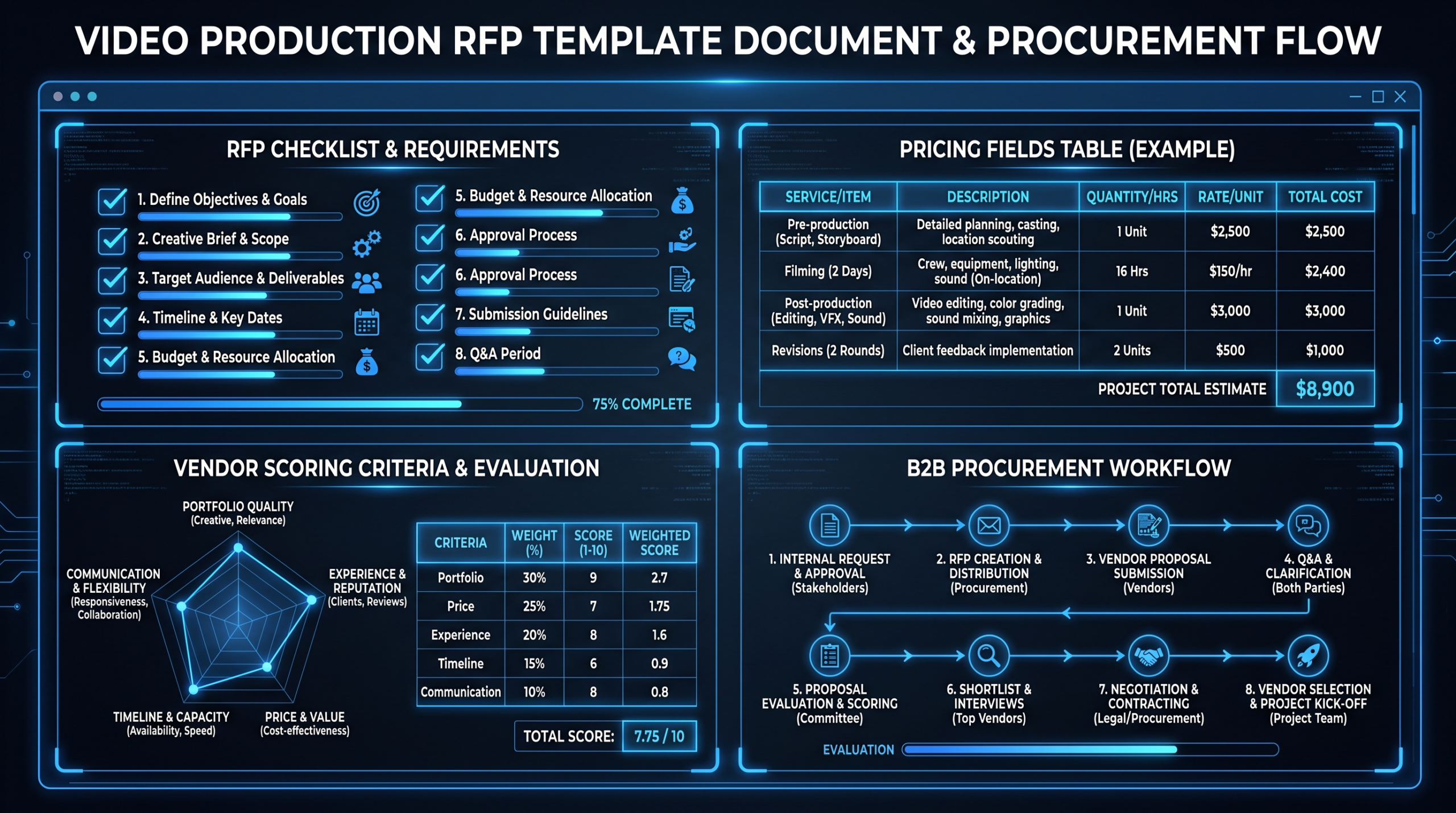
Required Pricing Fields for Video Production RFP Responses
| Pricing Field | What You're Asking | Notes for Vendors |
|---|---|---|
| Base production cost | Total cost for the full scope as specified in the RFP | All-in; no ambiguity on what's included |
| Per-video unit price | Cost per video if scope scales up or down by 20% | Useful for volume comparison across bids |
| Revision rounds included | Number of revision rounds in the base price | Vendor must define what counts as one round |
| Additional revision cost | Cost per revision round beyond what's included | Request a flat rate per round, not hourly |
| Rush delivery premium | Additional cost for turnaround below [X] business days | Specify your rush threshold in the RFP |
| Format variation cost | Additional cost per cut beyond the 16:9 master | Price for each: 9:16 vertical, 1:1 square |
| Stock footage and music | Estimated licensing cost; included or pass-through? | Request full license documentation at delivery |
| Captions and subtitles | Included in base or additional cost per video | Specify required languages in the RFP |
| Project file delivery | Cost to receive editable source files at project close | Often unlisted unless explicitly requested |
| Monthly retainer equivalent | What this scope would cost on a monthly retainer basis | Request even for per-project RFPs — see Section 8 |
| Payment terms | Deposit percentage, milestone schedule, final payment trigger | Standard is 50% upfront, 50% on final delivery |
To calibrate where bids should land given your deliverable complexity and duration, our breakdown of video editing cost per minute provides a useful benchmark across video types and production tiers.
Timeline, Revision, and Rights Requirements
These three areas generate more disputes in video production engagements than any other — not because vendors are unreliable, but because buyers leave them ambiguous in the brief and both parties fill in different assumptions. Locking down each of these in the RFP removes the ambiguity before work begins.
Timeline Requirements
State required delivery dates explicitly — not as ranges. "Final delivery by October 15" is a requirement. "Ideally in Q4" is not. If a campaign launch or event date is driving the timeline, say so. Vendors who cannot meet it should self-select out rather than try to compress the work and deliver something rushed.
Require vendors to respond with a full milestone schedule, not just a final delivery date. The standard milestones for a typical production project are:
- Kick-off call and brief review: Days 1–3
- Script or creative brief approval: Days 5–10
- First rough cut or motion draft delivered: Days 12–20 depending on complexity
- First revision round turnaround: Allow three to five business days per round
- Final delivery: Before campaign date, with a buffer of at least five business days
Revision Requirements
Define "one revision round" in your RFP so every vendor responds to the same standard. A workable definition: one revision round means a single set of written feedback consolidated from all internal stakeholders, submitted in one batch, with the vendor responding to all points in one updated delivery. Feedback split across multiple emails or calls counts as multiple rounds and is billed accordingly.
Also specify your maximum expected round count. Three revision rounds is a reasonable standard for polished B2B corporate video. Engagements requiring more than three rounds typically signal a brief that was underspecified upfront — which is precisely what the creative brief review milestone is designed to prevent.
Rights and Usage
Require vendors to state in their proposal what rights you receive in the final deliverable. At minimum, your RFP should require a full work-for-hire arrangement where your organization owns the finished video outright, including all edits and derivatives. Set conditions for portfolio use: vendors may want to feature your video in their reel, which is reasonable, but require written approval before any public use and allow for blurring sensitive product UI.
Clarify music licensing separately. Background music licensed for a video should cover perpetual use, worldwide distribution, and online and broadcast distribution if applicable. Sync licenses that cover only 12 months of online distribution — common from budget music libraries — require annual renewal and create administrative overhead that most teams don't anticipate.
How to Score Bids: Evaluation Criteria and Red Flags
Price is one input into vendor selection, not the primary one. A lower-priced vendor who misses deadlines, fails to deliver source files, or disputes every revision scope definition will cost more in total than a higher-priced vendor who delivers ahead of schedule and treats revisions as a normal part of a professional engagement.
Score proposals across five dimensions weighted to your priorities. The weights below are a starting point — adjust them based on your specific situation.
Evaluation Dimensions
- Creative capability (30%): Portfolio quality, relevance to your industry and format, and evidence of brand consistency across multiple client projects. The key question: do their portfolio samples look like they came from the same editorial team, or do they vary wildly by project in a way that suggests freelancer pooling rather than a consistent team?
- Process clarity (25%): Does their proposal explain how work actually flows from briefing through production to delivery? Vague process descriptions are a yellow flag. No process description is a red flag — it means either the vendor doesn't have one, or they don't think you'll ask about it.
- Post-production quality (20%): Color grading, sound mixing and leveling, motion graphics execution, and caption quality. These details determine whether your final video looks polished or amateur. If portfolio samples have muddy audio or inconsistent color treatment, the finished work on your project probably will too.
- Communication and reliability (15%): How quickly did they respond to your RFP questions? Did their proposal follow your submission instructions? References should be checked primarily against this dimension — not creative quality, which is visible in the portfolio. What you cannot see there is whether the vendor caused delays, disputed revision scope, or delivered source files late.
- Value (10%): Price relative to scope and quality, not price in isolation. The lowest bid frequently has the highest total cost when you account for revision overages, missed format variations, and timeline delays that push your campaign back.
Red Flags in Vendor Responses
- Portfolio samples irrelevant to your industry or format: A vendor whose portfolio shows only wedding films responding to a B2B SaaS product demo RFP has not self-filtered when they should have.
- Incomplete pricing fields: Any vendor who doesn't answer your required pricing fields is either careless or unwilling to commit to specific terms — both are problems that will surface again after you sign.
- No milestone schedule — only a final delivery date: This means there is no internal production workflow visible to you and no accountability at intermediate stages. You'll find out too late if something goes wrong.
- "Unlimited revisions" language: This is almost always a marketing claim, not a contractual commitment. Ask directly: what is the cost of a revision round after the third? The answer tells you more than the original claim.
- Vague rights language: Any proposal that does not explicitly confirm work-for-hire ownership of the final deliverable needs legal review before signing. Do not assume.
- Music and stock footage listed as "TBD" or "at cost": These costs should be estimated in the proposal. Leaving them open means your total budget is not visible until after work is underway.
For teams running their first outsourced video production process, our full guide to outsourcing video editing covers the operational workflow on the buyer's side — what to prepare, how to brief effectively, and how to manage the relationship after vendor selection.
HubSpot's marketing blog (blog.hubspot.com/marketing) also covers vendor evaluation frameworks for marketing procurement that translate well to video production decisions if your team is new to structured vendor selection processes.
Project Bid vs. Retainer: Which Structure to Request in Your RFP
Most procurement teams default to per-project bids because it is the familiar model. But if your video needs are ongoing — even just four videos per month — asking for retainer pricing alongside project bids usually reveals a cost difference that changes the decision. Request both in the same RFP. Add a single line to your Scope section: "Please also provide monthly retainer pricing for the scope described above, assuming a six-month engagement." This costs nothing in the RFP process and gives you real data to evaluate both structures simultaneously.
Project Bid vs. Monthly Retainer: Key Differences
| Factor | Per-Project Bid | Monthly Retainer |
|---|---|---|
| Pricing structure | Fixed price per engagement | Fixed monthly fee for agreed scope |
| Unit cost at volume | Higher — no volume or loyalty discount | Lower — vendor prices in predictable revenue |
| Commitment required | None — walk away after each project | Typically 3–6 month minimum |
| Vendor familiarity with brand | Starts from zero each engagement | Team learns your brand over time — faster turnarounds |
| Budget predictability | Variable — each project is a new negotiation | Fixed monthly spend, straightforward to budget |
| Capacity access | Competes with other clients for production slots | Reserved capacity allocated to your account |
| Scope flexibility | Any scope, any time | Scope changes require amendment or overage discussion |
| Typical break-even volume | Fewer than 4 videos per month | Four or more videos per month |
| Best suited for | One-off needs, testing a vendor for the first time | Ongoing content programs, consistent monthly output |
VEC's dedicated post-production team model sits at the retainer end of this spectrum: Growth ($5,000/month), Core ($9,500/month), and Scale ($16,000/month). Each plan includes a dedicated editing team — senior editor, junior editor, and project manager — rather than a rotating pool of freelancers, with a guaranteed output target backed by a 90-day performance guarantee. For SaaS teams producing product demos, customer testimonials, or webinar content on a recurring basis, the per-video unit cost on a retainer plan typically comes in well below what individual project bids would sum to at the same volume. See VEC's pricing page for a full breakdown of what each tier includes.
Sample RFP Scoring Table
Use this table to evaluate vendors consistently. Score each dimension 1–5 and multiply by the weight to produce the weighted contribution. Sum all five for the vendor's final score out of 100.
Video Production RFP Vendor Scoring Table
| Dimension | Weight | Score (1–5) | Weighted Score | What to Look For |
|---|---|---|---|---|
| Creative capability | 30% | __ | __ / 30 | Portfolio relevance to your format; brand consistency across clients |
| Process clarity | 25% | __ | __ / 25 | Briefing to milestone to delivery workflow; revision handling explained |
| Post-production quality | 20% | __ | __ / 20 | Color grading, sound mixing, motion graphics, caption quality |
| Communication and reliability | 15% | __ | __ / 15 | Responsiveness to RFP, proposal follows instructions, reference check |
| Value | 10% | __ | __ / 10 | Price relative to scope and quality — not price alone |
| TOTAL | 100% | — | __ / 100 |
How to calculate: For each dimension, score 1–5. Multiply the score by the weight as a decimal (0.30, 0.25, 0.20, 0.15, 0.10) and multiply by 20 to normalize to the dimension's maximum contribution. Sum the five weighted scores for the final total. A vendor scoring above 80 is generally a strong selection; below 65 warrants reconsideration regardless of price.
On reference checks: Ask references specifically about revision handling and communication under pressure — not just "were you happy with the work?" Creative output is visible in the portfolio. What you cannot see there is whether the vendor caused campaign delays, disputed what was in scope, or created friction at delivery. References surface this.
The scoring table structures your thinking — it does not replace judgment. If your team's assessment of a vendor's proposal significantly diverges from the numerical score, investigate the gap before making a final call. Numbers do not capture everything about a working relationship.
Frequently Asked Questions
What should a video production RFP include?
A complete video production RFP should include: company background, project objectives and success criteria, scope of work (video types, quantities, durations, and format variations), a required deliverables checklist, standardized pricing fields, timeline and revision requirements, rights and licensing terms, vendor qualification criteria, and submission instructions. The most common omission is the per-video deliverables checklist — without it, vendors default to delivering only the final MP4 and every additional format variation or source file becomes a new negotiation.
How do I compare bids when vendors use different pricing models?
Normalize all bids to effective cost per finished minute of final video. Divide the total proposed cost by the total minutes of final deliverable output across the full scope. This metric works across per-project, hourly, and retainer bids and gives you an apples-to-apples number. Also require every vendor to complete your standardized pricing fields before you evaluate — a bid missing revision costs, format variation fees, or licensing estimates is incomplete and cannot be fairly compared to one that is fully priced.
How many revision rounds should my RFP require vendors to include?
Three revision rounds is a reasonable standard for polished B2B corporate video. Define "one revision round" in your RFP as a single consolidated batch of written feedback from all stakeholders, with the vendor addressing all points in one updated delivery. Require vendors to state their cost per additional round beyond the included number — this field is frequently missing from proposals and becomes a source of disputes when the fourth or fifth round arrives. A clear per-round overage rate in the proposal protects both sides.
Should I request per-project or retainer pricing in my RFP?
Request both, even if you expect to buy per-project. Adding a retainer bid request costs nothing in the RFP process, and the data frequently shows that for four or more videos per month, the monthly retainer per-video unit cost is meaningfully lower than individual project bids at the same volume. Having both sets of numbers lets you make a real financial decision rather than defaulting to the familiar per-project model without comparing the alternative.
What are the biggest red flags in a video production proposal?
The highest-risk red flags are: vague or missing rights language that does not explicitly confirm work-for-hire ownership; "unlimited revisions" phrasing with no stated per-round overage cost; incomplete pricing fields (music, format variations, or project files listed as "TBD"); and no milestone schedule beyond a final delivery date. Incomplete pricing fields and vague rights language are the two items most likely to generate legal or financial disputes — treat either as a reason to send the proposal back for clarification before moving to evaluation.
Skip the RFP — Work with a Team That Already Knows the Process
VEC provides dedicated post-production teams for B2B SaaS companies that already have footage and need reliable editing at scale. Plans start at $5,000/month with a 90-day output guarantee: double your video output or month four is free.
Book a Free Strategy Call View Pricing Plans