Video Production for Consulting Firms: Guide
TL;DR
- Consulting firms use six core video formats: thought leadership, case studies, webinars, sales enablement, recruiting, and event content.
- The biggest production bottleneck is briefing and approvals — not editing. Fix the front end of the workflow first.
- Remote post-production teams scale expert content without adding headcount or burning partner time.
- The ROI case for video at consulting firms is built on proposal conversion, talent acquisition, and content distribution — not traditional ad-campaign metrics.
- In-house editing is rarely cost-effective once you exceed 8+ videos per month; dedicated remote teams typically deliver a lower effective cost per finished video.
Table of Contents
- Why Consulting Firms Are Investing in Video
- The 6 Video Formats Every Consulting Practice Needs
- Thought Leadership and Webinar Videos
- Case-Study and Client Success Videos
- Sales Enablement and Proposal Videos
- Recruiting and Culture Videos
- Editorial Workflow for Consulting Teams
- Cost and ROI: Making the Business Case
- Frequently Asked Questions
Consulting firms have a structural problem with content: the people who know the most — partners, managing directors, practice leads — are the least available to create it. Writing takes hours they don't have. Publishing decks as PDFs generates no organic reach. Webinars go live and disappear.
Video solves this. A 30-minute partner conversation, properly edited and repurposed, becomes four thought leadership clips, a YouTube deep-dive, and a client onboarding asset. The knowledge stays in circulation. The expert's time compounds.
This guide covers every major video format used by consulting firms, the editorial workflow that makes video production sustainable, and the cost math behind building or outsourcing the capability. No fabricated benchmarks — only the patterns we observe working with B2B professional services teams at scale.
Why Consulting Firms Are Investing in Video
Video has become the default medium for B2B buyer research. Partners evaluating a new consulting relationship routinely watch thought leadership content, review case-study materials, and make early-stage credibility judgments before a single sales conversation happens. Firms without a video presence are invisible in that research phase — and that invisibility compounds over time as competitors build content libraries.
Three structural shifts are driving the investment:
Expertise Is Now a Scalable Content Asset
A decade ago, consulting expertise mostly stayed inside client engagements. Today, firms capturing mindshare actively publish their frameworks, diagnostic approaches, and market perspectives. Video consistently generates the deepest engagement in B2B channels — longer watch time, higher share rates, and stronger recall than equivalent written formats. A 12-minute partner video on LinkedIn keeps working for 12 months; a partner spending 12 minutes in a cold call does not.
Buyers Want Proof Before the First Meeting
C-suite buyers at consulting target accounts are increasingly resistant to cold outreach but actively seeking credible content. A well-produced thought leadership video from a managing partner or a two-minute client success testimonial can accomplish the trust-building work that used to require three or four in-person meetings. Practices that have instrumented their proposal processes commonly report that video-touched proposals move through the approval process faster than proposals with no video asset attached — the credibility arrives before the conversation.
Talent Competition Has Become Global and Visible
The consulting talent market is competitive across experience levels. Candidates research firm culture, leadership visibility, and day-to-day work environment before applying. A careers page without video asks candidates to make a significant career decision on faith. Even simple, authentic partner conversations materially shift how candidates perceive a firm before they interview — and candidate quality at the top of the funnel determines who you're able to hire.
The 6 Video Formats Every Consulting Practice Needs
Most consulting firms do not need to produce all six formats simultaneously. But every established practice eventually gravitates toward this core set, because each format serves a distinct moment in the buyer, employee, or client journey that the others cannot adequately cover. Understanding which format belongs where prevents the common mistake of treating all video as interchangeable and then wondering why the results are inconsistent.
Consulting Firm Video Formats at a Glance
| Format | Primary Purpose | Typical Length | Main Channel | Production Complexity |
|---|---|---|---|---|
| Thought Leadership | Demand generation, credibility | 5–20 min | LinkedIn, YouTube | Medium |
| Case-Study / Client Success | Trust building, proposal conversion | 2–5 min | Proposals, website | High |
| Webinar Recording | Lead nurture, education | 30–90 min | Email, gated content | Low (editing only) |
| Sales Enablement / Proposal | Deal acceleration | 1–3 min | Email, Loom, proposals | Low–Medium |
| Recruiting / Culture | Talent acquisition | 2–5 min | LinkedIn, careers page | Medium |
| Event / Conference | Brand credibility, content repurposing | 3–15 min | YouTube, website | Medium |
The formats differ in production complexity, approval burden, and publishing cadence. A webinar recording only requires editing — the raw content already exists. A client case-study video requires legal clearance, client coordination, and multiple revision cycles. Understanding these differences before you build a production workflow prevents the mistake of treating all six formats as interchangeable and then getting burned by an unexpected approval cycle during a time-sensitive campaign.
Thought Leadership and Webinar Videos
Thought leadership videos are the demand-generation engine of modern consulting practices. They convert partner expertise into a scalable content asset — one that distributes across LinkedIn, embeds in newsletters, gets shared by clients, and indexes in search without the partner spending another hour on it after the recording session.
What Makes Consulting Thought Leadership Video Work
The most effective thought leadership videos share a common structure: a clear opening claim or genuine question (not a generic "Hi, I'm going to talk about…" introduction), a concrete framework or diagnosis anchored in specific domain experience, and a landing point that gives the viewer something actionable. The weakest videos open with biographical context that wastes the first 30 seconds and loses the audience before any value has been delivered.
The best-performing formats for consulting thought leadership:
- Point-of-view shorts (5–8 min): One clear perspective on a timely issue in the practice area. No slide deck. Partner on camera, well-lit, structured argument. Works exceptionally well on LinkedIn when the opening line is a genuine claim, not a topic announcement.
- Framework explainers (8–15 min): Walk through a proprietary diagnostic or methodology. Works well with simple motion graphics to illustrate the framework visually — not elaborate animation, just clean diagrams that reinforce the spoken explanation.
- Partner conversations (15–30 min): Two partners debating a strategic question from different practice areas. Requires editing to remove dead air and tighten arguments, but generates high engagement because the format feels authentic and unscripted.
- Sanitized engagement recaps: Anonymized takeaways from a completed engagement — what the team found, what changed, what a similar organization should expect. High credibility when done honestly; requires legal review.
Webinar-to-Video Repurposing
Most consulting firms are sitting on a significantly underused asset: their webinar archive. A 60-minute webinar, properly edited, yields at minimum:
- One full-length YouTube video with timestamp chapters
- Three to five LinkedIn clips (key moments, 60–90 seconds each)
- A condensed 8–10 minute "highlights" edit for website embedding or gated content offers
- A transcript-based blog post or LinkedIn article that captures the key arguments in text format
The editing investment is modest compared to producing original content from scratch. Webinar repurposing is often the fastest path for a consulting firm to build a video library quickly, because the raw footage is already approved, the expertise is already captured, and the content was already produced for another purpose.
Publishing Cadence That's Actually Sustainable
Consistency matters more than volume for thought leadership. A practice that publishes two well-produced videos per month builds a more credible presence over 12 months than one that releases twelve videos in a quarter and then goes silent. Aim for a sustainable rhythm that your partners can actually maintain — one flagship video per partner per quarter is a realistic starting point for most practices, with webinar repurposing filling in the gaps between those anchor productions.
Case-Study and Client Success Videos
Case-study videos are the highest-trust format a consulting firm can produce. A well-executed client success video — where a real client describes a real problem and a verifiable outcome — outperforms any other content type in proposals and late-stage deal conversations. It is also the most expensive and time-consuming format to produce correctly.
What to Include and What to Avoid
The strongest case-study videos follow a simple three-part structure: the client's situation before engaging the firm, the nature of the engagement, and the measurable change afterward. The critical discipline is honesty about outcomes — vague claims like "significantly improved our operations" read as marketing language and actively undercut credibility. Specific, verifiable outcomes ("reduced our procurement cycle from 45 days to 18 days") are more persuasive, even when the number seems less dramatic than a percentage headline.
Common mistakes that damage case-study video credibility:
- Scripted-sounding client testimonials. Clients reading from teleprompters or answering overly coached questions produce stilted video. Give clients three or four open-ended prompts and let them speak naturally — the authentic stumble is more credible than the polished recitation.
- Omitting the "before." Videos that only describe positive outcomes are less believable than ones that clearly establish what the problem looked like before the engagement. The contrast is the story.
- Unverifiable claims. If the client can't publicly confirm a number, it should not appear in the video. Hedged framing ("the team found material improvement in…") is more credible than a precise number you can't back up.
- Logo-only references. "We worked with a Fortune 500 healthcare company" tells the viewer almost nothing useful. Even limited attribution ("a regional health system with five hospitals") provides context that makes the case study credible.
The Client Approval Process
Client approval is the largest single production variable for consulting case-study videos and the one most consistently underestimated in project planning. A reliable process:
- Secure verbal agreement from the client before any production investment begins.
- Share a written outline covering what claims will be made and what the client will be asked to say on camera — before the recording session.
- Conduct the recorded interview with a structured but conversational format.
- Share a rough cut specifically flagging any claims the client may want to adjust.
- Collect consolidated written sign-off before the video is published anywhere.
Building this process into your production timeline from the beginning — not as an afterthought — is the difference between a 6-week project and a 4-month one. Client approval cycles are reliably slower than any production task, and they cannot be rushed without damaging the relationship.
Sales Enablement and Proposal Videos
Async video outperforms static decks in proposal follow-up. A three-minute walkthrough of a proposal — recorded by the partner who will lead the engagement, explaining the recommended approach and why — creates a level of personal connection and specificity that a PDF attachment cannot match. Buyers who watch proposal videos commonly report feeling the firm already understood their situation before the meeting happened.
When Proposal Videos Work Best
Proposal videos work at two specific moments in the deal cycle. The first is immediately after submitting a written proposal: "Here's a quick walkthrough of our recommended approach and the reasoning behind it." The second is as a discovery meeting follow-up: "I wanted to summarize what we heard and where we see the biggest opportunity before we get into scope discussions." Both require minimal production — a clean recording environment, decent audio, and light editing to remove dead air and tighten pacing.
Building a Sales Enablement Video Library
Beyond individual proposal videos, established consulting practices build video libraries for their business development and practice teams:
- Service line overviews (2–3 min): Clear explanations of specific offerings that any BD team member can share in outreach, without needing a partner available to explain the work.
- Objection-handling clips: Short videos addressing the most common concerns in the firm's market — "how are you different from the large consultancies?" or "how do you ensure knowledge transfer at the end of an engagement?" — so the answer is consistent and credible regardless of which person delivers it.
- Industry-specific context clips: Pre-built framing for conversations in specific verticals — healthcare, financial services, public sector, technology — that demonstrate sector depth before the first meeting.
These assets materially reduce per-conversation prep time for business development professionals and ensure messaging is consistent across the practice regardless of which team member is handling outreach. See how VEC's dedicated team model supports high-volume asset production for B2B professional services firms that need consistent multi-format output across multiple practice areas.
Production Approach for Sales Videos
Most sales enablement videos do not need heavy production. The core requirements are good audio quality, a clean and undistracting background, and edited pacing that removes dead air and tightens the argument to its essential structure. A simple bullet-point script on a second screen (not a teleprompter) keeps the partner on message without making the video sound rehearsed. Turnaround should target 24–48 hours — slow delivery on proposal videos eliminates the format's core advantage, which is arriving before the competition's next touchpoint.
Recruiting and Culture Videos
Consulting is fundamentally a talent business. The quality of the team determines the quality of the work, which determines the firm's ability to grow, retain clients, and charge premium fees. Recruiting videos are not a nice-to-have marketing asset — they are a competitive tool in a market where top candidates have multiple offers and make decisions based partly on their perception of firm culture, leadership visibility, and day-to-day work quality.
What Performs in Consulting Recruiting Video
Candidates at consulting's target programs and companies are sophisticated and research-oriented. They identify performative "culture washing" content immediately. What actually resonates:
- Unscripted partner interviews. Ask a partner to describe the work they're most proud of or the hardest problem they've solved in the last year. Honest, specific answers are more compelling than produced brand statements.
- Day-in-the-life edits. Show real work — whiteboard sessions, cross-practice team discussions, client presentation prep. Not staged office scenes with people looking thoughtfully at laptops.
- Alumni perspectives. Former consultants who moved into industry roles and describe how the firm shaped their thinking are highly credible to candidates weighing a consulting offer against a direct-to-industry path. They represent the "what comes next" question that most recruiting content ignores.
- Specific culture details. Candidates research mentorship, promotion transparency, and staffing practices extensively. Specific, concrete descriptions outperform every generic statement about "inclusive culture" or "collaborative environment."
Where Recruiting Videos Live
Distribution placement determines recruiting video ROI as much as production quality does. Primary placements: LinkedIn (organic posts from partners and HR leaders, not just the company page), the firm's careers page on every relevant role listing, and job posting attachments on LinkedIn and campus-specific platforms. Campus recruiting teams also integrate recruiting videos into information sessions and employer panels where a live presentation isn't possible.
Editorial Workflow for Consulting Teams
The bottleneck in consulting video production is almost never editing — it is briefing and approvals. Partners are busy. Legal review takes time. Client sign-off processes are unpredictable. A production workflow that doesn't account for these structural realities will fail regardless of how capable the editing team is, because the constraints are upstream of editing, not inside it.
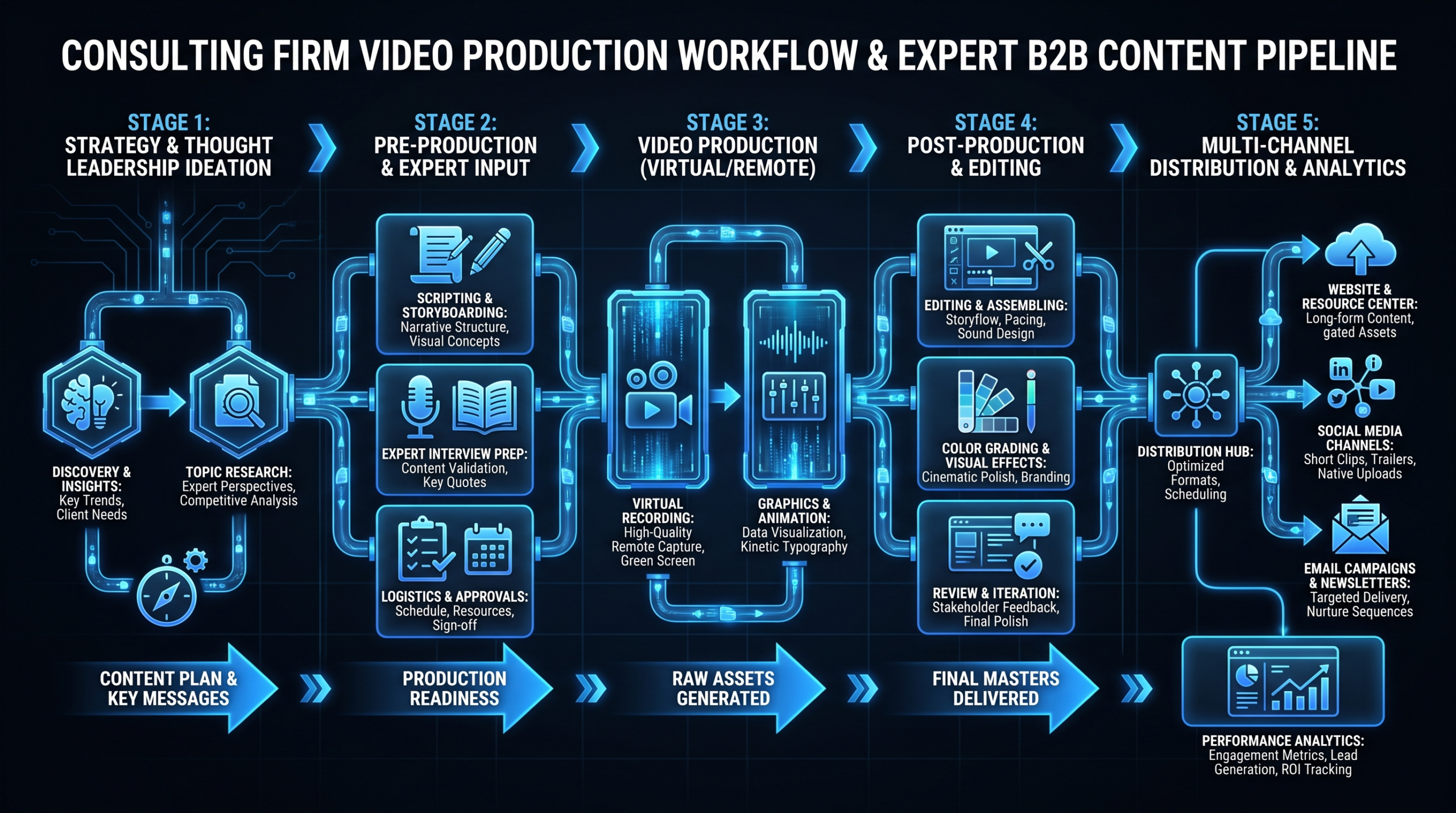
The 5-Stage Consulting Video Workflow
- Brief and align on concept (Week 1): Define the format, the speaker or speakers, the key messages, and the approval chain before any recording happens. Getting alignment on what the video is — and what it is not — before production begins prevents the most expensive revision type: the one where the partner watches the final cut and says "this isn't what I had in mind."
- Record (Week 1–2): Ideally in a professional recording environment. For partners who travel constantly, a well-equipped home or office setup (USB condenser mic, ring light, neutral background) produces acceptable quality for thought leadership and sales enablement formats. Remote recording coordination is a real workflow, not a compromise — it enables output that a studio-only requirement would block entirely.
- Edit and review (Week 2–3): The editing team produces a first cut. One designated internal reviewer — not a committee — gives consolidated feedback. This is operationally critical: distributed review processes where five people comment independently in a shared link produce conflicting notes and revision loops that add weeks to the timeline without improving the output.
- Legal or client sign-off (Week 3–4): Build this into the timeline as an explicit dependency, not a formality. For thought leadership content, legal review is typically lightweight. For case-study content involving client identities or claims, it is the longest phase.
- Publish and distribute (Week 4): Publication should happen as close to completion as possible. Finished videos sitting in approval queues lose relevance — particularly for time-sensitive thought leadership responding to market events or industry news.
How Remote Post-Production Removes the Bottleneck
The right outsourcing model for most consulting firms is remote post-production: a dedicated editorial team that handles all editing, motion graphics, sound design, and format variations, while the firm retains full control over scripting, recording, and messaging. This model lets firms scale video output without adding internal headcount or asking already-busy partners to manage an in-house editing team on top of their client and business development workload.
For firms starting out, a single dedicated editor who learns the firm's visual style, tone, and approval preferences can typically handle 8–12 videos per month across all formats. As output scales, the team grows without a proportional increase in the firm's management burden. This model is well-established in B2B SaaS and professional services video production — the workflow translates directly to consulting firm needs.
Common Workflow Mistakes
- Committee review. Video feedback needs one accountable reviewer per revision round, not a group thread in Slack or email. Consolidate all notes before sharing with the editor, not after.
- Treating each video as a one-off project. Firms that build standard brief templates, brand guidelines, and feedback process documentation see dramatically faster production cycles than those that reinvent the process for every video.
- Skipping the brief. "Just talk for 10 minutes and we'll shape it in post" produces expensive re-edits when the partner's talking points don't match the intended structure. Partners who receive a clear brief — key message, target audience, call to action, what to avoid — deliver better raw material that requires fewer revision rounds.
- Conflating approval chains. Internal approval (practice lead, marketing) and external approval (client, legal) are separate tracks with different timelines. Running them sequentially doubles the time. Run them in parallel wherever possible.
Cost and ROI: Making the Business Case
The right framing for video investment at a consulting firm is not "what does video cost per impression?" — it is "what is the value of one additional partner-level proposal conversion?" or "what is the lifetime value of retaining one high-performing consultant who chose the firm over a competitor?" Video's ROI lives in those high-value moments, not in top-of-funnel reach metrics that don't connect to business outcomes consulting leadership cares about.
Production Cost Ranges by Approach
Video Production Approaches for Consulting Firms
| Approach | Monthly Cost (Indicative Range) | Best For | Key Trade-offs |
|---|---|---|---|
| In-house video editor | $6,000–$9,500/mo (salary + benefits) | Single-format, high-consistency demand | HR overhead, single point of failure, capped skill set |
| Per-project agency | $3,000–$15,000+ per video | One-off brand or case-study productions | No brand memory, expensive at volume, long lead times |
| Editing subscription service | $2,000–$5,000/mo | High-volume simple edits (webinar cuts, social clips) | Queue-based, limited for complex formats, variable editors |
| Dedicated remote editing team | $5,000–$16,000/mo | Multi-format ongoing output, brand consistency at scale | Onboarding period (2–4 weeks); minimum commitment typically required |
For a detailed breakdown of how these pricing structures compare at different output volumes, our video production agency pricing models guide covers the cost math behind each approach.
Framing the Business Case Internally
At consulting firms, budget decisions for marketing investment require a direct connection to revenue, pipeline, or talent outcomes — not brand or reach metrics. Three angles that tend to work in internal business cases:
- Proposal conversion lift. If video assets are attached to proposals, track whether video-touch proposals convert at higher rates than non-video proposals over the same time period. A meaningful difference — even one additional win per quarter at typical consulting engagement values — can justify a full year of production investment.
- Content distribution efficiency. Calculate the implied cost of a partner producing equivalent written content (hourly billing rate multiplied by hours spent drafting, editing, and publishing). Video typically requires less partner time for equivalent reach and impact, particularly when repurposing webinar recordings that already happened.
- Recruiting funnel quality. Track application volume and offer-acceptance rates for roles with video on the job description versus those without over a comparable period. Firms that have run this analysis consistently find that video presence increases both application quality and candidate accept rates.
VEC provides dedicated video editing teams built specifically for clients producing consistent multi-format content — including professional services and B2B advisory firms. The Growth plan ($5K/mo) and Core plan ($9.5K/mo) are the entry points most consulting practices find match their initial production scale. The guarantee: double your video output in 90 days or month four is free. See how video has become central to B2B marketing strategy and why the infrastructure question matters more than it did five years ago.
Build vs. Buy vs. Outsource
For most consulting practices producing 4–15 videos per month across multiple formats, the most cost-effective model is keeping scripting, recording, and messaging in-house — where the expertise lives — and outsourcing all post-production to a dedicated remote editorial team. The partners and subject matter experts own the knowledge. That part cannot be outsourced. The editing, motion graphics, format variations, and publishing logistics can and should be handled by a team that operates at scale across multiple clients.
Full production outsourcing, including filming, makes sense for one-off, high-production case-study videos or brand films where production quality is part of the message. For the ongoing thought leadership and sales enablement library — the content that drives the day-to-day demand generation — a remote post-production partner is typically the most cost-effective path to consistent output.
Frequently Asked Questions
What types of videos do consulting firms produce most frequently?
Thought leadership clips and webinar recordings are the most common starting point because they repurpose content that already exists — partners have already prepared the thinking, and webinars are already recorded. Case-study videos are produced less frequently but tend to have the highest per-video impact on business development outcomes. Most practices that have been producing video for two or more years maintain an active library spanning most of the six core formats, with the mix weighted toward the formats their buyer journey relies on most heavily.
How long should a consulting thought leadership video be?
For LinkedIn distribution, videos in the 4–8 minute range typically generate the strongest engagement — long enough to make a substantive argument, short enough to watch without a major time commitment. YouTube and website embeds can support 10–20 minute deep-dive formats effectively when the content genuinely warrants the length. The key variable is whether the argument justifies the duration: a 5-minute video with one tight, well-supported claim outperforms a 15-minute video with three loosely connected ones every time.
How do consulting firms handle client confidentiality in case-study videos?
The standard approach is a structured written release process: the client reviews and explicitly approves every claim made in the video before it publishes anywhere. Some firms produce blind case studies with the industry and engagement type disclosed but the client name anonymized — useful when a client won't consent to public attribution. Others produce internal-only versions for proposal use that don't require public sign-off but serve the same conversion purpose in deal cycles. The key discipline is building the approval step into the production timeline from day one, not treating it as a post-production formality.
What is the most efficient way to scale consulting video without hiring in-house?
The model that works best for most consulting firms at 4–15 videos per month is keeping scripting, recording, and messaging in-house — where the expertise lives — and outsourcing all post-production to a dedicated remote editing team. This avoids the HR overhead of hiring, the single-point-of-failure risk of one in-house editor, and the management burden of building an internal video department. A dedicated editing partner who learns the firm's style, brand guidelines, and approval process typically delivers a lower effective cost per finished video than any in-house alternative at that output level, while absorbing the volume variability that comes with a professional services content calendar.
How should consulting firms measure video ROI?
Measure what video actually influences — not generic reach or view-count metrics. For thought leadership, track content-touched pipeline: do prospects who viewed your video convert at higher rates or move through the sales process faster? For case-study videos, compare proposal win rates when video assets are included versus when they are not. For recruiting, track application volume and offer-acceptance rates on roles with video in the listing versus those without. For sales enablement clips, track deal velocity and response rates when video is included in outreach versus text-only approaches. These metrics connect video investment directly to business outcomes that consulting firm leadership recognizes and values.
Ready to Scale Your Firm's Video Output?
VEC provides dedicated video editing teams for professional services and B2B advisory firms — thought leadership clips, case-study productions, webinar repurposing, and sales enablement assets, all from one team that learns your brand. Growth plan from $5K/mo. Double your video output in 90 days or month four is free.
Book a Free Strategy Call See How It Works See Pricing