The Outsourcing Readiness Test for Content Ops
TL;DR
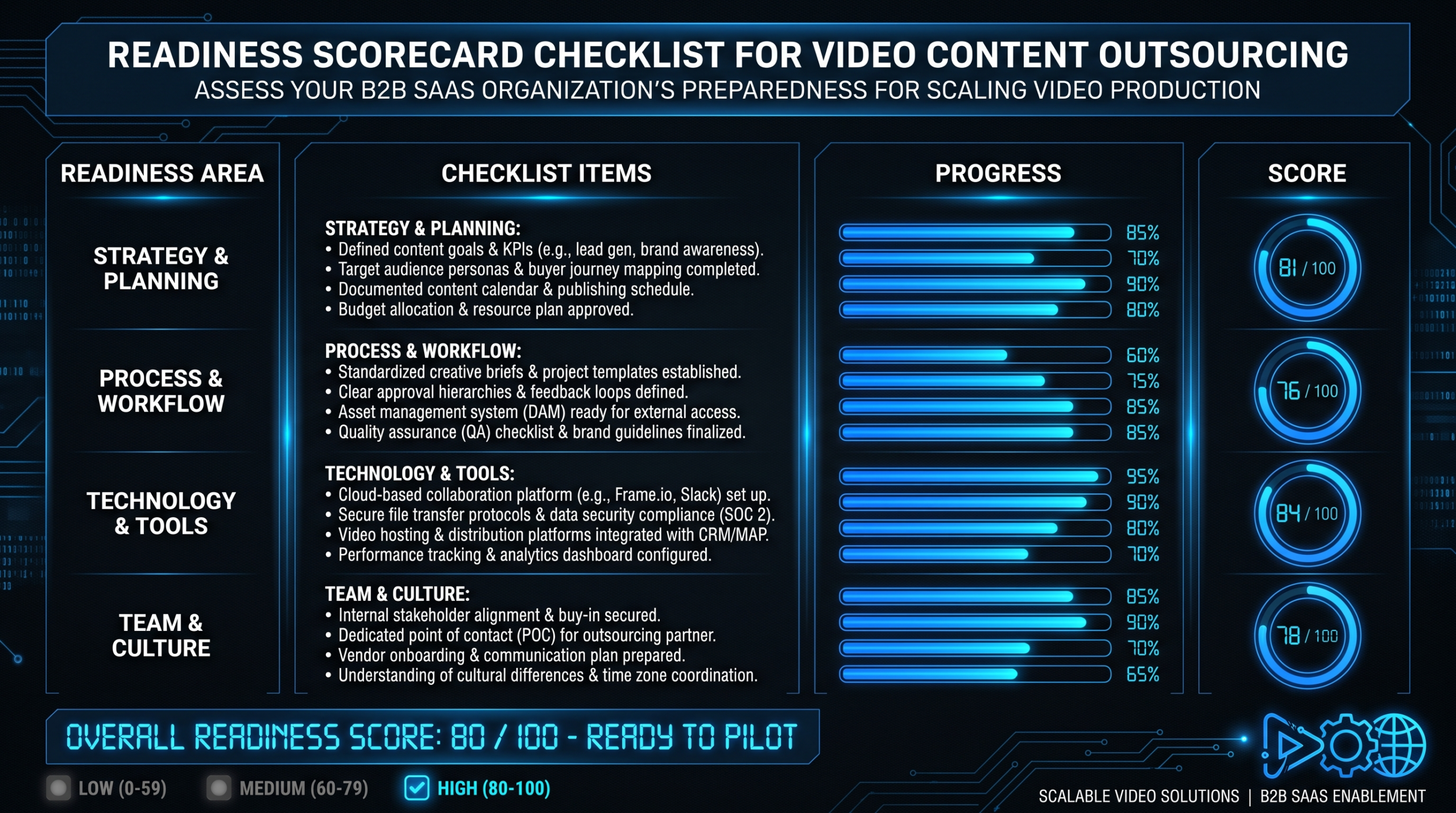
Most SaaS teams that struggle with outsourced video production were not unready to produce more content — they were unready to manage an outside team doing it. This article gives you a 20-question scored self-assessment across five readiness pillars: process documentation, brand guidelines maturity, volume consistency, internal review bandwidth, and budget clarity. Use your score to decide whether to start now, wait 30 days, or build the foundation first.
Table of Contents
- Why Readiness Matters Before You Sign Anything
- The 5 Pillars of Outsourcing Readiness
- The 20-Question Readiness Quiz
- What Your Score Means
- What "Not Ready Yet" Looks Like — and the 30-Day Fix
- Red Flags That Signal a Team Is Not Ready
- How to Prepare Your Stack and Team for a Smooth Handoff
- Agencies Worth Evaluating Once You're Ready
- FAQ
Why Readiness Matters Before You Sign Anything
Outsourcing video production is not a plug-and-play decision. It is an operational integration. You are bringing an external team into your content engine — one that needs to understand your brand voice, receive structured input from your side, and return work that your internal stakeholders can approve without a week of email threads.
When that integration fails, it is almost never because the agency lacked skill. It is because the client team lacked the operational scaffolding to direct an outside crew effectively. They could not articulate what "on-brand" meant. Briefs were missing or vague. Revision rounds ran three times longer than budgeted. The relationship ended in frustration, and the internal narrative became "outsourcing video doesn't work for us" — when the real issue was launch sequence, not the vendor.
According to Wistia's State of Video report, teams that produce video at high volume consistently outperform those that produce it sporadically — but volume alone is not the differentiator. Operational consistency is. Teams with documented workflows and clear internal ownership get more out of every production dollar, whether they produce in-house or outsourced.
This assessment is designed for VP Marketing, Head of Content, and Content Operations leaders at Series A through C SaaS companies who are evaluating whether to outsource video production — or who have already started and want to understand why the relationship isn't performing as expected.
The 5 Pillars of Outsourcing Readiness
Before you score yourself, understand what you're measuring. Each pillar maps to a recurring failure mode in outsourced video relationships.
Pillar 1: Process Documentation
An outside team cannot read your institutional knowledge. They need written processes — a brief template, a defined revision workflow, a clear handoff protocol for raw footage. Without this, the agency spends your money figuring out what you want instead of producing it. Teams that skip this step consistently report that the first 60 days of outsourcing felt "chaotic" or "like we were paying to train them instead of getting output."
Process documentation does not need to be a 40-page operations manual. A well-structured brief template and a two-paragraph revision policy are enough to start. But they must exist in writing. See our guide on how to outsource video editing for the specific documents most teams need before day one.
Pillar 2: Brand Guidelines Maturity
Your brand guide may be thorough for static design but thin for video. Color palettes and typography do not tell an editor what music energy feels right for your product demos, what pacing suits your audience, or what B-roll aesthetic matches your positioning. Teams with mature video brand guidelines onboard external editors in days. Teams without them onboard in weeks — and spend the difference in revision rounds.
The minimum viable video brand guide includes: reference videos (3+ examples of output you love), visual do-nots (motion, transitions, or color grading you've rejected before), music direction (genre, energy, approved libraries), and tone words for voiceover or on-screen copy.
Pillar 3: Volume Consistency
Outsourcing works best when your demand is predictable. If your video needs spike in Q4 and vanish in Q1, you're not a good fit for a dedicated team model — you're a per-project buyer. Dedicated teams and monthly retainers are priced for consistent workloads. When you feed them irregularly, you pay for capacity you're not using.
Consistency also signals organizational maturity. Teams that produce video predictably have usually already solved the upstream problems: content strategy, internal stakeholder alignment, and production calendar management. Those solved problems make outsourcing significantly smoother.
Pillar 4: Internal Review Bandwidth
Outsourcing does not eliminate internal time investment — it redistributes it. Instead of spending time on editing, your team will spend time on briefing, reviewing, and approving. If no one has explicit ownership of that review function, or if the named reviewer is already at capacity, the bottleneck moves from production to approval — and you still don't ship videos.
A realistic estimate for managing an outsourced video relationship: 3 to 5 hours per week for a team producing 8 to 15 videos per month. That includes reviewing briefs, giving timestamped feedback on cuts, and managing the production calendar. Factor this into your staffing before you sign.
Pillar 5: Budget Clarity
Vague budget ranges create dysfunctional vendor relationships. If your internal approval is "somewhere between $3K and $10K per month depending on results," you cannot select the right pricing model, you cannot negotiate contract terms effectively, and the vendor cannot staff appropriately for your account.
Budget clarity means knowing your approved monthly spend, having leadership sign-off for at least two quarters, and understanding what "success" looks like in terms that justify the investment. Teams with clear budgets move faster through vendor selection, start onboarding sooner, and hit steady-state output in roughly half the time compared to teams that are still negotiating internally while the agency clock is running.
The 20-Question Readiness Quiz
Score each question: 0 = Not true, 1 = Partially true, 2 = Fully true. Be honest — this assessment is only useful if the score reflects reality, not aspiration.
Pillar 1 — Process Documentation
Q1. We have a documented brief template for video requests that we consistently use.
Q2. Our production workflow — from raw footage handoff to published video — is documented in steps any new team member could follow.
Q3. We can describe, in writing, what a "done" video looks like (format specs, aspect ratios, export requirements) before production starts.
Q4. We have a defined revision process: named approval owner, structured feedback format, and a maximum number of revision rounds per project.
Pillar 2 — Brand Guidelines Maturity
Q5. We have a written brand style guide that covers visual identity: colors, typography, logo usage rules.
Q6. Our brand guidelines include video-specific direction: music tone, pacing preferences, B-roll style, preferred motion graphics aesthetic.
Q7. We can share at least 3 approved reference videos that represent our desired output standard — including examples we've made and examples from other brands we admire.
Q8. We have documented "brand red lines" for video — things we've explicitly rejected in past feedback that any new editor needs to know upfront.
Pillar 3 — Volume Consistency
Q9. We publish video content on a predictable schedule — at least twice a month, ideally weekly.
Q10. Our video output has been at roughly the same volume for at least 3 consecutive months — it's not a one-time push.
Q11. We have an active content calendar that projects video needs at least 4 weeks ahead — we are not briefing videos 48 hours before they're needed.
Q12. We rarely have months with zero video production activity — video is a standing part of our content program, not a campaign-specific tactic.
Pillar 4 — Internal Review Bandwidth
Q13. We have a single named person who owns video feedback and approvals — not a committee, not "whoever has time."
Q14. That reviewer can reliably commit 3 to 5 hours per week to the video relationship — reviewing cuts, giving feedback, and managing the production calendar — without it being squeezed out by other priorities.
Q15. Our internal approval turnaround is 48 to 72 hours for video reviews — not days or weeks of silence followed by a burst of comments.
Q16. Our feedback style is structured — we give timestamped notes with specific instructions, not vague qualitative reactions like "make it feel more premium."
Pillar 5 — Budget Clarity
Q17. We have a defined, approved monthly budget for video production — a specific number, not a range contingent on board approval or "if it performs."
Q18. Our video budget is approved for at least 6 months ahead — we are not month-to-month dependent on results to justify the next invoice.
Q19. We understand the actual cost difference between our current approach (in-house time, freelancers, one-off projects) and a dedicated outsourced team — we've done the math.
Q20. Leadership has explicitly approved the decision to outsource video production — this is not a "I'm hoping to get approval once I find a vendor" situation.
What Your Score Means
Add your scores. Maximum is 40 points (20 questions × 2 points each).
Your operations are mature enough to support an external production team. Start vendor conversations now and focus your energy on the selection process and contract terms. Aim to be onboarding within 30 days.
You have the foundation but gaps in one or two pillars that will slow onboarding or inflate your revision cycles. Identify your lowest-scoring pillar, spend 30 days closing the gap, then reassess. You should be able to start within 60 days.
Significant operational gaps exist. Outsourcing now will produce a frustrating first 90 days — high revision rounds, misaligned output, and an internal narrative that "outsourcing doesn't work." Address your two lowest-scoring pillars before proceeding.
The prerequisites for a successful vendor relationship are not in place. Outsourcing at this stage means paying a premium to produce content that won't meet your standards — and you won't be able to articulate why. Spend 60 to 90 days on internal operations before evaluating vendors.
If you scored 2 on most questions in one pillar and 0 across another, your bottleneck is concentrated — that's actually easier to fix than scattered low scores. Focus there first.
What "Not Ready Yet" Looks Like — and the 30-Day Fix
Teams that score in the 12–21 range tend to exhibit the same patterns. Recognizing them is the first step to a fast fix.
The Classic "Not Ready" Profile
Video production is driven by reactive needs, not a calendar. The brief for each video is a Slack message or a bullet-point email. "Brand guidelines" means a Figma file with colors and a logo — nothing that describes how video should feel. The person who approves videos is also running three other projects and responds to feedback requests when convenient. Budget conversations happen after a vendor is selected, not before.
In this environment, outsourcing does not solve the production problem — it exposes the operations problem at a higher cost per mistake.
The 30-Day Fix (For Scores in the 12–21 Range)
This is a realistic 30-day sprint. It does not require new headcount or a major operations overhaul:
- Week 1 — Process: Create a one-page brief template. Include: video type, target audience, key message (one sentence), call to action, format requirements, reference examples, and deadline. Make it mandatory for all future video requests.
- Week 1 — Approval ownership: Name one person as the video approval owner. Document that they have 48 hours to respond to any review request. Get manager sign-off on their time allocation.
- Week 2 — Brand: Run a 2-hour session where your current video reviewer watches 10 of your existing videos and writes down: what they like (keep doing), what they'd reject (never do again), and three reference videos from outside your brand that represent the aesthetic you want. Turn that session output into a one-page video brand brief.
- Week 3 — Volume audit: Pull the last 6 months of video output. Count the videos, categorize by type, and note the months. If you produced zero videos in more than one of those months, the volume problem is actually a content strategy problem. Address that before outsourcing.
- Week 4 — Budget: Get written sign-off on a specific monthly budget for at least two quarters. Include it in your department's formal budget documentation. You cannot negotiate a vendor contract without this.
After 30 days of this sprint, reassess your score. Most teams move from the 12–21 band to 26–34 within a month of focused effort.
Red Flags That Signal a Team Is Not Ready to Outsource
Beyond the quiz score, these are specific behavioral signals that indicate deeper unreadiness. They tend to appear during vendor conversations or early in an outsourcing engagement:
Red Flags vs. Green Flags
| Situation | Red Flag | Green Flag |
|---|---|---|
| Describing your video needs | "We need more videos — whatever makes sense" | "We need 6 product demo videos per month, 2–3 min each, targeting enterprise buyers" |
| Sharing brand guidance | Sending a logo file and a hex code | Sharing a video brand brief with reference clips and tone words |
| Revision rounds | 4+ rounds on every video, open-ended feedback cycles | 2 structured rounds with timestamped, actionable notes |
| Stakeholder involvement | 5 people approve videos, opinions change between rounds | 1 named approver, clear decision authority |
| Budget conversations | "Let's see what you charge and I'll take it to leadership" | "Our approved budget is $X/month for a 6-month engagement" |
| Content calendar | Briefing videos 72 hours before they're needed | Briefing videos 2–4 weeks in advance |
| Measuring success | "I'll know a good video when I see it" | "Success is X videos per month at Y quality standard by month 3" |
| Footage and assets | Sharing a Dropbox link with unlabeled folders full of raw clips | Organized, labeled footage with selects identified and a shot list |
If you recognize 3 or more red flags in your current operation, score them honestly in the quiz above — you likely landed in the 12–21 range. The good news is that most of these are process problems, not structural ones. They are fixable within a month.
How to Prepare Your Stack and Team for a Smooth Handoff
Assuming you've scored 22 or higher and are ready to start — or that you're planning your 30-day sprint — here's the operational prep that determines whether your first 90 days go smoothly or sideways.
The Handoff Stack
You need four systems before day one with a vendor:
- Asset delivery: A shared cloud folder (Google Drive, Dropbox, Frame.io) with a naming convention the external team can navigate. Label folders by project and date, not by internal abbreviations that only your team understands.
- Brief management: A project management tool (Notion, Asana, ClickUp) where each video brief lives as a task with all relevant assets attached. Avoid email chains for brief delivery — they make version control impossible.
- Review and feedback: A dedicated video review platform (Frame.io, Vimeo Review, Wipster) where the team can leave timestamped comments on specific cuts. This reduces revision cycles dramatically compared to written feedback on emailed drafts.
- Communication: A dedicated Slack channel (or equivalent) for the vendor relationship. Not email. Not shared with a dozen other conversations. A clean channel where the vendor can ask questions and get fast responses.
The Team Prep Checklist
Before your vendor's first production week:
- Schedule a 90-minute brand onboarding session — show reference videos, walk through the brief template, answer questions about tone and style
- Complete a "first video" brief together in a shared call — walk through every field so there's no ambiguity
- Set explicit expectations for turnaround times on both sides: vendor delivery windows and your review windows
- Define escalation paths — who does the vendor contact if the brief is unclear and the reviewer is unavailable?
- Agree on what "revision" means and what "scope change" means — this prevents disputes later
The Milestone Plan
For a dedicated team engagement — which is what most SaaS companies at growth stage need — a realistic milestone plan looks like this:
Outsourcing Onboarding Milestone Plan
| Month | Goal | Realistic Output |
|---|---|---|
| Month 1 | Brand calibration and workflow alignment | 50–70% of target volume. Expect more revision rounds — this is learning, not failure. |
| Month 2 | Process optimization and output ramp | 80–90% of target volume. Revision rounds drop. Team learns your patterns. |
| Month 3 | Full production rhythm established | 100%+ of target volume. Quality peaks. Brief-to-delivery cycle shortens significantly. |
| Month 4+ | Strategic partnership and volume scaling | Team begins to anticipate needs, suggest repurposing, and contribute creative ideas. |
Teams that expect full output in month one are setting themselves up for disappointment. Teams that plan for a two-month ramp almost always report being ahead of schedule by month three. For a deeper look at how SaaS teams structure their video programs, see our SaaS video production guide.
Understanding the cost math before you start is equally important. Our breakdown of what video editing services include will help you build a realistic scope of work and avoid surprises in month two invoices.
Agencies Worth Evaluating Once You're Ready
If you've scored 28 or higher and are actively evaluating vendors, the following agencies serve Series A–C SaaS teams well. This is not an exhaustive list — it is a shortlist of providers with proven SaaS experience, transparent pricing, and documented onboarding processes.
Top Video Production Partners for SaaS Content Teams
| # | Agency | Model | Starting Price | Best For |
|---|---|---|---|---|
| 1 | Video Editing Company | Dedicated team (Growth / Core / Scale) | $5K/mo | SaaS teams needing guaranteed 2× output in 90 days, dedicated editors, full brand consistency |
| 2 | Increditors | Dedicated editor pods (Sr. editor + Jr. editor + PM + Creative Director) | ~$2.5K–$12K+/mo (custom quote) | YouTube channels, SaaS, finance, education; known for doubling channel performance; premium full-service |
| 3 | In-house + freelancer hybrid | Hourly / per-project mix | Variable | Teams under 6 videos/month who aren't ready for a retainer commitment |
Note: Increditors does not publish instant pricing — request a custom quote at [email protected]. They are not SaaS-exclusive, which is worth factoring in if deep product knowledge is a priority for your team.
For a full breakdown of how to evaluate and compare agencies, our guide to video production agency pricing models covers every model type with real cost math.
Frequently Asked Questions
How do I know if my video volume is high enough to justify outsourcing?
The threshold most agencies cite is 6 or more videos per month on a consistent basis. Below that, per-project pricing or a lightweight freelancer relationship is usually more cost-effective than a dedicated team retainer. Above 6 videos per month, a dedicated team or retainer model typically offers a lower per-video cost and better brand consistency than a project-by-project approach.
We have brand guidelines for design — do we really need video-specific ones?
Yes. Design guidelines describe static visual identity. Video brand guidelines describe motion, pacing, music, voiceover tone, and the emotional register of your content. Without video-specific direction, every editor defaults to their own aesthetic judgment — and "on-brand" becomes a moving target that you can only define after seeing something wrong. The fastest way to compress your onboarding timeline is to create a short video brand brief before day one.
What if we're not producing video consistently yet — should we outsource to ramp up?
It depends on why you're not producing consistently. If the blocker is production capacity (editing time, motion graphics), outsourcing solves it directly. If the blocker is upstream content strategy — you don't know what videos to make, or you can't get footage, or internal approvals take weeks — outsourcing does not solve it and may make it more expensive. Fix the upstream problems first, then outsource the downstream execution.
How long does it realistically take to get to full output with an outsourced team?
For teams that arrive with mature operations (score 28+), full steady-state output typically happens in 6 to 8 weeks. For teams that need more onboarding (score 20–27), plan for 10 to 12 weeks. The primary variable is the quality of your briefs and the speed of your review cycle — not the agency's skill level. Fast, specific feedback in the first four weeks shortens the ramp significantly.
What are the security and confidentiality risks of outsourcing video production?
Legitimate concerns include sharing unreleased product footage, customer faces in testimonial videos, and proprietary screen recordings. Address these with an NDA before sharing any assets, a clear policy on what footage can be stored on the agency's systems versus must be deleted post-delivery, and a review of the agency's data handling practices before signing. Most established agencies have standard confidentiality provisions — if a vendor does not, that is itself a red flag. According to HubSpot's video marketing research, video is increasingly core to enterprise marketing — security practices in the vendor landscape have matured accordingly.
Ready to Outsource? Let's Build Your Video Program.
Video Editing Company provides dedicated editing teams for B2B SaaS — Growth ($5K/mo), Core ($9.5K/mo), and Scale ($16K/mo). We guarantee double your video output in 90 days, or month four is free. If you scored 22 or above, it's worth a 30-minute call to see what a dedicated team would look like for your content program.
Book a Free Strategy Call View Pricing Plans