Video Ops for Lean Teams: Replace a Manager
TL;DR
A dedicated video operations manager handles six core functions: brief intake, scheduling, vendor coordination, quality review, revision tracking, and distribution. Most of these can be systematized with the right SOPs and a three-role outsourced team structure. This guide shows you exactly how - with a sample weekly rhythm, a minimal four-tool stack, and the failure modes that kill lean video programs before they scale.
Table of Contents
- What a Video Ops Manager Actually Does Day-to-Day
- Which Tasks Can Be Systematized - and Which Can't
- How to Structure an Outsourced Video Team to Replace the Ops Layer
- Common Failure Modes (and How to Prevent Them)
- A Sample Weekly Video Ops Rhythm Without a Manager
- The Minimal-Tool Stack for Lean Video Operations
- Addressing Trust Objections Directly
- FAQ
If you're running video content at a Series A-C SaaS company with a lean content team - two, three, maybe four people including yourself - the conversation about video production usually goes one of two ways. Either someone suggests hiring a video ops manager to wrangle the growing chaos, or video quietly falls behind while the team keeps firefighting.
Neither outcome is good. A full-time video ops manager is a $90,000-$130,000 annual line item before benefits and tools. And letting video slip isn't an option when pipeline attribution, customer education, and brand differentiation all run through it.
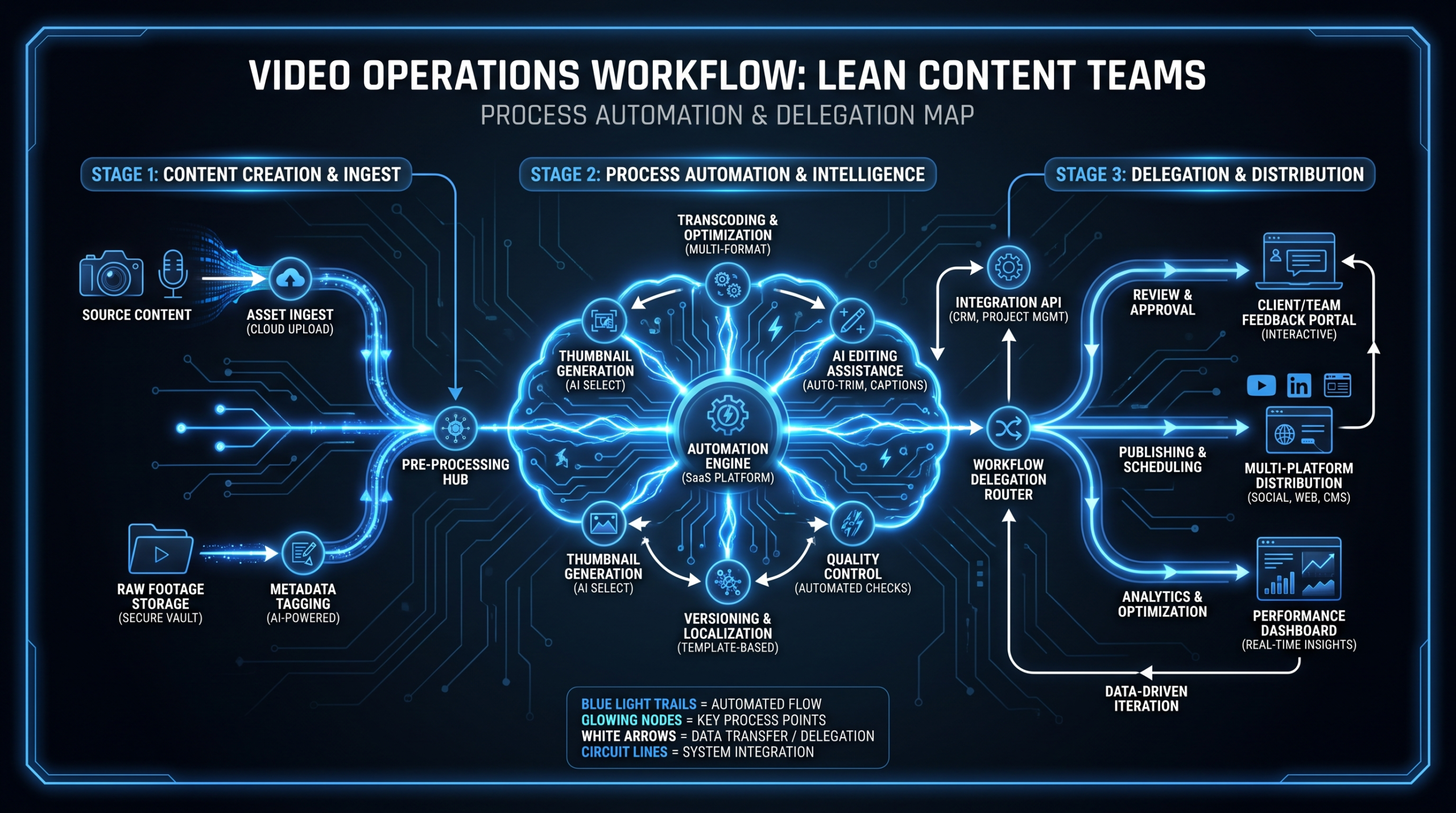
There's a third path: systematize the operations layer, outsource the execution, and keep your team focused on strategy and creative direction. This is what mature content teams at SaaS companies actually do - and this guide shows you exactly how to build that system.
What a Video Ops Manager Actually Does Day-to-Day
Before you can replace a video ops manager, you need an accurate map of what that role actually does. Most job descriptions blur the line between "creative director" and "operations coordinator." The operational functions are the ones you can systematize.
Brief Intake and Script Coordination
Every video starts with a brief. A video ops manager's job is to ensure that brief is complete, unambiguous, and contains everything the editor needs before a single frame gets touched. In practice, this means chasing down stakeholders for missing information, standardizing brief formats across requesters, and translating vague direction ("make it feel premium") into actionable specifications ("match the color grade from the Q2 product demo, keep music below 20% volume, use the condensed logo variant").
Teams that skip this step pay for it in revision cycles. The brief intake function is almost entirely systematizable with a well-built intake form and a brief template that forces specificity.
Production Scheduling and Capacity Management
A video ops manager maintains the production calendar - what's in queue, what's in edit, what's in review, and what's scheduled to publish. They balance competing priorities across requesters (demand gen, product marketing, CS, executive comms), set realistic delivery expectations, and prevent the system from overloading when three campaigns launch in the same week.
This is operational, not creative. A production tracker in Notion or Airtable, combined with a weekly sync cadence, handles 90% of this function.
Vendor and Editor Management
On lean teams using freelancers or agencies, someone has to manage the relationship: briefing editors, answering questions mid-production, tracking deliverables, and handling scope creep conversations. This coordination overhead is invisible until it isn't - when a freelancer goes dark or delivers something off-brief, someone on your team absorbs the fallout.
This is where the choice of production partner matters enormously. When you work with a dedicated outsourced team (as opposed to platform-based freelancers), the vendor management burden collapses because the team learns your system and operates within it. See our guide on how to outsource video editing for how to structure this selection process.
QA and Quality Review
Before a video goes to a stakeholder for review, someone needs to catch the obvious errors: wrong lower third spelling, music that cuts abruptly, a missing endcard, an off-brand font. This first-pass QA is often skipped on lean teams, which means errors get caught in stakeholder review - a far more expensive round of changes.
QA can be systematized with a checklist. It cannot be fully automated, but it can be delegated to a project manager within your production team.
Revision Coordination
Collecting and consolidating feedback from multiple stakeholders is one of the most time-consuming operational tasks in video production. A video ops manager consolidates comments from Frame.io, Slack, email, and live calls into a single revision brief, prioritizes changes, and communicates them clearly to the editor.
Without this function, editors get contradictory feedback from five different people and produce a video that satisfies none of them. The function is systematizable but requires clear communication protocols and tool discipline.
Distribution and Publishing
Once a video is approved, it needs to get to its destination: uploaded to YouTube, embedded on a landing page, distributed to the sales team, posted to LinkedIn, or sent to a customer success manager for onboarding. This is purely operational and fully systematizable with a distribution SOP and publish checklist.
Which Tasks Can Be Systematized - and Which Can't
Not everything a video ops manager does is equal. Some functions require human judgment and should stay with a senior person on your team; others are process-execution tasks that can be offloaded entirely.
Video Ops: Systematizable vs. Requires Human Judgment
| Task | Systematizable? | How |
|---|---|---|
| Brief intake and formatting | Yes - fully | Standardized intake form with required fields; auto-routes to production queue |
| Production scheduling | Yes - largely | Shared Notion tracker with capacity columns; PM maintains status |
| Editor briefing | Partially | Template-driven with human review for complex/new formats |
| Vendor management | Yes - with right partner | Dedicated team with embedded PM eliminates most of this overhead |
| First-pass QA | Partially | QA checklist delegated to production PM; final review stays human |
| Feedback consolidation | Partially | Frame.io centralizes comments; PM consolidates into revision brief |
| Creative direction | No | Requires brand judgment and strategic context - keep in-house |
| Stakeholder prioritization | No | Requires organizational context - stays with content lead |
| Distribution execution | Yes - fully | Publish checklist with channel-specific specs; no judgment required |
| Performance review | No | Requires strategic interpretation - stays with content lead |
The pattern is clear: execution tasks are systematizable; judgment tasks are not. A lean team's content lead should own creative direction, stakeholder prioritization, and performance review. Everything else can be absorbed by a well-structured outsourced team operating within defined SOPs.
This is the operating model that lets a two-person content team run a 15-20 video-per-month program without a dedicated video ops manager.
How to Structure an Outsourced Video Team to Replace the Ops Layer
The key insight is that most video outsourcing fails because teams hire for execution capacity - more editing hours - without solving for the operations gap. You get more editors but still spend your own time briefing, reviewing, and coordinating. The overhead doesn't shrink; it just scales sideways.
The model that actually absorbs the ops burden requires three specific roles working within your system.
The Core Three-Role Model
Role 1: The production project manager (PM). This person is your single point of contact. They receive briefs, assign work to editors, consolidate feedback, track delivery, and run the QA checklist. They know your brand well enough to catch obvious errors before anything reaches you. On a dedicated team arrangement, this role is already included - it's one of the primary reasons dedicated team models outperform freelancer pools for lean organizations. For more on what this structure looks like in practice, read our overview of what video editing services include.
Role 2: The senior editor. The senior editor owns the creative output - editing to brief, maintaining brand consistency, and flagging creative issues before they become revision problems. They should have a detailed brand style guide from your team and, after four to six weeks of working together, should require minimal direction on format and style.
Role 3: The junior editor or production coordinator. Handles first-cut assembly, format exports, transcriptions, thumbnail variants, and distribution tasks. This person executes the fully-systematized tasks - the ones that require no judgment, only process adherence.
This structure mirrors what you'd hire for in-house, at a fraction of the cost and with no recruiting, HR, or management overhead. Video Editing Company's dedicated team plans are built on exactly this structure - the PM layer is what separates a true ops partnership from a simple editing service.
Communication Protocols That Replace a Manager
Structure without communication protocols collapses under pressure. The three protocols that matter most:
- Brief submission ? confirmation SLA. Every brief submitted via your intake form gets a PM confirmation within four business hours. The confirmation includes: confirmed delivery date, any clarifying questions, and confirmation that assets were received and accessible. No confirmation = no production.
- Single-threaded feedback. All feedback goes through Frame.io, consolidated by the PM into a numbered revision list before it reaches the editor. No Slack DMs to the editor, no email chains. One feedback round, one revision brief.
- Weekly status async. The PM sends a Monday morning async update (Loom or written) covering: videos in edit this week, videos in review, videos ready to publish, and any blockers. Your content lead reviews it in five minutes. No weekly sync call needed unless there's an escalation.
These three protocols, embedded in a shared Notion workspace, replace 80% of what a full-time video ops manager handles day-to-day.
Common Video Ops Failure Modes (and How to Prevent Them)
Lean teams running video programs without a dedicated manager fall into predictable traps. Knowing them in advance lets you design around them.
The Brief Bottleneck
What it looks like: Videos consistently deliver late. The editor keeps asking for more information. Revision rounds are long. Stakeholders complain the final product "missed the point."
Root cause: Briefs are incomplete. Either the intake form doesn't force specificity, or people bypass it and brief editors directly via Slack. The editor starts work without enough context, guesses wrong, and the revision cycle becomes the briefing process.
Fix: Lock down the intake form. No brief, no production - the PM should return any submission missing required fields. Require: target audience, primary message (one sentence), call to action, visual reference examples, music direction, and delivery date. Make the form take five minutes to complete; it will save four hours of revision.
Revision Loops That Never End
What it looks like: A video goes through five, six, seven rounds of revision. Stakeholders keep adding new notes. The editor is demoralized. The publish date keeps slipping.
Root cause: No revision structure. Feedback is collected from multiple stakeholders asynchronously over multiple channels, with no consolidation step. Each stakeholder sees a different version and leaves conflicting notes. The editor tries to satisfy everyone and satisfies no one.
Fix: Define two revision rounds in your SOP. Round 1 is for structural changes (content, pacing, messaging). Round 2 is for polish (color, sound, fine cuts). All stakeholders submit feedback on the same version via Frame.io within a defined window (48 hours). The PM consolidates into one revision brief. Any feedback submitted after the window applies to the next video.
Brand Drift Over Time
What it looks like: Videos from six months ago look noticeably different from current ones. Colors are off, music is inconsistent, the logo appears in different positions. New stakeholders don't recognize it as your brand.
Root cause: No documented brand style guide for video. Editors work from memory, absorb inconsistencies over time, or get handed briefs with conflicting references. When team members change - on your side or the production side - the institutional memory is lost.
Fix: Build a video brand guide that covers: color palette with hex codes, approved font stack and sizes, logo placement rules, approved music genres and energy levels, and three to five reference videos that define "on-brand." Update it quarterly. Store it in the shared Notion workspace and link to it from every brief template. For an overview of what should be included in a full video editing engagement, see our video editing services guide.
A Sample Weekly Video Ops Rhythm Without a Manager
Here's what a well-functioning lean video ops system looks like in practice. This assumes a content team of two to three people working with a dedicated outsourced team, producing eight to twelve videos per month.
Weekly Video Ops Rhythm - Lean Team Model
| Day | Who | Action | Time Required |
|---|---|---|---|
| Monday AM | Production PM | Sends async status update via Loom: videos in edit, in review, ready to publish | PM: 15 min |
| Monday AM | Content Lead | Reviews PM update, flags priorities for the week, submits any new briefs via intake form | Lead: 20 min |
| Tuesday | Production Team | First cuts delivered to Frame.io for any videos briefed the prior week | Lead: review when available |
| Wednesday | Stakeholders | Feedback window closes on any video in review (48-hour window from delivery) | Stakeholders: 15-30 min each |
| Wednesday PM | Production PM | Consolidates stakeholder feedback into numbered revision brief, sends to editor | PM: 30 min |
| Thursday | Production Team | Revised cuts delivered; PM runs QA checklist before releasing to stakeholders | Lead: light review only |
| Friday | Content Lead | Approves final cuts, confirms publish schedule, triggers distribution SOP | Lead: 30 min |
| Friday PM | Production PM | Executes distribution checklist: uploads, embeds, sends to relevant internal stakeholders | PM: 45 min total |
Total time from your content lead: approximately two to three hours per week to oversee an eight to twelve video-per-month program. The rest is executed by the production team operating within the system you've built.
This is only achievable if the system is designed from the start - intake form, style guide, Frame.io workspace, revision protocols, and a PM layer that handles coordination. Without the system, the time investment from your team scales linearly with video volume. With it, the relationship between your time and output breaks: volume can double while your involvement stays flat.
According to Wyzowl's annual video marketing survey, the top reported barrier to video production isn't budget - it's time. The ops system described above directly attacks that constraint.
The Minimal-Tool Stack for Lean Video Operations
You do not need a complex toolchain. Four tools, used consistently, cover everything a video ops manager would otherwise handle manually.
Notion - Project Management and SOPs
Notion is your single source of truth. It holds: the production calendar (a simple board view with statuses: Brief Received ? In Edit ? In Review ? Approved ? Published), the brand style guide, all SOP documents, and the brief intake form. If you can only invest time in one tool, invest it here. A well-organized Notion workspace means anyone - including a new production partner - can onboard in hours rather than weeks.
The database structure that works: one row per video, with fields for: video title, requester, brief date, target publish date, current status, assigned editor, Frame.io review link, and YouTube/CMS publish URL. This one view replaces a video ops manager's status tracking entirely.
Frame.io - Review and Approval
Frame.io is built specifically for video review. Stakeholders can leave timestamped comments directly on the video - no more "at 0:48, the lower third..." descriptions in email threads. The PM collects all comments from a single URL, consolidates them, and sends the editor a clean revision brief. Review rounds are documented, so there's never ambiguity about what was requested or when.
Frame.io also integrates with Adobe Premiere Pro, which means editors can push updates directly to the review link without re-uploading. For teams using multiple editors, the version history is invaluable for tracking what changed and why.
Slack - Async Communication
One dedicated channel per project. All production-related communication goes there - no DMs to editors, no email. The channel history is the record. The PM monitors and routes; your content lead checks in when the PM pings for a decision. The rule that makes this work: editors never communicate directly with stakeholders. All stakeholder communication routes through the PM. This single rule eliminates the brief confusion and conflicting feedback that derails most lean video programs.
Loom - Brief Delivery and Async Updates
Some briefs are hard to convey in text. A sixty-second Loom showing a reference video with voiceover commentary saves four rounds of "can you clarify what you meant by..." The PM uses Loom for weekly status updates - faster to record, faster to watch, easier to absorb than a written report. As noted in HubSpot's video marketing research, video communication is processed significantly faster than text - the same applies internally, not just in marketing.
These four tools - Notion, Frame.io, Slack, Loom - are the operational infrastructure. They're not magic; a disorganized team using all four still has disorganized video operations. But a disciplined team using these four tools, combined with the SOP framework described above, doesn't need a fifth person to manage the system.
Addressing Trust Objections Directly
The three questions that come up every time a lean team considers outsourcing the video ops layer:
"How do we maintain quality without someone internal managing it?"
Quality is maintained through two mechanisms: the brand style guide and the QA checklist. The style guide documents what "on-brand" looks like with enough specificity that any competent editor can execute to it. The QA checklist catches deviations before they reach you. Neither requires an internal manager - they require a PM on the production side who takes both seriously. Vet your production partner on this question directly: ask to see their QA process before you sign anything. For context on what quality controls a serious outsourced team should have in place, see our guide to SaaS video production.
"What about sensitive product information in our footage?"
This is a legitimate concern, particularly for SaaS companies with pre-launch features or enterprise customer footage. The answer is a simple NDAs-and-access-control framework: the production partner signs an NDA before onboarding, assets are shared via a dedicated workspace (not personal accounts), and access is revoked if the relationship ends. Google Drive with folder-level permissions or Frame.io's workspace management handles the access control. The same risk exists with any freelancer or agency - the risk is managed through contracts and process, not by keeping production in-house.
"What if the team doesn't understand our brand well enough?"
Brand familiarity is a function of time and documentation, not physical proximity. A dedicated outsourced team that has edited fifty of your videos has deeper brand intuition than a new in-house hire on day thirty. The documentation requirement - brand style guide, reference videos, annotated examples of what "on-brand" and "off-brand" look like - is an investment in the relationship, not a one-time overhead. Teams that skip this step and then complain about brand drift are complaining about their own documentation failure. Video Editing Company builds brand onboarding into the first two weeks of every engagement precisely because documentation is what makes the long-term relationship work - not monthly check-in calls. Learn more about how our onboarding and engagement model works.
The teams that successfully replace a video ops manager with a system aren't the ones that trust the system blindly. They're the ones that invest two to three weeks upfront building the documentation and protocols, then let the system run.
Frequently Asked Questions
How many videos per month justifies replacing a video ops manager with an outsourced system?
The break-even point is typically four to six videos per month. Below that, the ops overhead is light enough that a content lead can absorb it without a dedicated manager or a complex system. Above that, the coordination burden grows exponentially - briefs, revision cycles, and distribution tasks compound. An outsourced system with a dedicated PM layer starts paying for itself around six videos per month and becomes dramatically more cost-effective at ten or more.
What's the biggest mistake teams make when trying to systematize video operations?
Systematizing the execution before systematizing the intake. Teams build elaborate production trackers and Frame.io workflows, then discover that half their videos are stalled because briefs are incomplete. The brief intake form is the most important document in your video ops system. Get that right first - every other process depends on a clean, complete brief at the start of production.
Can a single outsourced PM actually replace a full-time video ops manager?
For most Series A-C SaaS content teams producing eight to fifteen videos per month, yes - with one caveat. The PM must be embedded in a dedicated team structure (same editors, consistent availability, accountable to delivery SLAs) rather than assigned reactively from a freelancer pool. Platform-based PMs who manage dozens of accounts simultaneously cannot provide the focus and brand familiarity that makes dedicated team PMs effective. The PM-to-video-volume ratio matters: a PM managing more than fifteen to twenty active videos simultaneously is spread too thin to provide real ops coverage.
How long does it take for an outsourced video team to learn our brand well enough to operate independently?
With proper documentation (style guide, reference videos, annotated examples), a dedicated team typically reaches operational independence within four to six weeks - meaning they can execute standard formats without creative direction from your team on each video. Complex or novel formats take longer. Teams that invest in thorough brand documentation during onboarding commonly report that by month two or three, the production team is flagging creative inconsistencies they catch themselves before the client review stage. Documentation compresses the learning curve; it doesn't eliminate it.
What should we look for when evaluating an outsourced video team's ops capability?
Ask three questions in discovery: (1) "Show me your client onboarding process" - a serious team has a documented onboarding SOP, not just a kickoff call. (2) "How do you handle feedback consolidation from multiple stakeholders?" - the answer should reference a specific tool and process, not "we work with whatever the client prefers." (3) "What's your QA process before delivering to the client?" - there should be a checklist and a person accountable for it. If the answers are vague or ad hoc, the team's ops infrastructure isn't strong enough to absorb your management overhead. You'll end up managing them more than your current process requires.
Ready to Replace the Ops Overhead?
Video Editing Company's dedicated team plans are built around the three-role model described in this guide - PM, senior editor, junior editor - with documented onboarding, QA checklists, and async communication protocols that work for lean SaaS content teams. We guarantee double your video output in 90 days or month four is free.
Book a Free Strategy Call See How It Works See Pricing