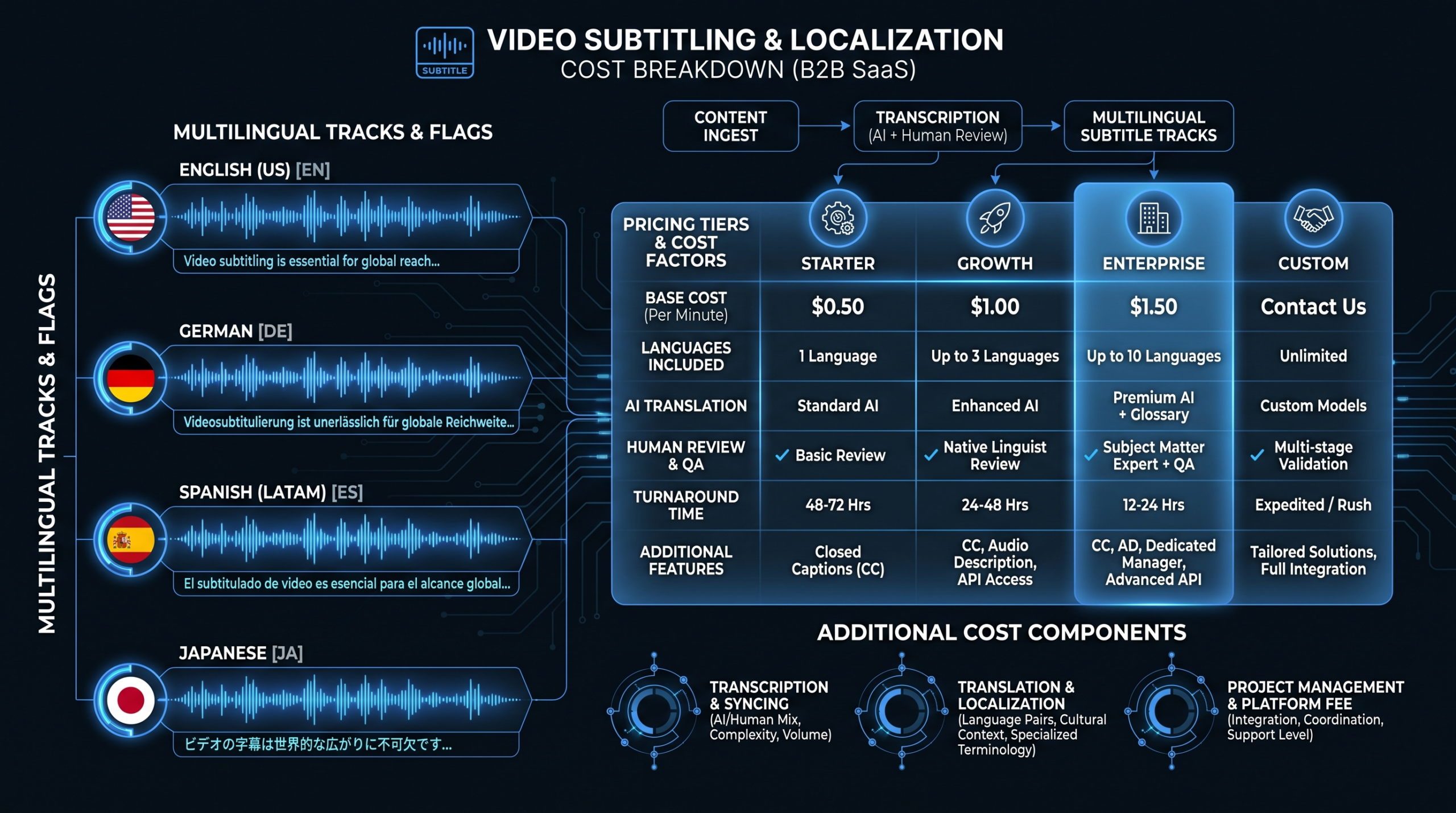
Video Subtitling and Localization Costs
TL;DR — Key Cost Ranges
- SRT/VTT subtitle file (human): roughly $1–$5 per finished minute per language
- Burned-in subtitles: typically $3–$12 per minute per language (re-render required)
- AI translation + human QA (subtitles): $0.05–$0.20 per word per language
- Full human translation (subtitles): $0.12–$0.30 per word per language
- AI dubbing: roughly $30–$150 per finished minute per language
- Human studio dubbing: $300–$1,500+ per finished minute per language
- Full localization (subtitles + graphics + VO review): $600–$5,000+ per video per language
Ranges reflect market observation, not guaranteed quotes. Actual pricing varies by agency, language pair, content complexity, and volume.
Table of Contents
- What Drives Video Localization Costs
- The Three Localization Tracks Explained
- Subtitle and Caption Costs: SRT/VTT vs Burn-In
- Dubbing and Voiceover: Where Costs Spike
- AI vs Human Translation: The Real Cost Comparison
- Accessibility and Compliance Deliverables
- Budget Scenarios by Team Type
- Building a Retainer Workflow for Ongoing Localization
- FAQ
Most global marketing teams approach video localization the wrong way: they treat it as an afterthought, get surprised by the cost, and either cut corners or blow the budget on deliverables they didn't need.
This guide is for VP Marketing, Head of Content, and content ops leads at SaaS companies, ecommerce brands, healthcare organizations, and enterprise teams who are building a real localization budget for the first time — or auditing one that has grown out of control. We cover every cost layer: subtitles, captions, dubbing, voiceover, translated graphics, AI vs human translation, accessibility compliance, and the economics of retainer vs. project-by-project workflows.
No invented statistics. Hedged market ranges based on what agencies, freelancers, and localization platforms publicly charge.
What Drives Video Localization Costs
Video localization cost is not one number — it's a product of several independent variables. Understanding each one gives you control over the budget before you send a single brief.
Language Pair
Cost does not scale linearly with language count. European language pairs with large freelance talent pools — Spanish (Latin America and Spain), French, German, Brazilian Portuguese, Italian — tend to sit at the lower end of the per-word range. Less common pairs (Thai, Swahili, Hebrew, Icelandic, Bengali) command a significant premium, often 40–80% above the baseline, simply due to talent scarcity. The gap widens further for dubbing, where voice talent in some languages is a much thinner market.
Video Length and Content Type
Subtitle and transcription services typically price by the finished minute of audio. A 2-minute product demo and a 30-minute webinar are priced very differently per project, though the per-minute rate is similar. Content type matters independently: heavily scripted, clean-audio demos are cheaper to transcribe and translate than interview content with overlapping speakers, strong accents, or highly technical jargon that requires specialist terminology review.
Deliverable Type
This is the biggest cost lever. An SRT file (soft subtitle) costs a fraction of burned-in text (which requires re-rendering the video). Full dubbing costs orders of magnitude more than either. Choosing the right deliverable for each market and content type is where most budget waste happens — teams default to dubbing for markets where subtitles convert just as well, and default to cheap SRT files for markets where audio replacement is expected.
Human vs AI Contribution
AI transcription and translation have materially reduced cost floors over the past two years. The relevant question is no longer "AI or human" but "how much human review does this content need?" Customer-facing campaigns targeting high-trust decisions require native speaker QA; internal training videos or rough market-testing cuts may not. The cost difference between raw AI output and human-reviewed output is typically 3–6× on a per-word basis.
Translated Graphics and Localized Post-Production
If your source video contains on-screen text — title cards, lower thirds, captions burned into animations, end-screen CTAs — every localized version requires a post-production pass to swap that text. This is separate from subtitle costs and adds design + rendering time for each asset in each language. A 3-minute explainer with 12 text overlays across 5 languages can generate 60 individual graphic swap tasks.
Review and QA Layers
Translation without review is a risk, not a cost saving. A terminology glossary review (does your product name translate correctly? Are UI terms consistent?) and a native speaker fluency check are the minimum QA layers for customer-facing content. Each adds time, and time adds cost — but the cost of a localization error on a paid campaign in a new market is typically far higher.
The Three Localization Tracks Explained
Before modeling any budget, identify which localization track each video type requires. The three tracks have dramatically different cost profiles.
Localization Tracks: Cost and Use Cases
| Track | What It Includes | Approx. Cost Range (per min, per language) | Best For |
|---|---|---|---|
| Track A: Subtitles / Captions | Translated, timed SRT/VTT/TTML file delivered separately from the video | $1–$5 (human) · $0.10–$0.75 (AI + review) | YouTube, LinkedIn, website video, LMS platforms |
| Track B: Subtitles + Localized Graphics | Subtitle file plus re-rendered title cards, lower thirds, and on-screen CTAs | $3–$12 (depends on graphic complexity) | Product demos, explainers, brand campaigns entering new markets |
| Track C: Dubbing / Voiceover | AI or human audio replacement, or narration recording in target language | $30–$150 (AI dub) · $300–$1,500 (human studio) | Hero brand videos, e-learning, YouTube channels in dub-preference markets |
The choice of track should be market-driven, not default-driven. German, French, and Japanese audiences have historically preferred dubbed content; most Spanish-speaking digital audiences are accustomed to subtitles. Your own analytics — watch-time drop-off by market, retention curves — are better inputs than general assumptions.
For teams new to multi-format post-production, our guide to what video editing services include covers how localization fits into a broader post-production scope.
Subtitle and Caption Costs: SRT/VTT vs Burn-In
The cheapest and most flexible localization deliverable is a soft subtitle file — SRT, VTT, or TTML — uploaded alongside the source video. The player handles display; the file can be updated without touching the video itself. This is the right starting point for most digital channels.
SRT/VTT Pricing
For human translation of subtitle files, market rates typically fall in the $0.12–$0.30 per source word per language range (for full human translation) or $0.05–$0.15 per word for AI translation with human post-editing. Framed by video length: a 5-minute video with approximately 700 words of subtitle text translated into five languages runs roughly $420–$1,050 for full human or $175–$525 for AI + review.
Some providers price by finished video minute rather than word count — typically in the $1–$5 per minute per language range for human work, closer to $0.25–$1.50 for AI-assisted workflows. Both models are common; ask for a word-count quote if your videos are dialogue-heavy (more words per minute) and a per-minute quote if they're narration-light.
Burned-In Subtitles
Burned-in (open) subtitles are rendered directly into the video frame, making them visible regardless of the platform or player. They're required for social media auto-play environments, reel-style formats, and any channel that strips external subtitle files. The cost premium reflects the additional rendering pass — typically 3–5× the cost of the equivalent SRT file per language.
For a 10-minute video in five languages, the difference is meaningful:
Soft Subtitles vs Burned-In: Cost Comparison (10-min video, 5 languages)
| Deliverable | Human Translation | AI + Review | Notes |
|---|---|---|---|
| SRT/VTT files (5 languages) | $500–$1,500 | $125–$500 | Updateable without re-render; ideal for web and LMS |
| Burned-in subtitles (5 languages) | $1,500–$5,000+ | $400–$1,500 | Required for social auto-play; immutable after render |
| Hybrid (SRT for web, burned-in for social) | $900–$2,200 | $250–$800 | Most common production approach for multi-channel distribution |
The hybrid approach — soft files for web and LMS, burned-in versions for social — is typically the most efficient split. You pay for one translation and two rendering passes rather than two separate translation jobs.
Understanding how rendering time affects total cost is covered in more detail in our video editing cost per minute breakdown.
Dubbing and Voiceover: Where Costs Spike
Dubbing is where video localization costs diverge sharply depending on quality tier. The gap between an AI-dubbed track and a professionally recorded, lip-synced studio dub can be 10–50×. Both have valid use cases; the mistake is applying the wrong tier to the wrong content.
AI Dubbing
AI dubbing tools (platforms like ElevenLabs, HeyGen, Papercup, and others) work from the source audio — transcribing it, translating the transcript, then synthesizing a voice in the target language. Cost typically runs $30–$150 per finished minute per language depending on the platform tier, word volume, and whether you're using a stock AI voice or a cloned voice of your original presenter.
AI dubbing quality has improved substantially and is often acceptable for e-learning modules, internal communications, product tutorial videos, and non-hero-tier content where budget is the binding constraint. It still struggles with: emotional nuance in complex sentences, technical jargon in non-English languages, natural prosody for highly conversational content, and mouth-sync accuracy where facial video is prominent.
Human Voiceover (Non-Sync)
Professional voiceover narration — a human narrator records the translated script against the video without lip-sync requirements — is the standard for explainer videos, e-learning, and most product demos. Cost typically runs $100–$400 per finished minute per language, with the range driven by language scarcity and talent tier. This is the most common upgrade from AI dubbing for customer-facing content where tone and credibility matter.
Studio Dubbing (Lip-Sync)
Full lip-sync dubbing — where the dubbed dialogue is timed to match on-screen mouth movement — is the highest-cost localization deliverable. It requires script translation adapted for timing, voice casting, studio recording, audio mixing, and QA. Expect $400–$900 per finished minute for European languages (Spanish, French, German, Italian, Portuguese) and $600–$1,500 per finished minute for Japanese, Korean, or Mandarin, where the structural differences between source and target language make timing adaptation significantly more complex.
Dubbing and Voiceover Cost by Tier and Language Group
| Tier | European Languages (ES, FR, DE, IT, PT) | East Asian Languages (JA, KO, ZH) | Less Common Languages |
|---|---|---|---|
| AI dubbing | $30–$100/min | $50–$150/min | $40–$120/min (if available) |
| Human VO (no lip sync) | $100–$250/min | $150–$350/min | $200–$500/min |
| Studio dubbing (lip sync) | $400–$900/min | $600–$1,500/min | $500–$1,200/min |
A common and cost-efficient hybrid: use AI dubbing for a first-pass cut in low-priority markets, and human VO for the 2–3 markets where conversion rates or deal size justify the investment.
AI vs Human Translation: The Real Cost Comparison
The AI vs. human debate in localization is less binary than it's often presented. In practice, most professional workflows use AI for the first pass and humans for review — the question is how much human involvement the content warrants.
What AI Does Well
AI translation (DeepL, GPT-4, Google Translate API, Amazon Translate) has become genuinely reliable for European language pairs with clean, formal source text. For subtitle content — typically short sentences, structured grammar, no heavy idiomatic language — AI quality is often high enough to require only light post-editing rather than full retranslation. Transcription tools (Whisper, AssemblyAI, Google Speech-to-Text) are accurate for clean recordings with single speakers and minimal background noise.
Where Human Review Is Non-Negotiable
AI translation reliably struggles with: brand-specific terminology that needs consistent treatment across videos (product names, UI labels, feature names), colloquial language and humor that requires cultural adaptation rather than literal translation, technical content in specialized domains (healthcare, legal, financial), and any language pair where the source text is low quality or heavily accented speech.
The reputational cost of a mistranslation in a customer-facing campaign — particularly in healthcare, financial services, or enterprise SaaS where buyer trust is the critical variable — is typically much higher than the cost of proper human QA. This is not a corner worth cutting.
AI vs Human Subtitle Translation: Cost and Quality Trade-offs
| Workflow | Cost Per Word Per Language | Turnaround | Quality Level | Best Use Case |
|---|---|---|---|---|
| Raw AI (no review) | $0.01–$0.05 | Minutes | Variable — acceptable for internal/testing | Internal communications, rough market testing |
| AI + light QA (fluency check) | $0.05–$0.12 | 1–3 days | Good — catches gross errors and flow issues | Low-stakes social content, explainers for warm audiences |
| AI + full post-edit (human rewrite) | $0.10–$0.20 | 2–5 days | High — near-equivalent to human translation | Product marketing, paid campaigns, customer-facing demos |
| Full human translation | $0.12–$0.30 | 3–7 days | Highest — full cultural and technical accuracy | Healthcare, legal, financial, brand-critical campaigns |
For a useful read on how translation costs fit into broader content production economics, see the Wistia guide on video accessibility and captioning — it covers the practical side of building multilingual video workflows.
Accessibility and Compliance Deliverables
Accessibility requirements are no longer optional for many organizations. They add a cost layer that is frequently overlooked in localization budgets — and the compliance risk of getting them wrong is significantly higher than the cost of getting them right upfront.
Closed Captions vs Open Captions
Closed captions are toggled on or off by the viewer and must be delivered in a format the player can render (SRT, VTT, SCC for broadcast CEA-608/708). Open captions are burned into the video frame. For compliance purposes, closed captions are generally preferable because they respect viewer preference; for social media distribution, open captions are often necessary because platform players don't reliably render external caption files.
US Compliance: ADA and Section 508
The Americans with Disabilities Act (ADA) and Section 508 (for federal agencies and their vendors) require accurate captions for publicly accessible video content. "Accurate" is not defined as "AI-generated first pass" — courts and regulators have found auto-captions with error rates above 5–10% to be non-compliant. For SaaS companies selling to healthcare, education, and government, this is a budget line, not a nice-to-have.
EU Compliance: EN 301 549 and WCAG 2.1
EN 301 549 covers ICT accessibility in the EU, including video content published by public sector bodies and many education institutions. WCAG 2.1 Success Criterion 1.2.2 requires captions for prerecorded audio in synchronized media; 1.2.6 requires sign language interpretation for Level AAA. For SaaS companies targeting EU education or public sector contracts, these aren't aspirational — they're gate criteria.
Cost Impact of Compliance
Compliant closed caption files (CEA-708 for digital broadcast, WebVTT for web) cost a modest premium over standard SRT — typically 15–35% more for proper formatting and encoding. The larger cost is quality QA: a compliance review for accuracy and formatting can add $100–$500 per video depending on length. Audio description tracks (narration for visually impaired viewers, required at WCAG AA for some content types) are more expensive — expect $150–$600 per finished minute for professionally written and recorded description.
The compliance services market has good public pricing information. Rev's caption services pricing page is a useful reference point for market-rate captioning in English before adding localization layers.
Budget Scenarios by Team Type
Abstract cost ranges are useful; actual budget scenarios are more actionable. Here are four representative scenarios based on common team profiles.
Video Localization Budget Scenarios
| Team Type | Volume | Languages | Track | Monthly Estimate |
|---|---|---|---|---|
| SaaS Series A–C (product demos, explainers) | 5–8 videos/mo | 3 (ES, FR, DE) | SRT + localized graphics for demos | $800–$2,500 |
| Ecommerce brand (product demos, social ads) | 15–20 videos/mo | 5 (ES-MX, PT-BR, FR, DE, JA) | AI + review (SRT) + VO for 2 priority markets | $2,500–$6,000 |
| Enterprise (global campaigns) | 20+ videos/mo | 10+ | Full pipeline: subtitles + graphics + VO or dub + accessibility QA | $15,000–$40,000+ |
| Healthcare / Education | 8–15 videos/mo | 2–4 | Human translation + CEA-708 captions + accessibility QA | $3,000–$10,000 |
A few notes on these scenarios:
- SaaS teams often underestimate the localized graphics line item. If your product demo has 8–12 on-screen UI labels and title cards, each requires a localized version for every language. At scale, this becomes a significant post-production task — not just a translation job.
- Ecommerce brands benefit most from AI + review workflows for social content, reserving human VO for higher-stakes formats (paid ads, hero brand content). The per-unit cost savings on high-volume short-form content are substantial.
- Enterprise teams with 10+ languages should budget for a dedicated localization project manager (internal or vendor-side) — the coordination overhead at that scale is underestimated more often than the translation cost.
- Healthcare and education teams should never use raw AI output for patient-facing or student-facing content. The quality and compliance requirements make full human translation the floor, not the ceiling.
For teams modeling their full video production budget — localization alongside production, editing, and distribution — our explainer video cost breakdown is a useful companion to this guide.
Building a Retainer Workflow for Ongoing Localization
Project-by-project localization is expensive and inconsistent. Every new job requires briefing, terminology alignment, file handoff, and QA from scratch. Teams that localize regularly — even 4–6 videos per month into 3 languages — almost always reduce their per-deliverable cost by 20–35% by moving to a structured retainer arrangement.
What a Retainer Workflow Provides
A retainer model for localization typically includes:
- Dedicated translator/team — the same people work on your content consistently, building familiarity with your product terminology, brand voice, and audience
- Standing terminology glossary — product names, UI terms, brand phrases, and do-not-translate items are documented once and applied consistently
- Defined SLAs — agreed turnaround times per deliverable type eliminate the "how long will this take?" negotiation on every job
- Versioning and file management — a structured handoff system for source files, translation memories, and approved deliverables
- Predictable monthly cost — budget certainty vs. fluctuating per-project spend
How Retainer Pricing Works
Localization retainers are typically structured as a monthly commitment of a defined word volume or video-minute volume. Common entry points are in the range of $1,500–$4,000/month for SaaS teams doing 3–5 languages on 5–10 short videos per month (subtitle-track only), scaling to $8,000–$20,000/month for enterprise workflows with dubbing, graphics, and accessibility deliverables across 10+ languages.
Where VEC Fits
For SaaS and B2B marketing teams, the localization workflow rarely lives in isolation — it sits inside a broader video post-production pipeline that includes editing, motion graphics, format variations (16:9, 9:16, square), and versioning. Separating "the translation vendor" from "the post-production team" creates a coordination gap that slows turnaround and increases error rate.
VEC's Core ($9.5K/month) and Scale ($16K/month) plans are built for teams that need multi-format, multi-language post-production handled as a single workflow — including localized graphics swaps, burned-in subtitle variants, and VO integration — without managing two or three separate vendor relationships. For teams committed to doubling video output without scaling headcount, that consolidated workflow is often where the ROI on localization investment becomes measurable.
For context on how outsourcing the broader video workflow works alongside localization, our guide to outsourcing video editing covers the vendor selection and onboarding process in detail.
See our pricing page for the current plan details and what's included at each tier.
Frequently Asked Questions
What does it typically cost to add subtitles to a 5-minute video in 5 languages?
With human translation, a 5-minute video (roughly 650–800 words of subtitle text) localized into 5 languages typically runs $400–$1,200 for SRT/VTT files, depending on language pairs and whether you're using a specialist or general translation provider. AI translation with human QA can bring that down to $100–$400 for the same scope. Burned-in subtitle variants (required for social distribution) add another 3–4× on the rendering side. European language pairs (ES, FR, DE, PT) cost less than East Asian or less common language pairs.
Is AI dubbing good enough for customer-facing B2B video content?
AI dubbing quality varies significantly by tool, language pair, and source content quality. For product tutorials, e-learning modules, and lower-funnel content where the primary audience is already familiar with your brand, AI dubbing at the $30–$100/minute tier is often adequate — particularly when combined with a brief human QA pass for tone and terminology. For hero brand videos, paid campaigns, and any content targeting buyers in high-trust categories (healthcare, finance, enterprise), human voiceover narration is still the stronger choice. The quality gap between AI and human has narrowed; the risk tolerance gap has not.
What's the difference between subtitles and captions for localization pricing purposes?
In localization workflows, subtitles translate the spoken dialogue for viewers who don't understand the source language. Captions (including closed captions) transcribe the spoken audio — plus non-speech sounds like [applause] or [music] — for viewers who are deaf or hard of hearing. In pricing, they're often treated the same way for the translation/timing layer, but compliance captions carry additional requirements: formatting standards (CEA-708 for digital, WebVTT for web), character-per-line limits, and accuracy thresholds that add a QA cost layer. Budget an additional 20–40% for compliance-grade captions over standard subtitle pricing.
How much does ADA-compliant captioning cost for a video library?
For an existing English-language video library, ADA-compliant captioning (accurate CEA-708 or WebVTT with QA) typically runs $1.50–$5 per finished minute with a reputable captioning provider. For a library of 50 videos averaging 10 minutes each, that's a one-time cost in the range of $750–$2,500. Ongoing captioning for new content at that rate adds up predictably. The higher-cost scenarios involve audio description tracks for visually impaired viewers — which add $150–$600 per finished minute — and are required for Level AA compliance in some content categories under WCAG 2.1.
When should a SaaS company invest in full dubbing rather than subtitles?
The clearest signal is market-specific data: if your analytics show significantly lower watch-time completion or engagement in a specific geography compared to your English-language performance, and that market has a cultural preference for dubbed content (Germany and Japan are the most common examples in B2B), the conversion math often supports dubbing investment. The break-even calculation is straightforward: if a target market represents meaningful pipeline or ARR opportunity, and dubbing increases completion rate or conversion rate by a measurable margin, the cost of $300–$900 per video minute becomes a media investment rather than a production expense. For most SaaS teams, human voiceover narration (not full lip-sync dubbing) hits the quality bar for that market while costing 3–5× less than studio dubbing.
Building a Multi-Language Video Pipeline?
VEC's dedicated editing teams handle multi-format, multi-language post-production — subtitles, localized graphics, VO integration, and format variations — in a single workflow. No vendor coordination, no briefing from scratch every job.
Book a Free Strategy Call See Pricing Plans