What's Included in a Video Editing Retainer
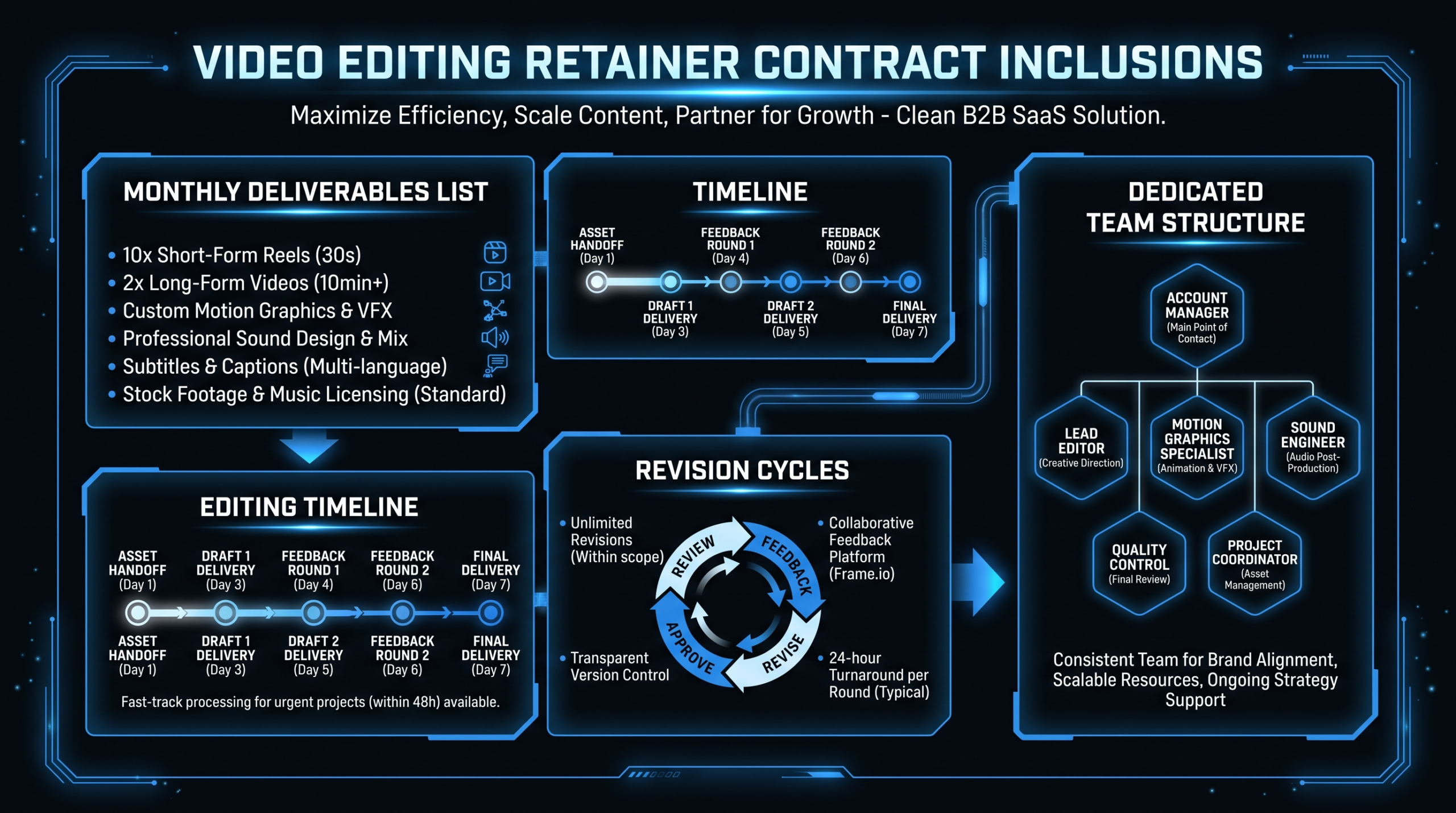
A video editing retainer includes a defined monthly output of professionally edited videos, an assigned editing team (or dedicated editor), a set number of revision rounds per video, and a project manager — all for a fixed monthly fee. At the $5K–$16K/month tier, most retainers also cover format variations (vertical cuts, square crops, thumbnail creation), basic motion graphics, and organized file delivery to your preferred platform.
What you actually get depends heavily on which agency you choose and how the contract is written. This guide breaks down every standard and non-standard inclusion so you can evaluate retainer proposals with confidence — and negotiate the right scope before you sign.
TL;DR — What a Video Editing Retainer Covers
- Core deliverable: Monthly quota of edited videos (volume varies by tier)
- Team: Dedicated editor(s) + project manager who learn your brand
- Revisions: Typically 2–3 rounds per video included; extras negotiable
- Formats: Primary cut + social variations (in most mid-tier and above retainers)
- Management: Project coordination, brief intake, delivery tracking
- Pricing range: Retainers typically start around $3,000–$5,000/month; B2B SaaS-focused teams like VEC run $5,000–$16,000/month
- Not included: Raw footage production, stock licensing, motion graphics at lower tiers, and animated content in most retainers
Table of Contents
What Is a Video Editing Retainer?
A video editing retainer is a contractual agreement where you pay a fixed monthly fee in exchange for a guaranteed volume of video editing services. Unlike per-project work — where you brief and price each video individually — a retainer reserves a team's capacity for your account month over month.
The core economic exchange: you commit to consistent revenue; they commit to consistent capacity and brand familiarity. Over time, a good retainer arrangement means the editing team essentially functions as an extension of your marketing department — knowing your templates, tone of voice, product visuals, and feedback preferences without re-briefing from scratch every month.
If you're comparing this model to per-project or subscription pricing, our breakdown of video production agency pricing models covers all five structures with real cost math.
For a deeper look at the history and mechanics of video retainers specifically, see our post on monthly video editing retainers explained.
Core Deliverables Explained
Most video editing retainer agreements bundle the same core categories, even when the agency brands them differently. Here's what each one actually means in practice.
Edited Video Volume (The Primary Deliverable)
This is the headline number — the monthly count of finished, ready-to-publish videos the agency commits to delivering. However, "video" is defined differently by different agencies, so this number needs scrutiny.
Questions to pin down before signing:
- Does one "video" mean a 3-minute YouTube video, a 30-second social clip, or either?
- Is a 10-minute long-form piece the same price unit as a 60-second explainer?
- Do format variations (vertical cut from a horizontal video) count as new deliverables or are they included?
- What's the maximum length per video at the retainer rate?
Well-structured retainers define this by complexity tier — for example, "up to 8 standard videos OR 4 premium videos per month," where standard and premium have explicit length and complexity definitions. Vague retainers that just say "8 videos/month" are a contract negotiation risk.
Revision Rounds
Most retainers include a fixed number of revision rounds per video — typically 2 to 3 rounds. A revision round means: you review the draft, submit consolidated feedback, the editor implements all changes, and delivers a revised cut. That cycle = one round.
What to clarify:
- What counts as one round? If you send feedback in three separate messages, that's often still counted as one round by client-friendly agencies. Less accommodating agencies count each exchange.
- What's the overage rate? Additional rounds should have a pre-agreed per-round rate ($75–$200 is typical).
- Do rounds roll over? Unused revision rounds almost never carry over to next month.
Project Management and Communication
Most retainers at $5,000/month and above include a dedicated project manager (PM) or account manager. This person handles intake, scheduling, deadline tracking, and communication — so you're not managing the editor directly or coordinating logistics yourself.
The PM is often the most undervalued inclusion. A good PM means your brief goes in and a finished video comes out without you chasing status updates. At lower-tier retainers ($2,000–$4,000/month), you may communicate directly with the editor, which is faster but requires more of your time.
Expect standard communication to run through Slack, Notion, or a dedicated project management portal (Frame.io, Monday.com, or Asana are common). If an agency asks you to manage briefs and revisions through email threads, that's a workflow risk worth flagging.
Format Variations and Repurposing
This is one of the most negotiated inclusions — and one of the highest-value ones if you're distributing video across multiple platforms.
Common format variations that should be included at $5K+/month retainers:
- Vertical (9:16) recut for Instagram Reels, TikTok, YouTube Shorts
- Square (1:1) crop for LinkedIn and Facebook
- Captions/subtitles added to all formats
- Thumbnail design (static images, not animated)
Format variations at lower tiers often cost extra. Get explicit written confirmation of which formats are included before signing — "social cuts included" means different things to different agencies.
Basic Motion Graphics and Brand Templates
Most mid-tier retainers ($5,000–$10,000/month) include basic motion graphics: lower-thirds, animated titles, intro/outro sequences, and branded transition templates. These are typically built once as reusable templates during onboarding, then applied across all subsequent deliverables.
What this does NOT include at the standard retainer rate:
- Custom animated explainer sequences (treated as premium add-ons)
- Whiteboard or character animation
- After Effects-heavy motion design projects
Asset Management and Brand File Organization
Quality retainers manage your asset library — your brand kit (logos, colors, fonts), approved music tracks, template files, and archived project files. This is rarely called out explicitly in retainer agreements but separates professional teams from transactional ones.
After 2–3 months with a well-run retainer team, your editor knows where every approved asset lives and applies them without being reminded. This is the brand familiarity compounding effect that makes retainers dramatically more efficient than per-project work over time.
Retainer Inclusions by Tier
The inclusions you can expect shift substantially by price tier. Use this table as a reference when evaluating proposals — and as a benchmark for negotiation.
What's Included at Each Retainer Tier
| Inclusion | Starter ($2K–$4K/mo) | Growth ($5K–$9K/mo) | Scale ($10K–$20K/mo) |
|---|---|---|---|
| Edited videos per month | 4–6 standard | 8–12 standard or 4–6 premium | 15–25+ mixed formats |
| Dedicated editor | Shared pool | Semi-dedicated (1–2 clients) | Fully dedicated editor(s) |
| Project manager | No (direct editor access) | Often included | Always included |
| Revision rounds per video | 2 rounds | 2–3 rounds | 3+ rounds or unlimited minor edits |
| Social format variations | Add-on | Included (9:16, 1:1) | Included + platform optimization |
| Captions/subtitles | Add-on | Included | Included (multi-language add-on) |
| Basic motion graphics | Templates only | Included | Included + custom builds |
| Thumbnail design | No | Sometimes included | Included |
| Creative direction / strategy | No | Rarely | Often included |
| Stock music licensing | Add-on | Add-on or library access | Often included (library) |
| Minimum commitment | Month-to-month or 3 months | 3–6 months | 6–12 months |
When comparing retainer proposals at the same price point, the delta is usually in who your editor is (dedicated vs. shared pool), what "one video" means (complexity cap), and whether format variations are bundled. Clarify all three before signing.
For a deep dive into how these tiers compare by price, see our full breakdown of video retainer tiers compared, or read our in-depth retainer vs. project pricing analysis to understand when a commitment-based model pays off.
What's Typically NOT Included
Knowing what's excluded is just as important as knowing what's in. The most common sources of scope creep and surprise invoices in retainer relationships:
Raw Footage Production
Video editing retainers cover post-production — editing, motion graphics, color, sound. They do not include filming, directing, or production coordination unless the retainer is explicitly a "full-service" video production retainer (which carries a different price point). You supply the raw footage; the editor delivers the finished video.
Stock Footage and Music Licensing
Stock footage and music licensing are almost always excluded at starter tiers and handled as pass-through costs at higher tiers. Confirm whether the agency has a stock library your retainer grants access to, or whether you're billed at cost for each license. Royalty-free music platforms like Artlist and Epidemic Sound run $200–$500/year for individual accounts; agencies often buy team accounts and can include access as a retainer benefit.
Custom Motion Graphics and Animation
Complex After Effects work — custom animated logos, character animation, whiteboard-style explainer sequences — is almost always scoped separately. These are project-rate items even when you're on a retainer. Budget $500–$3,000 per custom animated sequence depending on complexity, in addition to your monthly retainer.
Scriptwriting and Concept Development
Retainers cover editing; they don't cover the creative brief that informs the edit. Script development, storyboarding, and concept work are either separate project fees or belong to a broader creative services engagement. Some agencies offer copywriting or scripting packages as add-ons — worth asking about if your team doesn't have content creators.
Platform Uploading and Scheduling
Most editing retainers deliver finished files; they don't upload to YouTube, schedule posts, or write captions. A small number of full-service agencies include this, but it's the exception. Budget for someone in-house (or a social media management tool) to handle distribution.
Paid Media Creative Variants
If you're running paid video ads, you'll often need 15-second, 6-second, and specific dimension cuts optimized for each platform's ad specs. These are increasingly included at scale-tier retainers, but for most starter-to-growth retainers they're an add-on. Discuss paid media creative requirements during proposal review.
Contract Terms to Understand
The deliverables list is only half of a retainer agreement. The contract terms determine your flexibility, your risk, and your leverage.
Minimum Commitment Period
Most video editing retainers require a 3–6 month minimum commitment. Scale-tier retainers with dedicated teams typically run 6–12 months. This commitment exists because the agency invests in your onboarding — learning your brand, building your templates, and staffing your account. A shorter commitment at a higher per-month rate is often available if you need flexibility.
Rollover Policy for Unused Videos
If you don't use all your included videos one month, what happens? The majority of retainers use a "use-it-or-lose-it" model — unused capacity doesn't carry forward. A small number of agencies allow a 1-month rollover of a portion of unused deliverables. Ask about this during proposal review; it's a useful buffer during slow months.
Overage Pricing
What's the rate for videos beyond your monthly quota? This should be defined upfront, not negotiated in the heat of a busy month. Common overage structures: a per-video add-on rate (typically 20–40% off the standalone project rate), or a temporary monthly uplift.
Early Termination
Leaving a 6-month retainer after month 2 often triggers an early termination clause — typically 1–2 months of remaining fees. Understand the exit terms before you sign. Agencies with strong offboarding policies (who acknowledge the relationship may eventually end) are often more trustworthy overall.
For more on evaluating and negotiating retainer contracts, our guide on how to outsource video editing covers the due-diligence checklist in detail.
VEC's Retainer Inclusions
Video Editing Company (VEC) structures its retainers around three tiers, each built for B2B SaaS teams at different stages of content production. The core differentiator: every VEC retainer assigns a dedicated senior editor — not a shared pool — with a creative director and project manager on the account.
VEC Retainer Plans — What's Included
| Plan | Growth — $5,000/mo | Core — $9,500/mo | Scale — $16,000/mo |
|---|---|---|---|
| Video output | Up to 8 standard videos/mo | Up to 15 standard or 8 premium/mo | Up to 25+ videos/mo (mixed) |
| Editor setup | Dedicated senior editor | Sr. editor + Jr. editor | Full team (Sr., Jr., motion designer) |
| Project manager | Included | Included | Included + creative director |
| Revision rounds | 2 rounds per video | 3 rounds per video | 3 rounds + minor tweaks policy |
| Social format variations | Included (9:16, 1:1) | Included + platform optimization | Included + paid media variants |
| Captions | Included | Included | Included |
| Thumbnails | Add-on | Included | Included |
| Motion graphics | Templates + basic | Custom builds included | Full motion design included |
| Output guarantee | Double video output in 90 days or month 4 free | Double video output in 90 days or month 4 free | Double video output in 90 days or month 4 free |
The guarantee deserves a mention: VEC's retainers include a commitment to double your video output within 90 days, or month 4 is free. This frames the retainer not just as an outsourcing arrangement but as a measurable operational uplift — relevant if you're justifying the investment to a CFO or VP of Marketing.
Full plan details, including what "standard" vs. "premium" video means in VEC's framework, are on the VEC pricing page. For how the team works day-to-day, the how it works page walks through the full workflow from brief to delivery.
Red Flags in Retainer Agreements
Not all retainer contracts are created equal. These are the warning signs that an agreement will disappoint you in practice — regardless of how good the onboarding call felt.
Vague Video Definitions
If the contract says "8 videos per month" without defining video length, complexity, or format, the agency controls what "counts" as a video. One agency's "video" might be a 60-second social clip; another's might be a 10-minute YouTube video. Pin this down with specific length and complexity caps before signing.
No Named Editor or Team
Retainers that promise "a dedicated editor" but won't name or introduce that person before the contract starts often mean you'll be working with whoever is available. True dedicated teams have named editors you can meet during the sales process. If they can't introduce the team before you sign, you're not getting a dedicated team.
Missing Overage and Exit Terms
An agency that won't discuss overage pricing or early termination fees upfront is setting up a difficult conversation later. Professional agencies are transparent about both — it's not a red flag to ask; it's a red flag if they deflect.
Revision Rounds Defined as "Until Satisfaction"
This sounds client-friendly but creates scope creep risk for both parties. A better structure is a defined number of rounds with a clear overage rate — this forces efficient feedback and protects both sides.
No Written SOW or Scope Document
A retainer without a statement of work (SOW) defining deliverables, turnaround times, communication channels, and revision policy isn't a retainer — it's a monthly service agreement with no accountability structure. Require a written SOW before signing anything.
For guidance on what to look for specifically in video editing service agreements, our post on video editing services and what's included has a detailed checklist.
How to Maximize Your Retainer Value
Most teams underutilize their retainers — not because the agency isn't delivering, but because the client side isn't organized enough to feed the team a steady brief flow. Here's how to get full value from what you're paying for.
Build a 30-Day Brief Pipeline
Before the retainer starts, have your next 30 days of briefs ready. Many teams use the first month of a retainer at 50–60% of capacity because they're still figuring out what to assign. Coming in with a full brief queue on day one means the team can onboard and produce simultaneously.
HubSpot's video marketing hub has useful frameworks for building a video content calendar — organizing by funnel stage and channel before assigning to production is the right sequence.
Consolidate Your Feedback
The biggest time-waster in any retainer relationship: fragmented feedback. Three separate Slack messages after watching a draft are three times slower than one consolidated review document with timestamps. Use a tool like Frame.io or Loom to deliver timestamped visual notes — this alone can halve revision cycle time.
Use Your Revision Rounds Strategically
Save revision round 1 for structural feedback (pacing, narrative flow, missing sections). Save round 2 for polish (color, music, captions). If you're doing structural revisions in round 2, you've wasted round 1 on changes that weren't ready yet. Brief more specifically upfront; review more methodically before sending feedback.
Track Output Against Your Retainer Cap
By week 3 of every month, you should know whether you're on track to use your full allocation. If you're short on briefs, queue up repurposing work — pull clips from past long-form pieces, create social cuts from existing footage. This keeps the team utilized and your cost-per-video low.
Invest in Onboarding
The first 2–4 weeks of any retainer determine the quality of the next 12 months. A thorough brand document (tone guidelines, visual examples, competitor references, what "bad" looks like), an accessible asset library, and 1–2 live calls with the editing team at the start will save weeks of revision cycles over the retainer term.
Teams that treat onboarding as an afterthought consistently report lower satisfaction with retainer outcomes. Teams that invest 4–8 hours in week-one alignment consistently report faster turnaround and fewer revisions by month 2. Wistia's research on video production efficiency consistently shows that brief quality and clarity are the highest-leverage inputs to production output — not the editing team's skill.
Frequently Asked Questions
What does a video editing retainer typically include?
A video editing retainer typically includes a monthly quota of finished edited videos, a dedicated editor (or editing team), 2–3 revision rounds per video, a project manager, and — at mid-tier and above — social format variations (9:16, 1:1 cuts) and basic motion graphics. The exact inclusions depend on the tier; starter retainers around $3,000–$5,000/month may exclude format variations and PMs, while scale-tier retainers at $10,000+/month usually bundle all of the above plus custom motion design and thumbnail creation.
Does a video editing retainer include raw footage filming?
No. A video editing retainer is a post-production arrangement — the agency edits footage you supply. Raw footage production (filming, directing, on-location production) is a separate scope and separate budget. If you need both, look for full-service video production retainers, which typically start at $15,000–$30,000/month given the additional production overhead.
How many videos should a retainer include?
It depends on the tier, but a useful benchmark: a $5,000/month retainer should deliver 6–10 finished standard videos (YouTube-length edits, social clips, or a mix). A $10,000/month retainer should produce 12–20 videos. If an agency is quoting below these benchmarks, ask why — you may be paying a brand premium rather than for output. Always clarify what "one video" means in terms of length and complexity before comparing quotes.
What happens if I don't use all my retainer videos in a month?
Most retainers operate on a "use-it-or-lose-it" basis — unused deliverables don't carry over to next month. Some agencies allow a partial rollover (e.g., up to 25% of unused capacity rolls to the following month), but this is the exception rather than the rule. Ask about rollover policy during the proposal stage. The practical fix: build a brief pipeline so you always have work queued for the editing team, even in slower months.
How long is a typical video editing retainer commitment?
Most video editing retainers require a 3–6 month minimum commitment. Scale-tier retainers with fully dedicated teams typically run 6–12 months. The longer the commitment, the more the agency invests in your account setup — and typically the lower the effective monthly rate. Month-to-month retainers exist but usually carry a 15–25% premium over the equivalent 6-month rate. If you're not ready for a long commitment, start with a 3-month retainer and evaluate before extending.
Ready to See Exactly What's in a VEC Retainer?
Our Growth, Core, and Scale plans have specific, documented deliverables — no vague "videos per month" language. Talk to our team to get a proposal scoped to your actual content volume and video types.
Book a Free Strategy Call View Pricing Plans