Video Retainers Compared: $2K to $20K Tiers
TL;DR
Entry-level retainers ($2K–$3K/mo) cover basic editing support for lean teams with a shared editor pool and minimal motion graphics. Mid-tier programs ($5K–$9.5K) add dedicated editors, branded motion templates, and PM coverage that turns the agency into a real content partner. Scale-tier retainers ($16K–$20K+) deliver full creative direction, dedicated motion designers, and enough capacity for enterprise content programs. The right tier is the one where your monthly request volume consistently reaches 70–80% of capacity—not the cheapest tier that technically fits.
Table of Contents
- What a Video Retainer Actually Covers
- Retainer Tier Map: $2K to $20K+ at a Glance
- $2K–$3K Tier: Light-Touch Editing Support
- $5K Tier: Growth-Level Production
- $9.5K Tier: Core Production Partnership
- $16K Tier: Dedicated Team Scale
- $20K+ Tier: Enterprise Video Programs
- Budget Scenarios by Company Type
- Red Flags to Watch For
- When to Move Up a Tier
- FAQ
The range between a $2,000/month video retainer and a $20,000/month one isn't just budget — it's a completely different operational model. At $2K you're buying a slot in a shared editing queue. At $20K you're running an embedded content production unit with dedicated editors, a motion designer, a creative director, and a PM who manages your content calendar the way your internal team would.
Most buyers get stuck evaluating the wrong dimension: they compare video counts or delivery hours without understanding what they're actually buying at each price point. This guide breaks down every tier — what it delivers, what it doesn't, where each model breaks, and which tier fits which growth stage. No inflated benchmarks, no invented statistics — just the real-world mechanics of how these retainer structures work.
What a Video Retainer Actually Covers
A monthly video retainer is a fixed-fee arrangement where you pay an agency a set amount each month in exchange for a defined level of video production or editing output. The fee doesn't scale with every individual video — you get a package of capacity, and the relationship is designed to build efficiency over time as the team learns your brand.
Six variables drive most of the meaningful differences between video retainer tiers:
- Editing volume / output capacity: The raw throughput — how many videos or editing hours per month are included
- Turnaround time: Standard delivery windows vs. expedited options; whether same-day social pivots are possible
- Revision scope: How many rounds are included, and what counts as a revision vs. a scope change
- Motion graphics: Whether animation, kinetic typography, and branded graphic systems are in-scope or metered as add-ons
- Creative direction: Someone shaping what you should make and how — not just executing briefs
- PM / account management: A named person managing timelines, tracking briefs, coordinating feedback loops, and anticipating bottlenecks
The difference between a $5K and $9.5K retainer often isn't a 90% increase in video volume — it's the addition of motion graphics as a first-class deliverable and the upgrade from shared to dedicated PM coverage. Understanding which of these six variables your team actually needs is the foundation of choosing the right tier.
For a broader look at how retainers compare to per-project pricing and hourly models, see our breakdown of video production agency pricing models. For context on how B2B teams are investing in video programs, Wyzowl's annual video marketing report tracks adoption trends and budget patterns across industries.
Retainer Tier Map: $2K to $20K+ at a Glance
Here's how the five major video retainer tiers compare across the six variables that matter most:
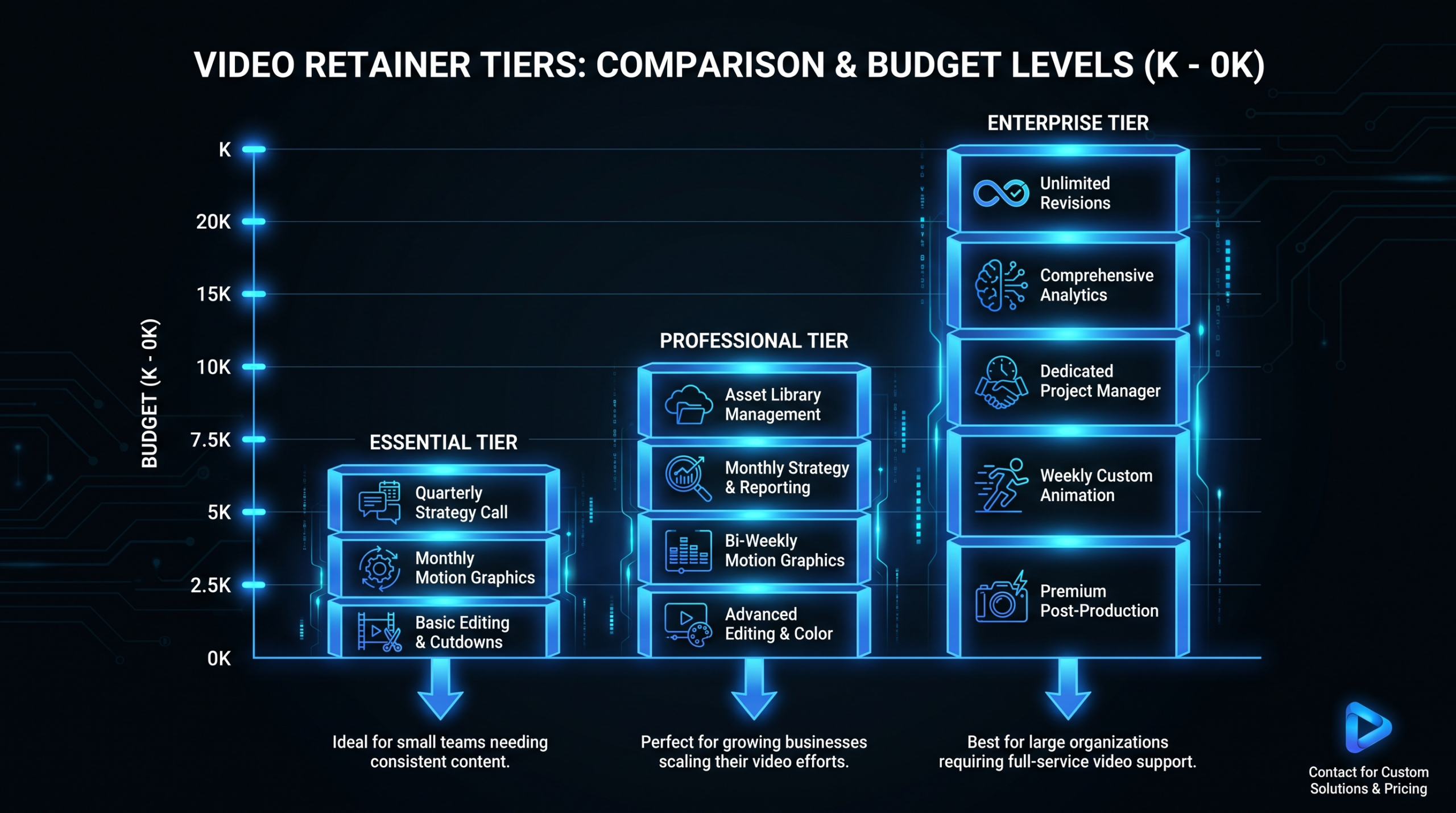
Video Retainer Tier Comparison
| Tier | Monthly Cost | Editor Structure | Motion Graphics | PM Coverage | Creative Direction |
|---|---|---|---|---|---|
| Entry | $2K–$3K | Shared pool | Minimal / none | None or self-serve portal | None |
| Growth | ~$5K | Dedicated or primary editor | Basic branded templates | Shared PM (4–6 accounts) | Light async input |
| Core | ~$9.5K | Senior + junior editor pair | Branded templates + custom | Dedicated PM (1–2 accounts) | Monthly strategy calls |
| Scale | ~$16K | Sr editor + Jr editor + motion designer | Full-service included | Dedicated PM + account director | Dedicated CD on calls |
| Enterprise | $20K+ | 3–5 editors + animators + CD | Custom brand system + 3D | Senior account director + PM | Embedded CD in strategy |
These ranges reflect how quality-focused agencies structure their retainer tiers. Subscription platforms and individual freelancer retainers may use similar price points with different structures — covered in the section on red flags below.
$2K–$3K Tier: Light-Touch Editing Support
The $2K–$3K range is the entry point for structured ongoing video retainers. At this price point, you're primarily buying a slot in an editing workflow — not a relationship with a dedicated team that learns your brand.
What This Tier Typically Delivers
- Editor structure: One active editing request at a time, processed sequentially from a shared pool
- Turnaround: 48–72 hours per video after assets are submitted
- Revision scope: 1–2 rounds included; additional rounds usually billed separately
- Motion graphics: Minimal — basic lower thirds and simple text overlays at most; full animation is out of scope
- PM coverage: Usually none; you submit briefs through a portal or Slack channel
- Creative direction: None — you brief, they execute
Where $2K Works
- Podcast audiograms and social clips (15–60 seconds) where the edit template is already defined
- YouTube video edits for established channels with a locked visual style guide
- Webinar recordings cut into highlight clips
- Simple product demo trims from existing screen-recorded footage
Where $2K Breaks
- Anything requiring significant motion graphics or branded animation
- Content that benefits from strategic creative input ("what formats should we be making this quarter?")
- Turnarounds under 24 hours for complex multi-asset edits
- Brand consistency across formats — shared pools mean different editors may handle different requests
At $2K–$3K, you're paying for editing time on a shared pool. Brand knowledge accumulates slowly — often not at all if a different editor handles each request. This is the right tier for tactical support, not for building a content program.
Honest tradeoff: This tier is cost-effective for simple, repetitive work where the brief is fully self-contained. It breaks quickly when you need any of the six variables that entry retainers don't cover: dedicated editors, motion graphics, PM oversight, or creative direction. Teams that start here frequently find themselves doing agency management work themselves to fill those gaps.
$5K Tier: Growth-Level Production
The $5K range is where the retainer model starts functioning as a genuine operational upgrade over freelancers. You're crossing the threshold from a shared queue into a dedicated or semi-dedicated editing relationship. This is VEC's Growth plan territory.
What $5K/Month Typically Delivers
- Editor structure: One primary editor assigned to your account; may handle 2–3 accounts total
- Video volume: Typically 6–10 videos/month at standard edit complexity, or the equivalent in mixed formats
- Turnaround: 24–48 hours per video after brief submission, with defined SLAs
- Revision scope: 2–3 rounds included; scope defined in the contract rather than left open-ended
- Motion graphics: Basic branded templates — usually built in month one from your brand kit
- PM coverage: Shared PM handling 4–6 accounts; responsive but not proactive
- Creative direction: Light async input — monthly check-in or brief review on request
Why the $5K Tier Is the Right Starting Point for SaaS Growth Teams
Series A and B SaaS companies producing content consistently — product demos, sales enablement clips, LinkedIn videos, customer onboarding content — are the core audience for this tier. You have a strategy; you need consistent execution. You're producing enough videos that per-project pricing has become expensive and slow, but you're not yet at the scale where a full dedicated team is justified.
The meaningful upgrade from entry retainers is the dedicated editor relationship. Over 60–90 days, a primary editor learns your product, your terminology, and your visual preferences. Revision cycles drop because the editor can anticipate your feedback before you give it.
For a detailed look at what a $5K retainer actually covers in deliverable terms, see our guide on video editing services: what's included.
The $5K Tier Ceiling
This tier works until you hit one of three walls: your monthly request volume exceeds what one editor can handle, you need motion graphics that go beyond template application, or you need proactive strategy input rather than reactive execution. When any of those happen consistently, you're in $9.5K territory.
$9.5K Tier: Core Production Partnership
At $9.5K/month, the retainer structure shifts from "editing support" to "creative production partner." Dedicated team structures become standard — not a premium upsell — and motion graphics move from a metered add-on to a first-class deliverable. This is VEC's Core plan.
What $9.5K/Month Typically Delivers
- Team structure: Senior editor + junior editor (or senior editor + motion designer) + a PM whose primary focus is your account
- Video volume: Typically 10–16 videos/month at mixed complexity, including long-form edits with social cut-downs
- Turnaround: 24–48 hours standard for most formats; same-day social pivots where footage and brief are ready
- Revision scope: 3 rounds standard; scope defined to prevent unbounded rework cycles
- Motion graphics: Included — branded motion template system built in month one and applied consistently; custom animations within scope
- PM coverage: Named PM primarily on your account; proactive timeline management, not just ticket responses
- Creative direction: Monthly strategy calls; input on what formats are working and what to prioritize next
The Structural Upgrade From $5K to $9.5K
The jump to Core tier isn't a 90% increase in editing hours — it's a structural change in what the agency relationship does. Three things change materially:
- Motion graphics become in-scope: At $5K, branded templates exist but complex animation is extra. At $9.5K, a motion designer is part of the team — lower thirds, animated product callouts, intro/outro sequences, and kinetic graphics are standard deliverables.
- PM coverage becomes proactive: A shared PM at $5K responds to your briefs. A dedicated PM at $9.5K tracks your content calendar, flags capacity conflicts before they cause delays, and manages the brief-and-review cycle on your behalf.
- Revision cycles shorten: With a senior + junior structure, the senior editor reviews all work before delivery. Edits reach "publish-ready" in fewer rounds because internal QA catches problems before they reach you.
This is the tier where VEC's 90-day output guarantee operates — the dedicated team model, combined with the senior+junior structure, is designed to double your publishing volume within that window.
Who the Core Tier Is For
Head of Content roles at Series B–C SaaS companies managing 3–5 content pillars simultaneously. Ecommerce brands running ongoing product launch cycles. B2B companies with active webinar programs, case study video series, and social distribution across multiple channels. If you're producing content across more than two format types per month and your internal team spends meaningful time on feedback and revision management, the Core tier pays for itself in internal time savings.
$16K Tier: Dedicated Team Scale
The jump from $9.5K to $16K typically represents a structural shift in team composition — not just more hours. You're moving from a senior+junior editor pair to a full production unit with dedicated creative direction. This is VEC's Scale plan.
What $16K/Month Typically Delivers
- Team structure: Senior editor + junior editor + dedicated motion designer + PM + access to a creative director for strategic direction
- Video volume: Typically 18–25 videos/month at mixed complexity; capacity for large-format productions alongside regular output
- Turnaround: 24-hour standard for priority work; 48-hour for complex motion pieces
- Revision scope: 3–4 rounds included; named creative lead manages brand consistency across revisions
- Motion graphics: Full-service — custom animation packages, kinetic typography systems, branded intros/outros, motion graphic templates for multiple platforms
- PM coverage: Dedicated PM + account director oversight; proactive capacity planning and content calendar management
- Creative direction: Dedicated CD on strategy calls; quarterly content strategy reviews; campaign concept input
What $16K Unlocks That $9.5K Doesn't
The Scale tier is where the agency relationship starts looking more like an embedded marketing team than a vendor relationship. Three capabilities open up at this level:
- True creative direction: At Core tier, creative direction is light and async. At Scale, a named creative director is on your strategy calls, reviewing campaign concepts, and shaping what you should produce — not just how it should look
- Dedicated motion design: A dedicated motion designer builds your brand's visual system from scratch — animation libraries, graphic templates across formats, and custom pieces that look intentional rather than templated
- Parallel campaign capacity: At Core tier, a major launch pushes regular content to the back of the queue. At Scale, the team has enough capacity to run simultaneous workstreams without bottlenecks
The Right Buyer for Scale Tier
Marketing agencies managing video for multiple clients. Enterprise SaaS teams running always-on content programs alongside quarterly campaigns. Ecommerce brands with peak seasons that require surge capacity. Companies where animated explainers, product walkthroughs, and motion-heavy ad creatives are standard deliverables, not premium additions.
$20K+ Tier: Enterprise Video Programs
Above $20K/month, you're building a fully staffed embedded content production unit. The economics only work at this level if video is a core channel — not a supporting one.
What $20K+/Month Typically Delivers
- Team structure: 3–5 editors, 2+ motion designers, creative director, dedicated PM, account director; often includes a scriptwriter or content strategist
- Video volume: 25–50+ videos/month across varied complexity; campaign-scale production with regional or format variations
- Turnaround: Same-day or next-business-day for priority content; defined SLAs with escalation paths
- Motion graphics: Fully custom — brand system design, 3D asset rendering, broadcast-quality animation, multi-platform asset libraries
- Creative direction: CD embedded in your content strategy; weekly leadership alignment calls; input into campaign narrative and brand expression
- PM coverage: Senior account director + dedicated PM; the agency operates as a named team inside your content operations
Who Needs $20K+
- Enterprise SaaS companies with global content programs and regional localization requirements
- Marketing agencies that white-label video production for their own clients across multiple accounts
- Consumer brands running always-on social programs with 50+ assets/month
- Pre-IPO companies where video content is part of the investor and analyst communication strategy
At this tier, you're not just buying editing capacity — you're buying creative infrastructure. The team invests time in understanding your industry, your competitive landscape, and your audience. They surface content ideas and campaign angles, not just process briefs. For companies at this scale, outsourcing video editing at the enterprise level requires a different evaluation framework than mid-market retainers.
Budget Scenarios by Company Type
Tier selection is most useful when anchored to your actual content program. Here's how the major buyer profiles map to retainer tiers:
Retainer Tier by Company Profile
| Company Type | Typical Content Needs | Recommended Tier | Why |
|---|---|---|---|
| SaaS Series A ($4M–$12M ARR) | Product demos, onboarding, sales clips, LinkedIn | $5K Growth | Consistent execution with a dedicated editor; volume typically doesn't yet justify Core structure |
| SaaS Series B–C ($15M–$80M ARR) | Multi-format content program, webinars, case studies, social series | $9.5K Core | 3+ content pillars need dedicated PM and motion graphics in-scope to run without internal bottlenecks |
| B2B Service Company (10–100 employees) | Thought leadership, event recaps, client case studies | $5K–$9.5K | Format diversity and periodic volume spikes favor Core; smaller programs can start at Growth |
| Ecommerce Brand (7–8 figure revenue) | Product videos, UGC edits, ad creatives, how-to series | $9.5K–$16K | High volume and fast turnaround for ad testing push toward Core or Scale |
| Marketing Agency (3–8 client video accounts) | White-label video production across multiple brands | $16K–$20K+ | Parallel workstreams across accounts require Scale-level capacity and dedicated account management |
| Enterprise / Pre-IPO ($100M+ ARR) | Global content program, localization, executive comms, investor content | $20K+ custom | Brand governance and stakeholder complexity require enterprise-level account management and creative oversight |
These scenarios assume a consistent monthly content cadence. If your output is sporadic — high one month, quiet the next — a retainer may be less efficient than per-project pricing for the same total spend. The retainer model pays off when consistency compounds: editors get better at your brief over time, PM overhead drops, and revision cycles shorten.
See how VEC's specific plans map to these profiles on our pricing page, including what's included in Growth ($5K), Core ($9.5K), and Scale ($16K).
Red Flags to Watch For
Not all retainers at the same price point deliver equivalent value. These are the warning signs that surface during vendor evaluation — and sometimes only after you've signed.
"Unlimited Videos" Without a Throughput Cap
Every retainer has real capacity limits determined by team size, hours, and sequential processing. If an agency pitches "unlimited" without defining active slots, turnaround windows, or complexity caps, the ceiling will appear the first time you try to surge output. Ask specifically: how many active requests can be in progress simultaneously, and what's the maximum realistic output per month for a client at this tier?
No Named Editor or PM
If an agency can't tell you specifically who will handle your account, you're in a shared pool. Brand consistency is difficult to achieve when different editors touch your work each month. Even a "primary editor" arrangement — where one editor handles most of your requests — is meaningfully better than a pure shared pool.
Revision Scope Described in Rounds Without Complexity Definition
A revision "round" can mean correcting one text overlay or restructuring an entire video sequence. Contracts that don't define what constitutes a revision vs. a scope change leave room for conflict. Look for language that distinguishes between corrections (fixing what was briefed incorrectly) and change requests (changing the brief itself).
No SLA on Turnaround Time
"We typically deliver in 48 hours" is not a commitment. Look for contracts that define turnaround windows with consequence clauses — a credit, a priority slot, or a defined escalation path — for missed deadlines. Agencies with genuine capacity and confidence in their workflow put this in writing.
Rollover Restrictions That Expire Immediately
If unused hours or videos expire at month-end with no rollover provision, you lose value every time your internal workflow causes a submission delay. The best retainers include a 30-day rollover window; some cap it at 50% of monthly value. Zero rollover at entry-level tiers is common and may be acceptable — but at $9.5K+ it should be a negotiation point.
Strategy and Creative Direction Described as "Available on Request"
At the Core tier and above, strategy input should be proactive, not something you have to ask for. If an agency at $9.5K describes creative direction as an optional add-on, you're pricing for execution-only — and the real cost of the tier is lower than it appears because the strategic value isn't there.
When to Move Up a Tier
The most expensive retainer mistake isn't overpaying for a tier. It's staying in an undersized tier past the point where the volume mismatch creates quality problems and revision overhead that costs more in internal time than the next tier up.
Upgrade Signals
- Consistent capacity exhaustion: If you're hitting 90%+ utilization for two or more consecutive months, you're effectively paying per-project overage rates on top of the retainer — the next tier is cheaper in total cost
- Revision cycles lengthening: More revision rounds than the contract includes signals a brand knowledge gap — the editor doesn't know your style well enough yet, or the team structure doesn't have the QA layer to catch issues before delivery
- You're doing the creative direction internally: If your team is planning what to produce, briefing concept angles, and managing format strategy — and paying the agency just for execution — you're leaving the most compounding value on the table
- Adding a new content format: Animated explainers, motion-heavy ad creatives, or localized versions typically exceed the motion graphics scope of entry and Growth tiers; adding them piecemeal as per-project add-ons is usually more expensive than moving up a tier
- A growth milestone is approaching: Product launches, fundraising announcements, and category expansion campaigns create surge demand. The right time to step up is before the spike hits, not during it
Downgrade Signals
- Content volume has dropped consistently for three or more months
- Your team has built in-house capacity that overlaps with what the agency is covering
- You're in a strategy or repositioning phase and pausing high-volume production
Evaluating retainers is part of a broader decision about how to structure video production as a function. Our guide on SaaS video production covers the broader framework for how video fits into a content-driven growth strategy — useful context for deciding when a tier upgrade also means a strategy upgrade. For data on how video performs in the B2B funnel, HubSpot's video marketing resources are a practical reference when building a business case for tier investment.
Frequently Asked Questions
What's typically included in a $5K/month video retainer?
A $5K retainer from a quality agency usually includes a primary or dedicated editor, 6–10 videos per month at standard edit complexity, 2–3 revision rounds, basic branded motion templates, and a shared project manager. It's the right tier for growth-stage SaaS teams producing consistent content across 1–2 formats. Motion graphics beyond template application and proactive creative direction are typically outside the $5K scope.
Is there a meaningful difference between $9.5K and $16K video retainers?
Yes — the jump from $9.5K to $16K is structural, not incremental. At $9.5K (Core), you have a dedicated senior+junior editor pair with a PM. At $16K (Scale), you add a dedicated motion designer to the team and a creative director with active involvement in your content strategy. That's not just more capacity — it's different capabilities. If your content requires custom animation and campaign-level creative direction, $16K is the right tier; if your motion needs are template-based and your creative direction is internal, $9.5K covers you.
How do I evaluate whether a retainer tier is actually being delivered?
Three leading indicators: (1) turnaround consistency — are deliverables arriving within the SLA window without you chasing? (2) revision count per video — if you're regularly using all 3 rounds, the team isn't learning your brand fast enough or the brief template needs refinement; (3) PM proactivity — a strong PM surfaces capacity conflicts and flags timeline risks before they affect delivery. If you're doing that tracking yourself, the PM layer isn't functioning as contracted.
When should I start with a lower tier and upgrade vs. starting at the right tier?
Start at the tier that matches your current consistent monthly volume — not your peak volume or your aspirational volume. Retainers are optimized for consistent utilization at 70–80% of capacity. Starting at $9.5K when your team can only generate $5K of briefs means paying for capacity you can't fill. However, if you're within 90 days of a content ramp (a product launch, a new marketing hire, a campaign cycle), start at the tier you'll need then — the onboarding investment of building brand knowledge in month one doesn't reset when you upgrade.
What's the minimum commitment for a video retainer at the $9.5K–$16K tier?
Most quality agencies require a 3-month minimum at this price point, with 6-month commitments common at the Scale and Enterprise tiers. The minimum reflects the onboarding investment the agency makes in learning your brand: a month one where the team is ramping, a month two where output quality accelerates, and a month three where the full value of the dedicated structure shows up. Shorter trials are sometimes available but typically come with a higher monthly rate that prices in the lower commitment. For a deeper look at the cost-effectiveness of retainers vs. other models, see our analysis of video production agency pricing models.
Not Sure Which Tier Fits Your Content Program?
VEC's Growth, Core, and Scale plans are built for B2B SaaS teams at different stages of their video program. If you're producing 6 to 25+ videos per month and want consistent quality without the overhead of in-house hiring, we'll match you to the right tier — and guarantee double your video output in 90 days or month four is free.
Book a Free Strategy Call See VEC Plans & Pricing