Video Editing Cost Per Minute: 2026 Market Rates
TL;DR — Key Numbers
- Simple cuts / talking head edits: commonly $75–$200 per finished minute of video
- Mid-complexity edits (B-roll, lower thirds, licensed music): typically $200–$500/min
- Complex edits (motion graphics, SaaS UI animation, multi-camera): often $500–$1,500+/min
- Subscription services: effective rate roughly $80–$250/min depending on plan throughput and volume
- In-house editor (fully loaded cost): effective per-minute rate depends entirely on monthly output volume
- 5 primary cost drivers: raw footage ratio, motion graphics scope, revision rounds, turnaround pressure, editor seniority
- VEC's flat retainers ($5K / $9.5K / $16K/mo) consistently deliver competitive per-minute economics for B2B SaaS teams running 8–40+ videos/month
Table of Contents
- Why "Cost Per Finished Minute" Is the Fairest Comparison Metric
- 2026 Market Rates by Complexity Level
- 5 Factors That Actually Drive Per-Minute Costs
- Cost Per Minute Across Engagement Models
- Provider Comparison: Benchmarks for 2026
- Hidden Costs That Inflate Your Effective Rate
- When Per-Minute Logic Applies — And When It Doesn't
- How VEC's Retainer Model Changes the Per-Minute Math
- FAQ
You've requested quotes from three video editing vendors. One bills hourly. One bills per project. One offers a monthly retainer. All three proposals look completely different — and comparing them feels impossible.
This is the central problem with video editing pricing: the billing unit varies so wildly across vendor types that surface-level comparison is almost meaningless. A $65/hr freelancer and a $9,500/month agency can land at nearly the same effective cost — or at wildly different costs — depending on throughput, revision efficiency, and how much of your budget disappears into overhead that never shows up in the invoice line items.
The fix is to normalize everything to one unit: cost per finished minute of video. According to Wyzowl's annual State of Video Marketing report, the vast majority of marketers now treat video as a core production commitment rather than a campaign add-on — which means the per-minute cost of that output is a real operating metric, not just a finance exercise. This guide gives you the 2026 market data you need to benchmark it.
Why "Cost Per Finished Minute" Is the Fairest Comparison Metric
Most video editing pricing conceals the actual cost. Hourly rates tell you what you pay per hour of editor time — but say nothing about how many hours it takes to produce one finished minute of deliverable video. Per-project quotes bury their assumptions about complexity, revisions, and turnaround. Monthly retainers look predictable until you divide by actual output.
Cost per finished minute cuts through all of that. For every minute of polished, published video content your team releases, how much did you spend? That number lets you compare a $50/hr Upwork freelancer against a $12,000/month agency using the same unit.
This metric matters because video output is the actual business asset. Whether you're producing SaaS product demos, thought leadership webinars, or social clips, your marketing budget ultimately needs to translate into finished minutes of video — not hours of editor time, not project counts, not monthly seat fees.
We've covered the foundational benchmarks in our video editing cost per minute overview — this guide goes deeper into the 2026 market specifically, with updated engagement model and provider comparison data.
The right question isn't "what does this vendor charge per hour?" It's "what does each finished minute of published video actually cost me — including revision cycles, file management, and communication overhead?"
How to Calculate Your Current Per-Minute Rate
Take your total monthly spend on video editing — agency fees, freelancer payments, or your in-house editor's fully loaded cost. Divide by the total minutes of finished, published video you released that month. That's your effective per-minute rate.
Example: you spend $8,000/month and publish 25 minutes of finished video (YouTube, demos, social content). Your current per-minute rate is $320/min. A competing agency promises 30 finished minutes per month at $9,500/month — their effective rate is $317/min. Roughly equivalent, but 20% more content.
The formula sounds simple. The hard part is being honest about what counts as "finished." First-draft assemblies don't count. Videos that came back for major structural revisions don't count. Only client-approved, published content counts.
2026 Market Rates by Complexity Level
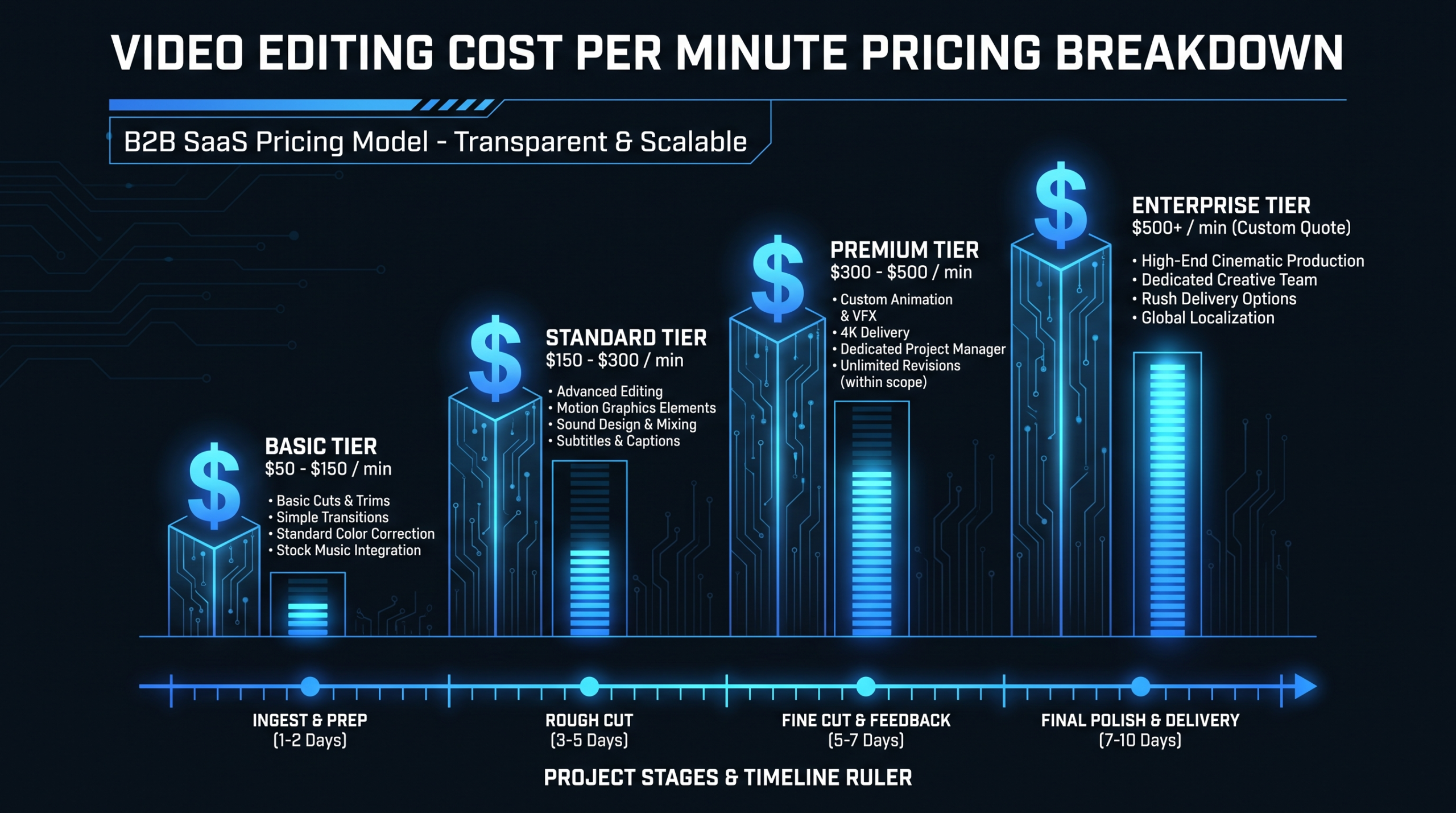
Cost per finished minute varies enormously based on what's actually in the video. Here are the ranges teams commonly report in 2026, segmented by editing complexity:
Video Editing Cost Per Minute — By Complexity Level (2026)
| Complexity Level | What's Typically Included | Common Range (per finished min) |
|---|---|---|
| Basic | Rough cut, color grade, licensed music, simple titles | $75–$200 |
| Standard | B-roll integration, lower thirds, branded template, basic captions | $200–$450 |
| Enhanced | Custom motion graphics, animated transitions, multi-cam sync, sound design | $450–$900 |
| Premium | Full motion design, SaaS UI overlays, screen recording integration, 2D animation elements | $900–$1,800 |
| High-end / Explainer | Full 2D/3D animation, character work, script-to-screen production | $1,500–$4,000+ |
These ranges reflect market rates across freelancers, agencies, and managed services for work delivered within standard turnaround windows (5–10 business days). Rush delivery and open-ended revision terms both push rates upward.
The most important observation: the same video category can span 5–10x in effective cost per minute depending on who's editing it, how organized your footage is, and how many revision rounds you go through. Most vendor comparisons ignore this variance entirely.
For a detailed look at how hourly rates translate to finished costs across different markets, our video editing hourly rate by country breakdown covers the geographic dimension in full.
5 Factors That Actually Drive Per-Minute Costs
The complexity tiers above are useful anchor points. But five specific variables determine where your actual cost lands within any given tier — and most content teams only control three of them.
1. Raw Footage Ratio
The ratio of raw footage to finished video is one of the most underappreciated cost drivers in the industry. A 5-minute finished video assembled from 20 minutes of raw footage is a fundamentally different editing task than the same 5-minute video assembled from 3 hours of raw footage.
When raw footage ratios are high — typical of conference recordings, panel discussions, long-form interviews, and screen captures — editors spend significant time on selects before assembly even begins. Teams commonly report that high footage ratios add 30–60% to effective per-minute editing costs compared to well-shot, controlled-ratio material.
What you can control: brief your production team to shoot tighter. Deliver time-coded selects or a detailed shot log to your editor. Organize files before handoff. These steps reduce editing time directly and show up immediately in your per-minute rate.
2. Motion Graphics Scope
Standard motion graphics — lower thirds, title cards, branded end screens — add minimal time when an editor works from pre-built templates. Custom motion graphics are a different story entirely. Animated SaaS product UI walkthroughs, data visualization sequences, and explainer animations can take 3–10 editor hours per finished minute in themselves, independent of the rest of the edit.
If your product demo videos require animated product interface sequences, expect that motion graphics alone represent a large fraction of your total per-minute cost. Our guide to product demo video production covers what that looks like in practice for SaaS teams.
3. Revision Rounds
Most agencies quote a base price that assumes 2–3 revision rounds. Here's what most content teams don't account for: revision rounds three through five often cost as much per editor hour as the initial cut — because the editor now re-cuts around late-stage feedback while preserving structure, pacing, and audio sync.
Teams that provide detailed, consolidated feedback — all stakeholders in one document, one round of notes, no mid-round additions — consistently report lower effective per-minute costs than teams that provide feedback iteratively over multiple exchanges. This is an operational discipline, not a vendor selection decision.
4. Turnaround Window
Rush delivery is expensive across every vendor type. Standard turnaround for a 5–10 minute video edit is typically 5–7 business days with most managed services. A 48-hour turnaround commonly triggers a 25–50% surcharge. Same-day delivery can double the effective per-minute cost.
If you're regularly requesting rush delivery, that premium is baked into your baseline per-minute rate whether or not it appears as a line item. The fix is a production calendar that builds in adequate lead time. Outsourcing video editing effectively means treating your vendor like an internal team — which requires the same planning lead time you'd give an in-house editor.
5. Editor Seniority and Team Structure
A junior editor might charge 40% less per hour than a senior editor — but often takes 60–80% longer to produce the same quality output. The effective per-minute cost can end up higher with the "cheaper" junior editor once you factor in the additional revision rounds required to fix quality issues.
The more consequential variable for SaaS companies is team structure. A solo freelancer, a structured agency pod (senior editor + junior editor + PM + creative director), and an in-house hire all deliver different risk profiles for quality consistency, brand familiarity over time, and capacity to scale output month-over-month without renegotiation.
Cost Per Minute Across Engagement Models
Once you understand the cost drivers, the key question is which engagement model delivers the best per-minute economics for your volume and content mix. Here's how the five primary models compare:
Effective Cost Per Finished Minute — By Engagement Model (2026 Estimates)
| Model | Typical Monthly Spend | Realistic Monthly Output | Effective $/min (est.) |
|---|---|---|---|
| Freelancer (Upwork/Fiverr, mid-level) | $1,500–$5,000 | 15–40 finished min | $75–$250/min |
| Per-project agency | $5,000–$20,000 | 10–30 finished min | $300–$900/min |
| Video editing subscription | $2,000–$8,000 | 20–60 finished min (simple only) | $80–$250/min |
| Dedicated team retainer | $5,000–$16,000 | 40–120 finished min | $100–$350/min |
| In-house editor (fully loaded) | $6,500–$11,000 | 20–50 finished min | $130–$550/min |
Output estimates assume standard complexity (B-roll, branded templates, captions). High-complexity content — motion graphics-heavy demos, multi-cam — reduces finished minutes and increases effective per-minute cost across all models.
Several observations matter for SaaS content teams specifically:
- Freelancers can look competitive on paper but rarely scale. Throughput is capped by one person's available hours, and quality consistency degrades under deadline pressure. Brand knowledge doesn't accumulate across projects the way it does with a dedicated team.
- Per-project agencies have the highest effective per-minute rate in most scenarios. You're paying for overhead — project management, new-client onboarding, internal coordination — without the volume discount that comes with a committed retainer.
- Subscriptions offer competitive per-minute rates for simple, high-volume content. The limitation is a complexity ceiling: most subscription services aren't built for SaaS-specific motion graphics, animated product demos, or multi-format brand content. Their "one active request at a time" model also creates throughput limits.
- Dedicated team retainers deliver the most competitive economics above roughly 30 finished minutes per month — especially for content requiring brand consistency and iterative improvement over time.
- In-house hiring can make economic sense at very high volumes, but the fully loaded cost (salary + benefits + equipment + software + employer taxes + management overhead) is frequently underestimated at the planning stage.
For a broader breakdown of how these models compare on factors beyond per-minute cost, see our guide to video production agency pricing models.
Provider Comparison: Benchmarks for 2026
Below is an honest comparison of the major named services and provider categories in the managed video editing space, including per-minute economics where publicly available or commonly reported.
Video Editing Provider Comparison — 2026
| # | Provider | Model | Pricing | Est. $/min | Best For |
|---|---|---|---|---|---|
| 1 | Video Editing Company (VEC) | Dedicated team retainer | $5K / $9.5K / $16K/mo | ~$120–$350/min | B2B SaaS; dedicated senior editor pod; 90-day output guarantee; flat transparent tiers |
| 2 | Increditors | Full-service custom retainer | ~$2.5K–$12K+/mo (quote-based) | ~$150–$450/min | YouTube creators, SaaS, finance, education; senior + junior + PM + CD pod; known for channel growth; con: no instant tier pricing |
| 3 | Vidchops | Subscription | Plans commonly start ~$1K/mo | ~$80–$200/min | YouTube creators, podcasters — fast turnaround on simple cuts; not suited for complex motion graphics or SaaS demos |
| 4 | Tasty Edits | Subscription | Plans commonly in $1K–$3K/mo range | ~$80–$220/min | Content creators, coaches — social clips, YouTube repurposing; limited complex project support |
| 5 | Upwork / Fiverr (marketplace) | Freelance marketplace | $15–$150/hr by editor level | $60–$500/min | One-off projects, overflow editing, budget-constrained teams; quality and consistency vary widely |
| 6 | In-house hire | Full-time employee | $55K–$90K/yr salary + ~30% overhead | $130–$700/min (volume-dependent) | High-volume programs where institutional knowledge and management bandwidth are available |
Pricing reflects publicly available plans and commonly reported market ranges as of mid-2026. Effective $/min is estimated based on typical output volumes for each model; actual rates vary by content complexity and team utilization. Contact each provider directly for current quotes.
Provider Notes
VEC's advantage in this comparison is specificity and transparency. The Growth ($5K), Core ($9.5K), and Scale ($16K) plans are built specifically for B2B SaaS content programs, with defined deliverables and a 90-day output guarantee — a structural commitment that matters when you're accountable to a VP of Marketing on content volume targets.
Increditors occupies a premium full-service position. Their editor pod model (senior editor + junior editor + PM + creative director) is well-suited to channels where creative quality and consistency are as important as throughput. They serve YouTube creators, SaaS companies, finance, and education clients — not SaaS-exclusive, but experienced in the category. The honest limitation: pricing is custom-quoted, so there's no instant tier comparison and upfront budget planning requires a direct conversation.
Subscription services (Vidchops, Tasty Edits) deliver compelling per-minute rates for simple, repetitive content — podcast clips, webinar highlight reels, talking head edits. They hit a ceiling when SaaS-specific requirements appear: animated product UI demonstrations, branded motion graphic systems, or content requiring product-domain context. The sequential "one active request at a time" workflow also creates throughput limits that don't fit teams running parallel content programs.
The freelancer route has the widest effective per-minute range of any category. High-quality Upwork freelancers often match or exceed agency rates per hour once you account for actual hours worked; lower-cost editors frequently require more revision rounds that erode the apparent savings. Quality assurance and availability consistency are the persistent risks.
Hidden Costs That Inflate Your Effective Per-Minute Rate
The numbers in the tables above are starting points. Your real per-minute cost is almost always higher than the base vendor rate once you account for costs that live outside the editing invoice.
File Organization and Handoff Overhead
Disorganized footage handoffs add time to every project. If your editor has to hunt through unlabeled folders, manually sync multi-camera audio, or parse ambiguous file names, that time shows up on your invoice — or it degrades output quality because the editor rushed through organization to stay within scope.
Teams that invest in pre-production organization — clearly labeled clips, time-coded selects, consistent folder structure, transcripts for long-form content — consistently report lower effective per-minute costs. The preparation time is real, but it happens on your team's side and doesn't bill at editor rates.
Stakeholder Review Cycles
Every review cycle that expands scope generates additional revision cost. The most common pattern: a VP watches a video after the content team has approved it and requests substantive changes. That's effectively a new revision round, often billed at full rates regardless of how "minor" the change appears to the requester.
Consolidated, structured feedback — one document, all stakeholders aligned before notes are sent, no mid-round additions — is the single highest-leverage operational change most content teams can make to reduce effective per-minute costs. HubSpot's video marketing research consistently shows that revision inefficiency is one of the top cited frustrations in agency relationships — it's structural, not unique to your vendor.
Rush Fees and Habitual Deadline Compression
Rush delivery commonly adds 25–50% to base rates. The more insidious pattern is habitual urgency: if your team routinely initiates video projects ten days before they need to go live — when standard turnaround is seven days — you're paying rush rates as your permanent baseline. A content calendar that builds in realistic lead time is worth real money in per-minute savings over a twelve-month period.
Format Variations
Producing one video and reformatting it for multiple platforms (16:9 YouTube, 9:16 Reels/TikTok, 1:1 LinkedIn) typically costs 30–50% of the original edit per additional format. Many teams treat this as a "quick resize" — it isn't, particularly when motion graphics, text overlays, and captions need repositioning for each aspect ratio.
Understanding what's included versus excluded in different editing tiers before you sign a contract is essential. Our breakdown of video editing services: what's included covers the common line items across service tiers.
Onboarding Time Cost
For any new vendor relationship — whether a freelancer, agency, or subscription service — the first four to six weeks typically deliver 50–70% of steady-state output while the editor learns your brand, your preferences, and your feedback patterns. That ramp-up period has a real per-minute cost that doesn't appear on any invoice. Factor it into your twelve-month cost model, not just your monthly rate.
When Per-Minute Logic Applies — And When It Doesn't
Cost per finished minute is the right metric for vendor comparison when you have consistent, ongoing video production needs. It breaks down in a few specific scenarios.
When Per-Minute Comparisons Work Well
- Comparing two retainer vendors at similar volume commitments
- Evaluating whether to bring editing in-house vs. stay with an agency
- Tracking cost efficiency over time as your production process matures
- Benchmarking your current vendor's performance against market rates mid-contract
- Building a board-ready budget model for a scaling content program
When Per-Minute Comparisons Break Down
- One-off, high-stakes projects: brand films, product launch videos, investor-facing content. Per-minute rate is the wrong anchor. What matters is total deliverable quality and the vendor's track record with that specific content type.
- Animation-heavy content: animation doesn't translate cleanly to a finished-minute unit because production time scales non-linearly with complexity. A 90-second animated explainer can require as much production time as a 20-minute talking head video. See our explainer video cost breakdown for how to scope that category separately.
- Strategy-inclusive engagements: if your vendor is also developing your content strategy, scripting, and creative direction, those services have real value that doesn't show up in finished minutes. A lower per-minute rate from a service that provides no strategic input isn't necessarily cheaper in total value terms.
How VEC's Retainer Model Changes the Per-Minute Math
For B2B SaaS teams running ongoing content programs, the metric that matters most isn't the per-minute rate at any given month — it's how that rate trends over a 6–12 month engagement.
The dynamic most content teams don't model at the planning stage: per-minute costs fall as your editing team accumulates brand knowledge. An editor who knows your product, your brand voice, your motion graphic system, and your feedback patterns produces output faster and requires fewer revision rounds. That means more finished minutes per month for the same retainer fee — which means a declining effective per-minute cost over time.
VEC's three-tier structure is built around this compounding dynamic:
- Growth ($5,000/mo): Dedicated senior editor pod. Entry-level retainer for teams producing 8–15 videos per month across product demos, thought leadership, and social content. Per-minute rate typically improves meaningfully after the first 60–90 days as the team fully internalizes your brand.
- Core ($9,500/mo): Expanded team capacity. Suited for teams publishing 15–30 videos per month across multiple formats. The expanded team handles parallel workstreams — product demos, long-form, and social repurposing running concurrently rather than sequentially.
- Scale ($16,000/mo): Full team including senior editor, junior editor, motion designer, project manager, and creative director. For SaaS teams where video is a primary growth channel and 30–50+ finished minutes per month is the baseline expectation. At this tier, the effective per-minute rate is consistently among the lowest in the dedicated-team category.
The 90-day output guarantee — double your current video output in 90 days or month four is free — is a structural commitment to making the per-minute math work. If VEC isn't delivering the throughput improvement they've committed to, you don't pay for that month. That's an unusual level of accountability in a category where most vendors talk about quality and deliver invoices.
For a breakdown of exactly what's included in each plan and how the team structure scales, see VEC's full pricing page.
If you're evaluating whether outsourcing is the right move at all for your current stage, our guide to SaaS video production covers the build-vs-buy decision framework in detail — including when bringing editing in-house starts to make more economic sense than a dedicated retainer.
Frequently Asked Questions
What is a typical cost per minute for professional video editing in 2026?
It depends heavily on complexity. Simple talking head edits with basic color grading and captions commonly run $75–$200 per finished minute. Standard B2B content with B-roll, branded templates, and motion graphics typically falls in the $200–$500 range. Complex SaaS demo videos with animated product UI overlays frequently reach $500–$1,500+ per finished minute. Your actual rate depends on vendor type, monthly volume, and how efficiently you manage footage handoffs and revision cycles.
How do I calculate cost per finished minute from an hourly rate?
First, establish the editing time ratio for your content type — how many editor hours does one finished minute of your typical video actually require? For talking head interviews with light editing, this might be 1.5–3 hours per finished minute. For motion graphics-heavy SaaS demos, it might be 6–12 hours per finished minute. Multiply the ratio by the hourly rate. A 4 hr/min ratio at $65/hr yields $260 per finished minute. This calculation explains why hourly rate comparisons between vendors are often misleading without accounting for actual throughput efficiency.
Is a dedicated team retainer or a subscription service cheaper per minute?
For simple, high-volume content (podcast clips, webinar highlights, basic social cuts), subscription services often deliver a lower effective per-minute rate — they're optimized for throughput on straightforward edits. For complex SaaS content — product demos, animated explainers, multi-format brand videos — dedicated team retainers typically win on per-minute economics at scale because the team builds brand knowledge that reduces revision rounds and ramp-up time on every subsequent project. The right answer depends on your content mix and monthly output volume.
Does an in-house video editor save money per minute compared to an agency retainer?
It depends on output volume and accurate loaded cost modeling. An in-house editor at $75K/year costs roughly $8,000–$10,500/month fully loaded (salary + benefits + equipment + software + employer taxes). If that editor produces 25 finished minutes/month, your effective per-minute cost is $320–$420. A dedicated retainer at $9,500/month delivering 35 finished minutes/month costs approximately $270/min — and doesn't require you to manage HR, handle turnover risk, or cover output gaps when the editor is on leave. The in-house model wins primarily at very high consistent output volumes where management bandwidth is readily available.
What's the most cost-effective video editing model for a Series B SaaS company?
Series B companies typically have defined content programs, consistent monthly video needs, and brand standards that require output consistency. For most teams at this stage, a dedicated retainer delivers the best per-minute economics: you're past the volume where per-project pricing makes sense, you need quality consistency that throughput-first subscription models struggle to guarantee, and the brand familiarity a dedicated team builds over 3–6 months directly reduces revision rounds and effective per-minute cost. See our pricing page for how the tiers map to typical Series B content program volumes.
See What Your Per-Minute Rate Could Look Like With VEC
VEC's Growth, Core, and Scale retainers are built for B2B SaaS content teams — dedicated editor pods, flat monthly pricing, and a 90-day output guarantee. Book a strategy call to see how your current per-minute cost benchmarks against what a dedicated team delivers.
Book a Free Strategy Call View Pricing Plans