What Video Content Costs Per Lead in B2B
TLDR
- The formula: Video CPL = (Total Video Production Spend + Distribution Spend) ÷ Leads Attributed to Video
- Channel benchmarks: B2B video CPL ranges from roughly $35–$90 for gated on-site video to $120–$380+ for LinkedIn video ads, depending on targeting and offer quality
- Type benchmarks: Product demos and case study videos typically deliver the lowest CPL; brand awareness content the highest
- Biggest CPL driver: Distribution spend and audience targeting — but production quality determines whether that distribution spend actually converts
- VEC math: At $5K/month producing 8–12 videos, teams commonly report competing effectively with paid search CPLs within 60–90 days of launch
Table of Contents
Why CPL Is the Right Metric for Video Investment
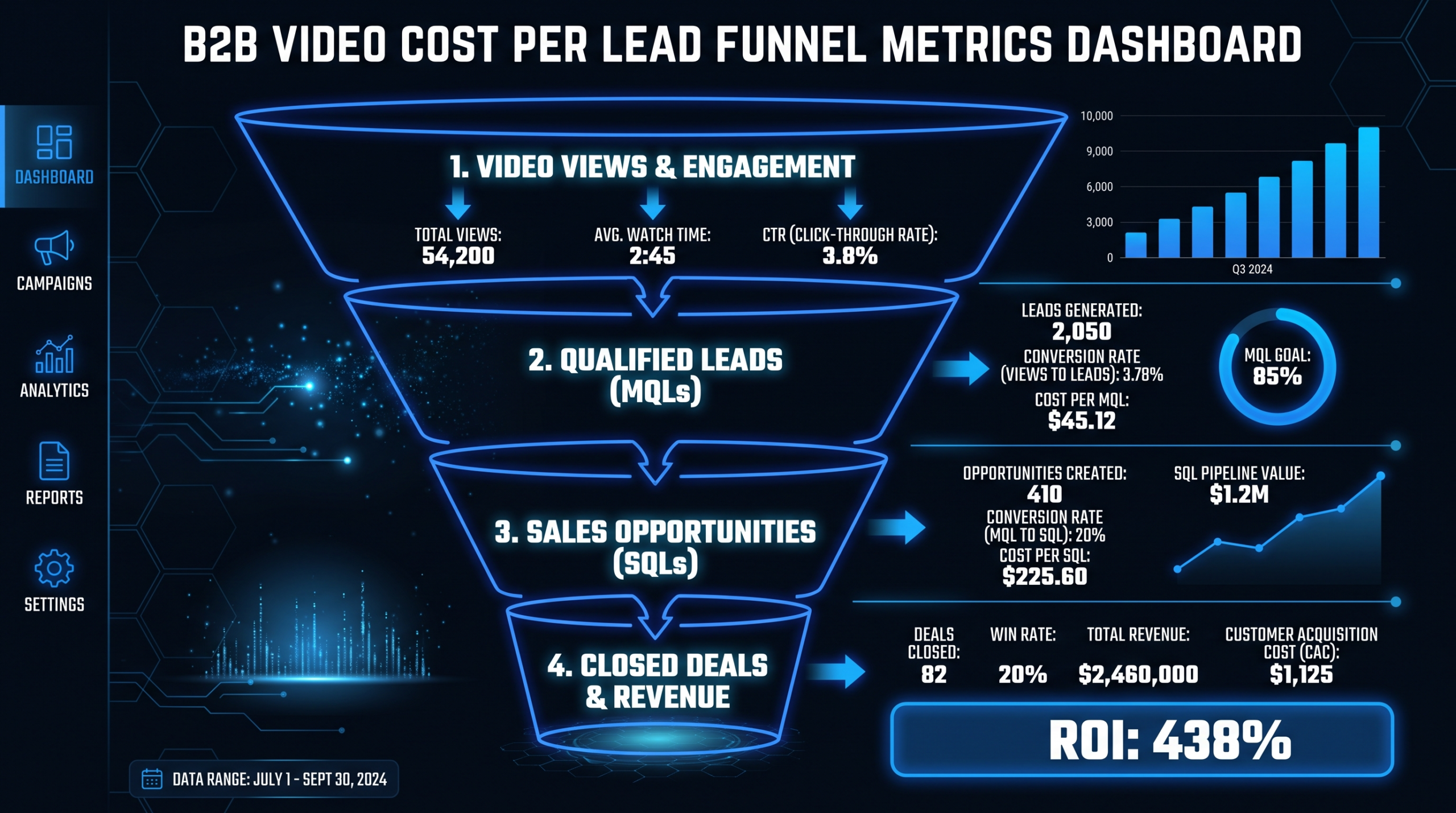
Most B2B marketing teams measure video success by the wrong things. Views, watch time, engagement rate — these are distribution metrics, not business metrics. They tell you whether your content caught someone's attention. They don't tell you whether it generated pipeline.
Cost per lead cuts through the noise. It forces you to tie every dollar of video spend — production, editing, distribution — to the output that actually matters in B2B: qualified contacts who might buy something. When you express video spend in CPL terms, you can finally compare it to other budget line items: paid search, content syndication, event sponsorships, SDR headcount.
The shift in framing matters strategically too. "We spent $8,000 on video last quarter" is a hard sell in a budget meeting. "Our video content delivered leads at $67 each, versus $180 for paid search in the same period" is a budget expansion conversation. The number doesn't just justify past spend — it creates a case for future investment.
This guide shows you how to build that case from the ground up: the calculation methodology, realistic benchmark ranges for B2B teams (hedged, because the variance is real), what levers actually move the number, and how to model it against your current budget and production setup.
How to Calculate Your Video Cost Per Lead
The core formula is straightforward:
The Video CPL Formula
Video CPL = (Production Spend + Distribution Spend) ÷ Attributed Leads
Where "Attributed Leads" = leads for which a video interaction was a first or last meaningful touchpoint before the form fill
Breaking Down the Inputs
Production Spend includes everything it costs to create the video: filming (if applicable), editing, motion graphics, voiceover, music licensing. If you're using a video editing agency or retainer, this is your monthly agency fee, or the portion of it attributable to the videos driving leads. For a breakdown of editing cost components by format, see our guide to video editing cost per minute.
Distribution Spend is what you pay to get the video in front of the right audience. This includes:
- Paid social (LinkedIn video ads, YouTube Ads, Meta video campaigns)
- Content syndication that features video
- Webinar platform costs for video-gated events
- Email platform costs for video-driven nurture sequences
Note: organic distribution has no direct cash outlay, but it has opportunity cost — time invested in SEO, social posting, and community engagement. Most CPL calculations focus on fully-loaded paid spend, treating organic as a separate efficiency lever you track independently.
The Attribution Problem
The hard part isn't the math — it's the attribution. "Leads from video" is not a clean category unless you've built the tracking infrastructure to support it. Here's how B2B teams typically handle it:
- UTM parameters: Tag all video content links with source, medium, and campaign. Any lead whose first or last session came through a video UTM gets attributed to that video.
- Gated video: The lead fills out a form to watch. Attribution is direct — 100% of form fills are video-attributed. Wistia Turnstile and Vidyard's lead capture are the most common tools for this implementation.
- Post-video CTAs: Video ends, a CTA appears, and the landing page includes a form. Leads who complete the form within the same session are attributed to the video.
- Retargeting audiences: You build a retargeting audience of video viewers (LinkedIn Video Viewer Audiences, YouTube Custom Audiences) and run lead-gen campaigns to that audience. Conversions from these campaigns are counted as video-influenced leads.
Each method has different fidelity. Gated video gives you the cleanest data. Retargeting attribution is looser — the user may have converted on a non-video ad but was in the audience due to prior video engagement. Most mature teams use a combination and accept some imprecision in exchange for coverage across the full funnel.
A Worked Example
Say your SaaS company spends $6,000/month with a dedicated video editing team (production) and $4,000/month on LinkedIn video ads (distribution). In a given month, those LinkedIn video campaigns generate 70 leads — people who filled out a demo request form after engaging with a video ad or visiting a video landing page.
Example CPL Calculation
| Input | Value |
|---|---|
| Monthly production spend | $6,000 |
| Monthly distribution spend (LinkedIn video ads) | $4,000 |
| Total monthly video spend | $10,000 |
| Attributed leads from video | 70 |
| Video Cost Per Lead | $142.86 |
Whether $143 is "good" depends on your average deal size, close rate, and what comparable channels cost you. That context is everything — and we'll get to the channel comparisons in a moment.
B2B Video CPL Benchmarks by Channel
CPL varies dramatically based on where you distribute the video. The same two-minute product demo will produce wildly different lead costs depending on whether it's gated on your website, running as a LinkedIn ad, embedded in a nurture email, or living on YouTube as an organic video.
The ranges below are drawn from practitioner conversations and available platform reporting data. They're deliberately wide — the variance within each channel is real, and anyone quoting a single "average CPL" number should be treated with skepticism.
B2B Video CPL by Distribution Channel (Hedged Ranges)
| Channel | CPL Range | Primary Variance Driver | Attribution Quality |
|---|---|---|---|
| Gated video on website (Wistia / Vidyard form gate) | $35 – $90 | Traffic quality, offer value, form length | High (direct) |
| LinkedIn video ads with Lead Gen Forms | $120 – $380 | Audience targeting, offer, CPM volatility | High (platform-reported) |
| YouTube video ads (TrueView, discovery) | $60 – $250 | Keyword targeting, landing page conversion rate | Medium (cookie-dependent) |
| Video-driven webinar (live or on-demand) | $40 – $130 | Topic relevance, promotion channel, registration friction | High (registration form) |
| Email with video (click through to form landing page) | $20 – $70 | List quality, video relevance, CTA clarity | Medium (UTM-based) |
| Organic social video (LinkedIn, YouTube unpaid) | $15 – $80 effective | Audience size, content quality, organic reach | Low (soft attribution) |
| Retargeting video viewers (paid follow-up campaigns) | $50 – $150 | Viewer audience size, retargeting offer, funnel stage match | Medium |
LinkedIn Video Ads: High CPL, High Quality
LinkedIn sits at the expensive end of the B2B video CPL spectrum. Teams commonly report CPLs in the $150–$350 range for well-targeted campaigns, with poorly-scoped targeting pushing $500+. The premium reflects the targeting precision available: job title, seniority, company size, industry, and recent behavior — simultaneously. No other platform comes close for B2B audience specificity.
The calculation matters in context. If your ACV is $60,000 and your close rate is 20%, a $200 CPL feeding a $12,000 average pipeline opportunity is extremely cheap. If your ACV is $8,000, that same CPL becomes a problem requiring a lead quality premium to justify it. LinkedIn video is a volume-compressed, quality-rich channel — worth it when your deal economics support it, not as a volume play.
Gated Video on Website: Often the Best Raw CPL
Gating high-value video content — a 20-minute product deep-dive, an ROI case study video, an industry benchmark report in video form — often delivers the lowest CPL of any video channel because the audience self-selects. The friction of giving an email address filters out casual browsers. Teams that have moved from PDF gating to video gating commonly report higher engagement rates with similar or better conversion rates, because video creates a more compelling reason to exchange contact details than a static document.
YouTube Ads: Volume Play with Attribution Caveats
YouTube's B2B CPL range is wide because the platform spans from broad consumer audiences to highly intent-driven keyword targeting. A B2B software company running in-stream ads against "project management software" search intent will see very different CPLs than one running bumper ads against broad business content categories. Teams using YouTube for B2B commonly report best results from custom intent audiences built around recent search behavior rather than topical content targeting alone.
Attribution is the real challenge with YouTube. Cross-device tracking gaps and cookie deprecation mean that YouTube's true contribution to B2B pipeline is often larger than last-touch attribution suggests. Teams that use data-driven attribution models or controlled holdout tests typically find YouTube's CPL contribution looks better than the platform-reported numbers.
B2B Video CPL by Video Type
The type of video you produce affects CPL independently of channel — because it affects conversion rate at each stage of the funnel. A brand story video builds awareness but rarely triggers an immediate demo request. A product walkthrough video, embedded on a pricing page or sent in a late-stage nurture sequence, commonly drives the opposite behavior.
B2B Video CPL by Video Type (Estimated Ranges)
| Video Type | Typical CPL Range | Best Channel Fit | Funnel Stage |
|---|---|---|---|
| Product demo / walkthrough | $30 – $90 | Website (gated or ungated), email nurture | Mid / BOFU |
| Customer testimonial / case study video | $35 – $100 | Website, LinkedIn retargeting, email | Mid / BOFU |
| Explainer video (problem/solution) | $60 – $160 | LinkedIn ads, YouTube ads, website homepage | TOFU / Mid |
| Thought leadership / educational series | $70 – $200 | Organic LinkedIn, YouTube, gated on-demand | TOFU |
| Webinar / live event recording | $40 – $130 | Email nurture, LinkedIn, on-demand gate | Mid |
| Video Sales Letter (VSL) | $25 – $80 | Dedicated landing pages, paid traffic, retargeting | BOFU |
| Brand / awareness video | $150 – $400+ | LinkedIn, YouTube (awareness-objective campaigns) | TOFU |
The pattern is consistent across teams: bottom-funnel video types generate leads at dramatically lower cost per lead than top-of-funnel awareness content. This is not a reason to skip TOFU video — it serves a different purpose and feeds the funnel that BOFU content converts. But it is a reason to be thoughtful about how you set CPL targets by video type. Holding your brand video to the same CPL benchmark as your demo video sets both up to fail.
For SaaS specifically, product demo videos consistently outperform other types on CPL when placed correctly. A 3–5 minute product walkthrough on your product demo page captures visitors who are already evaluating solutions — the video accelerates their decision-making rather than creating demand from scratch. The CPL is naturally low because the funnel position does the filtering work.
The Production Quality Multiplier
Production quality affects CPL indirectly but significantly. A low-quality video — shaky footage, poor audio, inconsistent brand treatment, rushed editing — signals low investment. In B2B, buyers are acutely sensitive to quality signals. A company whose marketing videos look underfunded raises a question about whether the product itself is underfunded.
Teams that have upgraded from "founder recording on a webcam" to properly edited, branded video content commonly report meaningful improvements in conversion rates on identical traffic. The mechanism: better video builds credibility faster, which reduces hesitation at the CTA. The production spend is not a cost center — it's the variable that determines whether your distribution spend actually converts.
What Drives Video CPL Down
Every team wants a lower cost per lead. Here are the levers that actually move the number, in roughly descending order of impact:
1. Match Video Type to Funnel Stage and Channel
This is the highest-impact alignment decision, and the one most teams get wrong. Sending a brand awareness video to a LinkedIn Lead Gen Form campaign produces terrible CPL — you're asking for a high-intent action (sharing contact details) from a low-intent content format. Match the ask to the moment:
- Gated product demos for warm website visitors or email nurture sequences
- Short explainers for cold paid social traffic (establish the problem before the offer)
- Testimonials and case studies for retargeting audiences who've already engaged
- VSLs on dedicated landing pages with direct-response paid traffic
When type-channel alignment is off, teams commonly find CPL 3–5x higher than it would be with the right pairing. This is the free optimization — no additional spend required.
2. Improve CTA Quality and Placement
A video that ends with no clear action step loses most of its CPL contribution. The highest-performing B2B video content uses CTAs at multiple points rather than waiting until the end:
- A verbal CTA from the presenter at the 60–70% mark (before viewer drop-off typically accelerates)
- An end-card or annotation linking directly to a demo request page
- A post-video form on the same page, especially for gated or long-form content
- A form gate (Wistia Turnstile or equivalent) triggered at a high-engagement moment inside the video
Teams that A/B test CTA placement commonly find that mid-video CTA placement outperforms end-of-video placement by significant margins — because viewers who reach the end are a self-selected subset of those who were engaged enough to convert.
3. Build a Retargeting Funnel Around Video Viewers
This is the highest-leverage move for systematic CPL reduction and one of the most consistently underused. When someone watches 50%+ of your LinkedIn video or 60+ seconds of your YouTube ad, they've demonstrated genuine interest — far stronger than a page view or ad click. Building a retargeting audience from these viewers and running a more direct, lower-funnel offer (trial signup, demo booking, case study) to that audience consistently produces lower effective CPL than cold targeting, because you're amplifying an existing signal rather than generating cold attention.
Teams that implement video viewer retargeting commonly report that retargeted leads convert to pipeline at 2–4x the rate of cold video leads — even when the raw CPL of the retargeting campaign looks similar. The quality premium is where the value lives.
4. Repurpose Long-Form Content Systematically
One of the most effective CPL reduction strategies is multiplying lead-generating touchpoints without multiplying production spend. A single 30-minute webinar recording can yield: 3–5 LinkedIn clips (punchy standalone moments), a 2-minute highlight reel for email sequences, a YouTube video with chapters for organic search, and an on-demand gated version for direct lead capture. Your production cost stays fixed while the number of lead-generating touchpoints multiplies 4–8x.
Teams that systematically repurpose long-form video into channel-specific formats commonly produce dramatically more leads from the same production investment — which mathematically compresses CPL without any additional spend. The key enabler is a production partner with enough capacity to handle the repurposing work efficiently, rather than treating each clip as a separate project.
5. Optimize Distribution Targeting, Not Just Spend Level
Many teams try to improve CPL by increasing or decreasing paid distribution spend. The actual lever is targeting quality. Audience segmentation (layering company size + seniority + recent behavior), bid adjustments by time and placement, frequency caps to avoid creative fatigue, and campaign structure for bidding efficiency all affect CPL independently of what's in the video. Treating distribution as a variable to optimize — not just a dial to turn up — is where most CPL gains come from at scale.
6. Increase Volume Within a Fixed Budget
Producing more video content within a fixed monthly budget lowers the effective cost per video and spreads production overhead across more lead-generating touchpoints. This is the core argument for retainer-based SaaS video production over per-project pricing: you lock in a monthly capacity at lower per-unit cost and produce consistently, rather than paying one-off premium rates for occasional projects and having gaps in your content calendar where no video-driven leads are entering the pipeline.
When Video Beats Other B2B Channels on CPL
Video is not always the lowest CPL channel. But there are specific scenarios where it consistently outperforms alternatives on a fully-loaded basis:
Complex Products That Require Demonstration
If your product takes more than 30 seconds to explain, text and static ads struggle to do the work. Video can demonstrate complexity in a way that no other format matches — showing rather than describing. B2B software teams selling products with non-obvious value propositions commonly find that video converts at higher rates than text-only landing pages because it does the cognitive work for the prospect before they hit the CTA. Lower conversion rate required to generate the same number of leads = lower effective CPL, even if the traffic cost is identical.
Competing Against Brand-Aware Alternatives
If a prospect is evaluating your product alongside a better-known incumbent, video is a leveling tool. A well-produced case study video featuring a credible customer story gives smaller vendors a way to compete on substance rather than name recognition. In evaluation-stage campaigns — retargeting, ABM video sequences, sales enablement content — case study video commonly delivers CPL competitive with or better than written case studies, with the added benefit of higher engagement and more emotional impact on the evaluation decision.
Webinars vs. Whitepapers on the Same Topic
Practitioners who have tested both consistently report that webinars (live or on-demand video) generate leads with stronger pipeline intent than whitepapers on the same topic. Registration requires a time commitment, and attendees arrive having invested attention — a warmer signal than someone who downloaded a PDF. The CPL for webinars is typically comparable to or lower than paid search for the same audience, particularly when the webinar is promoted to an owned or warm list where distribution costs are minimal.
Post-Trial Conversion via Product Video
One of the highest-ROI uses of video in B2B SaaS isn't at the top of the funnel — it's inside the product experience or post-trial nurture sequence. Short product tip videos sent to trial users commonly improve trial-to-paid conversion rates. When trial-to-paid goes from 15% to 25% through video-driven activation, the leads you already paid for via acquisition channels are suddenly worth significantly more — which retroactively improves the effective CPL of every channel that acquired those trials, without any additional acquisition spend.
Modeling Your CPL with a Dedicated Video Team
Let's run the actual math for different investment levels with a dedicated video production partner. Understanding what a fixed monthly production spend buys you — in terms of output volume and resulting CPL — is the calculation most B2B marketing leaders need before making a retainer commitment.
"The right question is not whether video production is expensive — it's whether the CPL is lower than what you're currently paying, and whether the lead quality justifies the difference."
Video Editing Company's plans are structured around dedicated team capacity: Growth ($5K/month), Core ($9.5K/month), and Scale ($16K/month). Each plan includes a senior editor, junior editor, project manager, and creative director working on your account with deep brand familiarity. Here's how CPL math plays out at different output levels and distribution budgets:
CPL Modeling: VEC Plans at Different Distribution Scenarios
| Plan | Production Cost | Add: Distribution Budget | Total Video Spend | Leads / Month | Effective CPL |
|---|---|---|---|---|---|
| Growth ($5K) — primarily organic + email | $5,000 | $2,000 | $7,000 | 80–140 | $50–$88 |
| Growth ($5K) — paid social (LinkedIn) | $5,000 | $5,000 | $10,000 | 50–90 | $111–$200 |
| Core ($9.5K) — mixed channel | $9,500 | $5,000 | $14,500 | 120–200 | $73–$121 |
| Scale ($16K) — full funnel program | $16,000 | $10,000 | $26,000 | 220–380 | $68–$118 |
Lead ranges are directional estimates based on common practitioner outcomes for B2B SaaS teams with active distribution programs. Actual results depend heavily on industry, offer quality, audience targeting, and attribution model.
The pattern across tiers: as production volume increases and the team builds brand familiarity, per-video production cost drops and consistency improves — both of which apply downward pressure on CPL over time. This is the compounding value of a dedicated team versus per-project production. A per-project approach produces the same per-unit cost in month 12 as it did in month 1. A dedicated team gets faster and more accurate with every video, improving throughput and quality simultaneously.
VEC's guarantee of doubling video output within 90 days means your lead-generating content surface area scales within a fixed budget. More touchpoints, more channels covered, more retargeting audiences built — all of which compress CPL without requiring more distribution spend.
For a broader view of production costs across formats and models, see our guide to outsourcing video editing and what to expect at different investment levels.
The Three Numbers That Determine Whether Your Video CPL Is Sustainable
The CPL figure alone doesn't tell you whether video makes business sense. Three additional data points are required to complete the picture:
- Your current CPL from other channels: If paid search delivers leads at $95, a video CPL of $120 needs to be justified by lead quality. If paid search is at $250, the same video CPL looks excellent.
- Lead quality / SQL conversion rate: Video-sourced leads often show higher SQL rates because video pre-qualifies. Someone who watched your product walkthrough video and then requested a demo is significantly warmer than someone who clicked a generic search ad. Teams that measure SQL rates by source frequently find that video-sourced leads convert at 1.5–2.5x the rate of cold paid search leads — which makes the economics favorable even at higher raw CPL.
- Average deal value and close rate: A $200 CPL is cheap if it's feeding a $50K ACV pipeline at a 20% close rate. It's expensive if your ACV is $5K at a 15% close rate. The math only works if you have these numbers.
Teams that calculate all three alongside CPL typically find that video's fully-loaded economics are more favorable than the raw CPL number suggests — especially when video-sourced leads carry a meaningful quality premium over the alternatives.
Frequently Asked Questions
What is a good video cost per lead for B2B?
There is no single benchmark that applies across all industries and deal sizes, but B2B teams commonly report video CPLs ranging from $40–$150 for well-executed on-site and email-driven video strategies, and $120–$380+ for LinkedIn video ad campaigns. Whether a specific number is good depends on your ACV, close rate, and what comparable channels cost you. If video-sourced leads convert to pipeline at a meaningfully higher rate than other channels, a higher raw CPL can still represent better overall economics.
How do I attribute leads to video content accurately?
The most accurate methods are: gating video content with a form before or during playback (using tools like Wistia Turnstile or Vidyard lead capture), UTM-tagged links from video touchpoints to landing pages tracked in your CRM or analytics platform, and building retargeting audiences from video viewers (LinkedIn Video Viewer Audiences, YouTube Custom Audiences) and tracking conversions from those campaigns separately. Each method has different attribution fidelity — gated video gives the cleanest data, retargeting the most indirect. Most teams use a combination.
Does production quality actually affect video CPL?
Yes — indirectly but measurably. Production quality affects credibility, engagement rate, and CTA click-through. Teams that have upgraded from low-production to properly edited, branded video content consistently report improvements in landing page conversion rates using the same paid traffic. The mechanism: better video signals more investment in the product, which reduces purchase hesitation at the CTA. The CPL impact is one step removed from the production spend itself, but the causal chain is well-supported by practitioner experience and platform benchmarking data from providers like Wistia.
Is video CPL typically better or worse than paid search CPL for B2B?
It depends on the channel and the funnel stage. Gated website video and email-embedded video often beat paid search CPL because the audience is already warm. LinkedIn video ad CPL is typically higher than branded paid search but can match or beat non-branded search for competitive keywords, especially when you factor in lead quality. The stronger argument for video is not always raw CPL — it's the SQL conversion rate premium that video-sourced leads frequently carry, because video does more pre-qualification work before the conversion event than most search ads do.
How much video content do I need per month to build a meaningful CPL program?
Teams commonly find that a sustainable video-driven lead program requires at minimum 4–8 new or refreshed assets per month across funnel stages — enough to run active distribution campaigns, A/B test formats, feed a retargeting funnel, and cover multiple channels. Below that threshold, there is not enough content variety to identify what is working or maintain consistent pipeline contribution. With a dedicated production partner, this volume is achievable within a structured monthly retainer. See VEC's pricing plans for what dedicated team capacity looks like at different budget levels and what monthly output you can realistically expect.
Know Your Video CPL Before Your Next Budget Cycle
Most B2B marketing teams cannot answer "what does a video lead cost us?" — which means they cannot defend their video budget or make the case to grow it. We help you build the content volume, attribution model, and production consistency to get to a number you can present to leadership with confidence. VEC's Growth plan starts at $5K/month with a dedicated team and a 90-day output guarantee.
Book a Free Strategy Call See VEC Pricing