Video Budget by Company Stage: Seed to IPO
TL;DR
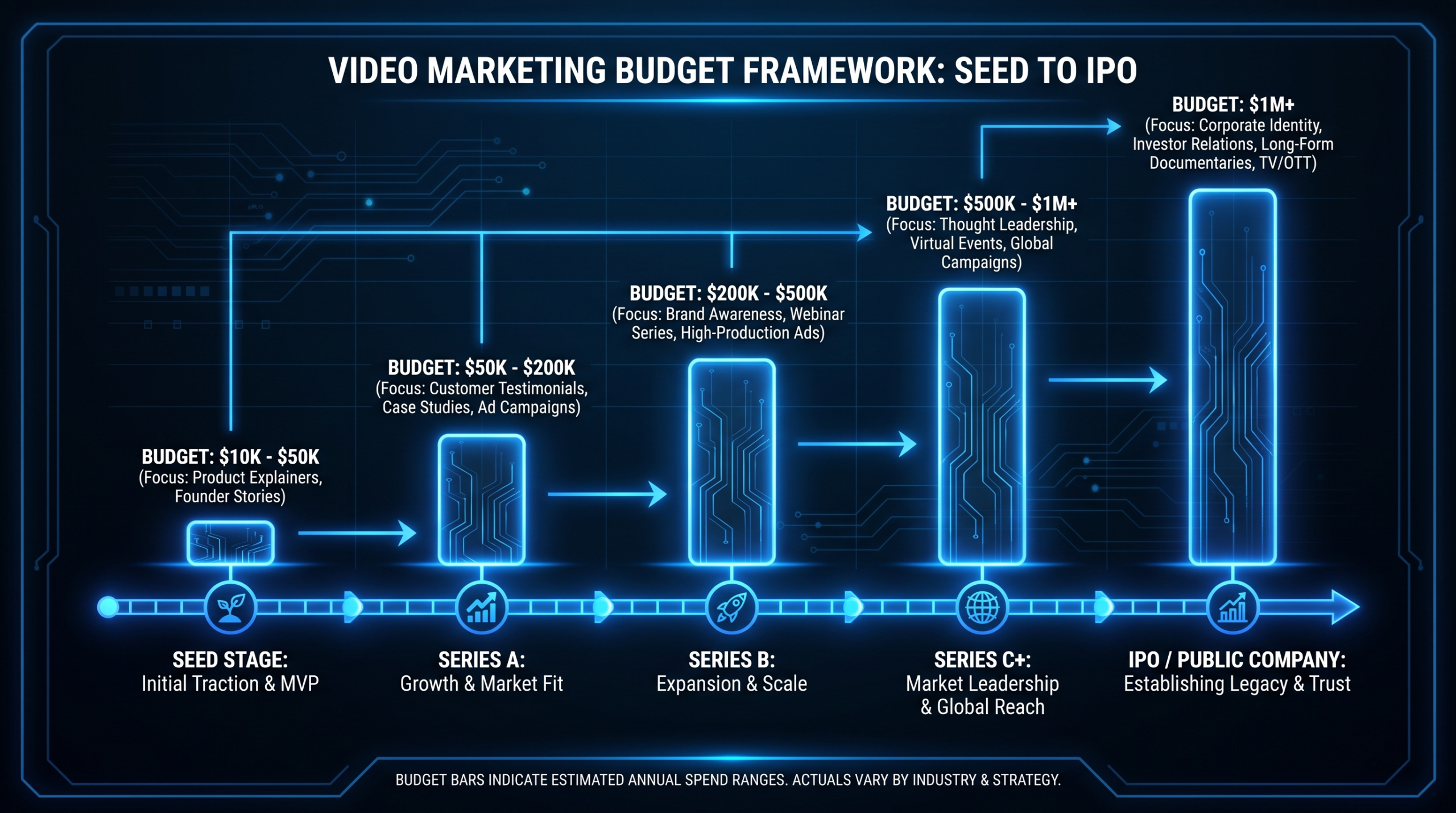
- Seed: $0–$2K/mo. Founder-led video, phone-quality is fine. Authenticity beats production value every time.
- Series A: $2K–$8K/mo. Invest in product demos and customer testimonials. Start a structured agency relationship.
- Series B/C: $8K–$20K/mo. Systemize. Move to a retainer or dedicated team. Build a multi-format pipeline.
- Growth/Pre-IPO: $20K–$60K/mo. Brand video, paid social creative, and sales enablement at scale.
- Enterprise/Public: $50K+/mo. Video as organizational infrastructure. Multi-vendor, governance, regional.
- The right video marketing budget is not about your revenue — it is about your stage, your goals, and your current content bottleneck.
Table of Contents
- Why Stage Matters More Than Size
- Seed Stage: The Founder-Led Video Era
- Series A: Building the Video Playbook
- Series B and C: Scaling What Works
- Growth Stage and Pre-IPO: Brand at Scale
- Enterprise and Public Companies: Video as Infrastructure
- Outsourcing Model by Stage
- Video Budget Allocation Framework
- Frequently Asked Questions
Every VP of Marketing gets the same question in budget season: how much should we spend on video? The answer almost never lives in a benchmark report. It lives in your company's stage, goals, and what video is supposed to accomplish for you right now.
A Seed-stage founder who spends $15K on a polished brand film is likely burning money on an asset they will rebuild in 18 months once their messaging stabilizes. A Series C company still relying on the CEO's iPhone clips is leaving pipeline on the table. The mismatch between video investment and company stage is one of the most common — and most fixable — mistakes in B2B marketing.
This guide gives you a stage-by-stage video marketing budget framework with realistic ranges, video type priorities, and clear guidance on when to use freelancers, project-based agencies, or dedicated teams. All ranges are hedged and practitioner-informed — no invented statistics, no "studies show" without context.
Why Stage Matters More Than Size
Company size — headcount, ARR, total revenue — is a rough proxy for video budget. Company stage is the right lens because it tells you something size alone does not: what you are actually trying to accomplish with video right now, and what resources you have to do it with.
Three Drivers That Shift at Every Stage
1. Content goals change completely. At Seed, you are validating your narrative with early customers and investors. At Series A, you are converting prospects into pipeline. At Series B and C, you are scaling a repeatable content engine. At Growth and Enterprise, you are protecting brand equity while supporting a much larger, more complex sales organization.
2. Audience size changes the ROI math. A carefully produced explainer video at Seed reaches hundreds of qualified prospects. The same asset at Series C reaches tens of thousands — and pays for itself in a fraction of the time. Production investment has a much larger denominator at scale, which is why higher spend makes sense later.
3. Internal resources change the make-vs-buy calculation. Seed teams have a founder who can speak on camera — that is often your most valuable video asset. Series A teams have a scrappy marketing manager running everything. Series B and beyond teams may have a content team, but they are still underwater on production capacity. That gap is where outsourced post-production earns its keep.
Video Marketing Budget Overview by Stage
| Stage | Typical Monthly Range | Primary Video Goals | Best Partner Model |
|---|---|---|---|
| Seed | $0–$2K | Narrative validation, investor comms, early community | DIY or freelancer |
| Series A | $2K–$8K | Lead conversion, product demos, customer proof | Project-based agency |
| Series B/C | $8K–$20K | Pipeline acceleration, multi-format content, SEO | Agency retainer or dedicated team |
| Growth/Pre-IPO | $20K–$60K | Brand differentiation, paid video, sales enablement | Dedicated team + agency partners |
| Enterprise/Public | $50K–$200K+ | Full-funnel, regional, internal comms, compliance | Multi-vendor + in-house capacity |
These ranges reflect what companies at each stage commonly spend — not universal prescriptions. Your specific number will depend on your go-to-market motion, channel mix, and how central video is to your acquisition and retention strategy.
Seed Stage: The Founder-Led Video Era
At Seed, the most powerful video asset you have is your founder. Raw, authentic, direct-to-camera content from someone who genuinely believes in the product consistently outperforms polished agency work — because your audience at this stage is looking for conviction and clarity, not production quality.
What to Spend
Realistically: $0–$2K per month. This typically covers a freelance editor for polish and cleanup (at $40–$80/hour for 10–20 hours of work), a one-time recording setup ($500–$1,500 for lighting, a USB microphone, and a decent webcam or a smartphone mount), and occasional stock footage or music licensing.
Where Seed companies regularly overspend: animated explainer videos. A polished 90-second explainer from a boutique animation studio commonly costs $5K–$20K. Before you have a stable narrative — messaging that has been stress-tested against 20+ customer conversations — you are building an expensive artifact that will need to be rebuilt at Series A once your positioning clarifies.
Video Types That Matter at Seed
- Founder story video: 2–3 minutes, direct to camera, honest and specific. Goes on your homepage, LinkedIn, and fundraising decks. Authenticity is more important than production value here — a well-lit iPhone video from a credible founder outconverts a studio-produced piece from an unknown brand.
- Product walkthrough: Screen recording with voiceover. Loom or similar tools work fine. Gets prospects to their "aha moment" without a sales call.
- Short-form LinkedIn clips: 60–90 seconds. Founder sharing a hard-won insight, a customer problem, or a contrarian take on the market. These build the personal brand that Series A investors and early customers will research.
- Async demo recordings: For sales conversations. Not polished — functional. If someone asks to see the product, a 10-minute screen recording is faster than scheduling a call and more effective than a slide deck.
The Freelancer Decision at Seed
A freelance video editor at $40–$80/hour is the natural first vendor relationship. You are not producing at volume — maybe 4–8 edits per month — and you do not need brand consistency at scale yet. Platforms like Upwork allow you to test two or three editors before settling on one whose style and communication you trust.
What you get from a solid freelancer at Seed: clean cuts, basic color grading, captions, and sound design. What you do not get: strategic input on content direction, proactive brand-building, or guaranteed availability during crunch time. For Seed stage, that tradeoff is usually fine.
Common Seed-Stage Video Mistakes
- Over-investing in animation before messaging is validated
- Waiting for "production-ready" footage before starting (natural light and a phone camera is genuinely enough)
- Skipping the founder's face entirely and going logo-on-slide — this is consistently the lowest-converting homepage video format
- Building a YouTube channel before you have a repeatable content system to sustain it
Series A: Building the Video Playbook
Series A is when video starts to matter for conversion, not just awareness. You have a product that works, paying customers who can testify to its value, and a sales motion that needs acceleration. This is the stage where video investment begins generating measurable pipeline returns — and where the right production partner makes a meaningful difference.
What to Spend
$2K–$8K per month is the range where Series A companies commonly land. The lower end covers a modest agency project or a retainer with a small post-production provider. The upper end funds a multi-video monthly pipeline: demos, testimonials, social cuts, and paid social creative running simultaneously.
Video Types That Matter at Series A
- Product demo video: The highest-ROI video asset for most SaaS companies at this stage. A well-structured 3–5 minute demo replaces the "can I show you the product?" call for a meaningful percentage of your inbound funnel — and shortens the sales cycle for the prospects who do book. See our guide on product demo video production for narrative structure and production recommendations.
- Customer testimonial videos: 2–3 minute case study pieces. Even two or three customer stories give prospects the social proof they need to move forward. Real customers, specific outcomes (even directional ones), honest tone. No scripted testimonials — buyers can tell.
- Paid social creative: 15–60 second cuts for LinkedIn and YouTube ads. At Series A, you are often running your first paid video experiments — start with 3–5 format variations and let performance data tell you which angles, hooks, and CTAs resonate.
- Webinar recordings and highlight reels: You are probably running webinars or virtual events. Editing these into 10–15 minute highlight clips extends their shelf life from a week to a year. It also gives your sales team async assets for specific buyer questions.
For broader context on what B2B video buyers are actually responding to, Wistia's video marketing learning hub tracks engagement patterns across large volumes of business video — useful for calibrating what formats and lengths to prioritize.
Agency vs. Freelancer at Series A
Series A is typically when companies outgrow their first freelancer. The inflection point: you need 6+ videos per month at consistent brand quality, and your freelancer has become a bottleneck — overloaded, unavailable during key campaign windows, or inconsistent as complexity increases.
Agencies offer project management, editorial consistency, and delivery guarantees that individual freelancers rarely match at scale. You do not need a retainer yet — most Series A companies start with project-based agency work (2–4 projects per quarter) to test fit before committing to an ongoing arrangement.
For a detailed breakdown of how per-project, hourly, retainer, and dedicated team models compare in real cost, our video production agency pricing models guide runs the math across multiple production volume scenarios.
Setting Up Basic Video Ops at Series A
Before you scale production, you need a simple operating system:
- A brief template. Every video request should document: goal, audience, key message, CTA, distribution channel, and deadline. Without this, your editor is guessing.
- A shared brand asset library. Fonts, logo files, color codes, approved music tracks, b-roll footage. Your editor needs these to maintain consistency across different pieces.
- A defined review workflow. Who approves? How many revision rounds? Undefined review processes are the single biggest cause of blown timelines at Series A content teams.
Series B and C: Scaling What Works
Series B marks a turning point: you are no longer testing whether video works for your business. You know it does. Now you need to produce it consistently, at higher quality, across more channels — without losing brand coherence or turning your marketing team into a post-production coordination desk.
What to Spend
$8K–$20K per month is where most Series B and C companies land when video is a core part of their go-to-market. The range widens because company-specific factors matter enormously at this stage: your sales cycle length, whether you are running heavy paid distribution, and whether you have any in-house video capacity.
Video Types That Matter at Series B/C
- Animated explainer and product overview: Your messaging has stabilized. This is the right time to invest in a high-quality explainer. A well-produced 90-second animated or live-action overview will live on your homepage for 18–24 months and work harder than almost any other single content asset. For realistic cost expectations across production approaches, see our explainer video cost breakdown.
- Sales enablement video: One-pagers and battlecard PDFs are fine. Video is better. Objection-handling clips, feature spotlight videos, and competitive positioning pieces give your reps something to send after a discovery call that prospects actually engage with — unlike another PDF.
- Multi-format content repurposing: A 45-minute webinar should produce 8 LinkedIn clips, 3 YouTube highlights, 1 email embed, and supporting social cuts. At Series B, you should be extracting maximum mileage from every production investment rather than treating each video as a standalone project.
- Paid video advertising: LinkedIn video ads, YouTube pre-roll, and retargeting creative. Series B companies commonly double down on paid video distribution once they have validated which angles drive pipeline — and need a steady supply of creative variants to avoid ad fatigue.
- Customer story videos: Longer and more produced than what you built at Series A. 3–5 minute case studies with named executives, on-site filming or high-quality remote interviews, and specific business outcomes (even directional ones — "significantly reduced" is fine; invented percentages are not).
The Retainer vs. Dedicated Team Decision at Series B
This is the inflection point for your outsourcing model. At 8–15 videos per month, project-by-project agency work becomes operationally painful: constant rebriefing, quality inconsistency, and no accumulated brand knowledge in your editing team.
A retainer ($5K–$12K/month typically) gives you reserved capacity and a team that builds familiarity with your brand over months. A dedicated team arrangement goes further — the same editors on your account every week, operating as an embedded extension of your marketing org, with brand knowledge that compounds over time.
VEC's Growth plan ($5K/mo) and Core plan ($9.5K/mo) both operate as dedicated team arrangements — not a rotating pool of contractors. That continuity is what compresses review cycles from three rounds to one. For a practical guide to making this transition without losing quality or momentum, see our how to outsource video editing guide.
Building a Video Content System at Series B
By Series B, video production should run like a system, not a fire drill. Key infrastructure:
- A content calendar with 4–6 weeks of lead time. Last-minute video requests are expensive, produce mediocre results, and exhaust everyone involved.
- A defined asset reuse workflow. What gets clipped for social? What gets localized? What gets reformatted for paid? Define this upfront, not retroactively.
- A measurement framework. View rate, play rate, completion rate, and downstream pipeline influence. If you cannot measure video's contribution, you cannot defend the budget at the next planning cycle.
Growth Stage and Pre-IPO: Brand at Scale
Growth-stage and pre-IPO companies face a video challenge that is qualitatively different from earlier stages: volume and brand consistency at the same time. You are producing tens of videos per month across multiple campaigns, channels, and potentially multiple markets — and every single piece needs to feel like it came from the same company.
What to Spend
$20K–$60K per month is the realistic range for growth-stage companies with serious video programs. This covers dedicated post-production capacity, paid social creative production, occasional brand-level productions, and event video. Many companies at this stage also maintain an in-house videographer or editor alongside outsourced post-production — the two models are complementary rather than competing.
Video Types That Matter at Growth and Pre-IPO
- Brand video: If you have not built a genuine brand film yet, growth stage is typically the right time. A $30K–$80K brand film that runs for three or more years pays for itself if the company is at the right scale and the creative is strong. Investor and analyst audiences research this asset — it signals maturity and category ambition.
- Sales enablement at scale: Regional or vertical-specific product videos, competitive battlecard videos, executive briefing materials. Your sales team is 50–200+ reps with specific objection patterns. Video assets that address those patterns directly — not generic demos — give them tools that actually get used.
- Paid video advertising: At growth stage, paid video likely has its own budget line. You are testing creative hooks at volume, iterating on what drives qualified pipeline, and potentially running video across LinkedIn, YouTube, and connected TV for enterprise-level deals.
- Customer success stories: High-production, multi-angle case studies featuring named executives and measurable outcomes. These are the assets that support long enterprise sales cycles where buyers spend weeks evaluating your credibility before engaging with sales.
- Internal communications: All-hands recordings, product launch videos, onboarding programs. At 200+ employees, asynchronous video becomes essential for alignment — written memos simply do not get the engagement or retention that video does.
The Dedicated Team at Growth Stage
Growth-stage companies commonly run one or more dedicated post-production teams as their core production capacity. VEC's Scale plan ($16K/mo) is built for this use case: a senior editor, junior editor, project manager, and creative director who function as an embedded video department — not a vendor relationship you manage project by project.
The operational benefit at this stage is editorial velocity. When a team knows your brand, your product, your feedback preferences, and your format requirements deeply, review cycles compress from three rounds to one. That difference is what separates shipping 15 videos per month from shipping 35.
Enterprise and Public Companies: Video as Infrastructure
At enterprise and post-IPO scale, video stops being a marketing channel and becomes organizational infrastructure. It touches investor relations, internal communications, regional marketing, compliance training, sales enablement across hundreds of reps, and product documentation — simultaneously.
What to Spend
$50K–$200K+ per month, typically across multiple budget owners. Enterprise video budgets are rarely managed by a single team. Marketing, sales enablement, internal comms, and product teams commonly maintain separate video line items that roll up under a total company spend that most outsiders would find surprising.
Video Types at Enterprise Scale
- Full-funnel video programs: Awareness (brand, thought leadership, analyst-facing) → consideration (demos, comparisons, vertical-specific use cases) → decision (ROI calculators in video format, executive briefings, references) → retention (onboarding sequences, product update videos, success community content).
- Investor and analyst communications: Earnings call support, investor day presentation packages, analyst briefing materials. These carry legal and compliance weight that production teams need to handle carefully.
- Regional and localized content: Global companies localize video into 5–10 languages. This requires dedicated post-production capacity for localization workflows — subtitle synchronization, voiceover replacement, culturally adapted b-roll — not just basic translation.
- Internal communications at scale: All-hands, town halls, leadership Q&As, onboarding programs, compliance training. At 1,000+ employees, async video is not optional — it is the only realistic way to communicate across time zones and functions consistently.
Multi-Vendor Reality at Enterprise
Enterprise companies almost always maintain multiple video vendor relationships simultaneously: a premium creative agency for brand-level productions, a dedicated post-production partner for high-volume editing, an event video team for conference and roadshow coverage, and internal studio capacity for quick-turn content.
The management challenge at this stage is not finding vendors — it is maintaining brand consistency across all of them. Detailed brand guides, pre-approved asset libraries, and a strong in-house video director become critical infrastructure that prevents each vendor relationship from producing a slightly different-looking "VEC."
HubSpot's video marketing resources track how enterprise teams structure their video programs — worth reviewing if you are building a governance framework for a multi-team video operation at scale.
Outsourcing Model by Stage: Freelancers, Agencies, and Retainers
The right outsourcing model at each stage is not just a cost question — it is a capacity and quality matching problem. Here is the decision framework in a single table, followed by the key inflection points to watch for:
Outsourcing Model Decision Matrix
| Stage | Typical Monthly Budget | Recommended Model | Why |
|---|---|---|---|
| Seed | $0–$2K | DIY or freelancer | Low volume; authenticity over polish; no need for operational overhead |
| Series A | $2K–$8K | Project-based agency | Quality step-up without long-term commitment; test agency fit first |
| Series B | $8K–$15K | Retainer or dedicated team | Volume and brand consistency require reserved, familiar capacity |
| Series C | $12K–$20K | Dedicated team | Editorial velocity and brand depth; lower per-video cost at scale |
| Growth | $20K–$60K | Dedicated team + agency partners | Multiple parallel workstreams require parallel production capacity |
| Enterprise | $50K+ | Multi-vendor + in-house | Scale, specialization, and governance require a distributed model |
Three Signals You Have Outgrown the Freelancer Model
- You are requesting more than 6 videos per month and waiting 7+ days for each one.
- You are spending significant time re-explaining your brand to a new editor because your regular one is unavailable.
- Review cycles are consistently taking 3+ rounds because the editor does not yet know your preferences well enough to anticipate them.
When Project-Based Agency Work Beats a Retainer
For companies with irregular production needs — two or three large productions per quarter rather than a steady monthly drip — project-based agency work is often more cost-effective than a retainer commitment. You pay for what you actually use, without a fixed monthly floor. The tradeoffs: higher per-video cost and no brand familiarity that compounds over time.
The VEC Model for B2B SaaS at Scale
VEC works exclusively with B2B SaaS companies on dedicated post-production arrangements. Every plan — Growth at $5K/mo, Core at $9.5K/mo, Scale at $16K/mo — includes a dedicated senior editor, project management, and guaranteed turnaround. Not a contractor pool. Not a shared queue. The same team on your account, every week, building the brand knowledge that makes the difference at volume.
For teams producing 8+ videos per month and frustrated with freelancer bottlenecks or inconsistent agency quality, the dedicated model eliminates coordination overhead and compresses review cycles. See our pricing page for a full breakdown of what is included at each tier.
Video Budget Allocation Framework
Once you know your total video marketing budget, the next decision is how to allocate it across video types and funnel stages. No single formula works for every company, but the following framework gives you a useful starting structure.
The Funnel-Stage Allocation Approach
A common allocation pattern for B2B SaaS companies at Series B and beyond: roughly 60% toward pipeline-driving video, 30% toward brand and awareness, and 10% toward internal and retention content. Teams adjust these ratios based on where their specific bottleneck sits — conversion, awareness, or retention.
- Pipeline video (60%): Product demos, customer testimonials, sales enablement clips, explainers, paid social creative. These assets are closest to measurable revenue and easiest to justify in a planning cycle. Start here before expanding into other categories.
- Brand and awareness (30%): Thought leadership content, founder and executive video, brand films, event and conference coverage. Harder to attribute directly to deals, but critical for enterprise sales cycles where buyers spend weeks researching your company before contacting anyone.
- Internal and retention (10%): Onboarding video, customer success content, internal communications. Often funded from a separate budget line — but worth tracking in your total video investment view to understand the real scale of your program.
How the Ratios Shift by Stage
At Seed, essentially all video budget goes to awareness and pipeline — there is no operational scale to justify internal communications video. At Enterprise, the ratios shift dramatically: internal comms, regional localization, and compliance content can consume 30–40% of total video spend, with the remainder spread across brand and pipeline.
Production vs. Distribution: Fund Both
A consistent planning mistake: allocating 90% of the video budget to production and 10% to distribution. A polished product demo that no one sees produces no pipeline. Build paid promotion budgets, email embed strategies, and sales team enablement workflows into your video budget from the start — not as an afterthought once production is done.
Video Type Priority by Company Stage
| Video Type | Seed | Series A | Series B/C | Growth | Enterprise |
|---|---|---|---|---|---|
| Founder story | ★★★ | ★★ | ★ | — | — |
| Product demo | ★★ | ★★★ | ★★★ | ★★★ | ★★★ |
| Customer testimonials | ★ | ★★★ | ★★★ | ★★★ | ★★★ |
| Animated explainer | — | ★★ | ★★★ | ★★★ | ★★ |
| Paid social creative | — | ★★ | ★★★ | ★★★ | ★★★ |
| Sales enablement | — | ★ | ★★★ | ★★★ | ★★★ |
| Webinars and events | — | ★★ | ★★★ | ★★★ | ★★★ |
| Brand film | — | — | ★ | ★★★ | ★★★ |
| Internal comms | — | — | ★ | ★★ | ★★★ |
| Regional and localized | — | — | — | ★ | ★★★ |
★★★ High priority · ★★ Medium priority · ★ Worth doing if resources allow · — Not typically applicable at this stage
For a deeper guide on building a SaaS video program with strategy baked in from the start — including channel allocation and measurement frameworks — see our SaaS video production guide.
The question is not what video budget you can afford at your current stage. It is what video budget you need to compete in your category — and then building a production system that deploys that investment without wasting it on the wrong formats or the wrong partners.
Frequently Asked Questions
How much should a Seed-stage startup spend on video marketing?
Most Seed-stage companies effectively spend $0–$2K/month on video. At this stage, a decent home recording setup, a part-time freelance editor, and a founder who speaks directly and honestly about the product will consistently outperform expensive production. Reserve significant production investment for Series A, when your messaging has stabilized and your audience is large enough to justify it.
When should a B2B SaaS company move from a freelancer to a dedicated video team?
The dedicated team model makes operational and financial sense when you are producing 8 or more videos per month consistently and review cycles are consuming more than a few hours per week. Below that threshold, a project-based agency or retainer is typically more cost-effective. Above it, the brand knowledge, reserved capacity, and lower per-video cost of a dedicated arrangement justify the higher monthly floor.
What is the most important video investment for a Series A SaaS company?
A strong product demo video. At Series A, you are converting prospects who already understand their problem — they need to see your product in action, understand what differentiates it, and feel confident enough to request a meeting. A well-structured 3–5 minute demo, with a clear problem-solution arc and specific customer proof points, consistently delivers the highest ROI of any video type at this stage.
How should I allocate my video marketing budget across funnel stages?
A widely used starting point for B2B SaaS companies at Series B and beyond: roughly 60% toward pipeline-driving video (demos, testimonials, paid social creative), 30% toward brand and awareness (thought leadership, brand films, executive content), and 10% toward internal and retention content. Adjust based on where your actual bottleneck sits — if awareness is the constraint, shift toward brand; if conversion is the gap, concentrate investment at the bottom of the funnel.
Can the same video production partner scale with us from Series A to enterprise?
Occasionally — if the partner is built to scale. Many companies find that early freelancer or project-agency relationships hit a ceiling at Series B, when volume, brand consistency, and turnaround speed all need to improve simultaneously. The test: can your current partner support 15+ videos per month with the same core editors on your account? If not, evaluating dedicated team models specifically designed for scale is worth the conversation.
Not Sure What Video Budget Fits Your Stage?
VEC works exclusively with B2B SaaS companies on dedicated post-production — Growth at $5K/mo, Core at $9.5K/mo, Scale at $16K/mo, with a guarantee to double your video output in 90 days or month four is free. Tell us your current stage and volume, and we will tell you honestly whether we are the right fit.
Book a Free Strategy Call See VEC Pricing