Switching Video Agencies: A 30-Day Migration Plan
TL;DR
- Most teams delay switching video agencies because they fear a content gap - but a structured 30-day migration eliminates that risk entirely.
- The key is a parallel production window: keep your current agency running while your new one onboards.
- Before you give notice, complete a brand asset audit, document your style preferences, and benchmark your current output quality.
- The 4-week framework here has been used by B2B SaaS marketing teams to switch agencies without missing a single scheduled publish.
Table of Contents
The relationship has soured. Turnaround times are slipping. Quality is inconsistent. You're spending more time on revision rounds than on strategy. You know you need to switch video agencies - but every time you get close to pulling the trigger, the same fear surfaces: what happens to our content calendar while we transition?
That fear is legitimate. But it's also solvable. The teams who get burned by agency switches don't fail because switching is inherently risky - they fail because they switch without a plan. They give notice, the content pipeline dries up for six weeks, and they spend the next quarter trying to recover momentum.
This guide gives you the plan. A 30-day framework designed specifically for B2B SaaS marketing teams that need to keep publishing while they transition. You'll find a week-by-week checklist, a full brand handover template, and the specific questions that determine whether a new agency can actually deliver before you're locked into a contract.
Why Teams Wait Too Long to Switch
The average marketing team tolerates a underperforming video agency for four to six months longer than they should. The reasons are understandable - switching feels like a project on top of an already full plate - but each month of delay compounds the cost.
The Sunk Cost Trap
You've spent months onboarding this agency. They know your brand (at least partially). Switching means starting that process over. This reasoning makes sense emotionally but doesn't hold up financially. If your current agency is producing mediocre work, every video you publish with them is a missed opportunity - not sunk cost recovery.
The "No Good Alternatives" Myth
Marketing teams often delay switching because their last vendor search was painful. They assume the next one will be equally difficult. In reality, the B2B video production market has matured significantly - there are now specialized agencies that focus exclusively on SaaS content, with predictable pricing, dedicated team models, and documented onboarding processes. The search is easier than it was two years ago.
The Content Gap Fear
This is the most rational concern, and it's the one this guide directly addresses. Yes, a rushed, unplanned agency switch can create a content gap. But a structured 30-day migration with a two-week parallel period eliminates this risk almost entirely.
The math is straightforward: if you give your current agency 30 days' notice, start onboarding your new agency on day one of that notice period, and run both simultaneously for two weeks, your content calendar never goes dark.
The Pre-Migration Audit
Before you contact a single new agency or give notice to your current one, complete this audit. It takes two to four hours and determines both how smooth your transition will be and how quickly a new agency can get up to speed.
Brand Asset Inventory
Create a single folder (Google Drive or Dropbox) containing everything a new agency would need to produce on-brand video from day one:
- Brand guidelines PDF - logos, colors (hex codes), typography, tone of voice
- Motion graphics templates - lower thirds, intros/outros, title cards
- Music library license information - which tracks you're licensed to use, which library you subscribe to
- Color grade references - 3-5 examples of videos with your preferred look and feel
- Font files - the actual font files, not just the names (licensing permitting)
- Audio brand guidelines - preferred music energy, tempo, genres to avoid
If you don't have some of these assets formalized, create them now. The time spent here pays dividends regardless of whether you switch agencies - having this package is a best practice for any team that outsources video editing.
Content Calendar Assessment
Map out the next 45 days of planned video publications. For each piece, note:
- Publish date
- Video type (product demo, explainer, testimonial, social clip, etc.)
- Current status with your existing agency (briefed / in production / in review / approved)
- Whether this piece can be delayed 1-2 weeks without significant impact
This map tells you two things: which pieces are at risk during a transition, and which pieces your new agency needs to be ready to handle first.
Performance Benchmarks
Pull your video performance data from the last 90 days. At minimum: average watch time, completion rates, and any conversion data you track. These benchmarks serve two purposes - they tell your new agency what "good" looks like for your audience, and they give you a before/after comparison point to measure whether the switch actually improved results.
Research from Wistia's video benchmarks report consistently shows that audience engagement is highly content-type specific - your benchmarks from product demos may look very different from your thought leadership videos. Document these by video type, not as a single aggregate number.
Current Agency Inventory
Before you give notice, confirm:
- What's currently in production and at what stage
- What footage or raw assets your current agency is storing on their end
- Who owns the project files - you or them
- What your contract terms are for early termination
The last two points are critical. Many agencies hold project files and raw edits on their own infrastructure. You need to request all of these back before the relationship ends, not after. File recovery from a former agency that isn't motivated to help is a headache you want to avoid entirely.
The 30-Day Migration Timeline
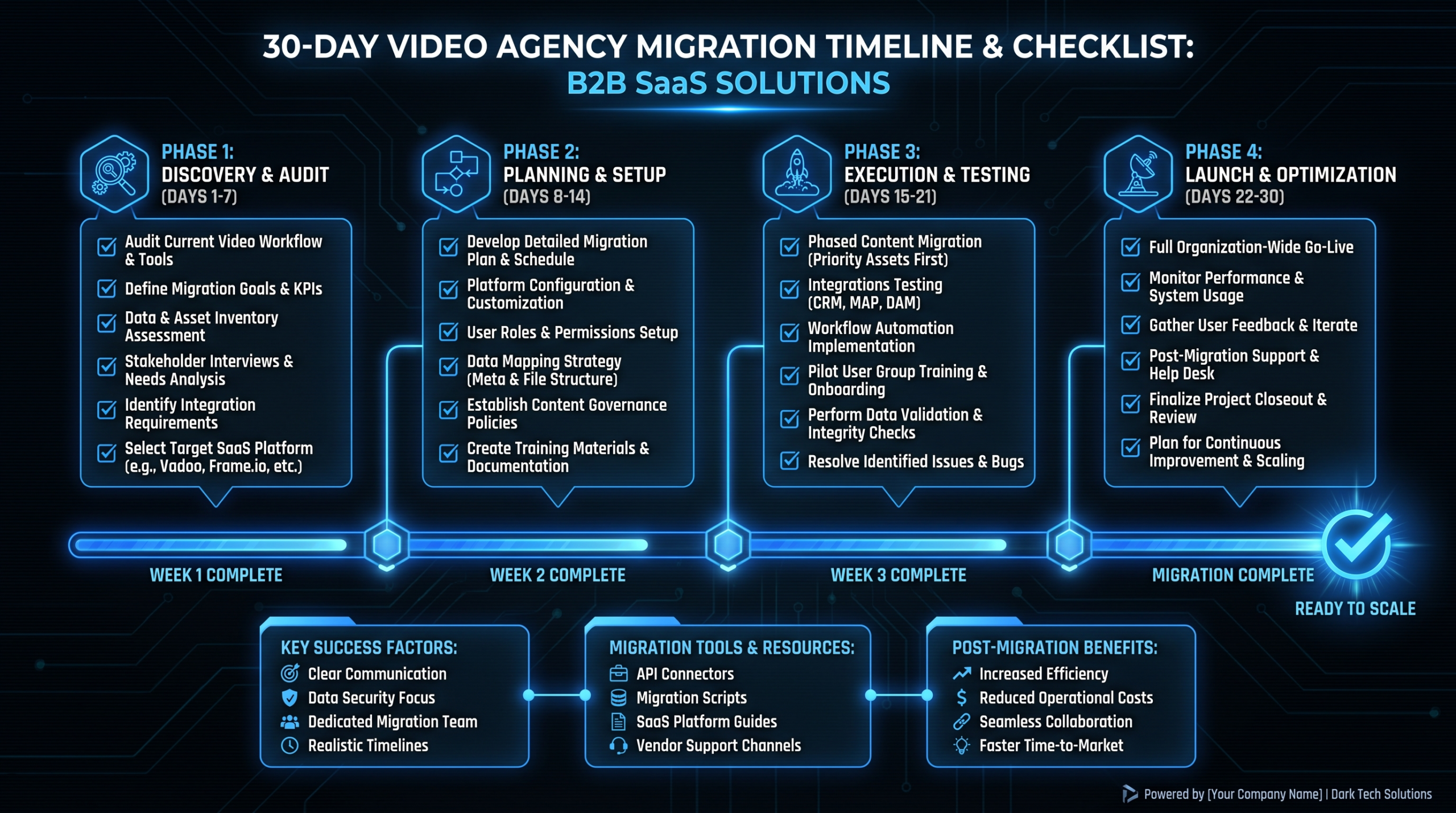
Here's the week-by-week breakdown. This assumes you've completed the pre-migration audit and have already selected your replacement agency before giving notice.
30-Day Migration: Week-by-Week Overview
| Week | Current Agency | New Agency | Your Team |
|---|---|---|---|
| Week 1 (Days 1-7) | Receives formal notice. Continues active projects in production. | Receives brand asset package. Completes intake and kickoff call. | Sends handover package. Briefs new agency on 2 starter projects. |
| Week 2 (Days 8-14) | Completing in-progress videos. Packaging all raw files and project files for delivery. | Produces first two videos - calibration pieces to align on style and quality. | Reviews calibration videos. Provides detailed feedback. Approves or iterates. |
| Week 3 (Days 15-21) | Final deliveries. Asset transfer complete. Account closed. | Takes on full production workload. Ramp-up to steady state volume. | Publishes Week 2 output. Monitors new agency quality closely. |
| Week 4 (Days 22-30) | Relationship closed. No open items. | Operating at normal capacity. Feedback loops established. | Reviews first full month of new agency output against benchmarks. |
Week 1 (Days 1-7): Give Notice and Start Parallel Onboarding
The most important principle of this week: give notice and begin onboarding your new agency on the same day. Most teams make the mistake of giving notice first, then scrambling to find a replacement. Do it in reverse - have your new agency selected, contracted, and briefed before you tell your current agency.
On day one, send your current agency a formal notice email confirming the end date (typically 30 days out per your contract). Simultaneously, send your new agency the brand asset package and schedule a kickoff call for that same week.
By end of week one, your new agency should have received all brand materials, completed their intake questionnaire, had a kickoff call with your team, and been briefed on their first two calibration projects. These calibration projects should be representative of your typical work - not your simplest pieces, but not your most complex either. You want to see how they handle a real brief under real conditions.
Week 2 (Days 8-14): Calibration and Parallel Production
This week is where both agencies are running simultaneously. Your current agency is completing their remaining projects. Your new agency is producing their first two pieces.
Treat the new agency's week 2 deliveries as calibration, not final output. Review them with the assumption that you'll need at least one revision round - not because the agency is bad, but because brand alignment always requires iteration. No agency nails your style on the first pass. What you're looking for is responsiveness to feedback, quality of their initial attempt, and how clearly they communicate during production.
By end of week two, you should have enough evidence to know whether you made the right hire. If the new agency's work is directionally right with easily fixable issues, you're in good shape. If it's fundamentally off-brand after detailed feedback, you have a problem that 30 days won't solve - and you'll need to make a harder call.
Week 3 (Days 15-21): Full Transition
Your current agency should deliver their final projects this week and package all assets for transfer. Follow up explicitly on:
- All original footage (exported or transferred via file share link)
- Project files (Premiere Pro, DaVinci Resolve, After Effects, or whatever they use)
- Motion graphics templates and any custom assets they built for you
- Any passwords or access credentials for accounts they manage on your behalf
Your new agency takes on the full production workload starting this week. They should have had two weeks of onboarding and calibration - they're not starting cold.
Week 4 (Days 22-30): Steady State and Retrospective
By week four, the transition should be functionally complete. Your new agency is handling your full content calendar, the old agency relationship is closed, and you're monitoring quality against the benchmarks you established in your pre-migration audit.
Schedule a week-four retrospective with your new agency's project manager. Cover: what's working, what needs adjustment in the feedback process, any gaps in the brand guidelines that have surfaced, and what the production schedule looks like for the next 60 days.
What to Hand Over (And How)
The quality of your handover package directly determines how quickly your new agency gets up to speed. Agencies that receive disorganized or incomplete handovers spend their first two weeks piecing together context that should have been delivered upfront. That's two weeks of your budget spent on logistics instead of production.
The Brand Handover Package
Beyond the assets listed in the audit section, your handover package should include a video brief document that covers:
- Audience context: Who watches your videos. Job titles, company sizes, what they care about. Include examples of audience language - how they describe their problems in their own words.
- Messaging framework: Your core value proposition, key differentiators, messages you're currently pushing in the market.
- Video type definitions: What you mean by "product demo" vs. "explainer" vs. "case study." These terms mean different things to different companies.
- Revision history examples: Screenshots or annotated frames from past revision rounds, showing what kinds of edits you typically request and what you're asking for when you say "tighten the pacing" or "make it feel more premium."
This last element - revision history examples - is underrated. It gives a new agency a window into your taste that no brand guideline document can replicate.
Style Reference Library
Compile a folder of 10-15 video examples that represent your target style. These should be a mix of:
- Your own best-performing videos (the gold standard for what you produce)
- Competitor or peer-company videos you admire (for aspirational reference)
- Videos that represent the energy, pacing, or aesthetic you want to move toward
Label each example with a one-sentence note: "We like the pacing here" or "We like the motion graphics, not the music choice." Context on why something is in the reference library is more useful than the reference itself.
Workflow and Communication Setup
Decide on your communication model before the first project brief goes out. Common options:
- Slack channel: Real-time communication, good for quick questions and approvals
- Project management tool (Asana, ClickUp, Monday): Better for tracking deliverables and deadlines
- Weekly status call: High-touch but higher time commitment
- Frame.io or Vimeo Review: Dedicated video review tools with timestamp comments - significantly reduces revision miscommunication
Most well-run video agencies will have their own production management system and will ask you to use it. That's fine - what matters is that your team has a single, clear channel for submitting briefs and reviewing work. Fragmented communication (some feedback via email, some via Slack, some in Zoom calls) is the leading cause of rework on video projects.
Protecting Brand Consistency During Migration
Brand consistency is the most cited concern when switching video agencies, and for good reason - your audience builds familiarity with your visual style over time. Inconsistent videos during a transition period can feel jarring, even if the quality of individual pieces is high.
The Style Calibration Session
Schedule a dedicated style calibration session in week two, separate from your regular production kickoff. This is a working session - not a presentation of deliverables - where you and your new agency watch your reference videos together and discuss specific elements:
- Color grading preferences (warmer, cooler, higher contrast, film-like vs. clean corporate)
- Pacing conventions (how long title cards stay on screen, how quickly scenes cut)
- Motion graphics style (minimal and typographic vs. dynamic and illustrated)
- Sound design preferences (music levels relative to voiceover, SFX usage)
- Text treatment (font weight, animation style, positioning conventions)
The goal of this session is to surface the unstated rules - the things you'd flag in a revision but have never formally documented. Every brand has them. Getting them out in a conversation is faster than discovering them one revision at a time.
Feedback Framework
Establish a feedback protocol on day one and stick to it. The teams that experience the most brand consistency problems during transitions are usually the ones who give feedback through multiple channels, from multiple stakeholders, without a clear hierarchy of whose input is final.
Designate a single point of contact on your team for video feedback. Their approval is the only approval that matters for releasing a video. Other stakeholders can contribute input through that person, but the agency communicates with one voice from your side. This eliminates the conflicting feedback problem that causes endless revision loops and erodes agency trust over time.
For practical guidance on structuring your feedback process, the overview of what's included in professional video editing services is a useful reference for aligning expectations before the first brief goes out.
Managing the Overlap Period
Running two agencies simultaneously for two weeks creates a short-term budget overlap. Here's how to think about it and minimize the cost.
Budget Considerations During the Transition
During weeks one and two, you're paying for your current agency's work in progress plus your new agency's onboarding and calibration projects. This overlap typically costs one to two additional weeks of production budget, depending on your current agency's contract terms.
Ways to reduce overlap cost:
- Time notice for a natural contract break point. If you're on a monthly retainer, give notice at the start of a billing cycle so you're not paying for a partial month twice.
- Minimize new work going to your current agency in the final two weeks. Focus them on completing in-progress pieces and packaging assets - not starting new projects.
- Brief calibration projects that will actually publish. Don't commission content from your new agency just to test them - give them real briefs for pieces you planned to produce anyway. This way the overlap budget produces publishable content.
Keeping Your Content Calendar Full
The content calendar gap risk is greatest in weeks three and four, when your old agency is wrapping up and your new agency is ramping to full capacity. Buffer against this by:
- Batching content ahead of the transition. If you know you're switching agencies, ask your current agency to produce 2-3 "evergreen" pieces in the month before your notice period that can publish during the transition window.
- Repurposing existing content. A well-performing webinar, product demo, or case study from 6-12 months ago can often be re-edited or re-cut into a new format - a lower-risk first project for your new agency while they calibrate.
- Adjusting publish cadence temporarily. A one-week gap in publishing is far less damaging than teams typically fear. Audience retention in B2B content is driven by quality consistency, not daily frequency - according to HubSpot's video marketing research, B2B audiences respond more strongly to quality than cadence.
How to Evaluate Replacement Agencies
The agency you choose determines how smooth the transition is. The right agency has documented onboarding processes, clear communication protocols, and experience with your type of content. The wrong agency - regardless of their portfolio quality - will extend your transition from 30 days to 90.
When evaluating candidates, understanding how a professional video production agency structures its workflow gives you a framework for assessing what questions to ask and what answers reveal actual operational maturity.
Agency Evaluation: Questions and What Good Answers Look Like
| Question to Ask | What a Strong Answer Looks Like | Red Flag Answer |
|---|---|---|
| How do you onboard a new client? | Documented intake process: brand questionnaire, style calibration session, first project review with structured feedback round. | "We just start with a brief and go from there." |
| Who is my dedicated point of contact? | Named project manager with direct contact info. Clear escalation path. | "We have a team inbox / support portal." |
| How do you handle revisions? | Defined revision rounds in contract. Clear scope of what counts as a revision vs. a scope change. | "We do unlimited revisions until you're happy." |
| Can I see examples from SaaS clients specifically? | Multiple examples of product demos, explainers, or customer story videos for software companies. | Only consumer brand examples or no examples in your vertical. |
| What's your turnaround time for a 3-minute product demo? | Specific timeline (e.g., "5-7 business days for first cut") with named factors that could extend it. | Vague answer or "it depends" without specifics. |
| What happens if my primary editor leaves? | Agency has documented brand profiles and backup editor processes. They describe the knowledge transfer protocol. | "That hasn't happened, we have low turnover." |
| Who owns the project files and raw assets? | Client owns all final assets. Project files transferred upon request. Clear data retention policy. | Ambiguous or "we keep files on our servers." |
Teams producing eight or more videos per month typically get better results with a dedicated SaaS video production partner than a generalist agency. The onboarding investment is higher, but the output consistency - which is what protects brand equity during and after a transition - is significantly better.
At VEC, for example, every client gets a dedicated editor pod (senior editor, project manager, and motion graphics support) that works on their account continuously. After the first 30 days, that team develops an understanding of your style that removes most of the feedback overhead that plagues generalist agency relationships.
Red Flags to Watch For
Not every agency that looks good in a pitch will perform in production. These signals - visible during the evaluation phase - predict difficult working relationships before you sign a contract.
Red Flags in the Proposal Stage
- Portfolio pieces without context. You want to see what brief they were working from and how the final product compares to the brief. Pretty videos don't tell you whether the agency can execute to your spec.
- Pricing that seems too good to be true. If an agency quotes 50% below every other proposal you received, they're either cutting corners somewhere or they're underquoting to win the business and will scope-creep you later.
- "We work with everyone" positioning. Agencies that claim expertise in every industry have expertise in none. You want a partner who has worked with B2B software companies specifically - ideally in your stage (Series A-C).
- No defined revision process. "Unlimited revisions" sounds customer-friendly but is usually a sign of an agency that hasn't defined their production process. Ambiguous revision terms lead to scope disputes.
Red Flags in the Onboarding Stage
- Slow intake response. If an agency takes more than 48 hours to respond to your brand questionnaire and kickoff request, that's their normal operating tempo. It won't improve once the relationship is established.
- Generic kickoff questions. Good agencies ask specific, smart questions during kickoff - about your audience, your existing performance data, your biggest pain points with the previous agency. Generic questions ("What's your budget?" "What's your timeline?") signal they don't have a real onboarding process.
- First deliverable is wildly off-brand. One significant miss is acceptable - it tells you where their calibration is wrong. But if first-round feedback results in a second deliverable that's still off-brand in the same ways, the agency isn't processing feedback properly. That's a structural problem, not a calibration one.
For a detailed view of what professional video editing services should include from day one, the guide to what's included in video editing services gives you a clear checklist to hold any agency accountable to.
When to Call It Early
If by the end of week two your new agency's calibration pieces show fundamental issues - not stylistic preferences but technical quality problems, missed deadlines, or unresponsive communication - you have a decision to make. Extending a trial with an agency that's already showing serious issues rarely results in a successful long-term relationship.
In that scenario, your options are: invoke your trial cancellation clause if you negotiated one (which you should, for the first 30 days), or have a direct conversation with the agency's leadership about what specifically isn't working. The clearest sign of a good agency is how they respond to that conversation - accountability and a concrete plan is a green light; defensiveness is a signal to exit.
After the Migration: Measuring Success
At the 60-day mark after your transition completes, run a formal comparison against the benchmarks you established in the pre-migration audit:
- Output volume: Are you publishing the same number of videos, more, or fewer?
- Production timeline: How does average turnaround time compare to your previous agency?
- Revision rounds: Are you averaging fewer revision cycles as the team develops brand familiarity?
- Audience engagement: How do watch time, completion rates, and conversion metrics compare?
- Team satisfaction: How much time is your internal team spending on video-related communication and review? This metric often tells more than the output metrics, because it captures the hidden overhead cost of a difficult agency relationship.
Most teams that plan their switch properly report one of two outcomes: either the new agency performs meaningfully better on most dimensions, or they perform similarly - which, combined with lower costs or better service, still represents a clear improvement. The rare case where teams regret switching is almost always a case where they chose the replacement agency too quickly, without testing, and without the evaluation framework above.
VEC's clients - SaaS marketing teams from Growth to Scale stage - typically see video output increase in the first 60 days post-migration not because they're producing more videos, but because fewer videos are getting stuck in extended revision cycles. When a dedicated team knows your brand, first-cut approval rates rise, and that recovered time compounds over months into a significantly higher output ceiling. You can explore plan details at the VEC pricing page.
Frequently Asked Questions
How long does switching video agencies actually take?
A well-planned transition takes 30 days from the date you give notice to the date your new agency is operating at full capacity. The 30-day window assumes you've already selected your replacement agency before giving notice. If you give notice and then start your search, add four to eight weeks to find, evaluate, and contract a replacement - bringing the total transition window to 10-12 weeks.
Will we lose brand consistency when we switch agencies?
Some inconsistency during the first 2-4 weeks of a new agency relationship is normal and manageable. The key is treating the first two deliverables as calibration pieces - you expect a revision round, and you use that feedback session to surface the unstated style rules that no brand guideline document captures. Teams that run a dedicated style calibration session in week two typically reach full brand consistency within 30 days of the transition completing.
What should I do with files and assets from my current agency?
Request all assets before your notice period ends, not after. Specifically: original footage (all takes, not just what was used), project files in their native format (Premiere Pro, Resolve, After Effects), exported motion graphics templates, any custom assets or elements built for your brand, and any stock footage or music licenses specific to your account. Get written confirmation from your current agency that these have been transferred. Agencies that are professional about offboarding will comply readily. Those that are difficult about it are telling you something important about why you were right to leave.
How do I manage my content calendar during the transition?
The most effective buffer strategy is to create a small stockpile of evergreen content in the month before your notice period begins. Two to three videos that can publish any time - product overviews, educational content, or repurposed webinar clips - give you scheduling flexibility during the transition window. Combined with the parallel production approach (running both agencies for two weeks), most teams find they don't need to skip a single scheduled publish date.
What questions should I ask a new video agency before signing?
The most revealing questions are operational, not creative: Who is my dedicated point of contact? What happens if that person leaves? What's your process when a first draft misses the brief? What specifically is included in a revision round vs. what counts as a new scope item? Who owns the project files? How do you onboard a new client in the first two weeks? Agencies with genuine operational maturity will answer these questions specifically. Agencies that are still figuring it out will give vague answers or redirect to their portfolio. For a fuller checklist, see our guide on how to outsource video editing effectively.
Ready to Switch? Let's Make the Transition Zero-Risk.
VEC's dedicated video editing teams are built for exactly this: taking over from an existing agency without disrupting your content calendar. We handle the onboarding, the style calibration, and the brand handover - and we guarantee double your video output in 90 days or month four is free.
Book a Free Strategy Call See How It Works See Pricing