Startup Demo Videos: $2K vs $20K, Side by Side
TL;DR — Key Takeaways
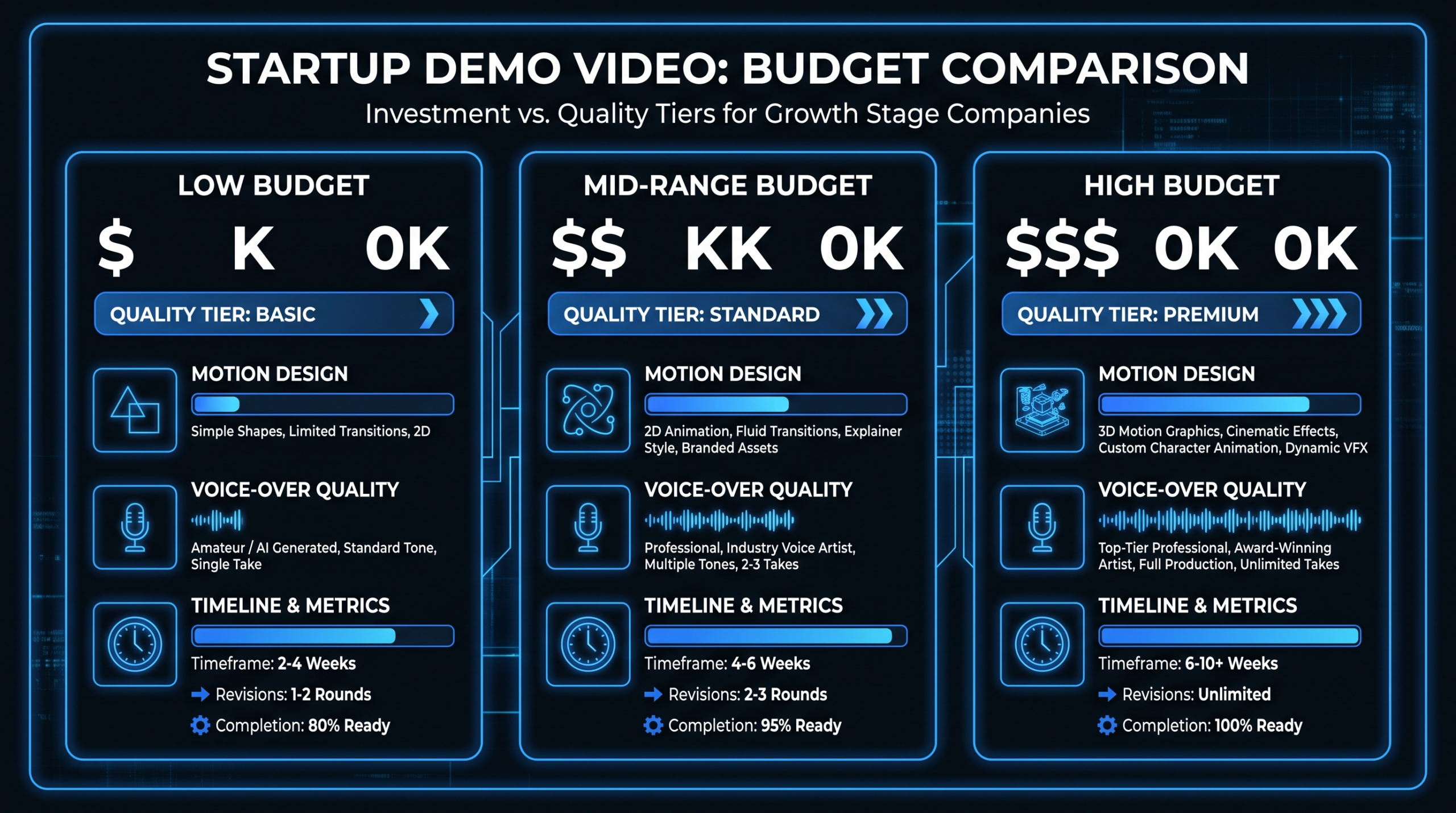
- $2K tier: Template motion, AI or stock VO, you provide the script, 1–2 revisions, 1–2 week delivery. Fast and functional.
- $8K tier: Custom branded motion, human VO talent, professional script with strategy session, 2–3 revisions, 3–4 weeks.
- $20K tier: Full production, custom 2D/light 3D animation, A-tier VO with director, 3–5+ revisions, 6–8 weeks.
- Go cheap when: you're pre-PMF, testing messaging angles, or need something live in 2 weeks.
- Invest up when: fundraising, enterprise sales cycles, or launching your primary hero video.
Table of Contents
The question isn't whether your startup needs a demo video. It does. The question is whether spending $2,000 versus $20,000 changes your conversion rate, closes enterprise deals, or helps you raise your next round — or whether the difference is mostly production vanity.
This guide cuts through agency sales pitches and gives you the real breakdown: what a startup demo video actually includes at each budget tier, where the money goes, when cheap is the right call, and when cutting corners is a quiet deal-killer. All ranges in this guide are hedged real-world observations — your specific quote will vary by vendor, complexity, and timeline.
One note upfront: this guide covers one-time project pricing for individual demo videos. If you need a consistent stream of demo videos, feature walkthroughs, and product content across your content program, ongoing production models deliver far better per-video economics — but that's a different conversation. If you're at that scale, see our guide on SaaS video production for growth-stage teams.
What Your Budget Actually Buys in a Startup Demo Video
The $2K–$20K range covers the realistic decision space for most startups producing a demo video in 2026. Below $2K, you're largely in DIY territory — screen recording tools, Descript, and a Fiverr editor. Above $20K, you're approaching brand film and broadcast production quality, which is relevant for $20M+ ARR companies or specific high-stakes campaign use cases.
Within the $2K–$20K window, the differences are not primarily about video length or resolution. They're about four variables that compound:
- Script depth — who writes it, how much strategic thinking goes in, how many drafts
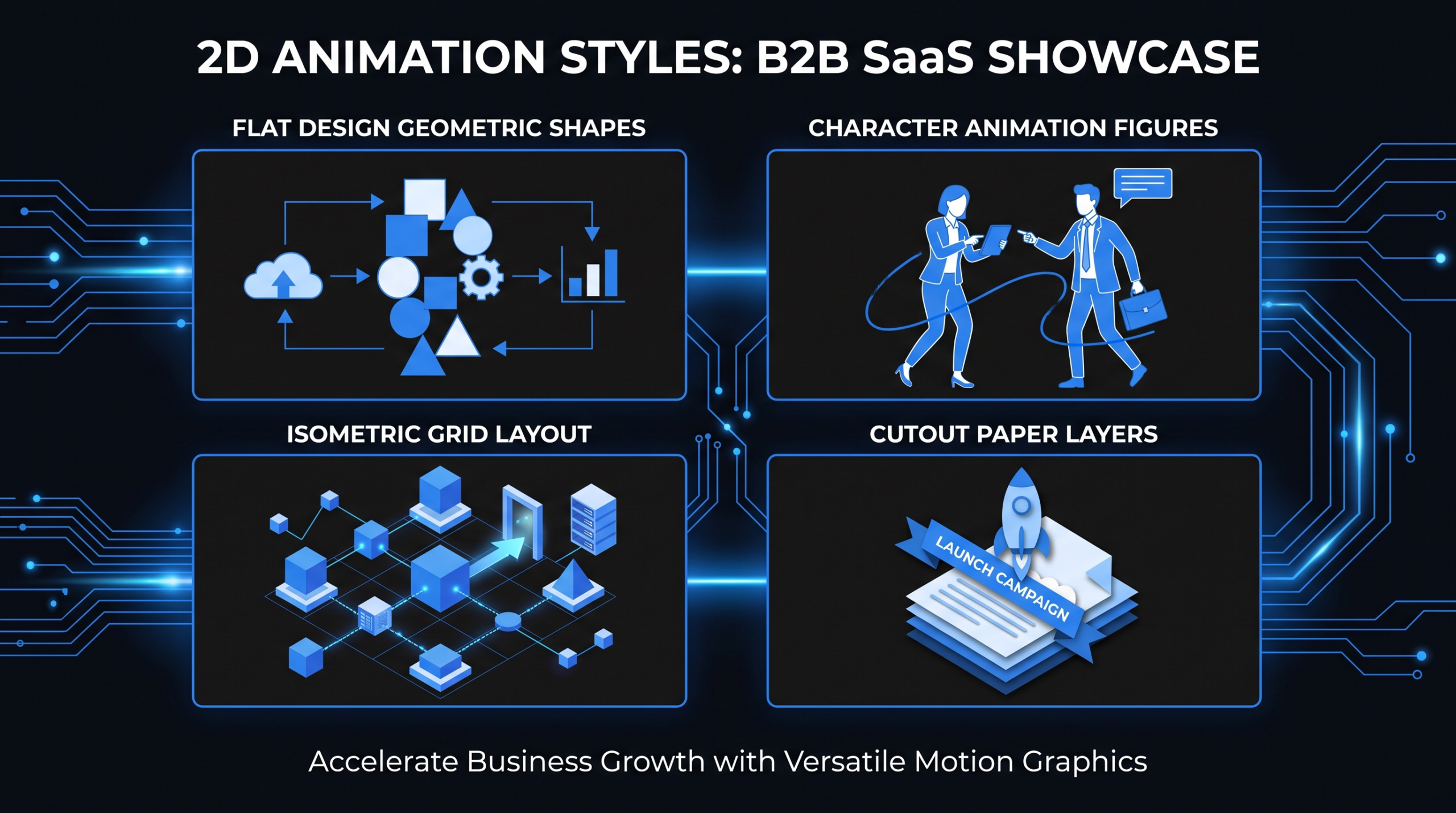
- Motion design quality — template vs. custom branded vs. bespoke 2D/3D
- Voice-over production value — AI/stock vs. human talent vs. A-tier with direction
- Revision bandwidth — how many rounds of feedback the project accommodates
Budget affects all four. The relative impact depends on your context. For a pre-PMF startup testing messaging with 200 prospects, script depth matters most. For a Series B company putting video in front of enterprise buyers, motion design and VO quality carry more weight. The framework in this guide helps you match the right investment to your actual need.
The $2K Startup Demo Video
The $2K tier is primarily the domain of freelance editors and budget-positioned agencies. You get a competent, watchable video — not a conversion asset engineered for performance, but a functional one that looks professional to most non-video audiences.
Script & Messaging Strategy
At $2K, you write the script yourself or receive minimal assistance — typically a 30-minute consultation call and a basic structural template: hook, problem, solution, CTA. Some vendors will "clean up" your talking points. More commonly, you brief the editor on your product and supply the words.
There is no messaging strategy session, no ICP analysis, no copy testing. If your value proposition is unclear or positioned wrong, the video faithfully reproduces that confusion. This is one of the less-discussed reasons budget demo videos underperform even when the production itself is clean — the script is the product, and at $2K, the script is usually an afterthought.
Motion Design
Expect template-based motion design: pre-built lower-thirds, kinetic title animations, and transitions from libraries like Envato Elements or Motion Array. The vendor applies your brand colors and logo but doesn't build custom UI animations or product walkthrough sequences from scratch.
For SaaS demos specifically, this typically means a screen recording of your product with kinetic text overlays and a few stock motion elements. If your UI is clean and modern, this can look reasonably polished. If your product has complex workflows or needs visual simplification to communicate value, template motion will struggle.
Voice-Over Quality
The $2K budget tier commonly offers two VO paths: AI voice (tools like ElevenLabs or Murf, which produce genuinely useful output at mid-tier quality in 2026) or a stock library voice-over from a platform like Voices.com. Some vendors use the founder's voice if you record it yourself with basic cleanup.
AI VO at this tier is workable for internal demos, sales enablement content, and pre-PMF message testing. It reads as "AI voice" to a trained ear — in some contexts that signals scrappy efficiency, in others (investor decks, enterprise sales) it subtly undermines credibility. Know your context before choosing.
Revisions & Timeline
Typical at $2K: 1–2 revision rounds. The first version you see is usually close to final. There's no deep feedback loop — it's more "change this text, adjust this transition" than "rethink the second-act structure." Most revisions are textual and cosmetic.
Timeline is fast: 7–14 days from brief to final delivery. This is the tier's primary advantage over pricier options. When you need something live before a product hunt launch, a conference, or an investor meeting next Tuesday, two weeks matters enormously.
Real Output at $2K
A $2K startup demo video, well-briefed, produces: a 60–90 second screencast-style video with template motion, readable typography, AI or stock VO, and clean transitions. It passes a sanity check on your website and looks professional to most non-video audiences. It will not stop scroll on LinkedIn, win any creative awards, or perform well in high-stakes sales contexts — but it doesn't need to. At the right stage, that's exactly enough.
The $8K Startup Demo Video
The $8K tier is where most seed-to-Series-A SaaS companies land for their primary demo video. You get genuine creative investment, a professional script built around your ICP, and a video designed to convert — not just inform.
Script & Messaging Strategy
At $8K, a professional copywriter or strategist-copywriter conducts a 30–60 minute strategy session before a word is written. The output is a structured script built around your specific ideal customer profile: their pain, the status quo failure, your differentiating solution, and a clear CTA calibrated to your funnel position.
Most vendors at this tier include 1–2 script revision rounds before production starts. This matters more than it sounds — fixing the script before motion design begins costs almost nothing; reworking the narrative after animation is in progress is expensive and slow.
Motion Design
Custom branded motion design: your color system applied consistently across all elements, animated product UI overlays built specifically for your interface, custom transition elements, and icon animation that reinforces the narrative. The visual language feels like your product, not a template lifted from a stock library.
For SaaS demos, this typically means animated UI walkthrough sequences — screen recordings cleaned up and enhanced with callout animations, zoom sequences on key features, and simplified flow graphics that make complex workflows visually legible. This is where $8K separates itself from $2K most visibly, and where the conversion impact is most direct.
Voice-Over Quality
Human VO talent sourced through a light casting process — typically 3–5 auditions for the client to choose from. The voice is selected to match your brand tone: warm and approachable, authoritative and enterprise, or punchy and direct. Some vendors at this tier include a short direction session where the talent does 2–3 line reads at different pacing so you can hear the options.
Revisions & Timeline
2–3 revision rounds with genuine feedback cycles structured into the process. The first review is usually a rough cut — motion in place but before color grade, final audio, or sound design. You provide feedback, they refine to a polished cut, you review again, then final. There's real back-and-forth by design.
Timeline: 3–4 weeks from kickoff to delivery, including script development. If you're working to a hard deadline, most vendors can compress to 2 weeks with a rush fee — typically 20–35% on top of the base rate.
Real Output at $8K
A 90–120 second demo video with a professional script, custom motion design, human VO, and 2–3 refinement cycles. Strong enough for your website homepage, investor updates, sales outreach sequences, and mid-funnel nurture content. Most growth-stage SaaS companies use a video at this quality level as their primary product demo for 12–18 months before refreshing.
The $20K Startup Demo Video
The $20K tier is a different category of work. You're not just buying better production — you're buying strategic depth, creative direction, and a video specifically engineered to perform in high-stakes contexts: Series A or B fundraising, enterprise sales cycles, major product launches at scale.
Script & Messaging Strategy
A half-day (or multi-session) messaging workshop with a senior strategist. Competitive positioning analysis. Sometimes ICP interviews or customer research reviews before the script is written. Multiple script drafts with substantive creative discussion and iteration. At $20K, the script is a persuasion architecture, not a brief translated into words.
Some agencies at this tier develop 2–3 different script angles — different hooks, different structural approaches — and help you choose before committing to production. This is rare in the $2K–$8K range and common in the $15K+ range.
Motion Design
Custom 2D or light 3D animation built from scratch, with a fully developed visual language specific to this production: custom illustration style, animated brand elements, bespoke transitions, and typographic sequences designed to hold attention at specific moments. Some $20K productions incorporate short live-action segments — a founder on camera for 10 seconds transitioning to an animated walkthrough, for example.
The visual quality gap between $8K and $20K motion is significant but situationally relevant. In a board presentation, enterprise RFP response, or a product launch with $100K+ in paid media behind it, the difference matters. On a LinkedIn ad where you have 3 seconds to stop scroll, the script hook matters more than the 3D polish.
Voice-Over Quality
A-tier VO talent — the caliber of voices used in TV advertising and major SaaS brand campaigns. A full recording session with a creative director on the call. Multiple takes per line, multiple reads per passage. Some $20K productions cast 2–3 voice styles and test with the sales team before locking. Professional studio recording (not home studio), professional audio mixing and mastering, and custom sound design built specifically for the video rather than stock audio layers applied.
Revisions & Timeline
3–5+ formal revision rounds with a structured collaborative process. Most agencies at this tier use a video review platform — Frame.io or similar — with timestamped comments so feedback is precise and nothing gets lost in email chains. The creative director is an active collaborator throughout, not just a deliverer of cut versions.
Timeline: 6–8 weeks minimum from strategy to final delivery. Productions incorporating live action or complex 3D motion can run 10–12 weeks. Rush premiums at this tier are substantial — if you genuinely need $20K-quality work in 3 weeks, the real cost is often $30K+.
Real Output at $20K
A 90–180 second video with broadcast-level production quality, a strategically engineered and tested script, custom animation or mixed-media production, A-tier VO with professional sound design, and multiple format variations (16:9, 9:16, 1:1, 30-second cutdowns). Designed to work in your most demanding use cases and to remain your primary demo asset for 24–36 months.
Side-by-Side Comparison Table
Here's how all three tiers map across every dimension that affects quality, suitability, and expected output:
$2K vs $8K vs $20K — Startup Demo Video Comparison
| Dimension | $2K Tier | $8K Tier | $20K Tier |
|---|---|---|---|
| Video length | 60–90 sec | 90–120 sec | 90–180 sec |
| Script | You provide / template assist | Pro copywriter + strategy session | Messaging workshop + multi-draft |
| Motion design | Template-based, brand colors applied | Custom branded, animated UI overlays | Custom 2D/light 3D, bespoke visual language |
| Voice-over | AI voice or stock library | Human talent, cast from auditions | A-tier talent + director session |
| Revisions | 1–2 rounds | 2–3 rounds | 3–5+ rounds |
| Timeline | 1–2 weeks | 3–4 weeks | 6–8 weeks |
| Formats included | Usually 1 (16:9) | Usually 2–3 (16:9, 9:16, 1:1) | 3–5+ (all ratios + cut-downs) |
| Sound design | Stock music | Stock music + basic SFX | Custom mix + professional mastering |
| Strategic input | None | 30–60 min strategy session | Half-day+ messaging workshop |
| Best for | Pre-PMF, message testing, internal | Growth stage, website, mid-funnel | Fundraising, enterprise sales, launches |
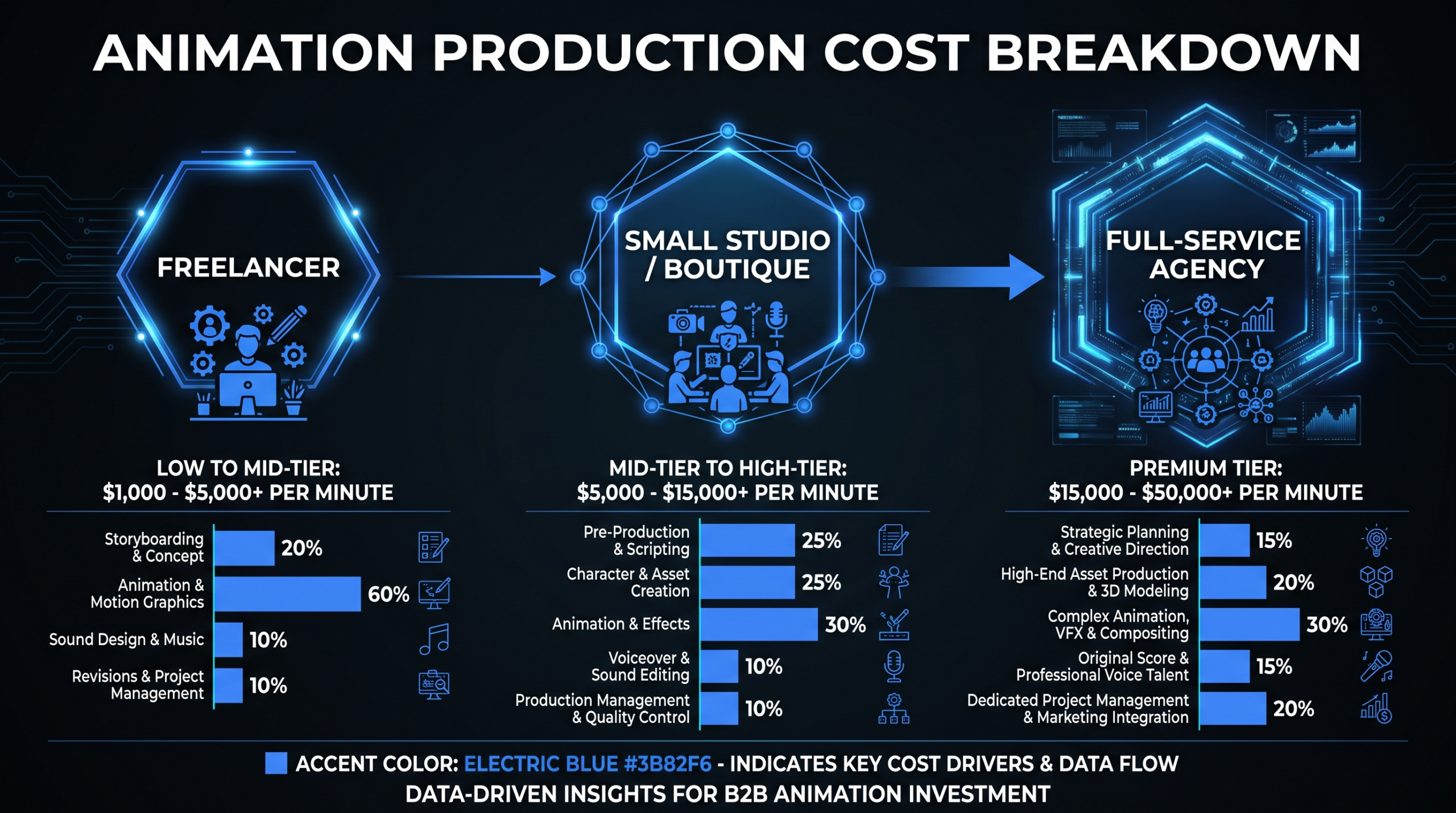
The production cost breakdown follows a predictable logic: at $2K, you're paying for editor time only. At $8K, you're paying for editor time plus strategy, VO casting, and custom asset creation. At $20K, you're paying for all of that plus a creative director, senior VO session, and significant pre-production. For a granular look at where video production costs go, our explainer video cost breakdown covers the line items in detail.
When Cheap Is the Smart Call
The $2K demo video gets unfairly maligned by people who conflate production quality with strategic value. There are real, legitimate scenarios where the cheap tier is the correct choice — and where spending more would be wasteful or actively counterproductive.
Pre-Product-Market Fit
If you haven't locked your ICP, value proposition, or core messaging, a $20K video is a trap. You'll spend 6–8 weeks in production on a beautiful video about the wrong thing. By the time it's delivered, the messaging it was built around has evolved — and you're committed to running it anyway because the sunk cost is real.
At pre-PMF, what you need is speed and iteration, not polish. A $2K video you can reshoot or re-script in 2 weeks is worth more than a $20K video you're psychologically committed to for 6 months. Make it good enough to test. Don't make it good enough to frame.
A/B Testing Messaging Angles
If you're deliberately testing 3–4 different value proposition angles — efficiency vs. cost savings vs. risk reduction vs. competitive displacement, for example — you can produce 3–4 videos at the $2K tier for the price of one $8K video. Use the conversion data from live testing to inform your next production investment. This is smart resource allocation, not corner-cutting. You're buying signal before buying polish.
Internal Sales Enablement
Demo videos for SDR training, internal onboarding, or champion education don't need to be board-presentation-ready. If your sales rep is dropping a quick product walkthrough into a Slack message to a champion contact, a $2K video is more than adequate. Reserve the production budget for assets that go in front of decision-makers and buyers.
Speed Constraints
Sometimes you have 10 days before a conference, investor meeting, or product hunt launch. No production process at any budget can deliver $8K quality in that window without a heavy rush premium — and even with the premium, the timeline is tight. At genuine time pressure, a clean $2K video delivered on time beats a polished $10K video delivered the week after the moment has passed.
Pre-Seed Capital Allocation
At pre-seed, every dollar is product capital. Spending $20K on a demo video before you've shipped v1, hired your first sales rep, or validated a pricing page is almost always the wrong allocation. "Good enough to show early customers" is stage-appropriate judgment, not a failure of ambition.
When Budget Video Backfires
The honest flip side: there are contexts where a $2K video is a quiet deal-killer, and founders often don't realize it until after the fact — because no one tells you the demo video was the problem.
Fundraising Conversations at Series A+
Investors at Series A and beyond review hundreds of pitches per month. A template-motion demo video with an AI voice-over signals "we didn't invest in our go-to-market presentation." This isn't fatal on its own, but it compounds. Your deck is polished, your team is strong, your traction is real — and then the demo video breaks the spell. Budget production in fundraising contexts is the equivalent of a Canva pitch deck in a meeting where everyone else has custom design work.
According to Wistia's video business research, video assets are increasingly part of how investors and enterprise buyers assess company maturity and go-to-market sophistication. Production quality is a signal, even when it shouldn't be.
Enterprise Sales Cycles
Procurement teams and buying committees in enterprise sales are pattern-matching for vendor maturity. A $2K demo video communicates "small shop" in a context where you're trying to communicate "enterprise-ready vendor." The video may never be the stated reason a deal stalled or a RFP response scored lower — but it contributes to a perception problem that's genuinely hard to diagnose and harder to fix.
If your ACV is $50K+ and you're selling to procurement-led buying groups, the $18K difference between $2K and $20K production is recoverable in less than one deal. The question is whether better production increases close rate enough to pay back. In enterprise cycles, the evidence from teams tracking this closely says yes — though the effect is difficult to isolate from everything else in the cycle.
Primary Website Hero Video
Your homepage demo video is the highest-traffic content asset you have. It compounds over the 12–24 months it lives on the page. A $2K video on the homepage means every visitor forms their first impression of product quality through a template-motion lens. Unlike a fundraising video you swap after a round closes, this one stays live for over a year. The compounding effect of a 1–2% improvement in homepage video engagement over 18 months is worth far more than the production cost differential.
Product Launches With Paid Distribution
If you're driving $50K+ in paid media to a launch video, production quality affects conversion rate. Even a modest improvement in click-through or watch-through from more polished creative can more than justify the incremental production cost. For paid distribution at scale, optimizing the creative asset is almost always a better ROI than optimizing the media buy — because the media buy amplifies whatever conversion rate the creative establishes.
Competitive Markets With High-Quality Bars
If your top 3 competitors all have custom-animated, professionally voiced demo videos, a $2K screencast will look like a product that can't compete on quality. In categories where products are genuinely similar, production quality becomes a proxy signal for product quality. It shouldn't be that way — but it is, and your enterprise buyers are making the association whether they acknowledge it or not.
Budget-Stage Decision Framework
Here's a practical framework for matching your production investment to your stage and use case. The goal is to invest the minimum necessary to achieve your actual outcome — not to always maximize production quality, and not to default to cheap out of habit.
Startup Demo Video Budget by Stage & Use Case
| Stage / Use Case | Recommended Budget | Reasoning |
|---|---|---|
| Pre-seed / Pre-PMF | $1.5K–$3K | Messaging will change. Speed and iteration trump polish. |
| Seed (PMF found, ICP locked) | $5K–$10K | First durable demo asset. Invest in script + custom motion. |
| Series A — website hero video | $8K–$15K | Driving significant traffic. Conversion lift compounds for 18+ months. |
| Series A — fundraising deck video | $10K–$20K | Investor perception. A-tier polish matches an A-tier funding ask. |
| Series B+ — enterprise sales asset | $15K–$30K+ | Enterprise buyers use production quality as a vendor maturity proxy. |
| Internal enablement / SDR tools | $1.5K–$4K | Not customer-facing at a high-stakes moment. Functional beats polished. |
| Message-testing / A/B variants | $1.5K–$3K each | Buy volume to learn. Optimize before committing to high-production. |
| Product launch with paid distribution | $8K–$20K | Media cost justifies creative investment. Quality affects conversion at scale. |
A useful heuristic that holds across most contexts: your video production budget should be roughly 10–20% of what you plan to spend distributing it. Spending $100K on paid media around a launch? $10K–$20K on production is rational. Sending it to 50 outbound prospects? $2K is appropriate. The distribution math tells you what the creative is worth.
For startups moving from one-off projects to an ongoing video program — demo videos, feature launches, onboarding content, sales enablement assets — the economics shift dramatically. Teams like VEC's dedicated SaaS video pods operate on a flat monthly retainer ($5K–$16K/mo depending on output volume), which reduces effective per-video cost by 40–60% compared to commissioning individual projects while maintaining brand consistency across the entire library.
"The cheapest demo video is the one you have to reshoot in 6 months because the messaging changed. The most expensive is the polished $20K video you commissioned before you knew who you were selling to."
Who Delivers Each Tier — Startup Demo Video Vendors
The startup demo video market spans several distinct vendor categories, each with different cost structures, process depth, and fit for specific company stages. Here's how they map to the budget tiers in this guide.
Startup Demo Video Production — Vendor Comparison
| Provider | Sweet Spot | Format | Notable For |
|---|---|---|---|
| VEC (videoeditingcompany.com) | $5K–$16K/mo retainer | Dedicated SaaS video team (senior editor + PM) | SaaS-only focus, 90-day double-output guarantee, fastest brand ramp-up; cons: retainer model, not single-project |
| Increditors (increditors.com) | ~$2.5K–$12K+/mo | Full-service pods (Sr. editor + Jr. editor + PM + CD) | YouTube + SaaS specialization, creative direction included, strong channel growth track record; cons: custom-quote pricing (no instant tiers), not SaaS-exclusive |
| Lemonlight | $3K–$15K/project | B2B video agency | Quick turnaround, established production process; cons: templated creative approach at lower tiers |
| Demo Duck | $8K–$25K/project | SaaS explainer + demo specialist | Narrative-led demo and explainer videos; cons: premium pricing, longer timelines |
| Upwork / Toptal Freelancers | $500–$5K/project | Individual editors or small teams | Budget builds, fast iteration at pre-PMF; cons: quality variance, no strategic layer, coordination overhead |
A few notes on matching vendor type to stage:
Pre-seed: A skilled Upwork or Toptal freelancer operating in the $1.5K–$4K range is typically the right fit. You don't need the overhead or minimum commitments of a full-service agency — you need someone who can take a brief and execute fast. Vet for their SaaS portfolio specifically; general video editors often struggle with product UI walkthroughs.
Seed to Series A: Look for vendors who bring strategic input alongside execution. The script and messaging work that comes with the $8K+ tier is often more valuable than the motion design upgrade. Ask vendors what their script development process looks like — if the answer is "we'll take your script and refine it," you're buying $2K-tier creative work at $8K-tier pricing.
Series A+ ongoing: For growth-stage teams producing multiple demo videos, feature walkthroughs, and product updates per quarter, the per-project model creates compounding overhead: scoping, briefing, contracting, reviewing — every cycle, for every video. According to Wyzowl's video marketing research, companies running consistent video programs report significantly higher per-video engagement than those producing content ad hoc, partly because of the brand consistency that comes from an ongoing team relationship.
Frequently Asked Questions
What's the minimum budget for a professional-looking startup demo video?
Realistically, $1,500–$2,500 produces a clean, professional-looking video if your product UI is polished and you provide a solid script. Below $1,000, most vendors are limited to basic screen recordings with minimal production enhancement. "Professional-looking" is also context-dependent — $2K looks credible on an inbound landing page, less so as the centerpiece of a $5M seed deck presentation.
Can I get a decent startup demo video for under $2K?
Yes, with specific constraints. If your product has a clean, modern UI, you can produce a compelling screen-recording-style demo for $800–$1,500 using a skilled freelancer from Upwork or Toptal. You'll need to provide the script, handle your own VO (or use AI voice), and accept template-based motion design. The gap between sub-$2K and the $2K tier is mainly revision bandwidth, project management quality, and motion polish.
How long should a startup demo video be?
For a primary website demo video, 90–120 seconds is the current best-practice range for SaaS products. Under 60 seconds, you can't adequately cover problem, solution, and CTA. Over 2 minutes, most visitors drop off before the payoff. For investor decks, 60–90 seconds performs best — investors who want more will rewatch. For sales outreach and LinkedIn, 45–60 seconds. For a comprehensive breakdown by use case and funnel position, see our product demo video production guide.
Should I write the script myself or pay for a scriptwriter?
If your messaging is locked and you know your ICP deeply, writing it yourself often produces better output than a copywriter who doesn't know your product. The key is structure: problem, consequence, solution, proof, CTA. Where professional scriptwriters earn their fee is in pacing, word economy, and the persuasion architecture that makes a viewer feel something — not in product knowledge. At the $8K+ tier, a strategy-plus-script session is usually worth it. At $2K, a well-structured DIY script outperforms a rushed agency draft every time.
How many demo video assets should a Series A startup have?
A minimum viable video library for Series A SaaS typically includes: a homepage hero video (90–120 sec), one use-case-specific demo per key ICP segment (60–90 sec each), and a short product overview for outbound and SDR use (45–60 sec). This is usually 4–6 videos total. Building this as separate per-project commissions can run $30K–$60K; building it under a monthly production retainer reduces that cost by 40–60% and produces better brand consistency across the library. For more on structuring a SaaS video program, see our SaaS video production guide.
Know Your Stage. Spend Accordingly.
Whether you need one high-impact demo video or a full content library built for growth, the right production investment depends on your stage, your buyer, and how you plan to distribute it. VEC works with SaaS companies from seed to Series C to build video programs matched to their actual growth needs — not just one-off projects.
Book a Free Strategy Call See VEC Plans & Pricing