Sales Enablement Video Cost: 2026 Guide
TL;DR
- Sales enablement video cost typically ranges from $500 for a simple recorded demo to $15,000+ for a polished animated explainer or customer story.
- The largest cost driver is production format: screen-recorded walkthroughs are cheapest, live-action and animation cost the most.
- For teams producing 4–10 SE videos per month, a dedicated editing retainer ($5K–$16K/mo) consistently delivers lower per-video cost and faster turnaround than project-by-project hiring.
- DIY tools can cut upfront spend, but internal time cost is frequently underestimated — an AE recording and self-editing a 5-minute demo can consume 4–8 hours of selling time.
- The highest-ROI SE videos are competitive battlecard videos and product demo walkthroughs: they directly shorten deal cycles and are relatively inexpensive to produce.
Table of Contents
What Is a Sales Enablement Video?
A sales enablement video is any video asset that helps your sales team close deals faster. The category is broad by design — it includes product demos, competitive battlecard walkthroughs, objection-handling clips, customer testimonials, pricing explainers, and onboarding handoff videos. What they share is a common job: move a prospect from consideration to decision more efficiently than a PDF or a live call alone.
Cost matters here because sales enablement video sits at the intersection of two budgets — marketing production and sales productivity — and teams often underestimate both the total spend and the return. A sales leader who thinks they're saving money by having AEs self-record Loom videos may be burning $800 in selling time per video. A marketing team that outsources every clip to a full-service studio may be overpaying by 3x for assets that don't need broadcast polish.
This guide gives you the real market ranges for 2026, the cost levers you can actually control, and the math to build a defensible SE video budget. For a deeper look at the strategic side, see our sales enablement videos guide.
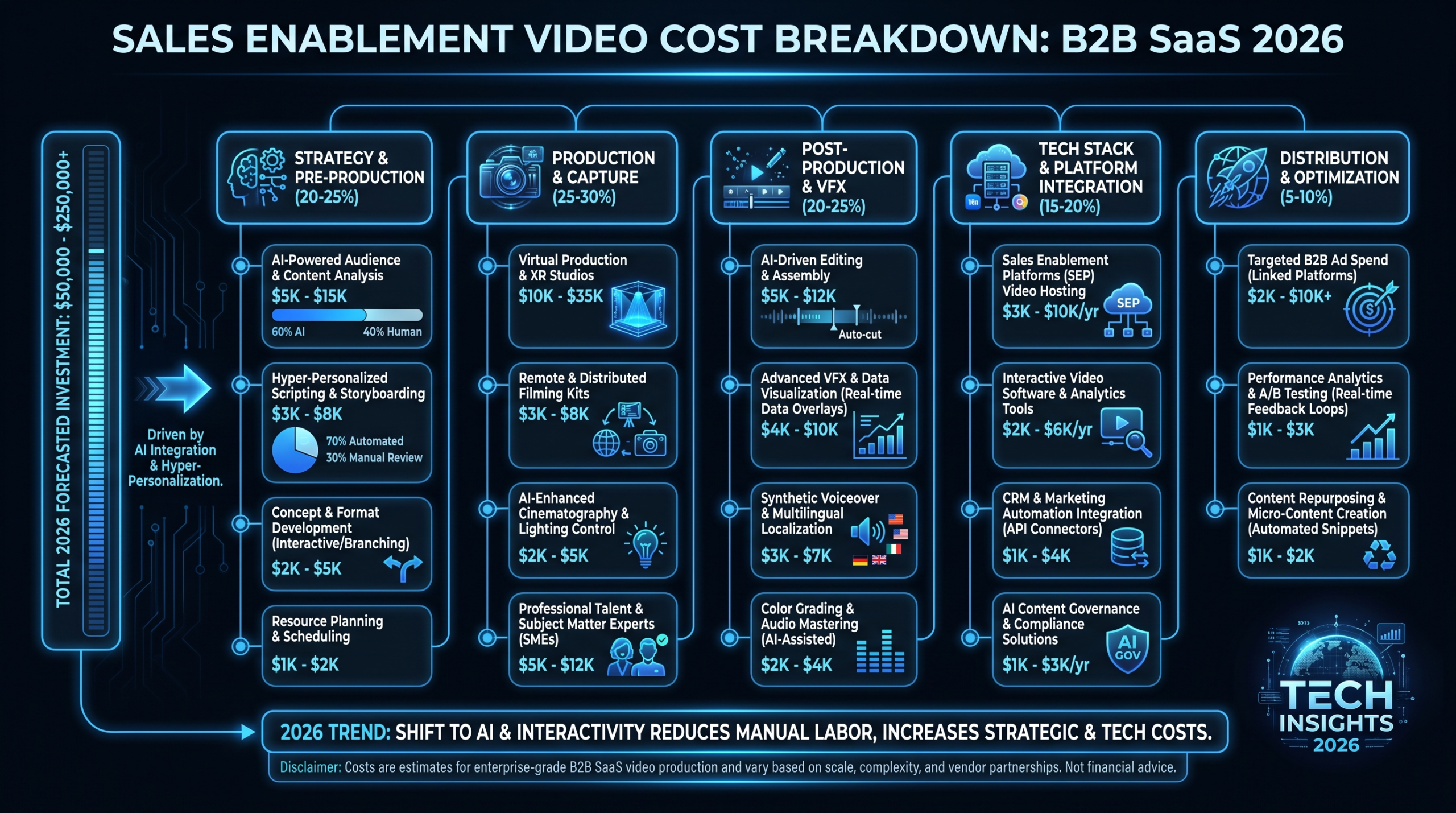
Sales Enablement Video Cost by Type
SE video cost varies more by format than by length. A 90-second animated explainer costs more than a 10-minute screen-recorded walkthrough — because animation requires a full production pipeline (script, storyboard, voiceover, animation, sound design), while a screen recording needs only editing and light motion graphics.
Here are the typical market ranges for each SE video format in 2026, based on what B2B SaaS teams commonly pay across freelancer marketplaces, boutique agencies, and dedicated editing services:
Sales Enablement Video Cost by Format
| Video Type | Typical Length | Market Range (Per Video) | Best Suited For |
|---|---|---|---|
| Screen-recorded demo (DIY edit) | 3–10 min | $0–$500 (tool cost only) | Low-stakes prospecting, SDR sequences |
| Screen-recorded demo (professionally edited) | 3–10 min | $500–$1,800 | Mid-funnel product walkthroughs |
| Talking-head or webcam sales message | 1–3 min | $300–$1,200 | Personalized outreach, follow-up |
| Competitive battlecard video | 2–5 min | $1,000–$4,000 | Late-stage deal support |
| Live-action product demo | 2–6 min | $2,000–$8,000 | Website, mid-funnel nurture |
| Customer testimonial / case study video | 2–4 min | $2,500–$10,000 | Social proof, proposal support |
| Animated explainer (2D) | 60–120 sec | $3,500–$15,000 | Complex product concepts, top-of-funnel |
| Pricing / packaging overview video | 2–4 min | $1,500–$5,000 | Pre-close, pricing page |
| Objection-handling series (4–6 clips) | 1–3 min each | $3,000–$12,000 (set) | Sales coaching, deal acceleration |
The ranges are wide because production quality, revision depth, and team structure vary significantly. A "professionally edited product demo" from a mid-level freelancer on Upwork and one from a dedicated video editing agency may land at very different price points — and deliver very different outputs in terms of pacing, branding consistency, and motion graphic polish.
For a broader view of how these numbers fit into your overall content budget, see our video production cost breakdown.
What Drives the Cost?
Five factors account for most of the variance in sales enablement video cost. Understanding them lets you make deliberate trade-offs rather than just accepting a quote.
1. Production Format
Format is the single biggest cost driver. Animation commands a premium because every frame is created from scratch — concept, script, voiceover casting, storyboard, animation, sound, revisions. Live-action with a film crew adds location, equipment, and talent costs. Screen recordings are cheap to capture but need editing to be useful. Most B2B SaaS teams get the best ROI from a mix: screen-recorded demos for volume, live-action or animation for flagship assets.
2. Production Team
DIY (an AE records and self-edits) has the lowest cash cost but the highest hidden cost — selling time. A freelancer is the next rung: faster, more polished, but variable quality and no brand familiarity. A dedicated editing service or agency adds consistency, a project manager, and faster iteration cycles, at a higher monthly spend but a lower effective per-video cost when volume is steady.
3. Script and Concept
Script development adds $500–$2,500 per video at the agency level. Many teams skip this for product demos (the AE narrates from experience) but invest in it for animated explainers and customer stories. If you provide a script, you typically save 15–25% on agency quotes.
4. Revision Rounds
Standard agency engagements include 2–3 revision rounds. Revisions beyond that are typically billed at $100–$350/round for editing-only work, higher for animation. Teams that provide clear feedback in a single round commonly save 20–30% on project-based engagements — and get faster turnaround.
5. Volume and Cadence
This is where smart procurement beats clever negotiation. A team producing 8 SE videos/month on a retainer typically pays 25–40% less per video than the same team commissioning 8 individual projects. Volume also builds editor familiarity — after 2–3 months, an assigned editor knows your product, terminology, and visual style, which cuts briefing time and revision rounds.
DIY vs. Freelancer vs. Agency: Cost Comparison
The right production model depends on your volume, quality bar, and how much internal time you can afford to spend. Here's an honest comparison for a team producing 6 sales enablement videos per month:
Monthly Cost Comparison: 6 SE Videos/Month
| Model | Cash Cost | Internal Time Cost | Quality Consistency | Effective Cost/Video |
|---|---|---|---|---|
| DIY (AE self-records + edits) | $50–$150/mo (tools) | ~24–36 hrs/mo (4–6 hr/video) | Low — inconsistent style and pacing | ~$1,200–$2,400 (at $50/hr AE rate) |
| Freelancer (Upwork/Fiverr) | $1,800–$5,400/mo ($300–$900/video) | ~6–10 hrs/mo (briefing, feedback, QA) | Medium — varies by freelancer | $300–$900/video (plus internal overhead) |
| Boutique video agency (project-based) | $6,000–$18,000/mo | ~8–12 hrs/mo | High — professional but no brand memory | $1,000–$3,000/video |
| Dedicated editing retainer | $5,000–$9,500/mo | ~4–6 hrs/mo (streamlined after onboarding) | High + brand-consistent | $835–$1,580/video |
The DIY model looks cheapest on paper but rarely is. When you account for an account executive's fully-loaded hourly cost, 4–6 hours of self-editing per video is a significant revenue opportunity cost. Sales teams that shift video production to a dedicated editing service commonly report freeing up 15–20 hours per month of AE time — time that goes back into pipeline.
If you're running SaaS video production at any real volume, the math tends to favor a retainer model over a freelancer pool once you're past 4 videos/month.
Where VEC Fits
Video Editing Company's Growth plan ($5K/mo), Core plan ($9.5K/mo), and Scale plan ($16K/mo) are structured as dedicated team retainers — a senior editor, junior editor, and PM assigned to your account. At Growth-tier volume, teams typically produce 8–12 SE videos per month, bringing effective cost per video to roughly $420–$625. See the full breakdown on the VEC pricing page.
How Much Do B2B SaaS Teams Typically Budget?
SE video budget varies significantly by company stage, sales motion, and how central video is to the revenue strategy. Here are the patterns that commonly emerge across Series A, B, and C SaaS companies:
Series A (10–30 AEs, early GTM)
Teams at this stage typically start with minimal SE video infrastructure — a handful of screen-recorded demos, maybe one animated explainer for the website. Monthly video spend commonly falls in the $2,000–$5,000 range, often through a mix of freelancer projects and self-recording. The priority is speed and coverage rather than polish.
Series B (30–100 AEs, scaling GTM)
This is where SE video investment typically ramps. Marketing teams are building out a full content library: product demos by use case, competitive battlecard videos, objection-handling clips, customer stories. Monthly spend commonly reaches $5,000–$12,000 as teams move to retainer relationships for consistency and speed.
Series C+ (100+ AEs, mature sales motion)
At this scale, SE video becomes a system — new releases require demo refreshes, new markets need localized assets, sales coaching uses video libraries. Monthly spend commonly exceeds $10,000, and dedicated editing teams (internal or external) become standard. Some companies at this stage invest $15,000–$25,000/month across SE video and broader content production.
"The mistake I see most often is treating SE video as a one-time production project. The teams getting the most value are treating it like a content program — steady cadence, versioning as the product evolves, and a consistent editing partner who knows the brand cold." — VEC, working with B2B SaaS content teams since 2022
If you're planning SE video production alongside other content formats, our full video production cost breakdown covers how to allocate across asset types without over-indexing on any single format.
How to Cut Costs Without Sacrificing Quality
The goal isn't always to spend less — it's to get more output for the same budget. These six levers consistently move the needle for B2B SaaS teams:
1. Batch Your Recordings
Recording 4 product demos on the same day vs. one per week cuts setup overhead and reduces coordination time between the AE or product team and the editing team. Batching commonly reduces effective per-video cost by 15–25% on freelancer and agency engagements.
2. Standardize Your Brief Template
An inconsistent brief is the fastest way to inflate revision rounds. A one-page video brief — target audience, key message, desired call to action, b-roll or UI elements to highlight — cuts revision rounds by 30–50% on complex SE assets. Your editing team should have this template and know it cold.
3. Repurpose Before Reproducing
A 10-minute full product demo recorded for a webinar can yield: a 90-second feature highlight clip, three 30-second social cuts, a 2-minute sales follow-up version, and a segment-specific walkthrough. Repurposing from existing footage costs 30–60% less than a fresh production — and you often get higher-quality raw material from a real, unscripted session.
4. Reserve Animation for Key Assets Only
Animated explainers are expensive because they're labor-intensive. Reserve animation for 1–2 flagship assets (your main value prop video, a complex integration explainer) and use screen recordings or live-action for everything else. This alone can cut a SE video budget by 30–40% while preserving the high-polish assets that actually need them.
5. Consolidate to One Production Partner
Using multiple freelancers or switching agencies introduces brand inconsistency and re-briefing overhead. A single dedicated editing partner who knows your product, terminology, and visual style typically delivers faster turnarounds and fewer revision rounds after the first 60 days — which compounds into real cost savings at volume.
6. Review Your Asset Library Before Commissioning New Work
It's common for teams to commission new SE videos for objections or use cases that are already addressed in existing footage. A quarterly audit of your SE video library — mapped against your active sales plays — often reveals 3–5 videos that can be refreshed for $300–$800 each rather than rebuilt from scratch at $2,000+.
For teams thinking about outsourcing this production workflow entirely, see our guide on product demo video production for the operational model that works at scale.
Is Sales Enablement Video Worth the Cost?
Sales enablement video's ROI case is strong when you measure the right things — and weak when you don't measure anything at all. Here's how to build the business case:
Shorter Deal Cycles
Deals that include video assets (product demos, customer stories, pricing explainers) in the proposal or follow-up stage commonly move through approval stages faster than text-only alternatives. The mechanism is straightforward: video answers objections asynchronously, reduces the number of live calls required, and gives champions a shareable asset to use internally. Teams that systematically use SE video in their proposals often report meaningful reductions in time-to-close on mid-market deals — though results vary significantly by product complexity, deal size, and sales motion.
Higher Win Rates on Competitive Deals
Competitive battlecard videos — short clips that walk through how your product compares to a specific competitor — address the "how are you different from X?" question with precision and confidence. AEs consistently report higher conversion in competitive situations when they have a video they can drop into a follow-up email versus a text-based battlecard the prospect may not read. The cost for a battlecard video ($1,000–$4,000) is typically recoverable in a single incremental closed deal.
Reduced AE Time Per Deal
Each hour an AE spends self-recording and editing a demo video is an hour not spent prospecting, running discovery calls, or following up with active opportunities. If your AEs are averaging 3–5 hours per video, and you have 20 AEs producing 2 videos each per month, that's 120–200 hours of selling time diverted to production every month. Outsourcing that production at even $1,500/video per AE typically generates a positive return when average deal value exceeds $25,000.
A Simple ROI Frame
SE Video ROI — Simplified Example
| Metric | Baseline (No SE Video) | With SE Video Program |
|---|---|---|
| Monthly qualified opportunities | 50 | 50 |
| Win rate | 22% | 26% (illustrative) |
| Average contract value | $45,000 | $45,000 |
| Monthly new ARR | $495,000 | $585,000 |
| Incremental ARR | — | $90,000/mo |
| SE video program cost | — | $9,500/mo |
| Net incremental return | — | ~9.5x (illustrative scenario) |
Note: This is an illustrative scenario using hedged assumptions. Actual results depend on deal volume, ACV, current win rate, and how systematically the SE video assets are used in the sales process.
The ROI frame matters because SE video cost is often evaluated against the wrong baseline — marketing production budget — rather than against sales productivity. A $9,500/month editing retainer that moves win rate by 3–5 percentage points in a mid-market sales motion often pays for itself within the first quarter. Resources like Adobe's sales enablement overview and HubSpot's sales enablement hub offer additional frameworks for building the internal business case.
Frequently Asked Questions
How much does a basic sales enablement video cost?
A basic screen-recorded product demo with professional editing typically costs $500–$1,800 per video. If the AE self-records and the editing team handles pacing, captions, and brand overlays, you're in the $500–$1,000 range. For a more polished walkthrough with motion graphics, branded lower thirds, and a branded intro/outro, expect $1,200–$1,800. These costs drop significantly on a monthly retainer at volume.
What type of sales enablement video has the best ROI?
Competitive battlecard videos and product demo walkthroughs consistently deliver the highest ROI relative to cost. Battlecard videos address the #1 late-stage objection ("how are you different from X?") in a format prospects can share internally — and cost $1,000–$4,000 to produce. Customer testimonial videos are the next highest-impact format: they build credibility at the proposal stage and can be reused across sequences, proposals, and nurture emails for months.
Is it worth hiring a dedicated agency for sales enablement video?
For teams producing more than 4 SE videos per month, a dedicated agency or retainer relationship typically delivers better economics than project-by-project hiring. You get consistent quality, faster turnaround as the team learns your product, and a lower effective cost per video. Below 4 videos per month, a freelancer relationship or hybrid model (AE records, agency edits) usually makes more financial sense.
How long does it take to produce a sales enablement video?
Turnaround time depends on format and production model. A screen-recorded demo with professional editing typically takes 2–4 business days from raw footage submission to delivery. A live-action product demo with professional filming can take 1–2 weeks including pre-production. An animated explainer typically requires 3–6 weeks from script to final delivery. Teams on monthly retainers with established briefs and brand guidelines generally see faster turnarounds — many dedicated editing services deliver edited demos in 24–48 hours for rush requests.
Can I repurpose existing content to reduce sales enablement video cost?
Yes — and this is one of the highest-leverage moves available to most B2B SaaS teams. Webinar recordings, live demo sessions, and customer call recordings are all usable raw material for SE video assets. A 45-minute webinar can yield a 2-minute feature highlight, three 30-second social cuts, and a 5-minute prospect follow-up version — at 30–60% of the cost of producing those assets from scratch. The key is having a production partner who can efficiently extract usable segments from longer recordings and edit them into standalone assets.
Ready to Build a Scalable SE Video Program?
VEC's dedicated editing teams work exclusively with B2B SaaS companies — we know your product language, deal cycles, and what makes buyers watch to the end. Tell us your current SE video needs and we'll show you the fastest path to consistent, high-converting assets.
Book a Free Strategy Call See Pricing Plans