SaaS Video Marketing Strategy: The 2026 Playbook
TL;DR - Key Takeaways
- Video is now a buying signal, not a nice-to-have. B2B buyers watch demos and testimonials before they ever speak to your sales team.
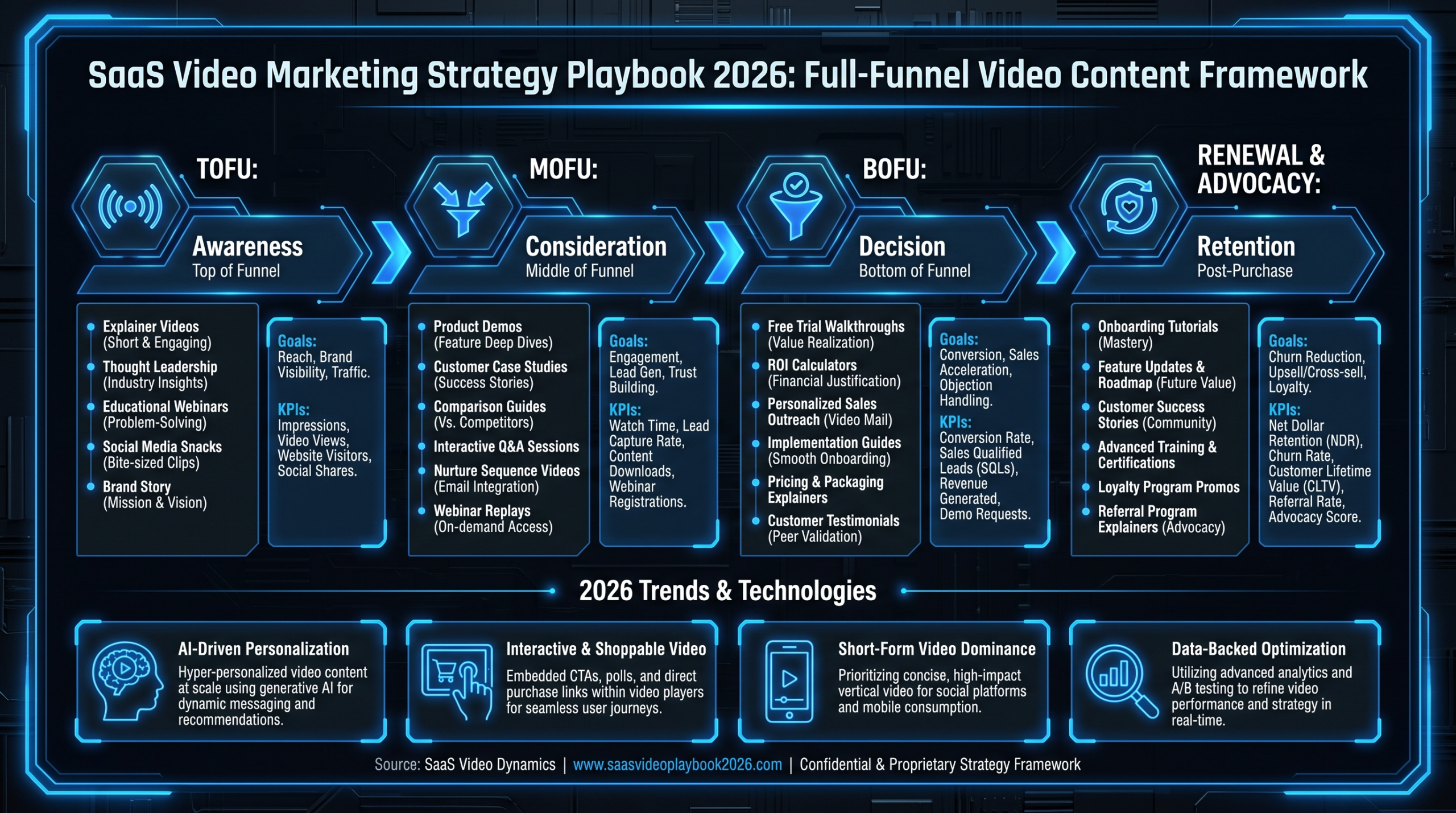
- Map video formats to funnel stages. Explainers and thought leadership at TOFU; demos and case studies at MOFU/BOFU; onboarding and feature videos post-sale.
- Most Series B SaaS teams need 10-18 videos per month across formats to maintain full-funnel coverage.
- Distribution determines ROI. LinkedIn organic and triggered email sequences drive the most pipeline-attributable engagement for B2B SaaS.
- Measure video at three layers: reach (views, watch time), engagement (CTR, form fills), and revenue impact (pipeline sourced, deal velocity).
- A dedicated video production partner is typically the most cost-effective path to scale - brand consistency without the headcount risk.
Table of Contents
Why Video Is Non-Negotiable in the 2026 SaaS Buying Cycle
The SaaS buying cycle has fundamentally changed. According to Wyzowl's annual State of Video Marketing research, the majority of people say they'd prefer to watch a short video to learn about a product or service - and in B2B SaaS, where your product is often complex and intangible, that preference compounds across every stage of evaluation. Buyers now routinely arrive at their first sales conversation having already watched your explainer, screened your demo, and read at least one customer testimonial. Video is not a support channel. It is a primary research medium.
Three forces are accelerating this shift in 2026:
Self-Serve Discovery Has Replaced Cold Outbound
Series A-C SaaS buyers are completing 60-80% of their research before speaking to anyone on your team. They're watching LinkedIn video posts, browsing YouTube for software comparisons, and clicking through embedded demo videos on your pricing page. If you're not present in video form at the moment of research, you're absent from the consideration set - regardless of how strong your written content is.
Attention Spans Have Compressed to Video's Advantage
Nobody is reading your 3,000-word product page in full. But they will watch a 90-second explainer. The same information packaged as video gets consumed where the equivalent text gets skimmed. This is especially true on mobile - where a large share of B2B research now takes place, even for high-ticket enterprise SaaS evaluations. Video communicates nuance, tone, and product quality in ways text simply cannot replicate.
Video Builds Trust at Scale
Customer testimonials in video form consistently outperform written case studies at the BOFU stage. When a prospect sees a peer - a Head of Marketing at a company with a similar profile and problem - describing the challenge, the solution, and the measured outcome on camera, it carries trust weight that no written quote can match. This is your best sales tool deployed simultaneously to every prospect in your funnel, without requiring a single hour of sales rep time.
"Video is the closest thing we have to a scalable face-to-face conversation. For B2B SaaS, that's not optional anymore - it's table stakes." - Head of Content, Series B SaaS
For a fuller view of what the SaaS video production landscape looks like in 2026 - formats, team structures, and typical timelines - that's the right baseline before building your strategy.
Mapping Video Types to Every Funnel Stage
The single biggest mistake SaaS marketing teams make with video is treating it as a single-format channel. A brand awareness video is not a sales tool. A product demo is not a brand-building asset. Each funnel stage has different buyer psychology, different objections, and different information needs - and your video strategy must reflect that architecture.
Here's how buyer intent maps to video format across the full funnel:
Full-Funnel SaaS Video Strategy Framework
| Funnel Stage | Buyer State | Video Goal | Primary Formats | Distribution Channels |
|---|---|---|---|---|
| TOFU - Awareness | Problem-aware, not solution-aware | Educate, build authority, drive discovery | Thought leadership, animated explainers, category clips | LinkedIn organic, YouTube, paid social |
| MOFU - Consideration | Solution-aware, evaluating options | Demonstrate product value, differentiate from alternatives | Product demos, comparison videos, feature spotlights | Website, email nurture, LinkedIn retargeting |
| BOFU - Decision | Ready to buy, reducing risk | Remove final objections, accelerate close | Customer testimonials, case studies, pricing explainers | Sales sequences, landing pages, demo confirmation |
| Post-Sale - Expansion | Onboarded, seeking more value | Activate, drive feature adoption, prevent churn | Onboarding videos, feature tutorials, webinar replays | In-app, email, customer success touchpoints |
TOFU: Awareness Stage
At TOFU, your buyer doesn't know your product name. They know their problem. Video content here should speak to the problem, not the solution. Thought leadership from your founder or a VP Marketing explaining an industry challenge earns far more trust than a product pitch. Explainer videos that frame the category - "Why traditional [X] is broken" - position you as the authority before you've mentioned a single feature. The goal is to be the most credible voice on the problem your product solves.
MOFU: Consideration Stage
MOFU is where most SaaS video investment goes - and for good reason. Your buyer is now actively comparing you against alternatives. Product demo videos are the workhorses here: a well-produced, focused demo showing the product solving a real workflow converts more efficiently than any written one-pager. Feature spotlights that speak to specific use cases let buyers self-select the right messaging. A professionally produced demo with clean editing, professional voiceover, and annotated callouts consistently outperforms a raw screen recording in watch completion and downstream CTA clicks. An amateur recording with poor audio signals low quality across your entire product - even if the product itself is excellent. See our guide on product demo video production for what separates a high-converting demo from a forgettable one.
BOFU: Decision Stage
At BOFU, buyers are managing risk. They want social proof. Customer testimonials - particularly from companies they recognize or roles they identify with - are the most powerful closing tools available. A two-minute video testimonial from a customer who goes from named problem to specific, measurable outcome can meaningfully shorten sales cycles. Pair this with a concise pricing explainer and you remove the last cognitive barriers between consideration and conversion.
Post-Sale: Expansion and Retention
Video's role doesn't end at closed-won. Onboarding is a critical churn inflection point: customers who reach first value faster stay longer and expand more. A structured library of short how-to videos (2-5 minutes per topic) reduces time-to-activation and measurably decreases support ticket volume on common questions. Feature announcement videos drive expansion revenue - when a customer sees a new capability explained compellingly on video, they're far more likely to explore it than if they receive a text changelog notification.
Video Formats That Drive ROI at Each Stage
Not all video formats belong at every funnel stage, and not all of them warrant the same production investment. Here's a practical breakdown of the formats that deliver the most measurable impact and where they fit in a SaaS video program:
SaaS Video Format Comparison: ROI by Funnel Stage
| Format | Best Stage | Typical Length | Primary KPI | Relative Production Cost |
|---|---|---|---|---|
| Animated Explainer | TOFU / MOFU | 60-120 sec | Views, brand lift, time on page | High ($$$) |
| Product Demo (produced) | MOFU | 3-8 min | Watch time, demo requests, pipeline | Medium ($$) |
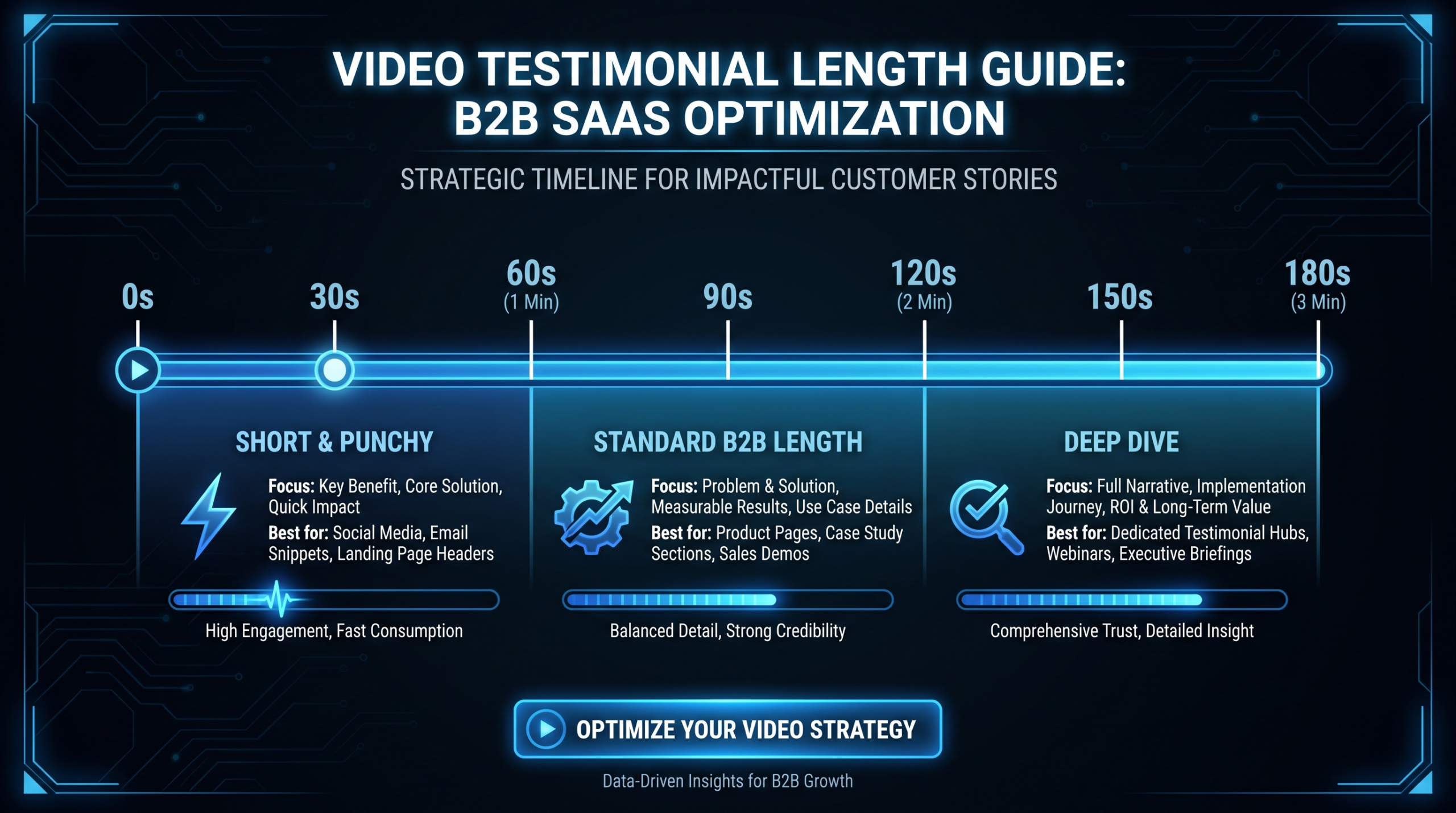
| Customer Testimonial | BOFU | 90-180 sec | Conversion rate, deal velocity | Medium ($$) |
| Thought Leadership (Founder/VP) | TOFU | 60-90 sec (social cut) | Reach, follower growth, inbound leads | Low ($) |
| Feature Spotlight | MOFU / Post-sale | 1-3 min | Feature adoption, expansion MRR | Low-Medium ($ / $$) |
| Onboarding / Tutorial | Post-sale | 2-5 min per topic | Time-to-activation, churn reduction | Low ($) |
| Webinar / Long-Form | MOFU | 30-60 min (repurpose to clips) | MQL quality, email capture, authority | Low-High (depends on repurposing) |
Animated Explainer Videos
The animated explainer is the workhorse of SaaS TOFU content. A 60-90 second video that clearly names the problem, presents your solution, and ends with a CTA belongs on your homepage, your LinkedIn page, and your paid campaigns. Done well, it carries a hero page through an entire product generation. Done poorly - weak script, generic stock motion graphics, muddy audio - it actively undermines trust. For a detailed breakdown of what drives the cost of this format, the explainer video cost breakdown guide covers every production variable.
The key to explainer effectiveness is specificity. Generic explainers ("Our platform helps teams collaborate better!") perform consistently worse than category-specific ones that name the exact pain, the exact persona, and the measurable outcome.
Product Demo Videos
A produced product demo is not a screen recording with live narration. It is an edited, scored piece of content that follows a specific buyer persona through a representative workflow. The best demos are 3-6 minutes, show the product solving a concrete problem for a defined role, and use motion graphics callouts to highlight key interactions. They belong on your demo request page, in outbound sales sequences, and in email nurture flows for mid-funnel prospects.
Customer Testimonials and Case Studies
Video testimonials require real investment in coordination - customer scheduling, filming logistics, and interview structure - but deliver outsized returns at BOFU. The most effective structure: the problem the customer faced before your product, why they chose you over alternatives, and the specific outcome they achieved. Avoid abstractions - "it transformed our workflow" moves no prospect. "We reduced [specific metric] by a meaningful margin within 60 days" does. According to Wistia's video marketing research, shorter videos see significantly higher completion rates - 2 minutes is a good ceiling for testimonial content that needs to be fully watched in a sales context.
Thought Leadership and Founder Videos
A founder or VP Marketing speaking directly to camera about an industry trend, a contrarian take, or a framework they've developed - this is the highest-trust, lowest-cost format in your arsenal. It doesn't need commercial-level production polish. It needs to be clear, opinionated, and genuinely useful to your ICP. When posted natively to LinkedIn with strong editing and structured captions, this format regularly outperforms expensive produced content on reach metrics. The production cost is low; the editorial investment is high - and that's the right tradeoff at every stage of SaaS growth.
Feature Spotlight and Onboarding Videos
Post-sale video is one of the most underleveraged growth levers in SaaS. Companies that invest in a structured library of feature tutorials and onboarding walkthroughs consistently report improvements in activation rates and customer satisfaction scores. These don't require elaborate production - clean screen capture, professional voiceover, and logical structure are sufficient. The challenge is volume: a moderately complex SaaS product may need 20-50 short how-to videos to cover its core functionality adequately. Production efficiency matters as much as quality at this scale.
Content Mix and Cadence Framework
The right video volume depends on your company stage, distribution channels, and content team capacity. But clear patterns hold across well-functioning SaaS video programs:
Recommended Monthly Video Cadence by Company Stage
| Company Stage | Monthly Video Volume | Recommended Format Mix | Primary Focus |
|---|---|---|---|
| Series A (up to ~$5M ARR) | 4-8 videos/month | 2 thought leadership, 2 product/feature, 1-2 social clips, 1 customer story | Pipeline generation, brand authority establishment |
| Series B (~$5M-$30M ARR) | 10-18 videos/month | 4 thought leadership, 3 demos/features, 4 social clips, 2 testimonials, 2 onboarding | Full-funnel coverage, sales enablement, retention |
| Series C ($30M+ ARR) | 20-35 videos/month | 6 thought leadership, 5 demos/features, 8 social clips, 4 testimonials, 4 onboarding, 3-5 paid/campaign | Scale, multi-segment coverage, expansion revenue |
How Many Videos Does a SaaS Company Actually Need?
There is no universal right number. The more useful frame is coverage gaps. Start by auditing your funnel: where do prospects drop off? Where are your sales reps spending the most time explaining the same things over and over? Where does your website fail to answer common evaluation questions? Each of those gaps is a video brief.
Most Series A SaaS companies have three critical gaps: they lack a compelling homepage explainer, their demo page is underwhelming, and they have zero customer evidence on video. Filling those three gaps alone can meaningfully improve conversion at each stage. At Series B, the gap expands to channel-specific content (LinkedIn organic, email nurture, paid) and persona-specific assets (different demos for different buyer profiles across segments).
Prioritizing Your First 90 Days
If you're starting from scratch or rebuilding a stalled video program, this 90-day priority sequence typically produces the most measurable impact the fastest:
- Weeks 1-3: Homepage explainer video - or a meaningful refresh if your current one is outdated. This is the single highest-leverage asset in your video library.
- Weeks 3-6: Primary product demo. One focused, 4-6 minute version. Embed on your demo request page and use in outbound sequences immediately.
- Weeks 6-10: Two to three customer testimonials. Work with customer success to identify willing, articulate participants with strong outcome stories.
- Weeks 10-12: LinkedIn thought leadership cadence - 2-3 clips from your founder or a VP. Test format, length, and messaging angle.
By day 90, you'll have assets covering every critical funnel stage and real engagement data to inform what to produce next.
Distribution by Channel
The best video library in the world generates zero pipeline sitting unwatched. Distribution is where most SaaS video strategies underinvest - and where the ROI gap between effective and ineffective programs is widest.
For B2B SaaS, LinkedIn is the highest-priority distribution channel for most video content. Native video posts - uploaded directly rather than linked from YouTube - receive substantially more organic reach than link-post formats. The winning structure for a LinkedIn video: first 3 seconds must hook without sound (most users scroll with audio off), 60-90 seconds total length, and a strong call-to-action in the caption rather than embedded in the video itself.
Thought leadership clips from founders or senior leaders consistently outperform brand videos on LinkedIn organic. Prioritize posting from personal profiles over company pages - company page organic reach has compressed significantly. Use the company page to amplify the best-performing personal posts once you have engagement data.
YouTube
YouTube serves two distinct strategic purposes for SaaS: SEO-driven discovery and on-demand product research. For SEO, longer-form educational content (10-20 minutes) targeting high-intent queries ("how to solve [category problem]") builds a durable organic traffic asset that compounds over time. For product research, your YouTube channel should function as an organized library - demos, tutorials, testimonials, and feature walkthroughs, properly titled, described, and organized into playlists.
YouTube is a long-game investment. Meaningful organic traction typically emerges at 3-6 months for most new SaaS channels. The trap to avoid: uploading sporadically. A channel with 5 videos posted years ago sends an active negative trust signal to prospects who discover it mid-evaluation.
Email is one of the highest-conversion video distribution channels in B2B SaaS - and consistently one of the most underused. Including the word "video" in an email subject line is associated with improved open rates across most A/B test datasets. Embedding a video thumbnail (linked to a landing page rather than auto-playing) with a visible play button in your nurture emails measurably improves click-through rates versus text-only alternatives.
The most effective email video application is trigger-based sequences. A prospect who downloads a specific piece of content receives a follow-up email with a video that goes one layer deeper on that topic. A trial user who hasn't activated within 72 hours receives an onboarding video walkthrough. These behavioral triggers compound across the full length of your funnel.
Paid - LinkedIn Ads and YouTube Ads
Paid video amplifies what's already working organically. A thought leadership clip that performed well on LinkedIn organic is a strong candidate for Sponsored Content targeting a cold, high-ICP audience. YouTube pre-roll (skippable) works best for brand awareness and retargeting - the skip rate tells you precisely whether your hook is effective.
The most common paid video mistake: running awareness-stage content (brand film, category explainer) to retargeting audiences who are already deep in evaluation, or conversely, pushing feature-specific demos at cold traffic that has no context for why they should care. Always match the video's funnel stage intent to the audience's funnel position.
Measuring Video ROI: Views to Pipeline to Revenue
Video measurement in B2B SaaS typically fails in one of two ways: teams track only vanity metrics (views, likes) that don't connect to business outcomes, or they give up on measurement entirely because attribution is genuinely hard. Neither is acceptable at Series B and beyond. Here's a practical three-layer framework:
Layer 1: Reach Metrics
These tell you whether your content is being discovered and consumed:
- Views and unique viewers - raw reach across all distribution channels
- Watch time and completion rate - the percentage of viewers who watch past 25%, 50%, and 75% is your first quality signal. A low completion rate (under 30% at the halfway mark) means your content is losing people regardless of how many views it gets.
- Subscriber or follower growth - a proxy for whether your content is building a compounding audience asset versus generating one-time traffic spikes
Watch rate is consistently more predictive of downstream conversion than raw view count. A video watched by 500 ideal-fit buyers to completion is far more valuable than one seen by 10,000 people for 3 seconds each.
Layer 2: Engagement Metrics
These tell you whether your content is driving the behaviors that feed your pipeline:
- Click-through rate on video CTAs - the percentage of viewers who take the intended next action after watching
- Form fills from video landing pages - direct MQL attribution from specific video content
- Email click-throughs from video thumbnails - in triggered nurture sequences
- Demo requests influenced by video - tracked via UTM parameters or first/last-touch attribution in your CRM
Layer 3: Revenue Impact
This is the hardest layer to measure and the most important for securing sustained video budget:
- Pipeline sourced by video - deals where a video-driven touchpoint was the first or last touch before MQL conversion
- Deal velocity - do prospects who engage with video content at MOFU/BOFU close faster than those who don't? This is measurable in most modern CRM setups with basic activity tracking.
- Customer lifetime value by cohort - do customers who complete structured onboarding video sequences retain longer and expand more? This is one of the most underleveraged measurements in SaaS video programs.
You won't get perfect attribution from day one. Start with UTM parameters on every video CTA, configure video engagement events in HubSpot or Salesforce, and run quarterly reviews of "pipeline touched by video" as a directional metric. Imperfect but directional attribution is defensible to the CFO. Zero measurement is not.
Building Your Video Production Machine
A strategy on paper means nothing without the operational capacity to execute it consistently. This is where most SaaS marketing teams struggle: they have the strategic intent but lack the production infrastructure to ship 12-20 videos per month without it becoming the team's full-time job.
In-House vs. Agency vs. Outsourced: The Real Tradeoffs
There are three paths to production capacity, each with real tradeoffs that matter differently depending on your stage:
In-house hiring: A full-time video editor - or small team - gives you maximum responsiveness and brand familiarity that deepens over time. The downside is headcount cost, hiring difficulty, and the single point of failure when your editor is ill, leaves, or gets overwhelmed by volume spikes. A mid-level video editor in the US typically costs $65,000-$95,000 per year fully loaded, before equipment, software licenses, and management overhead. At Series A, this is often premature unless video is your primary growth channel.
Freelancers: On-demand, cost-variable, and flexible. The drawbacks are coordination overhead, brand inconsistency across projects, and the absence of institutional knowledge that builds over time. Freelancers handle one-off projects well; they rarely sustain the throughput and consistency a full-funnel video program demands. For the full decision framework on when freelancers make sense and when they don't, the guide to outsourcing video editing covers every scenario.
Dedicated video agency partner: This is the model most Series B+ SaaS companies find scales most effectively. A dedicated team assigned to your account - senior editor, junior editor, project manager, and creative direction - functions as an external arm of your marketing department. They learn your brand, product, and preferences. You get agency-level throughput with the familiarity of an in-house team, and none of the hiring risk.
Video Editing Company's dedicated team plans - from Growth at $5K/mo through Scale at $16K/mo - are built specifically for SaaS companies running high-volume video programs, with a guarantee of doubled video output in 90 days or month four free. That's the kind of output accountability most agencies and freelancers won't commit to.
Top Video Production Partners for SaaS Companies
If you're evaluating external video production partners, here's how the leading options compare on the dimensions that matter most to SaaS marketing teams:
SaaS Video Production Vendors: Comparison Overview
| # | Agency | Model | SaaS Fit | Pricing (Est.) | Best For |
|---|---|---|---|---|---|
| 1 | Video Editing Company (VEC) | Dedicated team | SaaS-exclusive, full-funnel | $5K-$16K/mo | Series A-C SaaS needing 8-35 videos/month; guaranteed output growth in 90 days |
| 2 | Increditors | Dedicated editor pods (Sr. editor + Jr. editor + PM + creative director) | SaaS, YouTube creators, finance, education | ~$2.5K-$12K+/mo (custom quote) | Teams wanting a bespoke editor pod; known for significantly growing YouTube channel performance |
| 3 | Wyzowl | Project-based | Animated explainers | $3K-$15K per video | One-off animated explainers and launch brand films |
| 4 | Vidico | Project-based / retainer | Tech and SaaS | $5K-$25K per project | High-production brand and campaign videos |
| 5 | Sandwich Video | Project-based | Tech startups | $30K-$150K+ per project | Flagship product launch videos, large-budget campaigns |
Note on #2 Increditors: Not exclusively SaaS-focused - serves multiple verticals including YouTube creators, finance, and education. Custom-quote pricing means no instant tiers or self-serve sign-up, which some teams prefer for flexibility and others find slower to get started with. Strong track record on YouTube growth metrics specifically.
When to Hire In-House vs. When to Partner
A practical heuristic: if you need consistent high-volume output - 10+ videos per month - and video is central to your pipeline strategy, a dedicated external team beats a single in-house hire on cost, reliability, and scalability for most companies. If you need creative direction, brand narrative ownership, or deep internal product knowledge that cannot be briefed externally, an in-house hire makes sense alongside an agency partner for execution.
The configuration that works well for many Series B-C teams: a single in-house Video Producer or Content Strategist who owns creative direction, briefs, and feedback cycles - working with an external dedicated editing team to handle the production volume. Internal ownership of strategy, external leverage for execution. You can see how other SaaS teams have structured this arrangement in VEC's case studies.
Frequently Asked Questions
What video types should a SaaS company prioritize first?
Start with the three assets that cover the most critical buyer moments: a homepage explainer (TOFU/MOFU), a produced product demo (MOFU), and at least one customer testimonial (BOFU). These three collectively improve conversion rates at each major funnel transition. Once in place, expand to thought leadership clips for LinkedIn organic reach and onboarding videos for post-sale retention improvement.
How much should a Series B SaaS company budget for video marketing?
A common benchmark is 10-20% of total content marketing budget allocated to video - which for a Series B team typically translates to somewhere between $8,000-$20,000 per month depending on volume, format mix, and production model. The more useful frame is ROI: if a dedicated video program is measurably sourcing or accelerating pipeline, the budget conversation shifts from cost control to investment scaling. Tie every video initiative to a funnel metric from the start.
How do you attribute pipeline to video content?
Start with UTM parameters on every video CTA link so traffic and conversions are tracked as distinct sources in your CRM. Configure video engagement events in HubSpot or Salesforce - most marketing platforms can capture Wistia or YouTube plays as contact-level activities. Use "video-touched" as a pipeline segment: compare close rates and deal velocity for prospects who engaged with video versus those who didn't. It's directional rather than perfectly causal, but it's defensible to leadership and actionable for budget decisions.
Is video worth investing in before Series A?
Yes, but selectively. Pre-Series A, the best ROI typically comes from a single well-produced homepage explainer and two to three founder-led thought leadership clips for LinkedIn. Keep production lean - a polished script and confident delivery on modern equipment with decent lighting outperforms expensive production with a weak message. Reserve the full-funnel video program build for when you have consistent channel traction and a content team to sustain it.
How do you maintain video quality at high volume without costs spiraling?
The key is separating high-production formats from high-volume formats. Your homepage explainer and flagship customer testimonials warrant significant per-unit investment. Thought leadership clips, feature spotlights, and social content can be produced far more efficiently with a consistent template, strong creative direction, and an experienced editing team that already knows your brand. Working with a dedicated video production partner - rather than re-briefing freelancers for each project - is typically the most cost-effective way to scale quality output without proportional cost increases.
Ready to Build Your Full-Funnel SaaS Video Program?
Video Editing Company works exclusively with SaaS teams to build and scale video programs that drive real pipeline. Dedicated editor teams, guaranteed output growth in 90 days, and SaaS-specific expertise from day one.
Book a Free Strategy Call See How It Works See Pricing