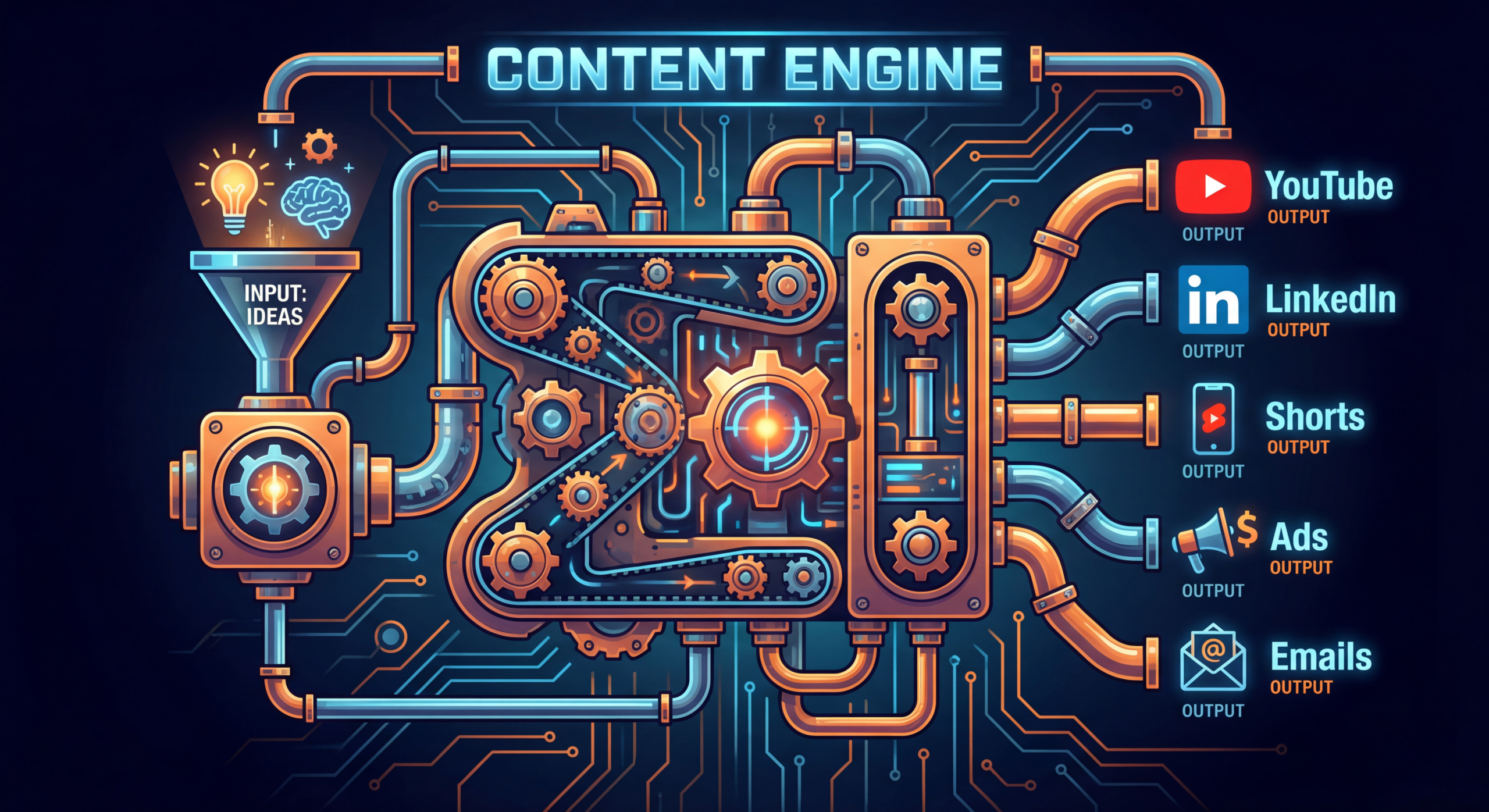
Content Strategy
SaaS
Video-First
By VEC Team
February 2026
20 min read
SaaS Content Production: Build a Video-First Content Engine
Most SaaS companies approach content production backwards. They write a blog post, then wonder if they should "also make a video." They create a webinar, then forget about it after the live event. They produce a customer testimonial, then let it gather dust in a Google Drive folder. The result is a content library that's wide but shallow—lots of assets, minimal impact, and an exhausted marketing team that never has enough content.
The video-first approach to SaaS content production flips this entirely. Instead of starting with text and trying to retrofit video, you start with video and extract everything else from it. One 20-minute video becomes a blog post, a podcast episode, 8 social clips, an email newsletter, 3 LinkedIn posts, and a set of quote graphics. The math is staggering: a single video recording session can fuel 2-4 weeks of content across every channel.
This isn't theory. It's the operating model used by the fastest-growing SaaS companies—from HubSpot to Gong to Loom—to dominate every content channel without burning out their teams. Here's how to build one for your company.
Why Video-First SaaS Content Production Wins
The traditional content production model is fundamentally inefficient. A marketing team member spends 6-8 hours writing a blog post. Then someone else spends 3-4 hours creating social content about the same topic. Then the demand gen team asks for an ad creative. Then the sales team needs a one-pager. Every asset is created from scratch, by different people, often telling slightly different versions of the same story.
The video-first model collapses this into a single creation event. Here's why it works:
Video Captures Maximum Information Density
A 15-minute video interview with your CEO about a topic contains approximately 2,250 words of spoken content, plus facial expressions, tone, energy, and visual context. That's more raw material than most blog posts. A writer can transcribe and reshape that into written content faster than generating it from scratch. An editor can clip it into social content in minutes.
Video Is the Hardest Format to Create from Others
You can easily turn video into text, audio, images, and quotes. Going the other direction is much harder. You can't turn a blog post into an authentic, energetic video of someone speaking passionately about a topic. That energy must be captured live. This asymmetry makes video the natural starting point.
Video Builds the Deepest Trust
Text builds awareness. Audio builds familiarity. But video builds trust. When a prospect sees and hears a real person from your company discussing their challenges, it creates a level of connection that text simply cannot match. In SaaS, where deals are large and sales cycles are long, trust is the currency that matters most.
Algorithms Reward Video Everywhere
LinkedIn, Twitter/X, Google, Instagram—every major platform's algorithm currently prioritizes video content. SaaS companies that include video in their content mix see 2-3x more organic reach compared to text-only strategies. This algorithmic advantage alone makes video-first the rational choice for SaaS content production.
🔄 Video-First Content Repurposing Flowchart
🎬 Source Video (15-20 min)
↓
🎞️
Full Video
YouTube, Website
🎙️
Audio Only
Podcast, Spotify
📝
Transcript
Blog post base
↓ ↓ ↓
✂️
Short Clips ×6
Reels, TikTok, Shorts
📰
Blog Post
SEO optimized
💬
LinkedIn ×3
Text + video posts
✉️
Email Newsletter
Key insights
↓
🖼️
Quote Cards ×4
Instagram, Twitter
🧵
Twitter Thread
Key takeaways
📊
Slide Deck
SlideShare, Sales
1 Video → 15+ Content Assets
The SaaS Content Production Operating Model
Building a video-first content engine requires a systematic approach. Here's the complete operating model, from planning to distribution.
Phase 1: Content Planning (Monthly)
At the start of each month, your content team should identify 4-6 core topics based on:
- SEO keyword research: What questions is your target audience searching for? Use tools like Ahrefs, Semrush, or even Google's "People Also Ask" to find topics with search volume and intent alignment.
- Sales team input: What objections come up repeatedly? What questions do prospects ask in demos? These are goldmines for content topics.
- Product updates: New features, integrations, or use cases that need marketing support.
- Industry trends: What's happening in your market that your audience cares about?
- Competitor gaps: What topics do competitors cover poorly or not at all?
Each topic becomes a "content pillar" that will be explored through a primary video recording and then atomized into multi-format assets.
Phase 2: Video Recording (Weekly)
Set a weekly recording cadence. Most successful SaaS content operations record 1-2 videos per week, each 10-20 minutes long. Recording formats include:
- Expert interviews: Your CEO, VP of Product, or customer success lead discussing a topic
- Customer conversations: Interview customers about their challenges and how they solved them
- Screen walkthroughs: Show how to accomplish specific tasks using your product
- Industry commentary: React to news, trends, or competitor moves in your space
- Webinars: Live educational sessions that become evergreen recorded content
The key insight: these recordings don't need to be perfect. They need to be information-rich. Polish comes in post-production. Raw authenticity comes from the recording session. Both are necessary; neither is sufficient alone.
Phase 3: Production and Atomization (Same Week)
This is where the magic happens. Within 48-72 hours of recording, your production team (or production partner) should deliver:
- Full-length video (edited for YouTube, website, and on-demand viewing)
- Audio extraction (for podcast distribution)
- Full transcript (edited for readability)
- Blog post draft (rewritten from transcript with SEO optimization)
- 4-8 short-form video clips (15-60 seconds each, formatted for social)
- Quote graphics (key statements turned into shareable images)
- Email newsletter content (summary with key insights)
- Social media copy (platform-specific captions for each clip)
One recording. Fifteen or more assets. This is the efficiency that makes video-first SaaS content production so powerful.
Phase 4: Distribution (Ongoing)
Assets are distributed across channels over 2-4 weeks to maximize exposure without audience fatigue:
- Day 1: Full video published on YouTube with SEO-optimized title, description, and chapters
- Day 2: Blog post published with embedded video clips
- Day 3: First short-form clip on LinkedIn + Twitter/X
- Day 4: Podcast episode goes live
- Day 5-7: Email newsletter featuring the topic
- Week 2: Additional social clips, quote graphics, and community shares
- Week 3-4: Repurposed formats (carousel, infographic, thread) and cross-platform sharing
📦 The 1-to-Many Content Asset Model
🎬
INPUT: 1 Video Recording Session
15-20 min expert interview or walkthrough
1×
🎞️
YouTube Video
Full-length, chaptered
1×
🎙️
Podcast Episode
Audio extraction
1×
📰
SEO Blog Post
2,000+ words from transcript
1×
✂️
Short-Form Clips
Reels, TikTok, Shorts
6×
💬
LinkedIn Posts
Text + video combos
3×
🖼️
Quote Cards
Shareable graphics
4×
✉️
Email Newsletter
Key insights digest
1×
🧵
Twitter Thread
Key takeaways
1×
OUTPUT: 18+ Unique Content Assets
From a single 15-20 minute recording session
Building Your SaaS Content Production Team
You don't need a 10-person content team to run a video-first production engine. Here's the minimum viable team at each stage.
Lean Team (1-3 people + production partner)
This is the setup for most early-to-mid-stage SaaS companies:
- Content Lead / Marketing Manager (1 person): Owns the content calendar, identifies topics, conducts or arranges interviews, manages the editorial workflow, and handles distribution. This is the strategist and orchestrator.
- Video Production Partner (external): Handles filming, editing, clip creation, and graphics. A good SaaS video production partner can do the work of 3-4 internal hires at a fraction of the cost.
- Writer (1 person, can be freelance): Transforms transcripts into blog posts, email content, and social copy. With AI assistance, one writer can handle the output from 4-6 videos per month.
This setup can produce 4-6 content pillars per month, generating 60-100+ individual content assets. That's more output than most companies with dedicated 8-person content teams.
Growth Team (4-6 people + production partner)
As you scale past Series A and need to increase volume:
- Head of Content (1): Strategy, planning, performance analysis
- Content Producers (2): Manage day-to-day production workflow, coordinate with video partners, handle distribution
- SEO Specialist (1): Keyword research, content optimization, technical SEO
- Social Media Manager (1): Platform-specific content adaptation, community engagement, paid amplification
- Production Partner (external): Scaled engagement for higher volume
The SaaS Content Production Tech Stack
The right tools make or break your content engine's efficiency. Here's the stack we recommend for video-first SaaS content production:
Function
Tool
Monthly Cost
Recording
Riverside.fm or Squadcast
$25-$50
Transcription
Descript or Otter.ai
$25-$35
Video Editing
Production partner or DaVinci Resolve
$0-varies
Clip Creation
OpusClip or Repurpose.io
$15-$50
Graphic Design
Canva Pro or Figma
$13-$15
Content Calendar
Notion or Airtable
$10-$20
Social Scheduling
Buffer or Hootsuite
$15-$99
SEO Research
Ahrefs or Semrush
$99-$200
Video Hosting
Wistia or Vidyard
$19-$79
Email Marketing
ConvertKit or Mailchimp
$29-$50
Total tech stack cost: approximately $250-$600/month. This stack, combined with a production partner, gives you an enterprise-grade content production capability at a fraction of the cost of building a full in-house team.
SaaS Content Production Workflows That Scale
Efficiency isn't about working faster—it's about systematizing the process so it's repeatable, predictable, and improvable. Here are the core workflows.
The Weekly Recording Workflow
- Monday: Confirm this week's recording topics (selected during monthly planning). Brief the subject matter expert with key talking points—not a full script. You want authentic conversation, not rehearsed presentations.
- Tuesday-Wednesday: Record 1-2 videos. Each session should be 15-25 minutes. Use a standard format (intro, 3-5 main points, conclusion) to make editing consistent.
- Wednesday-Thursday: Send recordings to production partner for editing. Simultaneously, run recordings through transcription and begin blog post drafting.
- Thursday-Friday: Review and approve edited content. Prepare distribution schedule for the following week.
The Content Atomization Workflow
When a full-length video is ready, this is the exact process for breaking it into component assets:
- Watch the full video and timestamp the 6-8 strongest moments (quotable statements, key insights, surprising data points, emotional peaks)
- Extract short-form clips at each timestamp. Each clip should be 15-60 seconds and stand alone without additional context.
- Format clips for each platform: add captions, crop to 9:16 for Reels/TikTok/Shorts, add branded intro/outro for LinkedIn.
- Pull quote text from the strongest statements. Create graphic cards using your brand template.
- Draft social copy for each clip and each platform. LinkedIn copy is different from Twitter copy is different from Instagram captions.
- Transform transcript into blog post. Restructure for SEO, add headers, internal links, external links, and optimize for primary keyword.
- Create email newsletter from the blog post. Pull the 3 best insights + a link to the full video.
- Schedule everything across the distribution timeline.
The Quality Control Workflow
Every piece of content should pass through these checkpoints before publishing:
- Brand consistency: Does it match your visual identity, tone of voice, and messaging framework?
- Accuracy: Are all facts, statistics, and claims verified?
- Platform optimization: Is the format, length, and style appropriate for the target platform?
- CTA alignment: Does every piece drive toward a clear next action?
- SEO compliance: For written content—keyword usage, meta descriptions, internal links, image alt text
Content Types for Every Stage of the SaaS Funnel
Not all content serves the same purpose. Your SaaS content production engine should create assets for every funnel stage.
Top of Funnel (Awareness)
Goal: Attract your target audience with valuable, educational content that positions your brand as an expert.
- How-to videos: "How to Reduce Churn by 30% in 90 Days"
- Industry insights: "5 Trends Reshaping [Industry] in 2026"
- Thought leadership: Founder or executive sharing contrarian perspectives
- Data-driven content: Original research or survey results presented visually
Middle of Funnel (Consideration)
Goal: Help prospects evaluate whether your solution fits their needs.
- Product walkthroughs: Show specific features in context of real workflows
- Comparison content: How you differ from alternatives (without being negative)
- Customer stories: Case studies and testimonials from similar companies
- Webinars: Deep-dive sessions on topics your audience cares about
Bottom of Funnel (Decision)
Goal: Remove final objections and drive action.
- Detailed demos: Comprehensive product demonstrations tailored to specific use cases
- ROI content: Videos showing the business impact and return on investment
- Implementation guides: Show how easy it is to get started
- Personalized sales videos: Custom walkthroughs for high-value prospects
Post-Sale (Retention & Expansion)
Goal: Ensure customers succeed and expand their usage.
- Onboarding videos: Step-by-step activation guides
- Feature education: Help customers discover underused features
- Best practice content: Show power-user workflows and tips
- Community content: User spotlights, community highlights
Measuring SaaS Content Production Performance
The metrics that matter for a video-first content engine go beyond simple view counts.
Production Efficiency Metrics
- Content velocity: How many assets are you producing per month? Track the ratio of recording sessions to published assets (target: 1:12 or better).
- Time to publish: How quickly do assets go from recording to live? Aim for under 5 business days for the first batch.
- Cost per asset: Total production cost divided by number of assets created. Video-first models should drive this below $100 per asset.
Engagement Metrics
- Total video watch hours: Aggregate attention your content captures per month.
- Engagement rate per platform: Likes, comments, shares, saves relative to impressions.
- Email open and click rates: Performance of newsletter content driven by video topics.
- Blog organic traffic: Search traffic to blog posts derived from video content.
Business Impact Metrics
- Content-attributed pipeline: Leads and deals that touched content before converting.
- Content-influenced revenue: Revenue from deals where prospects engaged with content during the sales cycle.
- Customer acquisition cost (CAC): Track how content production affects your overall CAC over time.
- Organic vs. paid mix: As your content engine matures, your organic percentage should increase.
Common SaaS Content Production Mistakes
Even companies that embrace video-first production can stumble. Here are the pitfalls to avoid:
Mistake #1: Creating Content Without a Distribution Plan
Production without distribution is just an expensive hobby. Before recording a single video, know exactly where each asset will live, when it will publish, and how it will be promoted. The distribution plan should be as detailed as the production plan.
Mistake #2: Prioritizing Volume Over Quality
A video-first approach increases efficiency, but it doesn't mean you should sacrifice quality for quantity. One exceptional video per week beats five mediocre ones. Focus on topics that genuinely help your audience, featuring experts who genuinely know what they're talking about.
Mistake #3: Ignoring SEO in Video Content
Every video you publish on YouTube should be optimized for search: keyword-rich titles, detailed descriptions, custom thumbnails, chapter markers, and relevant tags. Every blog post derived from video should follow SEO best practices. Content that can't be found is content that doesn't exist.
Mistake #4: Not Involving Subject Matter Experts
The best SaaS content features the people who actually build and use the product—engineers, product managers, customer success leads, and founders. Marketing-only content lacks the depth and credibility that comes from genuine expertise.
Mistake #5: Treating Content as a Campaign Instead of an Engine
Campaigns have start and end dates. Engines run continuously. The most successful SaaS content operations treat production as an ongoing discipline with consistent cadence, not a project with a deadline. This mindset shift is the difference between companies that dabble in content and companies that dominate their category.
Frequently Asked Questions
How many videos per month should a SaaS company produce?
For early-stage SaaS (seed to Series A): 2-4 primary videos per month, atomized into 30-60+ assets. For growth-stage SaaS (Series B+): 6-10 primary videos per month, generating 100-150+ assets. The video-first model means your asset count should be 10-15x your recording count.
What's the ideal length for SaaS video content?
It depends on the format and platform. YouTube/long-form: 8-20 minutes for educational content. LinkedIn native: 30-90 seconds. Reels/TikTok/Shorts: 15-60 seconds. Product demos: 2-4 minutes. Webinars: 30-45 minutes. The rule: every second must earn the next. Cut aggressively regardless of format.
How much does a video-first content engine cost to operate?
For a lean operation: $3,000-$8,000/month including production partner, tools, and one writer. For a growth operation: $10,000-$25,000/month with a larger team and higher production volume. The ROI typically becomes positive within 3-6 months as organic reach compounds and paid customer acquisition costs decrease.
Should we hire in-house or use a production partner for SaaS content production?
Start with a production partner. The expertise, equipment, and bandwidth of a specialized video production company far exceeds what a single in-house hire can deliver. Bring production in-house only when you're consistently producing 8+ videos per month and have the budget for multiple roles (videographer, editor, motion designer).
How long until we see results from a video-first content strategy?
Social engagement and direct traffic typically show improvements within 30-60 days. SEO results from video-derived blog content take 3-6 months. Measurable pipeline impact usually appears at the 3-4 month mark. Compounding organic growth that significantly impacts CAC happens around months 6-12. Consistency is the key variable.
Can we use AI to speed up SaaS content production?
Absolutely—for the right tasks. AI excels at: transcription, first-draft blog posts from transcripts, social media caption generation, thumbnail suggestions, and SEO optimization. AI should not replace: the actual expert perspectives captured on video, editorial judgment, brand voice consistency, or strategic content planning. Use AI as an accelerator, not a replacement for human expertise.
Plan your entire quarter's content production in one document. Includes topic planning, recording schedule, atomization checklist, and distribution timeline.
Get the Calendar Template →
The SaaS companies that will dominate their categories over the next 5 years are the ones building video-first content engines today. Not because video is trendy, but because it's the most efficient way to produce high-quality, multi-format content at scale. One recording session fuels weeks of content across every channel. That's not a marketing tactic—it's an operational advantage.
Ready to build your video-first content engine? Book a free strategy call
View Pricing and we'll design a SaaS content production system tailored to your team, budget, and growth goals.


