Proptech Explainer Videos: What Works
TL;DR
- Proptech explainer videos fail when they talk to everyone — they work when built for one specific audience: agents, investors, homebuyers, or enterprise buyers.
- The hardest proptech concepts (AI valuations, transaction management, digital mortgages, property data) need the Analogy Bridge method to become video-ready.
- Length guidance: 60–90 seconds for homebuyers, 90–150 seconds for agents (awareness), 2–3 minutes for investors, 3–5 minutes for enterprise evaluation content.
- The biggest mistake: leading with features instead of the painful workflow problem the audience already feels every day.
Table of Contents
- Why Proptech Explainer Videos Are Different
- Know Your Audience Before You Write a Word
- The Four Proptech Concepts That Resist Video
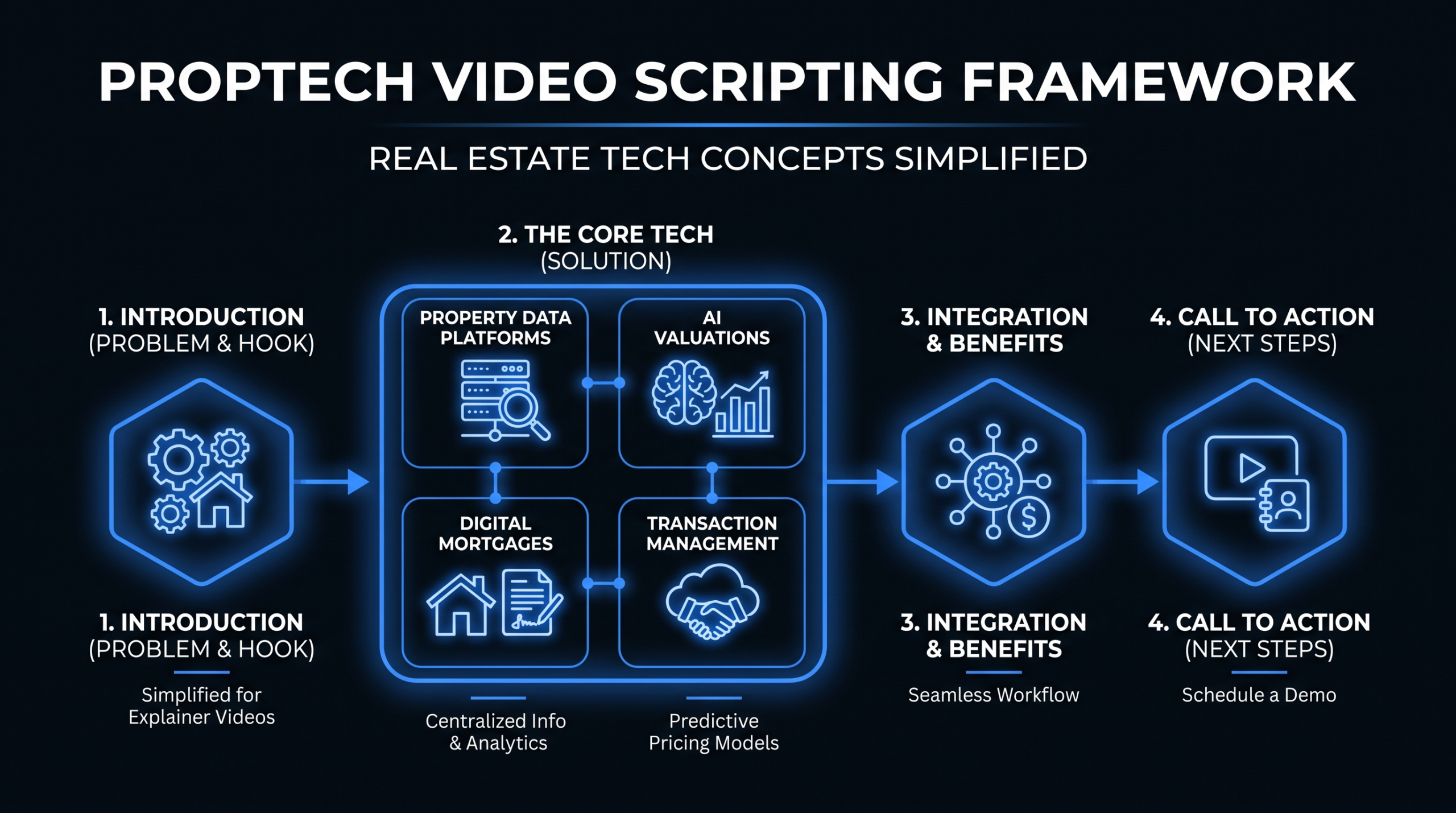
- Scripting Framework for Proptech Explainer Videos
- Length Guide by Audience and Stage
- Channel and Format Guide
- What Great Proptech Explainer Videos Have in Common
- Three Mistakes That Kill Proptech Explainer Videos
- FAQ
Proptech is selling to people who already think they understand their industry. A real estate agent has closed hundreds of deals without your transaction management platform. A property investor has built a portfolio without AI valuations. A homebuyer got a mortgage before digital lending existed. Your explainer video isn't just explaining a product — it's asking someone to rethink a workflow they've spent years perfecting.
That's why proptech explainer videos are harder to get right than SaaS explainers in other verticals. The same script that works for a fintech or edtech product often fails completely when applied to real estate technology. The concepts are more complex, the audiences more skeptical, and the trust bar higher — because the underlying transaction is the single largest financial decision most people will ever make.
This guide covers what actually works: the scripting frameworks, audience-specific approaches, length guidance, and common failure modes we've observed working with proptech clients across their video content programs. For a broader look at video production in the proptech space, see our proptech video production hub.
Why Proptech Explainer Videos Are Different
Proptech sits at the intersection of two categories that independently resist video explanation: real estate (a relationship-driven industry with decades of established workflow) and technology (abstract processes and data models that don't naturally visualize). When you combine them, you get an explainer challenge that's genuinely harder than most verticals.
Several factors make proptech video distinct from other B2B categories:
- Resistant audiences. Real estate professionals are proud of their expertise. An explainer that implies "you've been doing this wrong" will lose them in the first 15 seconds. The approach must position the technology as an upgrade to what they already do well — not a replacement for their judgment.
- Regulatory complexity. Digital mortgages, property data, and AI valuations all intersect with compliance and regulatory frameworks that vary by jurisdiction. Videos can't make legal claims, but they also can't ignore the question "is this compliant where I operate?" The best proptech explainers address compliance at a signal level without turning into legal disclaimers.
- Multiple decision-makers with different anxieties. A proptech sale often involves agents, brokers, IT, compliance, and C-suite — each with different technical literacy and different objections. One video rarely speaks effectively to all of them.
- High trust bar. Real estate is the single largest purchase most people make. Any technology touching that transaction faces a credibility threshold that B2B SaaS in other categories doesn't have to clear. Production quality isn't a nicety — it's a trust signal.
- Process invisibility. What transaction management software or a property data platform actually does — routing documents, matching buyers to sellers, scoring listings — is invisible by default. The visible output (a closed deal, a mortgage approved) has dozens of contributing factors. Making the technology's causal role legible on video takes deliberate craft.
Understanding these constraints is the starting point. Every scripting and production decision that follows should be made in light of them, not despite them.
Know Your Audience Before You Write a Word
The most common proptech explainer failure is writing a script for "real estate professionals" — a category so broad it forces the video into vague, hedged territory that speaks to no one. Every proptech explainer should be built for one primary audience. Here's what that means in practice for the four main segments.
Real Estate Agents and Brokers
Agents operate in a world of competing priorities: lead generation, client communication, transaction management, compliance documentation, and their own marketing. Technology anxiety is real — agents have been through multiple waves of "the tool that will change everything" and most of them didn't. Your video needs to demonstrate time-to-value in the first 20 seconds or the agent has mentally moved on.
What works: Lead with a workflow pain point they recognize immediately ("You're managing 12 transactions across 3 platforms right now"). Show the before-and-after as a workflow comparison, not a feature list. Use screen recordings sparingly — agents want to see outcomes, not UX. Keep it under 2.5 minutes for awareness-stage content; allow 3–5 minutes if this is a demo for agents already in evaluation.
Language that lands: Conversational, direct, avoiding developer terminology. Never imply they don't understand the technology — frame it as a tool that handles the administrative burden so they can focus on the relationship and negotiation work they're exceptional at.
Property Investors
Investors — whether individual or institutional — are data-driven and time-scarce. They're often more technically sophisticated than agents, but their decision frame is entirely financial: does this tool help them find better deals, underwrite faster, or reduce holding-cost risk? Abstract technology explanations don't move them. ROI framing does.
What works: Lead with a market efficiency problem ("By the time you finish underwriting a deal manually, better-capitalized buyers have already moved"). Show data outputs in the video — dashboards, comp tables, scoring outputs — with hedged framing about what the numbers represent. Use third-person case framing ("investors using this approach commonly report…") rather than direct performance claims. Allow 3–4 minutes; investors will watch the full runtime if the data angle is compelling.
Language that lands: Financial, analytical. Terms like "underwriting velocity," "deal flow," "comp accuracy," and "portfolio exposure" will resonate. Avoid residential real estate agent framing entirely if the audience is institutional.
Homebuyers and Renters
This is the most emotionally charged audience and the most skeptical of technology. Homebuyers are making the largest financial decision of their lives, often in a state of high stress. They don't care about the technology — they care about getting approved faster, paying less, and not being surprised at closing.
What works: Keep it extremely short (60–90 seconds). Focus entirely on the fear eliminated ("No more wondering if your mortgage will close on time"). Human tone over technical. Social proof — real-name customer quotes or hedged testimonials — carries more weight than any feature description. Animated explainers often perform better than live-action here because the visual simplicity matches the audience's desire for simplicity.
Language that lands: Plain English throughout. If a first-time homebuyer has to look up a word you used, you've lost them. Avoid fintech terminology entirely. "Digital mortgage" is accessible; "automated underwriting decision engine" is not.
Enterprise Clients: Banks, Lenders, and Brokerages
Enterprise proptech buyers evaluate technology on compliance, integration, security, and scalability — not just workflow improvement. The video is rarely the decision-making tool; it's the credential check. "If this company produces content at this quality level, they're a real vendor." The actual sale happens in demos and RFP responses. But a strong explainer video validates the shortlisting decision and keeps you in conversations longer.
What works: Lead with the business problem at scale ("When your loan officers are processing 500 applications per week, manual verification becomes your bottleneck"). Show system integration at a high level without getting into API specifics. Compliance language matters — "SOC 2 Type II," "MISMO standards," "RESPA compliance" are reassurance signals. Allow 3–5 minutes; enterprise buyers will watch longer video if it addresses their specific concerns. For a deeper look at production approaches for this type of content, see our guide to SaaS video production.
Language that lands: Professional, measured. Avoid superlatives and vague efficiency claims. Specific, hedged ranges ("typically reduces review time by a significant margin for high-volume lenders") are more credible than broad promises.
The Four Proptech Concepts That Resist Video
Some proptech product categories are intrinsically hard to explain on video because the mechanism is invisible, abstract, or technically complex. Here's how to approach the four most common ones.
Transaction Management Platforms
The challenge: transaction management looks like a list of tasks and documents. That's visually dull and hard to distinguish from email or spreadsheets to a viewer who hasn't felt the pain of managing a complex close across multiple parties, multiple timelines, and multiple compliance touchpoints.
What works: The "chaos-to-clarity" visual metaphor. Open with a split-screen showing the chaotic reality (fragmented email threads, missed deadlines, frantic calls the day before closing) and transition to the organized, automated flow. Animate the document routing and deadline sequencing rather than showing raw screen recordings. The emotional story of "the deal that almost didn't close" is more effective than any feature walkthrough for this category.
AI-Powered Valuations
The challenge: how an algorithm generates a valuation is genuinely complex — comp selection, condition scoring, micro-market weighting, days-on-market adjustments — and the output (a number) is exactly what agents and appraisers are protective of getting right through their own expertise. The video must explain the "how" without threatening the audience's professional identity.
What works: The "more data, same judgment" framing. The AI isn't replacing the agent's or appraiser's judgment — it's giving them access to far more comparable data than manual research would generate in the same time. Visualize data inputs (county records, MLS data, renovation permits, sold transactions) flowing into a confidence-weighted output. Always present the valuation as a range with the human's final adjustment capacity visible, not as a hard number the algorithm owns alone.
Digital Mortgage and Lending Tech
The challenge: the mortgage process has so many steps, parties, and potential failure points that any video trying to cover "how it works" end-to-end will either be too long or too shallow. The fear of mortgage complexity is real for borrowers — "digital" doesn't automatically reduce that fear; it can amplify it if the video fails to convey human oversight.
What works: Map the video to a single moment of fear or friction ("waiting weeks to hear if your loan was approved") and show precisely how the technology eliminates that specific moment. Don't try to explain the whole mortgage process. Compliance callouts — handled securely, certified standards, regulatory alignment — should appear naturally in the flow, not as a legal disclaimer dump at the end. For related insights on building this type of content cost-effectively, see our explainer video cost breakdown.
Property Data Platforms
The challenge: data platforms are a means to an end, not an end themselves. Investors, agents, and analysts care about the decision they can make with better data — not about the data itself. Videos that explain data sources, refresh rates, and API coverage without connecting to a concrete decision miss the point entirely.
What works: "Decision under uncertainty" framing. Show the viewer in a state of incomplete information — making an offer without knowing neighborhood appreciation trends, or selecting a market without knowing cap rate spreads — and then show how the data platform gives them the information needed to act with confidence. Visualize the data through maps, heat maps, and charts rather than spreadsheets. The data should feel like insight, not raw output.
Scripting Framework for Proptech Explainer Videos
Three proven script architectures work across proptech audiences. The right choice depends on where the viewer is in their buying journey and how technically complex the product concept is.
The Problem-Solution-Proof Structure (P-S-P)
Best for: awareness and consideration stage content for audiences who know they have a problem but haven't committed to a solution category yet.
- Problem (20% of runtime): Name the specific pain point in the first sentence. Don't build up to it — lead with it. "You're losing deals because your offer takes 24 hours to underwrite manually." The viewer should recognize themselves immediately or you've started with the wrong pain point.
- Solution (50% of runtime): Show the mechanism — how the product eliminates the problem. Keep this visual and outcome-oriented. Avoid feature names and UI screenshots unless they directly communicate the outcome to a non-technical viewer.
- Proof (30% of runtime): Third-person evidence of the outcome. This can be a customer quote with real name and company (highest credibility), a hedged metric range ("clients commonly report cutting underwriting time from 48 hours to under 4"), or a concrete scenario walkthrough. Close with a clear CTA that matches the viewer's most likely next action at this funnel stage.
The Analogy Bridge Method
Best for: complex concept explainers (AI valuations, property data platforms) where the mechanism is genuinely hard to visualize. Audiences with moderate technical literacy who need to understand the category before they'll seriously consider a specific product.
The method: start with something the audience already deeply understands — a process from their existing workflow — build an explicit analogy to what your product does, then show how the product executes that familiar logic at scale or speed.
Example for AI valuations: "A senior agent can mentally weight 20 recent sales to arrive at a list price in 15 minutes. Our platform does the same thing — weights recent sales, adjusts for condition and micro-location — but across 2,000 comps in under 30 seconds." The audience knows what "weighting comps" means. They've done it. The analogy makes the AI mechanism legible without requiring any understanding of machine learning.
The Analogy Bridge works because it starts from the viewer's expertise rather than challenging it. The technology is framed as doing what the viewer does, just faster and at a scale no individual can match manually.
The Trust-First Opening
Best for: consumer-facing content (homebuyers, renters) where skepticism about technology in high-stakes transactions is elevated. Also effective for agents in markets that have experienced previous proptech adoption failures or vendor overpromising.
Open not with the product but with an explicit acknowledgment of the viewer's skepticism: "We know you've heard 'digital mortgages make it faster' before. Here's what's actually different — and what we won't promise." This pattern works counterintuitively. Naming the viewer's skepticism openly is more disarming than pretending it doesn't exist. It signals honesty, which is the foundational trust signal in any real estate context.
Follow with a specific, hedged claim rather than a vague efficiency promise. Close with one simple, low-commitment action — a free rate check, a 5-minute demo, a calculator tool — not an immediate purchase CTA. Consumer proptech typically requires more trust-building steps than B2B before a conversion event is realistic.
Length Guide by Audience and Stage
Proptech video length guidelines deviate significantly from generic SaaS video advice because the trust-building requirements vary so dramatically by audience and the complexity of the concepts involved. The framework below reflects practical patterns; completion rate data from your own analytics should always be used to refine it for your specific product and audience.
Proptech Explainer Video Length Guide
| Audience | Stage | Recommended Length | Notes |
|---|---|---|---|
| Homebuyers / Renters | Awareness | 60–90 seconds | Lead with fear elimination; single CTA; no technical language |
| Homebuyers / Renters | Consideration | 90–120 seconds | Add social proof; still one clear outcome; human tone throughout |
| Real Estate Agents | Awareness | 90–150 seconds | Workflow pain first; end with time-savings framing |
| Real Estate Agents | Demo / Evaluation | 3–5 minutes | Deeper feature context; workflow walkthrough; optional comparison |
| Property Investors | Awareness | 2–3 minutes | Data visualization heavy; financial framing throughout |
| Property Investors | Evaluation | 4–6 minutes | Case scenarios with hedged ranges; model transparency critical |
| Enterprise (Banks / Brokerages) | Awareness / Credentialing | 2–3 minutes | Problem at scale; compliance signals; integration overview |
| Enterprise (Banks / Brokerages) | Technical Review | 5–8 minutes | Security, compliance, integration depth; may include architecture overview |
Research on video engagement consistently shows that completion rates are highest in the first 60–90 seconds of any video, regardless of total runtime. Wistia's analysis of video engagement by length demonstrates that front-loading value — getting to your core message before the viewer's attention dips — is more important than optimizing total runtime. A proptech video that earns viewer commitment in the first 60 seconds will retain far more viewers through the full runtime than one that builds slowly toward its point.
For proptech companies with multiple audiences, the most efficient production approach is to build one core 3–4 minute master explainer, then create audience-specific cuts: a 90-second homebuyer version, a 2-minute agent version, a 3-minute investor version. This yields six or more distinct assets from a single production investment.
Channel and Format Guide
Format and channel decisions affect how you approach the script and visual treatment. A LinkedIn thought leadership video for enterprise brokers needs a different structure than a YouTube explainer for first-time homebuyers, even if the underlying product is the same.
Proptech Explainer Video: Channel and Format Guide
| Channel | Primary Audience | Format | Max Effective Length | Key Emphasis |
|---|---|---|---|---|
| YouTube | Homebuyers, agents (research phase) | Animated or screen-recorded with narration | 3–4 min | SEO-optimized title; chapter markers; hook in first 15 seconds |
| Agents, investors, enterprise buyers | Live-action or animated; captions mandatory | 90–120 sec (feed); up to 5 min for article posts | Hook in first 3 seconds; business outcome framing; no jargon | |
| Website hero / product page | Evaluation-stage, all segments | High-production animated or motion graphics | 60–90 seconds | No sound dependency; autoplay-safe; outcome-first structure |
| Sales outreach / email | Enterprise buyers, agents | Loom-style or personalized screen-record | 2–3 minutes | Personalized opening; specific pain point named; soft CTA |
| Trade show / event screen | Mixed proptech audience | Motion graphics, no narration required | 60–90 sec (loop) | Visuals carry all content; large readable text; brand-first |
| Paid social (Meta/Instagram) | Homebuyers, renters | Vertical 9:16, captions on | 15–45 seconds | Problem named in first 3 seconds; emotion-first; single CTA |
The multi-cut strategy deserves emphasis: producing separate videos per channel from scratch is expensive and creates inconsistency. Producing one master at the right length and quality level, then cutting it for each channel, is the efficient path. See our guide to outsourcing video editing for how to structure this kind of multi-cut production workflow with an external team.
What Great Proptech Explainer Videos Have in Common
Beyond scripting frameworks and length guidance, the best proptech explainer videos share execution qualities that are harder to codify but easy to recognize when they're present — and their absence is what makes most proptech video content forgettable.
They Respect the Viewer's Existing Expertise
The strongest proptech explainers position the technology as a partner to the viewer's expertise, not a replacement for it. An AI valuation tool explainer that opens with "imagine if you never had to do a CMA again" will alienate agents — the CMA is a skill they've developed over years, and it's part of how they justify their professional value. The same message reframed as "imagine doing a CMA with 100x more comp data in the same time" positions the tool as an amplifier rather than a threat. This isn't just a tone shift — it's a fundamental choice about how you frame the relationship between the professional and the technology.
They Are Visually Concrete About Abstract Outputs
Property data, AI confidence scores, transaction timelines — these need to be visualized, not described. Every abstract proptech concept has a visual analog that makes it more intuitive: a comp match can be shown as a scoring matrix, a transaction timeline as a progress bar with milestone notifications, a digital mortgage pipeline as a visual funnel with real-time status indicators. The production teams that get proptech explainer videos right spend significant time in the visual development phase translating abstract product concepts into concrete on-screen representations. This is where working with editors experienced in data visualization and motion graphics — rather than generalists — pays a measurable dividend.
They Make One Promise and Keep It
Proptech products often do many things. The worst explainer videos try to cover all of them in 90 seconds. The best identify the single highest-value outcome for the specific audience, build the entire video around that outcome, and let other features live in follow-up content. "Helps you close faster, reduces documentation errors, integrates with your MLS, and automates compliance reporting" in 90 seconds means the viewer remembers none of it. "Cut your time-to-close by weeks" in 90 seconds — supported with a clear mechanism — means the viewer walks away with a specific expectation they can test against their current workflow.
They Meet Enterprise-Grade Production Standards
Proptech buyers, whether agents or institutional lenders, compare your video against the best marketing content in the broader SaaS ecosystem — not against other proptech videos. A low-production explainer signals a low-maturity company, regardless of how sophisticated the underlying technology is. The quality benchmark should be the kind of content you'd expect from a Series B SaaS company with a developed content function. HubSpot's video marketing resources reflect the quality standard that sophisticated buyers encounter regularly from companies they trust. At VEC, proptech clients commonly find that their video content is among the first signals that elevates them to "serious vendor" status in enterprise evaluations — especially before any live demo has occurred.
Three Mistakes That Kill Proptech Explainer Videos
These failures appear repeatedly across proptech video content, and they're worth naming explicitly because each one is counterintuitive — they look reasonable until you understand why they consistently underperform.
Mistake 1: Feature-First Scripting
Feature-first scripting is the most common failure mode in proptech video. "Our platform has automated document routing, integrated e-signature, and AI-powered timeline forecasting." These are features. The viewer hasn't connected them to a problem they feel yet. Leading with features forces the viewer to do the translation work themselves: "How does that solve something I actually care about?" Most don't — they click away.
The fix: write the problem statement first, validate it with someone who actually experiences the problem, then write features as named solutions to that specific problem. If you can't connect a feature to a felt problem in one sentence, cut it from the awareness-stage video. It belongs in a demo, not an explainer.
Mistake 2: Treating "Real Estate" as One Audience
A video for "real estate professionals" is a video for no one. An agent's workflow, a mortgage officer's workflow, an institutional investor's workflow, and a homebuyer's decision process have almost nothing in common beyond the underlying asset class. Using audience-agnostic language forces the script into abstraction that doesn't land for any specific viewer.
The fix: build a separate video (or at minimum a separate opening 20 seconds) for each primary audience. The incremental production cost is small relative to the conversion improvement from speaking directly to someone's specific situation. See our pricing page for multi-video production options that keep per-asset cost manageable at scale.
Mistake 3: Invisible Technology With No Mechanism
Some proptech marketing teams avoid showing how the product works because "it's too technical." The result is a video about outcomes with no visible mechanism — which reads as a promise rather than a product. Buyers don't trust promises; they trust explanations. You don't need to show the algorithm. You do need to show data going in and insight coming out, with some visible indication of what happens in between.
The fix: develop a visual metaphor for your core mechanism that works for your primary audience's level of technical literacy. This might be a flowchart, a simplified data pipeline diagram, a before-and-after comparison dashboard, or an animated sequence of the process. The goal isn't technical accuracy at the implementation level — it's enough transparency to build confidence that there's a real, tested mechanism behind the output.
Frequently Asked Questions
How long should a proptech explainer video be?
Length depends on the audience and buying stage. Homebuyer-facing videos should stay at 60–90 seconds for awareness content. Agent and investor videos can run 2–3 minutes at the awareness stage and up to 5 minutes for evaluation-stage demos. Enterprise proptech videos for technical reviewers can go to 6–8 minutes if the content justifies the runtime. The guiding rule is that length should match the depth of commitment the viewer is making at that stage — not the volume of features the marketing team wants to cover.
Should proptech explainer videos be animated or live-action?
For concept-heavy proptech — AI valuations, property data platforms, transaction management — animation commonly outperforms live-action because it gives full control over what the viewer sees and removes the visual noise of real-world environments. For consumer-facing proptech where human trust is the core purchase driver, live-action with real people tends to build more credibility. Many proptech teams use a hybrid approach: animated product explanation with live-action customer testimony at the bookends, giving you the clarity of animation and the authenticity of real humans in one video.
How do you explain AI valuation technology without overclaiming?
Lead with the data inputs rather than the output number. Show the diversity and volume of data the platform synthesizes — sold transactions, permit history, MLS data, neighborhood trends — and present the valuation output as a confidence range rather than a single definitive number. Always make clear that the human (agent, appraiser, or investor) retains the final decision. This framing respects professional expertise, avoids regulatory risk around automated valuation claims, and is actually more honest about how AVM technology operates in practice.
What's the best way to cross-link proptech explainer videos to other content?
On YouTube, use cards and end screens to link to related topic videos. On your website, embed the explainer on product pages and cross-link from relevant blog posts. In email sequences, use the explainer as a mid-funnel touchpoint after initial interest but before a scheduled demo — it warms the prospect without requiring a time commitment. For a full content strategy built around the proptech vertical, see our proptech video production hub, which covers both production strategy and distribution approaches for this category.
How many proptech explainer videos does a company realistically need?
A minimum viable set is two to three: one for each primary audience segment most relevant to your go-to-market. A more complete program includes stage-specific cuts per segment: a 90-second awareness cut and a 3-minute evaluation cut per audience. Proptech companies with enterprise sales motions commonly add a technical deep-dive video (5–8 minutes) for IT and compliance stakeholders and a customer story video for each major use case. The production investment compounds in value when you produce from a master-cut strategy — one high-quality master, multiple audience-specific cuts — rather than standalone productions that each start from scratch.
Need a Proptech Explainer Video That Actually Converts?
VEC builds dedicated video editing teams for B2B SaaS and proptech companies — delivering consistent output at scale without the overhead of hiring in-house. Our Growth plan starts at $5K/month with a guarantee to double your video output in 90 days, or month 4 is free.
Book a Free Strategy Call View Pricing Plans