Product Demo Video Cost: $1K vs $5K vs $15K
TL;DR
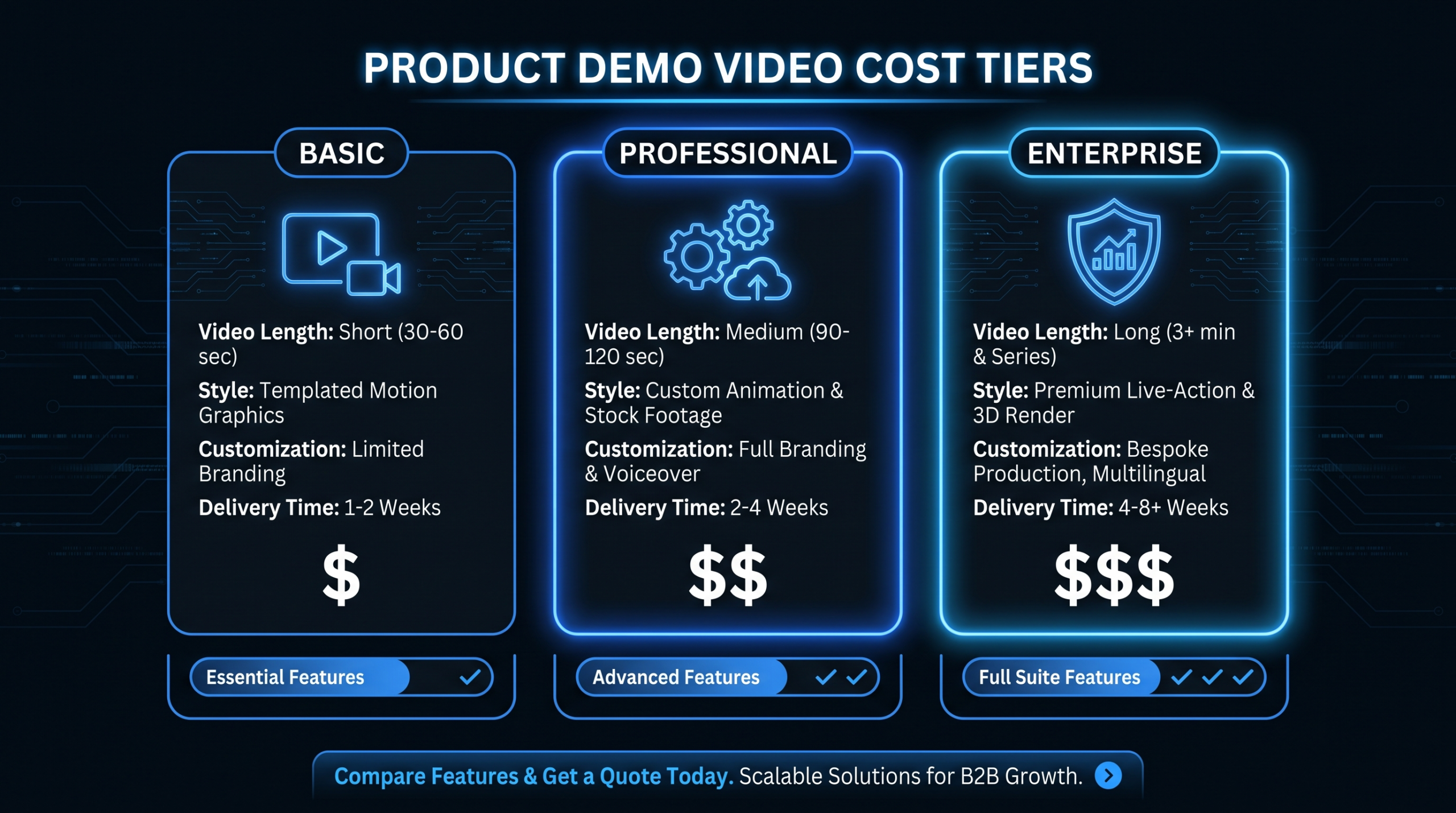
- $1K: Freelancer edit of screen recordings + basic motion. Functional but generic. Good for early-stage testing or internal use.
- $5K: Agency-quality production with custom motion graphics, polished script, and 2–3 revision rounds. Converts at a meaningful rate on landing pages and in sales sequences.
- $15K: Full-service: custom animation, directed professional VO, sound design, brand-matched visuals, and multi-format delivery. Built for high-stakes placements — website hero, paid ads, enterprise sales decks.
Table of Contents
- What Product Demo Video Cost Actually Covers
- The $1K Budget: What You Actually Get
- The $5K Budget: Where Quality Becomes Reliable
- The $15K Budget: Full-Service Demo Production
- All Three Tiers at a Glance
- What Actually Drives Demo Video Costs
- Budget Decision Framework
- One-Off vs. Ongoing Demo Video Program
- FAQ
The question "how much does a product demo video cost?" gets a frustratingly wide range of answers. You'll find freelancers offering $200 screen-recording edits and agencies quoting $40,000 for fully animated productions. Neither end of that spectrum is useful when you're trying to make a real budget decision.
This guide focuses on three realistic, meaningful budget tiers for SaaS and B2B product demo videos: $1K, $5K, and $15K. At each tier, you'll find out exactly what production elements you can expect, what you're trading off, and who each tier actually makes sense for. No vague ranges — concrete expectations so you know what you're buying before you commit.
The goal isn't to find the cheapest option. It's to match your budget to your use case so your demo video actually does its job: convert prospects into customers.
What Product Demo Video Cost Actually Covers
Before comparing tiers, it's worth being precise about what goes into a product demo video budget. The total cost breaks into five categories:
- Pre-production: Scripting, storyboarding, style direction, screen flow planning. This is the strategic work that determines whether the video is effective — not just whether it looks good.
- Post-production editing: Assembly of footage, pacing, transitions, color grading, captions.
- Motion graphics: Animated callouts, feature highlights, UI zoom-ins, kinetic text, custom animations. This is often where the biggest cost delta occurs between tiers.
- Voiceover: Script recording (professional VO artist vs. AI-generated), sync, and audio mixing.
- Revisions: How many rounds of feedback are included before overage charges apply.
The ratio of time and resources spent on each category changes dramatically across the three tiers. At $1K, you're essentially paying for post-production editing and basic motion only. At $15K, all five categories receive serious attention.
For a full breakdown of how editing time translates to per-minute cost, see our guide on video editing cost per minute.
The $1K Budget: What You Actually Get
A $1,000 product demo video is achievable. It's also honest to say that at this budget, you're accepting real tradeoffs that will be visible in the final product.
Production Specs at $1K
$1K Demo Video — Typical Deliverables
| Element | What to Expect |
|---|---|
| Script | You write it, or it gets a light editorial pass on your draft |
| Screen recording | Your raw recordings (Loom, Camtasia) — editor works from what you supply |
| Motion graphics | Template-based callouts, zoom-ins, lower thirds. Limited custom animation |
| Voiceover | AI-generated VO or you provide your own recording |
| Sound design | Background music track from a stock library. No custom sound effects |
| Duration | 60–120 seconds of finished video |
| Revisions | 1–2 rounds included |
| Turnaround | 5–10 business days from final assets |
| Formats | Usually 1 format (16:9). Additional formats cost extra |
Who Does the Work at $1K
At this budget, you're working with an individual freelancer — typically a mid-level video editor with a motion graphics toolkit. You're not getting a dedicated team, creative direction, or strategic input on your script. The editor's job is to execute what you hand them as efficiently as possible.
On platforms like Upwork, a competent freelancer in this range might have a base rate around $30–50/hour. A 2-minute demo at this quality level commonly takes 15–25 hours of editing time. That math checks out for a $1K budget without much room for anything extra.
What You're Sacrificing at $1K
The limitations at this tier are real and predictable:
- No strategic script input. A poorly structured demo script produces a well-edited video that doesn't convert. The edit can't save a script that doesn't lead the viewer through a clear problem → solution → CTA flow.
- Template motion graphics look like template motion graphics. If your UI is complex or your differentiation is nuanced, generic callouts won't communicate it effectively.
- AI voiceover is detectable. It's improved dramatically, but attentive viewers — including enterprise buyers — still notice. It signals a certain production tier.
- No format variations included. A 16:9 website version is one thing. If you also need a 9:16 social cut and a 1:1 LinkedIn version, budget more.
- Revision rounds run out fast. If your first review generates significant feedback, you'll likely pay for additional rounds.
When $1K Is the Right Call
- You're pre-PMF and testing whether video helps conversion at all
- The video is for internal sales training or low-stakes onboarding, not your homepage
- You need a rough proof-of-concept before pitching the board for a larger video budget
- You have a single simple feature to demonstrate — not your full product
Don't put a $1K demo video on your homepage hero or in a paid ad campaign targeting enterprise buyers. The production signals will undermine your positioning before a word is spoken.
The $5K Budget: Where Quality Becomes Reliable
Five thousand dollars is a meaningful threshold for product demo video cost. At this budget, you're getting a small team working on the project, genuine script development, and custom motion graphics that match your brand — not Envato templates.
Production Specs at $5K
$5K Demo Video — Typical Deliverables
| Element | What to Expect |
|---|---|
| Script | Full script development with agency input — problem framing, benefit-led structure, CTA language |
| Screen recording | Agency may produce recordings or direct your team on specific flows to capture |
| Motion graphics | Custom animated callouts, feature highlight sequences, branded lower thirds, UI zoom transitions |
| Voiceover | Professional human VO artist from a vetted roster |
| Sound design | Curated music track, light sound effects, professional audio mix |
| Duration | 90 seconds – 3 minutes of finished video |
| Revisions | 2–3 rounds included |
| Turnaround | 10–15 business days from kickoff |
| Formats | 16:9 primary + 1 cut-down. Social variants typically cost extra |
Who Does the Work at $5K
At $5K, you're typically engaging a small video agency or a senior editor who subcontracts motion graphics work. A common team structure for a $5K project: a senior editor (strategic, handles script + overall cut), a motion graphics designer (builds custom elements), and a project manager handling communication and timelines.
This is the tier where you start getting people who have produced demos for SaaS products before and understand concepts like feature reveals, benefit framing, and how to make a UI walkthrough not feel like a screen recording tour. The difference in conversion between a generic demo and a strategically structured one can be dramatic — Wistia's research on video engagement consistently shows that viewer drop-off rates are highly sensitive to the pacing and narrative decisions made in post-production.
The Quality Jump Is Real at $5K
The gap between a $1K and a $5K demo isn't just cosmetic. Here's what changes structurally:
- Script strategy changes the outcome. A $5K production team will push back on weak value propositions and restructure the demo narrative to lead with the buyer's pain point, not your feature list.
- Custom motion graphics match your brand. Callout boxes use your typography, brand colors, and visual language. The video looks like it belongs on your website.
- Human VO changes perception. Enterprise buyers process production quality as a proxy for product quality. A professional voice artist reading a well-crafted script signals a different category of company than AI voiceover over a Loom recording.
- You get real creative feedback. The team will flag if your planned feature walkthrough is confusing, if a sequence doesn't land, or if the pacing feels off. At $1K, the editor follows your brief. At $5K, they improve it.
For SaaS teams thinking about the broader demo video strategy beyond individual video cost, our product demo video production guide covers script frameworks, demo length optimization, and placement strategy.
When $5K Is the Right Call
- The video will live on a landing page, product page, or be used in outbound sales sequences
- You're post-PMF and have validated that video helps your pipeline
- You're targeting mid-market or enterprise buyers who evaluate vendors carefully
- You need a video that can run for 12+ months without looking dated
The $15K Budget: Full-Service Demo Production
A $15,000 product demo video is a significant investment. At this tier, you're not just buying a better version of what you get at $5K — you're buying a fundamentally different process that encompasses strategy, animation, production design, and post-production as integrated disciplines.
Production Specs at $15K
$15K Demo Video — Typical Deliverables
| Element | What to Expect |
|---|---|
| Script | Full discovery, messaging strategy, narrative arc development, multiple draft rounds |
| Visual approach | Custom storyboard, style frames, bespoke UI animation (not just screen recordings) |
| Motion graphics | Full custom animation: character/icon animation, kinetic typography, particle effects, multi-layer compositing |
| Voiceover | Professional talent selection, multiple takes, directed recording session |
| Sound design | Custom sound design, licensed music, full audio mastering |
| Duration | 2–4 minutes of finished video (often with chapter structure) |
| Revisions | 3–5 rounds at multiple stages: script, animatic, rough cut, final |
| Turnaround | 4–8 weeks from kickoff |
| Formats | Multiple deliverable formats included: 16:9, 9:16, 1:1, :30 and :60 cut-downs |
What "Full-Service" Actually Means
At $15K, the agency functions as a production partner, not a vendor executing a brief. The process typically includes:
- Discovery call + messaging audit. The team reviews your positioning docs, ICP profile, and competitive landscape before writing a single word of script.
- Script strategy workshop. A structured session to identify the demo's core job: what objection does it need to overcome? What does a converted viewer look like?
- Storyboard + style frames. Visual mockups of key moments before any animation work begins. You approve the visual direction before the expensive production phase starts.
- Staged review cycles. You review an animatic (rough animation with temporary VO) before the full production completes. This catch-early process eliminates expensive late-stage revisions.
- Asset delivery package. Beyond the final video, you typically receive project source files and brand-matched motion templates for future use.
Who Builds It
A $15K production involves a dedicated team: creative director, scriptwriter or strategist, senior animator, editor, sound designer, and project manager. The hours behind a production at this tier commonly run 80–150+ depending on complexity.
Teams capable of producing at this level have deep SaaS-specific experience. They understand the difference between a feature walkthrough and a benefit demonstration. They know how to animate a complex dashboard in a way that shows users what they want to see — not just what the UI contains. See our SaaS video production guide for what separates demo videos that generate pipeline from ones that just look polished.
When $15K Is the Right Call
- The video is your website hero or primary product marketing asset
- You're spending $20K+/month on paid acquisition and need ad creative that converts at enterprise CPAs
- You're raising a funding round or entering a new market where first impressions are critical
- Your product is complex and requires visual storytelling beyond UI recordings to communicate value
- You need a suite of videos (hero demo + feature spotlights + persona-specific cuts) from one production run
Product Demo Video Cost at a Glance
Here's the full tier comparison in one place — production quality, production specs, and best-fit scenario for each budget:
Product Demo Video Cost: $1K vs $5K vs $15K
| Element | $1K Tier | $5K Tier | $15K Tier |
|---|---|---|---|
| Script | You write it | Agency develops | Strategy + full development |
| Motion graphics | Templates | Custom, brand-matched | Full custom animation |
| Voiceover | AI or self-recorded | Pro human VO | Directed pro VO session |
| Sound design | Library music only | Music + light SFX | Custom sound design + mastering |
| Duration | 60–120 sec | 90 sec – 3 min | 2–4 min + cut-downs |
| Revisions | 1–2 rounds | 2–3 rounds | 3–5 rounds, staged |
| Turnaround | 5–10 days | 10–15 days | 4–8 weeks |
| Format variants | 1 format | 1–2 formats | Multiple included |
| Team | 1 freelance editor | Editor + motion + PM | Full production team |
| Creative direction | None | Limited | Full, with approval stages |
| Best for | Testing, early-stage, internal | Mid-market sales and landing pages | Hero assets, enterprise, paid ads |
The table reveals that cost-to-value scaling isn't linear. The $5K tier represents a significant quality step up from $1K. But the jump from $5K to $15K is more about scope and process complexity than pure output quality — many $5K productions can compete with $15K on final appearance for straightforward demos. The $15K tier earns its cost on complex products, high-stakes placements, and when you need a multi-format suite from a single production run.
What Actually Drives Demo Video Costs
Understanding the cost levers helps you get more video for your budget — or negotiate smarter with vendors.
Animation Complexity
This is the single biggest cost driver. A screen recording with zoom-ins and callouts might take 10–15 hours of motion work. A fully animated product walkthrough with custom UI rendering, icon animation, and kinetic text can take 60–100+ hours. If your product has a clean, intuitive UI that reads well on screen, lean on real recordings. If your UI is complex or your differentiation is abstract, animation earns its cost.
Script Development
A strategically strong script is disproportionately valuable relative to its production cost. The difference between a script that leads with your feature set and one that leads with the buyer's problem is often the difference between a video that gets watched 30% through and one that gets watched 80% through. Paying extra for a genuine copywriter or strategist on the script phase is almost always worth it relative to the total production spend.
Voiceover Approach
AI voiceover saves $300–800 per project and is increasingly acceptable for internal tools and early-stage demos. For enterprise sales assets, the marginal cost of a professional human VO artist is worth it. VO cost at this level typically runs $200–600 for a 2–3 minute script including revision takes.
Revision Rounds
Scope creep on revisions is one of the most common reasons demo video projects go over budget. If your internal stakeholders have different opinions about what the demo should communicate, resolve those before briefing the production team. A project that should take 2 revision rounds can require 4–5 if internal alignment is weak — and most agency contracts charge for rounds beyond what's included.
Format Variations
A 16:9 master is the baseline. If you want a 9:16 vertical cut for LinkedIn or Instagram, a 1:1 square format, and a :30 cut-down for paid ads, you're adding 30–50% to production time. Bundle format variants into your initial brief to negotiate a package price rather than treating them as add-ons after delivery.
For more detail on how editing time is priced across different formats and complexity levels, see our video editing cost per minute breakdown.
Budget Decision Framework
Use this checklist to determine which tier fits your situation before committing to a production budget:
Demo Video Budget Decision Checklist
| Question | → $1K if... | → $5K if... | → $15K if... |
|---|---|---|---|
| Where will it live? | Internal, sales deck, low-traffic page | Product page, landing page, outbound sequences | Homepage hero, paid ads, enterprise sales |
| Who's the audience? | Existing users, warm leads | Mid-market buyers evaluating options | Enterprise, investors, or high-CPM paid audiences |
| Product complexity? | Simple, intuitive UI | Moderate — needs selective highlighting | Complex, abstract, or highly differentiated |
| Company stage? | Pre-seed to Seed, testing | Series A–B with defined marketing budget | Series B+ with video ROI data |
| Shelf life? | 6–12 months (expect rebuild) | 12–24 months with minor updates | 24–36 months as a core asset |
| Format needs? | One format only | 1–2 formats, plan in advance | Multi-format suite needed from day one |
A practical rule: if the video will be shown to buyers you'd spend more than $500 of sales rep time to reach, the video's production value should reflect that investment. Using a $1K video as the primary demo asset for an enterprise deal with a $50,000 ACV is a poor use of leverage.
The demo video isn't just explaining your product — it's making a claim about what kind of company you are. The production tier you choose broadcasts that claim before a single word is spoken.
One-Off vs. Ongoing Demo Video Program
Most SaaS companies make the mistake of treating demo videos as one-off projects. They invest $5K–15K in a flagship demo, then use it unchanged for two years while their product evolves, their messaging sharpens, and their competitive landscape shifts.
A more effective approach is to treat demo video as a program rather than a project:
- Flagship hero demo ($5K–15K, once or twice per year): Your primary brand-forward product narrative. Updated when positioning changes significantly or a major product release warrants it.
- Feature demos ($1K–3K, monthly or quarterly): Quick, focused walkthroughs of specific features for sales enablement, onboarding, and product marketing.
- Persona or use-case cuts ($1K–2K each): Edits of the flagship demo that emphasize different pain points for different ICPs — same underlying content, different narrative framing.
This program approach unlocks economies of scale that one-off budgeting misses. A dedicated team relationship — like those offered through Video Editing Company's Growth and Core plans — can handle both the high-production flagship and the rapid-turnaround feature demos within a single monthly arrangement, rather than rebriefing a new vendor every time. For a comparison of how retainer and dedicated team models work at scale, our video production agency pricing models guide covers the math in detail.
The benefit of the program approach is version control: each demo is designed to replace its predecessor, not accumulate alongside it. Your buyers always see the most current version of your product story. For teams considering how to structure ongoing outsourced video production, our guide on how to outsource video editing covers how to build a vendor relationship that keeps quality high without micromanagement.
Want to see what these budgets buy? Watch 10 official demos in our 15 SaaS demo video examples, broken down by hook, pacing, structure, voiceover and CTA.
Frequently Asked Questions
What is the average cost of a product demo video?
For SaaS and B2B companies, product demo video cost typically ranges from $1,000 for a basic freelancer-produced edit to $15,000–25,000 for a full-service agency production. The most common budget range that teams report getting strong ROI from is $4,000–8,000 — enough for professional motion graphics, real VO, and proper script development without the full bespoke animation cost of the $15K+ tier.
Can I get a good demo video for under $1,000?
You can get a functional one. Loom-style recordings with minimal editing commonly run $200–500 and work for internal onboarding, warm lead walkthroughs, and low-stakes use cases. But for anything a buyer will encounter during their evaluation process, sub-$1K production typically signals a quality level that undermines trust rather than building it — especially in competitive categories where alternatives have invested in professional demos.
How long should a product demo video be?
Length depends on placement. Homepage hero demos typically perform best at 60–90 seconds — enough to establish the problem, show the core workflow, and land a CTA. Deeper product demos used in email sequences or on dedicated product pages can run 2–4 minutes effectively. Demos used inside the product for onboarding tend to be shorter: 30–60 seconds per feature. Research from Wistia's video engagement benchmarks shows engagement drop-off accelerates significantly past the 2-minute mark for top-of-funnel video.
How do I get the most out of a $5K demo video budget?
Three moves that consistently improve return on a $5K production: (1) Come to the kickoff with a written brief that includes your ICP's top three pain points, your top three differentiators, and the specific action you want a viewer to take after watching. (2) Consolidate stakeholder feedback before your first revision round — nothing burns through included rounds faster than sequential feedback from multiple internal reviewers. (3) Plan format variants from day one rather than requesting them as add-ons after production. Many agencies will include an additional cut for a small upcharge if you negotiate it at project kickoff rather than asking post-delivery.
Does product demo video cost change based on industry?
Somewhat. Products with complex UIs — fintech dashboards, enterprise analytics, security platforms — tend to cost more to produce well because the UI itself doesn't communicate clearly on a raw screen recording. It requires deliberate highlighting, zooming, and often simplified "hero UI" overlays to guide the viewer's eye. Consumer-facing SaaS with clean, modern interfaces typically has lower production complexity and can be done effectively at the lower end of each tier. Regulatory requirements such as data masking or compliance-specific screenshot handling can also add cost at any tier.
For real examples of app demo and promo videos at each budget tier, see our app demo and promo video examples guide — five verified real-world videos analyzed from $500 freelancer cuts to $80K+ studio productions.
Know Your Budget. Not Sure What to Prioritize?
Talk to our team about building a demo video program — from a flagship hero demo to rapid-turnaround feature walkthroughs — structured around your content calendar and budget tier.
Book a Free Strategy Call See Our Plans and Pricing