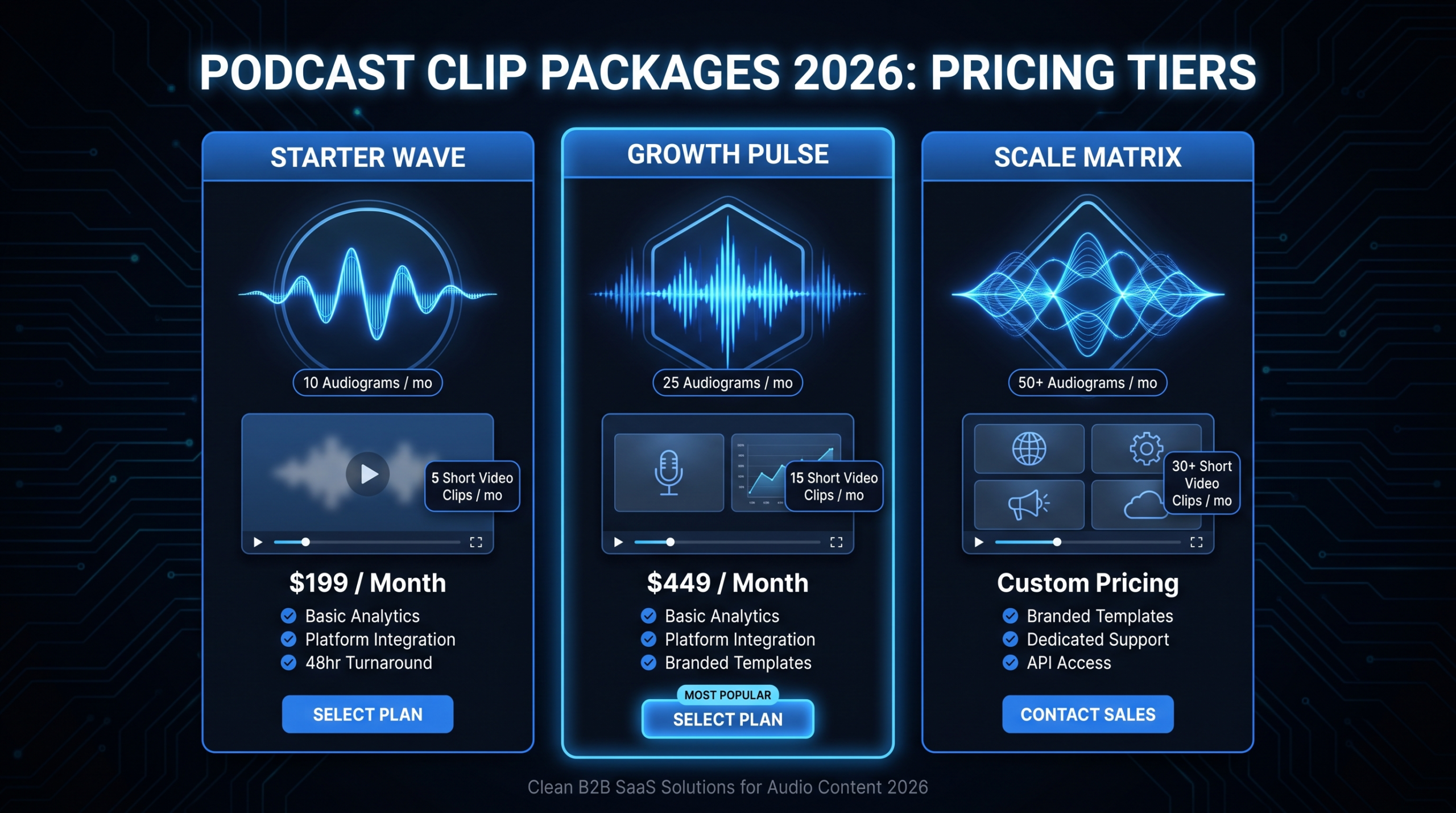
Podcast Clip Packages: 2026 Pricing
TL;DR — What to Expect to Pay
- Basic clip package (3–5 clips, captions, single format): $150–$350/episode
- Standard package (5–8 clips, audiogram, multi-format): $350–$700/episode
- Full repurposing package (8–12 clips + audiograms + hook variants + show notes): $700–$1,500/episode
- Monthly retainer — B2B Growth (4–8 episodes, full scope): $2,000–$4,000/month
- Monthly retainer — Scale (12–30+ episodes, multi-show): $6,000–$15,000/month
- Key cost drivers: episode length, clip count, audiogram complexity, platform format count, turnaround time, caption quality tier
Table of Contents
- What's in a Podcast Clip Package
- Pricing at a Glance: 2026 Market Rates
- What Drives the Cost of Podcast Clips
- Short Clips, Audiograms, and Full Repurposing Packages
- Platform Formats and Their Impact on Price
- Batch Pricing and Monthly Retainers
- Budget Scenarios: Starter, Growth, and Scale
- Revision Scope: What to Negotiate
- Frequently Asked Questions
Podcast clip packages have become one of the fastest-growing video editing services for B2B teams — and one of the most confusing to price. A "podcast clips package" can mean anything from five raw cuts of a 45-minute episode to a full content-repurposing system with captioned reels, audiograms, hook variants, show notes, and platform-specific crops — all delivered on a weekly cadence.
The gap between those two things can be $200 or $2,000 per episode. This guide maps the real pricing landscape for 2026, explains what actually drives cost, and helps you determine exactly what scope makes sense for your team's goals — whether you're running a B2B podcast, creator channel, SaaS company, agency, or executive thought-leadership program.
What's in a Podcast Clip Package
A podcast clip package is a bundle of deliverables produced from a single recorded episode. The specific scope varies significantly by vendor and tier, but here's what the market means by each deliverable type — and what distinguishes the low end from the high end of each.
Short Video Clips
The foundational deliverable. An editor watches the raw recording, identifies the highest-value moments — a sharp insight, a memorable framework, a bold take — cuts them to 60–90 seconds for LinkedIn and YouTube Shorts or 15–30 seconds for TikTok and Instagram Reels, applies burned-in captions, and exports in your platform format. Most packages deliver 3–10 clips per episode. The editorial judgment required to find genuinely shareable moments (versus just transcribing the first 90 seconds) is what separates $150/episode packages from $600/episode packages.
Audiograms
Animated waveform overlays on a branded background or static image, typically square or portrait-format. Originally popularized on Twitter/X and LinkedIn, audiograms signal "audio content worth hearing" to scrollers — a waveform animation is a recognized visual cue that lifts play rates versus a plain text card or static image. Quality ranges from template-based waveform animations with auto-captions at the low end to custom-designed animated compositions with manual caption timing and color variants at the high end.
Captioning
Burned-in or SRT subtitles synchronized to speech. Caption quality tier matters significantly for B2B and executive content: auto-generated captions from tools like Descript are fast and cost-efficient but vary in accuracy depending on audio quality, accents, and technical vocabulary. Human-reviewed captions — where an editor corrects the auto-generated transcript before burning it in — cost more but are standard for executive podcasts, technical B2B material, and any context where a misquote would undermine credibility.
Hook Variants
Alternative intro cuts for the same clip, designed to test different angles on the same content moment. A strong podcast clip might be packaged with two or three hook variants targeting different audience pain points or personas. Hook variants are most common in full repurposing packages or executive thought-leadership programs where A/B testing distribution is part of the content strategy.
Show Notes and Snippet Support
Written summaries, pull quotes, chapter timestamps, and SEO-optimized descriptions derived from the episode transcript. Some podcast clip vendors include lightweight written deliverables as part of full repurposing packages; many don't touch written content at all. If you want show notes, LinkedIn post captions, or pull-quote carousels alongside your video clips, confirm explicitly whether these are in scope before signing — most per-episode pricing does not include them by default.
Pricing at a Glance: 2026 Market Rates
Podcast clip pricing spans a wide range depending on scope, volume, and vendor type. Here's how the market breaks down for the primary package tiers in 2026:
Podcast Clip Package Pricing by Scope Tier
| Package Tier | Scope | Per-Episode Rate |
|---|---|---|
| Basic | 3–5 short clips, auto-captions, single platform format | $150–$350 |
| Standard | 5–8 clips, audiogram (1–2), manual captions, 2 platform formats | $350–$700 |
| Full Repurposing | 8–12 clips, audiograms, captions, hook variants, show notes snippet, 3 formats | $700–$1,500 |
| Enterprise / Agency | 12+ clips, all formats, custom audiograms, manual QA, batch delivery coordination | $1,500–$2,500+ |
For monthly programs with four or more episodes, batch and retainer pricing typically reduces per-episode cost by 25–40% versus standalone rates. See the batch pricing and retainer section for the math.
Podcast Clip Pricing by Vendor Type
| Vendor Type | Monthly Range | Best For | Key Limitation |
|---|---|---|---|
| Freelancer (Upwork / Fiverr) | $200–$1,500 | Creator-stage, single-format clips | Availability gaps, no brand templates, inconsistent editorial eye |
| Video editing subscription | $1,500–$4,000 | High-volume social clips, fast turnaround | Sequential queue limits throughput; complex scopes often out of tier |
| Podcast production agency | $2,000–$6,000 | Done-for-you audio + video + distribution | Video quality varies; most built around audio-first workflows |
| Dedicated video editing team (retainer) | $3,000–$15,000 | B2B podcasts, exec thought leadership, SaaS programs needing brand consistency at volume | Higher monthly floor; best value at 4+ episodes/month or multi-format output |
For a broader view of how these vendor models compare across video types, see our breakdown of video editing services and what's included at each tier.
What Drives the Cost of Podcast Clips
The most common pricing mistake is comparing package prices without comparing scope. Two vendors quoting $500/episode may be delivering five clips in one format versus ten clips in three formats with custom audiograms. Here's what actually moves the needle on podcast clip cost:
Episode Length
Longer episodes produce more raw footage to review and more potential clips to surface — but also require proportionally more editor time to watch, evaluate, and select. A 30-minute episode is roughly 2–3× faster to clip than a 90-minute deep-dive. Most per-episode quotes assume 45–60 minutes of source material; episodes significantly longer than that often incur a time surcharge or expanded-scope clause. Confirm what "episode length" your vendor's base pricing assumes before comparing quotes.
Clip Count per Episode
Going from 5 clips to 12 clips per episode doesn't double the price, but it does increase it materially — typically 50–80% more, depending on the complexity of each clip selection, the caption work involved, and the number of platform format variations. Define the clip count explicitly in any scope document, and note whether "clips" means raw video cuts only or fully captioned, exported, platform-ready deliverables.
Audiogram Complexity
A simple static audiogram — branded template, waveform animation, auto-captions — is substantially cheaper than a custom-designed animated audiogram with motion graphics, manual caption timing, and multiple color or layout variants. Template-based audiograms work well for consistent weekly cadences; custom-designed audiograms are standard for executive content and high-production thought-leadership programs. Know which tier you're buying before comparing prices.
Caption Quality Tier
Auto-generated captions are fast and cost-efficient, but accuracy varies with audio quality, speaker accents, and domain-specific terminology. For executive podcasts and technical B2B content where a misquote or misspelling undermines authority, human-reviewed captions — where an editor corrects the machine transcript before export — are the standard. Expect to budget an additional $25–$80 per episode for thorough manual caption review on top of base clip pricing.
Platform Format Variations
One clip repurposed into 16:9 (YouTube), 9:16 (TikTok/Reels/Shorts), and 1:1 (LinkedIn/Instagram feed) is three separate exports — and often three separate editorial decisions about framing, panning, and caption placement. Each additional format adds cost per clip. Teams publishing to three or more platforms should expect a format multiplier of 1.5–2.5× on base single-format pricing when scoping all required crops.
Turnaround Time
Standard turnaround for a podcast clip package is 3–5 business days from raw file submission. Rush delivery in 24–48 hours typically adds 25–50% to the base cost. For weekly podcasts that need clips published the same week as the episode, turnaround is a first-order scoping criterion — not an afterthought. Confirm the SLA upfront and note whether the clock starts from raw file upload, from your editorial sign-off, or from revision completion.
Revision Rounds
Most packages include one or two rounds of revisions per clip. Additional rounds typically cost $50–$150 per round per clip at overage rates. If your editorial process involves multiple approvers — founder, marketing lead, compliance — you'll regularly exceed two rounds unless you enforce consolidated, simultaneous feedback passes. Negotiate the revision policy explicitly rather than discovering overage charges mid-engagement.
Short Clips, Audiograms, and Full Repurposing Packages
These three product types serve different distribution goals and carry different price points. Understanding the distinction prevents scope misalignment when comparing vendors.
Short Video Clips
The minimum viable podcast clip service. An editor selects the most quotable, shareable moments from a recording, cuts them to platform-appropriate lengths, applies captions, and delivers in your requested format. The value is in editorial judgment: which moments are actually worth clipping, and how to frame the clip so it plays without the full episode context. Base packages in this tier typically deliver 3–8 clips per episode.
Cost range: $50–$120 per clip at per-unit rates; $150–$400/episode in bundled packages at 5 clips per episode; $250–$600/episode at 8 clips per episode with standard captioning.
Audiograms
Short audio or video clips formatted with an animated waveform, layered over a branded card or background. Used primarily on LinkedIn and Twitter/X where square or vertical video performs well. The waveform animation functions as a visual signal — it tells the scroller "this is audio content worth unmuting." Template-based audiograms are faster and cheaper; custom-designed animated audiograms with motion graphics are more expensive but produce a more premium-feeling asset for executive content.
Cost range: $40–$100 per audiogram at per-unit rates; bundled as 2–4 audiograms per episode in the $100–$300 add-on range. Custom animated audiograms with motion graphics run $150–$400 each.
Full Repurposing Packages
A full repurposing package treats the podcast episode as a content engine. From one 60-minute recording, it extracts: 8–12 short video clips in multiple platform formats, 2–4 audiograms, fully reviewed burned-in captions, hook variants for the top clips, and a show notes snippet or pull-quote carousel for LinkedIn distribution. The operating logic is that a single recording session should generate 30–60 individual content pieces, amortizing the production cost across a month's worth of distribution activity.
Cost range: $700–$1,500/episode standalone; $400–$900/episode in a monthly retainer at four or more episodes per month. For B2B SaaS companies, agencies, and executive thought-leadership programs where each episode is a high-production asset, this tier is the standard operating model.
For a framework on how to structure the vendor relationship for ongoing repurposing work, see our guide on how to outsource video editing effectively.
Platform Formats and Their Impact on Price
Platform format requirements directly multiply your cost — and are frequently underspecified in RFPs. Each platform has distinct aspect ratio requirements, and a single clip may need three or four separate exports to perform well across channels.
Podcast Clip Platform Format Reference (2026)
| Platform | Preferred Format | Optimal Duration | Caption Approach |
|---|---|---|---|
| YouTube Shorts | 9:16 vertical | 15–60 sec | Burned-in or YouTube auto-generated |
| LinkedIn (video) | 1:1 square or 4:5 portrait | 30–90 sec | Burned-in (mobile-first, silent viewers) |
| Instagram Reels | 9:16 vertical | 15–90 sec | Burned-in recommended |
| TikTok | 9:16 vertical | 15–60 sec | Burned-in or TikTok auto |
| Twitter / X | 16:9 or 1:1 | Under 140 sec | Burned-in optional but lifts watch rate |
| YouTube (long-form companion clip) | 16:9 landscape | 2–5 min highlight | SRT upload or auto-generated |
Teams publishing to three or more platforms from a single episode should expect a format multiplier of roughly 1.5–2.5× on base single-format pricing. A clip package priced at $300/episode for LinkedIn-only 1:1 delivery might cost $500–$750 when expanded to LinkedIn + YouTube Shorts + Instagram Reels, because each crop often requires re-framing the subject, adjusting caption position, and a separate export pass.
How to Scope Platform Formats in Your RFP
List platforms and aspect ratios explicitly, not generically. "All major platforms" is not a scope definition — it's an invitation for vendor interpretation and scope creep. Define: which clips need which formats (not every clip necessarily needs every format), how many total format variations per episode, and whether format-switching incurs a per-variation charge or is bundled into the package. This single specification step eliminates the most common pricing disagreement in podcast clip engagements. Recording platforms like Riverside.fm can also auto-generate raw vertical and horizontal recordings simultaneously, which simplifies the editor's framing task and can reduce format variation costs slightly.
Batch Pricing and Monthly Retainers
The most cost-efficient structure for ongoing podcast clip production is a batch commitment — either a monthly retainer or episode-bundle pricing. The per-episode rate drops materially once you commit to four or more episodes per month.
Per-Episode vs. Batch Pricing
Batch Pricing Comparison: Standard Package (5–8 Clips + Captions + 2 Audiograms)
| Volume Commitment | Effective Per-Episode Rate | Estimated Monthly Total |
|---|---|---|
| 1 episode/month (one-off) | $500–$700 | $500–$700 |
| 2 episodes/month (bi-weekly) | $400–$580 | $800–$1,160 |
| 4 episodes/month (weekly, batch rate) | $325–$500 | $1,300–$2,000 |
| 8 episodes/month (retainer tier) | $250–$400 | $2,000–$3,200 |
| 16+ episodes/month (agency/SaaS scale) | $175–$300 | $2,800–$4,800 |
The batch rate break at four episodes per month is the clearest value threshold. If your podcast publishes weekly, you are automatically in the batch tier — negotiate accordingly rather than accepting per-episode rack rates. Most reputable vendors will offer a 20–35% per-episode discount for a monthly commitment versus one-off pricing.
Monthly Retainer Models for Podcast Clips
A monthly retainer reserves dedicated editing capacity for your program, usually with a defined number of episodes, clips per episode, and platform formats per month. Retainers suit teams with consistent publishing cadences (weekly, bi-weekly) and multi-format output requirements where a rotating pool of freelancers introduces too much variability.
Monthly Podcast Clip Retainer Tiers
| Tier | Episodes / Month | Scope per Episode | Monthly Rate Range |
|---|---|---|---|
| Creator | 2–4 | 5 clips + captions, single format | $600–$1,500 |
| B2B Growth | 4–8 | 8 clips + audiograms + captions + 2 platform formats | $2,000–$4,000 |
| Exec Thought Leadership | 4–12 | 10+ clips + custom audiograms + hook variants + show notes snippet + 3 formats | $4,000–$8,000 |
| Agency / SaaS Scale | 12–30+ | Full repurposing suite, team-based delivery, QA review, multi-show coordination | $6,000–$15,000 |
Teams scaling beyond eight episodes per month — or running multi-show programs with separate brand guidelines per show — typically benefit from a dedicated video editing team operating as an embedded content partner rather than a subscription queue. VEC's retainer model is built for exactly this: a senior editor, project manager, and defined delivery SLA matched to your publishing cadence. Growth plan starts at $5K/month; see the VEC pricing page for full tier details.
Turnaround SLAs: What to Confirm Before Signing
Standard retainer turnaround for a podcast clip package is 3–5 business days from raw file submission. Premium and agency-tier retainers typically offer 24–48 hour delivery. Before committing, confirm what "3 business days" means in practice: does the clock start from your raw upload, from your editorial approval of a rough cut, or from your final revision sign-off? The answer can shift your actual publication timeline by a full week.
Budget Scenarios: Starter, Growth, and Scale
Here's how three real-world B2B podcast programs typically structure their podcast clip budgets in 2026:
Scenario A — Starter (Early-Stage SaaS or Creator, 2 Episodes/Month)
Goal: Test clip distribution without a major commitment. Publish to LinkedIn and YouTube Shorts from a bi-weekly show without a dedicated in-house video editor.
- Scope: 5 clips per episode, 1:1 and 9:16 formats, auto-captions
- Episodes per month: 2
- Estimated monthly cost: $600–$1,200
- Best vendor type: Freelancer with podcast editing experience or entry-tier subscription service
- Typical constraint: No brand template consistency without explicit design brief
Scenario B — Growth (Series B SaaS or B2B Agency, 4–6 Episodes/Month)
Goal: Consistent weekly distribution across LinkedIn, YouTube Shorts, and Instagram Reels, with audiograms for executive guest episodes and manual caption QC to maintain brand credibility.
- Scope: 8 clips per episode, 3 platform formats, 2 audiograms per episode, human-reviewed captions
- Episodes per month: 4–6
- Estimated monthly cost: $2,500–$5,000
- Best vendor type: Video editing retainer with a dedicated editor and project manager
- Typical constraint: Clip selection quality depends heavily on editor familiarity with your content domain
Scenario C — Scale (Multi-Show Program or Executive Thought Leadership)
Goal: Every episode becomes a full content engine — 30–50 pieces of content from a single recording. Multiple hosts or shows, content repurposed across social distribution, sales enablement, and blog amplification.
- Scope: 12+ clips per episode, all platform formats, hook variants per top clip, show notes snippets, custom audiograms, batch QA review
- Episodes per month: 10–20+
- Estimated monthly cost: $6,000–$15,000
- Best vendor type: Dedicated video editing team with podcast specialization and multi-show workflow systems
- Typical constraint: Requires structured briefing system and clear brand style guide to maintain quality at scale
For a framework on how to structure an outsourced content operation at growth or scale, our guide on how to outsource video editing covers briefing systems, approval workflows, and SLA management in detail.
Revision Scope: What to Negotiate
Revision policies are one of the most common points of friction in podcast clip engagements — and one of the most addressable with upfront negotiation. Here's what standard looks like, what to push for, and where costs typically blow out.
What's Standard in the Market
- One to two rounds of revisions per clip included in base pricing
- A "revision round" is defined as one consolidated feedback pass per deliverable — not one comment at a time
- Turnaround for revision delivery: 1–2 business days
- Additional rounds billed at overage rates (typically $50–$150 per round per clip)
What Well-Structured Contracts Include
- Clear definition of what constitutes a "revision" versus a "new request" — timing adjustments and caption corrections are revisions; changing the selected clip to a different moment in the recording is a new request
- A consolidated feedback window — typically 24–48 hours to submit all notes on a batch delivery, preventing sequential round consumption by multiple stakeholders reviewing at different times
- Explicit per-revision overage rate in the contract, so there are no surprises when rounds are exceeded
When to Negotiate Extra Rounds
If your editorial process involves multiple approvers — a content lead, founder, head of marketing, or legal review — assume you will use more than two rounds. The most cost-effective approach is not to pay for extra rounds upfront, but to enforce a consolidated simultaneous feedback rule: all stakeholders review and submit notes at the same time, in a single pass. Sequential approvals on a two-round contract routinely exhaust the included rounds before the first real editorial revision is even made.
For programs where revision cycles are particularly long — executive content, highly regulated industries, multi-stakeholder review processes — consider a retainer structure where revision rounds are unlimited within a monthly capacity commitment rather than counted per clip. This is a standard option with dedicated editing teams and eliminates per-clip overage costs entirely.
See our full overview of what video editing services include for more detail on how revision scope is typically structured across different engagement models.
Frequently Asked Questions
How much does a podcast clip package cost in 2026?
Podcast clip packages typically range from $150–$700 per episode for standard scopes — 5–8 clips, captions, and one to two platform formats. Full repurposing packages with audiograms, hook variants, and show notes run $700–$1,500 per episode standalone. Monthly retainers for four or more episodes per month bring per-episode costs down to roughly $250–$500, depending on scope and volume commitment.
What's the difference between a podcast clip and an audiogram?
A podcast clip is a short video segment from the episode recording — typically 60–90 seconds with burned-in captions and the speaker's video visible. An audiogram is a visual representation of audio content: an animated waveform displayed over a branded card or background image, usually without video. Audiograms are particularly effective on LinkedIn and Twitter/X, where a waveform animation signals audio content to scrollers who would otherwise scroll past a plain image or text post.
Do podcast clip packages include show notes?
Most standard packages do not include show notes by default. Written deliverables — episode summaries, pull quotes, chapter timestamps, LinkedIn post captions — are typically add-ons or features of full repurposing packages at the $700+/episode tier. If show notes or written snippets are part of your content program, specify this explicitly in your brief and confirm it is in scope before signing. Assuming written deliverables are included is the most common source of post-contract friction in podcast clip engagements.
How many clips should I get per podcast episode?
For a 45–60 minute episode, 5–10 clips is a practical target for most distribution programs. The limiting factor usually isn't the editor's ability to find shareable moments — it's your team's capacity to consistently post, caption, and promote each clip across your channels. Starting with five clips per episode and scaling to eight or ten once your distribution workflow is running smoothly is a common approach for teams building systematic clip publishing for the first time.
What's a realistic budget for a weekly B2B podcast clip program?
A weekly B2B podcast — four episodes per month — with a standard repurposing scope of eight clips per episode, two audiograms, human-reviewed captions, and LinkedIn plus YouTube Shorts formats typically runs $2,000–$4,000/month at batch retainer rates. Executive thought-leadership programs with custom audiograms, hook variants, and show notes support are commonly in the $4,000–$8,000/month range. Multi-show programs with 12 or more episodes per month and full repurposing scope typically budget $8,000–$15,000/month for dedicated editing capacity at that volume.
Need a Podcast Clip Program That Runs on Autopilot?
VEC builds dedicated video editing teams for B2B podcasts, SaaS companies, and executive thought-leadership programs — delivering clips, audiograms, and multi-format repurposing on a consistent weekly cadence. Growth plan starts at $5K/month with a 90-day output guarantee.
Book a Free Strategy Call See Pricing Plans