Offshore vs Nearshore vs Onshore Video Editing
TL;DR
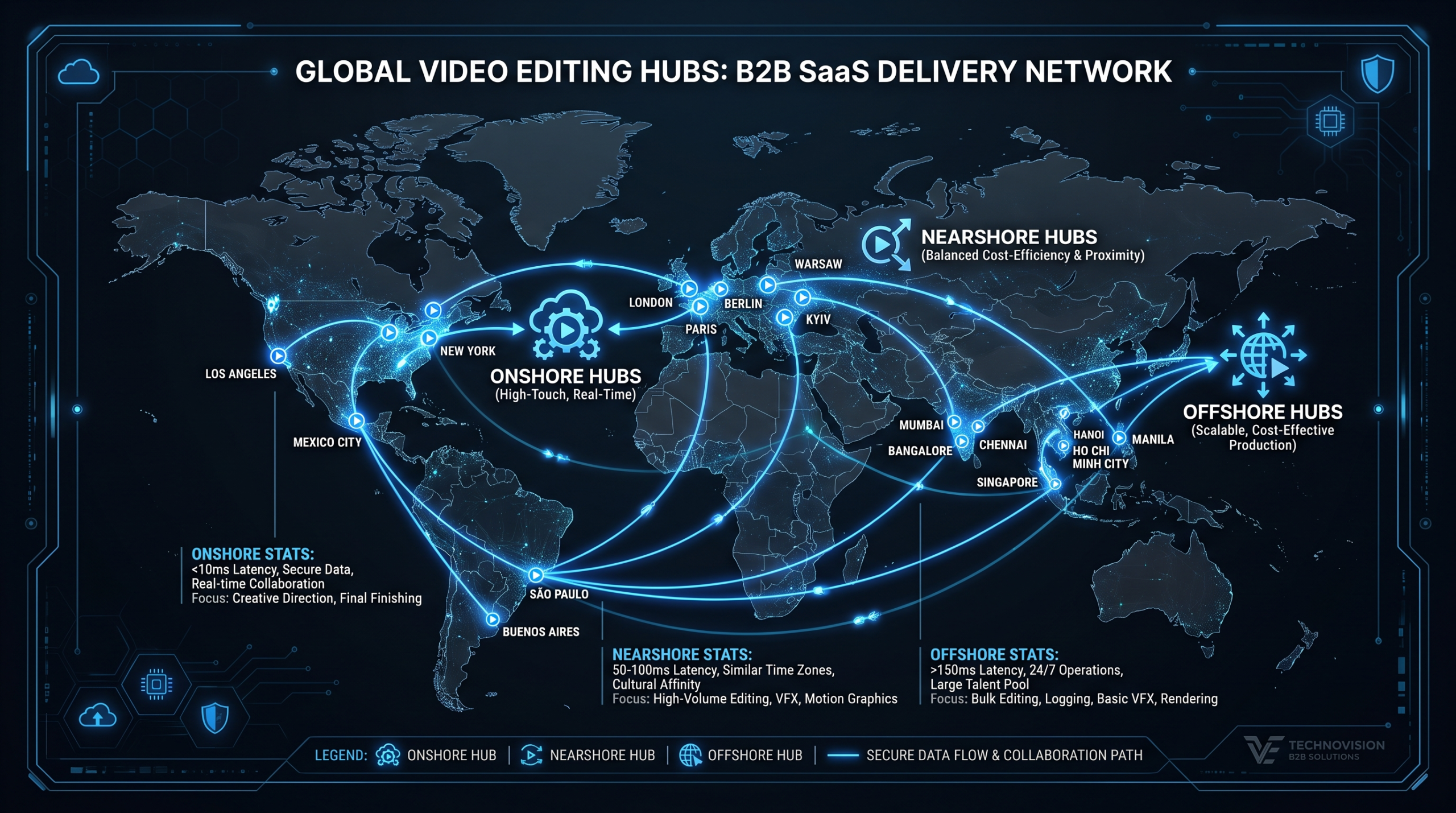
- Offshore video editing (Southeast Asia, South Asia, Eastern Europe) delivers the steepest cost savings — typically 50–70% below US rates — at the cost of time-zone overlap and higher QA investment.
- Nearshore (Latin America, Mexico, Poland) narrows the time-zone gap to 1–5 hours while keeping costs 30–50% below onshore. Best of both worlds for teams that need real-time collaboration.
- Onshore (US, UK, Canada, Australia) costs the most and offers the fastest native feedback loops. Justified when regulatory constraints, security requirements, or cultural nuance are non-negotiable.
- For most B2B SaaS marketing teams, offshore or nearshore with a managed delivery layer (dedicated PM, structured QA, async-first workflow) eliminates 80% of the risk while keeping costs in check.
Table of Contents
When a B2B SaaS marketing team starts scaling video output — product demos, onboarding tutorials, thought leadership content, paid ads — they hit a predictable wall: their internal resources can't keep pace, and hiring full-time editors is expensive and slow. The answer is almost always some form of outsourced offshore video editing, nearshore, or onshore production support.
But "outsource your video editing" covers a spectrum so wide that two companies with the same budget will have completely different experiences depending on which model they choose. A VP of Marketing who picks a purely offshore freelancer team with no structure will have a different (and likely worse) outcome than one who goes with a managed nearshore agency — even at a similar price point.
This guide maps the three models honestly: cost ranges, time-zone realities, quality risks, security considerations, and a clear decision framework for Series A–C SaaS teams. No boosterism for any particular model. The right answer depends on your specific situation.
The Three Models Defined
Before comparing them, it's worth being precise about terminology — because "offshore" and "nearshore" get used interchangeably in vendor marketing, which creates real confusion when you're trying to evaluate options.
Offshore Video Editing
Offshore means your editing team is located in a region with significant time zone difference from your headquarters — typically 8–14 hours. The most common offshore locations for English-language video editing include the Philippines, India, Pakistan, Ukraine, Romania, and Serbia. The defining characteristic isn't just geography — it's the combination of meaningful cost differential and significant time-zone separation that creates both the savings and the coordination challenges.
Nearshore Video Editing
Nearshore refers to teams located close enough geographically (and temporally) to allow real-time or near-real-time collaboration. For US-based companies, nearshore typically means Latin America — Mexico, Colombia, Argentina, Brazil — or for European companies, Poland, Czech Republic, or Portugal. Time zone overlap is typically 4–8 hours, making daily standups and live feedback sessions practical.
Onshore Video Editing
Onshore means your editing team is based in the same country as your marketing team — typically the US, UK, Canada, or Australia. Same time zone, same cultural context, typically native English speakers. Highest cost, lowest coordination friction. For video editing specifically, onshore usually means working with a domestic agency or individual editors at US market rates.
Three Models at a Glance
Offshore
Philippines, India, Eastern Europe. 8–14h time gap. Highest savings, highest coordination lift.
50–70% savings
vs. US onshore
Nearshore
Latin America, Poland, Portugal. 1–5h overlap. Balanced cost and collaboration.
30–50% savings
vs. US onshore
Onshore
US, UK, Canada, Australia. Same time zone. Maximum alignment, maximum cost.
Market baseline
$75–200/hr editors
Cost Ranges: What the Numbers Actually Look Like
Cost is where the offshore vs. nearshore vs. onshore conversation usually starts — and where most comparisons oversimplify. The rate differential is real, but the total cost picture is more nuanced once you factor in management overhead, revision cycles, and quality-control labor.
Our detailed video editing hourly rate by country breakdown goes deep on the global rate card. Here's the summary for the three models:
Offshore vs Nearshore vs Onshore: Cost Comparison (2026)
| Model | Editor Hourly Rate | Managed Team Monthly (Sr+Jr+PM) | Effective Cost Reduction |
|---|---|---|---|
| Onshore (US) | $75–200/hr | $18,000–35,000/mo | Baseline |
| Nearshore (LATAM) | $35–75/hr | $9,000–18,000/mo | 30–50% |
| Offshore (SEA/Eastern EU) | $15–45/hr | $5,000–12,000/mo | 50–70% |
These ranges are wide for a reason. A mid-level editor in Colombia charges very differently from a senior editor in Mexico City. A Philippine agency with strong US clients and a dedicated QA layer charges more than an unvetted freelancer on the same island. The model tells you where to look — the specific vendor determines what you actually pay and get.
The Hidden Cost Variable: Management Layer
What the rate card misses is the management overhead that varies dramatically by model. Offshore teams working asynchronously across a 12-hour gap often require more project management investment — detailed briefs, structured feedback templates, revision tracking systems. Teams that skip this investment don't save as much as they expect: the coordination cost eats into the labor savings.
Nearshore teams reduce this overhead because real-time meetings are practical. Onshore teams reduce it further because cultural and communication friction is minimal. The question for each organization is: what is your management capacity for the coordination overhead that the cheaper model requires?
For more on video editing cost per minute across different models and quality tiers, that breakdown covers the per-output math rather than the hourly billing structure.
Time Zone Reality Check
Time zone is the most misunderstood variable in the offshore vs. nearshore decision. The instinct is to treat it as a pure negative for offshore — and for teams that rely on synchronous, iterative feedback, that instinct is correct. But async-first teams can turn the time-zone gap into a structural advantage.
The Async Advantage (When Offshore Works)
A marketing team on US East Coast time that sends footage and a detailed brief at 5 PM can wake up to a first cut at 9 AM the next morning — if the offshore team is working a standard day in the Philippines or India. Effectively, the time gap becomes a production overnight. Teams that operate this way report faster overall turnaround than they achieved with domestic freelancers who competed for their attention during business hours.
This works when:
- Briefs are detailed enough that the editor doesn't need to ask clarifying questions mid-task
- Feedback is batched and specific — not a live conversation
- The PM layer handles exception management so the marketing team never has to troubleshoot timezone logistics directly
When Time Zone Becomes a Real Problem
The async model breaks down when:
- Your creative director wants to give live feedback during editing ("can we try the transition differently?")
- Campaign launches require same-day turnaround on revision requests
- Stakeholders change their minds frequently and need rapid iteration cycles
- You're producing live event coverage, rapid-response content, or anything where hours matter
In these scenarios, nearshore becomes the more practical model — the 1–5 hour overlap with LATAM or European teams allows morning standup calls, real-time Slack collaboration, and same-day revision cycles without scheduling heroics.
Onshore Time Zone Premium
Onshore teams eliminate the time-zone variable entirely. Same hours, same spontaneous conversations, same ability to jump on a call when a draft needs a quick fix. For content that requires high editorial agility — where the creative direction evolves through conversation rather than documented briefs — this premium can be worth it. For process-driven content production at volume, it typically isn't.
Quality Control and Brand Consistency
Quality is the trust objection that kills most offshore video editing relationships before they start — or within the first three months. It's also the area where the quality gap between offshore and onshore has narrowed most dramatically over the past five years, as editing software has standardized and remote collaboration tools have improved.
The more accurate framing isn't "offshore quality vs. onshore quality." It's "managed quality vs. unmanaged quality." A well-structured offshore team with a strong QA layer and brand guidelines will produce more consistent output than an unmanaged onshore freelancer who interprets every brief differently.
What Brand Consistency Actually Requires
Brand consistency in video comes down to five documented elements:
- Style guide — cut pacing, transition style, color grading presets, text animation style
- Asset library — approved music tracks, logo files, lower-thirds templates, brand fonts
- Feedback history — documented record of what worked, what didn't, and what never to do again
- Dedicated editors — same people on your account every time, building institutional knowledge
- QA checklist — standardized review before delivery to catch anything that violates the above
When these five elements are in place, the editing team's location becomes largely irrelevant to output consistency. When even one is missing — especially dedicated editors — brand consistency suffers regardless of whether the team is in Manila or Manhattan.
This is why VEC's dedicated team model structures every engagement around permanent team assignment rather than a shared pool. The same senior editor who worked on your onboarding demo in month one is still on your account in month six — with the brand knowledge that makes month six output dramatically better than month one.
The First-Month Ramp Reality
Whatever model you choose, expect the first four to six weeks to be lower quality than steady state. Any team — offshore, nearshore, or onshore — needs time to internalize your brand, your feedback style, and your specific content formats. The difference is that nearshore and onshore teams can accelerate this ramp through synchronous conversation; offshore teams need more structured documentation to get there in the same timeframe.
Building out your brand guidelines document before you start a new engagement — regardless of the model — cuts ramp time by roughly half. The investment is worth it. See our guide on how to outsource video editing for a full onboarding framework.
Security, IP, and Data Protection
Security and IP protection are legitimate concerns, not just offshore objections dressed up in technical language. How significant the risk actually is depends on what data the editing team accesses and what contractual and technical controls are in place.
What Data Is Actually at Risk
For most B2B SaaS video editing engagements, the sensitive data is:
- Unreleased product footage (showing features before launch)
- Customer testimonials and case study footage with PII
- Internal training content not intended for public view
- Brand assets that could be misused or leaked to competitors
Actual source code, financial data, and customer databases don't typically flow through video editing workflows — so the risk profile is narrower than many procurement teams assume.
Controls That Actually Reduce Risk
The right controls don't depend on geography — they depend on the vendor's security practices:
- NDA and IP assignment clauses — explicit language in the contract that all work product belongs to you, and that confidential footage cannot be shared or retained
- Permissioned asset access — delivering footage via Frame.io or a permissioned Dropbox folder rather than email or open links, with access revoked post-project
- Watermarked review files — internal review cuts delivered with client watermarks so any leak is traceable
- No raw footage retention — contractual requirement that the editing team does not retain source files after project completion
- Data residency requirements — for regulated industries (healthcare, fintech), specifying which countries data can be stored in
Onshore vendors don't automatically provide these controls. Some offshore vendors do. Evaluate the vendor's security posture, not just their postcode.
When Onshore Is Genuinely Required
There are real scenarios where onshore is the right answer from a security standpoint:
- US federal government or defense contractor content with ITAR/DFARS requirements
- Healthcare content that includes identifiable patient information under HIPAA
- Financial services content under specific regulatory frameworks requiring domestic data handling
Most B2B SaaS companies don't face these requirements. If you're a Series B CRM or a Series C marketing platform, your product demo footage doesn't need ITAR compliance. Don't let procurement templates written for defense contracts govern your content production vendor selection.
Communication Overhead
Communication overhead is the cost that rarely appears in a vendor quote but shows up in every team's internal time tracking. Someone has to write the brief, review the draft, give feedback, track revisions, and manage exceptions. The question is how much of that load falls on your team versus the vendor's PM layer.
The Brief Depth Trade-Off
Offshore teams require better briefs. Not because offshore editors are less capable — they're often highly skilled — but because the async workflow doesn't support the quick clarifying conversation that a collocated or nearshore team can have. "What did you mean by dynamic cuts in the intro?" is a 30-second question in a Zoom call with a nearshore team. It's a 24-hour back-and-forth with an offshore team operating on a different schedule.
This means your team needs to invest in brief templates and review frameworks that capture creative direction clearly enough to survive the time gap. That investment pays off in two ways: the offshore engagement works better, and your content strategy becomes more documented and transferable.
What a Good PM Layer Solves
The most underrated feature of a well-run offshore or nearshore video editing engagement is the project manager. A strong PM:
- Absorbs ambiguous briefs and asks clarifying questions before tasking the editor (saving you from 24-hour delays)
- Runs the internal QA before you see the first cut (so you're reviewing polished work, not rough output)
- Tracks revision rounds and flags when you're approaching the limit
- Manages the production schedule so you don't have to think about the logistics
An offshore team without a PM layer is a coordination tax on your marketing team. An offshore team with a strong PM is largely invisible in your day-to-day workflow — you get drafts in your inbox, you give feedback, content ships. That's the model that actually delivers the cost savings without the headache.
According to research from Wistia on video marketing programs, teams that invest in systematic production workflows — regardless of where their editors are located — produce significantly more content and achieve better consistency than teams relying on ad-hoc arrangements. The infrastructure matters as much as the location.
Decision Framework: Which Model Fits Your Team
There's no universally correct model. The right choice depends on four variables specific to your situation.
Decision Framework: Offshore vs Nearshore vs Onshore
| Factor | Choose Offshore | Choose Nearshore | Choose Onshore |
|---|---|---|---|
| Monthly budget | Under $8K/mo with high volume goals | $8K–$18K/mo, balanced needs | $18K+/mo, quality is primary constraint |
| Collaboration style | Async-first, detailed briefers, patient | Need live feedback loops 1–2x/week | Real-time iteration is non-negotiable |
| Content complexity | Process-driven, repeatable formats | Mixed — demos + brand + social | High creative ambiguity, cultural nuance |
| Security requirements | Standard NDA/IP controls sufficient | Standard + some data residency needs | Regulated industry, strict data requirements |
| Turnaround needs | 24–48hr turnaround acceptable | Same-day or next-morning OK | Real-time or same-hour revisions |
| Video volume | High volume (15+ videos/mo) | Medium (8–15 videos/mo) | Low-medium (4–10 videos/mo) at premium quality |
The Series A–C SaaS Sweet Spot
For most B2B SaaS companies between Series A and Series C — the range where video becomes a strategic channel rather than a nice-to-have — the practical decision usually comes down to offshore with a managed delivery layer versus nearshore.
At Series A, budget is often tight enough that offshore is the only model that allows building a real content engine. A $6,000–9,000/month offshore dedicated team can produce 15–20 videos per month. The same budget at US onshore rates buys you perhaps 4–6 videos.
At Series B and C, the constraint shifts from budget to coordination. Marketing teams are larger, stakeholders are more opinionated, and launch cadences are tighter. Nearshore becomes more attractive because the real-time collaboration capacity matches the organization's pace.
As noted in HubSpot's video marketing research, companies that make video a consistent, high-frequency channel outperform those treating it as a campaign-by-campaign tactic. The model that lets your team sustain high frequency — while keeping quality above a minimum viable threshold — is the right model, regardless of geography.
For a detailed breakdown of how to structure the outsourcing relationship itself — from brief templates to feedback workflows — see our guide to SaaS video production.
Provider Landscape: Where Each Model Lives
The market for video editing services has consolidated around a handful of delivery models. Here's an honest map of where providers sit and what they typically offer, including pricing context to help you benchmark:
Top Dedicated Video Editing Providers (B2B SaaS Focus)
| Provider | Model | Pricing (est.) | Best For |
|---|---|---|---|
| Video Editing Company | Offshore dedicated team | $5K–$16K/mo | B2B SaaS teams scaling video output; Growth, Core, Scale plans; 90-day output guarantee |
| Increditors | Offshore dedicated team | ~$2.5K–$12K+/mo | YouTube creators, SaaS, education, finance; senior editor + junior + PM + creative director pods; known for doubling YouTube channel performance; custom-quote pricing |
| Major domestic agencies | Onshore full-service | $15K–$50K+/mo | Enterprise, regulated industries, high-production brand campaigns |
| Freelancer platforms (Upwork/Fiverr) | Offshore unmanaged | $500–$3K/mo | Low volume, experimental, budget-constrained; high coordination lift |
| LATAM nearshore agencies | Nearshore managed | $8K–$18K/mo | US teams needing real-time collaboration with meaningful cost savings |
A few notes on this landscape:
- Dedicated team providers beat unmanaged freelancers on consistency, even when the hourly rates are similar. The PM layer and brand continuity are the difference.
- Full-service domestic agencies serve a different market — typically campaign-level work where creative strategy, production, and distribution are bundled. They're rarely cost-competitive for ongoing monthly content production.
- Subscription-model providers (the "unlimited editing" category) occupy a distinct niche — high throughput for simple formats, but usually not suited for complex SaaS video types like product demos or animated explainers. See our video editing services breakdown for what falls in and out of scope for each service type.
Frequently Asked Questions
What is offshore video editing and is the quality good enough for B2B SaaS?
Offshore video editing means working with an editing team based in a region with a significant time-zone difference — most commonly Southeast Asia, South Asia, or Eastern Europe. Quality is a function of vendor selection and process structure, not geography. Offshore teams with dedicated editors, strong project management, and documented brand guidelines routinely produce output indistinguishable from onshore work. The risk is with unmanaged offshore arrangements — vetting the vendor's QA process and insisting on dedicated (not shared pool) editors are the two most important quality controls.
How much cheaper is offshore video editing compared to hiring in-house or using a US agency?
Offshore dedicated teams typically cost 50–70% less than equivalent onshore arrangements. A managed offshore team capable of producing 15–20 videos per month commonly runs $6,000–$10,000/month all-in. Hiring the equivalent capacity in-house in the US — senior editor, junior editor, project manager — typically costs $18,000–$28,000/month in fully-loaded salary plus equipment and software. The offshore model also eliminates hiring risk: if an editor leaves, the agency provides a replacement without interrupting your production schedule.
What is nearshore video editing and when does it make sense over offshore?
Nearshore video editing uses teams in regions with minimal time-zone separation — for US companies, primarily Latin America (Mexico, Colombia, Argentina). The defining advantage over offshore is real-time collaboration: you can have live feedback calls, same-day revision cycles, and spontaneous creative conversations that an offshore async workflow doesn't support. Nearshore makes sense when your creative direction is still evolving, when stakeholders give feedback verbally rather than in writing, or when you launch on cadences that require same-day turnaround on revisions. Expect to pay 30–50% less than US onshore rates, compared to 50–70% for offshore.
How do I protect IP and confidential footage when working with an offshore editing team?
IP protection with offshore teams comes down to contractual and technical controls, not geography. On the contractual side: explicit IP assignment clauses, non-disclosure agreements signed by all team members, and a clear policy on footage retention (the vendor should destroy or return raw files post-project). On the technical side: deliver footage via permissioned review platforms like Frame.io rather than open links, watermark review copies, and restrict access to only the specific files required for each project. Regulated industries with HIPAA, ITAR, or specific data residency requirements may genuinely need onshore vendors — but most B2B SaaS content production doesn't trigger those regulations.
Can offshore or nearshore video editing teams handle complex SaaS content like product demos and animated explainers?
Yes — both model types have teams with the technical skills for complex SaaS video formats. The offshore Philippines and India markets in particular have large pools of editors skilled in screen recording editing, motion graphics, and SaaS-specific formats like product walkthroughs and UI animation. The complexity variable that matters more than location is whether the team has SaaS-specific experience (editing software interfaces, UI flows, technical concepts) and whether they have templates and workflows built for that content type. When evaluating vendors for complex formats, review their portfolio specifically for SaaS or B2B tech work — not just general video editing samples. Our product demo video production guide covers the specific elements that make SaaS demos effective.
Not Sure Which Model Fits Your Team?
VEC offers dedicated offshore video editing teams purpose-built for B2B SaaS — Growth ($5K/mo), Core ($9.5K/mo), and Scale ($16K/mo) plans with a 90-day guarantee: double your video output or month four is free. Book a 30-minute strategy call and we'll map the right model to your content volume and workflow.
Book a Free Strategy Call View Pricing