Motion Graphics Cost Per Second: Real Math
TL;DR
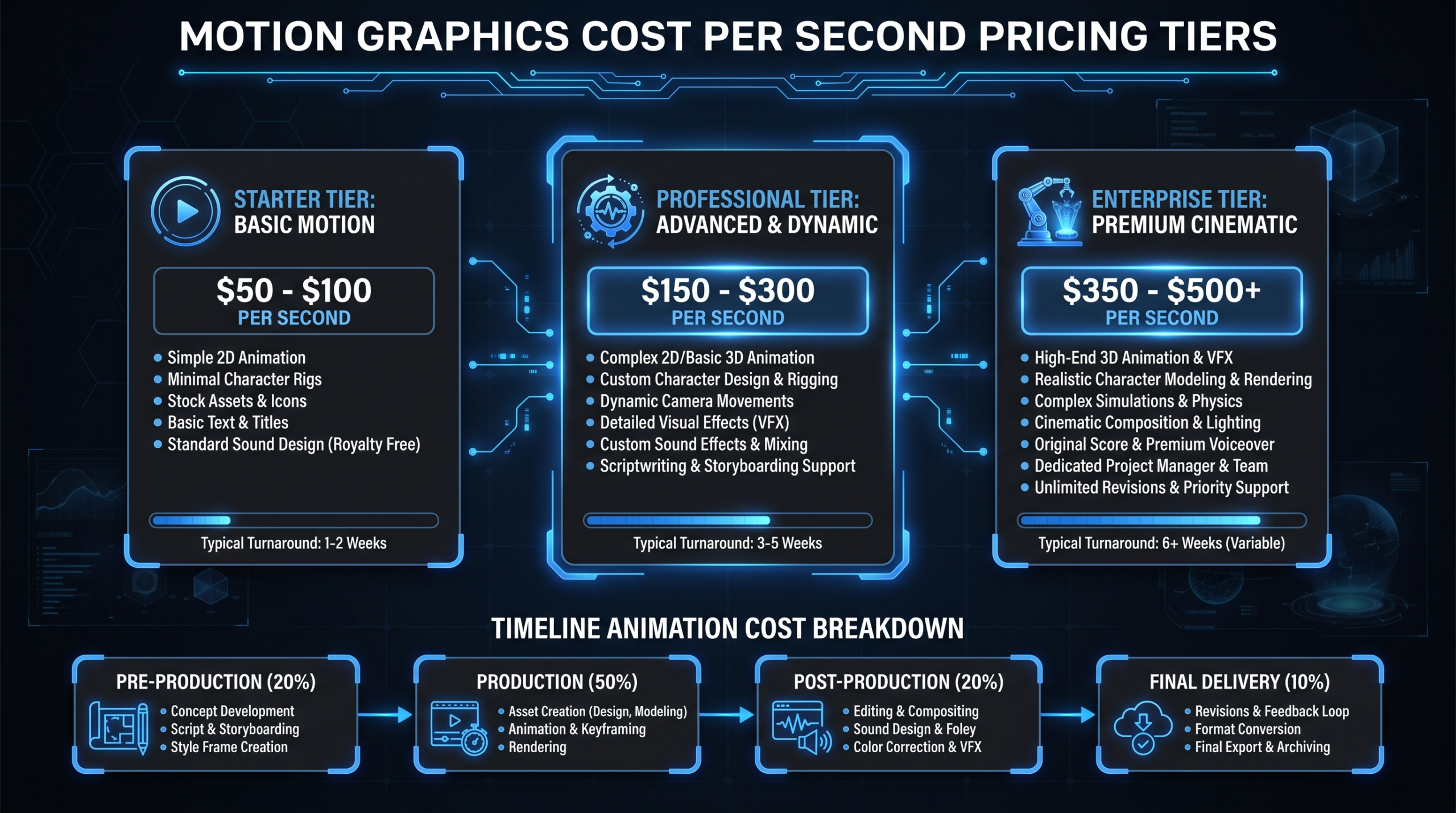
- Motion graphics typically cost $5–$40/second for basic text and transitions, $40–$120/second for mid-complexity animation, and $120–$400+/second for character work or 3D.
- Per-second pricing is a derived metric — it reflects hours of artist time multiplied by the studio's effective rate. The math is straightforward once you know the complexity tier.
- A 90-second SaaS explainer can cost anywhere from $3,000 to $50,000+ depending on style, revision scope, and whether you're buying one-off or via a retainer.
- The right question isn't "how much per second?" — it's "what complexity tier do I actually need for this content goal?"
Table of Contents
- What "Cost Per Second" Actually Measures
- The 4 Complexity Tiers of Motion Graphics
- The Real Per-Second Math: Hours × Rate = Cost
- Per-Second vs. Per-Project vs. Retainer
- What Drives Cost Per Second Up or Down
- How to Budget Motion Graphics for Your Content Program
- How to Vet a Per-Second Quote Before You Sign
- FAQ
A vendor quotes you $180 per second for a 60-second motion graphics explainer. Is that a fair price? Too high? A red flag? Most marketing teams have no reference point for evaluating per-second motion graphics pricing — which is exactly how studios prefer it.
This post fixes that. We're going to break down the actual math behind motion graphics pricing — what drives per-second costs, what each complexity tier genuinely requires in terms of labor, and how to benchmark a quote before you accept or reject it. No guesswork, no invented numbers, no "industry average" citations that don't exist.
For a broader look at all motion graphics pricing structures — per-second, per-project, and retainer — see our full motion graphics pricing guide. This post focuses specifically on the per-second metric and the math behind it.
What "Cost Per Second" Actually Measures
Per-second pricing is a normalized metric, not a billing mechanism. Very few studios actually invoice by the second. Instead, they quote a project price based on estimated hours and complexity — and the resulting "cost per second" is what you get when you divide that total by the video's runtime.
This matters because: a 30-second video doesn't cost exactly half what a 60-second video costs from the same studio. Fixed costs (briefing, setup, export, revisions) don't scale linearly with duration. Shorter videos often have a higher per-second cost than longer ones from the same project, because those fixed costs get amortized over fewer seconds.
How Studios Actually Arrive at a Quote
The honest answer is: studios estimate hours by complexity tier, multiply by their blended hourly rate, add a margin, and present you with a project number. If you ask them to express that as a per-second figure, they'll divide. Here's the chain:
- Complexity assessment: How many animated elements? Any character animation? 2D or 3D? Custom illustrations or stock assets?
- Hour estimate: Each complexity tier has a rough hours-per-second-of-finished-video range that experienced studios use to scope work.
- Rate application: Multiply hours by the studio's effective hourly rate (which varies enormously by geography, seniority, and overhead).
- Revision buffer: Most studios build in 20-30% to cover feedback rounds. This is already priced in; it's not hidden — but it's rarely disclosed explicitly.
Once you understand this chain, a per-second price becomes something you can audit. Let's walk through each complexity tier.
The 4 Complexity Tiers of Motion Graphics
Per-second pricing is meaningless without anchoring it to complexity. Here are the four tiers most studios and agencies use internally, with hedged real-world ranges based on what's publicly visible in the market:
Tier 1: Basic Text, Transitions, and Lower-Thirds
Simple kinetic text, animated logos, slide transitions, title cards, lower-thirds, and basic icon animations. Produced in After Effects or comparable tools, often using motion presets. Artist time is low — a skilled motion designer can typically produce 3-6 seconds of this style per hour of work.
Typical cost per second: $5–$40
This is the range for simple text-on-screen animations, basic brand bumpers, and social media caption overlays. At the lower end ($5–$15/second), you're typically working with offshore teams or template-based workflows. At the higher end ($25–$40/second), you're getting a senior US/UK-based motion designer with real creative input.
Tier 2: Mid-Complexity 2D Animation
Custom illustrated assets, smooth character-free motion sequences, animated diagrams, product UI mockups in motion, and coordinated multi-element compositions. This is the bread-and-butter of SaaS explainer content. Expect 0.5–2 seconds of finished video per hour of motion design work.
Typical cost per second: $40–$120
A 60-second SaaS product explainer at mid-complexity commonly falls in the $3,000–$7,000 total range. The variance comes from how many custom-illustrated scenes are required vs. adapted stock elements, and from the studio's geographic base.
Tier 3: Character Animation and High-Complexity 2D
Full character rigging and animation, complex narrative sequences, multi-scene storytelling with lip-sync or expressive performance, and heavily illustrated custom assets. Character animation is labor-intensive: even experienced animators may produce less than 1 second of polished finished video per hour of work when rigging is involved.
Typical cost per second: $100–$250
A 90-second character-driven explainer can easily reach $15,000–$25,000 at this tier. Studios that quote $60-80/second for character work are either using offshore labor or template characters with limited expressiveness — which may be exactly what you need, but go in with that expectation.
Tier 4: 3D Animation and Photorealistic Motion
Full 3D modeling, rendering, lighting, and compositing. Product visualization in 3D, architectural walkthroughs, photorealistic UI animations, and cinematic motion graphics. Render times alone can consume dozens of hours for complex scenes. Even simple 3D animations take 2-5× longer than their 2D equivalents.
Typical cost per second: $150–$400+
High-end 3D product visualizations for enterprise SaaS commonly range from $20,000–$60,000+ for a 60-90 second piece. The ceiling is essentially unlimited for broadcast-quality work.
The Real Per-Second Math: Hours × Rate = Cost
Here's the core equation: Cost Per Second = (Hours Per Second of Finished Video) × (Studio Effective Hourly Rate)
Let's make that concrete across the tiers and geographies you're likely to encounter.
Per-Second Cost Reference: Motion Graphics by Tier and Region
| Complexity Tier | Hours/Second Estimate | US/UK Studio ($100-150/hr) | Managed Offshore ($30-60/hr) | Template/AI-Assisted ($15-30/hr) |
|---|---|---|---|---|
| Tier 1: Basic text & transitions | 0.1–0.3 hr/sec | $10–$45/sec | $3–$18/sec | $1.5–$9/sec |
| Tier 2: Mid-complexity 2D | 0.5–1.5 hr/sec | $50–$225/sec | $15–$90/sec | $7–$45/sec |
| Tier 3: Character animation | 1.5–4 hr/sec | $150–$600/sec | $45–$240/sec | Not applicable |
| Tier 4: 3D / photorealistic | 3–8+ hr/sec | $300–$1,200+/sec | $90–$480/sec | Not applicable |
Note on rate ranges: These are not "industry survey" numbers — they're derived from public agency rate cards, freelancer platforms (Upwork, Contra), and publicly quoted project ranges from agencies across the US, UK, Eastern Europe, and Southeast Asia as of 2026. Individual studios vary significantly based on overhead, team seniority, and demand. Treat these as benchmark ranges for sanity-checking, not precise targets.
Real-World Example: Pricing a 90-Second SaaS Explainer
Let's walk through how a studio actually arrives at a number. You need a 90-second animated explainer for your product onboarding flow. Mid-complexity Tier 2: custom illustrated UI elements, smooth transitions, animated data visualizations, no characters.
- Estimated hours: 0.75 hr/sec × 90 sec = ~67.5 hours of motion design time
- Add production overhead: briefing, revisions, export, QA — typically adds 25-40%: ~90-95 total hours
- US studio at $120/hr blended: ~$10,800–$11,400
- Managed offshore team at $45/hr blended: ~$4,050–$4,275
- Per-second equivalent: $120–$127/sec (US) · $45–$48/sec (offshore)
This is why a $6,000 quote and a $12,000 quote for the same 90-second brief can both be completely legitimate — they're just pricing different labor inputs. The question is whether the quality output justifies the rate.
For context on how per-minute rates compare across editing types, see our video editing cost per minute breakdown — motion graphics skew higher than raw editing because of the creation component.
Per-Second vs. Per-Project vs. Retainer
Per-second pricing is one of three ways studios structure motion graphics quotes. Each has different implications for your budget and your relationship with the studio. Our full motion graphics pricing guide covers all three in depth; here's the comparison matrix:
Motion Graphics Pricing Model Comparison
| Model | How You're Charged | Best For | Risk | Typical Range |
|---|---|---|---|---|
| Per-second | Derived rate (project total ÷ runtime) | Benchmarking and comparison; rarely primary billing mechanism | Misleading without tier context | $5–$400+/sec |
| Per-project (fixed) | Flat fee for defined scope | One-off pieces, defined deliverables | Scope creep, revision overruns | $500–$50,000+ |
| Monthly retainer | Fixed monthly fee, agreed output | Ongoing content programs, consistent style | Underutilization in slow months | $3,000–$20,000/mo |
| Dedicated team | Monthly team fee, embedded animators | High volume, brand consistency critical | Higher base cost, onboarding time | $5,000–$25,000/mo |
The per-second metric is most useful as a comparison tool. When you receive two competing quotes for the same 60-second video, converting both to cost-per-second immediately reveals whether you're comparing the same tier of work — or whether one studio is proposing simpler animation at a lower rate while the other is quoting genuinely higher-quality production.
For a direct comparison of animated vs. live-action approaches and their cost implications, see our animation vs. live-action cost comparison.
What Drives Cost Per Second Up or Down
Every factor below is a real lever. Understanding them lets you negotiate intelligently and make smart scope decisions.
Factors That Push Cost Per Second Higher
- Custom illustration from scratch. If every scene requires original illustrated assets, expect 2–3× the labor compared to a project that adapts a design library. This is the single biggest cost driver in Tier 2 work.
- Character animation. Rigging a character properly takes 8–20+ hours before any animation begins. If your brief requires expressive character performance, you're in Tier 3 regardless of other factors.
- 3D elements. A single 3D product render can require 6–12 hours of modeling, texturing, lighting, and rendering. Mixing 3D with 2D typically floors your per-second cost at $150+.
- Many unique scenes. A 60-second video with 25 scene changes is more expensive than one with 8 scene changes, even at the same runtime. Each scene needs its own composition, assets, and transitions.
- Tight revision turnaround. Rush fees typically run 25–50% on top of base pricing when you need feedback incorporated within 24–48 hours vs. a standard 5–7 day cycle.
- Sound design and music licensing. Not always included in the base quote. Custom sound design adds $500–$3,000+ depending on complexity; licensed music from premium libraries can add $200–$1,500 per piece.
Factors That Push Cost Per Second Lower
- Template-based design systems. If the studio has pre-built your brand's motion design system (or if you're using their established templates), per-second costs drop significantly — sometimes by 40–60% vs. fully custom work.
- Long-form videos. A 3-minute explainer has a lower per-second cost than a 30-second spot from the same studio, because fixed costs (briefing, setup, QA) are amortized over more seconds.
- Repurposing existing assets. If the studio already has your brand's illustrated assets and motion templates from previous work, new videos cost significantly less per second. This is the compounding advantage of a long-term agency relationship.
- Minimal revision rounds. Studios price in revision overhead. If you come in with tight, aligned briefs and approve quickly, some studios will credit or discount future work. At minimum, you're not triggering scope-creep overages.
- High volume commitments. Committing to 5–10 videos on a retainer structure vs. buying one-off typically reduces effective per-second cost by 20–35%.
The explainer video cost breakdown gets into similar levers for the full production stack — useful if motion graphics are one piece of a larger explainer project.
How to Budget Motion Graphics for Your Content Program
The most common mistake: teams assign a dollar figure to "motion graphics" without first deciding what tier they actually need. Here's a rational budgeting approach.
Step 1: Anchor to Output, Not Runtime
Don't think "I need 10 minutes of motion graphics per month." Think "I need 4 product demo clips, 8 social shorts, and 1 brand explainer per quarter." Then estimate the runtime of each. This gives you a volume-and-complexity picture that maps to real costs.
Step 2: Match Tier to Content Goal
Not every video needs Tier 3 polish. A social short that runs for 72 hours on LinkedIn before it's replaced by the next piece is a Tier 1–2 project. A hero demo video that lives on your homepage for 18 months warrants Tier 2–3 investment. Mismatching tier to lifespan is the most common cause of over- and under-spending.
A practical benchmark from what SaaS marketing teams commonly report: Tier 1 text animations for social → $200–$600 per piece. Tier 2 product explainers (30–90 sec) → $2,500–$8,000 per piece. Tier 3 brand films → $12,000–$35,000 per piece.
Step 3: Factor in the Relationship Cost
Per-project pricing at a studio you've never worked with includes a hidden onboarding cost: the first briefing is longer, the first round of revisions is heavier as the studio learns your brand voice, and the creative direction is iterative. Budget an extra 15–25% for "first video" reality vs. your modeled per-second math.
Teams that work with dedicated video editing partners — like the dedicated SaaS-focused teams at Video Editing Company — eliminate this ramp-up tax after the first 2–4 weeks, because the assigned team develops brand familiarity that carries forward to every subsequent piece.
Monthly Budget Reference for Common SaaS Content Programs
Motion Graphics Monthly Budget Benchmarks by Content Volume
| Content Program | Monthly Output | Estimated Budget Range | Recommended Approach |
|---|---|---|---|
| Early-stage (0–Series A) | 2–4 social clips/mo + 1 explainer/quarter | $1,500–$4,000/mo | Per-project or low-tier subscription |
| Growth stage (Series A–B) | 6–12 pieces/mo across tiers | $5,000–$12,000/mo | Retainer with dedicated motion designer |
| Scale stage (Series B–C+) | 15–25+ pieces/mo, mixed tiers | $12,000–$25,000/mo | Dedicated team, brand motion system |
| Enterprise content machine | 30+ pieces/mo, multi-channel | $20,000–$50,000+/mo | Dedicated team + in-house creative direction |
Wistia's research on video engagement and length provides useful context here: engagement curves differ significantly by content type, which should inform how much production investment is justified per piece. A 30-second product clip that gets watched to 85% completion is more valuable than a 3-minute brand film watched to 22% — and that ratio should affect your per-second budget allocation.
How to Vet a Per-Second Quote Before You Sign
You now have the framework to evaluate a quote intelligently. Here's a concrete checklist.
Questions to Ask Any Studio
- "What complexity tier are you quoting for?" If they can't answer this, or if they describe it in vague terms ("professional quality"), probe further. Ask them to describe the number of unique scenes, whether any character animation is involved, and whether they're using custom-illustrated assets or adapted stock.
- "How many hours is this project estimated at?" With their blended rate and the estimated hours, you can reverse-engineer their per-second cost and sanity-check the math against the reference table above.
- "What's included in revisions?" The standard answer is 2–3 rounds. If the quote says "unlimited revisions," find out what one revision "round" actually means — does it include structural changes or just minor tweaks?
- "Does this include sound design and music?" Many studios quote animation-only. Add-ons for licensed music ($200–$1,500) and sound design ($500–$2,000) are common.
- "What's your turnaround from brief approval to first draft?" 7–14 business days is reasonable for mid-complexity work. If they're quoting 3 weeks for 60 seconds of Tier 2 animation, capacity may be constrained — which becomes a problem if you need iterations.
Red Flags in Per-Second Pricing
- Flat per-second rate regardless of complexity. "$50/second for any motion graphics" means either they're not accounting for complexity in their quote (and will over-deliver on simple work and under-deliver on complex work), or they're quoting Tier 1 pricing and banking on you not knowing the difference.
- No itemized scope. A quote that says "60-second explainer: $8,000" with no breakdown of scenes, revisions, or assets included is a scope dispute waiting to happen.
- Extremely low per-second pricing for stated complexity. A quote of $15/second for character-animated Tier 3 content is either using heavily AI-assisted workflows (with corresponding quality tradeoffs), or the scope hasn't been properly understood. Get the hour estimate and apply the math.
When evaluating whether animation is the right format at all for your content goals, the cost and performance comparison in our animation vs. live-action cost analysis helps frame the decision.
Teams that work at high video volume often find that per-second pricing becomes less relevant once they're on a retainer or dedicated team structure — because the relationship shifts from transactional to ongoing. The VEC model is built around this: a dedicated senior editor and PM assigned to your account, which means your effective per-second cost drops as the team builds brand familiarity and reduces revision cycles over time.
Wyzowl's annual video marketing statistics report consistently shows that teams with structured, ongoing video production programs outperform ad-hoc buyers on content output and cost efficiency — which is the core argument for moving off per-second transactional pricing into a retainer or dedicated model once your volume justifies it.
Frequently Asked Questions
What is a typical cost per second for a basic SaaS explainer video?
For a mid-complexity SaaS explainer (custom 2D animation, product UI mockups, no character work), the typical range is $40–$120 per second of finished video. A 60-second explainer from a US-based studio commonly falls between $3,500 and $8,000 total; from a managed offshore team, $1,500–$4,500. The per-second figure assumes a full project quote — not billing-by-the-second, which studios don't actually do.
Why does per-second cost vary so much between studios?
Per-second cost reflects hours per second of finished video multiplied by the studio's effective hourly rate. Both variables swing widely: a senior US-based motion designer charges $100–$150/hr while an offshore team charges $25–$50/hr. And a complex scene may take 2 hours to animate while a simple text overlay takes 10 minutes. Multiply those differences and you get 5–10× variance in per-second pricing for nominally similar outputs.
How do I know if a per-second quote is for the complexity I actually need?
Ask the studio to describe the number of unique scenes, whether they're using custom-illustrated assets or adapted stock, and their total estimated hours. Then apply the reference math: hours per second × their stated hourly rate. If those numbers don't reconcile with the quote, ask for clarification before signing. Legitimate studios are transparent about this.
Does a longer video cost less per second than a shorter one?
Generally yes, because fixed costs (briefing, export, QA, revision rounds) are spread across more seconds. A 3-minute explainer typically has a 15–25% lower per-second rate than a 30-second piece at the same complexity tier, from the same studio. This is one reason studios often offer package pricing rather than linear per-second rates.
When does it make sense to move from per-project to a retainer for motion graphics?
When you're producing 4+ motion graphics pieces per month consistently. At that volume, the per-second cost savings from a retainer (typically 20–35% lower than per-project rates) outweigh the flexibility cost of a monthly commitment. The brand familiarity benefit — a team that knows your design system and doesn't need rebriefing for every asset — compounds over time and further reduces effective per-second cost through fewer revision cycles.
Know Your Numbers Before You Negotiate
If you're producing motion graphics regularly for a SaaS product and want to understand what a dedicated video team model costs vs. per-project buying — our team can model both scenarios against your actual volume. No pressure, just math.
Book a Free Strategy Call See VEC Plans