Legaltech Video Production Cost: 2026 Guide
TL;DR
Legaltech video production typically costs $3,500–$20,000+ per project depending on format, compliance requirements, and whether you need animation or on-camera production. Monthly retainer programs for ongoing output run $5,000–$16,000/month. The biggest cost driver unique to legaltech — and the one most agencies fail to price accurately — is the compliance and regulatory review cycle, which commonly adds 20–40% to standard production budgets through script revisions, voiceover re-records, and liability framing rework.
Table of Contents
- What Makes Legaltech Video Production Different
- Cost by Format: From Explainers to Training Videos
- The Compliance Factor: Regulatory Language and Liability Framing
- Bar Association Advertising Rules: What Marketers Need to Know
- Freelancer vs. Agency vs. Dedicated Team
- What $5K, $9.5K, and $16K/Month Gets You
- How to Build a Realistic Legaltech Video Budget
- Hidden Costs Legal Marketing Teams Miss
- FAQ
Legaltech marketing teams operate in one of the most constraint-heavy video environments in B2B. Your compliance team has veto power over the script. Your legal counsel reviews claims before anything goes to production. Your bar association may have specific opinions about attorney advertising. And the video production vendor you hire may have no idea any of these constraints exist.
That mismatch — between what generalist agencies quote and what legaltech video production actually costs when done properly — is the source of most budget overruns in this space. This guide gives you real production cost ranges, explains the structural cost drivers unique to legal software marketing, and helps you build a budget that accounts for the full picture: not just the edit, but the reviews, the revisions, and the complexity layers that differentiate legaltech from standard SaaS video work.
What Makes Legaltech Video Production Different
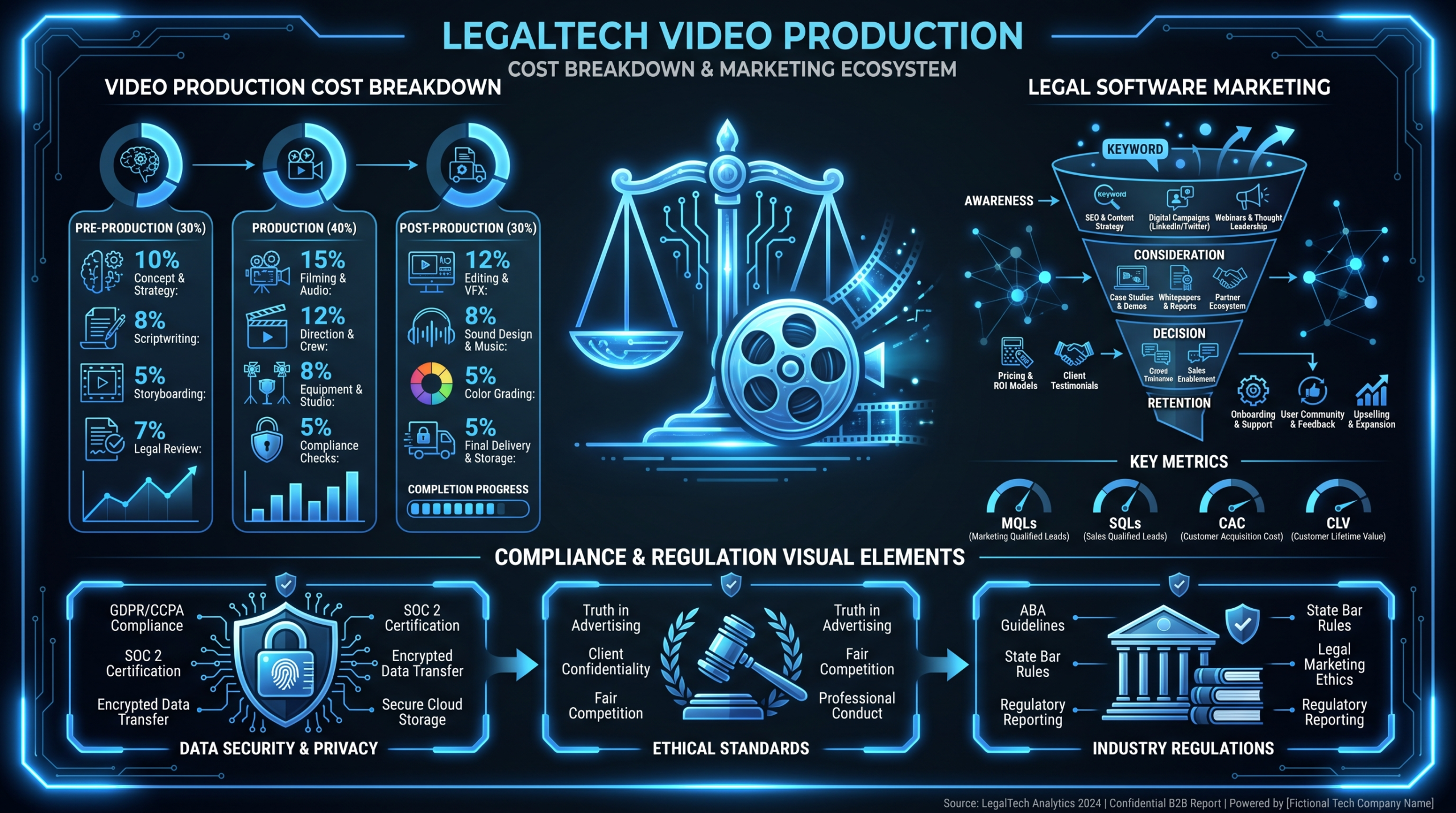
Legaltech companies sit at the intersection of legal professional services and software — two sectors with some of the most stringent content compliance requirements in B2B marketing. Understanding why legaltech video production tends to cost more than equivalent SaaS video comes down to three structural factors that don't exist in most other verticals.
Regulatory Language Review Cycles
Scripts for legaltech companies — especially those selling to law firms, in-house legal departments, or regulated financial institutions — commonly require multiple compliance and legal reviews before any recording begins. Each review cycle adds 3–10 business days and typically generates script revisions that affect downstream deliverables: voiceover, animation, motion graphics, and on-screen text. Agencies that don't account for this will underestimate the actual timeline by 30–50% and often charge you per revision round rather than building it in.
Liability Framing Requirements
Legal software that handles case management, billing, e-discovery, contract lifecycle management, or compliance tracking must describe its capabilities with precision. Claims about security posture (SOC 2 Type II, end-to-end encryption), productivity outcomes ("reduces matter intake by X hours"), and integration capabilities need to be scoped carefully to avoid misrepresentation liability. This creates a scripting layer — claim-hedging and framing work — that a generalist video production agency will not perform and may not flag as necessary.
Bar Association and Regulatory Constraints
If your content features attorneys, references specific legal outcomes, or makes representations about legal process improvement, applicable bar association advertising guidelines may apply. These vary significantly by U.S. jurisdiction and can affect everything from the language used to describe results to required disclaimer copy and even on-screen text placement. These aren't edge cases — they're routine constraints that legaltech marketers navigate quarterly.
These three factors don't just affect timeline. They directly affect production cost through additional revision rounds, longer production windows, and the need for specialized script review that generalist agencies don't provide.
Cost by Format: From Explainers to Training Videos
Legaltech video production costs vary widely by format. Here are typical ranges for common legaltech video types, reflecting post-production and animation costs for remote delivery. On-location filming and full production (direction, camera crew, set) adds 40–80% to these figures.
Legaltech Video Production Cost by Format (2026)
| Video Type | Duration | Typical Cost Range | Key Cost Driver |
|---|---|---|---|
| Animated explainer (legaltech SaaS) | 60–90 sec | $4,000–$15,000 | Complex workflow visualization; compliance revision rounds |
| Product demo / screen-capture edit | 2–5 min | $3,500–$12,000 | Motion graphics, multi-stakeholder approvals, liability framing |
| Attorney thought leadership interview | 3–8 min | $2,000–$8,000 | On-site or remote; post-production polish for talking-head format |
| Client testimonial / case study | 2–4 min | $3,500–$12,000 | Coordinating GC or partner schedules; outcome language hedging |
| Webinar / event recording edit | 30–90 min | $500–$2,500 | B-roll, graphics packaging, cuts for distribution |
| Compliance training video | 5–20 min | $6,000–$25,000 | Narration scripting, screen capture, accessibility requirements |
| Sales enablement / one-pager video | 60–120 sec | $2,500–$8,000 | Multiple format deliverables (16:9, 9:16, 1:1); branding precision |
| Full campaign (5+ videos) | Various | $20,000–$75,000+ | Volume discount applies; compliance overhead still scales proportionally |
For a granular breakdown of what post-production work costs at the per-minute level — useful for benchmarking agency proposals — see VEC's guide to video editing cost per minute. And for a full breakdown of animated explainer production economics, the explainer video cost breakdown covers the animation pipeline in detail.
How Format Complexity Affects Compliance Cost
Compliance review costs scale with script and visual complexity. A simple talking-head edit with minimal on-screen text has low compliance surface area. An animated explainer that diagrams a client intake workflow, references data security standards, or implies specific productivity outcomes has high compliance surface area — and will generate more review rounds. Budget your compliance buffer based on the visual complexity of the script, not just its length.
The Compliance Factor: Regulatory Language and Liability Framing
The compliance factor is the variable that most legaltech marketing teams underestimate — and that most generalist video agencies fail to price accurately. Understanding how it affects your budget lets you have a more productive conversation with production partners.
Script Review Cycles and Their Downstream Cost
Every compliance review cycle that generates significant script changes creates costs in downstream production steps:
- Voiceover re-records: Each session to re-record revised lines typically costs $200–$800 for studio talent fees, plus re-booking time. For premium VO talent with a day rate, partial re-records can cost $1,500–$4,000 per session.
- Animation rework: In an animated explainer, script changes after animation begins typically cost $150–$500 per affected scene for revision work, plus timeline delay.
- On-screen text revisions: For product demo videos with overlay text, liability framing changes mean reworking text layers — typically $50–$200 per revision pass.
- Timeline extension cost: Every week of delay in a fixed-term production contract has an opportunity cost. Projects that run 3 weeks over schedule because of compliance rounds effectively cost more than the original quote.
The practical implication: if your compliance process typically generates two rounds of script feedback before approval, build in budget for a third round — because production rarely ends at two, especially in legaltech verticals where claims sensitivity is high.
Liability Framing: What It Is and What It Costs
Liability framing is the practice of scoping specific claims so they don't create legal or regulatory exposure. In standard SaaS marketing, a claim like "reduces case intake time by 40%" might go through marketing review and launch. In legaltech, that same claim needs sourcing, hedging language ("based on reported client outcomes, results vary"), or removal if it can't be substantiated.
Script consultants who specialize in legaltech marketing review and framing typically charge $500–$2,500 per project. This is a pre-production cost that most generalist video agencies don't budget for — and won't tell you about until you ask.
Some legaltech companies handle liability framing internally through their legal or compliance team. If that's your process, build explicit timeline for their review into your production schedule — not as an afterthought, but as a gated milestone the production agency must plan around.
Bar Association Advertising Rules: What Legaltech Marketers Need to Know
Bar association advertising regulations in the United States apply specifically to attorney-sponsored or attorney-related advertising. For legaltech companies, this matters when:
- Your video features attorneys speaking on behalf of your company or a client law firm
- Your content references specific legal outcomes achieved using your software
- Your marketing is directed at attorney audiences in regulated jurisdictions
- Your video makes comparative claims about legal process performance
The most conservative jurisdictions — including Florida, Texas, New York, and California — have specific requirements around: required disclaimers for outcome-based claims, restrictions on comparative advertising phrasing, mandatory language like "results may vary," and in some cases, pre-publication submission requirements for certain attorney advertising formats.
If your legaltech product serves firms across multiple U.S. states, you may need jurisdiction-specific video versions with different disclaimer language or different framing of outcome claims. Each version adds 15–25% to base post-production cost. This is a real budget line item that most first-time legaltech video budgets omit entirely.
For companies operating internationally, GDPR-adjacent data handling language in videos for EU law firm audiences adds another layer of precision requirement. While it typically doesn't require separate video versions, it does affect how your production team scripts data security claims.
Wistia's business video marketing resource hub covers video strategy fundamentals that apply broadly. For legaltech-specific content strategy decisions — including when to produce video vs. written thought leadership — the HubSpot video marketing guide provides useful B2B context, though neither addresses the compliance layer that makes legaltech distinct.
Freelancer vs. Agency vs. Dedicated Team
How you structure your production relationship significantly affects both your monthly cost and your exposure to compliance-related surprises. Here's how the three main models compare for legaltech video work:
Legaltech Video Production: Model Comparison
| Model | Monthly Cost Range | Legaltech Fit | Key Limitation |
|---|---|---|---|
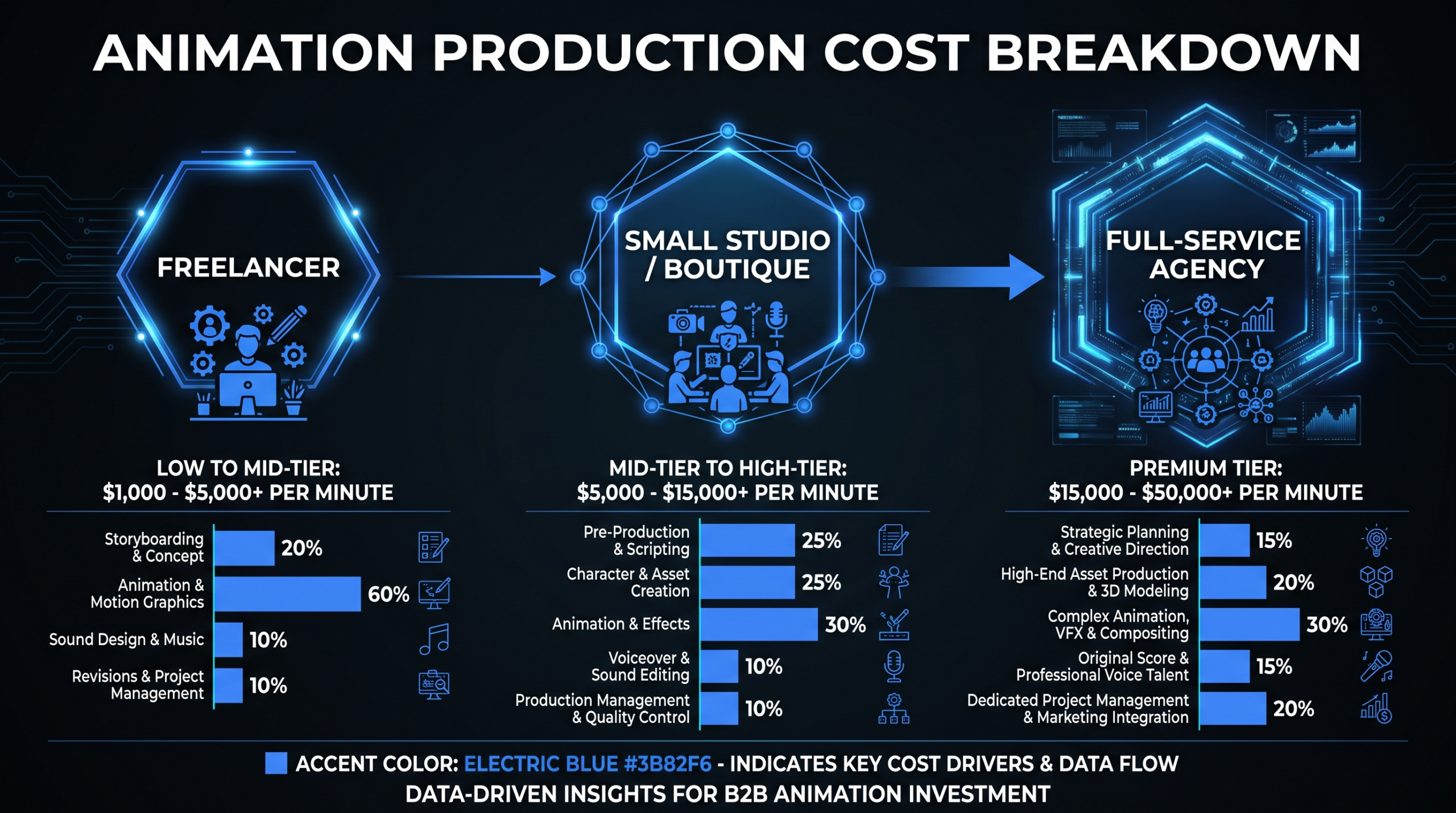
| Freelancer (Upwork / Fiverr) | $1,500–$5,000 | Low | No compliance awareness; inconsistent quality; no PM buffer for review cycles |
| Video editing subscription | $2,500–$7,500 | Low–Medium | Sequential queue; throughput limited; not suited to complex revision cycles |
| Generalist agency (project-based) | $8,000–$30,000/project | Medium | May not flag compliance risks proactively; high per-project cost; per-round invoicing |
| Boutique legaltech-specialist agency | $10,000–$25,000/month | High | Premium pricing; small rosters; booking lead times of 4–8 weeks common |
| Dedicated B2B SaaS video team | $5,000–$16,000/month | High | Requires onboarding to your compliance workflow; best value at consistent output volume |
The dedicated team model is particularly well-suited to legaltech companies with consistent ongoing video output, for three specific reasons:
- The team learns your compliance workflow. After 1–2 months, the same editors know which script structures trigger your compliance team's review, which claim types need hedging, and which formats have passed review before. This institutional knowledge compounds over time and reduces revision cycles — lowering effective cost per video.
- Flat monthly cost removes per-revision invoicing surprises. Compliance-driven revision rounds don't generate add-on charges. You know what you're paying each month regardless of how many review cycles a given video generates.
- You control pace without penalty. You can hold a video pending compliance review without being billed for idle production time. With a project-based agency, delays often create rebooking or storage fees.
For a broader look at how these models stack up across B2B SaaS video production in general, see VEC's breakdown of video production agency pricing models.
What $5K, $9.5K, and $16K/Month Gets You in Legaltech
Video Editing Company (VEC) works with B2B SaaS companies across regulated verticals including legaltech platforms, compliance software, and legal services technology. Here's how VEC's three plans map to common legaltech production scenarios:
Growth — $5,000/month
Best for: legaltech companies building their first consistent video program and need a production partner that understands SaaS marketing cadence. Dedicated senior editor + junior editor + project manager. Capacity for approximately 8–12 standard edits per month — thought leadership interview edits, product demo edits, webinar repurposing, and social cuts.
What it covers well: ongoing post-production for existing recorded content, iterative product demo updates, and social content. It does not cover full animation production from scratch, which requires a separate motion design scope.
Core — $9,500/month
Best for: legaltech companies running active, multi-format content programs. Full dedicated team with creative direction. Output capacity of 12–18 mixed-format videos per month — product demos, thought leadership edits, case study production, compliance training edits, and social distribution cuts. The creative director layer is particularly useful in legaltech for enforcing consistent claim framing and visual branding across deliverables produced under different compliance conditions.
Scale — $16,000/month
Best for: enterprise legaltech platforms, PE-backed legaltech companies, or legal software companies with multi-channel content requirements across multiple product lines. Full team with expanded capacity at 20–30+ videos per month. Priority turnaround for time-sensitive regulatory campaign launches and a dedicated PM with daily check-in availability for fast-moving compliance windows.
All VEC plans include a 90-day output guarantee: double your video output in 90 days or month four is free. For plan details and exact deliverables, see the VEC pricing page. For context on how a dedicated team integrates into a legal marketing workflow, see the how VEC works page.
How to Build a Realistic Legaltech Video Budget
Effective legaltech video budgeting separates costs into three distinct buckets. Conflating them is where most marketing teams get surprised mid-production.
Bucket 1: Production Core Cost
The actual editing, animation, motion graphics, and delivery. This is the number your production agency quotes. For a legaltech company producing 8–12 videos per month, production core cost typically ranges from $5,000–$12,000/month depending on format complexity. This is what you're comparing when you evaluate agency quotes.
Bucket 2: Compliance and Review Overhead
Script revisions, voiceover re-records, and animation rework triggered by compliance review cycles. A practical rule of thumb for legaltech teams new to structured video programs: budget 20–35% on top of core production cost for the first quarter while your production team learns your compliance workflow. This drops to 10–20% once the team understands your constraints and has a library of pre-approved framing approaches to draw from.
Bucket 3: Pre-Production (The Most Overlooked Bucket)
Script development, storyboarding, legal review fees for pre-production scripts, on-camera talent or spokesperson fees, and any location logistics costs. Post-production agencies quote Bucket 1 only — they do not include Bucket 3, because it's not their scope. For a 3-minute product demo video, pre-production commonly runs $2,000–$8,000 before post-production begins. For a full animated explainer, pre-production (script, storyboard, VO recording, compliance sign-off) can run $3,000–$10,000 separate from the animation itself.
A Realistic Monthly Budget for a Mid-Stage Legaltech Company
- Production core (dedicated team, mid-tier plan): $7,500–$9,500/month
- Compliance overhead (first quarter): $1,500–$3,000/month
- Pre-production (amortized across formats): $2,000–$4,000/month
- Total: approximately $11,000–$16,500/month for a serious, structured video program
For legaltech companies earlier in their content journey — building their first program with a narrower format mix — VEC's Growth plan ($5,000/month) combined with conservative pre-production budgeting can bring total all-in spend to $7,000–$9,000/month for 6–10 polished videos per month.
For guidance on structuring the outsourcing relationship to keep costs predictable, see the guide on how to outsource video editing.
Hidden Costs Legal Marketing Teams Miss
Beyond the three buckets, there are cost line items that consistently surprise legaltech marketing teams — not because they're hidden deliberately, but because they're not part of the standard production agency proposal and require proactive budgeting.
Jurisdiction-Specific Version Cuts
If your legaltech product operates across multiple U.S. states with different bar advertising requirements, you may need version cuts with different disclaimer language or different framing of attorney testimonials. Each version adds 15–25% to base post-production cost — more if voiceover re-records are required for jurisdiction-specific language changes. This is an easy budget line item to omit in early planning and an easy one to get surprised by at launch.
Voiceover Compliance Re-Records
Compliance changes to a script after voiceover has been recorded require partial or full re-records. Studio talent rates range from $200–$600 for session talent. Premium voiceover talent on a day rate may cost $1,500–$4,000 for a partial re-record session. Agencies that price voiceover separately from post-production will invoice these as add-ons; agencies with flat monthly plans absorb standard revision work but may charge for extraordinary revision volume.
Accessibility Compliance for Government-Facing Legaltech
If your legaltech product sells to government agencies, courts, public defenders' offices, or federally funded legal aid organizations, Section 508 accessibility requirements may apply to video content. Standard closed captioning costs $1–$3 per finished minute of video. Audio description tracks (for vision-impaired viewers) add $500–$2,000 per video depending on content complexity. For WCAG 2.1 Level AA compliance, both are typically required.
Stock Asset Licensing for Legal Content
Standard royalty-free stock libraries (Storyblocks, Envato) have limited coverage for legaltech-specific imagery — courtroom environments, legal document workflows, legal software UI concepts. Premium stock libraries (Getty, Shutterstock Editorial) carry higher per-asset licensing fees. Budget $300–$1,500 per video for licensed visual assets if your content requires anything beyond generic office or technology stock.
Rush Production Fees
Compliance windows are unpredictable. When a campaign launch shifts or a conference deadline moves up, rush production fees commonly add 25–50% to base production cost. This isn't unique to legaltech — but the unpredictability of compliance timelines makes rush scenarios more frequent here than in most other verticals. Working with a dedicated team on a flat monthly plan is the most effective structural defense against rush fee exposure: your team is always available, so emergency timelines don't trigger re-booking costs.
For context on what's typically included in a standard production engagement and what falls outside scope, see VEC's breakdown of what's included in video editing services.
For the complete legaltech video strategy guide — including content type selection, distribution, and format decisions for legal software companies — see VEC's legaltech video production hub.
Frequently Asked Questions
How much does a legaltech explainer video cost in 2026?
A 60–90 second animated explainer for a legaltech company typically costs $4,000–$15,000 for animation and post-production, depending on visual complexity and review cycles. The high end reflects legaltech-specific needs: complex workflow visualization, multiple compliance review rounds, and voiceover re-records triggered by script revisions. Standard SaaS explainers in the same format range from $3,000–$10,000, making the legaltech premium roughly 15–40% on average.
Why does video production cost more for legal and compliance-sensitive industries?
Three structural factors drive higher costs in legaltech video: regulatory language review cycles (which generate revision rounds in animation and voiceover), liability framing requirements (claims must be scoped carefully to avoid misrepresentation risk in a legal context), and bar association advertising rules for attorney-facing or attorney-featuring content. These factors add an average of 20–40% to standard production budgets, primarily through revision overhead and extended production timelines.
Should a legaltech company use a specialized video agency or a generalist?
A generalist agency can produce technically competent video — the editing and animation quality may be equivalent. The real risk is that generalist agencies won't proactively identify compliance risks in your script, won't build review cycles into their timeline, and will invoice revision rounds as add-ons. A B2B SaaS-focused video team that has worked with legal or regulated industries is meaningfully better: they build compliance buffer into production planning, understand liability framing requirements, and structure their workflows around multi-stakeholder review processes.
What's a realistic all-in monthly budget for ongoing legaltech video production?
For a mid-stage legaltech company running 6–12 videos per month across mixed formats, a realistic all-in monthly budget ranges from $7,000–$16,500/month, depending on format complexity and compliance overhead. This covers production core costs ($5,000–$9,500/month for a dedicated team), compliance revision buffer (10–35% on top), and amortized pre-production costs. Early-stage companies running 3–6 simpler edits per month can operate effectively in the $4,000–$7,500/month range.
What compliance and regulatory requirements affect legaltech video production?
Several compliance layers are relevant depending on your company's specific context. U.S. state bar associations regulate attorney advertising content — applicable when video features attorneys or references legal outcomes. FINRA rules apply if your legaltech product serves financial advisors or broker-dealers. Section 508 accessibility requirements apply to video content sold to or used by government agencies. GDPR-aligned data handling language matters for EU law firm audiences. None of these requirements prevent effective legaltech video marketing — they require thoughtful scripting, appropriate hedging language, and production partners experienced in navigating them.
Budget Clarity Before You Brief an Agency
Most legaltech marketing teams discover compliance-driven cost surprises mid-production. VEC's dedicated teams work with B2B SaaS companies in regulated verticals — including legaltech and compliance software — and build review cycles into production planning from day one. Talk to our team about what your program actually costs to run properly.
Book a Free Strategy Call See VEC Plans