Video for Legal: Compliance and Claims Rules
TL;DR
- Legal and legaltech video content faces a two-layer compliance burden: attorney advertising regulations (ABA Model Rules + state bar rules) and general marketing law (FTC endorsement guidelines, ADA accessibility).
- The highest-risk content types are client testimonials, results-based claims, and comparative statements - all require specific disclaimers and, depending on jurisdiction, pre-publication review.
- No fabricated rule numbers or state-specific percentages appear in this guide. Every regulatory reference is hedged and linked to primary sources - verify all requirements against your specific state bar's rules before publishing.
- A practical internal approval system, a platform-by-platform review workflow, and a disclaimer checklist follow below.
Table of Contents
- Why Legal Video Has a Higher Compliance Bar
- Attorney Advertising Rules: The Foundation
- Testimonials and Results Claims
- Disclaimer Requirements That Actually Work
- Platform Review Workflows
- Building an Internal Approval System
- Accessibility Compliance: Captions and ADA
- Working With a Video Production Partner
- FAQ
Legal video marketing is not like marketing a SaaS product or a fitness app. Every frame you publish - from attorney bio clips to client testimonial compilations - sits at the intersection of professional ethics rules, consumer protection law, and platform content policies. Get it wrong and you're not just looking at a poor-performing ad; you're looking at a bar complaint, a regulator inquiry, or an FTC enforcement action.
This guide is for marketing leaders at law firms, legal technology companies, and in-house legal marketing teams who want a working compliance framework for their video content programs. It is not legal advice. Nothing here substitutes for counsel from your firm's ethics lawyer or outside bar compliance specialist - and that caveat is itself part of the point. Compliance in legal video starts with understanding where the guardrails are, not with assuming your marketing instincts translate from other industries.
What follows is a practical, actionable set of rules you can act on now, hedged where precision would require jurisdiction-specific legal research you'll need to do yourself.
Why Legal Video Has a Higher Compliance Bar
Most marketing teams operating in B2B SaaS or professional services can publish a customer success video and call it a day. Their legal review is a 10-minute check for accuracy and brand consistency. Legal and legaltech marketers face a materially different environment for three structural reasons.
Professional Ethics Obligations Layer on Top of Marketing Law
Attorneys are regulated professionals. The bar associations in every US state - and their international equivalents - maintain conduct rules that govern how lawyers communicate about their services. These rules exist independently of FTC marketing regulations and can be stricter. A video testimonial that would be perfectly acceptable for a hospital marketing campaign may violate attorney advertising rules in certain states simply because it implies guaranteed outcomes or makes comparative claims the lawyer cannot substantiate.
Jurisdiction Layering Creates Real Complexity
An attorney licensed in three states must comply with the advertising rules of all three - and those rules are not uniform. Some states have adopted versions of the ABA Model Rules with minimal modification; others have significantly diverged. A compliance standard that works for a New York-licensed attorney may not satisfy Texas bar requirements, and vice versa. For legaltech companies marketing to attorneys, this creates an additional layer: your marketing cannot facilitate or encourage conduct that might violate your prospects' professional obligations.
The Stakes of Non-Compliance Are Asymmetric
A misleading consumer goods ad might generate an FTC warning letter and a corrective campaign. A bar advertising violation for an attorney can result in public censure, suspension, or (in egregious cases) disbarment. The asymmetry means legal marketers cannot use the "publish fast and fix later" approach that's standard in growth-stage SaaS. The approval workflow has to front-load review, not back-load remediation.
Attorney Advertising Rules: The Foundation
The foundational framework for attorney advertising in the United States derives from the ABA Model Rules of Professional Conduct, specifically the rules governing communications about legal services. Most US state bars have adopted versions of these rules, though the specific language, restrictions, and required disclosures vary significantly by jurisdiction. Always verify against your specific state bar's published rules - the ABA's model is a starting point, not a guarantee of what your jurisdiction requires.
The Core Prohibition: No False or Misleading Communications
The bedrock rule across virtually all US jurisdictions prohibits attorneys from making false or misleading communications about their services or qualifications. For video marketing, this rule has direct and often non-obvious implications:
- Credentials must be accurate. If an attorney bio video references specialization, board certification, or awards, those claims must be verifiable and current. Outdated awards or credentials that have since lapsed create exposure.
- Comparative claims require substantiation. Saying "we win more cases than anyone in the state" or similar comparative superlatives generally requires objective, verifiable data to support the claim - and even then, some state bars restrict comparative statements in advertising.
- Implied promises are treated like explicit ones. A video that implicitly suggests a client will achieve a particular outcome - through selective testimonial editing, music choices that evoke triumph, or visual storytelling that implies causation between hiring the firm and winning - can be treated as a misleading claim even without explicit language.
State-Level Variations to Know
Several states maintain advertising rules that are notably stricter than the ABA baseline. Some require attorneys to submit advertising materials to the state bar before (or shortly after) publication - a pre-clearance or filing requirement that significantly affects production timelines. Others require specific mandatory disclosures - "Attorney Advertising" notices, for example - to appear in prominent positions on all attorney advertising, including video.
Rather than attempt to enumerate state-specific rules here (which would quickly become inaccurate as rules evolve), the practical guidance is: before any video content featuring an attorney goes live, confirm whether your jurisdiction requires pre-filing, mandatory disclosures, or other procedural steps. Your state bar's website is the primary source. If you operate across multiple states, map each licensed attorney's jurisdictions and cross-reference requirements before finalizing your standard production workflow.
Legaltech Companies: Different but Not Exempt
If you're marketing a legal technology product rather than legal services directly, you're not governed by attorney advertising rules as an entity. But the content of your marketing matters. Videos that feature attorneys, imply legal outcomes, or make legal performance claims can still run into FTC concerns - and if your marketing implicitly encourages attorneys to make representations to their clients that would violate bar rules, the reputational and commercial exposure is significant. Hedge legal outcome claims the same way you'd hedge clinical claims in a healthcare SaaS context.
Testimonials and Results Claims
Client testimonials are among the most persuasive video formats in legal marketing - and among the highest-risk. The risk is two-layered: attorney ethics rules governing testimonials about legal services, and FTC guidelines governing endorsements and testimonials in all commercial contexts.
The "Past Results" Disclaimer: What It Is and Why It's Not Enough Alone
The most commonly used disclaimer in legal video - "past results do not guarantee future outcomes" (or similar variations) - exists because most state bars treat statements about past case results as potentially misleading if presented without context. The disclaimer acknowledges that legal outcomes depend on facts, circumstances, and factors outside the attorney's control.
What the disclaimer does not do, on its own, is make a poorly structured testimonial compliant. If the visual narrative of a testimonial video creates a clear implication of typical results - even if the disclaimer text appears at the end - regulators and bar ethics committees may still find the overall communication misleading. The disclaimer needs to be:
- Visible for long enough to be read (not a flash-frame at the end of the video)
- In a font size and contrast ratio that makes it legible on mobile screens
- Contextually positioned so it relates clearly to the results described, not buried in general end-card text
- Substantively accurate - if the results described were significantly above typical outcomes, some jurisdictions require additional context about why they were atypical
Client Testimonials: Consent and FTC Requirements
The FTC's Endorsement Guides apply to all commercial testimonials, including those in legal marketing videos. The key obligations that affect legal video production teams are:
- Material connections must be disclosed. If a client received any compensation - monetary, a fee reduction, a gift, or any other benefit - in exchange for appearing in a testimonial video, that connection must be disclosed clearly.
- Testimonials must reflect honest opinions. You cannot cherry-pick or edit a testimonial to create a false impression of the client's actual experience.
- Results that are atypical require clear disclosure. If the outcome described in the testimonial is not what most clients can expect, the FTC requires a clear and conspicuous disclosure of what typical results look like. For legal matters, this often means adding context about case complexity, settlement versus verdict, and factors specific to that client's situation.
In addition to FTC requirements, most state bar rules require written client consent before featuring a client in attorney advertising. The consent should be documented, cover the specific use case (video testimonial for digital advertising), and be obtained before production begins - not after the video is already edited.
Legal Video Content Types by Compliance Risk Level
| Content Type | Risk Level | Key Requirements |
|---|---|---|
| Attorney bio / intro | Low | Accurate credentials, current awards only, no misleading claims |
| Practice area overview | Low-Medium | No misleading capability claims, accurate service descriptions |
| Educational explainer | Medium | "Not legal advice" disclaimer required; general information only |
| Firm overview / brand video | Low-Medium | Attorney Advertising notice (state-dependent), no outcome implications |
| Client testimonial | High | Written client consent, FTC disclosure, results disclaimer, bar rule compliance |
| Case results / outcome video | High | Results disclaimer, atypicality disclosure if results are exceptional, compliance review |
| Comparative claims ("best," "#1") | Very High | Objective substantiation required; many states restrict or prohibit; pre-review recommended |
Disclaimer Requirements That Actually Work
Disclaimers serve two functions in legal video marketing: they satisfy regulatory requirements, and they build credibility with sophisticated prospects who know the difference between a well-structured legal marketing video and one that's trying to paper over questionable claims with fine print. Done well, disclaimers are a trust signal. Done poorly, they're a compliance fig leaf that satisfies neither regulators nor prospects.
The Four Disclaimers Legal Video Teams Use Most
1. "Attorney Advertising" - Required in many state jurisdictions on any video that constitutes attorney advertising. The precise placement requirements (beginning vs. end of video, size relative to other text) vary by state. When in doubt, place it prominently at both the start and end of the video, and include it in the video description on every platform where it's published.
2. "Past results do not guarantee future outcomes" - Standard language for any video referencing case results, verdicts, settlements, or client outcomes. The exact phrasing matters less than the positioning: it must appear in context with the results discussion, not just at the end of a 3-minute video after 2 minutes of implied guaranteed success.
3. "This video is for informational purposes only and does not constitute legal advice" - Required for any educational content, webinar recordings, or explainer videos that discuss legal topics. Even clearly educational content should include this disclaimer because viewers can misinterpret general legal information as advice specific to their situation.
4. Compensation/relationship disclosure - Required by FTC guidelines whenever a client, spokesperson, or influencer received any form of compensation or material benefit for their appearance. For most client testimonials where the client simply agreed to share their experience, this disclosure may not apply. For any arrangement where value was exchanged - including fee discounts, gifts, or introductions - disclose clearly.
Making Disclaimers Visible: Production Standards
A disclaimer that appears for two seconds in 8-point gray text at the bottom of a dark video frame is not a compliant disclaimer in any meaningful sense. Production teams working on legal video should treat disclaimer legibility as a non-negotiable technical requirement, not an afterthought. Minimum standards to build into your production brief:
- Disclaimer text appears for a minimum duration that allows average reading speed (typically 3-5 seconds per short disclaimer line)
- Font size scales for mobile viewing - test on a physical phone, not just desktop preview
- Sufficient color contrast between disclaimer text and background
- Disclaimers are included in video captions/transcripts, not just as on-screen graphics
- Platform-specific versions account for overlaid UI elements (YouTube cards, LinkedIn banners) that may obscure disclaimer text positioned at the bottom of frame
Platform Review Workflows
Each distribution channel where legal video content appears has its own content policies, its own ad review process, and its own technical requirements for how disclaimers must appear. A single "approved" video may need platform-specific modifications before it's publishable without risk.
Platform-by-Platform Compliance Checklist
| Checkpoint | YouTube (Organic) | LinkedIn (Organic) | Paid Ads (Any Platform) | Firm Website |
|---|---|---|---|---|
| "Attorney Advertising" notice | In description + on-screen if required by state | In post text + on-screen | In ad copy + on-screen (platform-dependent) | On-screen + page footer |
| Results disclaimer | On-screen + description | On-screen + post text | On-screen + ad copy | On-screen + page |
| Client written consent documented | Required | Required | Required | Required |
| "Not legal advice" notice | For educational content | For educational content | For educational content | For educational content |
| Compliance counsel review | For high-risk content types | For high-risk content types | Always recommended | Always recommended |
| Captions accuracy check | Required (auto-gen is not sufficient) | Required | Required | Required |
YouTube-Specific Considerations
YouTube's auto-generated captions frequently misrepresent legal terminology - a problem that creates both accessibility failures and accuracy issues when legal terms are garbled. Any legal video published to YouTube needs manually reviewed and corrected captions before publication, not after. YouTube also allows (but does not require) an "attorney advertising" tag in descriptions; include it as a matter of standard practice for any attorney advertising content.
For paid ads on YouTube, Google's advertising policies layer on top of regulatory requirements. Legal services ads are subject to Google's policies for professional services, which include certification requirements in some jurisdictions. Review current Google Ads policy for legal services before launching any paid video campaign.
LinkedIn-Specific Considerations
LinkedIn's professional context makes it a natural channel for legal video marketing - and that same context raises expectations. Connections expect professional accuracy; a misleading claim on LinkedIn is more likely to generate direct professional pushback than the same claim on a general-audience platform. Disclaimer placement in LinkedIn video is particularly important because LinkedIn's native player overlays engagement buttons and text in positions that may obscure on-screen disclosures. Test how your disclaimer appears in the actual LinkedIn player, not just in your editing software's preview.
Paid Advertising: The Highest-Risk Distribution Channel
Paid video advertising - on any platform - is typically treated as the highest-risk distribution method for legal video content. Paid ads reach audiences who have not opted in to your content, create implied sponsorship relationships, and are subject to both platform ad review policies and regulatory scrutiny. Any paid legal video campaign should undergo compliance review before launch, not as a post-launch audit. For firms in states with pre-submission requirements, paid video ads are a category where pre-filing with the state bar is likely mandatory.
Building an Internal Approval System
The most common compliance failure in legal video marketing is not malicious intent - it's an approval process that treats video as a marketing artifact rather than a regulated communication. A video that goes through brand review, design review, and executive sign-off but skips compliance and ethics review is a liability waiting to publish.
Who Needs to Be in the Review Chain
- Marketing lead - Content accuracy, brand consistency, platform fit, disclaimer placement
- Practice group or attorney reviewer - Factual accuracy of any legal claims, credential verification, case result accuracy
- Ethics/compliance counsel - Bar rule compliance, jurisdiction-specific requirements, testimonial consent documentation
- Client relations (for testimonial content) - Confirms client consent is documented and the client has approved the final edit
For low-risk content (attorney bio videos, firm overview content without results claims), the ethics/compliance review may be a lighter-touch self-certification against a pre-approved checklist rather than a full legal review. For high-risk content (testimonials, results videos, comparative claims), a full ethics review is not optional.
A Simple Multi-Stage Review Process
The workflow below reflects what well-run legal marketing teams commonly implement. Adapt it to your firm's size and structure - a solo practitioner needs a simpler version than a multi-state firm with a dedicated marketing department.
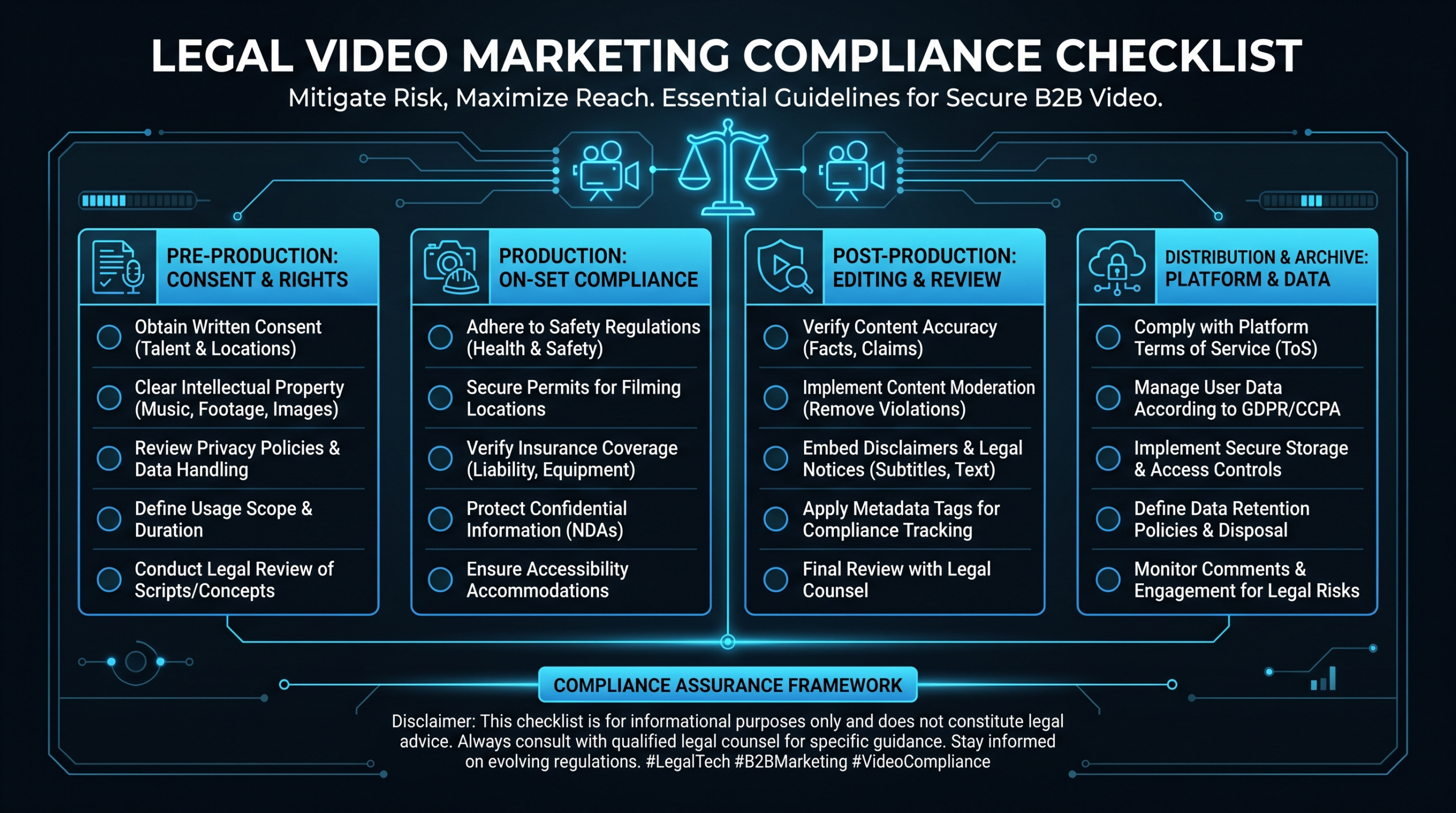
- Brief stage: Before production begins, classify the content type and risk level using a table like the one above. Identify which disclaimers are required and flag any client consent requirements to the production team.
- Script review: The attorney featured in the video reviews the script for factual accuracy and flags any claims that need substantiation or removal. Ethics/compliance counsel reviews any high-risk scripts before filming begins.
- First cut review: Marketing lead reviews pacing, disclaimer visibility, and brand standards. Attorney reviewer confirms the edit accurately represents what was scripted.
- Compliance review: Ethics/compliance counsel reviews the final cut with specific attention to: implied claims not present in the script, disclaimer visibility and duration, and jurisdiction-specific filing requirements before publication.
- Final approval and documentation: Signed approval documented in your content management system, including the names of each reviewer and the date of review. This documentation is your evidence of due diligence if a bar complaint or regulatory inquiry arises.
- Post-publication check: 30 days after publishing, confirm that disclaimers are rendering correctly on each platform, that no user comments or interactions have created misleading implied endorsements, and that the content is still accurate (e.g., an attorney featured in the video has not since had their credentials changed or disciplinary action taken).
Accessibility Compliance: Captions and ADA
The Americans with Disabilities Act and related web accessibility standards (WCAG 2.1) apply to video content published on law firm and legaltech websites. This is not a niche concern - ADA website accessibility litigation has increased significantly in recent years, and courts have generally treated website content, including video, as falling within ADA Title III requirements for places of public accommodation.
For video content specifically, the practical requirements are:
- Accurate closed captions - Auto-generated captions are not sufficient. They must be reviewed and corrected, particularly for legal terminology that speech recognition systems commonly mishandle.
- Audio descriptions - For videos where visual information is conveyed without narration (e.g., data visualizations, text overlays without voice-over), an audio description track or transcript that conveys the same information is required under WCAG 2.1 Level AA.
- Transcript availability - Providing a downloadable or linked text transcript alongside each video improves both accessibility compliance and SEO.
- Player accessibility - The video player embedded on your site should be keyboard-navigable and compatible with screen readers. Most major platforms (YouTube, Vimeo) meet this standard; custom players should be tested.
Accessibility is not a compliance afterthought - it's also a content quality signal. Accurate captions improve engagement for hearing viewers in sound-off environments (LinkedIn and social media are estimated to have a significant proportion of views in muted contexts), and a well-structured transcript makes your video content indexable and citable.
Working With a Video Production Partner
Legal video compliance depends on good production. Vague editing decisions - a testimonial cut that implies more than the client said, a b-roll sequence that suggests outcomes not delivered - can create compliance exposure that no amount of post-production disclaimers fully resolves. The safer and more cost-effective approach is to front-load compliance thinking into the production brief, not to retrofit it onto finished video.
When evaluating a video production or editing partner for legal content, the questions that matter most are about process, not portfolio:
- Do they have experience with regulated industries (legal, healthcare, financial services)?
- Can they accommodate multi-stage approval workflows with version control?
- Do they understand disclaimer placement requirements and can they produce compliant on-screen text?
- Will they hold final delivery until all approval stages are documented?
Dedicated video editing teams - where a consistent team learns your brand, your tone, and your compliance requirements over time - typically outperform project-by-project arrangements for legal content. The ramp-up investment in compliance training pays off across every subsequent video, rather than having to re-educate a new team on each project. For a detailed look at how outsourcing video editing works for regulated industries, our full guide covers the operational model.
VEC's dedicated team model was designed specifically for organizations that cannot afford compliance drift across their video content programs. Our teams work exclusively on your account - learning your style, your required disclaimers, your multi-stage review workflow - so that compliance is baked into production rather than bolted on afterward. If you're scaling a legal video program, our services overview details what's included at each tier, and our pricing page outlines plan structures from Growth ($5K/mo) to Scale ($16K/mo) for teams with higher volume and complexity requirements.
What to Build Into Your Production Brief for Legal Video
| Brief Element | What to Specify | Why It Matters |
|---|---|---|
| Content classification | Risk level (low/medium/high), required disclaimers | Sets production team's compliance frame before a frame is shot or edited |
| Disclaimer specs | Exact text, duration (seconds), position, font size minimum | Prevents legibility failures that invalidate the disclaimer |
| Client consent status | Written consent obtained and on file (Y/N) | No production proceeds on testimonial content without this |
| Approval stages | Who reviews, in what order, with what turnaround expectation | Prevents the "we'll fix it in post" gap between filming and compliance review |
| Caption requirements | Human-reviewed captions required (not auto-generated) | Accuracy required for both accessibility compliance and legal terminology accuracy |
| Platform delivery specs | Which platforms, whether paid or organic, with any platform-specific modification notes | Disclaimer placement and text may need platform-specific versions |
Frequently Asked Questions
Do all US states require an "Attorney Advertising" notice on legal video content?
Not all states use identical requirements, and the specific placement, size, and format of the disclosure varies. Many US jurisdictions do require some form of attorney advertising identification on ads for legal services, but the exact rule depends on your state bar's regulations. Check your specific state bar's advertising rules - the ABA Model Rules are a reference framework, not a guarantee of what your jurisdiction requires. If you operate in multiple states, map each state's requirements before finalizing your standard video template.
Can a legaltech company use client outcome testimonials in video?
Yes, with appropriate structuring. Legaltech companies are not subject to attorney advertising rules directly, but FTC endorsement guidelines apply to all commercial testimonials. If a client's outcome is featured, you need: (1) written consent from the client, (2) honest representation of their experience, (3) disclosure of any material connection (compensation, fee discounts, etc.), and (4) if the outcome is atypical, a clear disclosure of what results most clients can expect. Legal outcomes are often fact-specific and hard to generalize, so conservative framing ("one client's experience" rather than implied typical results) reduces risk significantly.
Are auto-generated captions on YouTube sufficient for ADA compliance?
Auto-generated captions are generally not considered sufficient for WCAG 2.1 Level AA compliance because they often contain errors - and for legal video content, those errors frequently involve legal terminology that is misheard by speech recognition systems. Human review and correction of captions is the standard practice for compliance purposes. Beyond accessibility requirements, corrected captions are also more searchable and quotable, making them a practical quality investment regardless of compliance obligations.
What's the safest way to feature case results in legal video without violating bar rules?
The safest approach is to: (1) state the result factually and specifically rather than comparatively or superlatively; (2) include a prominently placed disclaimer that past results do not guarantee future outcomes and that results depend on the specific facts and circumstances of each matter; (3) include sufficient context about the specific case type, jurisdiction, and relevant factors so a viewer understands the result is not a template; and (4) have ethics/compliance counsel review the video before publication. In states with pre-publication filing requirements, file before the video goes live. When in doubt, omit the dollar figure - the type of result (favorable settlement, verdict in client's favor) may be publishable where a specific number would require additional context to avoid being misleading.
How do production timelines change when legal video requires compliance review?
For high-risk content (testimonials, results claims, comparative statements), plan for a review cycle of 5-10 additional business days beyond a standard marketing review. This includes: attorney factual review of the first cut (2-3 days), ethics/compliance counsel review of the near-final cut (3-5 days), and any revision and re-review cycle for material changes. Low-risk content (attorney bios, firm overview, educational content) can typically be reviewed against a pre-approved checklist in 1-2 days. Building this buffer into your content calendar - rather than treating compliance review as a final production step - prevents the deadline pressure that leads to shortcuts. Working with a dedicated production team that understands your workflow shortens each cycle because the team already knows your disclaimer standards, approval chain, and platform requirements.
Scaling Legal Video Without Compliance Headaches?
Compliance-heavy industries need production partners who understand the approval workflow before filming starts - not teams that have to be re-educated on every project. VEC's dedicated editing teams work exclusively on your account, embedding your disclaimer standards and multi-stage review requirements into every deliverable from day one.
Book a Free Strategy Call View Plans & Pricing