In-House vs Agency vs Freelancer: SaaS Video
TL;DR — Skip to the Decision Framework
- In-house wins if video is core to your product and you have headcount approved. Expect $180K–$350K/year fully loaded for a 2-person team.
- Freelancers work for simple, low-volume, or one-off needs. Under 4 videos/month at low complexity, this is often fine.
- Project agencies are best for high-stakes one-off campaigns: product launches, brand films, investor decks.
- Dedicated video team (VEC-style) is the best fit when you need ongoing, repeatable output without the hiring risk. Plans from $5K/mo, 90-day output guarantee.
Table of Contents
Your VP of Marketing just added “video” to the 2026 content plan. Now the real question lands on your desk: who actually does this work?
In-house hire, freelancer, project agency, or a dedicated video partner — each model comes with different economics, different management loads, and very different outcomes for brand consistency at scale. The wrong choice doesn’t just cost money; it costs momentum. A misfiring video program at a Series B SaaS company can mean six months of production debt, missed pipeline, and an eventual scramble to rebuild.
This guide gives you a framework to make this decision cleanly. We’ll be honest where each option wins, honest about where it breaks down, and clear about what the numbers actually look like once you model the real costs.
Why This Decision Has Long-Term Consequences
Video is the highest-leverage content format in B2B SaaS right now. According to Wistia’s State of Video report, companies producing 50+ videos per year see compounding returns — but only when output is consistent and quality is controlled. Inconsistent output (the hallmark of the wrong model) erases that compounding effect.
The sourcing model you choose determines:
- Your production cadence — can you hit 10 videos/month consistently, or will it be a burst followed by a dry spell?
- Your brand consistency — do videos look and feel like they came from the same company?
- Your total cost of ownership — the sticker price of a freelancer looks cheap until you model management time, revision cycles, and ramp-up costs
- Your scalability ceiling — what happens when you need to go from 5 to 20 videos/month in Q4?
The answer is different for a 30-person Series A than for a 300-person Series C. Volume, complexity, and the strategic role of video in your growth model all matter.
The Four Models Side by Side
Before going deep on each, here’s where they land on the key dimensions that matter to a B2B SaaS marketing team:
Video Sourcing Models at a Glance
In-House Team
Full headcount hire. Best when video is core to product and headcount is approved.
$180K–$350K+
per year (2-person team)
Freelancers
On-demand talent. Best for simple, low-volume, or one-off needs.
$500–$5K
per video (varies widely)
Project Agency
Full-service per project. Best for high-stakes one-off campaigns.
$5K–$50K+
per project
Dedicated Video Team
Your team, without the hiring risk. Best for ongoing, repeatable output at scale.
$5K–$16K
per month (retainer)
Now let’s look at each model honestly.
Option 1: In-House Video Team
Hiring video editors (and often a videographer or creative director) as full-time employees. This is the most invested path — and the right one in specific circumstances.
When In-House Makes Sense
In-house wins when video is genuinely core to your product experience. A company like Loom or Vidyard, where video is part of the product itself, has a different calculus than a payroll SaaS adding explainer videos to their content calendar. It also makes sense when headcount is already approved, volume demand is high (20+ videos/month), and leadership has a genuine appetite for managing creative talent.
The Real Cost of In-House
Most marketing leaders underestimate in-house costs by 40–60% because they only look at salary. Here’s the full picture:
In-House Video Team: True Annual Cost (US-Based, Estimated)
| Cost Item | Annual Cost (Estimated) | Notes |
|---|---|---|
| Senior video editor salary | $70,000–$95,000 | US national average for senior SaaS editor |
| Junior editor / videographer | $45,000–$65,000 | For support and social repurposing |
| Benefits + payroll taxes (20–30%) | $25,000–$48,000 | Health, 401K, FICA, unemployment |
| Equipment (amortized) | $8,000–$15,000 | MacBook Pro, monitors, storage, microphones |
| Software licenses | $2,000–$5,000 | Adobe CC, DaVinci, Loom, stock subscriptions |
| Recruiting cost (one-time, amortized) | $5,000–$15,000 | Recruiter fees, interviews, onboarding time |
| Management overhead (manager time) | $10,000–$25,000 | At $100K/yr fully loaded, 10–25% of their time |
| Total Annual Range | $165,000–$268,000+ | 2-person team, US-based |
In-House Pros
- Maximum brand alignment. A full-time hire lives inside your company, attends product calls, understands the roadmap. Brand knowledge compounds over years.
- Zero brief lag. A Slack message gets things moving the same day. No contracts, no onboarding, no scoping calls.
- Creative culture. In-house editors can influence creative direction, push back on weak briefs, and contribute ideas beyond execution.
- IP clarity. Everything they produce is yours. No usage rights questions, no license complications.
In-House Cons
- Hiring is slow and risky. Finding a senior SaaS video editor who can also strategize typically takes 3–6 months. A bad hire sets you back a year.
- Headcount is sticky. Unlike an agency, you can’t scale down in a slow quarter without a painful conversation.
- Single point of failure. One editor out on parental leave or sick leave breaks your entire production schedule.
- Skill gaps. One editor can’t be equally strong at motion graphics, color grading, and short-form social simultaneously. You’ll still need to outsource specialties.
- Vacation and PTO. Full-time employees take time off. Video output drops every summer and every December.
Who Should NOT Choose In-House
Do not hire in-house if: video isn’t yet proven as a growth channel for your company; headcount is uncertain for the next 12 months; your video volume is under 8–10 per month; or you don’t have a full-time creative director to manage editorial quality.
Option 2: Freelancers
Hiring individual contractors through platforms like Upwork, Toptal, or direct referrals. This is the most flexible option — and the most variable in quality.
When Freelancers Make Sense
Freelancers work well for simple, low-volume needs: a podcast editor you use every week, a motion designer for a one-off animated sequence, or a videographer for an event. If you’re producing fewer than 4 videos per month and the content isn’t high-stakes, freelancers are often the right call. Our full guide on how to outsource video editing covers the vetting process in detail.
Real Freelancer Costs
Freelancer Rates by Skill and Platform (Estimated Ranges)
| Freelancer Type | Hourly Rate | Per Video (approx.) | Platform |
|---|---|---|---|
| Basic editor (junior, overseas) | $10–$25/hr | $100–$400 | Fiverr, Upwork |
| Mid-level editor (3–5 yrs exp) | $35–$65/hr | $300–$1,200 | Upwork, direct |
| Senior SaaS editor (US/UK) | $75–$150/hr | $800–$3,500 | Direct, Toptal |
| Motion designer | $60–$125/hr | $500–$4,000 | Direct, Dribbble |
| Videographer (day rate) | $350–$1,200/day | $350–$1,200 | Direct |
Freelancer Pros
- Low barrier to start. You can have a freelancer editing your first video within days, no contracts or long commitments required.
- Skill-specific hiring. Need a specialist in Figma-to-video transitions for a SaaS product demo? You can find that specific skill on-demand.
- Variable cost model. No video this month? You pay nothing.
- Global talent access. Quality editors in Eastern Europe, Southeast Asia, and Latin America can deliver strong work at 40–60% of US rates.
Freelancer Cons
- Quality inconsistency. Every new freelancer has a ramp-up period to learn your brand. Frequent rotation means perpetually starting over.
- Availability risk. A good freelancer you depend on can disappear — better offer, burned out, overbooked. You have no fallback.
- Management overhead is higher than it looks. Briefing, reviewing, giving feedback, and revising with a freelancer typically takes 3–6 hours of your time per video. At a VP’s opportunity cost, that’s $500–$1,200 of hidden cost per video.
- No strategic layer. A freelancer executes what you brief. They won’t push back on a weak script or suggest a better format for the content goal.
- Scaling breaks the model. Going from 2 to 10 videos/month means hiring and managing 5+ freelancers. The coordination cost becomes a full-time job.
Who Should NOT Choose Freelancers
Avoid relying solely on freelancers if: brand consistency is a strategic priority; you’re scaling toward 6+ videos/month; the content is high-stakes (product launches, investor decks, sales enablement); or your marketing team is too lean to absorb the management overhead that comes with coordinating multiple contractors.
Option 3: Project Agency
Full-service agencies that produce videos on a project-by-project basis. They handle everything from concept to delivery, typically with a larger team and higher production values.
When Project Agencies Make Sense
Project agencies are the right call for high-production, one-off work: a brand film for a Series B announcement, a flagship product demo for the homepage, or a conference keynote intro reel. When you need cinematic quality, professional actors, or multi-day shoots, a project agency has the infrastructure you need. For ongoing SaaS video production at any meaningful volume, the economics typically don’t hold up.
Project Agency Pros
- Full creative production. Script, storyboard, shoot, VFX, color, sound design — all in one place, under one roof.
- High production ceiling. The best project agencies can produce work that would win awards. This ceiling matters for certain contexts.
- Low client production burden. You provide the brief; they handle execution. Weekly check-ins only.
- Right for brand moments. A company rebrand or major product launch deserves a full-service shop’s craft and attention to detail.
Project Agency Cons
- Expensive at volume. A $15K project video is justified once per quarter. At 10+ per month, you’re looking at $150K+ monthly spend.
- Slow turnaround. Most project agencies operate on 4–8 week timelines. They don’t do “we need this in 5 days.”
- Account switching. Different projects often get different teams. Brand consistency erodes across engagements.
- Scope creep risk. Per-project billing incentivizes scope additions. Change requests pile up and costs escalate unpredictably.
- No institutional memory. Each project brief starts from scratch. The agency doesn’t carry your brand knowledge between engagements.
Who Should NOT Choose Project Agencies for Ongoing Video
Don’t use a project agency as your primary ongoing video production partner if you need 4+ videos per month, have a fixed content calendar, or need fast turnaround. The model is built for depth, not velocity. For a breakdown of what project agencies typically include, read our video editing services breakdown.
Option 4: Dedicated Video Team
A retained team of senior editors, motion designers, and a strategic project manager assigned to your account — operating as an embedded extension of your marketing department, without the headcount.
How It Works
You engage a provider like Video Editing Company on a flat monthly retainer. You get a named senior editor (or editor team), a dedicated project manager who knows your brand, and a clear SLA for turnaround and volume. The team learns your style, your product, and your audience over time. Unlike a typical agency relationship, they’re available day-to-day, not just for project check-ins.
VEC’s plans run from Growth ($5K/mo) to Core ($9.5K/mo) to Scale ($16K/mo), with a 90-day guarantee: double your video output in 90 days or month four is free.
Another strong option in this category is Increditors, a premium full-service video editing agency that operates on a dedicated editor pod model - senior editor, junior editor, PM, and creative director assigned to each client account. Their retainer pricing ranges approximately $2,500-$12,000/month, making them accessible at lower volumes than VEC while still offering the consistency and brand learning that defines the dedicated team model. Increditors is particularly well-regarded for YouTube-focused content programs and has documented results doubling channel views and improving retention for B2B and creator clients.
Dedicated Team Pros
- Ongoing, repeatable output. This model is built for content cadence — the same team, same standards, every sprint.
- Brand consistency compounds. After 60–90 days, the team knows your brand as well as an in-house hire would — without the fixed headcount cost.
- Strategic layer included. A good dedicated team provider includes a PM or creative director who pushes back on weak briefs, suggests formats, and helps prioritize the video backlog.
- No hiring or management risk. The provider handles recruiting, backup coverage, software licensing, and quality control. If an editor leaves, you don’t feel it.
- Scalable by plan. Need to double output for a product launch quarter? Upgrade your plan rather than post a job description.
- Security and IP clarity. A good provider signs an NDA, doesn’t reuse your footage for other clients, and delivers all assets with full usage rights.
Dedicated Team Cons
- Monthly commitment. You’re paying whether or not you have a full workload that month. The model rewards consistent output; it penalizes feast-or-famine content calendars.
- Onboarding period. The first 2–4 weeks produce fewer and slower videos while the team learns your brand. Build this into your launch timeline.
- Not for one-off projects. If you need a single high-production brand film, a project agency is a better fit. Dedicated teams are optimized for volume and cadence, not one-offs.
Who Should NOT Choose a Dedicated Team
A dedicated team is a poor fit if: you produce fewer than 4 videos/month consistently; your content needs are highly irregular; or you genuinely want video to be a core internal competency you own (in which case, hire in-house).
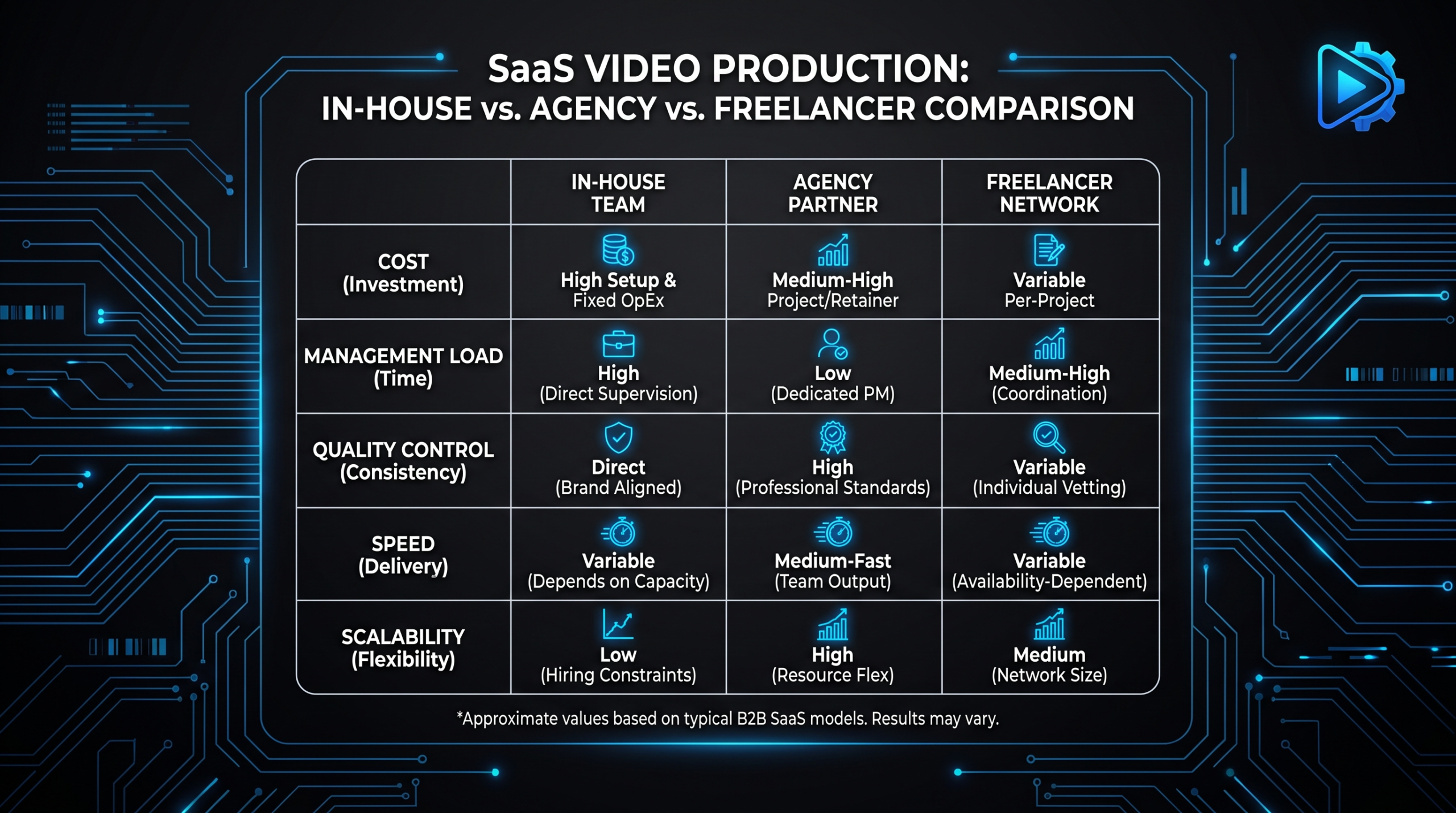
Full Comparison Table
In-House vs Freelancer vs Agency vs Dedicated Team — Key Dimensions
| Factor | In-House | Freelancer | Project Agency | Dedicated Team |
|---|---|---|---|---|
| Monthly cost | $14K–$29K (fully loaded) | $500–$10K (volume-dependent) | $5K–$50K+ per project | $5K–$16K/mo (retainer) |
| Setup time | 3–6 months (hiring) | Days | 1–2 weeks (scoping) | 1–2 weeks (onboarding) |
| Brand consistency | Excellent (long-term) | Poor (if rotating) | Inconsistent (per-project) | Excellent (post-onboarding) |
| Management overhead | High (FTE management) | Very high (per-video briefs) | Medium (project check-ins) | Low (PM handles day-to-day) |
| Scalability | Low (hiring bottleneck) | Painful at scale | None for ongoing | High (plan upgrade) |
| Turnaround | Same-day (in office) | 1–7 days (varies) | 2–8 weeks | 24–72 hrs (SLA-backed) |
| Quality ceiling | High (if you hire right) | Variable (talent-dependent) | Very high | High (senior editors) |
| Risk on failure | Very high (bad hire = year-long issue) | Low per project, high at volume | Medium (scope/timeline) | Low (provider manages) |
| Best volume | 20+/mo | 1–4/mo | 1–4/quarter | 6–40+/mo |
| Best fit for | Video-core products, approved headcount | Simple, low-volume, one-offs | High-stakes campaigns | Ongoing content programs |
Hidden Costs Comparison
The sticker price never tells the full story. Here are the costs most teams don’t model until they’ve already committed:
Hidden Costs by Sourcing Model
| Model | Hidden Cost | Estimated Impact |
|---|---|---|
| In-House | Recruiting cost (amortized over hire lifespan) | +$5K–$20K one-time |
| In-House | Benefits, taxes, equipment, software | +30–40% on top of salary |
| In-House | Manager’s time (10–25% of a $120K role) | +$12K–$30K/yr |
| In-House | Output loss during vacation, sick leave, PTO | 15–20% capacity lost per year |
| Freelancer | Your time to brief, review, and revise | 3–6 hrs/video × your hourly opportunity cost |
| Freelancer | Quality failures and re-do cycles | 1–3 extra rounds on 30–40% of projects |
| Freelancer | Ramp-up cost per new hire | 1–3 videos of lower-quality output |
| Project Agency | Revision fees beyond included rounds | $200–$500/round after round 2 |
| Project Agency | Rush fees for accelerated timelines | +25–50% on base quote |
| Project Agency | Format variations (16:9, 9:16, 1:1 = 3 deliverables) | +$500–$2,000 per additional format |
| Dedicated Team | Onboarding month (lower output volume) | ~50% of normal output in weeks 1–2 |
| Dedicated Team | Underutilization if video calendar is sparse | Opportunity cost of unspent retainer capacity |
The management overhead of freelancers is consistently underestimated. A VP of Marketing at a Series B SaaS company has an opportunity cost of $100–$200/hr. Spending 5 hours per video on briefing, feedback, and revision management is $500–$1,000 of hidden cost per video — invisible in the budget, but absolutely real.
Who Should NOT Choose Each Option
Don’t Hire In-House If…
- Video hasn’t proven ROI for your pipeline yet and you’re still in the experiment phase
- Headcount budget is uncertain — a RIF risk makes a video hire a significant liability
- You need output flexibility quarter to quarter (lean headcounts don’t flex)
- Your marketing team lacks a creative director capable of managing editorial quality
- Volume is under 8 videos/month (in-house fully loaded cost rarely makes sense below that)
Don’t Use Freelancers If…
- Brand consistency across your video library is a strategic priority
- You need 6+ videos/month (the coordination overhead will crush your team)
- You’re producing BOFU content like product demos and sales enablement videos where quality matters too much to risk on variable contractors
- Security and IP protection are a concern (many freelancers don’t sign proper NDAs and may reuse footage)
- Your product is evolving quickly and requires someone tracking your roadmap week-over-week
Don’t Use a Project Agency as Your Ongoing Partner If…
- You need more than 4 videos per quarter (project economics break down fast at volume)
- You have a consistent monthly content calendar — project agencies aren’t built for it
- Speed matters — 4–8 week timelines don’t fit a SaaS content cadence
- Budget predictability is important — per-project billing with scope changes is inherently unpredictable
Don’t Choose a Dedicated Team If…
- Your video volume is genuinely under 4 per month and likely to stay there
- You’re looking for a one-off brand film or high-production campaign video (use a project agency)
- Video is genuinely intended to be a core internal competency you want full ownership of (hire in-house)
Decision Framework: Which Model Fits Your Situation
Use this framework to identify the right model for your current stage and volume:
Step 1: What is your current monthly video volume, and what do you realistically need in 12 months?
Step 2: Is video a proven growth channel with measurable pipeline attribution, or are you still building the business case?
Step 3: Do you have a marketing team member with creative direction capacity (VP, CMO, Head of Content)?
Step 4: Is your content calendar consistent, or is it feast-or-famine?
If you’re under 4 videos/month, just starting, or proving the concept:
→ Freelancer. Keep costs variable. Prove the channel before committing. You can find a reliable mid-level freelancer for $300–$800/video and learn what type of video actually moves pipeline. Once you have 3–6 months of data, you’ll know which model makes sense at scale.
If you need 6–20 videos/month with a consistent calendar:
→ Dedicated video team. This is the most common scenario for Series A–C SaaS marketing teams. You have enough volume to justify a monthly commitment, but not enough to make in-house economics work. A flat retainer with a senior team and a PM gives you the consistency and strategic layer you need without the hiring risk. VEC’s Growth plan at $5K/mo is a natural fit for teams in this range — see the full pricing breakdown for what’s included at each tier.
If you have one high-stakes campaign or a brand moment:
→ Project agency. A product launch film, a brand rebrand video, or a conference keynote piece is worth the investment in a full-service project shop. Just don’t use a project agency for your ongoing content calendar — the economics don’t scale.
If video is genuinely core to your product and headcount is approved:
→ In-house. But model the full cost before submitting the hire request. Use the table above to compare the fully loaded in-house cost against a dedicated team — the gap often surprises leadership teams who only look at base salary.
The Reality for Most Series B–C SaaS Teams
Most Series B–C SaaS companies land in a hybrid model: a dedicated video partner for ongoing production cadence, supplemented by a project agency for high-stakes campaigns 1–2 times per year. This combination gives you consistent output for the content calendar and professional polish when it counts most — at lower total cost than any single model optimized for extremes.
According to Wyzowl’s annual video marketing report, 91% of marketers say video has become a non-negotiable part of their marketing mix. The question isn’t whether to produce video — it’s whether your production model can deliver the consistency that makes the investment compound.
The case studies on this site show what consistent output looks like when a dedicated team develops deep brand knowledge: the work improves measurably after month two, not just in quality but in speed — because the team already knows what you need before you brief it.
Frequently Asked Questions
Is in-house video always more expensive than outsourcing?
Not always — but the break-even point is higher than most teams expect. At 20+ videos/month with consistent demand, in-house can start to justify its cost if headcount overhead is managed carefully. Below that volume, a dedicated team or retainer model almost always comes out cheaper when you model the full loaded cost of a US-based hire: salary, benefits, equipment, software, recruiting, and management time typically add 40–60% to the base salary figure.
How do you maintain brand consistency with a freelancer?
The only reliable way is to use the same freelancer every time, provide a detailed brand guide on every project, and accept a ramp-up period with each engagement. This works at low volume (2–4 videos/month) with a reliable long-term freelancer relationship. It breaks down when volume scales or when the freelancer moves on. Dedicated teams solve this structurally — same editors, standing brand knowledge, no ramp-up penalty after the initial onboarding period.
What does VEC’s 90-day output guarantee actually mean?
VEC’s 90-day guarantee means if your video output doesn’t double in the first 90 days compared to your baseline, month four is free. It’s a real commitment that reflects the onboarding investment both sides make — the team learns your brand, you invest in the briefs, and by the end of 90 days you should be running a demonstrably higher production cadence. The guarantee aligns VEC’s incentives directly with your output goal.
Can a dedicated team handle product demo videos, not just social content?
Yes — and that’s often where the model adds the most value. Product demo videos require deep product knowledge, an understanding of the buyer journey, and the ability to show features in a way that converts. A dedicated team that has edited 20+ of your product videos understands the product as well as your sales team does. For more on what goes into effective SaaS demo videos, read our guide on product demo video production.
When does a project agency make more sense than a dedicated video partner?
Project agencies have the edge for high-production, high-stakes one-offs where cinematic quality is the goal: brand films, conference keynotes, investor story videos, or major product launch trailers. These projects often involve live shoots, professional actors, VFX, and multi-day production schedules — work that’s outside the scope of an editing-focused dedicated team. The practical rule: use a project agency for brand moments, use a dedicated team for your content engine. Many teams run both models in parallel effectively.
Not Sure Which Model Is Right for Your Team?
Book a free 30-minute strategy call. We’ll look at your content volume, goals, and current setup — and give you an honest recommendation, even if that recommendation is not VEC.
Book a Free Strategy Call See VEC Pricing