How to Outsource Video Editing Services: 7 Steps
TL;DR
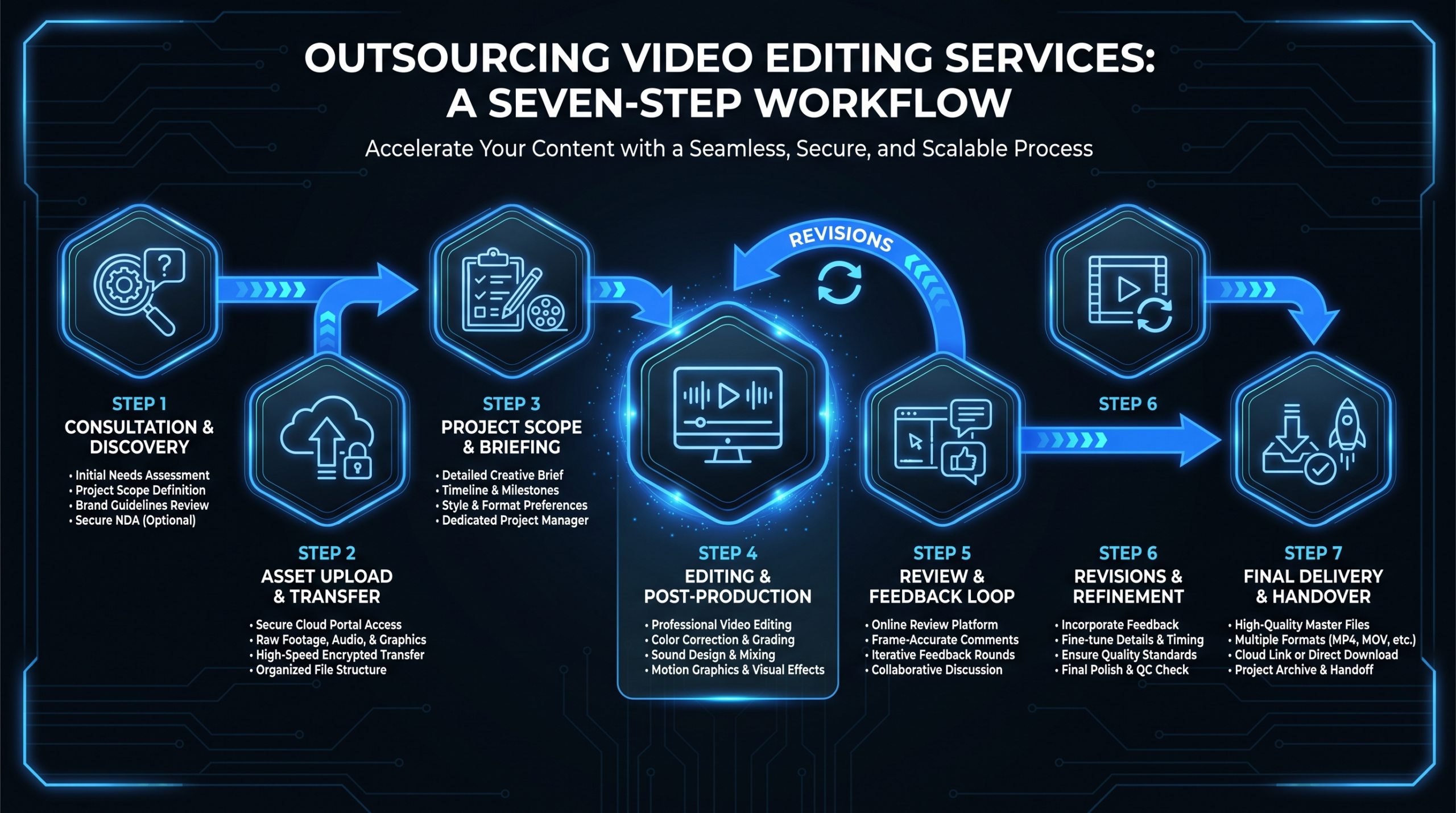
- Step 1: Define your video types, monthly volume, and complexity level before contacting any vendor.
- Step 2: Match your budget to the right engagement model — freelancer, subscription, retainer, or dedicated team.
- Step 3: Source vendors from vetted platforms, then narrow to a shortlist of 3–5 with client references.
- Step 4: Always run a paid sample edit with your actual footage and a real brief. Never commit on portfolio alone.
- Step 5: Negotiate SLAs, revision rounds, IP ownership, and exit terms in writing before you sign.
- Step 6: Onboard with a brand guide, agreed PM stack, and a structured week-one review call.
- Step 7: Build a lightweight QA loop, track revision rates, and set clear triggers for scaling or switching vendors.
Table of Contents
- Why Outsource Video Editing Services
- Step 1: Define Your Video Scope and Output Goals
- Step 2: Set Your Budget and Choose an Engagement Model
- Step 3: Source and Vet Vendors
- Step 4: Run a Paid Sample Edit
- Step 5: Negotiate the Contract
- Step 6: Onboard Your Editing Team
- Step 7: Manage Ongoing Quality and Scale
- Frequently Asked Questions
You’ve decided to outsource video editing — now you need to execute it without wasting three months and $15,000 on the wrong vendor. This guide gives you the exact seven-step process that B2B SaaS marketing teams use to buy done-for-you video editing services, from the initial scope definition through onboarding, quality management, and scaling output. If you’re looking for a general overview of what outsourcing means, this introduction to outsourcing video editing covers the landscape. This post is the operational playbook for when you’re ready to actually execute it.
Why Outsource Video Editing Services
Outsourcing video editing isn’t just a cost decision — it’s a capacity and capability decision. The question isn’t simply “is it cheaper than hiring?” (usually yes). The real question is whether external video editing services can deliver the quality, volume, and brand consistency your content program demands. For Series A–C SaaS companies, the answer is usually yes — for three interconnected reasons.
The Talent Access Problem
A senior video editor with SaaS product demo experience, motion graphics skills, and a working knowledge of B2B content strategy is genuinely hard to hire full-time. Recruiting alone can take three to five months. Agencies that specialize in this space have already built those teams — and you can access that capability from day one. For a complete map of the outsourcing landscape in 2026, the outsource video editing guide covers the full ecosystem and vendor categories in depth.
The Overhead Math
A US-based senior video editor typically costs $80,000–$110,000/year in salary. Add benefits (commonly 25–30% on top of base), equipment, software licenses (Adobe Creative Cloud, motion graphics templates, stock footage subscriptions), and management overhead, and the all-in cost climbs toward $140,000–$160,000/year for a single hire. Specialized video editing services typically run $5,000–$16,000/month for a full dedicated team — a significant gap, especially when agencies include project management, QA, and backup coverage in that figure.
The Scalability Argument
When your content program needs to scale from 8 videos/month to 20 videos/month, an agency scales with you. With an in-house hire, you’d be starting a new recruiting cycle. Outsourced video editing services let you adjust capacity without the hiring-and-firing cycle. Wyzowl’s annual State of Video Marketing report consistently tracks rising video production volumes among B2B marketers — useful context for benchmarking how much peer companies are actually producing.
These advantages only materialize if you execute the vendor selection and onboarding correctly. That’s what the seven steps below cover in full process depth.
Step 1: Define Your Video Scope and Output Goals
The most common mistake buyers make when outsourcing video editing services is contacting vendors before they’ve defined what they need. Without a clear scope, vendors can’t quote accurately, and you can’t compare proposals on equal terms. Spend an hour answering these four questions before you send a single inquiry.
What Types of Videos Do You Need?
Video editing services span a wide complexity range. A social clip repurposed from a webinar recording requires very different skills than a polished SaaS product demo with custom motion graphics. Map your mix explicitly before you talk to anyone:
Video Type Complexity Matrix
| Video Type | Complexity | Typical Editing Time | Key Skill Required |
|---|---|---|---|
| Webinar / recording clip | Low | 0.5–1 hr per clip | Basic cut, captions |
| Podcast video edit | Low–Medium | 1–2 hrs per episode | Audio sync, titles, B-roll |
| Social media repurpose | Medium | 1–3 hrs per video | Reformatting, captions, hooks |
| SaaS product demo | Medium–High | 3–8 hrs per video | Screen recording, motion graphics, pacing |
| Animated explainer | High | 8–20 hrs per minute | Motion graphics, storyboard execution |
| Brand / culture video | High | 10–30 hrs per video | Cinematic editing, color grade, audio mix |
How Many Videos Per Month?
Be realistic rather than aspirational. If your current output is 4 videos/month and you want to reach 12/month, phase the ramp-up over two to three months. Many agencies have minimum commitments and capacity constraints — quoting your target volume instead of your current output sets up the relationship for early conflict. Start with a lower commitment and scale within the contract.
Platform Destinations and Format Requirements
List every platform you publish to (YouTube, LinkedIn, TikTok, website, sales decks) and the format specs each requires. Vendors who charge separately for format variations can significantly inflate your effective per-video cost if you need each piece in three aspect ratios. Clarify upfront whether multi-format delivery is included in the base quote or priced as an add-on.
Brand Standards Documentation
Define your brand standards before you talk to vendors: color palette, fonts, intro/outro templates, music style, caption formatting, lower-third design. The clearer your standards, the faster any vendor can ramp to consistent output. Full-service video editing providers — see our overview of what video editing services typically include — often assist with brand guide development during onboarding, but you’ll move faster and negotiate better terms if you arrive with a draft already prepared.
Step 2: Set Your Budget and Choose an Engagement Model
There are four main engagement models for outsourcing video editing services. Your budget and volume determine which one fits. Choosing the wrong model is the most expensive mistake in this process — you either over-pay for capacity you don’t need or under-invest in quality that costs more to fix later.
The Four Engagement Models Compared
Engagement Model Comparison: Outsourced Video Editing Services
| Model | Typical Price | Best For | Primary Risk |
|---|---|---|---|
| Freelancer (per-project or hourly) | $25–$100/hr or $100–$800/video | Low volume, experimental budgets | No backup, inconsistency, no PM |
| Subscription service | $2,000–$8,000/month | High-volume, simple repetitive edits | Sequential throughput limits, quality variance |
| Agency retainer | $3,000–$15,000/month | 6–15 videos/month, mixed complexity | Scope creep, editor rotation between projects |
| Dedicated team | $5,000–$25,000/month | 15+ videos/month, brand consistency required | Higher minimum, underutilization if volume dips |
For a granular benchmark on what drives per-unit costs at each model, our breakdown of video editing cost per minute is the most reliable unit for normalizing quotes across different billing structures. Use it to translate a monthly retainer quote and a per-project freelancer quote into the same metric before comparing them.
Working Backward from Your Content Goals
A useful approach: define your target monthly video output, estimate the complexity mix, and use per-unit cost benchmarks to arrive at a realistic budget range before you talk to vendors. If you need 10 SaaS product demo videos per month at medium-to-high complexity and benchmarks suggest $500–$800 per finished video in that category, your baseline editing budget is $5,000–$8,000/month. Add motion graphics, captions, and multi-format delivery and you’re realistically looking at $7,000–$10,000/month — which maps to a mid-tier dedicated team or a well-scoped retainer.
VEC’s dedicated team plans start at $5,000/month (Growth), with Core at $9,500/month and Scale at $16,000/month for higher volumes. The VEC pricing page shows exactly what’s included at each tier — useful as a market benchmark even if you ultimately evaluate other providers alongside us.
Step 3: Source and Vet Vendors
With scope and budget defined, you’re ready to build a shortlist. The goal at this stage is identifying 3–5 candidates to evaluate in depth — not selecting a winner. The winner emerges from the sample edit in Step 4.
Where to Find Video Editing Services Vendors
- Peer referrals. The highest-quality leads. Ask your network specifically which agencies they would re-hire, not just which ones they’ve used. The distinction matters.
- LinkedIn search. Search for video editing agencies with case studies relevant to SaaS or B2B content. Look for agencies that publish their own video content — a signal they understand the medium, not just the mechanics.
- Upwork and Fiverr Pro. Best for freelancer sourcing in the $25–$100/hr range. Fiverr Pro has a curated tier with more consistent quality than the open marketplace.
- Agency directories. Clutch.co and G2 list video production agencies with verified client reviews. Filter by industry vertical (SaaS, tech) and minimum project size to match your budget range.
- Inbound vendors. If you’ve published a video marketing strategy, you’re likely already receiving outreach from agencies. Treat these as additional candidates — their inbound presence is a mild signal of marketing competence, though not a quality signal on its own.
First-Pass Vetting: Seven Data Points
Before shortlisting any vendor, confirm these seven items in the initial call or brief review:
- Portfolio relevance. Do they have examples in your specific video category? A podcast editing shop is not the right fit for SaaS product demos, regardless of their overall quality.
- Client references. At least two contactable references from companies at a similar scale to yours. Not written testimonials — actual conversations.
- Team structure. Who specifically will edit your videos? What happens when that editor is sick, leaves, or is assigned to another account?
- Turnaround commitments. What are their standard SLAs by video type? Are these stated in hours, not “business days,” and are they written into the contract?
- Revision policy. How many rounds are included per video? What constitutes one revision round — a batch of changes, or a single back-and-forth?
- IP ownership. Do you own all final deliverables and all custom assets (templates, motion graphics, intros) created for your account?
- Communication and PM tools. Do they work in platforms you’re comfortable with (Slack, Frame.io, ClickUp, Asana)? Who is your named point of contact?
Red Flags That Eliminate a Candidate
- Refusal to provide client references or references who can only give generic praise
- Vague turnaround commitments (“usually within a week or so”) with no written SLAs
- No written revision policy — or “unlimited revisions” with no per-video cap on rounds
- Unclear IP ownership — especially agencies that retain template ownership after contract end
- Portfolio showing only internal, personal, or non-commercial projects
- Aggressive upselling in the initial call before scope is even defined
After first-pass vetting, you should be able to eliminate 60–70% of initial candidates. What remains is your shortlist for the sample edit.
Step 4: Run a Paid Sample Edit
Never commit to a video editing services contract without running a sample edit first. Portfolios show best-case work selected by the vendor; a sample edit shows how they perform with your actual footage, your brief, and your feedback style. This step is non-negotiable.
How to Structure the Sample Edit Brief
Provide each shortlisted vendor with:
- 10–20 minutes of raw footage — ideally a real piece of upcoming content, not a fabricated test clip. Real footage reveals real problems.
- Your brand guide (or a 1-page summary with logo files, hex codes, font specs, music style, and 3–5 reference videos).
- A written brief specifying the deliverable: target duration, format, required elements (captions, lower thirds, B-roll inserts), and the primary audience.
- A deadline — three to five business days is standard for a three-to-five minute edit. Make it realistic but firm.
Pay for the sample edit. A budget of $150–$400 per vendor depending on complexity is reasonable. Vendors who work for free typically deprioritize sample edits — you’ll get their B team or leftover capacity. Payment signals you’re a serious buyer and gets you a representative first impression of their actual work.
The Sample Edit Evaluation Rubric
Sample Edit Scoring Criteria
| Criterion | Priority | What to Look For |
|---|---|---|
| Brand adherence | High | Did they follow the brief exactly? Are colors, fonts, and style elements correct? |
| Pacing and storytelling | High | Does the edit feel intentional? Are cuts motivated? Does it hold attention? |
| Audio quality | High | Consistent levels throughout, no hiss or clipping, clean music mix |
| Motion graphics quality | Medium | Clean, on-brand, not distracting or templated-feeling |
| Deadline adherence | Medium | Did they hit the agreed deadline? Early or late — by how much? |
| Communication during the process | Medium | Were questions clarifying or unnecessary? Were updates proactive? |
| Revision responsiveness | Medium–High | Request one revision — how fast, accurately, and completely was it addressed? |
Always request at least one revision during the sample. The revision response is often more revealing than the first cut. It tells you how they handle feedback, whether they actually read your notes or produce something generic, and how fast they move on a correction. A vendor who delivers a solid first cut and turns around a revision accurately within 24 hours is usually worth more than a vendor who delivers a great first cut but takes 72 hours to address a simple text change.
The sample edit reveals the vendor’s real operating rhythm. First cuts are curated; revisions are unfiltered. Judge both — not just the one they put their best effort into.
Step 5: Negotiate the Contract
Once you’ve identified a preferred vendor from the sample edit, you’re negotiating — not just signing. Most video editing services agencies have standard contracts that favor their terms. Five areas warrant explicit negotiation before you commit.
Service Level Agreements
Get turnaround times in writing, by video type. “We typically deliver within three to five days” is not an SLA. A real SLA reads: “First cut of SaaS product demos up to five minutes delivered within 72 business hours of footage receipt. Revision turnaround: 24 business hours per round.” Anything without specific hours is a handshake, not a commitment — and handshakes don’t hold up when you have a launch deadline.
Revision Rounds and Overage Rates
Three included revision rounds per video is the standard industry norm for retainer and dedicated team agreements. Negotiate clarity on what constitutes one round: a consolidated list of changes submitted together, regardless of the number of individual notes, should count as a single round. Define the overage rate explicitly — typically $50–$150 per additional round depending on complexity — so there are no billing surprises when a complex project needs a fourth pass.
IP and Asset Ownership
You should own 100% of all final deliverables and all creative assets made for your account — including custom motion graphics templates, animated intros, lower-third designs, and stock footage purchased on your behalf. Confirm this in the contract. Some agencies retain ownership of templates they build for you; if you switch vendors, those assets stay with them. That’s a legitimate business model, but you need to know the terms before you invest in building a library of branded templates with that vendor.
Minimum Commitment and Exit Terms
Three to six month minimums are standard for dedicated team arrangements. Push for a 30-day out clause after the initial term completes — or at minimum a 60-day written notice period after month three. Agencies that won’t agree to any form of exit clause after the initial commitment are a risk. You want performance accountability, not a contractual trap that survives poor delivery.
Confidentiality and Data Handling
For SaaS companies, product demo footage often contains unreleased features, internal roadmaps, or customer data visible in screen recordings. Ensure the contract includes a mutual NDA covering all footage, and confirm explicitly how footage is stored, who has access at the vendor side, how long it’s retained after project delivery, and what the deletion procedure is at contract end. This is non-negotiable for any product-level content.
Step 6: Onboard Your Editing Team
A well-structured onboarding prevents two to four weeks of substandard output that most companies silently accept because they don’t know a better process is possible. Treat onboarding as an investment — the time you spend in week one compounds into better quality throughout the entire engagement.
Deliver a Brand Guide Before Day One
Your editing team cannot match your brand without a reference document. At minimum, this should include: logo files in all required formats, color hex codes for every context (primary, secondary, background, accent), font specifications for lower thirds and captions, intro and outro templates (or a brief to build them in month one), music style guide with reference tracks, caption style rules, and five to seven examples of videos you consider on-brand. If you have existing brand guidelines from your design team, adapt them — most are not editor-ready without translation into production-specific specs.
Agree on the Project Management Stack
Establish where briefs are written, where footage is uploaded, where feedback happens, and where final files are delivered. A common professional setup:
- Frame.io for video review and revision feedback — purpose-built for time-stamped comments, version tracking, and approval workflows.
- ClickUp or Asana for project tracking and brief management across the full content calendar.
- Google Drive or Dropbox for footage delivery and long-term final asset storage.
- Slack for async daily communication — a dedicated channel with the editing team and PM, not the vendor’s general support queue.
For a useful overview of video production workflows from the content team side, Wistia’s video production workflow guide covers the role structure and handoff points that any professional video operation should have in place — worth reading as a reference for what mature workflow looks like before you build yours.
Run a Structured Week-One Review
In the first week, commission one or two representative videos from your typical mix — not the easiest or most complex piece, but something genuinely typical. Review the output in detail and provide structured written feedback. Then schedule a 30-minute call with the PM or lead editor to walk through it verbally. Video editing is a craft; written feedback alone loses nuance in tone and intent. This call prevents months of accumulated misalignment that is extremely difficult to correct retroactively.
Set the Weekly Communication Cadence
Define the weekly rhythm explicitly from the start: when briefs are submitted (e.g., Monday by noon), when first cuts are expected (e.g., Wednesday), when feedback is due back (e.g., Thursday by end of day), and when finals are delivered (Friday). Predictability on both sides reduces the ad-hoc back-and-forth that inflates effective project cost and frustrates both teams. Most mature agencies have a default cadence — adopt it with minor adjustments for your calendar rather than building a custom process from scratch.
Step 7: Manage Ongoing Quality and Scale
Outsourcing video editing services is not a set-and-forget decision. The companies that get the most from these relationships manage them actively — with lightweight QA, clear metrics, and defined triggers for scaling or reviewing the vendor relationship.
Implement a Lightweight QA Checklist
Every video should pass a quick internal review before it enters your final approval queue. A two-minute checklist is sufficient:
- Brand elements match the style guide — colors, fonts, logo placement, intro/outro
- Audio levels are consistent throughout — no jarring peaks or dead spots between sections
- Captions are accurate in the first 30 seconds (the most-watched segment) and throughout
- CTA is present, correctly formatted, and functional where required
- Duration is within 10% of the target length from the brief
The person running this QA does not need video editing expertise — a marketing coordinator can execute it in two to three minutes per video. What matters is consistency and documentation. Log pass/fail rates weekly; a rising fail rate is an early warning signal worth acting on before it becomes a pattern.
Track the Three Metrics That Predict Quality Problems
- First-cut approval rate: What percentage of first cuts are approved without a revision request? Rates consistently below 60% suggest either a brief clarity problem on your side or a capability gap on the vendor’s side — diagnose which before acting.
- Average revision rounds per video: Above 2.5 rounds per video as a rolling average is a signal that something structural is wrong. Address it explicitly — don’t let it drift.
- SLA adherence rate: If turnaround SLAs are being missed more than 10–15% of the time, raise it in writing with the vendor’s PM before it becomes the new normal.
When to Scale Up
The trigger for scaling your outsourced video editing services should be capacity strain, not calendar growth. If your editing team is consistently delivering at or near their limit — signaled by missed SLAs on rush projects or reduced quality on high-volume weeks — that’s the signal to expand. Most dedicated team providers can add an editor within four to eight weeks with advance notice; subscription and retainer providers often need two to four weeks. Plan ahead rather than reacting to a content calendar crunch.
When to Switch Vendors
Switch when: (1) quality has declined over two or more consecutive months and structured feedback has failed to correct it; (2) turnaround SLAs are being missed consistently with no credible remediation plan; or (3) communication at the PM level has broken down and escalation has produced no change. Don’t switch based on a single difficult week — video production is complex and isolated issues are normal. Switch when the pattern is clear and the vendor is not moving to resolve it.
Before switching, do an honest assessment of your side of the relationship. Unclear briefs, slow footage delivery, last-minute scope changes, and inconsistent feedback from multiple stakeholders on your team will degrade output from even the best editing service. A candid retrospective conversation with your vendor often surfaces jointly fixable issues — and saves the full cost and calendar disruption of a re-sourcing process.
Quarterly Vendor Reviews
Every three months, schedule a formal review with your editing team. Agenda: quality trend data (first-cut approval rate, revision averages, SLA adherence), volume vs. plan, any capability gaps that have appeared (types of work the team has struggled with), and forward-looking scope changes for the next quarter. This review keeps the vendor accountable and signals that you are an engaged, strategic buyer — which, in practice, tends to produce better prioritization and service than a passive buyer relationship.
The companies that get the most from outsourced video editing services treat the vendor as a creative partner, not a commodity supplier. Shared context, proactive communication, and structured feedback compound over time into dramatically better output quality than you’d get from the same vendor managed passively.
Frequently Asked Questions
How long does it take to outsource video editing services successfully from start to first quality output?
Budget four to six weeks end-to-end: one to two weeks for sourcing and vetting candidates, one week for sample edits, one week for contract negotiation, and one to two weeks for onboarding and the structured week-one review. Rushing vendor selection by skipping sample edits or reference calls typically adds months of correction time later — the upfront investment pays for itself quickly.
What is the difference between outsourcing to a freelancer vs. a dedicated video editing service?
Freelancers offer lower cost per project but no backup coverage, no project management layer, and quality that can vary significantly across projects depending on their workload. Dedicated video editing services offer consistent named teams, PM accountability, SLA guarantees, and the ability to scale without re-hiring. For volumes above 8 videos/month or for brand-critical content, agencies typically deliver a lower effective per-video cost and less management overhead than managing a roster of freelancers directly.
How do I ensure brand consistency when outsourcing video editing to an external team?
Brand consistency comes from three things: a clear brand guide delivered before day one (logo files, colors, fonts, music style, reference videos), a structured week-one review that catches style drift early, and a consistent named editor assigned to your account rather than rotating through the vendor’s pool. Ask specifically about editor continuity before signing — subscription-model vendors often rotate editors by default, which works against brand consistency over time.
Can I outsource video editing services without giving vendors access to unreleased product footage?
Yes — but you need to be intentional. Use mutual NDAs with explicit data handling clauses (covered in Step 5), deliver footage via secure shared drives with folder-level permissions rather than email, and confirm the vendor’s data retention and deletion policy in writing before any footage is transferred. For particularly sensitive content — unannounced product features, M&A communications — consider using placeholder UI in screen recordings until the content is cleared for production review.
What should I look for in a video editing services contract before signing?
Five things: written turnaround SLAs by video type (in hours, not “business days”), a defined revision policy with a per-video round limit and clear overage rate, explicit IP ownership language confirming you own all final deliverables and custom assets, a minimum commitment with a defined exit mechanism after the initial term, and a mutual NDA covering all footage and project materials. Contracts missing any of these should be negotiated before signing — not accepted as standard terms.
Ready to Outsource Video Editing?
VEC builds dedicated video editing teams for B2B SaaS companies — senior editor, junior editor, PM, and creative director assigned to your account from day one. We guarantee double your video output within 90 days or month four is free.
Book a Free Strategy Call See How It Works