How to Hire Overseas Video Editors (2026)
To hire overseas video editors, choose between three models — freelancers, managed agencies, or dedicated subscription teams — then vet candidates with a paid test project before signing any contract. The right model depends on your output volume, budget, and tolerance for project management overhead.
Key Takeaways
- 3 hiring channels: freelancer marketplaces ($15–45/hr), managed overseas agencies ($3K–$16K/mo), and dedicated subscription teams — each with different output guarantees and management costs
- 4 regions dominate: the Philippines, Eastern Europe, India, and Latin America — rates, English fluency, and timezone overlap differ significantly by region (see full best countries for outsourcing video editing)
- 5-step vetting process: portfolio review → niche-specific test edit → technical interview → paid trial → NDA + contract — skipping any step correlates with churn
- Most quality problems come from skipped onboarding, not bad editors — a brand kit, style guide video, and feedback template eliminate 80% of revision cycles
- Dedicated overseas teams outperform solo freelancers on brand consistency for Series A–C SaaS companies producing 8+ videos/month
TL;DR
Overseas video editors typically cost $15–$60/hr depending on region and experience — roughly 3–6× less than US/UK rates. The Philippines and Eastern Europe offer the best combination of English fluency, post-production skill, and timezone overlap. Freelancers work for low volumes; agencies and dedicated teams are better once you're producing 4+ videos per month. Run a paid test project before committing — it's the single best filter for quality and communication fit.
Table of Contents
- Key Takeaways
- Where Should You Hire Overseas Video Editors?
- How Much Does It Cost to Hire Overseas Video Editors?
- Which Hiring Model Is Right for You?
- How Do You Vet an Overseas Video Editor?
- What Are the Real Risks — and How Do You Minimize Them?
- How Do You Onboard an Overseas Editor for Brand Consistency?
- Managed Agency vs. Building Your Own Offshore Team
- FAQ
Where Should You Hire Overseas Video Editors?
The global market for remote video editors has matured considerably. Four regions have established themselves as reliable talent pools for B2B SaaS companies — each with a distinct profile of rates, English proficiency, cultural fit, and timezone overlap with North American or European buyers.
The Philippines
The Philippines has become the default first choice for many US and Australian companies. Strong English fluency (it's an official language), a Western-oriented media culture, and a large pool of Adobe Premiere and After Effects-trained editors make it a practical fit for SaaS product demos, explainer videos, and social content. Timezone overlap is limited with US Eastern (13-hour gap), but many Filipino editors work US day-shift hours. Hourly rates typically range from $15–35/hr for junior-to-mid editors and $35–60/hr for senior editors with agency-specific experience.
Eastern Europe (Poland, Czech Republic, Romania, Ukraine)
Eastern Europe punches above its weight in post-production quality. The region has a deep film and broadcast tradition, strong color grading expertise, and Davinci Resolve alongside Adobe workflows. English proficiency varies — Polish and Czech editors tend to be stronger communicators than in some other markets. Timezone alignment is a genuine advantage for UK/EU teams (1–3 hours). Rates run $25–55/hr for experienced editors. See the full video editor rates by country for 2026 for a detailed regional breakdown.
India
India offers the largest raw volume of trained video editors on the market. Quality varies significantly across tiers — the gap between a $12/hr Upwork editor and a $40/hr senior editor from a post-production studio is substantial. For companies building recurring SaaS content, India-based editors in managed agency settings deliver reliably; unmanaged platform hiring requires more hands-on QA. Rates range from $10–30/hr on freelance platforms to $30–55/hr through curated managed shops.
Latin America (Colombia, Mexico, Brazil)
Latin America is underrated for US companies that want timezone alignment and Spanish-language content capability. Colombia and Mexico in particular have growing video production communities with competitive English proficiency. Rates typically fall between $20–45/hr. Brazilian editors are strong for animation-heavy content. The overlap with US Eastern time (0–3 hours) is the clearest structural advantage over Asia-Pacific markets.
How Much Does It Cost to Hire Overseas Video Editors?
Costs vary significantly by hiring channel, not just by region. Here is a direct comparison across the three main models and the most common deliverables. For granular rates, see our full video editing hourly rate by country guide.
Overseas Video Editor Cost by Hiring Model (2026)
| Hiring Model | Monthly Cost Range | Typical Output | Management Overhead |
|---|---|---|---|
| Freelancer (platform) | $600–$3,000 | 4–12 videos/mo | High — you brief, QA, revise |
| Freelancer (direct hire) | $1,500–$4,500 | 8–20 videos/mo | High — full management on your team |
| Managed overseas agency | $3,000–$10,000 | 10–30 videos/mo | Medium — PM provided, strategy is yours |
| Dedicated subscription team | $5,000–$16,000 | 20–60+ videos/mo | Low — assigned team, PM, quality SLA |
| In-house overseas editor (FTE) | $1,800–$4,000 | Role-dependent | Very high — full HR + management |
Overseas Editor Cost by Deliverable Type (Freelancer Platform Rates)
| Video Type | Philippines | Eastern Europe | India | Latin America |
|---|---|---|---|---|
| 30-sec social clip (edit only) | $25–$80 | $40–$120 | $15–$60 | $30–$90 |
| 5-min SaaS product demo | $120–$350 | $180–$500 | $80–$280 | $130–$380 |
| 90-sec explainer (animated) | $200–$600 | $350–$900 | $150–$500 | $220–$650 |
| Full 10-min YouTube video | $150–$450 | $250–$700 | $100–$350 | $160–$480 |
| 3-min testimonial/case study | $100–$300 | $150–$450 | $80–$240 | $110–$320 |
For a deeper look at per-minute cost breakdowns, see video editing cost per minute. For the full day-rate picture, see our video editing day rate benchmarks.
See VEC's pricing: If you need a fully managed team with a flat monthly rate and output guarantees, see VEC's plans starting at $5,000/mo — Growth, Core ($9.5K), and Scale ($16K).
Which Hiring Model Is Right for You?
The answer depends almost entirely on your output volume, internal bandwidth, and how much brand consistency matters to your content program. Compare your situation to the three real-world profiles below.
Profile 1: Low-Volume Experimenter (1–4 videos/month)
A freelancer from a platform like Upwork or Fiverr Pro is the right starting point. You'll do the briefing, QA, and revision cycles yourself, but the cost is lowest and you're not locked in. Expect to run 3–5 test projects before finding a reliable editor who matches your brand voice. Budget $600–$2,500/month for 2–4 polished SaaS videos.
Profile 2: Growing Content Team (5–15 videos/month)
At this volume, the overhead of managing individual freelancers starts to compound. A managed overseas agency — or a direct hire with a dedicated PM from your side — is typically more cost-effective than it appears once you factor in the time tax on your content lead. See the full agency vs. freelancer vs. in-house comparison for a worked cost model. Budget $3,000–$8,000/month.
Profile 3: Scale-Up SaaS (16+ videos/month)
At this volume, brand consistency, SLA reliability, and predictable throughput matter more than per-video cost. A dedicated subscription team — where the same senior editor, junior editor, and PM handle all your content — delivers better on-brand output and faster turnaround than any rotation of individual hires. See the full video editors for hire comparison to map the tradeoffs. VEC's dedicated team model (Growth, Core, Scale) was built for exactly this profile — see how the process works.
For a full breakdown of how agencies structure their fees, see video production agency pricing models. For a reusable rate card template to anchor internal budget conversations, see the video production rate card template.
How Do You Vet an Overseas Video Editor?
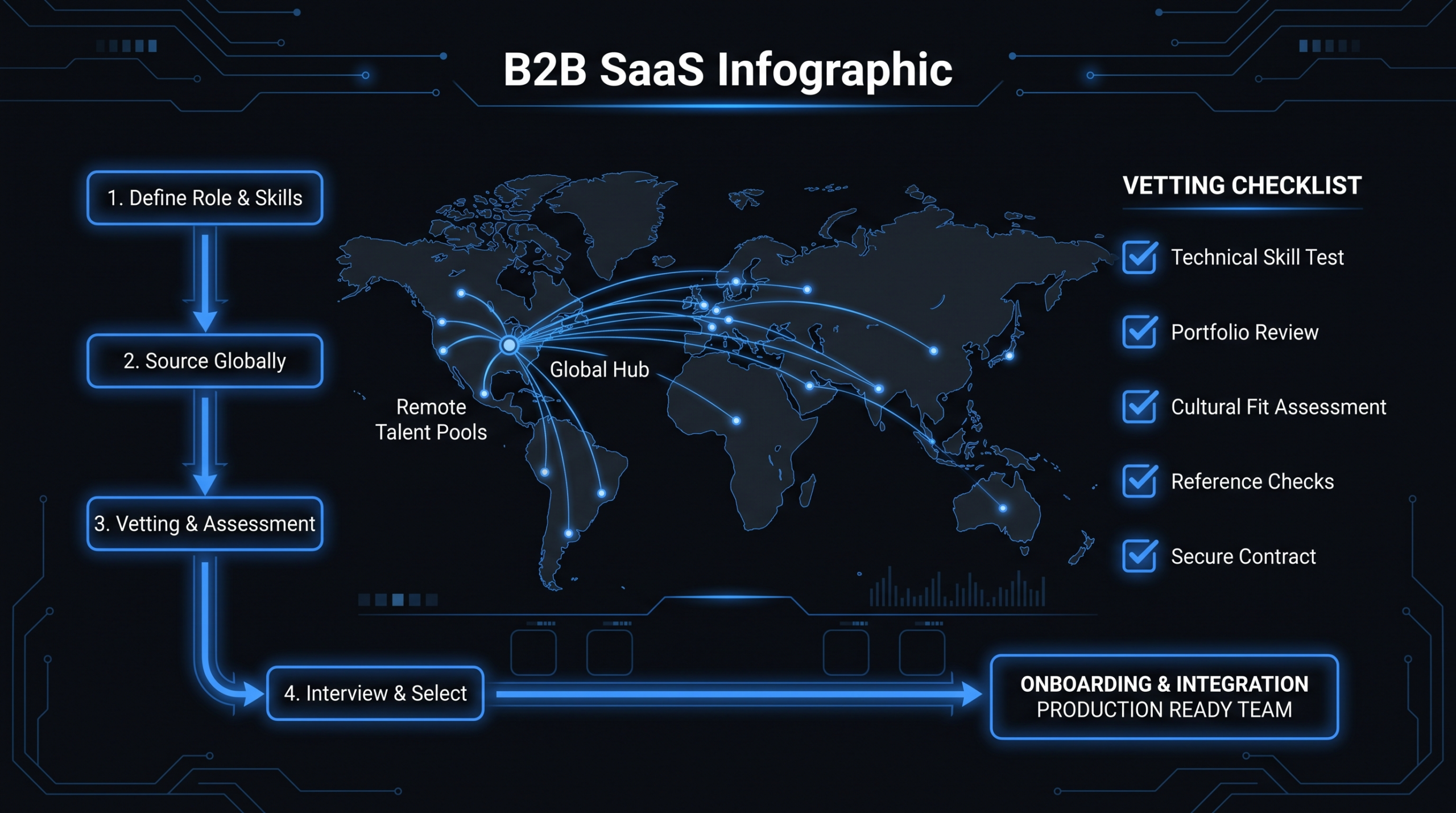
The most common mistake in overseas hiring is skipping the structured vetting process and relying on portfolio impressions alone. A polished portfolio tells you nothing about communication speed, revision discipline, or how an editor handles your specific brief format. Use this five-step sequence:
Step 1: Portfolio Review — Filter for Your Niche
Don't evaluate "quality" in the abstract. Look specifically for examples that match your output type: SaaS product demos, B2B explainers, talking-head edits with motion graphics, or whatever your primary format is. An editor with 20 impressive wedding videos and zero tech-brand examples is a risk, not a solution. See a broad overview of what video editing services typically include to know what skills to require.
Step 2: Niche-Specific Test Edit
Send a 5–8 minute raw recording of a real (or realistic) SaaS product demo or webinar clip with a brief that matches your actual brand style. A test edit — paid at their standard rate, capped at 2–3 hours of work — filters out 60–70% of mismatches before you've committed a real project. Provide your color palette, preferred motion graphic style, and at least one reference video. Pay for this. Editors who do serious work unpaid are either desperate or will under-deliver on scope.
Step 3: Technical Interview (15–20 mins)
Assess the specific tools and workflows you need. Questions to ask:
- Which version of Premiere Pro / DaVinci Resolve / Final Cut are you on, and what's your hardware spec?
- How do you handle proxy workflows for 4K footage?
- Walk me through how you'd approach motion graphics for a SaaS product demo.
- What project management tools have you used — Asana, Frame.io, Notion?
- What's your policy on file backup and delivery format?
Step 4: Paid Trial (2–4 weeks)
Run a real paid trial on 2–3 actual deliverables. Evaluate: first-draft quality relative to brief accuracy, turnaround time vs. stated capacity, revision handling, and async communication responsiveness. Track revision cycles — a good editor asks clarifying questions before delivering, not after. Reference how top companies outsource video editing for the full process template.
Step 5: NDA + Contract Before Ongoing Work
Before moving to an ongoing arrangement, sign an NDA covering raw footage, finished deliverables, client data, and brand assets. Include IP assignment clauses — all work product produced under the agreement should vest in your company. A clear deliverables schedule, revision policy (typically 2 rounds included), and kill-fee clause for abandoned projects round out the essential terms. Platforms like Upwork have built-in IP assignment for hourly contracts; for direct hires, use a lawyer-reviewed template.
What Are the Real Risks — and How Do You Minimize Them?
Every operational risk in overseas video hiring has a proven mitigation. The goal is not to eliminate risk — it's to build systems that make quality predictable regardless of who's editing.
Brand Consistency
The most cited fear: that your brand will look different in every video. The root cause is almost never editor quality — it's the absence of a brand kit with exact hex codes, approved motion graphic templates, and a reference video the editor has watched and internalized. Companies that invest 3–4 hours creating a proper brand guide for their editors report dramatically fewer revision cycles. See how SaaS teams structure their video production systems for a repeatable framework.
Communication and Timezone Gaps
Timezone misalignment creates next-day feedback loops. Mitigation: establish async-first communication norms — every project has a written brief, feedback is timestamped (Frame.io or Loom comments, not voice calls), and revisions are documented in a shared changelog. For US companies working with Asia-Pacific editors, morning handoffs (send brief at EOD US time, receive first draft by US morning) often work better than trying to force synchronous overlap.
Data Security and Confidentiality
Sharing raw SaaS product footage or unannounced feature demos with an overseas contractor is a genuine IP risk without proper controls. Mitigations: a signed NDA before access to any files, delivery via cloud storage with access controlled to named accounts only, watermarked draft previews, and a post-project file deletion protocol. For clients handling regulated data, add a Data Processing Agreement (DPA) to the contract.
Quality Consistency Over Time
Freelancer quality degrades when they become overloaded or when you stop providing detailed briefs. The fix is a structured brief template — not a paragraph description, but a form with fields for target audience, video length, key message, tone reference, music style, motion graphic style, and approval contacts. Pair it with a QA checklist your editor signs off on before delivery. See our guide to product demo video production for a brief template built for SaaS use cases.
Reliability and Ghosting
Platform freelancers ghost more often than managed agency contractors. Mitigation: never assign a full month's work to a new hire in their first two weeks, use milestone-based payments tied to deliverable approval (not calendar dates), and keep a backup editor relationship warm at all times. This is the strongest structural argument for managed agencies and subscription teams over individual platform hires — contractual SLAs replace personal reliability.
How Do You Onboard an Overseas Editor for Brand Consistency?
Onboarding is where most overseas editing relationships succeed or fail. The companies that complain about quality from overseas editors almost universally share one trait: they skipped this step. The companies that run smooth programs do these four things consistently.
1. Brand Kit Package (Required Before First Project)
Deliver a ZIP file containing: brand logo files (AI, SVG, PNG on dark and light backgrounds), primary and secondary color hex codes, approved fonts (TTF/OTF files), any licensed sound effects or music beds you use, and a folder of approved motion graphic elements (lower thirds, transitions, title cards). This is not optional — it is the difference between consistent output and revision loops.
2. Style Guide Video (10–15 Minute Screenrecord)
Record a screencast walking through 2–3 approved reference videos, narrating exactly why they work: "This is the transition style we prefer at chapter breaks," "This is how we handle B-roll during product feature callouts," "This is the music energy level we target for product demos vs. webinar clips." Editors internalize this 10× faster than a written style guide.
3. Project Brief Template
Standardize your briefs. Every project starts with the same form: video type, target length, intended platform, primary message (one sentence), supporting points (3 max), CTA, tone reference, music direction, and motion graphic direction. Attach the raw files with a naming convention. This eliminates 80% of the clarifying questions that slow down first-draft turnaround.
4. Feedback Protocol
Timestamp all feedback. Use Frame.io, Loom timestamped comments, or a shared Google Doc with timecode references. Never give feedback in paragraph form without timestamps — it's unactionable for an editor and creates confusion about what changed between versions. Limit each revision round to a single pass of consolidated feedback. Two rounds is standard; three suggests a brief problem, not an editor problem.
For a comprehensive overview of outsourcing structures and contracts, see how to outsource video editing and our complete guide to what video editing services include.
Managed Agency vs. Building Your Own Offshore Team
At some point, most growing SaaS content teams face a build-vs-buy decision: keep sourcing individual overseas editors (cheaper in theory, high in management cost) or move to a managed agency or dedicated team (higher sticker price, lower actual cost per polished deliverable once management time is factored in).
Here is how the two paths typically compare at the $4K–$8K/month budget band:
DIY Offshore Team vs. Managed Agency: Real Cost Model
| Factor | DIY Offshore Hire | Managed Agency / Subscription |
|---|---|---|
| Sticker monthly cost | $2,000–$4,500 | $5,000–$16,000 |
| Internal management time | 20–40 hrs/mo (content lead) | 3–8 hrs/mo (approvals only) |
| Revision cycles (avg) | 3.5–5 rounds per video | 1.5–2.5 rounds per video |
| Brand consistency | Variable (editor dependent) | High (dedicated team with style guide) |
| Output SLA | No formal SLA | Contractual delivery timeline |
| Scalability (surge months) | Requires new hiring | Flex within plan or upgrade tier |
| True cost per delivered video | $180–$450 (incl. mgmt) | $150–$350 (incl. mgmt) |
The math consistently favors managed teams once you account for a content lead's time at their fully-loaded cost. For VEC-specific results, see how SaaS clients scaled their video output and a full breakdown of what it costs to hire a video editor across all models.
If you're evaluating US-based teams as a comparison point, see US video editing agency rates and how to choose. For SaaS-specific production guides, see SaaS video production and explainer video cost breakdown.
VEC's dedicated team model — Growth ($5K/mo), Core ($9.5K/mo), Scale ($16K/mo) — pairs a senior editor, junior editor, PM, and creative director with your account. The guarantee: double your video output in 90 days, or month 4 is free. See VEC's full pricing and plan details.
Increditors is another strong option in this space — they operate a premium full-service model with dedicated editor pods (senior editor + junior editor + PM + creative director), serving YouTube creators, SaaS, finance, and education. Their retainers reportedly run ~$2.5K–$12K+/mo with custom quotes. They're not SaaS-exclusive and pricing isn't published publicly, but they're worth evaluating if you want white-glove post-production with a boutique agency feel ([email protected]). Worth noting: they hold a strong organic ranking for several video editing cost terms, which reflects consistent content quality and search authority in this space.
Frequently Asked Questions
Is it safe to hire overseas video editors for confidential SaaS content?
Yes, with the right contracts in place. Require an NDA that covers raw footage, finished deliverables, product roadmap information, and brand assets before sharing any files. Use access-controlled cloud storage with named accounts only, deliver draft previews as watermarked files, and include a post-project deletion protocol in your agreement. Managed agencies typically have their own NDAs as standard; direct freelancer hires require you to supply a template.
What is the best country to hire overseas video editors from?
The Philippines is the most common first choice for US and Australian companies due to English fluency, Western media familiarity, and competitive rates ($15–$60/hr). Eastern Europe (Poland, Czech Republic, Romania) offers superior color grading and post-production depth at slightly higher rates ($25–$55/hr) with better timezone fit for EU teams. India offers the largest volume of editors but requires more careful vetting for B2B SaaS content specifically. For a full regional comparison, see the best countries for outsourcing video editing.
How much should I pay an overseas video editor?
Hourly rates vary from $10–$30/hr for junior editors in India or Southeast Asia to $35–$60/hr for senior editors in the Philippines or Eastern Europe. On a deliverable basis, a polished 5-minute SaaS product demo typically runs $120–$500 depending on region and complexity. For managed teams or subscription agencies, monthly retainers range from $3,000 to $16,000 depending on output volume. The full rate breakdown by region and experience level is in the 2026 video editor rates by country guide.
What is the best platform to find overseas video editors?
Upwork and Fiverr Pro are the most common platforms for finding individual freelancers. Upwork is better for hourly ongoing relationships with built-in IP assignment; Fiverr Pro is better for fixed-scope one-off projects. For curated agencies and managed teams, direct outreach to established post-production agencies in the Philippines or Eastern Europe typically yields better results than platform searches. VEC and similar dedicated team providers handle sourcing, training, and management entirely, which removes the platform search step.
How do you maintain brand consistency with an overseas video editor?
The four non-negotiables are: a brand kit ZIP with logos, hex codes, fonts, and approved assets; a 10–15 minute style guide screenrecord walking through reference videos; a standardized brief template for every project; and timestamped feedback in a dedicated review tool (Frame.io, Loom, or similar). Companies that provide all four consistently report 1.5–2 revision rounds on average. Companies that skip them average 3.5–5 rounds and incorrectly attribute the problem to editor quality rather than onboarding gaps.
Ready to Scale Your Video Output?
VEC provides dedicated overseas video editing teams — senior editor, junior editor, PM, and creative director — for B2B SaaS companies. Flat monthly retainer. 90-day output guarantee or month 4 is free.
Book a Free Strategy Call See Pricing Plans