Fintech Explainer Videos: What Works in 2026
TL;DR
- Fintech explainer videos fail when they treat compliance as an obstacle instead of a trust signal — the companies doing this well have flipped that framing.
- Motion graphics and 2D animation consistently outperform live action for financial products because they let you visualize abstract flows (transactions, risk scoring, portfolio allocation) that a camera can't capture.
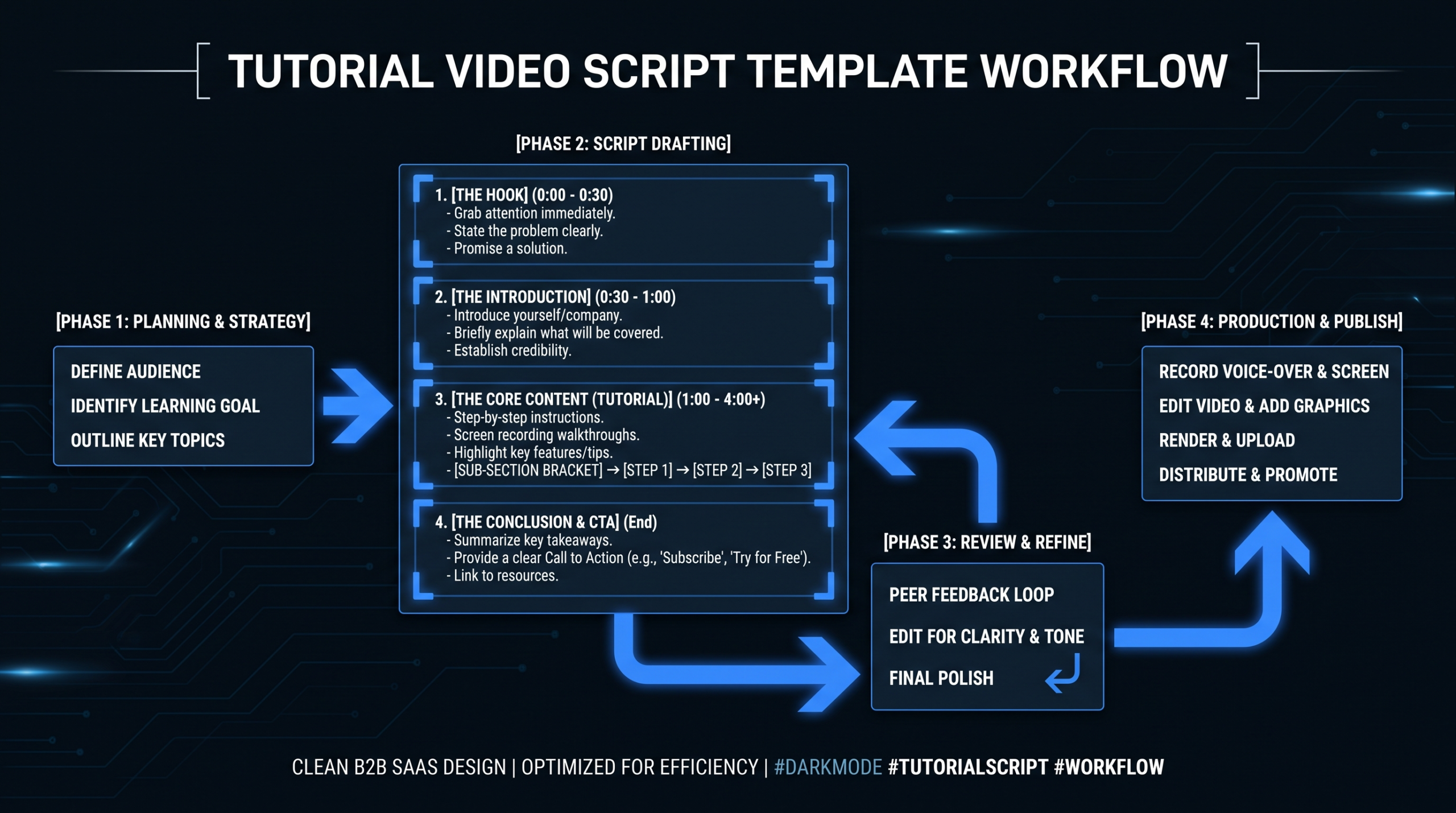
- The highest-converting fintech explainer script structure: pain → claim → proof mechanism → outcome → CTA, with compliance language woven into the proof layer rather than bolted on at the end.
- Production typically ranges from around $8,000 for a solid animated explainer to $40,000+ for a broadcast-quality brand film — but the biggest ROI driver is script quality, not production budget.
- Dedicated fintech video production teams who understand the regulatory terrain save an average of several revision rounds versus general video agencies.
Table of Contents
- Why Fintech Explainer Videos Need a Different Approach
- Script Structures That Work for Regulated Financial Products
- Animation vs. Live Action for Fintech
- Trust-Building Elements You Must Include
- Compliance-Safe Claims: What You Can and Can't Say
- Real Fintech Explainer Video Examples Worth Studying
- Production Costs for Fintech Explainer Videos
- How to Brief Your Video Production Partner
- FAQ
Fintech explainer videos are not like SaaS explainer videos. The product is more abstract, the stakes feel higher to the viewer, and there are real regulatory limits on what you can promise. Most fintech marketing teams discover this the expensive way — after three rounds of legal revisions on a video that was written for a project management tool, not a lending platform.
This guide is written specifically for fintech marketing leaders: VP Marketing and Head of Content roles at payments companies, lending platforms, wealth management apps, insurance tech, and B2B financial infrastructure. We cover what actually works in 2026 — script frameworks, format decisions, compliance-aware copywriting, and examples from real companies you can study.
Why Fintech Explainer Videos Need a Different Approach
Fintech products sit at the intersection of three forces that standard explainer video playbooks don't account for:
Financial Complexity
Your product probably involves abstract financial mechanisms — interest rate calculations, risk scoring algorithms, real-time settlement rails, portfolio rebalancing logic. These are genuinely hard to visualize. Standard product demo formats (screen recordings, talking heads) cannot show the audience why your approach is better. You need animation to make the invisible visible.
Regulatory Constraints
Fintech operates under FCA, SEC, FTC, CFPB, or equivalent oversight depending on your market and product category. Regulated financial products require careful claim construction — what's a normal marketing statement for a SaaS company ("our tool saves teams 10 hours a week") can become a material misrepresentation in financial services ("our platform generates consistent returns"). This shapes every line of the script, not just the disclaimers at the end.
Trust Deficit
Financial products require users to hand over money, banking credentials, or investment decisions. The trust bar is meaningfully higher than it is for project management software or a CRM. Your explainer video has to close a trust gap that most SaaS videos never need to address. That changes the emotional arc of the script — from "let me show you how this works" to "let me show you why it's safe to trust us with this."
The fintech companies with the best explainer video performance in 2026 treat these three factors as features of their creative brief, not obstacles to route around. Their videos are built around the constraints, not despite them. For a broader look at how fintech brands approach the full video production for fintech pipeline, that's a useful starting point before diving into explainer-specific tactics.
Script Structures That Work for Regulated Financial Products
The highest-performing fintech explainer scripts follow a consistent arc that differs meaningfully from standard SaaS explainers. Here are the frameworks that consistently perform well.
The Pain → Mechanism → Outcome Framework
This is the most reliable structure for financial infrastructure and B2B fintech products. It works because it never makes a performance promise — it explains what the product does, not what the customer will earn or save.
- Pain (10–15 seconds): Name the specific friction point in terms the viewer recognizes. Not "payments are slow" — "your invoices clear in 3–5 business days while your suppliers charge late fees after 2."
- Mechanism (30–45 seconds): Explain how the product works at a conceptual level. This is where animation earns its keep — you're showing the process, not just asserting the benefit.
- Outcome (10–15 seconds): Describe the operational outcome (faster settlement, fewer failed payments, lower FX spread) in factual terms. Hedge appropriately.
- CTA (5–10 seconds): Single action, low friction — demo, trial, or conversation with a specialist.
Total: 60–90 seconds for a standard explainer, up to 3 minutes for complex B2B products targeting a buying committee.
The Problem → Social Proof → Explanation Framework
Better suited for consumer fintech (challenger banks, investment apps, insurance tech) where you can legitimately feature customer outcomes. The structure:
- Problem moment (10 seconds): A scene the audience personally recognizes — being denied a loan, not understanding their insurance, watching fees eat their returns.
- Social proof signal (10–15 seconds): A credible indicator that real people trust this product — not "customers love us" but something specific and verifiable. User count, a recognizable partnership, a regulatory license.
- Explanation (30–45 seconds): How the product actually works, with enough mechanism to satisfy skeptics without losing casual viewers.
- Outcome + CTA (15 seconds): What changes for the viewer, hedged appropriately. One action.
What Doesn't Work
Two structures that repeatedly fail in fintech:
- The generic SaaS explainer ("Meet Sarah, she has a problem..."): Consumer trust for financial products is too low for cartoon avatars and simplified "before/after" arcs. They feel trivializing for serious money decisions.
- The ROI-first structure ("Our customers save $X per year..."): This structure requires performance claims that are either too vague to be meaningful or too specific to survive compliance review. Skip it entirely.
Animation vs. Live Action for Fintech
For most fintech products, motion graphics or 2D animation outperforms live action. Here's the honest breakdown:
Animation vs. Live Action for Fintech Explainer Videos
| Factor | Motion Graphics / 2D Animation | Live Action |
|---|---|---|
| Visualizing abstract processes | ✅ Ideal — transaction flows, algorithms, data movement | ❌ Cannot show invisible mechanisms |
| Compliance flexibility | ✅ Easier to revise script without reshoot | ❌ Compliance changes often require reshoots |
| Brand consistency | ✅ Fully controllable — color, style, motion language | ⚠️ Dependent on casting, location, lighting |
| Trust / human warmth | ⚠️ Can feel cold at enterprise tier | ✅ Real people communicate credibility |
| International / multilingual | ✅ Easy to revoice without reshooting | ❌ Reshoots or heavy dubbing required |
| Typical production timeline | 4–8 weeks for a 90-second piece | 6–12 weeks including pre-production |
| Typical cost range | $8,000–$35,000 for a polished animated explainer | $15,000–$60,000+ for brand-quality live action |
| Revision cycle | Lower cost — only re-render affected scenes | Higher cost — reshoots if content changes |
When Live Action Makes Sense in Fintech
Live action is a legitimate choice in three specific scenarios:
- Executive credibility videos: A CEO or founder speaking directly to camera for an enterprise sales audience builds personal trust that animation cannot replicate. Keep it under 90 seconds and professionally lit.
- Customer testimonial formats: Real customers describing their experience with a financial product are more persuasive than scripted animated outcomes — provided the claims are reviewed for compliance and the customers are real.
- Premium brand films: If your target audience is institutional — family offices, CFOs at large corporations — a cinematic brand film communicates the level of craft and seriousness that B2B fintech at that tier requires.
The most effective fintech explainer programs often combine formats: an animated explainer for top-of-funnel awareness (designed to run as a paid ad or on the homepage), and a live-action customer story for mid-funnel nurture. See our explainer video cost breakdown for how the economics of each format compare in detail.
Trust-Building Elements You Must Include
Trust elements in fintech video content work differently than in other verticals. A badge saying "Trusted by 10,000+ customers" means something for a project management tool. For a platform handling someone's savings, the viewer needs more specific credibility signals.
Regulatory and Credential Signals
State your regulatory status directly if you hold a meaningful license or certification — FCA-authorized, SEC-registered, bank-chartered, PCI-DSS compliant. Put these in the video itself, not just the footer. A viewer who sees "FCA-authorized" in the first 15 seconds of your explainer video carries that credential throughout the rest of the content.
Named Institutional Partnerships
Integrations with or endorsements from recognized financial institutions (major banks, custodians, card networks) function as credibility proxies. "Integrates with [Major Bank]" implies that the major bank's compliance team evaluated and approved the integration. Name the partner if you have permission.
Security and Data Infrastructure Claims
For products handling sensitive financial data: SOC 2 Type II certification, bank-level encryption language, and data residency statements all reduce anxiety at the moment of conversion. These belong in the mechanism section of the script, not just the legal footer.
Specificity Over Scale
Broad claims ("millions of customers") are less reassuring in fintech than specific process descriptions ("funds settle in one business day, not three to five"). Viewers trust the specific over the sweeping because specificity implies the company actually knows what it's doing. Hedge appropriately ("typically settles in one business day") rather than making unhedged commitments.
Compliance-Safe Claims: What You Can and Can't Say
This is the section most video agencies miss, and it's the reason fintech explainer videos go through more revision rounds than almost any other content type.
Compliance review is not the enemy of good creative. Compliance constraints, correctly briefed upfront, produce sharper scripts — because they force you to be specific and honest rather than reaching for marketing superlatives you can't back up.
What You Can Generally Say (with appropriate hedging)
- How the product works (mechanism description, no performance promise)
- Typical transaction speeds ("typically settles within one business day")
- Fee structures ("no monthly fee, 0.5% per transaction" — if accurate)
- Regulatory status and licenses held
- Customer counts or volumes that have been reviewed by legal
- Awards, certifications, and third-party recognition
What to Avoid or Heavily Hedge
- Investment return promises: "Earn more on your savings" should become "we offer rates that are typically higher than traditional banks — check current rates at [URL]." Never guarantee returns.
- Credit approval claims: "Everyone gets approved" or even "most people qualify" can create FTC/CFPB exposure. Say "see if you qualify" instead.
- "Safe" or "risk-free" applied to investments: These terms have specific regulatory meanings. Your legal team will catch this, but catch it at the brief stage, not after production.
- Third-party performance benchmarks without sourcing: "The average fintech company saves $200,000 annually on payment processing" — sourced from where? If you can't link the study, don't use the number.
The Compliance-Friendly Script Review Process
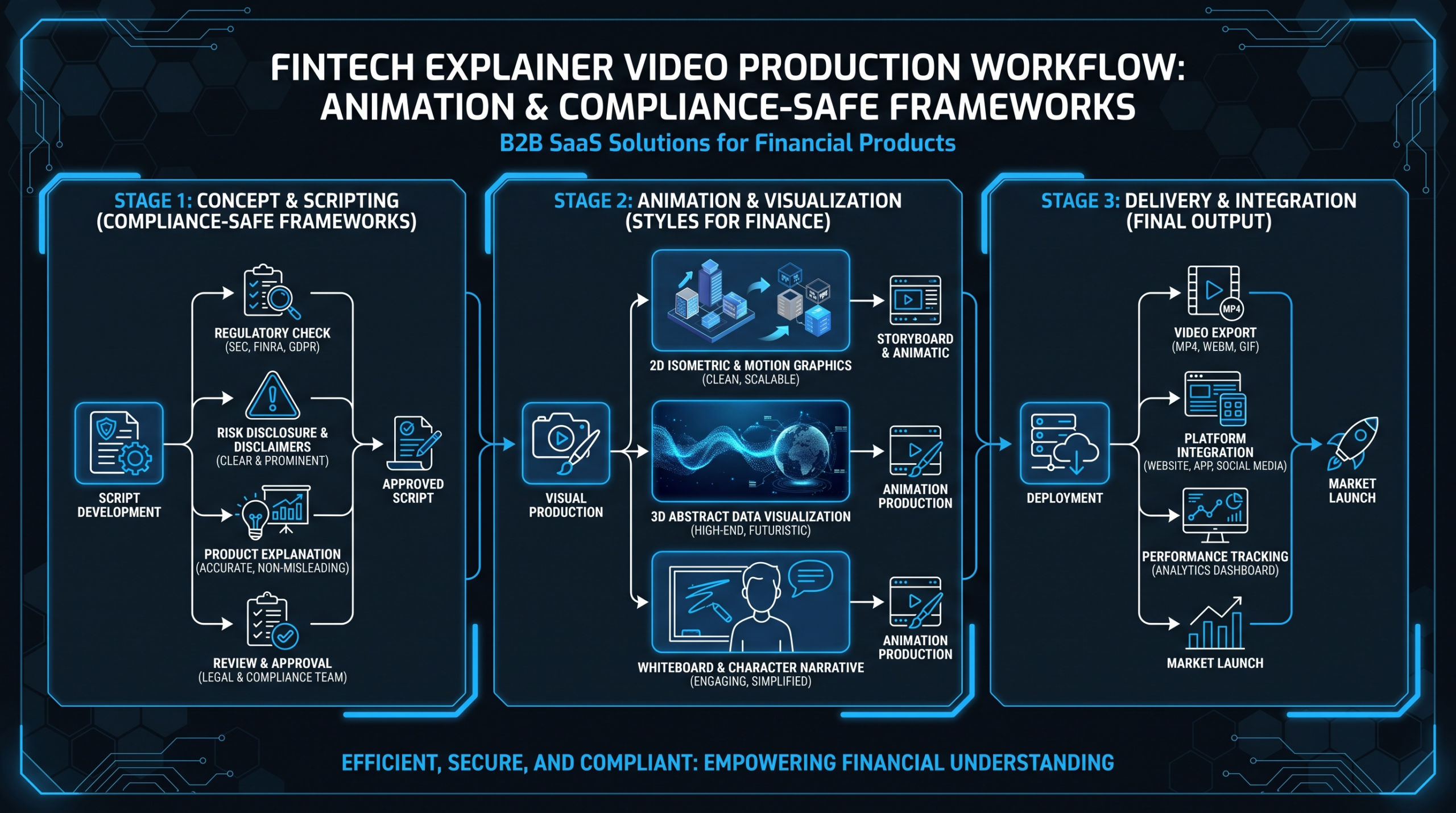
Brief your compliance team before scripting, not after. Give them three inputs: the target audience, the product claims you want to make, and the regulatory jurisdictions the video will run in. Ask them to flag red-line language and provide hedged alternatives. Bake those into the brief before a writer touches it. This typically reduces compliance revision cycles from three or four rounds to one.
For a detailed look at what fintech video production costs at each compliance tier, see our fintech video production cost guide.
Real Fintech Explainer Video Examples Worth Studying
Rather than inventing examples, here are fintech companies with publicly accessible video content that demonstrates the principles above. Study their approach — their videos are indexable and illustrative, even if the specific execution differs from what makes sense for your product.
Stripe
Stripe's product explainers (available on stripe.com) consistently use motion graphics to show payment flow at a conceptual level rather than walking through a product UI. The mechanism-first approach works because Stripe's audience (developers and finance teams) wants to understand the infrastructure, not watch someone fill out a form. Key lesson: when your audience is technical, show the architecture, not the interface.
Wise (formerly TransferWise)
Wise (wise.com) has built a library of explainer content around a single, relentlessly repeated mechanism: "your money never actually crosses borders — it moves within local banking networks." This one honest mechanism differentiates Wise more effectively than any performance claim could. Key lesson: one true, distinctive mechanism, repeated clearly, builds durable brand understanding.
Plaid
Plaid (plaid.com) faces a specific challenge: they're a B2B infrastructure company that needs to explain their product to two different audiences — developers building on their API and consumers seeing a "Connect with Plaid" screen. Their consumer-facing content prioritizes security messaging over feature explanation. Key lesson: for financial data products, trust comes before utility. Consumers don't need to understand how it works; they need to feel safe using it.
Chime
Chime (chime.com) is a useful case study in consumer fintech video for mass-market audiences. Their approach uses relatable pain-state scenarios (overdraft fees, delayed paycheck access) before introducing the product mechanism. The emotional framing is more direct than B2B fintech because the audience's decision is personal and immediate. Key lesson: consumer fintech can lean harder on emotional pain points than B2B — the decision is personal, not institutional.
What These Examples Have in Common
Each company found one honest mechanism that differentiates their product and built their explainer content around communicating that mechanism clearly. They are not promising outcomes. They are explaining a process. That's the posture that survives compliance review and builds lasting trust.
Production Costs for Fintech Explainer Videos
Fintech explainer video costs vary significantly based on animation style, length, compliance complexity, and the production partner's experience with regulated financial content. Here are realistic market ranges — hedged appropriately, since final costs depend on specific project scope.
Fintech Explainer Video Cost Ranges by Format
| Format | Length | Typical Cost Range | Best For |
|---|---|---|---|
| 2D motion graphics (standard) | 60–90 sec | $8,000–$20,000 | Product mechanism explainers, app walkthroughs |
| 2D motion graphics (premium) | 90–120 sec | $20,000–$35,000 | Flagship homepage explainers, investor content |
| 3D animation | 60–90 sec | $30,000–$80,000+ | Premium brand films, enterprise sales content |
| Live action (interview-style) | 60–120 sec | $15,000–$35,000 | Executive credibility, customer testimonials |
| Live action (cinematic brand) | 2–3 min | $40,000–$100,000+ | Institutional audiences, large fundraising contexts |
| Whiteboard / simplified animation | 60–90 sec | $3,000–$8,000 | Internal training, regulated disclosure content |
The cost ranges above reflect general market pricing. Fintech-specific productions often run toward the upper end of each range for two reasons: compliance review cycles add revision rounds (each round adds cost), and financial services audiences have higher production quality expectations than most verticals — a low-budget explainer for a payments company can undermine trust before the viewer hears the first line of copy.
Where Budget Actually Matters
The research on video marketing effectiveness consistently points to script quality as the primary driver of conversion, not production budget. A well-written 60-second script on a $10,000 production budget will typically outperform a poorly structured script on a $40,000 production. For fintech specifically, the highest-value investment in any explainer project is usually time spent on the brief and the compliance pre-read — both of which cost nothing beyond internal time.
Where higher production budget demonstrably improves outcomes in fintech: animation quality for complex mechanisms (a poorly-rendered transaction flow animation is worse than a clear diagram) and voiceover casting (credibility signals are partly tonal, and a professional voiceover for a financial product is not a place to cut budget).
For a more granular look at how production costs break down by deliverable type, see our explainer video cost breakdown and the broader video editing services overview to understand what's typically included in each engagement tier.
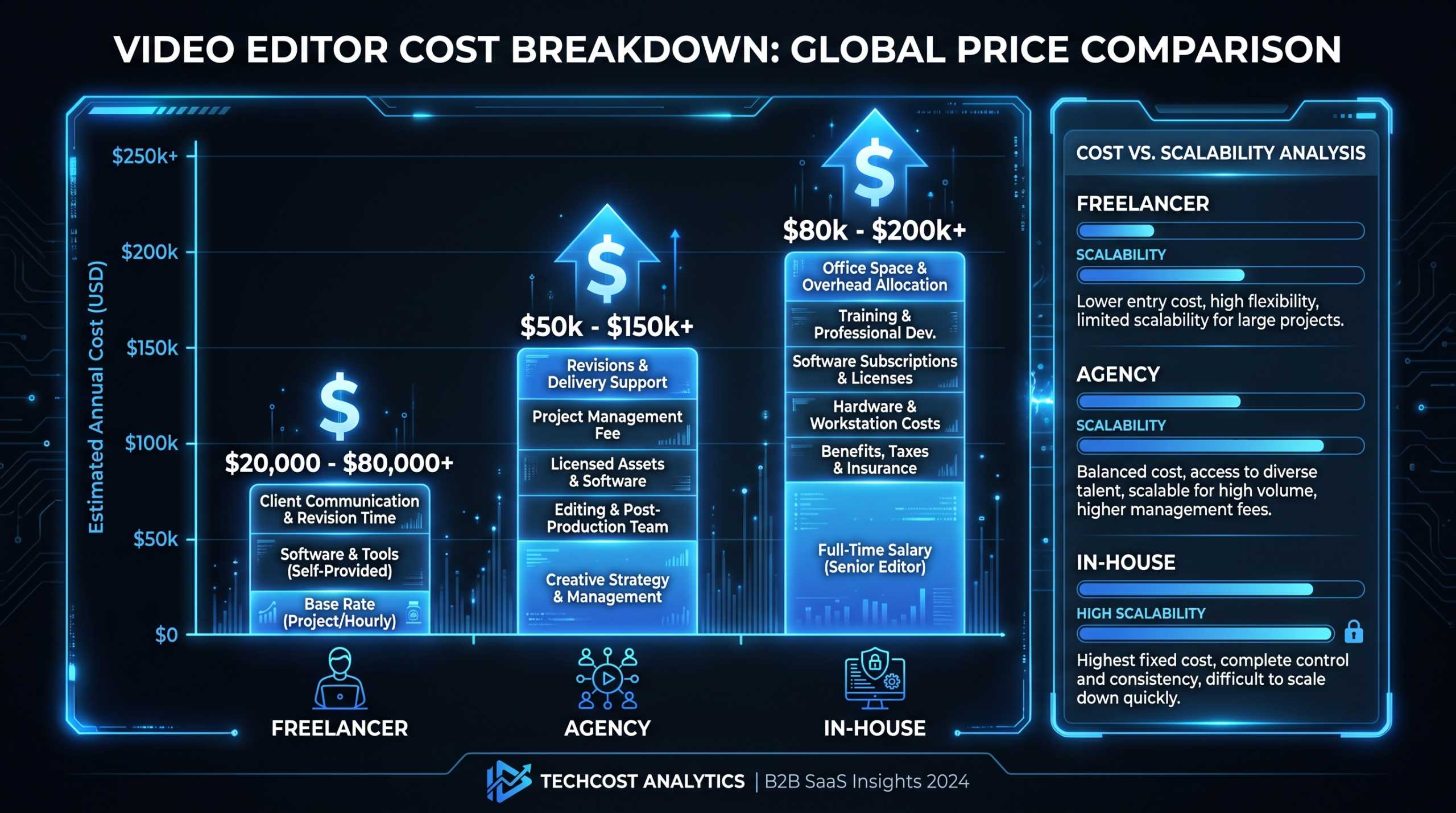
Teams managing ongoing fintech video programs — rather than one-off productions — typically see significantly lower per-video costs on a dedicated team model versus per-project pricing. The VEC pricing page covers the dedicated team tiers, which are structured specifically for content programs running 8+ videos per month.
How to Brief Your Video Production Partner
A weak brief is the single most common cause of expensive revision cycles in fintech video production. Here's what a strong fintech explainer brief covers:
The Seven Elements of a Fintech-Ready Brief
- Regulatory context: Which regulatory bodies govern your product? What jurisdictions will this video run in? This determines what claims are available to you before scripting begins.
- The one mechanism: The single most important thing the viewer should understand about how your product works. Not your feature list — one mechanism.
- Audience profile: Be specific. "Fintech buyers" is not useful. "CFOs at mid-market e-commerce companies evaluating payment processing alternatives to Stripe" is a brief the writer can work with.
- Claims pre-cleared by legal: Provide three to five statements your legal team has pre-approved as usable in marketing content. The writer works within these, not around them.
- Trust signals available: Licenses held, institutional partnerships approved for naming, certifications, customer count or volume figures that are factual and reviewed.
- Competitive positioning: What's your honest differentiator vs. the two or three alternatives your target audience is actually considering? Your video doesn't need to trash competitors — it needs to be specific enough that the viewer can place you accurately in the landscape.
- Distribution context: Paid ad (where first three seconds are critical), website hero (where you can assume intent and spend 90 seconds), or sales enablement (where the viewer is already warm and you can go 3–4 minutes). The distribution context determines length, hook style, and how much mechanism explanation is appropriate.
Questions to Ask a Video Production Partner Upfront
Before engaging an agency, ask:
- Have you produced explainer content for FCA-regulated, SEC-regulated, or equivalent financial products before?
- What's your process for compliance review integration — do you have experience incorporating legal feedback into scripts without full rewrites?
- Can you show three examples of fintech or financial services work at our production quality tier?
- What revision rounds are included, and what's your process if compliance requires changes after animation has started?
General video agencies often learn regulatory nuance at your expense. A production partner with existing fintech experience reduces your revision cycles, which — in a 6-to-8-week project — is the difference between launching on schedule and missing a product announcement window.
VEC's dedicated fintech video production teams work within compliance briefing processes and have experience with financial services content across payments, lending, wealth management, and insurance tech verticals. If you're evaluating production partners for an upcoming campaign, it's worth a conversation to understand whether a dedicated team model fits the volume and consistency of your content program — the how it works page explains the engagement model in detail.
Frequently Asked Questions
How long should a fintech explainer video be?
For homepage or paid ads, 60–90 seconds is the proven range — long enough to establish mechanism and trust signals, short enough to hold attention. For sales enablement or investor content targeting a buying committee that's already warm, 2–3 minutes is appropriate. Avoid the temptation to go longer to cover more features; each additional 30 seconds typically costs more conversions than it gains in comprehension.
Can I make ROI or return claims in a fintech explainer video?
Generally no, unless those claims are narrowly scoped, fully substantiated, and reviewed by legal for your specific regulatory context. The safer posture is mechanism-based claims: describe what the product does (settles payments faster, charges lower FX spreads, automates reconciliation) rather than what outcomes the customer will achieve (you'll earn more, you'll save $X). The exception is documented case studies where specific customers gave consent to share specific outcomes — and even those require careful hedging.
Should I use animation or live action for my fintech explainer?
For most fintech products, motion graphics or 2D animation is the better choice. It lets you visualize abstract financial mechanisms (transaction flows, risk scoring, portfolio logic) that a camera can't capture. Live action makes sense for executive credibility videos and customer testimonials — scenarios where a real human face builds trust that animation cannot. A combination approach (animated explainer for awareness, live customer testimonials for nurture) tends to perform well across the funnel.
How do I handle compliance review in the video production process?
Brief your compliance team before scripting, not after first draft. Give them the audience, the claims you want to make, and the jurisdictions. Ask them to provide pre-approved language and red-line terms. Use those inputs as part of the creative brief rather than as a filter applied after the script is written. This approach typically reduces compliance revision rounds from three or four to one — which in a 6-to-8-week production timeline is the difference between launching on time and missing your window.
What does a fintech explainer video cost?
A solid animated fintech explainer (60–90 seconds, motion graphics) typically ranges from around $8,000 to $35,000 depending on animation complexity and the production partner's experience with financial services content. Live action brand films for institutional audiences can run $40,000–$100,000+. The biggest variable in fintech is compliance complexity — products in heavily regulated categories (lending, investment, insurance) require more revision cycles, which adds cost. See our fintech video production cost breakdown for a full cost model.
Need a Fintech Explainer That Passes Compliance Review?
VEC builds dedicated video production teams for fintech companies — teams that understand the regulatory terrain and have experience producing explainer content that legal actually approves. If you're planning a campaign and want to discuss what a production program looks like for your product category, book a free call with our team.
Book a Free Strategy Call Explore Fintech Video Services See Pricing