Edtech Video Production Cost: 2026 Benchmarks
TL;DR
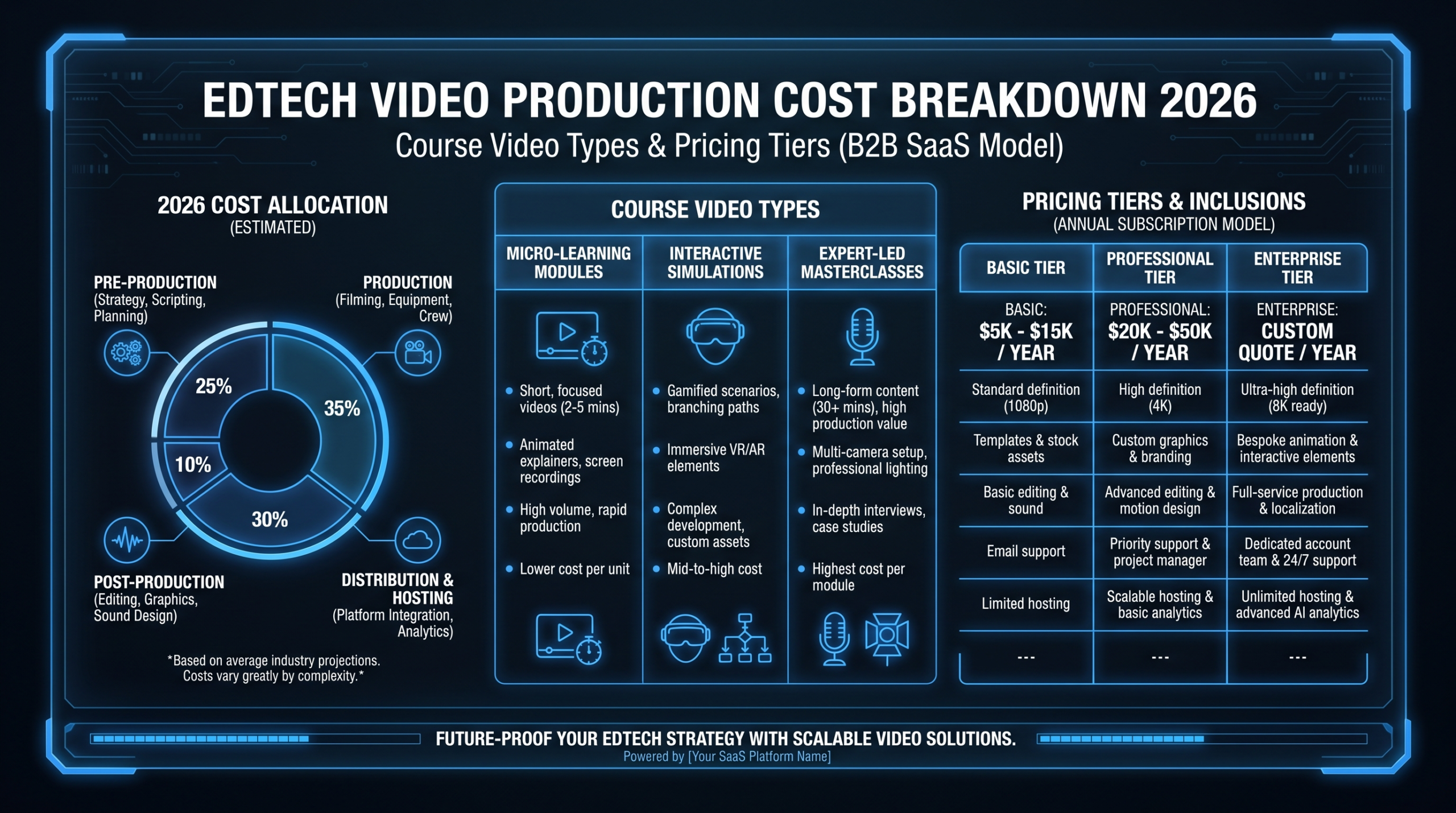
- Course explainer videos: typically $1,500–$8,000 per finished module depending on format and animation level.
- Onboarding video series: common range $4,000–$20,000+ for a 5–10 video set.
- Product demo videos: $2,000–$12,000 per video for SaaS edtech platforms.
- Demand-gen (ads, thought leadership): $1,500–$6,000 per asset.
- Monthly retainer model: often the most efficient path for edtech teams producing 8+ videos/month; dedicated team plans start around $5K/mo.
- The single biggest cost driver is animation complexity, not video length.
Table of Contents
- Why Edtech Video Production Costs More Than Generic B2B
- Edtech Video Production Cost by Video Type
- The 7 Cost Drivers That Move the Budget Needle
- Freelancer vs. Agency vs. Dedicated Team: Cost Comparison
- Retainer Math: When Monthly Plans Beat Per-Project Pricing
- How to Budget for an Edtech Video Program in 2026
- Red Flags in Edtech Video Quotes
- FAQ
Edtech companies sit in an awkward position when it comes to video production costs. Their content demands are more intensive than generic corporate video—course modules require instructional precision, product demos must mirror live software flows, and onboarding videos need to adapt to learner personas—yet many edtech marketing and instructional design teams are working with budgets originally sized for written content.
This guide lays out what edtech video production actually costs in 2026, broken down by video type and production model. All ranges here are based on publicly available market data and agency pricing—no invented benchmarks. Where ranges are wide, we explain why.
Why Edtech Video Production Costs More Than Generic B2B
Edtech video sits at a higher cost baseline than most B2B content for three structural reasons.
Instructional Accuracy Requirements
A generic brand video can be impressionistic. A course module or onboarding video cannot. Edtech content must be factually accurate, pedagogically sequenced, and aligned with specific learning outcomes. That means more rounds of subject-matter expert (SME) review, more revision cycles, and tighter scripting requirements—all of which add production time.
Screen Recording + Animation Demands
Software product tours, LMS walkthroughs, and feature explanations almost always require screen recording integration with motion graphics overlays, callouts, and UI annotations. Clean screen-to-screen transitions and animated UI states cost significantly more than a talking-head cut or a simple slide-based edit.
Volume Requirements
A corporate video might produce 6–12 videos per year. A mid-market edtech company might need 40–100 course modules, 10–20 onboarding touchpoints, quarterly product demos, and ongoing demand-gen content simultaneously. Volume pushes companies toward retainer or dedicated team models—which change the per-unit economics significantly.
Rule of thumb: edtech video typically runs 20–40% higher per unit than equivalent B2B SaaS video due to SME coordination, instructional review cycles, and screen-recording complexity. Budget accordingly from the start.
Edtech Video Production Cost by Video Type
The most useful way to plan an edtech video budget is to separate costs by video type, since each has a different production complexity and revision expectation.
Course and Learning Module Videos
Course module videos are the core content unit of edtech. They range from screencast-style walkthroughs to fully animated explainers. Cost is driven primarily by whether content is on-screen narration with light editing, or a fully produced animated lesson.
Course Module Video — Cost by Format
| Format | Typical Duration | Estimated Range | What's Included |
|---|---|---|---|
| Screencast + voiceover (light edit) | 5–10 min | $800–$2,500 | Audio cleanup, basic cuts, lower-thirds, branding |
| Talking head + screen recording | 5–15 min | $1,500–$4,500 | Multi-cam sync, screen compositing, motion callouts |
| Presenter + slide animation | 8–20 min | $2,500–$7,000 | Keynote/PPT animation, transitions, full audio mix |
| Fully animated explainer (2D) | 3–8 min | $4,000–$15,000 | Character animation, illustrated scenes, professional VO |
| Interactive video module | Varies | $6,000–$20,000+ | Branching logic, H5P/LMS integration, UX design |
A full online course with 20–30 modules using the talking head + screen recording format commonly runs $30,000–$90,000 in total production budget. Screencast-only courses can come in significantly lower. Fully animated courses can exceed $150,000 for comprehensive curricula.
Onboarding Video Series
Customer and employee onboarding videos are high-ROI content—they reduce support load, accelerate time-to-value, and scale knowledge transfer. Edtech companies often need both learner onboarding (for students/users entering the platform) and instructor onboarding (for course creators using the LMS).
A typical onboarding series of 5–10 videos in the 2–5 minute range runs $4,000–$20,000, depending on production quality and whether the content is screen-recording only or includes motion graphics and animation. High-quality, brand-consistent onboarding with custom graphics tends to run toward the upper end. See our overview of what video editing services typically include to understand what drives scope in these projects.
Product Demo Videos
For SaaS edtech platforms, product demos are a critical conversion asset. They need to show the actual product in action, communicate value to multiple buyer personas (administrators, instructors, learners), and compress a complex feature set into 2–5 minutes. Learn more about the production process in our product demo video production guide.
Edtech Product Demo Video — Cost Range
| Demo Type | Duration | Typical Cost Range | Key Considerations |
|---|---|---|---|
| Basic screen walkthrough | 2–4 min | $1,500–$4,000 | Light editing, VO, basic transitions |
| Polished UI demo + motion overlays | 2–5 min | $3,500–$8,000 | Animated callouts, smooth UI zoom, brand voiceover |
| Multi-persona demo (admin + learner views) | 3–7 min | $5,000–$12,000 | Parallel storylines, scene-by-scene storyboarding, multiple VO tracks |
| Full sales enablement demo + social cuts | 5–10 min hero + clips | $8,000–$18,000 | Hero video + 3–5 repurposed clips in multiple aspect ratios |
Demand-Gen and Thought Leadership Video
Webinar recordings, LinkedIn video, paid ad creative, and conference keynote clips all fall into demand-gen territory. These are typically lower-cost per asset because they start with existing footage (recordings, interviews, slide presentations) that just needs editing rather than production from scratch.
- Webinar/event recut: $500–$2,000 per finished asset
- LinkedIn thought leadership clips (60–90 sec): $400–$1,200 per clip from raw interview footage
- Paid video ad (15–30 sec, platform-optimized): $1,000–$3,500 per ad from existing assets
- Testimonial video (customer story, 2–4 min): $2,500–$6,000 including light motion graphics and captions
The 7 Cost Drivers That Move the Budget Needle
Understanding what makes edtech video production expensive—and what doesn't—lets you make smarter tradeoffs when budget is constrained.
1. Animation Complexity (Biggest Driver)
The single largest budget lever in edtech video is animation. A screencast with a voiceover and text overlays might cost $1,000. The same content with character animation and illustrated scenes might cost $8,000–$15,000. Motion graphic complexity—particularly custom UI animations and kinetic typography—sits in the middle.
2. Script and SME Coordination
Videos that require original scripting, subject-matter expert review cycles, and instructional design input cost 30–50% more than videos where you deliver a finished script. If your in-house team handles scripting and SME alignment before handoff to production, you significantly reduce agency costs.
3. Voiceover Talent
Stock AI voiceover can work for internal training or first-pass content, but professional human voiceover with industry-appropriate tone typically adds $200–$800 per finished video depending on duration and studio rates. For customer-facing edtech content, human VO is usually worth the investment.
4. Revision Rounds
Edtech content is reviewed by more stakeholders than most video: instructional designers, product owners, legal, and sometimes regulatory bodies. Agencies typically include 2–3 revision rounds in base quotes; rounds 4+ are billed at $100–$300/round. Getting stakeholder alignment before review submission pays back in hard dollars.
5. Number of Output Formats
Edtech content often needs to exist in multiple contexts: LMS-embedded, YouTube-hosted, short clips for LinkedIn, and full-length downloads. If you need the same content in multiple aspect ratios and platform formats, build that into your brief from the start—post-production retrofitting of aspect ratios is significantly more expensive than planning for it upfront.
6. Accessibility Requirements
Closed captions, audio descriptions, transcript generation, and WCAG-compliant subtitling are increasingly required by edtech buyers, especially in enterprise and government segments. These add $100–$400 per video per accessibility deliverable. Many agencies offer accessibility packages that are more cost-effective than a-la-carte additions.
7. Footage and Asset Source
When the production team works from raw footage you provide (screen recordings, recorded webinars, interview footage), costs are typically 30–50% lower than projects requiring the agency to handle production direction, studio time, or professional filming. The cleaner and more organized your raw assets, the less production time billed.
Freelancer vs. Agency vs. Dedicated Team: Cost Comparison
The production model you choose matters as much as the video type. Each option has fundamentally different economics, quality ceilings, and scalability characteristics for edtech teams. For a deeper breakdown of how these models compare on cost per minute, see our video editing cost per minute analysis.
Production Model Comparison for Edtech Video
| Model | Typical Cost Range | Best For | Limitations |
|---|---|---|---|
| Freelancer (Upwork/platform) | $25–$80/hr or $300–$2,500/video | Simple screencast edits, budget-constrained projects, one-off content | Inconsistent quality, no brand retention between projects, slow for complex work, hard to scale |
| Freelancer (senior, vetted) | $75–$150/hr or $1,500–$6,000/video | Complex single videos, animated explainers, when you have strong project management | Single point of failure, availability gaps, no team redundancy |
| Project-based agency | $3,000–$20,000/video | High-production-value hero videos, brand launches, large one-off campaigns | Expensive at volume, slow ramp-up on each project, inconsistent editors across engagements |
| Retainer agency | $4,000–$15,000/mo | Teams with consistent 6–15 video/month needs, predictable content calendars | "Use it or lose it" risk, scope can be ambiguous, team familiarity builds slowly |
| Dedicated team | $5,000–$18,000/mo | Teams producing 15+ videos/month, SaaS edtech with ongoing course + demand-gen needs | Higher entry commitment, underutilization risk at low volumes |
Where VEC Fits for Edtech
Video Editing Company serves edtech companies at the retainer and dedicated team level, with plans starting at $5,000/month (Growth), $9,500/month (Core), and $16,000/month (Scale). Each plan assigns a dedicated senior editor, junior editor, project manager, and creative director who learn your platform, your course structure, and your brand standards over time. For edtech teams producing a combination of course content, product demos, and demand-gen video simultaneously, the dedicated team model typically delivers better per-unit economics and more consistent quality than cycling through project-based agencies.
You can review our approach on the VEC pricing page and see how clients have scaled their video programs on the case studies page.
Retainer Math: When Monthly Plans Beat Per-Project Pricing
The break-even point between per-project and retainer pricing depends on your volume and video mix. Here's the math for a typical mid-market edtech company.
Example: An edtech company needs 4 course module videos, 2 product demo clips, and 4 social/LinkedIn clips per month — 10 videos total.
Per-Project vs. Retainer Cost — 10 Videos/Month Scenario
| Video Type | Qty | Per-Project (each) | Per-Project (total) |
|---|---|---|---|
| Course module (talking head + screen) | 4 | $3,000 | $12,000 |
| Product demo (polished UI) | 2 | $5,500 | $11,000 |
| Social clips (from existing footage) | 4 | $700 | $2,800 |
| Monthly Total — Per-Project | $25,800/mo |
A dedicated team at $9,500/month handling the same 10-video mix would represent a 63% reduction in monthly spend — and deliver better brand consistency because the same team works on every asset. The per-project model makes sense for infrequent, one-off needs. At 8+ videos per month consistently, retainer or dedicated team models almost always win on economics.
For a detailed look at how to evaluate different agency billing structures, read our guide to video production agency pricing models.
The 90-Day Guarantee Factor
VEC's dedicated team plan includes a "double video output in 90 days or month 4 is free" guarantee. For edtech teams trying to clear a backlog of course modules or launch a new product's demo library, this output commitment materially changes the ROI calculation compared to per-project work where delivery timelines are project-by-project.
How to Budget for an Edtech Video Program in 2026
Building a realistic edtech video budget starts with three inputs: content type mix, monthly volume target, and quality tier. Here's a practical framework.
Step 1: Map Your Content Mix
List every video type you need in a 12-month window. Separate them into four buckets: (1) evergreen course content, (2) product-driven demos and walkthroughs, (3) onboarding sequences, (4) demand-gen and paid media. Each bucket has a different cost-per-unit and different update cadence.
Step 2: Assign Volume by Quarter
Edtech video needs are often seasonal. Course launches drive Q1 and Q3 content spikes. Paid media ramps ahead of enrollment periods. Assign rough volume by quarter so you can size your production model appropriately rather than paying for year-round dedicated capacity you only need six months.
Step 3: Choose Your Production Level
Not all videos need the same production quality. A framework that works well for many edtech teams:
- Tier 1 (hero): 10–15% of volume, highest production — animated explainers, signature product demos, launch videos. Budget $5,000–$15,000+ per video.
- Tier 2 (standard): 50–60% of volume — polished course modules, onboarding series, testimonials. Budget $2,000–$6,000 per video.
- Tier 3 (efficient): 25–35% of volume — screencasts, lightweight social clips, webinar edits. Budget $500–$2,000 per video.
Step 4: Model Per-Project vs. Retainer
If your monthly Tier 2+3 volume is 6 or more videos consistently, run the retainer comparison. Use the production model table above and your actual video mix to find the crossover point. For most teams producing 8+ videos/month, a retainer or dedicated team plan is demonstrably cheaper within 60–90 days of launch. See how to outsource video editing for a step-by-step guide on structuring the handoff.
Typical Full-Year Edtech Video Budget Ranges
Annual Edtech Video Budget by Company Stage
| Company Stage | Video Volume | Typical Annual Budget | Recommended Model |
|---|---|---|---|
| Seed / Early-stage | 10–20 videos/yr | $15,000–$40,000 | Per-project or freelancer |
| Series A / Growth | 30–60 videos/yr | $50,000–$120,000 | Retainer ($4K–$8K/mo) |
| Series B / Scale | 80–150 videos/yr | $100,000–$200,000 | Dedicated team ($8K–$16K/mo) |
| Enterprise edtech | 200+ videos/yr | $200,000–$500,000+ | Multiple dedicated teams or hybrid in-house + agency |
These ranges reflect production costs only and don't include platform licensing (Articulate, Camtasia, etc.), distribution costs, or internal team time for scripting and review.
Red Flags in Edtech Video Quotes
Getting an accurate quote is harder in edtech video than in most B2B video because the category is underdefined. Here are the signals that a quote is likely to balloon.
No Revision Round Policy
Any quote that doesn't specify included revision rounds is an open-ended cost exposure. Edtech content goes through more stakeholder review than most video. If the agency says "unlimited revisions," ask what that means in hours — then you'll get a real answer.
Animation "Included" Without Scoping
Animation in edtech video spans $500 (kinetic text) to $15,000 (character-driven scenes). A quote that says "includes animation" without specifying style, complexity, and duration is meaningless. Demand a breakdown of what "animation" means in deliverable terms before signing.
Flat Per-Video Pricing Across Types
A legitimate edtech video agency will quote differently for a screencast walkthrough versus a fully animated module. Flat per-video pricing that doesn't differentiate by complexity is either a sign of very low quality across the board, or hidden overages waiting to hit on your complex projects.
No LMS or Platform Experience
Edtech video often needs to render correctly inside an LMS (Moodle, Canvas, Teachable, LearnDash), meet SCORM or xAPI standards, or integrate with accessibility tools. If an agency doesn't ask about your platform environment, they haven't worked in edtech before. Mismatched specs discovered in post can add 20–40% to your production costs in rework.
Turnaround Promises Without Team Commitment
Edtech course launches are deadline-driven. An agency promising "48-hour turnaround" without a dedicated team assigned to your account is making a promise that depends on their other client load — which you can't control. Ask specifically who will be on your project and what their current utilization looks like.
Frequently Asked Questions
How much does edtech video production cost per minute?
Edtech video production typically runs $200–$2,000+ per finished minute depending on format. A simple screencast walkthrough with light editing sits at the low end. A fully animated course module or multi-persona product demo sits at the high end. The most common format — talking head with screen recording and motion graphics overlays — typically falls in the $400–$800 per finished minute range from a professional agency.
Is it cheaper to produce course videos in-house or outsource?
In-house production has lower per-video variable costs once equipment and software are in place, but the true cost includes staff salaries, benefits, tools, and opportunity cost of time spent on video rather than instructional design. Most edtech companies find that outsourcing to a dedicated team is cost-competitive with in-house for volumes under 200–300 videos/year, without the hiring risk or overhead. The calculation shifts when you have full-time instructional designers who are primarily content creators — in that case, a hybrid model (in-house scripting and review, outsourced post-production) often works best.
What's the fastest way to reduce edtech video production costs without sacrificing quality?
The highest-leverage cost reduction in edtech video is delivering well-organized, complete raw assets to your production team. This means finished, approved scripts before recording starts; properly synced and labeled screen recordings; clean audio with minimal background noise; and clear brand guidelines shared upfront. Teams that deliver "production-ready" footage routinely see 20–30% lower per-video costs compared to teams that hand off rough or incomplete material requiring production-side organization and cleanup.
Should edtech startups use freelancers or agencies for video production?
At seed stage producing fewer than 15–20 videos per year, a vetted senior freelancer is often the most cost-efficient option. Once you're producing 6+ videos per month consistently — or when brand consistency and deadline reliability become critical to your product roadmap — a retainer or dedicated team agency model typically delivers better value. The quality ceiling of a solo freelancer also becomes limiting once you need animation, professional voiceover, and multi-format deliverables on the same projects.
How long does it take to produce an edtech course module video?
Production timelines vary significantly by format. A screencast walkthrough with light editing typically takes 3–7 business days from raw footage delivery. A polished talking head + screen recording module with motion graphics typically takes 7–14 business days. A fully animated explainer module typically takes 3–6 weeks depending on complexity and revision cycles. Building a dedicated team relationship shortens timelines significantly after the first 4–8 weeks, as the team learns your brand and feedback patterns and can start work with less briefing time.
Planning an Edtech Video Program?
Get a production estimate tailored to your course library, demo needs, and content volume — without the guesswork. Our team works with edtech companies at Series A through enterprise scale.
Book a Free Strategy Call See VEC Pricing