10 Cybersecurity Video Examples to Copy
TL;DR
The best cybersecurity video examples share one trait: they make invisible threats feel real and urgent without drowning viewers in jargon. This post breaks down 10 real cybersecurity videos from CrowdStrike, Palo Alto Networks, Darktrace, Cloudflare, Fortinet, Tenable, Okta, and SentinelOne — analyzing what each does well and exactly what your marketing team can replicate regardless of production budget.
Table of Contents
- Why Cybersecurity Companies Need Video Marketing
- 10 Cybersecurity Video Examples (and What Makes Each Work)
- What Every Great Cybersecurity Video Has in Common
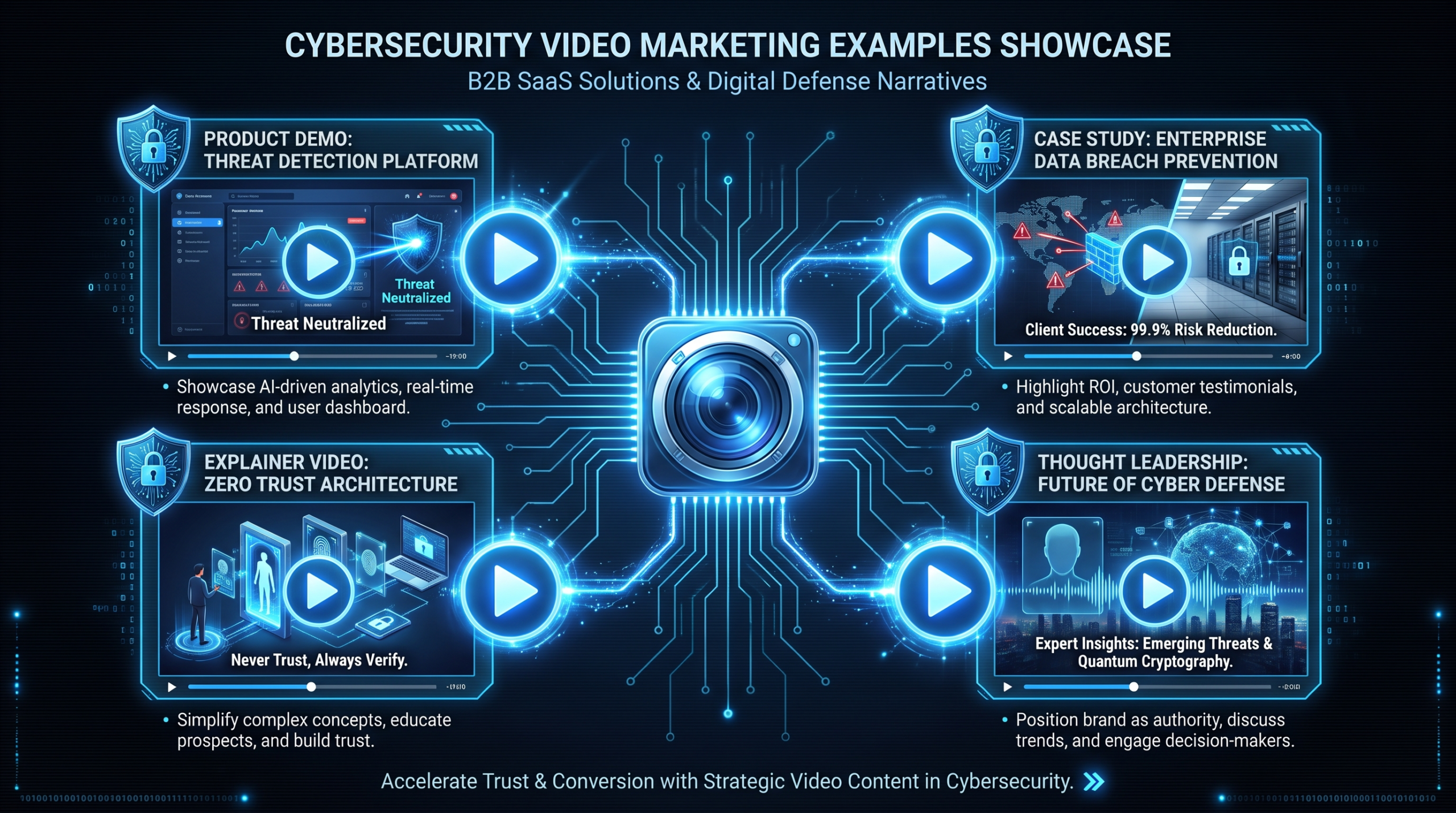
- Cybersecurity Video Types and When to Use Each
- How to Brief Your Video Team on a Cybersecurity Campaign
- Production: Costs, Format Choices, and Common Mistakes
- FAQ
Cybersecurity is one of the hardest categories to market with video. The threats are abstract. The technology is complex. And your buyers — CISOs, IT directors, and VP-level security leads — are among the most skeptical audiences in B2B.
Yet the best cybersecurity companies are producing video content that cuts through exactly that skepticism: brand commercials airing during the Super Bowl, animated explainers that make Zero Trust architecture click in 90 seconds, and cinematic campaigns featuring Hollywood talent that make AI security feel urgent and human.
This post collects 10 real cybersecurity video examples from companies at the top of the market. For each, we break down what the video does, why it works, and the specific technique your team can replicate. Every video linked below is publicly viewable and verified.
Why Cybersecurity Companies Need Video Marketing
The B2B buyer journey for cybersecurity products is long — often six months to a year for enterprise deals — and involves multiple stakeholders from security, IT, finance, and the C-suite. Video content serves a specific, irreplaceable function in that journey: it builds emotional confidence before the sales call happens.
Written content can explain what a product does. Video can make buyers feel why it matters. That distinction is critical in a category where fear, trust, and credibility drive purchasing decisions more than feature comparisons.
Cybersecurity video serves three functions that text cannot replicate as effectively:
- Threat visualization: Abstract concepts like ransomware, lateral movement, and supply chain compromise become concrete when animated or dramatized. Buyers who can visualize the threat are more motivated to act on it.
- Trust signaling: Production quality signals organizational credibility. Enterprise security buyers associate low-quality video with low-quality security thinking — the correlation isn't fair, but it's real.
- Differentiation in a noisy market: When every competitor claims "AI-powered" and "best-in-class," a memorable video narrative is often the only thing that sticks after a vendor review cycle.
For marketing teams producing SaaS video content at scale, cybersecurity represents one of the most demanding verticals — and one of the highest-ROI opportunities when executed correctly. The examples below show exactly what the market leaders are doing.
10 Cybersecurity Video Examples (and What Makes Each Work)
Example 01
CrowdStrike — "The Future" (Super Bowl LVIII, February 2024)
Brand Commercial / Narrative Storytelling
Copy This: The Good-vs-Evil MetaphorCrowdStrike ran a 60-second Super Bowl commercial set in a futuristic Wild West. A lone hero — Charlotte, armed with the Falcon XDR platform — faces four archetypal nation-state and eCrime cyber adversaries riding into town. The production is cinematic; the metaphor is instantly legible.
Why it works: Cybersecurity is fundamentally a story of good versus evil — defenders versus adversaries. CrowdStrike doesn't try to explain how Falcon works. Instead, they dramatize the feeling of being protected, which resonates with CISO buyers who live that pressure daily. The Wild West setting also aligns with CrowdStrike's "adversary-focused" brand positioning: they don't just stop threats, they know who the threat actors are. The commercial reinforces this by naming specific adversary archetypes as characters.
What to copy: Pick one dominant brand metaphor and dramatize it visually. The metaphor should reflect your company's core positioning, not just the category. CrowdStrike chose "adversary-focused" — so the video literally features named adversaries. Your narrative should be just as specific to your differentiated point of view. A strong metaphor also gives you creative territory to expand across multiple executions.
Example 02
Palo Alto Networks — "This Is Precision AI" featuring Keanu Reeves (2024)
Celebrity-Anchored Brand Campaign
Copy This: The Emotionally Anchored Product MessagePalo Alto Networks launched a multi-spot campaign built around Keanu Reeves as the face of Precision AI, their AI-native security platform. The spots run 30-60 seconds, are dialogue-driven, and are designed to make "AI-powered security" feel concrete rather than abstract. A second spot in the series (watch here) extends the campaign with additional scenarios.
Why it works: Reeves carries dual appeal — mainstream famous but widely perceived as genuine and unassuming, a rare combination that matches the authenticity cybersecurity buyers demand. More importantly, the campaign doesn't lead with features. It leads with a feeling: the world is under constant attack; Precision AI sees what others miss. The feature case gets made in follow-on content, not the ad itself.
What to copy: You don't need Keanu Reeves. You need an emotionally resonant entry point — a customer, a practitioner, a founder — who makes the abstract threat feel personal. The structure to replicate: establish threat context in 10 seconds, introduce the solution as a capability shift in 15 seconds, close on a brand moment in 5 seconds. Pair each short spot with a longer piece that delivers the technical evidence.
Example 03
Palo Alto Networks — "Precision AI: Origin" Campaign Film (May 2024)
Cinematic Brand Narrative
Copy This: The "Regular Monday" Normalized-Threat OpenThe campaign opener is a short cinematic film that begins: "It might be a regular cybersecurity Monday… but the fight has changed." It sets the emotional context for the entire Precision AI campaign without naming a single product feature. Movie-quality production, minimal dialogue, high-impact score.
Why it works: "A regular Monday" is a masterclass in threat normalization. It acknowledges what every CISO already knows: attacks are not exceptional events anymore, they are daily reality. Starting from that acknowledged truth builds immediate credibility. The film uses that credibility to argue that the response must also change — setting up the Precision AI campaign as the answer to a problem the buyer already owns.
What to copy: Open your video from the buyer's existing worldview — the daily reality they're already living — before introducing your solution. This is the opposite of leading with your product. It signals that you understand the problem before you sell the answer. Pair a longer cinematic piece like this with shorter, more direct campaign spots for distribution across paid, organic, and email.
Example 04
Darktrace — Behind the Scenes with McLaren F1 (ongoing partnership)
Co-Branded Partnership Content
Copy This: Borrowed Prestige Through Real-World StakesDarktrace has maintained a multi-year partnership with McLaren Formula 1 as its official AI cybersecurity partner. Their video content takes viewers behind the scenes at race weekends to show how Darktrace's Self-Learning AI protects McLaren's global operations — IoT sensors on the cars, communications infrastructure across multiple countries, design data worth hundreds of millions of dollars.
Why it works: F1 carries precisely the brand attributes Darktrace wants to own: precision, speed, high-stakes performance, elite engineering. Every second counts in a race weekend — exactly the urgency Darktrace wants associated with cyber threat response. The video makes the value proposition tangible without a single abstract security concept: you can see McLaren's infrastructure, understand what's at stake, and immediately grasp why response speed matters.
What to copy: Identify a partner, customer, or context that shares your brand's key attributes. You don't need F1 — you need a real-world environment where your product's value is viscerally obvious. The production quality can be modest; what matters is the authenticity of the use case and the brand-attribute transfer from the partner. Always show the technology protecting something the viewer already cares about.
Example 05
Cloudflare — Cloudflare One: Zero Trust Platform Overview (October 2023)
Animated Product Explainer
Copy This: Concept-First, Product-Second Animation StructureThis 90-second animated overview explains Zero Trust network access using clean, minimal 2D animation and plain language. It defines the concept before naming the product, walks through the architecture with simple visual metaphors — verified users, secure pathways, blocked access — and closes with Cloudflare One as the implementation.
Why it works: "Zero Trust" is a category term that most security buyers have heard but many cannot concisely define. Cloudflare earns credibility by explaining the concept clearly before pitching their product. The animation style is crisp, modern, and consistent with Cloudflare's overall brand identity — and the pacing is fast enough to keep non-technical executives engaged alongside IT practitioners.
What to copy: For any product requiring category education — where the buyer needs to understand the concept before evaluating the solution — lead with the concept, not the product. Animated explainers excel here because they can visualize abstract architectures (Zero Trust, SASE, XDR) that are impossible to show with live footage. Keep animation on-brand; avoid the generic "people connected by blue lines" stock style that makes every cybersecurity video look identical.
Example 06
Fortinet — A New Approach to Cybersecurity: The Security Fabric
Platform Architecture Animation
Copy This: The Connected-System Platform VisualizationFortinet's Security Fabric animated overview maps the full digital attack surface — IoT to cloud, data center to home office — and shows how their integrated platform covers each layer simultaneously. Rather than presenting individual products in a catalog format, the animation makes the architecture the hero: a unified mesh where each element strengthens the whole.
Why it works: Platform companies face a specific challenge: buyers see a portfolio of products and don't understand how they connect or why buying a suite beats buying best-of-breed point solutions. The Security Fabric video solves this by showing the connected system first, products second. Seeing the integrated mesh helps buyers grasp the platform value — and understand why fragmented security creates gaps no single product can close.
What to copy: If your company sells a platform or product suite, invest in an architecture visualization video that shows the connected system rather than individual components. This format converts best at the consideration stage when buyers are evaluating platforms against point-solution alternatives. Map your products onto a visual architecture the buyer can immediately grasp — then use product-specific demos to go deeper on individual components.
Example 07
CrowdStrike — Proactive Security: Outpace the Adversary (Falcon Platform, February 2025)
Adversary-Framed Platform Demo
Copy This: Narrative-First Demo StructureThis platform demo doesn't open with a UI tour. It opens with the problem: adversaries are constantly refining their tactics, and defenders who react after the fact are always behind. The Falcon platform demo is then framed as the tool that moves organizations from reactive to proactive — to "outpace the adversary."
Why it works: Traditional product demos lose the audience in the first 20 seconds by jumping straight to the interface. This demo earns attention by establishing the stakes — the adversary context — before showing the platform. The "outpace" framing also works at a psychological level: it transforms the demo from "here's a tool" into "here's how you win." Security buyers respond strongly to winning-oriented framing.
What to copy: Never open a product demo with the login screen. Open with the problem the product solves, framed in the buyer's language. For cybersecurity, that means naming the adversary, the attack type, or the gap in existing defenses — before showing your solution. Keep demos under five minutes; use animated overlays and callout boxes to direct attention to key moments in the interface without requiring the viewer to hunt for what matters.
Example 08
Tenable — How Exposure Management Prevents Cybersecurity Breaches: Tenable One Explained (2025)
Category Creation Explainer
Copy This: The Category Frame Before the ProductTenable positioned itself as the leader in "exposure management" — a category they helped define as the evolution beyond traditional vulnerability management. This explainer video doesn't sell Tenable first; it sells the need for exposure management as a discipline, then introduces Tenable One as the platform that delivers it.
Why it works: When your company is defining or redefining a category, your most important video is the category explainer, not the product demo. Buyers who understand why exposure management matters are pre-sold on the problem Tenable solves. This video type also performs strongly in organic search and AI engine citations because it answers definitional questions — "what is exposure management?" — that buyers are actively researching at the start of their journey.
What to copy: If your company has a unique angle on a known problem — reframing "vulnerability management" as "exposure management," or "endpoint protection" as "AI-native XDR" — invest in a category education video before the product demo. Structure it: current paradigm → why it fails → new paradigm → why your solution is the right implementation. Content at this level performs across every funnel stage and builds the credibility for all downstream product content.
Example 09
Okta — CISO-Focused Identity and Zero Trust Content Series
Thought Leadership Video Series
Copy This: The Practitioner Audience HookOkta's YouTube channel runs a consistent mix of CISO-level thought leadership, identity architecture walkthroughs, and Zero Trust framework discussions — content designed specifically for security practitioners rather than general executives. Their videos address questions that security leaders are actively debating: how does identity fit into a Zero Trust strategy? What is the right MFA framework at scale? How do you prove identity security ROI to the board?
Why it works: Okta sells to security and IT leaders who are deeply skeptical of marketing content. By producing content that speaks at the practitioner level — using the right frameworks, correct terminology, and genuine debates in the field — Okta earns credibility with the actual evaluators of the product, not just the economic buyers. This is brand-building through genuine education, not thinly veiled product promotion.
What to copy: Identify the 5-7 questions your ideal buyer is actively debating — not "why should I buy your product" but "what is the right identity strategy for Zero Trust?" — and create video content that answers those questions without a sales pitch. This approach builds a subscriber base of in-market buyers who associate your brand with reliable expertise long before they enter a formal evaluation process.
Example 10
SentinelOne — Singularity XDR Platform Overview and Customer Case Studies
Platform Overview + Social Proof Video Library
Copy This: The Proof-Backed Product Content SystemSentinelOne pairs platform overview videos — positioning Singularity XDR as a unified AI security operating system — with a library of customer case study videos from enterprise customers across manufacturing, healthcare, and financial services. The combination creates a self-reinforcing content system: here is what we do; here is proof it works at scale, in environments like yours.
Why it works: In cybersecurity, where buyers are deeply skeptical of vendor claims, peer proof is often more persuasive than any product demonstration. SentinelOne's customer case study videos translate the abstract ("autonomous AI-powered protection") into the concrete: a real company, a real security outcome, a real practitioner vouching for the result. Paired with a strong platform overview, the combination covers both the rational and emotional dimensions of a high-stakes purchase decision.
What to copy: Build a video content system, not just individual videos. Your platform overview earns initial credibility; your customer case studies convert intent into action. Produce at least three customer case study videos at different company sizes, industries, or use cases — so buyers can find one that mirrors their situation. Production quality can be relatively modest for case studies; authenticity and specificity matter more than polish. One real practitioner saying a specific outcome happened beats a polished voiceover claiming general benefits every time.
What Every Great Cybersecurity Video Has in Common
Across all 10 examples above, five patterns repeat regardless of company size, video type, or production budget.
Shared Characteristics of High-Performing Cybersecurity Videos
| Characteristic | What It Looks Like | Why It Matters for Cybersecurity |
|---|---|---|
| Threat-first framing | Opens with the adversary, the vulnerability, or the consequence — not the product | Establishes stakes before the pitch; earns buyer attention in a category where "always-on threat" is the buyer's daily reality |
| Concrete visuals for abstract threats | Animation, metaphor, real-world context (F1, Wild West) makes invisible risks tangible | Cybersecurity's core challenge: threats are invisible; video is the best medium for making them visible without requiring technical literacy |
| Practitioner-level credibility signals | Correct terminology, real adversary names, honest acknowledgment of tradeoffs | Security buyers detect marketing overclaiming immediately; credibility is the gate that everything else must pass through first |
| Differentiated positioning, not category claims | "Adversary-focused," "Precision AI," "Exposure Management" — not just "AI-powered protection" | Category parity claims are forgettable the moment the browser tab closes; differentiated positioning creates durable memory |
| Single, clear call to action | Demo request, trial, or deeper content consumption — one CTA per video | Cybersecurity buyers won't chase multiple next steps; make the one right action obvious and frictionless |
Cybersecurity Video Types and When to Use Each
Different video formats serve different stages of the cybersecurity buyer journey. Most marketing teams over-index on product demos and under-invest in awareness-stage and category education content. Here is how to match format to funnel stage:
Cybersecurity Video Types by Funnel Stage and Goal
| Video Type | Funnel Stage | Avg. Length | Primary Goal | Example From This Post |
|---|---|---|---|---|
| Brand commercial | Awareness | 30–90 sec | Memorability, emotional association | CrowdStrike Wild West Super Bowl |
| Category explainer | Awareness / Education | 60–120 sec | Define the problem, establish authority | Tenable Exposure Management |
| Animated product explainer | Consideration | 90 sec – 3 min | Explain how the product works conceptually | Cloudflare Zero Trust Overview |
| Platform architecture video | Consideration | 2–5 min | Show connected system, defeat fragmentation objection | Fortinet Security Fabric |
| Product demo | Consideration / Decision | 3–10 min | Demonstrate capability, reduce evaluation friction | CrowdStrike Falcon demo |
| Customer case study | Decision | 2–5 min | Peer proof, reduce purchase risk | SentinelOne case studies |
| Co-branded / partnership | Awareness / Trust | 2–5 min | Brand association, credibility transfer | Darktrace x McLaren F1 |
| Thought leadership series | All stages | 5–20 min | Ongoing relationship, community and authority building | Okta CISO content series |
The companies producing the most effective cybersecurity video marketing — Palo Alto Networks and CrowdStrike in particular — run content at every stage simultaneously. Each format is designed specifically for its position in the buyer journey, not repurposed from another format as an afterthought. For more on the economics of producing video at different scales, see our guide on video production agency pricing models.
How to Brief Your Video Team on a Cybersecurity Campaign
The gap between a forgettable cybersecurity video and a memorable one is almost always in the brief, not the production. Here is what every cybersecurity video brief should include.
1. Name the Adversary or Threat Type, Not Just the Feature
Your video team cannot make strong creative decisions about a "next-generation endpoint protection platform." They can make decisions about a video that protects a healthcare network from a ransomware group targeting backup systems. Be specific about the threat context the video addresses. If your product combats phishing, supply chain compromise, or insider threats, name it — the specificity is what creates emotional resonance.
2. Define the Audience's Emotional State
CISO buyers are under board-level pressure to reduce breach risk while managing team burnout and budget constraints. They are fatigued by vendor overclaiming. Your brief should specify the emotional journey the viewer should take — from skeptical and pressured at the start, to curious and confident about your specific solution by the end. This framing shapes tone, pacing, and every creative decision downstream.
3. Specify the Single Takeaway
The best cybersecurity videos communicate one idea clearly, not five ideas adequately. What is the one thing you want the viewer to remember after the video ends? CrowdStrike's answer: "They know who the adversaries are." Palo Alto's answer: "Their AI is precise, not generic." Tenable's answer: "Vulnerability management is obsolete; exposure management is the future." Your brief should state this as a single sentence before any creative work begins.
4. Choose Format Before Budget
Animation costs more than a talking head and less than live production with actors and locations. A cinematic brand commercial costs more than a product demo screen recording. Choose your format based on what your audience expects at this funnel stage and what your content goal demands — then build a budget around that format. Producing two solid videos at the right format beats producing one expensive video in the wrong format.
5. Plan for Distribution Simultaneously
A three-minute product overview video should not be your only asset from that production. Brief your editing team to simultaneously deliver: a 30-second cut for LinkedIn, a 15-second cut for paid ads, and a 90-second cut for email sequences. One production, multiple formats, dramatically better ROI across channels. Our guide on how to outsource video editing covers how to set up this kind of multi-format repurposing workflow so it runs without adding management overhead.
Production: Costs, Format Choices, and Common Mistakes
Cybersecurity video has production-specific constraints that general B2B video does not share. Here is what to account for before production begins.
Security and Compliance in Production
If your video includes actual product interfaces, ensure no real customer data, real IP addresses, or real vulnerability findings appear on screen. Use dedicated demo environments with sanitized data. Work with legal to confirm any customer testimonials include appropriate NDA clearance and publicity release language before the shoot — discovering this after post-production is an expensive problem.
Animation Style Choices
The cybersecurity market has two dominant animation aesthetics. The first is dark-theme technical: near-black backgrounds, electric blue or green accents, geometric shapes representing networks, data flows, and attack paths. This resonates with security practitioners who live in dark-mode interfaces. The second is bright-theme approachable: lighter palettes, more humanized characters, aimed at board-level and executive audiences who are not security practitioners. Match your style to your primary audience — using the wrong aesthetic is an instant credibility signal to practitioners who can spot generic stock animation in seconds.
Audio and Voiceover
Cybersecurity voiceovers work best when they are authoritative but not alarmist. Avoid scripts that lead with fear as the primary driver — experienced security professionals find fear-mongering dismissible and associate it with low-credibility vendors. Lead with competence and precision instead. Music beds should be subtle; avoid the dramatic orchestral swells that make every cybersecurity ad sound like a movie trailer regardless of content.
Typical Production Costs
Cybersecurity Video Production Cost Ranges (2026)
| Video Type | In-House + Freelancer | Boutique Agency | Dedicated Editing Team |
|---|---|---|---|
| 60-sec animated explainer | $3,000–$8,000 | $8,000–$20,000 | Included in team capacity |
| Product demo (screencap + voiceover) | $1,000–$3,000 | $3,000–$8,000 | Included in team capacity |
| Live-action brand commercial | $15,000–$40,000 | $40,000–$150,000+ | Supplemented with shoot crew |
| Customer case study (interview-based) | $3,000–$8,000 | $8,000–$25,000 | $2,000–$6,000 in team capacity |
| Platform architecture animation | $5,000–$15,000 | $15,000–$40,000 | Included in team capacity |
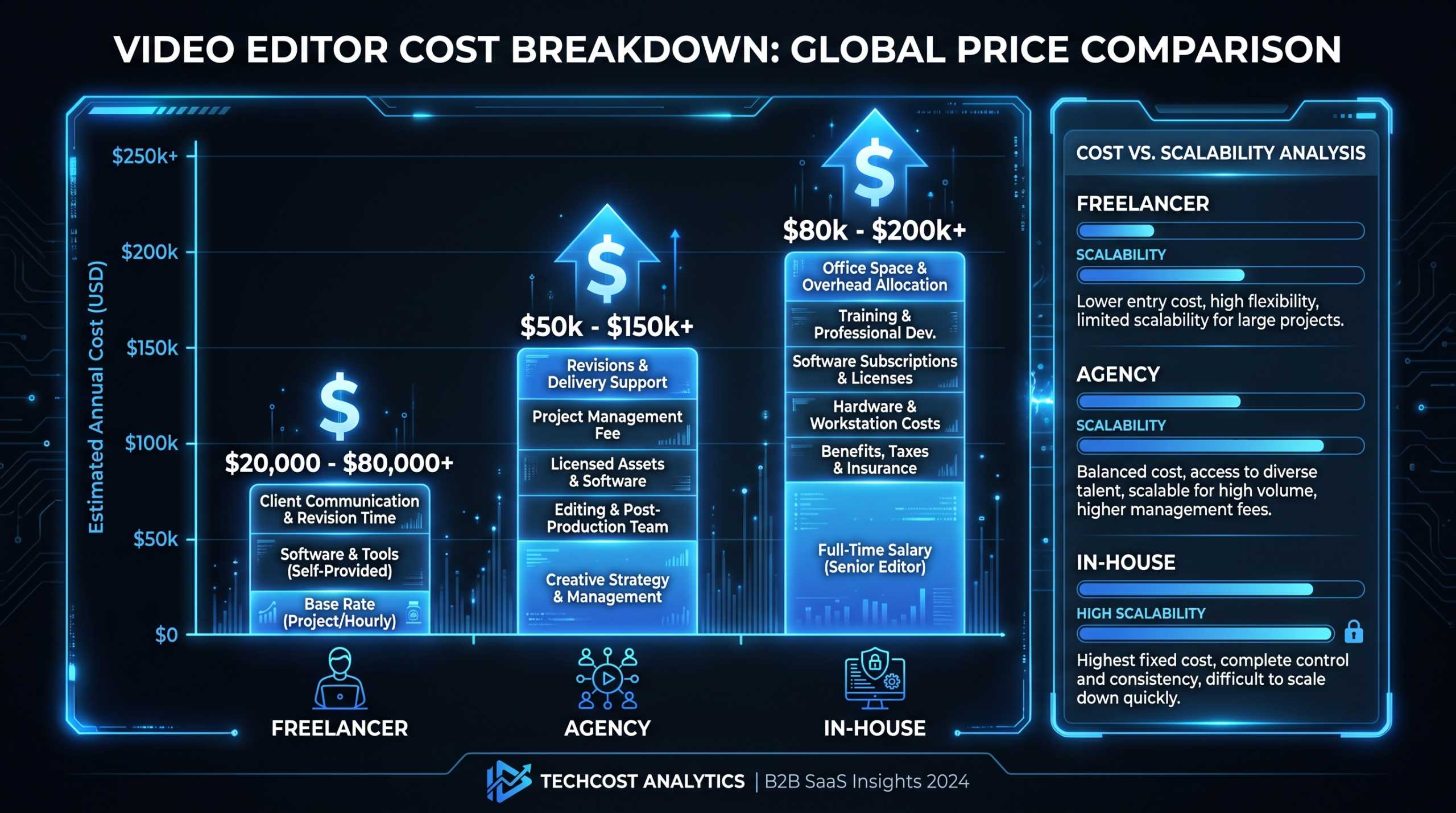
For cybersecurity companies producing more than 8–10 videos per month — common once you account for product updates, regional variants, and multi-format social cuts — a dedicated video editing team typically delivers a lower cost-per-video than project-by-project agency work. For a detailed breakdown of the formats driving that volume, see our guide to explainer video cost. VEC's dedicated team model starts at $5,000/month with a guarantee of doubling your video output in 90 days or month four is free.
Frequently Asked Questions
What makes cybersecurity video marketing different from other B2B categories?
Cybersecurity buyers evaluate vendor credibility as part of evaluating vendor products — the two are inseparable. This means video content must demonstrate genuine expertise, not just assert it. The most effective cybersecurity videos speak at the practitioner level, use accurate technical framing, and avoid exaggerating threat severity. Fear-based marketing tends to backfire with experienced security professionals who have seen every variation of it and associate it with vendors who don't have the technical depth to make a more substantive case.
How long should a cybersecurity explainer video be?
For awareness-stage animated explainers targeting executive buyers, 60–90 seconds is the optimal range. For consideration-stage architecture or platform overview videos targeting practitioners, 2–4 minutes is appropriate. Product demos can run 3–10 minutes depending on complexity, but should include chapter markers for navigation. Long-form thought leadership content (10–20 minutes) works well for audiences who have already engaged with your brand and are actively in an evaluation cycle.
Should cybersecurity companies use animation or live action?
Both serve specific purposes. Animation excels at visualizing abstract threats, network architectures, and attack paths that do not exist in the physical world — which covers most of what cybersecurity videos need to explain. Live action excels at human trust signals: customer testimonials, executive thought leadership, and behind-the-scenes content that shows real people and real environments. High-performing cybersecurity video programs use both formats, matching each to content type rather than committing to one across the board for reasons of convenience or budget.
How often should a cybersecurity company publish video content?
Marketing teams at funded cybersecurity companies commonly aim for 8–16 videos per month across formats: one or two longer explainer or thought leadership pieces, four to eight product update or demo clips, and four to eight social-optimized short cuts repurposed from longer content. The right volume depends on the number of products being marketed, how many audience segments you are addressing, and the aggressiveness of your content SEO program. Consistent output at a sustainable cadence consistently outperforms burst-and-go-quiet publishing patterns in both search and social distribution.
What video type generates the most demo requests in cybersecurity?
Customer case study videos consistently generate the highest demo-request conversion rates in cybersecurity because they provide peer proof at the moment of highest buyer intent. A CISO watching a peer from a similar-sized organization in a similar industry describe a real security outcome is more persuasive than any polished product demo. Keep case study videos under five minutes, open with the business context before the technical problem, and always include a specific and measurable outcome — not just a general endorsement. See our pricing page to understand how VEC structures dedicated teams for this kind of ongoing content volume.
Ready to Produce Cybersecurity Video at Scale?
VEC builds dedicated video editing teams for B2B SaaS and cybersecurity companies. You get a senior editor, junior editor, and project manager assigned exclusively to your account — with a guarantee to double your video output in 90 days or month four is free.
Book a Free Strategy Call See Pricing