8 Consulting Firm Video Examples That Work
TL;DR
- The world’s leading consulting firms — McKinsey, Accenture, Deloitte, PwC, BCG, EY, KPMG, and Oliver Wyman — use video for four core jobs: thought leadership, case study storytelling, recruitment, and sales enablement.
- Each example follows a repeatable format you can adapt regardless of firm size or budget.
- Expert interview, animated research, and client transformation formats generate the most measurable business value for professional services firms.
- The most common consulting video mistake: producing videos that belong in a slide deck instead of adapting them for how buyers actually consume content.
- Production quality matters less than specificity. The best consulting videos do exactly one thing and stop.
Table of Contents
- What Makes Consulting Videos Work
- 1. McKinsey & Company: Expert Interview Series
- 2. Accenture: Client Transformation Stories
- 3. Deloitte: Culture and Recruitment Films
- 4. PwC: Animated Research and Survey Content
- 5. BCG: Concept Explainers for Sales Enablement
- 6–8. EY, KPMG, and Oliver Wyman: Three More Patterns
- Consulting Video Format Comparison
- How to Build Your Consulting Video Program
- FAQ
Consulting firms earn trust by demonstrating expertise. For decades, that meant white papers, speaking slots, and bylined articles. Video is now doing the same job — and at scale, for a fraction of the per-impression cost.
The firms doing this well have built content machines that generate pipeline, attract talent, and reinforce authority simultaneously. They’re not filming talking heads on a conference stage and calling it a content strategy. They’re engineering specific video formats for specific business outcomes.
This guide breaks down eight real consulting firm video examples from firms that have figured it out. Each section covers what the firm is doing, why the format works, and what you can adapt for your own program.
What Makes Consulting Videos Work
The shared trait across every effective consulting video isn’t production quality — it’s specificity. The videos that drive business outcomes do exactly one thing: they answer one question, demonstrate one capability, or tell one story. Then they stop.
Consulting firms that waste budget on video do the opposite: they try to communicate everything they offer in one video, produce it at broadcast quality, and wonder why nobody watches past the 30-second mark. Buyers aren’t watching to be impressed by your brand. They’re watching because they have a problem and they’re evaluating whether you understand it better than your competitors do.
The Four Jobs Consulting Videos Do
Every effective consulting video example falls into one of four categories:
Consulting Video Purpose Map
| Job | Primary Audience | Best Format | Business Goal |
|---|---|---|---|
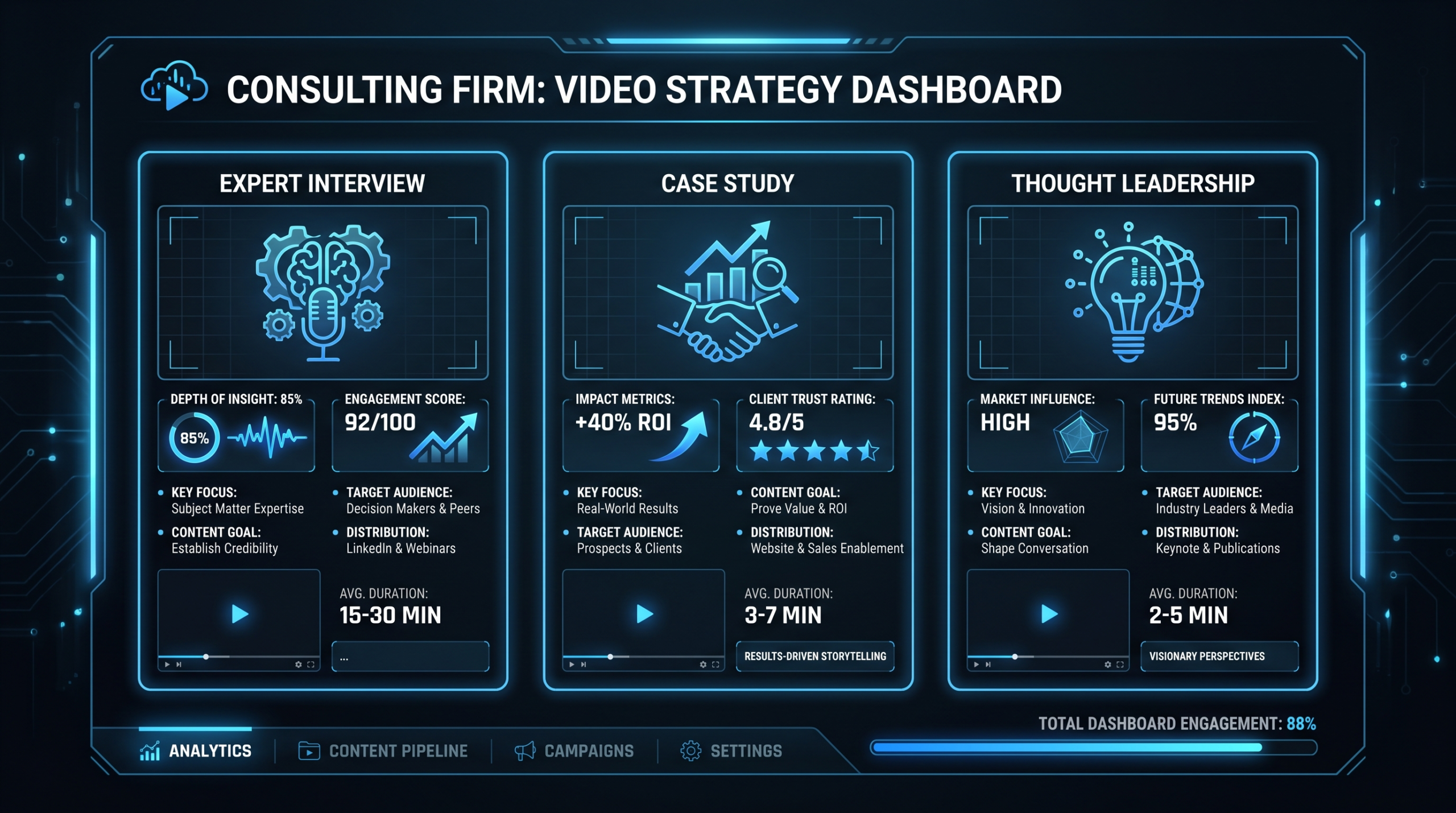
| Thought Leadership | Potential clients, press, analysts | Expert interview, trend explainer | Build credibility and inbound pipeline |
| Case Study Storytelling | Late-stage prospects | Client transformation narrative | Reduce sales cycle friction |
| Recruitment | Candidates | Culture film, day-in-the-life | Attract and convert top talent |
| Sales Enablement | Active pipeline contacts | Capability explainer, practice overview | Move deals forward without a sales call |
The eight examples below cover all four. Notice how the format always matches the job — there is no generic “about us” video trying to serve all audiences at once. That is the first lesson.
1. McKinsey & Company: Expert Interview Series
McKinsey’s video content strategy is built on one core format: short, direct interviews with partners and senior advisors on specific industry topics. The videos run 3–8 minutes, are lightly produced, and focus entirely on one question at a time. You can explore their library on the McKinsey Global YouTube channel, which covers topics from AI adoption to supply chain strategy to organizational resilience.
What McKinsey Gets Right
- One expert, one question. The videos never attempt to introduce the firm or its services. The expert answers a specific question — “What does AI-driven cost reduction actually look like in manufacturing?” — and the answer is the entire video. No padding, no firm pitch at the end.
- Minimal production signals confidence. A clean chair, professional lighting, no elaborate motion graphics. This communicates: “the thinking is strong enough that we do not need to dress it up.” Overproduction on a thought leadership video actually undermines trust because it signals the content needs help.
- Topic titles, not clickbait titles. McKinsey titles describe the content (“AI’s Impact on Manufacturing Margins”) rather than creating suspense. Buyers searching for specific answers find these videos. That is the distribution strategy.
The Formula You Can Replicate
Extract your firm’s most frequently asked client questions. Film a 4–6 minute answer from your most credible expert on each one. Edit for clarity — cut the preamble, start at the answer. Publish on a consistent weekly or biweekly cadence.
After twelve months, you have a searchable library of proof-of-expertise that functions as a permanent sales asset. A partner can text a prospect a relevant video before a call. A proposal can link to four videos instead of four case study PDFs. The format is cumulative: each video adds to the library’s authority, and the library compounds in value over time.
The expert interview is the highest-ROI consulting video format for firms at any size. Low production cost, high credibility signal, and direct pipeline value.
2. Accenture: Client Transformation Stories
Accenture’s video case studies do what written case studies cannot: they make the client’s satisfaction visible and audible. The format — typically 2–4 minutes, featuring client spokespeople alongside Accenture leads — is organized by industry and service line on Accenture’s Insights hub and deployed throughout the sales cycle.
The Structure of Accenture’s Client Stories
The videos follow a consistent three-act structure:
- Problem framing in the client’s words. Not Accenture’s description of the problem — the client’s. This is credibility by proxy. A buyer hearing another client describe a problem they recognize immediately thinks: “These people understand our situation.”
- Specific intervention. A brief description of what changed, stated concretely rather than methodologically. Not “we applied our digital transformation framework” — rather, “we moved their core operations to a cloud-native architecture in fourteen months.” Specificity is what makes the claim credible.
- Measurable outcome, stated by the client. Even where outcomes are hedged or approximate, having the client state the result is more persuasive than any amount of agency-authored copy. Video captures what written testimonials cannot: the credibility signal of watching someone say something they believe.
Why This Format Works for Complex Services
Consulting services are abstract. Buyers struggle to evaluate capability because they cannot see the product before they buy. Video case studies solve this by making the abstract concrete. They also function as social proof at scale: instead of asking for client references in a sales call, you can send a prospect a curated library of video stories sorted by their industry and challenge type.
VEC’s own case studies show how story-driven video content performs across B2B verticals when the production is handled consistently. The pattern transfers directly to professional services contexts.
3. Deloitte: Culture and Recruitment Films
Deloitte produces a distinct category of video content aimed not at clients but at candidates — and the format difference is significant. Where client-facing content aims to demonstrate expertise, recruitment video aims to demonstrate belonging. The best Deloitte recruitment films achieve this through employee voices, not corporate messaging.
What Deloitte’s Recruitment Content Does Differently
- Employee protagonists, not HR spokespeople. The most effective Deloitte recruitment videos feature analysts and managers describing their actual day — not a Chief People Officer explaining the firm’s values. A candidate wants to know what it feels like to work there, and that only comes from people who are doing it.
- Problem-first framing. “You studied finance and want to work on something that matters. Here’s how that happens at Deloitte.” They start with the candidate’s desire, not the firm’s history. This is the same answer-first principle that makes thought leadership videos work — just applied to a different audience.
- Specificity over aspiration. Rather than generic “we value inclusion” messaging, the videos that convert show specific programs, specific offices, and specific career trajectories. A candidate watching should be able to picture themselves in the role — and that requires specifics, not values statements.
The Recruitment Video Format That Converts
The format that works at scale: 60–90 seconds for awareness-stage social content (broad message, high energy, optimized for mobile-first vertical viewing), plus 3–5 minute long-form versions for candidates who have already applied or are actively considering an offer.
The short version generates interest. The long version answers the “is this really for me?” question that determines whether a qualified candidate accepts an offer or chooses a competitor. Both versions need to be produced professionally — candidates researching major career decisions are evaluating the firm on every signal they receive, including production quality.
4. PwC: Animated Research and Survey Content
PwC’s animated video format solves a specific problem: making proprietary research consumable for time-pressed executives who will not read a 60-page PDF. Their annual Global CEO Survey — which canvasses thousands of executives worldwide — generates a library of short animated videos extracting the most counterintuitive findings from each edition.
Why PwC Animates Their Research
- Data becomes immediately legible. A chart that takes 30 seconds to interpret in a PDF becomes clear in 5 seconds when animated and narrated simultaneously. The information density per minute is higher in video than in print for data-heavy content.
- Video creates a shareable unit from a non-shareable asset. A PDF is a repository — you download it, read it, and maybe file it. A 3-minute video with a clear thesis is a shareable piece of content. Executives forward it to colleagues, post it on LinkedIn, and reference it in meetings. The research reaches audiences the PDF never would.
- Animated summaries extend research shelf life. The video drives viewers to the full report, which means the research investment pays off twice: once in the video views and once in the PDF downloads. The video and the PDF serve different audiences at different depths.
How to Apply This to Your Firm’s Content
Most consulting firms already produce proprietary research — benchmarks, industry surveys, or analysis reports. The ROI on converting these into animated summary videos is high because the intellectual work is already done. You are not creating new content; you are making existing content visible to audiences that will never read the source document.
Two-to-three-minute narrated animations with clean motion graphics — one key insight per video segment, clear voiceover, and hedged but specific data points — is a format that translates across professional services sectors. See our SaaS video production guide for how data storytelling principles apply across B2B content types.
5. BCG: Concept Explainers for Sales Enablement
Boston Consulting Group uses video extensively for buyer education: explaining complex frameworks, illustrating how their methodologies work in practice, and positioning their thinking as substantively different from competitors. Their YouTube channel mixes proprietary concept explainers with executive interview content, and both formats are designed to move prospects further down the consideration funnel without requiring a sales conversation.
How BCG Uses Video for Pipeline Development
The most interesting aspect of BCG’s video strategy is how explicitly sales-oriented it is while appearing purely educational. A video explaining “how we think about business model disruption” is not really educational content — it is a demonstration of the thinking you would be buying when you engage BCG. Every minute of that video is a capabilities pitch dressed in thought leadership format.
This is a sophisticated play: buyers consume it because it is genuinely useful. The conversion happens because the quality of the thinking itself signals what the engagement would feel like. Buyers who have watched 12 minutes of a BCG framework video are substantially more ready to have a commercial conversation than buyers who have watched zero.
Lessons for Mid-Size and Boutique Consulting Firms
- Your proprietary frameworks are video assets. If your firm has a methodology or a distinctive way of approaching a client problem, put it on video. Walking through a framework on screen is more compelling than describing it in a capabilities deck.
- Short over long for sales enablement. Five-to-ten-minute explainers work for consideration-stage buyers doing independent research. For late-stage prospects who need to explain your value to a CFO internally, 90-second capability recaps are more immediately useful.
- Organize by buyer question, not by service line. “How do we scale content production without losing brand consistency?” is a buyer question. “Our Content Operations Practice” is an org chart. Buyers search for answers; structure your video library accordingly.
6–8. EY, KPMG, and Oliver Wyman: Three More Patterns Worth Stealing
6. EY: Brand Storytelling That Scales Credibility
EY’s “Better Questions” brand campaign is one of the more ambitious examples of consulting video at the awareness level. The campaign centers on a single premise: asking better questions leads to better business outcomes. This positions EY not as a service provider but as a thinking partner — a meaningfully different frame than “we provide audit and advisory services.”
What makes the format noteworthy is structural: the videos lead with a question rather than an answer. They open with intellectual engagement rather than a value proposition. This inverts the typical B2B content formula (here is what we know — hire us) and instead creates curiosity first, authority second.
What to take from it: Brand-level videos work when they are grounded in a genuine POV your firm actually holds and can defend. A manufactured tagline with expensive production is immediately transparent. A genuine organizing question that structures your firm’s public thinking — and that you are willing to answer publicly and specifically — creates lasting differentiation in a category where most competitors say nearly identical things.
7. KPMG: Sector Insight Series
KPMG produces a consistent stream of sector-specific insight videos — financial services, healthcare, technology, energy — that follow a tight template: a firm leader presents three to five specific observations about where a sector is heading, supported by KPMG’s own research or client-derived observations (properly hedged and without naming clients).
The videos run under four minutes and are optimized for LinkedIn distribution. Each video functions as a standalone conversation starter: a KPMG partner can share it in a prospect’s LinkedIn feed as a credibility signal without it reading as a sales pitch. The format transforms a newsletter-worthy insight into something a buyer will actually watch.
What to take from it: Sector specificity dramatically outperforms generalism in consulting video content. “Five trends reshaping healthcare payments in 2026” attracts the exact buyers you want and repels everyone else. Generic thought leadership competes with everything; sector-specific thought leadership competes with nothing. Build your video calendar around buyer roles and industry verticals, not practice areas and service lines.
8. Oliver Wyman: Long-Form Executive Interview Depth
Oliver Wyman has built a strong video presence through long-form executive interviews on the Oliver Wyman Forum platform. These run 20–40 minutes — substantially longer than most consulting video content — and target senior executives rather than the full buyer committee.
The logic is different from the McKinsey short-form model. Oliver Wyman is playing in a segment where the buyer — a C-suite executive with genuine domain expertise — has the attention span and the desire for real intellectual exchange. A 30-minute conversation between two genuine subject matter experts, where both people cover ground they haven’t publicly covered before, creates a level of credibility that a four-minute explainer never achieves.
What to take from it: Long-form video is not dead; it is audience-dependent. If your buyers are senior enough and your content substantive enough, committing to longer format signals respect for your audience’s intelligence and time. Not every consulting firm has the content depth to pull this off honestly — but for those that do, the format creates differentiation in a landscape where most competitors compete on short-form content alone.
Consulting Video Format Comparison
Here is how the eight examples map to format, production investment, and primary use case:
Consulting Video Format Comparison
| Format | Example Firm | Ideal Length | Production Level | Primary Use |
|---|---|---|---|---|
| Expert Interview | McKinsey | 4–8 min | Low–Medium | Thought leadership, search traffic |
| Client Transformation | Accenture | 2–4 min | Medium–High | Late-stage sales, case study library |
| Culture / Recruitment | Deloitte | 60–90 sec (social) / 3–5 min (funnel) | Medium | Talent acquisition, employer brand |
| Animated Research | PwC | 2–4 min | Medium (animation) | Research amplification, social sharing |
| Concept Explainer | BCG | 5–10 min | Low–Medium | Pipeline development, buyer education |
| Brand Campaign | EY | 60–120 sec | High | Brand awareness, differentiation |
| Sector Insight | KPMG | 3–4 min | Low–Medium | Social distribution, prospecting |
| Long-Form Executive Interview | Oliver Wyman | 20–40 min | Medium | C-suite trust building, podcast audience |
Notice the production level column. Six of the eight examples sit at low-to-medium production. High-budget investment concentrates in brand campaigns and client transformation stories — the two formats where production quality is most visible to the buyer and most likely to influence a decision. This is the right allocation: thought leadership and sector insight content should be fast, frequent, and lean. Save the high-production budget for content that is directly present at deal close.
For a deeper look at how video editing complexity maps to B2B video types, the Wistia video marketing resource hub offers the most comprehensive B2B-specific reference available.
How to Build Your Consulting Video Program
The pattern from the eight examples above points to a clear starting sequence for consulting firms investing seriously in video for the first time.
Start With Thought Leadership (Month 1–3)
Your first investment should be the expert interview format — the McKinsey model. It requires the least production infrastructure and delivers immediate SEO and credibility value. Pick your firm’s three or four most credible voices, identify the ten questions your prospects ask most often, and produce one video per question. Publish on a consistent cadence: weekly or biweekly.
The total production investment for a first batch is modest: professional camera or high-quality webcam, lighting kit, a quiet space, and a video editing team to handle post-production. VEC’s guide to outsourcing video editing covers how to structure the editing workflow so revision cycles do not become a production bottleneck.
Add Case Study Videos at Month 3
Once you have a steady cadence of thought leadership content, layer in case study videos. These take longer to produce — client approval, filming coordination, sensitive outcome negotiation — but have the highest direct sales impact of any consulting video format.
The minimum viable case study video: a 60–90 second narrated walkthrough with motion graphics, featuring one specific outcome statement the client has approved. You do not need on-camera client interviews to start. A well-produced data story with a client logo and hedged outcome language is substantially more useful in a sales conversation than no video case study at all.
Expand to Recruitment and Sales Enablement at Month 6+
Recruitment and sales enablement videos require a more developed production process because they are deployed repeatedly at high-stakes moments — final talent decisions, late-stage deal close. These warrant professional cinematography, careful scripting, and polished post-production.
At this stage, most consulting firms find that managing a consistent video production pipeline becomes a constraint on the content team’s time. A dedicated video editing service with a team assigned to your account handles the ongoing edit load, revision cycles, and format variations while your team focuses on strategy, scripting, and on-camera talent. VEC works with professional services clients at this stage of video maturity — our dedicated editor teams handle the post-production pipeline so your program scales without the overhead of building that function internally.
Frequently Asked Questions
What types of video work best for consulting firms?
Expert interview videos (thought leadership) and client transformation case studies consistently deliver the strongest results for consulting firms. Expert interviews are the best starting point — low cost to produce, strong SEO and credibility signal, direct pipeline value. Case study videos have the highest single-deal impact but require more production coordination. Animated research summaries work well for firms with existing proprietary research they need to make more accessible.
How long should consulting firm videos be?
Length depends on the format and audience. Thought leadership expert interviews perform best at 4–8 minutes — long enough to demonstrate real depth, short enough to hold a decision-maker’s attention. Recruitment videos work at 60–90 seconds for social distribution and 3–5 minutes for candidates in active consideration. Animated research summaries run 2–4 minutes. Brand campaign films should be 60–120 seconds. Long-form executive interview content — like the Oliver Wyman approach — works for C-suite audiences at 20–40 minutes, but only when the content is genuinely substantive enough to justify that investment of the viewer’s time.
Do consulting firms need high production quality for their videos?
For thought leadership and sector insight content, audio and clean framing matter more than cinematic production value. A buyer watching a 6-minute expert interview on a trend in their industry cares whether the thinking is sharp, not whether the set design is elaborate. High production investment makes sense for client case studies (present in sales conversations) and brand campaigns (competing for brand-level attention). Most firms do well allocating 70% of their video budget to frequent, leaner content and 30% to occasional high-production set pieces.
How do consulting firms handle client confidentiality in case study videos?
The standard approach is to get client sign-off on logo and name usage and let the client define what outcome data can be shared publicly. Many case study videos use industry-anonymized outcomes (“a leading financial services firm reduced processing time by approximately one-third”) rather than naming specific clients or precise percentages. The alternative is producing the video without specific outcome data — focusing on methodology and a client spokesperson testimonial — and reserving the quantified results for materials shared under NDA in the late stages of a sales conversation.
How often should consulting firms publish video content?
For thought leadership, a cadence of two to four videos per month is sustainable for most mid-size consulting firms and sufficient to build meaningful search authority and audience over a 12-month period. Brand campaigns and case study videos are produced as-needed rather than on a publishing calendar. The consulting firms with the strongest video libraries — McKinsey, Accenture, BCG — built them through consistent output over years, not through bursts of intensive production. Cadence consistency compounds in value over time; a weekly video for a year outperforms ten videos published in one month followed by silence.
Ready to Build Your Consulting Video Program?
VEC’s dedicated editing teams work with professional services firms to turn raw thought leadership footage, case study interviews, and research content into polished, publish-ready video — at the cadence your program needs, without the overhead of building an in-house post-production team.
Book a Free Strategy Call See How It Works See Pricing