Company Culture Video Ideas: 2026
TL;DR
The best culture video ideas in 2026 are the ones candidates can verify — day-in-the-life clips, values-in-action stories, team spotlights, and milestone moments. Polished brand films now underperform against authentic, specific content on LinkedIn and YouTube. This guide gives you 10 proven formats, a channel-fit comparison table, a production calendar template, and realistic cost ranges for each type.
Table of Contents
Why Culture Videos Matter in 2026
Culture videos are now primary recruitment and retention tools — not nice-to-have brand assets. Candidates routinely research companies on LinkedIn, YouTube, and Glassdoor before accepting offers. What they find (or don’t find) shapes their decision as much as compensation does.
For B2B SaaS companies competing in technical talent markets, this is especially high-stakes. Engineers, product managers, and senior marketers have options. They’re comparing cultures, not just jobs. A company with a coherent, visible culture story has a measurable hiring advantage over one that only posts open roles.
The strategic problem: most companies treat culture videos as a one-time project (“we shot something in 2024”). The companies building strong employer brands in 2026 treat it as a recurring content program — quarterly at minimum, ideally monthly — because the audience for culture content constantly cycles in new candidates.
According to LinkedIn’s Employer Brand research, candidates are significantly more likely to apply to companies where they can get a realistic preview of the work environment before reaching out. Video is the format that delivers that preview most efficiently. It is also the hardest content type for a competitor to copy quickly — your people, your moments, your specifics are proprietary.
Recruiting teams at growth-stage SaaS companies commonly report that candidates who engaged with employer brand video content before applying tend to be better-fit hires who had fewer mismatched expectations — they self-selected based on what they saw.
The good news: you do not need a large production budget to start. The ideas below range from smartphone-ready formats to polished brand pieces, with guidance on when each format earns its cost.
10 Company Culture Video Ideas That Actually Work
The formats below are ordered roughly from lowest production cost to highest. Start with the low-lift options to build a content base, then invest in the polished formats as your employer brand program matures.
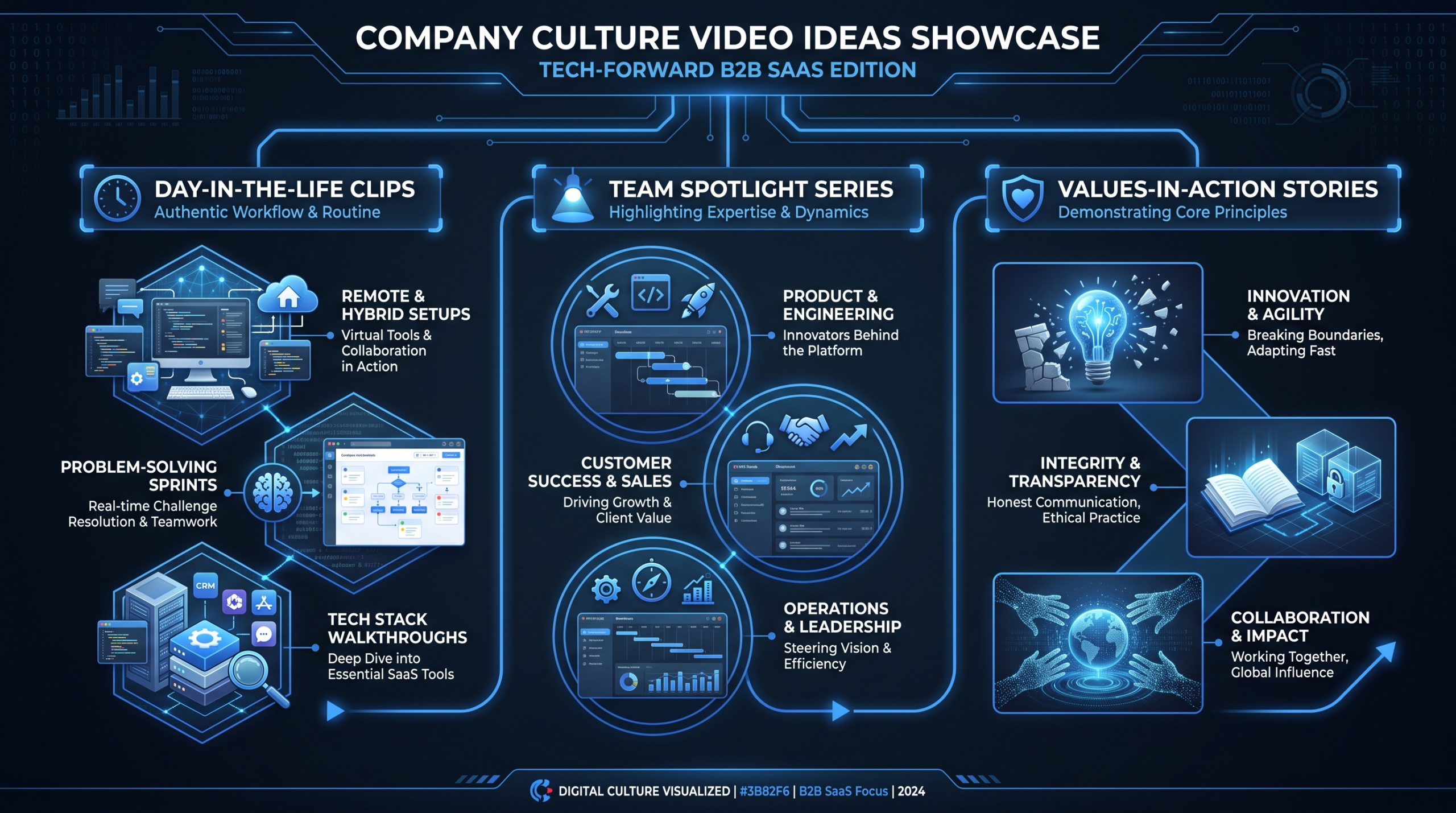
1. Day-in-the-Life Videos
Follow one employee through a real workday — team standup, deep work time, lunch, afternoon collaboration. No scripted lines. Just a camera following someone doing their actual job.
Why it works: Candidates want to know what a Tuesday actually looks like, not what the about page says it looks like. Authenticity outperforms polish here. The rougher edges (“my desk is a mess, we’re debugging something that should be simple but isn’t”) build more trust than a glossy montage.
Best formats: 60–90 second LinkedIn cut; 4–6 minute YouTube version with chapters. Shoot on a gimbal smartphone for a naturalistic look; add clean captions for the majority of LinkedIn viewers who scroll with sound off.
2. Team Spotlight Series
Interview a different team member every 2–4 weeks: what they work on, what drew them to the company, what they would tell someone considering joining. Keep each piece to 60–90 seconds.
Why it works: A series signals an ongoing culture program rather than a one-off campaign, builds personal connection with real people, and gives candidates proxies to self-identify with. If someone sees a person similar to them who is thriving, the implicit message is that they could too.
Production note: Batch-record 6–8 spotlights in one day to maximize setup efficiency. A consistent visual style across all episodes signals organizational cohesion and makes the series look intentional rather than ad hoc.
3. Values-in-Action Stories
Do not say “we value transparency.” Show a moment where it happened: the all-hands where leadership shared a hard revenue miss honestly; the customer conversation that led to a policy change; the time the team stayed late because a key account needed it and nobody complained about it.
Why it works: Values-in-action videos are the hardest to fake — which is exactly why sophisticated candidates trust them. Specific, verifiable stories about your values showing up in real decisions communicate something competitors cannot easily copy.
4. Office or Remote Culture Tour
Walk through your physical space — or your remote setup — and show how you actually work. Office layout, the tools on people’s desks, the Slack channels that get the most traffic, the Friday ritual that accidentally became tradition.
Why it works: Work environment is a real decision factor. For remote-first companies, showing your async tools, documentation culture, and “how we stay connected” answers the questions candidates are too awkward to ask in interviews.
5. Behind-the-Scenes Launch Content
When you are shipping a major product update, running a company offsite, or hosting a customer event — document it. A 60–90 second “behind the build” or “behind the launch” clip shows culture under pressure, which is more revealing than culture at rest.
Why it works: Launch moments capture energy that cannot be recreated in a studio. They also serve double duty as product marketing content — distributing production value across two budget owners and making the per-piece cost more defensible.
6. Employee Milestone Celebrations
Work anniversary highlights, promotions, cross-departmental project wrap-ups. A 30–60 second clip featuring a team member’s journey: what they joined to do, what they have built, what comes next.
Why it works: Milestone content demonstrates that you notice growth and recognize contribution. Candidates read this as: this company tracks people, not headcount. It also performs well on LinkedIn because the featured employee’s network engages, organically expanding your reach without paid spend.
7. Candidate Q&A Videos
Take the most common questions candidates ask (“How does the team handle disagreement?” “What does work-life balance actually look like?”) and answer them on camera in short, honest segments from team members at different levels.
Why it works: This format directly addresses candidate hesitation before it becomes a rejection. It also signals confidence: companies that hide things do not make pre-emptive transparency videos. For technical roles especially, hearing directly from engineers about how work is structured removes friction from the decision.
8. Mission and Impact Stories
Feature the people who deliver customer impact: a success manager who helped a customer 3x their pipeline, an engineer whose fix prevented a major incident, a marketer who identified the campaign that opened a new segment. Connect individual work to external outcome.
Why it works: Purpose-driven candidates — common in SaaS where many people could work anywhere — need a reason to care beyond compensation. Impact stories give them one. For SaaS companies, connecting engineering or marketing work to real customer outcomes is underused and high-value.
9. Learning and Growth Spotlights
Feature your internal learning culture: book clubs, conference attendance, certifications sponsored, lunch-and-learns, mentorship programs. Short clips from actual sessions, not just testimonials about them.
Why it works: Ambitious candidates — the ones you want — are optimizing for learning environments. Showing a real mentorship session or a team member’s conference talk signals investment in professional development more concretely than “we offer a learning stipend” in a job description ever can.
10. Leadership Transparency Videos
Founders and C-suite sharing company direction, what they are learning, what they got wrong last quarter, what excites them about the next six months. Not a PR-polished message — a candid, camera-front conversation.
Why it works: In a market full of polished founder LinkedIn posts, authentic self-awareness from leadership stands out. Candidates evaluate leadership character heavily; a transparent, honest video from your CEO is employer brand content that no marketing team can fabricate for a company where it would not be true.
To see how B2B SaaS companies have executed these formats in practice, check our curated collection of employer brand video examples — organized by type and company stage.
Which Culture Video Format Fits Which Channel
Not every format performs equally on every channel. Here is the breakdown by distribution context, so you can prioritize where to invest production effort:
Culture Video Format × Channel Fit
| Format | YouTube | Careers Page | Instagram / TikTok | |
|---|---|---|---|---|
| Day-in-the-Life | ✅ Excellent | ✅ Excellent | ✅ Good | ✅ Good (short cut) |
| Team Spotlight Series | ✅ Excellent | ✅ Good | ✅ Excellent | ⚡ Moderate |
| Values-in-Action | ✅ Excellent | ✅ Good | ✅ Excellent | ⚡ Moderate |
| Office / Remote Tour | ⚡ Moderate | ✅ Excellent | ✅ Excellent | ✅ Good (vertical) |
| Behind-the-Scenes Launch | ✅ Excellent | ✅ Good | ⚡ Moderate | ✅ Good |
| Milestone Celebrations | ✅ Excellent | ❌ Low | ⚡ Moderate | ⚡ Moderate |
| Candidate Q&A | ⚡ Moderate | ✅ Excellent | ✅ Excellent | ❌ Low |
| Mission / Impact | ✅ Excellent | ✅ Excellent | ✅ Excellent | ⚡ Moderate |
| Learning Spotlights | ✅ Good | ⚡ Moderate | ✅ Good | ⚡ Moderate |
| Leadership Transparency | ✅ Excellent | ✅ Good | ✅ Good | ❌ Low |
A few channel-level rules of thumb: LinkedIn rewards personal, specific, and emotionally resonant content — team spotlights and milestone pieces consistently outperform polished brand films. YouTube rewards length and depth — full day-in-the-life and candidate Q&A videos perform best when they are genuinely thorough, not cut short for fear of losing viewers. Careers pages should anchor 2–3 formats that best represent your core culture pillars, not try to feature everything at once.
Culture Video Budget Comparison
Budget expectations vary significantly based on production quality and whether you are shooting in-house, hiring a freelancer, or working with a full-service team. Here is a realistic breakdown across the formats above:
Culture Video Production Cost Ranges (2026)
| Format | DIY / In-House | Freelancer | Full-Service Agency |
|---|---|---|---|
| Day-in-the-Life (60–90 sec) | $0–500 | $800–2,500 | $3,000–8,000 |
| Team Spotlight (per episode) | $0–300 | $500–1,500 | $2,000–5,000 |
| Values-in-Action Story | $200–800 | $1,000–3,000 | $4,000–10,000 |
| Office / Remote Tour (2–4 min) | $0–400 | $800–2,000 | $2,500–6,000 |
| Behind-the-Scenes Launch | $100–600 | $1,000–2,500 | $3,000–7,000 |
| Milestone Celebration (30–60 sec) | $0–200 | $300–800 | $1,000–3,000 |
| Candidate Q&A Series (5 clips) | $200–600 | $1,500–4,000 | $5,000–12,000 |
| Mission / Impact Story (2–3 min) | $300–1,000 | $1,500–4,000 | $5,000–15,000 |
The DIY column assumes a team member with reasonable smartphone skills and basic editing software. Editing is often where in-house teams hit their ceiling — you can capture the footage, but turning raw clips into polished, captioned, branded content consistently takes more time than most marketing teams budget for. Our guide on what’s included in professional video editing services breaks down exactly what post-production adds to raw footage.
For companies running a recurring culture video program (4–8 pieces per month), a dedicated SaaS video production arrangement typically costs less per unit than per-project freelancer rates while delivering consistent quality and brand standards — critical when you are publishing under your employer brand and every piece needs to look like it came from the same organization.
Planning Your Culture Video Calendar
The companies building strong employer brands do not plan one culture video. They plan a culture video calendar — a recurring schedule that maps formats to publishing cadence and organizational moments.
Quarterly Cadence (Minimum Viable Program)
If your team can execute only one or two culture pieces per quarter, prioritize formats that compound over time: team spotlights (because you will eventually feature everyone) and values-in-action stories (because they build a specific, verifiable archive of your culture). One well-produced day-in-the-life per quarter gives candidates a fresh window into your team without requiring a large ongoing commitment.
Monthly Cadence (Growth Stage)
At this level, publish at least 1–2 LinkedIn-native pieces (short, personal), 1 YouTube piece (longer, more thorough), and update your careers page content quarterly. Plan around company events: product launches, team milestones, new hire cohorts. This level of output is typically where editing overhead starts to outpace in-house capacity — the footage capture is manageable, but the edit, captioning, color, and format variations add up.
Weekly Cadence (Full Employer Brand Program)
Series B+ companies with active hiring programs often publish weekly. At this volume, you are running a media operation inside your marketing team — with regular shoots, a consistent editing pipeline, and multi-channel distribution. This is where a dedicated video editing team becomes economically rational. VEC’s Growth plan ($5K/mo) is designed for this volume: dedicated editors who learn your brand, consistent turnaround, and the capacity to handle spikes around launches or hiring pushes without dropping quality across the rest of your program.
For the full production workflow — from brief to published piece — including shoot logistics, briefing templates, and the edit-to-publish pipeline, see our guide on company culture video production.
Mapping Formats to Organizational Moments
- Product launch → Behind-the-scenes launch clip + team celebration
- New hire cohort → Day-in-the-life of a recent joiner 30 days in
- Company offsite → Highlights reel + candid team moments
- Quarterly all-hands → Leadership transparency clip (edited from the recording)
- Work anniversary season → Milestone celebration series
- Open requisitions → Candidate Q&A + team spotlight from the hiring team
- Customer case study → Mission/impact story featuring the team that delivered it
Culture Video Mistakes to Avoid
The fastest way to waste your culture video budget is to produce content candidates do not believe. Here are the patterns to avoid:
Over-Polishing Authentic Content
A day-in-the-life video with a cinematic grade, ADR voiceover, and stock background music stops feeling like a real day. Candidates notice the gap between what they see in the video and what they hear from real employees on LinkedIn. Leave some natural sound, keep the pacing loose, and resist the urge to “clean up” the candid moments that make it real. The roughness is the credential.
Generic Mission Statements Instead of Specific Stories
“We’re passionate about empowering our customers” tells candidates nothing. “This customer was about to churn because their team could not onboard fast enough — here is what our CS team did about it” tells them something real and verifiable. Every culture video should be grounded in a specific person, moment, or decision. Generalities are invisible; specifics are memorable.
Only Showing the Best Days
The most trusted employer brand content acknowledges difficulty. A team member saying “the hardest thing about working here is [specific real challenge]” builds more trust than a reel of office perks and team celebrations. Candidates are not looking for perfection — they are looking for honesty about the tradeoffs, because they know every job has them.
Neglecting Captions and Accessibility
A significant portion of LinkedIn and social video is consumed in silent mode. Videos without captions lose most of their potential audience before the first five seconds. Clean, accurate captions are table stakes for culture video distribution in 2026. Burned-in captions — styled and on-screen rather than auto-generated subtitle files — perform better on most platforms and give you control over readability and brand presentation.
According to Wistia’s video marketing research, captioned videos consistently show higher engagement rates and completion rates than uncaptioned equivalents, particularly on social platforms where auto-play with sound off is the default viewer behavior.
One-and-Done vs. Consistent Program
A single culture video from two years ago communicates stagnation, not culture. Candidates notice publication dates. A library of culture content published consistently signals an active, evolving organization. Even a quarterly publishing cadence is dramatically more effective than a one-time brand film.
When to Outsource Your Culture Video Production
In-house production makes sense for raw capture: a modern iPhone on a gimbal can shoot compelling day-in-the-life or milestone content. Where in-house teams typically hit the ceiling is in post-production — editing, color grading, captions, music licensing, format variations (16:9 for YouTube, 9:16 for Stories, 1:1 for LinkedIn feed), and the consistency of visual style across a recurring series.
Three signals that it is time to outsource:
- Your editors are spending more than 8–10 hours per piece. Professional culture video editors who have built a workflow for this specific content type typically deliver in 3–5 hours what takes an in-house generalist 10–15 hours — and the output looks better.
- Your content looks inconsistent across pieces. Candidates who visit your careers page or LinkedIn and see four different visual treatments assume organizational chaos. Dedicated editors maintain brand standards piece-to-piece without you managing it.
- You are producing 4+ pieces per month. At that volume, the economics favor a dedicated editing arrangement over per-project work. Check our full guide on how to outsource video editing for the complete make-vs.-buy decision framework, including the break-even point by content volume.
For teams ready to scale their culture video program, VEC’s Core plan ($9.5K/mo) includes dedicated editors assigned to your account who learn your brand, your people, and your editing preferences over time — so the twelfth episode of your team spotlight series looks as sharp as the first, without the briefing overhead of a new freelancer each time. See all plan details on our pricing page, or book a strategy call to discuss which arrangement matches your content volume and goals.
Frequently Asked Questions
What is the best company culture video idea for a startup?
Day-in-the-life videos are the highest-return format for early-stage companies. They are low production cost, highly shareable on LinkedIn, and give candidates a credible window into your actual work environment. A founder day-in-the-life — showing real work, real decisions, real team interactions — outperforms a polished brand film at this stage because authenticity is a startup’s comparative advantage over larger, more established employers who are harder to access in the same way.
How long should a company culture video be?
It depends on the channel and format. LinkedIn-native culture clips perform best at 60–90 seconds. YouTube day-in-the-life and candidate Q&A videos work well at 4–8 minutes when they deliver genuine substance throughout. Careers page hero videos are typically 90 seconds to 2 minutes — long enough to convey character, short enough that candidates watch to the end. The guiding principle: cut every second that does not add information or emotional value.
Do culture videos actually affect hiring outcomes?
Recruiting teams at growth-stage SaaS companies consistently report that candidates who engaged with culture content before applying tend to be better-fit hires with fewer unmatched expectations. The mechanism is straightforward: culture videos give candidates information they would otherwise need to guess at, which means the candidates who apply after watching have already decided the culture fits them. This self-selection effect is especially pronounced for senior hires, who research extensively before moving.
Should culture videos be scripted or unscripted?
Most formats perform better unscripted or lightly guided. Give participants 2–3 prompt questions beforehand so they can think, but let answers happen naturally on camera rather than scripting lines. Values-in-action and milestone videos especially benefit from natural speech patterns; scripted lines read as corporate and undermine the authenticity these formats are meant to convey. The exception is candidate Q&A content, where light scripting helps ensure answers are complete and do not meander into territory that raises more questions than it answers.
How many culture videos should a company produce per year?
A minimum viable employer brand program looks like 8–12 pieces per year — roughly one per month. Growth-stage companies with active hiring programs typically publish 2–4 pieces per month to maintain a current, active-looking content library across LinkedIn and their careers page. Series B+ companies running full employer brand programs often publish weekly. The right cadence is the one you can maintain consistently; sporadic publishing is worse than a modest but reliable schedule.
Ready to Scale Your Culture Video Program?
VEC provides dedicated video editing teams for B2B SaaS companies — editors assigned to your account who learn your brand, your people, and your style. We guarantee double your video output in 90 days, or month 4 is on us.
Book a Free Strategy Call See Pricing Plans