B2B Video Strategy on a $5K Budget: 2026
TL;DR
$5K/month is enough to run a real B2B video program — if you allocate it correctly. That budget covers a dedicated video editing team at the Growth tier, roughly 8–12 edited videos per month depending on complexity.
The biggest mistake at this budget: spreading it too thin across too many formats. The highest-ROI play is to pick two video types (typically product demo + short-form social clips), batch your shoots, and let a dedicated editing team handle the output volume.
This guide shows you the math, the allocation, and the sequencing to make $5K/month actually move pipeline — not just fill a content calendar.
Table of Contents
- What $5K Actually Buys You in B2B Video (2026)
- Three Ways to Spend $5K/Month: The Trade-offs
- Which Video Types Deliver the Most ROI at This Budget
- The $5K Allocation Framework: Where Every Dollar Should Go
- How to Stretch $5K Further: Batch Shooting and Repurposing
- Agency vs. Freelancer vs. In-House at the $5K Level
- When You're Ready to Scale Beyond $5K
- FAQ
Five thousand dollars a month sounds like real money — and it is. But the B2B video landscape in 2026 is more competitive than it was three years ago. Every SaaS company now has a YouTube channel, a LinkedIn video strategy, and a library of demo videos. If your $5K is being spent without a clear framework, you're probably getting less than half the output — and less than a quarter of the pipeline impact — that this budget can actually produce.
This guide is for VP Marketing and Head of Content roles at Series A–C SaaS companies who want to know: what does a $5K B2B video budget actually buy, how should it be allocated, and what's the fastest path from first video to measurable sales impact?
What $5K Actually Buys You in B2B Video (2026)
At $5,000/month, you're operating at the entry point of the professional agency tier — not freelancer territory, not the enterprise tier. Here's what that number realistically covers in 2026:
$5K/Month: What's Included by Engagement Model
| Engagement Model | What $5K/mo Gets You | Typical Monthly Output | Best For |
|---|---|---|---|
| Dedicated video editing team (agency) | Senior editor + PM, brand style guide, unlimited revisions within scope | 8–12 edited videos/mo | Consistent B2B content programs |
| Freelance pool (managed in-house) | 2–3 freelancers at mixed rates, direct management required | 6–10 videos/mo (variable quality) | Teams with a strong in-house creative director |
| Video editing subscription service | 1–2 active requests, basic editing only | 8–12 simple edits/mo | High-volume simple content (social clips, podcast edits) |
| Full-service production agency (project-based) | 1–2 produced videos from scratch (scripting, filming, editing) | 1–2 videos/mo | Flagship content: brand film, hero demo |
The key distinction: $5K/month is a production budget, not a shoot budget unless you're going full-service project-based. If you're shooting your own footage and handing it to a team for post-production, $5K goes significantly further. If you need someone to film, direct, script, and edit from scratch, $5K gives you one or two high-quality videos per month — not a content engine.
The Realistic Per-Video Math
Most B2B SaaS teams in 2026 operate on a shoot-then-edit model: your founders or customer success team records content (or you do quarterly batch shoots), and a dedicated editing team handles post-production, motion graphics, captions, and platform-specific formatting.
At that model, $5K/month typically produces:
- 2–4 long-form videos (10–20 min YouTube, webinar repurposes)
- 4–8 short-form clips (60–90 sec LinkedIn/YouTube Shorts cuts from long-form)
- 1–2 product demo or feature walkthrough videos (3–5 min, motion graphics overlays)
That's a sustainable content calendar. The variable is complexity — motion graphics-heavy demos take longer to edit than talking-head interview cuts. Factor that into your expectations when scoping with any vendor.
For a broader look at which agencies operate at this budget level, the best video marketing agencies for B2B comparison covers options from the $3K–$20K monthly range with honest assessments of what each tier delivers.
Three Ways to Spend $5K/Month: The Trade-offs
There isn't one right way to allocate a $5K video budget. The best model depends on whether you have in-house creative resources, how much content you need, and what your primary goal is (pipeline vs. brand vs. retention).
Model A: All Post-Production (You Shoot, They Edit)
You or your team records raw footage (founders, product walkthroughs, customer interviews). A dedicated editing partner handles everything after the camera stops: cutting, color grading, motion graphics, captions, thumbnail creation, and platform exports.
Pros: Maximum output volume at $5K. Best brand consistency since you control the on-camera presentation. Lower per-video cost because production labor isn't in the budget.
Cons: Requires someone internal to manage shoot logistics, scripting, and on-camera talent. Output quality is bounded by your raw footage quality.
Right for: Companies with a founder or customer success leader comfortable on camera, and a marketing manager who can coordinate shoots. Common at Series A–B where founder-led video still performs well.
Model B: Split Budget (50% Production, 50% Post)
$2,500 goes to one or two quarterly full-production shoots (filming, lighting, direction). The remaining $2,500 funds ongoing editing of both the new shoot footage and existing content repurposing.
Pros: Gives you professionally shot footage quarterly while maintaining a month-to-month editing cadence. One well-produced shoot can generate 3–4 months of edited content.
Cons: Reduces monthly editing budget, which may limit turnaround speed and output volume in non-shoot months.
Right for: Companies that want polished video without committing to a full production agency, and can plan content 60–90 days ahead.
Model C: Full-Service Project-Based
Spend $5K on one or two full-service videos per month — agency handles scripting, shooting, editing, and delivery. No in-house production involvement required.
Pros: Highest production quality. Zero internal management overhead on the creative side. Good for cornerstone content (brand video, primary demo).
Cons: Lowest volume. One polished video per month does not sustain a content engine. Better suited as a complement to an editing-focused program, not as the entire strategy.
Right for: Companies that need one flagship asset (like a redesigned hero demo or an ABM video series) and are willing to accept lower volume in exchange for higher individual quality.
Which Video Types Deliver the Most ROI at This Budget
Not all B2B video types perform equally — and at $5K/month, you can't afford to produce everything. Here's how the major formats stack up on ROI-to-cost at this budget level, based on what agencies consistently report across B2B SaaS accounts.
B2B Video ROI at the $5K Budget Level
| Video Type | Avg Cost to Produce | Primary Use | Pipeline Impact | Priority at $5K |
|---|---|---|---|---|
| Product demo / feature walkthrough | $400–900/video | Bottom-of-funnel, sales enablement | High — directly supports conversion | ✅ Tier 1 |
| Short-form social clips (60–90 sec) | $150–350/clip | Top-of-funnel awareness, LinkedIn | Medium — builds awareness and retargeting pool | ✅ Tier 1 |
| Customer testimonial / case study video | $500–1,200/video | Mid-funnel trust building | High — peer validation drives intent | ✅ Tier 1 (if you have customers willing to go on camera) |
| Long-form YouTube (educational) | $300–600/video | SEO, thought leadership | Low immediate, high cumulative over 6–12 months | ⚠️ Tier 2 (do if you can batch from existing recordings) |
| Animated explainer video | $2,000–6,000/video | Homepage, awareness campaigns | Medium — good for complex products | ⚠️ Tier 2 (one per quarter max at this budget) |
| Brand / culture video | $3,000–8,000/video | Recruiting, investor relations | Low direct pipeline impact | ❌ Deprioritize until $10K+ budget |
The highest-leverage play at $5K: product demos and short-form clips from the same raw footage. One 30-minute product demo recording session can yield a 5-minute edited demo, three 60-second LinkedIn clips highlighting specific features, and a YouTube cut with chapters and motion graphics. That's four to five assets from one shoot — the kind of repurposing math that makes $5K feel like $15K.
Learn more about what goes into a professional demo at the product demo video production level — including the editing decisions that differentiate a conversion-driving demo from a screen recording.
The $5K Allocation Framework: Where Every Dollar Should Go
The biggest budget mistake at this level: companies spend $5K/month with no allocation plan and wonder why the output feels scattered. Here's a practical framework based on what actually compounds into pipeline over 6–12 months.
The 60/30/10 Rule for B2B Video at $5K
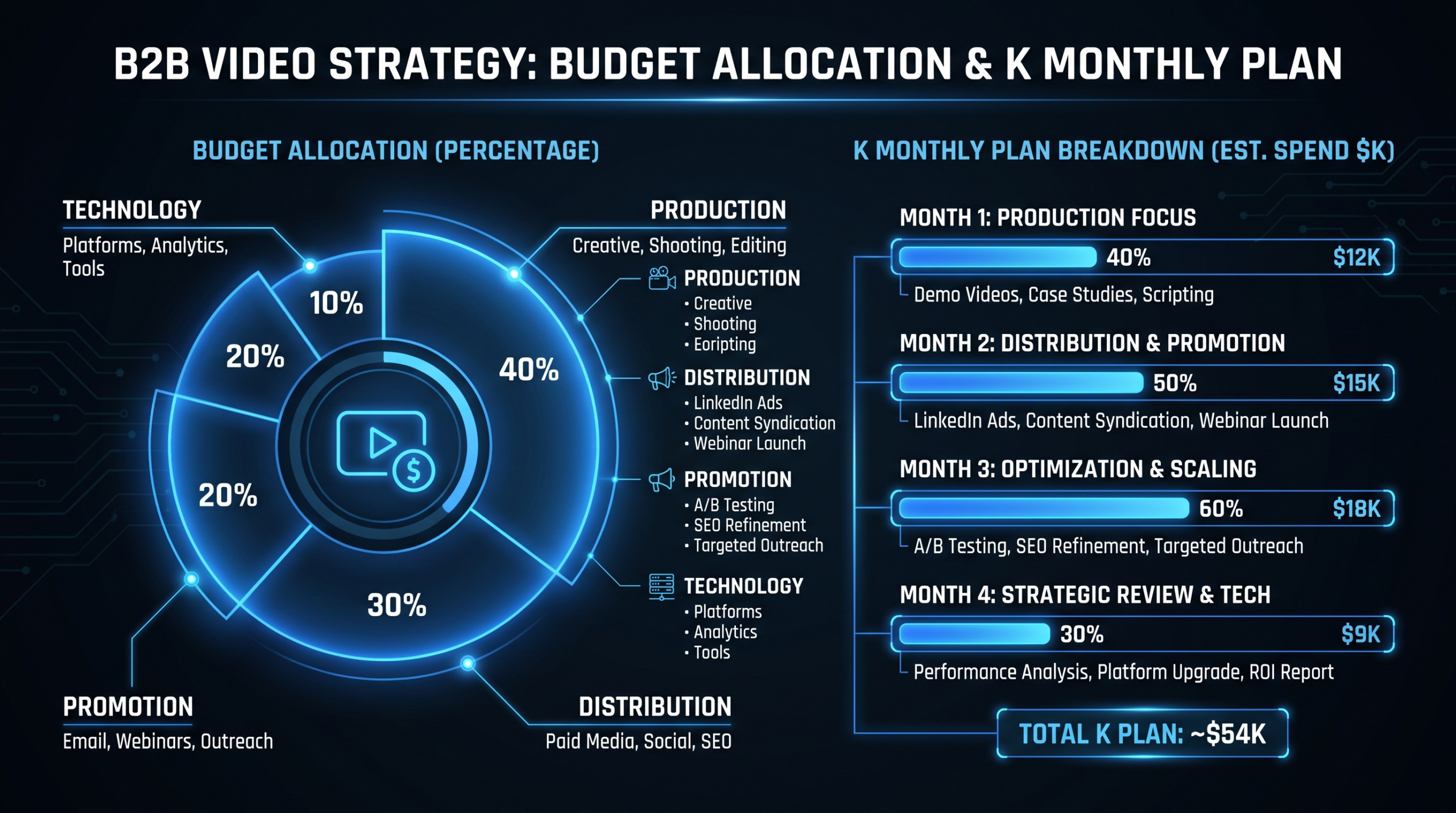
Recommended $5K Monthly Budget Split
| Category | % of Budget | Monthly Spend | What It Covers |
|---|---|---|---|
| Post-production (editing team) | 60% | $3,000 | Editing, motion graphics, captions, platform exports for 8–10 videos |
| Shoot / production | 30% | $1,500 | Monthly mini-shoot or quarterly full production day (amortized) |
| Distribution and promotion | 10% | $500 | LinkedIn video ads spend, YouTube promotion, or thumbnail A/B testing tools |
The 10% distribution budget matters more than most teams realize. A polished demo video sitting on an unwatched YouTube page doesn't move pipeline. Even $500/month in LinkedIn video ad spend targeting your ICP by title and company size can meaningfully amplify reach. Wistia's research on B2B video engagement consistently shows that gated video assets generate significantly higher lead quality than blog-gated content — but only when distribution is intentional.
Priority Sequencing: What to Build First
Most teams try to build everything at once and end up with nothing exceptional. The compounding video strategy at $5K follows a clear build order:
- Month 1–2: Foundation assets. One polished product demo (primary use case), three customer testimonial clips (even iPhone-recorded with professional editing counts). These are your sales enablement core.
- Month 3–4: Top-of-funnel engine. Repurpose existing webinars, founder recordings, and sales call content into short-form LinkedIn clips. This is your awareness layer and retargeting pool.
- Month 5–6: SEO and long-form. Once the above is producing leads, add YouTube content targeting educational keywords your ICP searches. These take 90+ days to rank but compound indefinitely.
Teams that skip directly to YouTube educational content at month 1 typically see slow results and conclude "video doesn't work for B2B." It works — but only when the bottom-of-funnel assets are in place first. See our full breakdown of SaaS video production strategy for how high-growth SaaS teams sequence their video programs.
How to Stretch $5K Further: Batch Shooting and Repurposing
The single most effective tactic for getting $15K of content value from a $5K budget is batch shooting combined with systematic repurposing. This is not a new idea, but most B2B teams implement it poorly.
The One-Day Shoot Strategy
One structured 6-hour shoot day — with a clear shot list and a professional editor waiting for the footage — can produce 3–4 months of content. Here's how a typical output breaks down from a single batch shoot:
- 1× long-form educational video (20–30 min, edited to YouTube-ready)
- 5–8× short-form clips (cut from the long-form)
- 2–3× product feature walkthroughs (separate recordings, edited with screen overlays)
- 1× customer testimonial (if you bring a customer on-site or record via Zoom)
- Thumbnail assets, chapter markers, and social copy from the same session
At $5K/month, you can afford one 6-hour batch shoot day per month or a half-day every two weeks. The investment in shoot logistics (location, lighting, teleprompter if needed) is roughly $500–1,000. The remaining $4,000–4,500 goes entirely to post-production — where a dedicated editing team turns raw footage into polished assets across every format you need.
The Repurposing Stack
Every long-form piece of content should be systematically broken into derivative assets. This is where the per-video cost drops dramatically:
Repurposing Stack: 1 Recording → Multiple Assets
Source recording (30–40 min)
Founder interview, product walkthrough, or webinar
YouTube long-form (18–25 min edited)
Chapters, B-roll, motion graphics lower thirds, thumbnail
LinkedIn short-form clips (60–90 sec each)
Key insights extracted, captioned, 9:16 and 16:9 formats
Sales enablement snippet (3–5 min)
Best 5 minutes for mid-funnel email campaigns and deal rooms
Total: 6–8 assets from one source recording. Effective cost per asset at $5K/month: $625–835.
The editing cost for this repurposing stack is dramatically lower than producing each format independently. A dedicated editing team that knows your brand style — your color palette, your lower-third templates, your caption style — produces each derivative 40–60% faster than starting fresh. That efficiency compounds every month.
This is one of the core reasons VEC's Growth plan at $5K/month is structured around a dedicated editing team rather than a per-project model. The team learns your brand in month one; by month three, turnaround times have dropped and consistency has improved. You can explore how this works in practice at the how it works page.
Agency vs. Freelancer vs. In-House at the $5K Level
At $5,000/month, you have three realistic options for who does the editing work. Each has a meaningful trade-off that affects not just the budget math but the quality of output and the internal management burden.
$5K/Month: Agency vs. Freelancer vs. In-House
| Model | What $5K Gets You | Internal Mgmt Burden | Quality Consistency | Scale Path |
|---|---|---|---|---|
| Dedicated agency team | Senior editor + PM, 8–12 videos/mo, brand onboarding | Low (PM handles coordination) | High — same editors, same standards | Upgrade tier; team scales with you |
| Freelancer pool (2–3 people) | ~100–130 hours of editing, you manage the queue | High — you are the PM | Variable — depends on individual availability | Add more freelancers; management overhead grows |
| In-house junior editor | One full-time junior editor (salary ~$48–62K/yr in USD, ~$4,000–5,200/mo loaded) | Medium — hiring, onboarding, feedback | High once trained, inconsistent early | Hire second editor; significant cost jump |
| Video editing subscription service | Basic plan: 1 active request at a time, 48–72hr turnaround | Low (portal-based submission) | Medium — editor rotation possible | Upgrade to premium plan; throughput-limited |
The Hidden Cost of DIY Management
The freelancer model looks attractive on paper — $5K spread across three skilled freelancers sounds like more value than one agency team. In practice, the management overhead eats into that equation significantly.
Managing a freelancer pool at meaningful video volume requires 5–8 hours/week of marketing manager time: briefing, QC reviewing, coordinating revisions, chasing deliverables, and handling availability gaps when a freelancer is sick or overbooked. At a $100K marketing manager salary, that's $12,000–19,000/year in hidden management cost on top of the $60K annual freelancer spend.
The dedicated agency model with a built-in PM eliminates most of that overhead. You submit briefs, review finished videos, and provide feedback. The PM handles everything in between. For most B2B SaaS teams where the marketing function is stretched thin, the management hour savings alone justify the slightly higher cost versus managing freelancers directly.
For a detailed breakdown of how to outsource video editing — including what to include in a brief, how to structure feedback, and what handoff assets to prepare — that guide covers the operational side in depth.
"The first time we tried to scale video, we hired three freelancers and spent more time managing the queue than we did promoting the finished videos. Moving to a dedicated team added $1,500/month but saved us 6+ hours/week of PM time. That was an easy ROI calculation." — Common pattern from B2B SaaS marketing teams scaling from 2 to 10+ videos/month.
When You're Ready to Scale Beyond $5K
The $5K/month program described in this guide is a legitimate content engine — but it has limits. You'll hit those limits when one or more of the following happens:
- Output volume isn't enough for your content calendar. If you need 15+ edited videos/month consistently, $5K starts to feel tight. The Core tier (~$9.5K/month) adds a second editor, motion graphics capacity, and roughly doubles throughput.
- Complexity increases. As your product matures and your video strategy matures, you'll move from simple screen recordings to animated product walkthroughs, multi-interview case study videos, and branded motion graphics. That complexity requires more editing hours per video.
- Video becomes central to pipeline, not supplemental. When your video assets are generating a meaningful fraction of your inbound pipeline, the ROI on increased spend becomes demonstrable — and the conversation with leadership becomes easier.
The natural progression for most Series A–B SaaS companies looks like this: start at $5K (Growth), hit consistent output at month 3, see pipeline impact at month 6, and make the case for $9.5K–$16K/month by month 9–12 when the data supports it.
When you're ready to evaluate which agency can handle that scale, the best B2B video marketing agencies guide benchmarks the main options at the $5K–$20K+ tier, including what each agency specializes in and which company profiles they serve best.
You can also review VEC's pricing tiers to see how the Growth, Core, and Scale plans differ in team structure, output capacity, and included services — which makes the "when to upgrade" decision clearer before you're in the middle of a content crunch.
HubSpot's video marketing research consistently shows that companies with documented video strategies report higher ROI than those who produce video on an ad-hoc basis. The $5K framework in this guide is the documented strategy — execution consistency over 6+ months is what converts it into pipeline data.
Frequently Asked Questions
Is $5K/month enough for a real B2B video strategy, or is it too small to matter?
$5K/month is enough for a genuine B2B video program that can move pipeline — but only with a focused strategy. Spread across too many formats or managed inefficiently, $5K produces scattered output that doesn't compound. Concentrated on 2–3 high-ROI video types (product demos, short-form clips from batch shoots), managed by a dedicated editing team, $5K can sustain 8–12 edited assets per month — enough to fill a LinkedIn posting calendar, support sales enablement, and build a YouTube presence simultaneously.
Should I hire a freelancer or use an agency at the $5K budget level?
For most B2B SaaS marketing teams, a dedicated agency team makes more sense at $5K than a freelancer pool. The math looks comparable on paper, but managing 2–3 freelancers directly adds 5–8 hours/week of marketing manager time in briefing, QC, and coordination — often $12,000–19,000/year in hidden overhead. An agency with a built-in project manager eliminates most of that burden. The exception: teams with a strong in-house creative director who actively wants direct freelancer relationships and has bandwidth to manage the queue.
What video types should I prioritize first when starting with a $5K budget?
Start with bottom-of-funnel first: a polished product demo and 2–3 customer testimonial clips. These assets directly support your sales team and have measurable impact on conversion rates. Add short-form LinkedIn clips in months 2–3 by repurposing existing recordings. Long-form YouTube educational content is valuable but takes 90+ days to compound — build it after the bottom-of-funnel assets are in place, not instead of them.
How do I measure ROI on a $5K/month video program?
Track three metrics from the start: (1) video-influenced pipeline — contacts who watched a video before booking a demo or starting a trial; (2) sales cycle length for video-touched vs. non-video-touched deals; (3) video engagement on specific assets — watch-through rates on demos above 50% indicate content resonance. Most CRMs can tag contacts who clicked video links in emails or watched gated demo pages. Set this tracking up before month 1, even if the data is sparse early — you'll need 90–180 days of baseline before the numbers are meaningful.
Can I run a B2B video strategy without a dedicated production budget if I already spend $5K on editing?
Yes, but your raw footage quality becomes the ceiling. Many B2B SaaS companies run entirely on self-recorded content — founders on a decent mirrorless camera or even iPhone 15+ with good lighting and a lapel mic. The production quality gap between a well-lit iPhone recording and a professional camera setup is smaller than most people assume, especially for product walkthroughs and talking-head interviews. A dedicated editing team can dramatically elevate self-recorded footage with color grading, noise reduction, motion graphics, and tight cuts. The ceiling is set by lighting and audio quality, not by camera hardware.
Ready to Build a $5K B2B Video Program That Actually Works?
VEC's Growth plan is built specifically for Series A–C SaaS companies running a $5K/month video budget. Dedicated senior editor and project manager, brand onboarding in week one, and a 90-day output guarantee. If we don't double your video output in 90 days, month 4 is free.
Book a Free Strategy Call See Growth Plan Details