B2B Video Production Pricing: 2026 Models
TL;DR
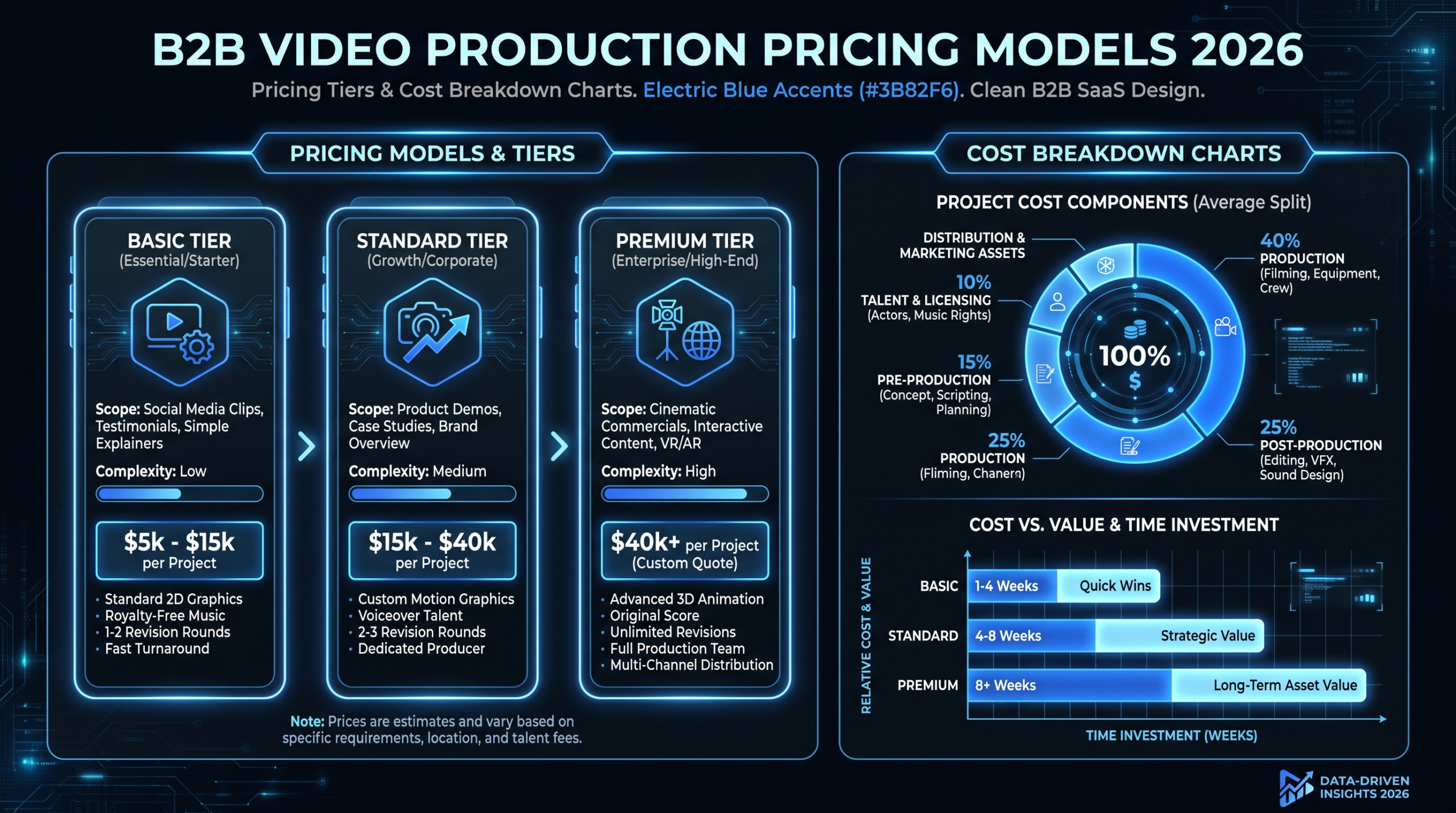
B2B video production typically costs more per asset than consumer-facing content — longer approval chains, stricter compliance requirements, and the need for industry-specific accuracy all push prices up. In 2026, four engagement models dominate: per-project ($1,500–$30,000+), agency retainer ($3,000–$15,000/mo), full-service subscription ($2,000–$9,500/mo), and dedicated team ($5,000–$20,000/mo). The right model depends on your monthly video volume, complexity needs, and whether brand consistency or cost-per-asset matters more to your team. This guide breaks down every major format, the four models, hidden costs, and how to structure a B2B video budget that scales.
Table of Contents
B2B marketing teams are investing more in video than at any point in the past decade. The format generates pipeline, shortens sales cycles, and builds the trust that long B2B buying processes demand. The challenge? Video production pricing for B2B is fundamentally different from what most guides describe — and using consumer-market benchmarks will leave your budget either wildly over or under-prepared.
This guide is built specifically for VP Marketing, Head of Content, and demand-gen leaders at Series A–C SaaS companies. We cover real-world pricing ranges, the four dominant engagement models, and the cost levers that matter most in a B2B context. We've also broken down where VEC's clients typically land, based on our work with dozens of SaaS teams.
Why B2B Video Pricing Is Different
B2B video production reliably costs more per asset than equivalent consumer-facing content — and not simply because agencies charge a premium for the "B2B" label. The structural reasons are real and worth understanding before you build a budget.
Longer Approval and Review Cycles
Consumer video moves fast: brief → shoot → edit → post. B2B video adds layers. Legal review for regulated industries (fintech, healthcare, enterprise software) commonly adds one to three rounds. Stakeholder sign-off from Sales, Product, and Leadership means a 5-minute product demo video can take six weeks from brief to publish. Production partners price that overhead into their quotes — more revision rounds, longer project timelines, and more PM involvement.
Subject-Matter Accuracy Requirements
A consumer lifestyle brand can afford approximate messaging. A SaaS company demoing a complex product workflow cannot. B2B video scripts require review by product and customer success teams, often triggering multiple rewrite rounds before a single frame is cut. Agencies that specialize in B2B invest in writers and editors who understand software products, enterprise workflows, and technical audiences — and that expertise commands a premium.
Format Complexity
B2B video libraries typically include product demos, animated explainers, customer case study videos, webinar recordings, and sales enablement content — each requiring distinct production approaches. Animated explainers alone (common in SaaS for onboarding and top-of-funnel) cost 2–5x more than a standard talking-head edit. When your video program spans multiple formats, average per-asset cost rises significantly.
Volume and Distribution Requirements
B2B content engines produce video for multiple channels simultaneously: LinkedIn, YouTube, website, sales enablement platforms, and customer portals. That means each asset often needs reformatting for 16:9 (YouTube), 1:1 (LinkedIn), 9:16 (Stories/Shorts), plus internal and external variants. Format proliferation multiplies editing hours without necessarily multiplying the sticker price per video — which is why per-project pricing becomes expensive fast for B2B teams.
The Four B2B Video Production Pricing Models
Four engagement structures dominate B2B video production in 2026. Each suits a different stage of a company's content maturity and monthly output volume.
B2B Video Production Pricing Models Comparison
| Model | Typical Monthly Range | Best For | Main Risk |
|---|---|---|---|
| Per-Project | $1,500–$30,000+ per video | 1–3 videos/quarter; campaign bursts | Highest per-unit cost; no brand continuity |
| Agency Retainer | $3,000–$15,000/mo | 6–15 videos/month; consistent calendar | Use-it-or-lose-it if pipeline slows |
| Full-Service Subscription | $2,000–$9,500/mo | High-volume simple content; social clips | Sequential queue limits throughput |
| Dedicated Team | $5,000–$20,000/mo | 15+ videos/month; complex, brand-sensitive work | Underutilization if volume drops |
Per-Project: When It Makes Sense (and When It Doesn't)
Per-project pricing is the correct choice for genuine one-off needs: a new brand video for a funding announcement, a single product demo for a key conference, or a pilot to test an agency relationship. It becomes expensive quickly when used as the default model for ongoing content programs. A B2B SaaS company producing 8 videos/month at per-project rates will commonly pay 40–80% more than the same team on a retainer or dedicated arrangement. For a detailed breakdown of how per-project and retainer economics compare, see our analysis of video production agency pricing models.
Agency Retainer: The Volume Sweet Spot
Retainers work well for teams with a defined monthly content calendar and consistent volume. The agency reserves capacity; you get a lower per-video cost and a dedicated point of contact who learns your brand over time. Standard retainers run 3–6 month minimums, with better terms available on 12-month commitments.
Full-Service Subscription: Throughput Is the Constraint
Subscription plans appeal because of their simplicity: one flat fee, unlimited requests submitted through a portal. The catch for B2B teams is that "unlimited requests" means unlimited items in a queue, not unlimited production capacity. With most subscription plans operating on a one-active-request model, throughput tops out at 8–15 videos/month on standard plans. Complex B2B formats (animated explainers, case study videos with interview footage) often aren't included at standard subscription tiers.
Dedicated Team: The Long-Term Play for Scale
Dedicated team arrangements assign a consistent group of editors, a project manager, and sometimes a creative director to your account. The team learns your product, brand voice, and internal review process — which significantly reduces revision cycles after the first month. At 15+ videos/month, dedicated teams reliably deliver the lowest effective cost-per-finished-video of any model. This is the model used by most enterprise and high-growth SaaS marketing organizations. Visit our case studies to see how B2B SaaS teams have structured these arrangements.
B2B Video Cost Ranges by Format
B2B video programs span a wide range of formats. Each carries distinct production complexity — and therefore distinct cost ranges. These figures represent typical agency and production house quotes in 2026 for US-based or US-managed teams; offshore and hybrid arrangements commonly run 30–60% lower for equivalent quality tiers. For a line-by-line breakdown of what makes up those numbers, see the video production cost breakdown guide and the corporate video production cost guide.
B2B Video Cost by Format (2026 Ranges)
| Format | Typical Length | Per-Project Range | Key Cost Driver |
|---|---|---|---|
| Product demo video | 2–5 min | $3,000–$12,000 | Screen recording QA, script accuracy review |
| Animated explainer | 60–90 sec | $5,000–$20,000 | Script + storyboard + animation complexity |
| Customer case study video | 2–4 min | $4,000–$15,000 | Customer coordination, filming (if on-site), editing |
| Webinar / event edit | 30–90 min | $500–$3,000 | Multi-camera sync, lower-third graphics |
| Social clips (repurposed) | 15–60 sec each | $150–$600/clip | Reformat + subtitle + platform sizing |
| Brand / company overview | 1.5–3 min | $5,000–$25,000+ | Scripting, motion graphics, voiceover |
| Sales enablement video | 1–3 min | $1,500–$8,000 | Screen capture, personalization, CRM integration |
The ranges above are wide because production costs are highly variable within each format. A product demo video for a simple SaaS tool with an existing brand kit and clean screen recordings can land at $3,000–$5,000. The same format for an enterprise infrastructure product — requiring narrated walkthroughs of complex workflows, legal review, and five rounds of stakeholder feedback — routinely reaches $10,000–$12,000. For a granular view of what drives per-minute costs, see our video editing cost-per-minute breakdown.
The biggest pricing mistake B2B teams make: comparing cost per video without normalizing for format. A $3,000 social clip package and a $3,000 product demo are not comparable investments — they serve completely different roles in the funnel and carry different production complexity.
Retainer and Subscription Plans for B2B Teams
For B2B teams producing video consistently, retainer and subscription models deliver lower per-asset costs than per-project pricing — typically 20–45% lower at comparable quality levels. The choice between the two structures comes down to content mix and flexibility needs.
When Retainers Win
Retainers suit B2B teams with diverse, complex content needs: a mix of animated explainers, case study videos, product demos, and social repurposing in the same month. Retainer agencies assign dedicated points of contact who understand your product and approval process. Complexity is handled without constant re-scoping. The tradeoff is commitment — most retainers require 3–6 months minimum, and unused capacity in slow months is typically forfeited.
When Subscriptions Win
Subscription plans excel for B2B teams with high-volume, standardized content: regular webinar edits, consistent social clip production from existing long-form, or a podcast with a predictable edit workflow. The sequential queue constraint is less of an issue when content types are similar and repeat-request workflows are established. Subscriptions also offer easier scaling up or down without renegotiating contracts.
Hybrid Arrangements
Increasingly, growth-stage SaaS companies use a hybrid approach: a dedicated-team or retainer arrangement for their core content program (product demos, case studies, brand video), supplemented by a subscription service for high-volume social repurposing. This structure keeps core brand quality consistent while handling throughput spikes economically.
What Drives B2B Video Costs Higher
Understanding cost drivers lets you control spend without sacrificing quality. These are the seven factors that most reliably push B2B video production costs above benchmark ranges.
1. Script and Brief Quality
Poor briefs cause expensive revisions. An agency that receives a complete script, approved messaging hierarchy, and clear visual reference examples will deliver the first cut far closer to final than one working from a paragraph of notes. Strong briefs can reduce revision rounds from three to one — saving $1,000–$5,000 per complex asset. Invest in the brief before the production starts.
2. Revision Rounds Beyond Scope
Most agency quotes include two to three revision rounds. B2B approval processes often generate more feedback than that. The third, fourth, and fifth revision rounds cost $150–$500 each on a standard retainer — and more on per-project arrangements. Consolidating feedback from all stakeholders before submitting each revision round is the most reliable cost control lever available to B2B marketing teams.
3. Format Proliferation
Producing the same video in four platform formats (YouTube 16:9, LinkedIn 1:1, Instagram Stories 9:16, Shorts 9:16 short-form) can cost 2–3x the base edit if each requires custom reframing, separate subtitle tracks, and different lower-third graphics. Negotiate a format package rate upfront rather than treating each variant as a new project.
4. Compliance and Legal Review
Enterprise SaaS companies in regulated categories — fintech, healthcare tech, legal tech, HR — often route video content through legal before publication. Each legal review cycle that returns changes adds editing hours. Budget 15–30% overhead for compliance-heavy content types if your industry requires it.
5. Talent and Specialization
B2B video that requires on-camera spokesperson talent, professional voiceover artists, or specialized motion graphics designers costs more than standard editing work. Voiceover for a two-minute animated explainer alone typically runs $200–$800 depending on talent rate and revision count. Factor these line items in before finalizing a per-video budget.
6. Custom Motion Graphics and Animation
SaaS product marketing frequently needs custom UI animation — product walkthroughs, feature demos, and workflow diagrams that require either screen recording enhancement or fully illustrated animation. Custom motion graphics add $500–$5,000+ per asset depending on complexity. Templates reduce this cost but require upfront investment to build.
7. Turnaround Time
Rush delivery — particularly for event-driven content, product launch videos, or reactive campaign assets — typically carries a 25–50% premium on standard production quotes. B2B content calendars that build in 10–15 business days of standard production time consistently pay less per asset than teams operating in perpetual urgency mode.
VEC's B2B-Specific Video Plans
VEC (Video Editing Company) specializes exclusively in B2B SaaS — dedicated video editing teams for software companies, from Series A through enterprise. Our plans are structured around the reality that B2B marketing teams need consistent output, brand continuity, and editors who understand complex software products.
VEC's three plans address different stages of B2B content maturity:
- Growth ($5,000/mo): For SaaS teams building their video program. Includes a dedicated senior editor, project manager, and the capacity for 8–12 edited assets per month. Ideal for teams moving from per-project to consistent production.
- Core ($9,500/mo): For teams with an established content calendar and multi-format needs. Dedicated team of senior + junior editor with PM. Covers product demos, social repurposing, webinar edits, and case study videos within a single monthly commitment.
- Scale ($16,000/mo): For high-growth marketing organizations producing 20–40+ assets/month across channels. Full dedicated team with creative direction, highest-priority turnaround, and the capacity to handle animated explainers and brand-level productions alongside regular volume.
All plans come with VEC's "double your video output in 90 days or month 4 is free" guarantee. View detailed deliverables and what each plan includes on our B2B video production pricing page.
How to Build a B2B Video Budget That Scales
A B2B video budget built on the right structure compounds in value — each asset repurposed further, each dollar delivering more reach. Here's how to build one that doesn't require constant renegotiation.
Step 1: Anchor to Monthly Video Volume
Start with how many finished assets your program needs per month — not aspirationally, but realistically given your distribution channels, team review capacity, and content calendar. Most B2B SaaS teams at Series A produce 4–8 assets/month; Series B–C teams commonly reach 12–20 as distribution scales.
Step 2: Map Volume to the Right Engagement Model
Use this as a starting guide:
- Under 4 assets/month: Per-project or entry-level subscription
- 4–8 assets/month: Agency retainer or mid-tier subscription
- 8–15 assets/month: Retainer or dedicated team (Growth-tier)
- 15+ assets/month: Dedicated team (Core or Scale-tier)
Step 3: Budget Format-by-Format, Not Just Volume
One animated explainer costs as much as eight social clips. Build your budget from the actual content mix your program requires, weighted by format complexity, not just headcount of videos. Wistia's research on B2B video marketing consistently shows that product demos and case study videos drive the highest engagement with buying committees — prioritizing those formats in your budget allocation often delivers more pipeline impact per dollar than social-volume plays.
Step 4: Build in a 15% Revision and Format Buffer
B2B approval cycles are longer than B2C. Build a 10–15% buffer into your monthly production budget specifically for revision overages and format variations. This is cheaper than negotiating overage charges in the moment, and it keeps your production pipeline moving without budget surprises. For teams starting a new agency relationship, Wyzowl's video marketing statistics report highlights that creative alignment in the first two months of a new production relationship typically requires more revision cycles — budget accordingly.
Step 5: Establish a Repurposing Multiplier
Every long-form asset your program produces — a case study video, a webinar, a product demo — should generate at least 3–5 derivative social clips. Negotiate this repurposing as a package rate with your production partner rather than pricing each clip individually. At scale, this repurposing multiplier can reduce your effective cost-per-published-asset by 30–50%. For a full framework on how to build an outsourced video program that delivers at scale, see our guide on how to outsource video editing.
Frequently Asked Questions
What is a realistic monthly budget for B2B video production at a Series B SaaS company?
Series B SaaS companies typically spend $6,000–$15,000/month on video production when running a consistent content program across product demos, social content, and one to two case study or brand-level assets per quarter. Teams at this stage that need to compress per-asset costs usually benefit most from a retainer or dedicated team arrangement rather than per-project pricing. The right budget anchor is monthly video volume: eight assets/month at $9,500/mo on a dedicated-team plan costs roughly $1,187/asset — significantly lower than per-project rates for equivalent quality.
How do B2B video production costs compare to in-house video teams?
A fully loaded in-house video team — senior editor, junior editor, and project coordinator — typically costs $180,000–$240,000/year in salary, benefits, equipment, and software when US-based. Dedicated team arrangements from specialized agencies run $60,000–$192,000/year at comparable output levels, with no hiring risk, no equipment overhead, and built-in coverage for team changes. The economic case for outsourcing strengthens at scale, where dedicated teams add specialized skills (animation, motion graphics) without adding full-time headcount.
Are there hidden costs in B2B video production retainers?
Yes — the most common are revision overage fees (charged when feedback rounds exceed the included number, typically two to three), format variation costs (producing 16:9, 1:1, and 9:16 versions of the same asset often costs extra unless negotiated as a package), and early termination penalties on 6- or 12-month retainer agreements. Always read the scope definition carefully: "one video" in a retainer contract may exclude complex formats like animated explainers unless explicitly included. Negotiate a clear deliverable definition and overage rate before signing.
What should a B2B animated explainer video cost in 2026?
Animated explainer videos for B2B SaaS typically range from $5,000 to $20,000 for a 60–90 second finished asset. The wide range reflects differences in animation style (motion graphics vs. fully illustrated character animation), script complexity, voiceover talent, and revision rounds. Whiteboard or slide-based animation sits at the lower end ($5,000–$8,000); premium 2D character animation or product UI animation for enterprise buyers can reach $15,000–$20,000. SaaS teams on dedicated-team arrangements with an established brand kit often pay significantly less for repeat formats once templates and brand assets are built.
How should B2B marketing teams evaluate video production agencies on pricing?
Normalize all quotes to "effective cost per finished minute of final video delivered." This metric accounts for different billing structures (per-project vs. retainer vs. subscription) and lets you compare agencies that package deliverables differently. Beyond the number, evaluate: (1) what revision rounds are included and what overages cost; (2) whether the team has worked in your specific software category; (3) how they handle format variations; and (4) what the ramp-up period looks like before the team produces at full quality. References from B2B SaaS clients are more relevant than a general portfolio. You can also review how VEC approaches B2B video programs in our client case studies.
Get a B2B Video Production Plan Built for Your Volume
VEC works exclusively with B2B SaaS companies. Tell us your monthly video targets and content mix — we'll recommend the plan that delivers the best cost-per-asset ratio for your program, with a guarantee: double your video output in 90 days or month 4 is free.
Book a Free Strategy Call View B2B Plans & Pricing