AI vs Human Voiceover: What B2B Buyers Trust
TL;DR
- AI voiceover is appropriate for internal videos, onboarding content, rapid prototypes, and high-volume localization — where speed and cost matter more than emotional nuance.
- Human voiceover is the right call for homepage demos, outbound sales videos, conference keynotes, and any video where a prospect's first impression of your brand is at stake.
- The productivity gains from AI VO tools are real — but so is the trust deficit they create in high-stakes selling contexts. The cost difference is smaller than most teams assume.
- The smartest SaaS marketing teams use a tiered approach: AI for scale, human for conversion.
Table of Contents
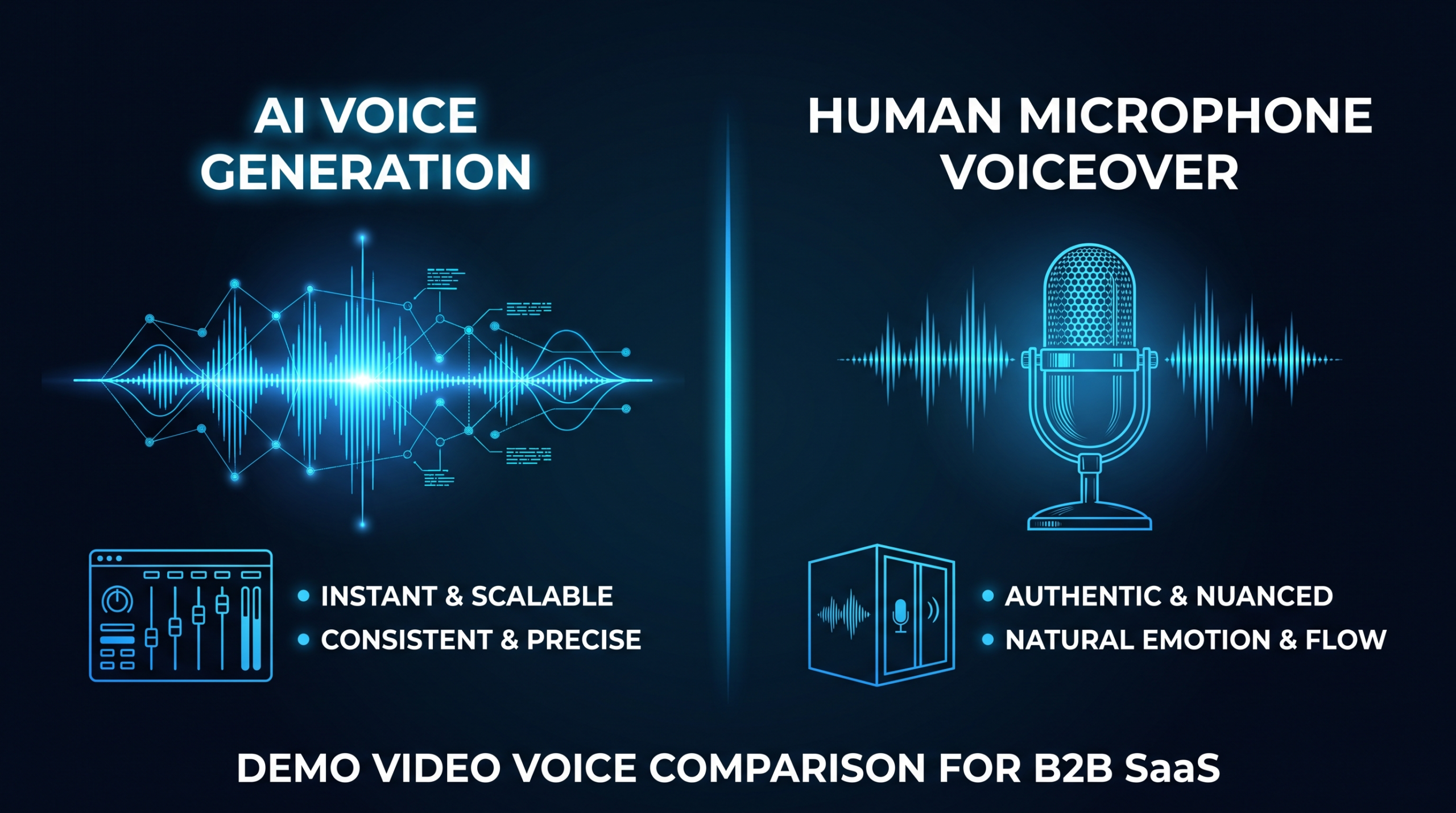
The choice between AI and human voiceover for your demo video is not a budget decision. It's a trust decision — and the two are not the same thing.
B2B buyers have become more discerning about AI-generated audio faster than most marketing teams expected. The same tools that sound impressive in a demo reel can trigger immediate skepticism in a sales call. The question isn't whether AI voiceover technology is good enough — it clearly is for many use cases. The question is whether it's good enough for your specific video, watched by your specific buyer, at the specific moment in their evaluation journey when trust is the scarce resource.
This guide gives you a clear decision framework. No blanket recommendation for either side — just the criteria that actually determine which approach serves your pipeline.
Why Voiceover Is the Trust Signal in AI Voiceover Demo Videos
Demo videos carry a lot of weight in B2B buying cycles. They're often the first technical touchpoint after an inbound inquiry. They're shared internally — forwarded to the VP of Engineering, the procurement team, the CFO who wants to understand the value. They're watched without your sales rep in the room to interpret or recover.
In that context, voiceover does more than narrate. It signals: who made this, how much they care, and whether I can trust them with my company's workflow.
Research from video engagement studies consistently shows that audio quality affects viewer retention and perceived production value more than most marketers expect. A technically polished demo with thin, slightly robotic narration reads as "they cut corners somewhere" to the enterprise buyer who has seen dozens of vendor demos. That association — even if subconscious — affects conversion.
This is not an argument against AI voiceover. It's an argument for using it deliberately, with eyes open to where it helps and where it quietly costs you deals.
Where AI Voiceover Actually Works (And Works Well)
AI voiceover tools have improved dramatically. The best voices from platforms like ElevenLabs now pass casual listening tests. For many video types, the quality-to-cost ratio is genuinely compelling. Here's where AI VO earns its place.
Internal Documentation and Employee Onboarding Videos
If your audience is employees — new hires learning your product, support staff reviewing process updates, internal stakeholders watching a quarterly business review — the trust dynamic is completely different. These viewers aren't evaluating you; they're trying to extract information efficiently. AI voiceover is faster, cheaper, and often preferred by internal audiences who watch videos on 1.5x speed anyway.
SaaS companies with large global workforces use AI VO to produce onboarding libraries at scale that would otherwise require months of studio time and budget. When the goal is information transfer rather than impression formation, AI is clearly the right tool.
Localization at Scale
If you need to produce your demo in five languages, human voiceover for each becomes a significant production and coordination challenge. You need native-speaking talent, individual recording sessions, separate audio editing passes, and lip-sync adjustments for talking-head segments. The per-language cost quickly reaches thousands of dollars per video version.
AI voice cloning and multilingual synthesis have made this tractable. Teams commonly report being able to localize a full demo video library into six or eight languages in a matter of days using AI VO, at a fraction of the cost. For markets where your brand isn't yet well-known and the trust bar is lower, this trade-off usually makes sense.
Rapid Prototyping and Client Draft Reviews
AI voiceover is genuinely useful as a production tool even when the final deliverable will use human VO. Using an AI voice for draft reviews lets your team and stakeholders evaluate pacing, script length, and visual timing without waiting for a studio session. Changes at the draft stage cost almost nothing; changes after a human recording session mean rebooking talent and reshooting audio.
Many professional video teams at agencies that handle high-volume outsourced production use AI VO for first-pass client approvals as a standard part of the production workflow, then bring in human talent after the script is locked. This reduces revision costs and speeds up overall turnaround.
High-Volume Social and Repurposed Clips
Short-form clips repurposed from longer demos — the 30-second LinkedIn cut, the product highlight for a paid ad — often work fine with AI voiceover, especially when the visual storytelling carries most of the weight. These formats are consumed quickly and in noisy environments where nuanced audio is less impactful. The volume and iteration speed that AI VO enables is a genuine advantage here.
Where Human Voiceover Wins Every Time
The case for human VO in specific video contexts isn't sentimental. It's about conversion rates and the reality of how enterprise buyers process vendor materials.
Homepage and Hero Demo Videos
Your homepage demo video is working harder than any other piece of content on your site. It's handling cold traffic from paid campaigns, warm traffic from direct search, and returning visitors from your nurture sequences — often all in the same week. It's frequently the video that determines whether a prospect books a call or bounces.
This is not where you optimize for production cost. A polished, professionally voiced demo that converts at 8% is worth far more than a faster-produced version that converts at 5%, even if the human VO version costs $800 more to produce. For the video with the highest commercial leverage in your entire content library, human talent is almost always the right call.
See our guide on product demo video production for the full production considerations beyond voiceover.
Sales-Facing Outbound Video and Proposals
Personalized video outreach — the Loom-style message from your AE, the custom demo cut for an enterprise prospect — is increasingly common in B2B sales. These videos work precisely because they feel human and specific. The moment a prospect senses that your "personalized" video has an AI voice, the entire premise collapses.
Similarly, video proposals sent to late-stage prospects — the ones who are weeks from a purchasing decision — carry enormous per-viewer value. These buyers are scrutinizing every signal. A synthetic voice in this context doesn't save you money; it costs you trust at the worst possible moment in the sales cycle.
Conference, Webinar, and Launch Content
Videos shown at your own events, embedded in webinar presentations, or used as part of product launch campaigns are typically watched by audiences who've already invested attention in your brand. They're in a high-signal-reception state, and they're surrounded by humans speaking naturally. AI voiceover in this context creates a jarring contrast that undermines the premium positioning most Series A–C SaaS companies are trying to establish.
Testimonial and Case Study Narratives
If your video tells a customer's story — even with actors or narrators rather than the actual customer — the voice carries the emotional credibility of that story. AI voiceover tends to deliver monotone pacing even on emotionally charged scripts. Human talent brings the subtle emphasis shifts, the slight pause before a key result, the warmth that makes a case study feel true rather than manufactured.
Cost Breakdown: AI Tools vs. Human VO Rates
The cost gap between AI and human voiceover is real but narrower than teams typically assume — especially once you account for the full production cycle rather than just the raw recording cost.
AI Voiceover Tool Pricing
AI Voiceover Tools — Monthly Subscription Costs (2026)
| Tool | Plan Tier | Monthly Cost | What You Get |
|---|---|---|---|
| ElevenLabs | Creator | ~$22/mo | 100K characters/mo, 30 custom voices, commercial license |
| ElevenLabs | Pro | ~$99/mo | 500K characters/mo, 160 voices, priority processing |
| Murf.ai | Business | ~$75/mo | Unlimited voice gen, 120+ voices, team collaboration |
| Descript | Creator | ~$24/mo | AI voices + video editing in one platform |
| HeyGen | Creator | ~$29/mo | 15 videos/mo, AI avatars + voice, lip-sync |
The subscription cost is almost negligible compared to production labor. The real cost consideration with AI VO is the editing and revision time: AI voices still require careful script timing, pacing adjustments, and occasionally re-generating problematic phrases. Teams that budget only the subscription fee often undercount this production overhead by 2–3 hours per video.
Human VO Rates by Talent Tier
Human Voiceover Rates — Typical Market Range (2026)
| Talent Tier | Rate Structure | Typical Range | Best For |
|---|---|---|---|
| Freelance (Fiverr/Voices.com entry) | Per finished minute | $50–150/min | Simple explainers, internal content |
| Professional freelance VO | Per finished minute | $200–400/min | Demo videos, explainer production |
| Mid-tier commercial talent | Per project or per word | $400–800/min | Homepage demos, ad campaigns |
| Top-tier commercial / union talent | Session fee + usage | $800–2,000+/min | Enterprise brand films, broadcast ads |
| In-house narrator (your own team member) | Internal labor cost | Variable | Authentic content, founder-led demos |
A typical 3-minute SaaS product demo narrated by a solid professional freelancer runs $600–1,200 for the voice recording alone. Add editing, timing sync, and revisions and the true per-video cost difference between AI and human VO for a single demo is often $800–2,000. That sounds significant until you measure it against the lifetime value of the enterprise deals your demo is meant to close.
For detailed benchmarks on how voiceover costs fit into broader video budgets, the Wistia blog regularly publishes video production and engagement research that's worth bookmarking.
How B2B Buyers Perceive AI vs. Human Voiceover
Buyer perception of AI voiceover is shifting — and not uniformly in the direction AI advocates hope.
The Trust Stack in Enterprise Buying
Enterprise software purchases typically involve multiple stakeholders, extended evaluation cycles, and significant organizational risk. In that context, buyers aren't just evaluating your product features — they're evaluating your company. Every production choice in your demo is a signal: do these people take their work seriously? Do they invest in quality where it matters?
A visually polished demo with subtly synthetic narration creates a specific cognitive dissonance: the visuals say "premium," the voice says "we found a shortcut." For buyers who process this consciously, it raises a question: if they cut corners on the video their prospects see first, where else are they cutting corners?
This doesn't apply uniformly. The PLG-model SaaS company selling to developers has a very different trust threshold than the enterprise HR platform selling to CHROs. Know your buyer's sophistication and their sensitivity to production signals.
When Buyers Notice — and What They Do
The detection problem with AI voiceover isn't that buyers always consciously identify it. It's that they often sense something is slightly off without naming it. Teams commonly report in retrospective deal reviews that prospects describe AI-voiced demos as "feeling generic" or "not quite landing" — without explicitly citing the voice. That vague negative impression is often enough to deprioritize a vendor at a critical stage of an evaluation.
In competitive deals — which is most B2B SaaS at Series B and beyond — small trust differentials compound. The vendor whose demo felt most credible and human often enters the final selection process with a meaningful, if unmeasured, advantage.
When Buyers Don't Care
It's equally important to acknowledge: many B2B buyers genuinely do not notice or care about AI voiceover, particularly in these contexts:
- Technical product walkthroughs where the screen content is doing 90% of the work
- Low-stakes evaluation content like documentation videos or feature release notes
- Heavily localized content where the buyer expects some degree of production compromise
- Content consumed in noisy environments (trade show booths, conference replay streams)
The rule of thumb: the higher the stakes of the viewing moment, the higher the cost of a synthetic voice that falls short.
The Hybrid Voiceover Workflow
The most operationally mature SaaS video programs don't treat this as binary. They build a tiered system: human VO for the videos that directly drive revenue, AI VO for the volume work that supports it.
Tiered Voiceover Strategy by Video Type
A practical tier structure for a Series B SaaS company with a 20-video-per-month production volume:
- Tier 1 — Human VO always: Homepage demo, pricing page video, sales proposal videos, conference content, brand launch videos. These get a professional freelancer at $250–400/min rate, locked down before the shoot begins.
- Tier 2 — Evaluate per project: Feature explainers, webinar clips, case study narratives, partner enablement. Decision made based on audience (external vs. internal), distribution (website vs. email), and whether the content runs in competitive sales cycles.
- Tier 3 — AI VO standard: Onboarding videos, knowledge base tutorials, changelog announcements, internal training, localized content. Speed and volume matter more than voice quality here.
Integrating VO Decisions Into Your Production Workflow
The mistake most teams make is treating voiceover as a late-stage production decision — something you figure out after the script is written and the visuals are cut. By that point, the script may not be optimized for human delivery, and the timeline may not have room for a studio session.
Voiceover strategy should be decided at the brief stage, before a frame of video is produced. When the Video Editing Company team takes on a new SaaS video project, the VO approach is specified in the initial creative brief — because it determines script pacing, on-screen text density, pause structure, and which production assets need to be held for audio sync. Getting this wrong at the brief stage creates rework that's far more expensive than the voiceover cost itself.
The operational workflow for a hybrid approach:
- Classify the video at brief creation (Tier 1, 2, or 3).
- Draft the script with the intended delivery style in mind — AI VO scripts are typically denser and shorter on pauses; human VO scripts leave more room for natural breathing and emphasis.
- Produce an AI VO draft for internal review regardless of final delivery — this catches pacing issues and client feedback before you book studio time.
- Lock the script before booking human VO talent. One revision round after recording costs more than the entire AI VO draft production.
- Record and sync human VO, then complete the final edit pass with the real audio.
For teams outsourcing their video production, make sure your production partner understands this workflow. Review the VEC pricing tiers to understand how dedicated video editing teams handle VO workflows across a full content calendar.
Decision Framework: Which to Use When
If you want a single reference to share with your team, use this framework. The goal is to make the default decision obvious at the brief stage so it doesn't become a debate at the end of production.
AI Voiceover vs. Human VO — Decision Matrix
| Signal | AI Voiceover | Human Voiceover |
|---|---|---|
| Primary audience | Internal employees, existing users | Prospects, buyers, executives |
| Sales cycle stage | Top of funnel, post-sale | Mid-funnel, late-stage, competitive |
| Video placement | Help docs, knowledge base, email sequences | Homepage, pricing page, sales proposals |
| Content lifespan | Short (under 6 months, feature-specific) | Long (12+ months, brand cornerstone) |
| Language versions | 3+ languages needed | 1–2 languages, primary market focus |
| Production timeline | 72 hours or less | 5–10 business days acceptable |
| Viewer context | Noisy, casual, mobile, multitasking | Focused evaluation, shared internally |
| Emotional register needed | Neutral, informational | Inspiring, persuasive, trustworthy |
| Brand positioning | Utility / product-led | Premium / relationship-led |
The framework isn't a rigid scorecard. A Tier 3 video that unexpectedly gets featured in a major press article gets upgraded to Tier 1 for its next version. The point is to make the default obvious so your team isn't making this decision ad hoc under deadline pressure.
The question isn't "can our buyer tell the difference?" It's "what does our choice of voice communicate about how seriously we take our buyers' time and attention?"
Frequently Asked Questions
Can B2B buyers tell the difference between AI and human voiceover?
Increasingly, yes — though not always consciously. The more discerning the buyer (enterprise procurement, technical evaluators, executives who watch many vendor demos), the more likely they are to register something as "off" even if they can't name it. The detection rate also varies by AI tool quality: the best ElevenLabs voices pass casual listening tests, while lower-tier tools are identifiable within seconds. The more relevant question is whether detection matters for your specific video and audience — and for high-stakes sales content, it usually does.
How much does professional human voiceover cost for a 3-minute demo video?
For a 3-minute SaaS demo video, a solid professional freelancer typically charges $500–1,200 for the voice recording. This varies significantly by talent tier, usage rights, and revision rounds included. Add 2–4 hours of editing time to sync and clean the audio, and the all-in production cost for voiceover on a 3-minute demo commonly runs $700–1,800 when handled through a full-service video editing team. The per-video cost difference vs. AI VO is real but often smaller than teams assume when the comparison is done properly. See our full breakdown of video editing cost per minute for context.
Which AI voiceover tool is best for SaaS demo videos?
ElevenLabs consistently produces the most natural-sounding voices for technical narration, particularly for demo content that requires clear enunciation of product terms. Murf.ai offers strong collaboration features that work well for marketing teams reviewing and approving VO in a shared workflow. Descript is worth considering if your team is already using it for video editing, since combining AI VO and editing in one platform reduces handoff friction. The tool that matters less than the workflow: regardless of which AI platform you use, always produce a timing draft before locking the visual edit to avoid expensive rework.
Should I use AI voiceover for localized versions of a demo that uses human VO for the primary language?
This is one of the most defensible hybrid approaches. Your primary-language version (typically English) uses professional human VO for maximum trust and conversion quality. Secondary-language versions use AI voice cloning or multilingual synthesis for cost and speed. This approach is common at growth-stage SaaS companies expanding internationally: the primary market gets full production quality, while emerging markets get quality-appropriate localization at a fraction of the cost. Disclose the approach internally; your international sales team will have opinions about specific markets where human VO is necessary for relationship reasons.
How do I build a scalable voiceover workflow for a team producing 15+ videos per month?
At 15+ videos/month, ad hoc VO decisions create production bottlenecks and quality inconsistency. The solution is a tiered classification system decided at the brief stage — not at the edit stage. Assign every video to a VO tier (AI standard, evaluate, human required) when the creative brief is written. Maintain a roster of 2–3 preferred human VO freelancers with pre-negotiated rates, available on recurring retainer or fast-turnaround terms. Use AI VO for all draft reviews regardless of final delivery. Teams that work with dedicated video editing pods find this workflow easier to enforce because the PM layer owns the brief classification before production starts — removing the decision from editors who shouldn't be making it.
Building a Video Content Engine That Actually Converts?
Video Editing Company provides dedicated editing teams for Series A–C SaaS — structured around your content calendar, not one-off projects. Growth plan from $5K/mo. We guarantee double your video output in 90 days or month 4 is free.
Book a Free Strategy Call See Pricing